Jeremiah 33:21

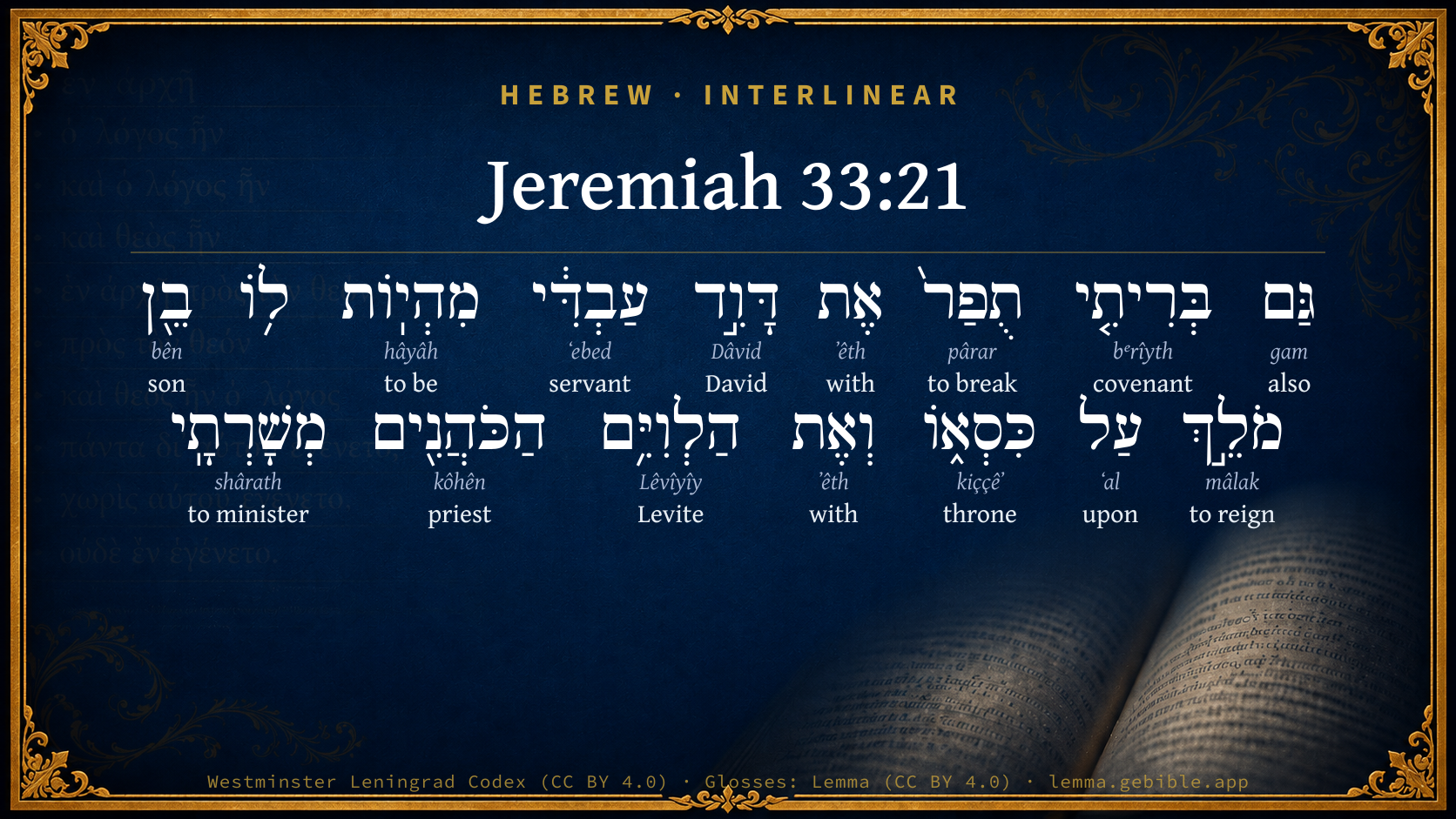
Hebrew (Westminster Leningrad Codex) Jeremiah 33:21 appears in the Hebrew Old Testament. The text above is from the Westminster Leningrad Codex. Each word links to its Strong’s number, a concise gloss, and parsing drawn from the Open Scriptures Hebrew Bible morphology. Click any word for its full Brown-Driver-Briggs (BDB) entry.
Download image
Cite this verse

Jeremiah 33:21 (World English Bible). Public Domain. Lemma interlinear Bible study tool, https://lemma.gebible.app/v/jeremiah/33/21.

Show BibTeX & RIS
BibTeX
RIS
English Translation
then may also my covenant be broken with David my servant, that he shall not have a son to reign on his throne; and with the Levites the priests, my ministers.
World English Bible · Public Domain
Download a study sheet

One document with this verse’s original text, its word-by-word gloss line, the meaning frame, cross-references with their text, attributed commentary, and full source and license credits — printable, and it pastes into notes with its structure intact.

This verse Autodidact and up

Study sheet (.html) Plain text (.txt)

A passage Seminary Student

Up to 50 verses in one chapter. A passage sheet keeps up to 6 commentary sources and 12 cross-references per verse, in the order this page ranks them, and says so on the sheet whenever that leaves anything out. Ask for a single verse and you get the Autodidact verse sheet above.

Everything on this page stays free to read, with no account — the sheet is a download of what is already on screen, not access to it.

Want to remove ads? Support Godless Engineer
Compare translations 3

The same verse in 3 English versions, stacked beneath the original-language interlinear above. Click any original word for its lexicon entry.

Each is an independent rendering of the whole verse — the interlinear is not word-aligned to these translations.

Highlighted words mark where these versions differ — a whole-verse word diff, not a word-by-word alignment.

  • World English Bible Public Domain
    then may also my covenant be broken with David my servant, that he shall not have a son to reign on his throne; and with the Levites the priests, my ministers.
  • King James Version Public Domain
    Then may also my covenant be broken with David my servant, that he should not have a son to reign upon his throne; and with the Levites the priests, my ministers.
  • unfoldingWord Literal Text CC BY-SA 4.0
    then you will be able to break my covenant with David my servant, so that he will no longer have a son to sit on his throne, and my covenant with the Levitical priests, my servants.

unfoldingWord Literal Text — © unfoldingWord, licensed CC BY-SA 4.0. Word-aligned USFM3 via Door43 (git.door43.org/unfoldingWord/en_ult).

Versions to compare (up to 4)

3 of 4 selected

Show all 18 translations

Every available English version of this verse, each an independent rendering of the whole verse.

  • World English Bible Public Domain
    then may also my covenant be broken with David my servant, that he shall not have a son to reign on his throne; and with the Levites the priests, my ministers.
  • Berean Standard Bible Public Domain
    then My covenant may also be broken with David My servant and with My ministers the Levites who are priests, so that David will not have a son to reign on his throne.
  • Majority Standard Bible Public Domain
    then My covenant may also be broken with David My servant and with My ministers the Levites who are priests, so that David will not have a son to reign on his throne.
  • King James Version Public Domain
    Then may also my covenant be broken with David my servant, that he should not have a son to reign upon his throne; and with the Levites the priests, my ministers.
  • American Standard Version (1901) Public Domain
    then may also my covenant be broken with David my servant, that he shall not have a son to reign upon his throne; and with the Levites the priests, my ministers.
  • Revised Version (1885) Public Domain
    then may also my covenant be broken with David my servant, that he should not have a son to reign upon his throne; and with the Levites the priests, my ministers.
  • Geneva Bible (1599) Public Domain
    Then may my couenant be broken with Dauid my seruant, that he should not haue a sonne to reigne vpon his throne, and with the Leuites, and Priests my ministers.
  • Douay-Rheims (1899) Public Domain
    Also my covenant with David my servant may be made void, that he should not have a son to reign upon his throne, and with the Levites and priests my ministers.
  • Young's Literal Translation Public Domain
    Also My covenant is broken with David My servant, So that he hath not a son reigning on his throne, And with the Levites the priests, My ministers.
  • Literal Standard Version CC BY-SA 4.0
    My covenant is also broken with My servant David, || So that he does not have a son reigning on his throne, || And with the Levites the priests, My ministers.
  • Unlocked Literal Bible CC BY-SA 4.0
    then you will be able to break my covenant with David my servant, so that he will no longer have a son to sit on his throne, and my covenant with the Levitical priests, my servants.
  • unfoldingWord Literal Text CC BY-SA 4.0
    then you will be able to break my covenant with David my servant, so that he will no longer have a son to sit on his throne, and my covenant with the Levitical priests, my servants.
  • Darby Bible Public Domain
    [then] shall also my covenant be broken with David my servant, that he should not have a son to reign upon his throne; and with the Levites, the priests, my ministers.
  • World Messianic Bible Public Domain
    then my covenant could also be broken with David my servant, that he won’t have a son to reign on his throne; and with the Levitical priests, my ministers.
  • Webster's Bible Public Domain
    Then also may my covenant be broken with David my servant, that he should not have a son to reign upon his throne; and with the Levites the priests, my ministers.
  • Free Bible Version CC BY-SA 4.0
    only then would my agreement be broken with David my servant and with the Levites who serve as my priests, so that David would not have a descendant to rule on his throne.
  • Bible in Basic English Public Domain
    Then my agreement with my servant David may be broken, so that he no longer has a son to take his place on the seat of the kingdom; and my agreement with the Levites, the priests, my servants.
  • JPS Tanakh (1917) Public Domain
    Then may also My covenant be broken with David My servant, that he should not have a son to reign upon his throne; and with the Levites the priests, My ministers.

Literal Standard Version (2020), Covenant Press — licensed CC BY-SA 4.0. Text via the HelloAO Bible API (eBible.org). Unlocked Literal Bible (unfoldingWord) — licensed CC BY-SA 4.0. Text via the HelloAO Bible API (eBible.org). unfoldingWord Literal Text — © unfoldingWord, licensed CC BY-SA 4.0. Word-aligned USFM3 via Door43 (git.door43.org/unfoldingWord/en_ult). Free Bible Version, Dr. Jonathan Gallagher — licensed CC BY-SA 4.0. Text via the HelloAO Bible API (eBible.org).

Word by word

More ways to search: Search by grammar → Find every occurrence → Compare this word →

Practice this passage: Drill this verse → Learn its vocabulary →

תֻפַר֙
pârar
H6565
“to break”
Verb, Hophal, Imperfect, 3rd Person, Feminine, Singular
Part of Speech
Verb
Stem
Hophal
Form
Imperfect
Person
3rd Person
Gender
Feminine
Number
Singular
Full BDB Definition

Origin: a primitive root

TWOT: 1829 , 1830 , 1831

to break, frustrate - (Hiphil) - to break, violate - to frustrate, make ineffectual - (Hophal) - to be frustrated - to be broken - to break - (Pilpel) to break to bits, shatter - to split, divide - (Qal) to split, crack through - (Poel) to break apart - (Hithpoel) to be split, be cracked through
  1. גַּם gam H1571 “also” Particle, Accusative
  2. בְּרִיתִ֤י bᵉrîyth H1285 “covenant · my” Noun, Common, Feminine, Singular, Construct + Suffix, Personal, 1st Person, Common, Singular
  3. אֶת ʼêth H854 “with” Preposition
  4. דָּוִ֣ד Dâvid H1732 “David” Noun, Proper
  5. עַבְדִּ֔י ʻebed H5650 “servant · my” Noun, Common, Masculine, Singular, Construct + Suffix, Personal, 1st Person, Common, Singular
  6. מִהְיֽוֹת hâyâh H1961 “from · to be” Preposition + Verb, Qal, Infinitive Construct
  7. בֵ֖ן bên H1121 “son” Noun, Common, Masculine, Singular, Absolute
  8. מֹלֵ֣ךְ mâlak H4427 “reigning” Verb, Qal, Participle Active, Masculine, Singular, Absolute
  9. עַל ʻal H5921 “upon” Preposition
  10. כִּסְא֑וֹ kiççêʼ H3678 “throne · his” Noun, Common, Masculine, Singular, Construct + Suffix, Personal, 3rd Person, Masculine, Singular
  11. וְאֶת ʼêth H854 “and · with” Conjunction + Preposition
  12. הַלְוִיִּ֥ם Lêvîyîy H3881 “the · Levites” Particle, Definite Article + Noun, Gentilic, Masculine, Plural, Absolute
  13. הַכֹּהֲנִ֖ים kôhên H3548 “the · priests” Particle, Definite Article + Noun, Common, Masculine, Plural, Absolute
  14. מְשָׁרְתָֽי shârath H8334 “ministering · me” Verb, Piel, Participle Active, Masculine, Plural, Construct + Suffix, Personal, 1st Person, Common, Singular

About this verse

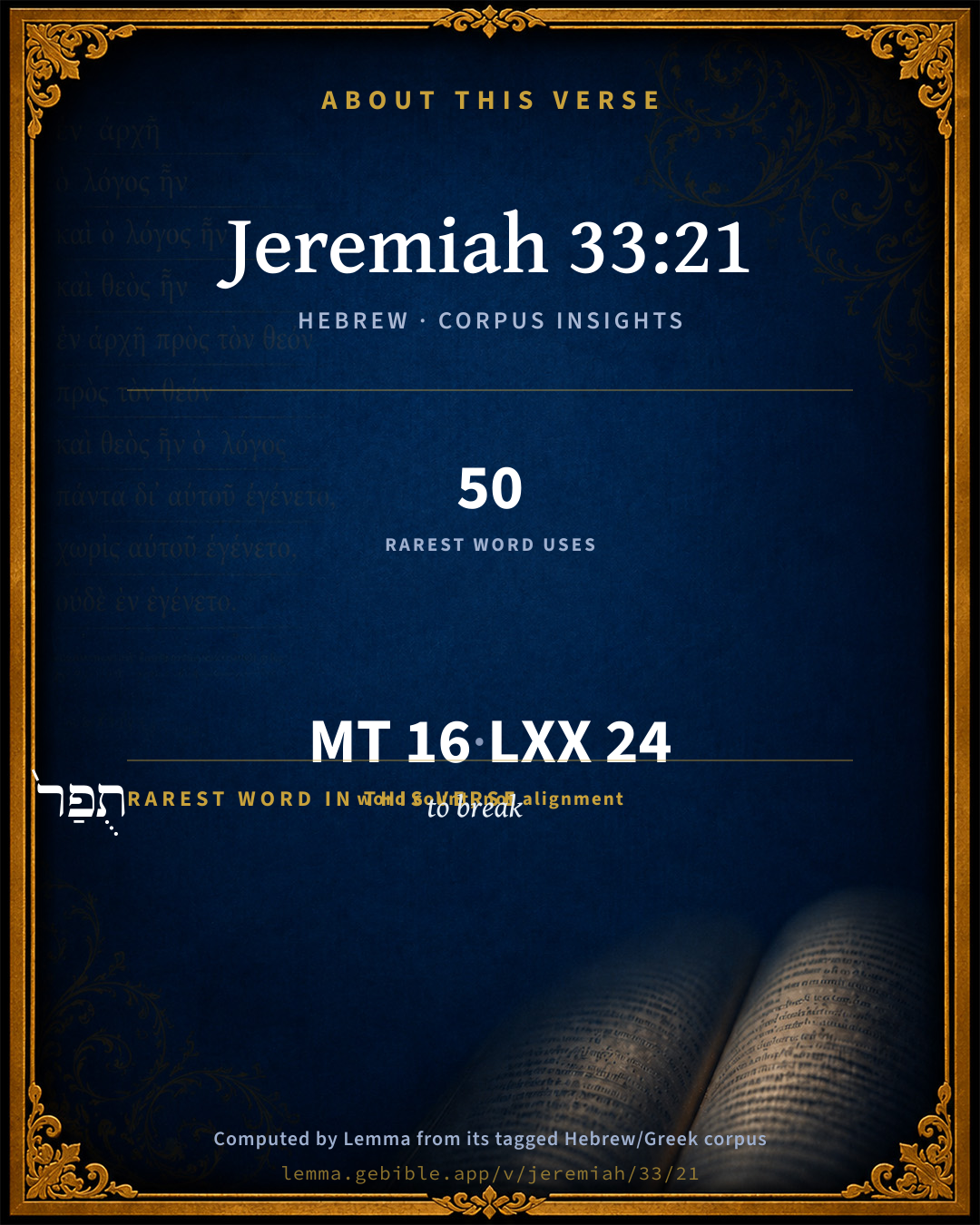
These counts appear in no published source. They are computed here, from the morphology-tagged text and Lemma’s own curated glosses. What Lemma adds →

16
words
14
distinct lemmas
Prophets
section

Shared distinctive vocabulary

תֻפַר֙ to break H6565 occurs in 46 verses of the Hebrew Bible. Also found in:

Grammatical profile

  • 4 verbs
  • 7 nouns
  • 4 prepositions
  • 1 particle

Verb forms

  • תֻפַר֙ Hophal · Imperfect
  • מִהְיֽוֹת Qal · Infinitive Construct
  • מֹלֵ֣ךְ Qal · Participle Active
  • מְשָׁרְתָֽי Piel · Participle Active

Repetition

A word recurs within this verse — often emphatic in Hebrew:

  • אֶת with H854 ×2

Hebrew & Septuagint length

In the original languages it is 16 Hebrew tokens and 24 Greek tokens — but the two are counted differently (Hebrew bundles its prefixes and suffixes into one token; the Greek is in lemma form), so that isn’t a like-for-like length.

Cross-references

14

Topical passages linked to Jeremiah 33:21 in the Treasury of Scripture Knowledge — connected by theme and wording, ordered by reader-vote popularity; previews shown in the World English Bible.

  • Psalms 89:34 I will not break my covenant, Nor alter what my lips have uttered.
  • 2 Chronicles 7:18 then I will establish the throne of your kingdom, according as I covenanted with David your father, saying, There shall not fail you a man to be ruler in Israel.
  • 2 Samuel 23:5 Most assuredly my house is not so with God; Yet he has made with me an everlasting covenant, Ordered in all things, and sure: For it is all my salvation, and all [my] desire, Although he doesn't make it grow.
  • 2 Chronicles 21:7 However Yahweh would not destroy the house of David, because of the covenant that he had made with David, and as he promised to give a lamp to him and to his children always.
  • Matthew 24:35 Heaven and earth will pass away, but my words will not pass away.
  • Luke 1:32–33 He will be great, and will be called the Son of the Most High. The Lord God will give him the throne of his father, David,
  • Luke 1:69–70 And has raised up a horn of salvation for us in the house of his servant David
  • Revelation 5:10 And made them kings and priests to our God, And they reign on earth."
  • Psalms 132:11–12 Yahweh has sworn to David in truth. He will not turn from it: "I will set the fruit of your body on your throne.
  • Psalms 132:17 There I will make the horn of David to bud. I have ordained a lamp for my anointed.
  • Isaiah 9:6–7 For to us a child is born, to us a son is given; and the government shall be on his shoulder: and his name shall be called Wonderful, Counselor, Mighty God, Everlasting Father, Prince of Peace.
  • Isaiah 55:3 Turn your ear, and come to me; hear, and your soul shall live: and I will make an everlasting covenant with you, even the sure mercies of David.
  • Jeremiah 33:18 neither shall the priests the Levites want a man before me to offer burnt offerings, and to burn meal-offerings, and to do sacrifice continually.
  • Daniel 7:14 There was given him dominion, and glory, and a kingdom, that all the peoples, nations, and languages should serve him: his dominion is an everlasting dominion, which shall not pass away, and his kingdom that which shall not be destroyed.

Cross-references courtesy of OpenBible.info (CC BY 4.0).

Hebrew and Greek witnesses Masoretic Hebrew ↔ Greek Septuagint

The same verse in the two great witnesses to the Old Testament, shown verse-for-verse.

These are two independent witnesses, not word-aligned to each other, and the Septuagint is shown in lemma (dictionary) form.

Hebrew Jeremiah 33:21 Masoretic · Westminster Leningrad Codex

גַּם בְּרִיתִ֤י תֻפַר֙ אֶת דָּוִ֣ד עַבְדִּ֔י מִהְיֽוֹת ל֥וֹ בֵ֖ן מֹלֵ֣ךְ עַל כִּסְא֑וֹ וְאֶת הַלְוִיִּ֥ם הַכֹּהֲנִ֖ים מְשָׁרְתָֽי

then may also my covenant be broken with David my servant, that he shall not have a son to reign on his throne; and with the Levites the priests, my ministers.

World English Bible · Public Domain

Greek LXX Structure differs

In the Septuagint, Jeremiah is about an eighth shorter than the Hebrew and arranges its material differently — the Oracles Against the Nations (Hebrew chapters 46–51) appear in the middle of the Greek book, after 25:13. Because the chapter and verse boundaries do not line up, a verse-for-verse comparison with the Hebrew is not shown.

A verse-for-verse comparison isn’t shown here because the chapters and verses don’t line up. Switch to the LXX edition with the MT / LXX toggle above to read the Greek directly.

Hebrew: Westminster Leningrad Codex (CC BY 4.0). Greek: Septuagint (public domain); English from a public-domain English Septuagint. How the Septuagint differs from the Hebrew →

Targum (Aramaic paraphrase)

1

The Targum is the ancient Jewish Aramaic paraphrase of the Hebrew Scriptures — an interpretive translation, not the Hebrew text itself. Onkelos (literal) and Pseudo-Jonathan (expansive) render the Torah, and Jonathan the Prophets. Coverage is partial: where no permissively-licensed English translation exists for a verse, only the Aramaic is shown. This is verse-level text, not a word-by-word alignment to the Hebrew.

  1. Targum Jonathan Prophets (Joshua–Malachi)
    אַף קְיָמַי לָא יְבַטֵיל דַאֲקֵימִית עִם דָוִד עַבְדִי מִלְמֶהֱוֵי לֵיהּ בַּר מְלִיךְ עַל כּוּרְסֵיהּ וְיַת לֵוָאֵי כַהֲנַיָא דִמְשַׁמְשִׁין קֳדָמַי:

    (no public-domain English translation for this verse)

    Targum Jonathan — Aramaic: “Mikraot Gedolot” (public domain). English: “Sefaria Community Translation” (CC0 1.0 (public-domain dedication)); “London "Chaldee Paraphrase," 1871” (public domain). Text via Sefaria.

Commentary

Notes on Jeremiah 33:21 from classic Christian and Jewish commentators (each source and its license shown beneath its notes). The classic Christian expositions comment on the surrounding passage and are grouped to its opening verse, so a note may address several verses; the Jewish commentaries on the Tanakh (Rashi and others) are per-verse, so they appear only where the commentator wrote on this verse.

Lemma curates 59 commentaries, every one of them public domain or Creative Commons licensed, each selected and text-cleaned for this edition rather than reprinted as found. About our sources →

Trapp's Complete Commentary

John Trapp

Jer 33:21 [Then] may also my covenant be broken with David my servant, that he should not have a son to reign upon his throne; and with the Levites the priests, my ministers.

Ver. 21. Then may also my covenant.] See Jer 33:17-18. The poet hath somewhat like this:

“ Iungantur ante saeva sideribus freta,

Et ignis undae, tartaro tristi polus,

Lux alma tenebris, roscidae nocti dies, ”& c.

- Sen. in Octavia.

John Trapp, A Commentary or Exposition upon All the Books of the Old and New Testament (1647–1656) — public domain. Text from a community e-Sword module.

John Calvin's Commentaries

Hence he says, There shall be abolished my covenant with David my servant, that he should not be my son, etc. He repeats what he had said, even that it could not be but that the posterity of David should obtain the kingdom, which we know has been fulfilled in Christ. The throne of David he now calls what he had named before as the throne of the house of Israel; but he means the same thing. It is called the throne of the house of Israel, because the king and the people are relatively connected, and also because the posterity of David ruled for the public good, not for their own sake.

He adds, and with the Levites, the priests, my ministers He had called David his servant, he now calls the Levites his ministers. The word שרת sheret, is commonly known, and is used often by Moses, when speaking of the Levitical priesthood. Its meaning is to serve. He adds —

John Calvin's Commentaries (1540-1563) — public domain. Text from the Calvin Translation Society English edition (1840s-50s) via the Christian Classics Ethereal Library (ccel.org). Calvin's coverage is partial (roughly two-thirds of the Bible); uncommented books and verses are honest gaps, never fabricated. The 19th-century editor's footnotes and remarks are omitted so the notes are faithfully Calvin's own voice.

The Cambridge Bible for Schools and Colleges

gen. ed. J. J. S. Perowne

21. See 2Sa_7:12-16.

The Cambridge Bible for Schools and Colleges (gen. ed. J. J. S. Perowne; Cambridge University Press, 1878–1918) — public domain. Text from a community e-Sword module.

John Gill's Exposition

Then may also my covenant be broken with David my servant,.... A type of the Messiah, with whom the covenant of grace is made, stands fast, and will never be broken; see Psa 89:3; for, as the other is impossible, the breaking of the covenant with day and night, or hindering the certain rotation of them; so likewise as impossible is the breaking of the covenant with David concerning the perpetuity of his kingdom in the Messiah:

that he should not have a son to reign upon his throne; which he has in Christ, and ever will have; for he shall reign for ever and ever:

and with the Levites my priests, my ministers; of the line of Phinehas, to whom an everlasting priesthood was promised, and which has been fulfilled in Christ, who has an unchangeable priesthood; a priesthood that will never pass from him, and go to another; see Num 25:13, Heb 7:24.

John Gill's Exposition of the Whole Bible (1746–1763) — public domain (CC PDM 1.0). Text via the HelloAO Bible API.

Albert Barnes' Notes on the Bible

This promise also has been not literally, but spiritually fulfilled, for in this sense only have the seed of David and the Levites been multiplied.

Albert Barnes' Notes on the Bible (1834–1885) — public domain. Text from a community e-Sword/MySword module.

Haydock's Catholic Bible Commentary

Ministers. The promise in not conditional, but as unchangeable as the course of the seasons. (Calmet)

George Leo Haydock (1774–1849), Haydock's Catholic Family Bible and Commentary, 1859 edition — public domain. Excludes Psalms (Douay-Rheims chapter numbering differs from Protestant) and Deuterocanonical books (Catholic canon only).

Lesson kit

Teaching starters — assembled from the data on this page, not authored interpretation. Every prompt links to the verse data it draws on. Edit before teaching.

Jeremiah, in the Prophets, opens this verse with 16 words (14 distinct Hebrew lemmas). Its most distinctive word is pârar (“to break”). A historical commentator’s framing appears above. Read the whole chapter for the surrounding context.

Discussion questions

  1. How does “to break” (pârar) shape what this verse is saying?
  2. Genesis 17:14 shares the word «to break» with this verse. How do the two illuminate each other?
  3. “with” occurs 2× in this one verse. What is the effect of the repetition?
  4. These translations render this verse differently; the difference is in the English rendering, not the original. What questions does that raise?
  5. The verb «תֻפַר֙» is Hophal Imperfect. How does its form color the action?
  6. Reading how Trapp's Complete Commentary and John Calvin's Commentaries read this verse, where do the two commentators agree and where do they part?

Things to notice

Reading settings

Reading text

Shown beneath each verse's original-language words.

Old Testament
Old Testament edition

Read the OT as the Masoretic Hebrew (MT) or the Greek Septuagint (LXX).

English shown for the Greek Septuagint (in the Hebrew ↔ Greek comparison).

Comparing translations? Open the Compare panel on any verse page to stack up to four side by side.