
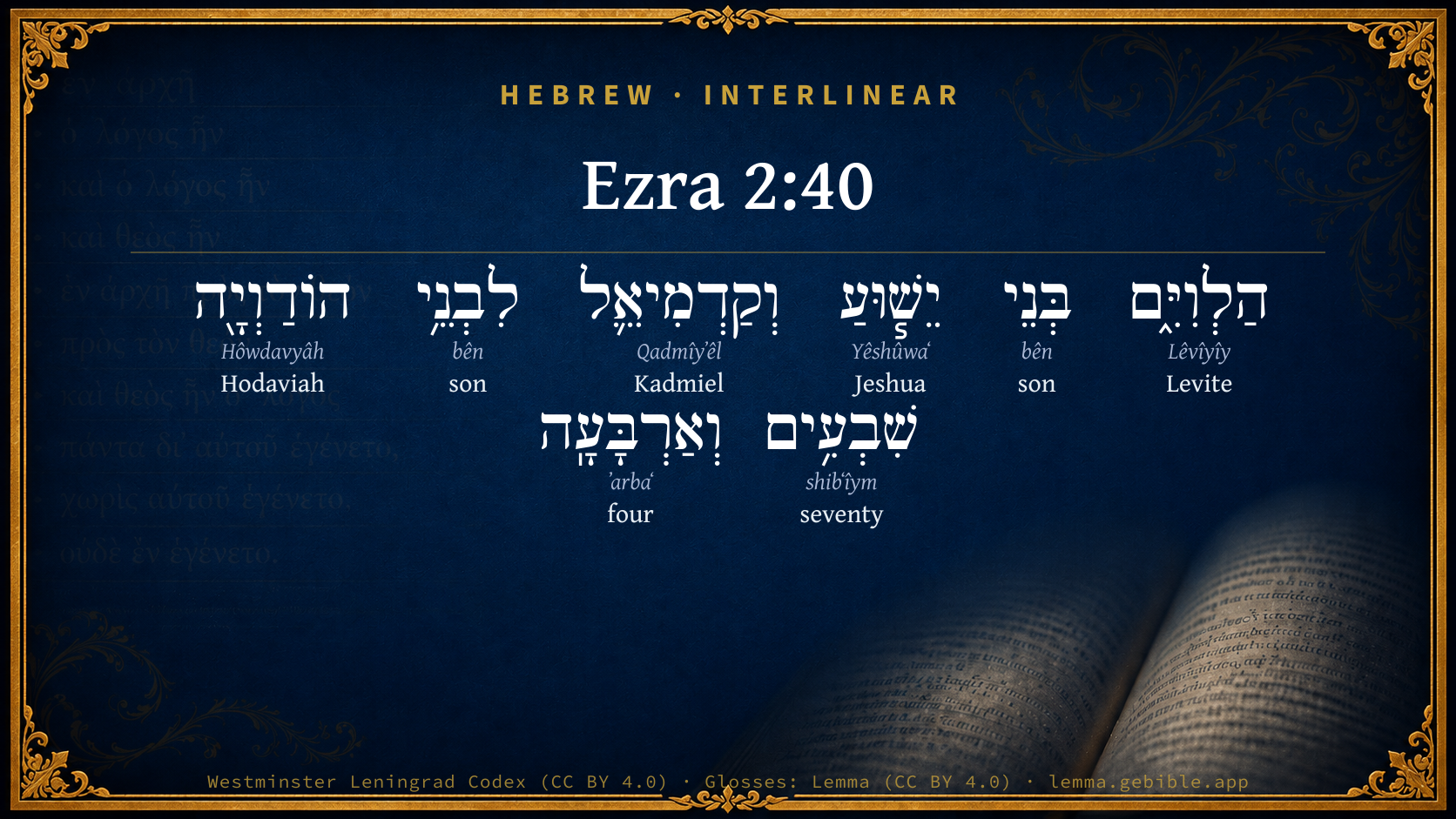
Ezra 2:40

Hebrew (Westminster Leningrad Codex) Ezra 2:40 appears in the Hebrew Old Testament. The text above is from the Westminster Leningrad Codex. Each word links to its Strong’s number, a concise gloss, and parsing drawn from the Open Scriptures Hebrew Bible morphology. Click any word for its full Brown-Driver-Briggs (BDB) entry.
Download image
Cite this verse

Ezra 2:40 (World English Bible). Public Domain. Lemma interlinear Bible study tool, https://lemma.gebible.app/v/ezra/2/40.

Show BibTeX & RIS
BibTeX
RIS
English Translation
The Levites: the children of Jeshua and Kadmiel, of the children of Hodaviah, seventy-four.
World English Bible · Public Domain
Highlights
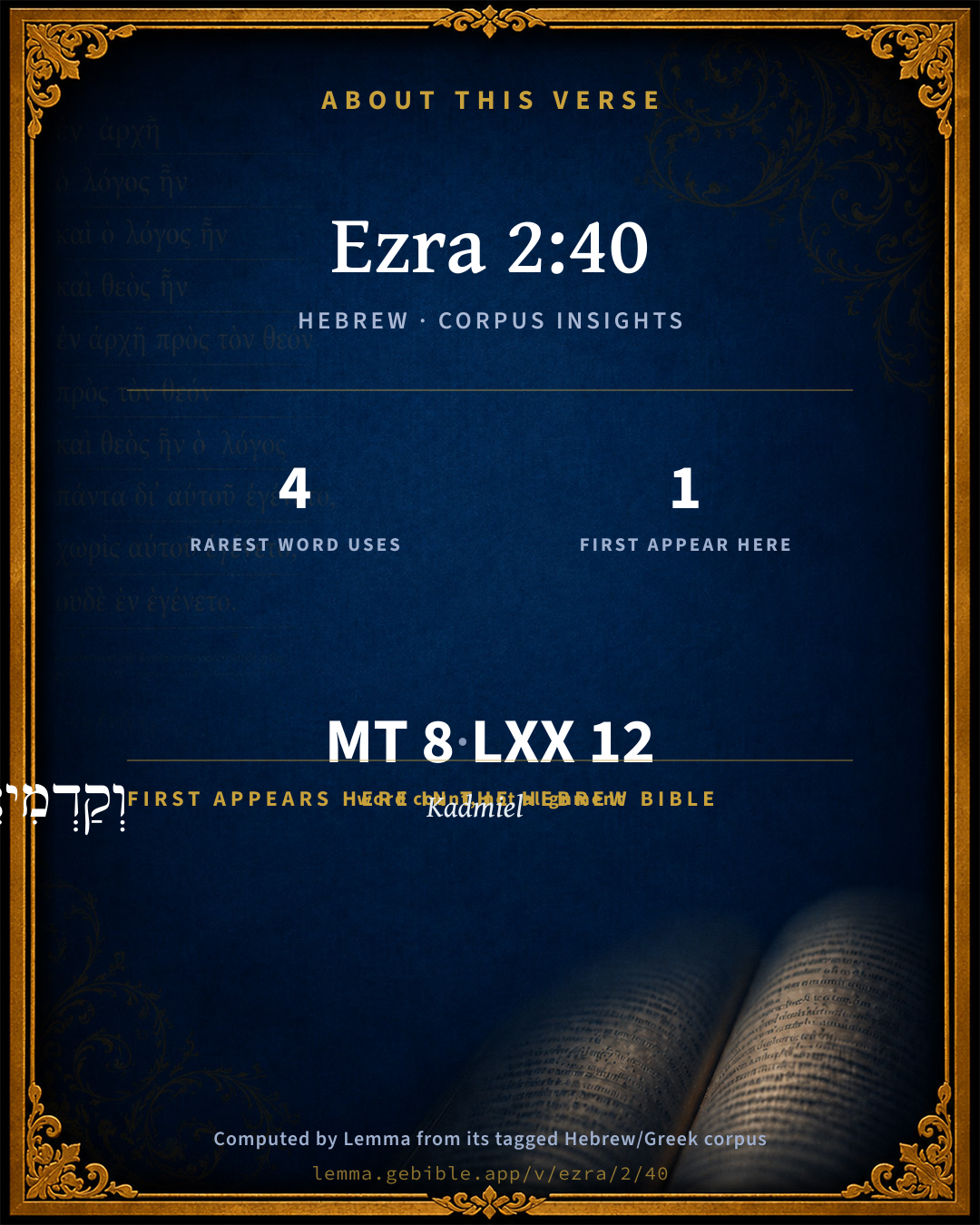
  • 1 first appearance in the Hebrew Bible
Full analysis ↓
Download a study sheet

One document with this verse’s original text, its word-by-word gloss line, the meaning frame, cross-references with their text, attributed commentary, and full source and license credits — printable, and it pastes into notes with its structure intact.

This verse Autodidact and up

Study sheet (.html) Plain text (.txt)

A passage Seminary Student

Up to 50 verses in one chapter. A passage sheet keeps up to 6 commentary sources and 12 cross-references per verse, in the order this page ranks them, and says so on the sheet whenever that leaves anything out. Ask for a single verse and you get the Autodidact verse sheet above.

Everything on this page stays free to read, with no account — the sheet is a download of what is already on screen, not access to it.

Want to remove ads? Support Godless Engineer
Compare translations 3

The same verse in 3 English versions, stacked beneath the original-language interlinear above. Click any original word for its lexicon entry.

Each is an independent rendering of the whole verse — the interlinear is not word-aligned to these translations.

Highlighted words mark where these versions differ — a whole-verse word diff, not a word-by-word alignment.

  • World English Bible Public Domain
    The Levites: the children of Jeshua and Kadmiel, of the children of Hodaviah, seventy-four.
  • King James Version Public Domain
    The Levites: the children of Jeshua and Kadmiel, of the children of Hodaviah, seventy and four.
  • unfoldingWord Literal Text CC BY-SA 4.0
    The Levites: the sons of Jeshua and Kadmiel, of the sons of Hodaviah, were 74.

unfoldingWord Literal Text — © unfoldingWord, licensed CC BY-SA 4.0. Word-aligned USFM3 via Door43 (git.door43.org/unfoldingWord/en_ult).

Versions to compare (up to 4)

3 of 4 selected

Show all 18 translations

Every available English version of this verse, each an independent rendering of the whole verse.

  • World English Bible Public Domain
    The Levites: the children of Jeshua and Kadmiel, of the children of Hodaviah, seventy-four.
  • Berean Standard Bible Public Domain
    The Levites: the descendants of Jeshua and Kadmiel (through the line of Hodaviah), 74.
  • Majority Standard Bible Public Domain
    The Levites: the descendants of Jeshua and Kadmiel (through the line of Hodaviah), 74.
  • King James Version Public Domain
    The Levites: the children of Jeshua and Kadmiel, of the children of Hodaviah, seventy and four.
  • American Standard Version (1901) Public Domain
    The Levites: the children of Jeshua and Kadmiel, of the children of Hodaviah, seventy and four.
  • Revised Version (1885) Public Domain
    The Levites: the children of Jeshua and Kadmiel, of the children of Hodaviah, seventy and four.
  • Geneva Bible (1599) Public Domain
    The Leuites: the sonnes of Ieshua, and Kadmiel of the sonnes of Hodauiah, seuentie and foure.
  • Douay-Rheims (1899) Public Domain
    The Levites: the children of Josue and of Cedmihel, the children of Odovia, seventy-four.
  • Young's Literal Translation Public Domain
    The Levites; sons of Jeshua and Kadmiel, of the sons of Hodaviah, seventy and four.
  • Literal Standard Version CC BY-SA 4.0
    The Levites: sons of Jeshua and Kadmiel, of the sons of Hodaviah, seventy-four.
  • Unlocked Literal Bible CC BY-SA 4.0
    The Levites: descendants of Jeshua and Kadmiel, descendants of Hodaviah: seventy-four.
  • unfoldingWord Literal Text CC BY-SA 4.0
    The Levites: the sons of Jeshua and Kadmiel, of the sons of Hodaviah, were 74.
  • Darby Bible Public Domain
    The Levites: the children of Jeshua and of Kadmiel, of the children of Hodaviah, seventy-four.
  • World Messianic Bible Public Domain
    The Levites: the children of Yeshua and Kadmiel, of the children of Hodaviah, seventy-four.
  • Webster's Bible Public Domain
    The Levites: the children of Jeshua and Kadmiel, of the children of Hodaviah, seventy and four.
  • Free Bible Version CC BY-SA 4.0
    This is the number of the Levites: the sons of Jeshua and Kadmiel (sons of Hodaviah), 74;
  • Bible in Basic English Public Domain
    The Levites: the children of Jeshua and Kadmiel, of the children of Hodaviah, seventy-four.
  • JPS Tanakh (1917) Public Domain
    The Levites: the children of Jeshua and Kadmiel, of the children of Hodaviah, seventy and four.

Literal Standard Version (2020), Covenant Press — licensed CC BY-SA 4.0. Text via the HelloAO Bible API (eBible.org). Unlocked Literal Bible (unfoldingWord) — licensed CC BY-SA 4.0. Text via the HelloAO Bible API (eBible.org). unfoldingWord Literal Text — © unfoldingWord, licensed CC BY-SA 4.0. Word-aligned USFM3 via Door43 (git.door43.org/unfoldingWord/en_ult). Free Bible Version, Dr. Jonathan Gallagher — licensed CC BY-SA 4.0. Text via the HelloAO Bible API (eBible.org).

Word by word

More ways to search: Search by grammar → Find every occurrence → Compare this word →

Practice this passage: Drill this verse → Learn its vocabulary →

About this verse

These counts appear in no published source. They are computed here, from the morphology-tagged text and Lemma’s own curated glosses. What Lemma adds →

8
words
7
distinct lemmas
Historical
section

Notable vocabulary

The rarest word here is הוֹדַוְיָ֖ה Hodaviah H1938 — appearing just 4 times in the whole Hebrew Bible.

First appearance in Scripture

This word makes its first canonical appearance in the Hebrew Bible here:

  • וְקַדְמִיאֵ֛ל Kadmiel H6934

Shared distinctive vocabulary

הוֹדַוְיָ֖ה Hodaviah H1938 occurs in 4 verses of the Hebrew Bible. Also found in:

Grammatical profile

  • 6 nouns
  • 2 adjectives

Repetition

A word recurs within this verse — often emphatic in Hebrew:

  • בְּנֵי son H1121 ×2

Hebrew & Septuagint length

In English translation the verse runs 14 words from the Hebrew and 16 from the Septuagint (LXX English) — closely comparable.

A rough comparison of the two English renderings, which tokenize alike — not a word-level alignment.

Word counts can differ between the Hebrew and the Greek without any difference in meaning — e.g. the Hebrew direct-object marker אֵת has no separate Greek word, and Greek often adds the article ὁ.

In the original languages it is 8 Hebrew tokens and 12 Greek tokens — but the two are counted differently (Hebrew bundles its prefixes and suffixes into one token; the Greek is in lemma form), so that isn’t a like-for-like length.

Cross-references

2

Topical passages linked to Ezra 2:40 in the Treasury of Scripture Knowledge — connected by theme and wording, ordered by reader-vote popularity; previews shown in the World English Bible.

  • Ezra 3:9 Then stood Jeshua with his sons and his brothers, Kadmiel and his sons, the sons of Judah, together, to have the oversight of the workmen in the house of God: the sons of Henadad, with their sons and their brothers the Levites.
  • Nehemiah 7:43 The Levites: the children of Jeshua, of Kadmiel, of the children of Hodevah, seventy-four.

Cross-references courtesy of OpenBible.info (CC BY 4.0).

Hebrew and Greek witnesses Masoretic Hebrew ↔ Greek Septuagint

The same verse in the two great witnesses to the Old Testament, shown verse-for-verse.

These are two independent witnesses, not word-aligned to each other, and the Septuagint is shown in lemma (dictionary) form.

Hebrew Ezra 2:40 Masoretic · Westminster Leningrad Codex

הַלְוִיִּ֑ם בְּנֵי יֵשׁ֧וּעַ וְקַדְמִיאֵ֛ל לִבְנֵ֥י הוֹדַוְיָ֖ה שִׁבְעִ֥ים וְאַרְבָּעָֽה

The Levites: the children of Jeshua and Kadmiel, of the children of Hodaviah, seventy-four.

World English Bible · Public Domain

Greek LXX Ezra 2:40 Septuagint · lemma form

καί ὁ λευείτης υἱός ἰησοῦς καί καδμιηλ ὁ υἱός ωδουια ἑβδομήκοντα τέσσαρες

And the Levites, the sons of Jesus and Cadmiel, belonging to the sons of Oduia, seventy-four.

LXX2012 (modern English Septuagint) · Public Domain

In the Septuagint this is one book — Esdras B (2 Esdras): Ezra is chapters 1–10, Nehemiah 11–23.

Hebrew: Westminster Leningrad Codex (CC BY 4.0). Greek: Septuagint (public domain); English from LXX2012 (modern English Septuagint) (Public Domain). How the Septuagint differs from the Hebrew →

Commentary

Notes on Ezra 2:40 from classic Christian and Jewish commentators (each source and its license shown beneath its notes). The classic Christian expositions comment on the surrounding passage and are grouped to its opening verse, so a note may address several verses; the Jewish commentaries on the Tanakh (Rashi and others) are per-verse, so they appear only where the commentator wrote on this verse.

Lemma curates 59 commentaries, every one of them public domain or Creative Commons licensed, each selected and text-cleaned for this edition rather than reprinted as found. About our sources →

Ellicott's Commentary for English Readers

(40) The Levites: the children of Jeshua.—Then follow the Levitical families, not priests: that is, the Levites proper, the singers, the door-keepers or porters. Of the first there were only two families, and these are both traced up to one, that of Hodaviah or Judah (Ezr_3:9) or Hodevah (Neh_7:43). The hereditary choristers are also few: of the families of Asaph, Heman, and Jeduthun the first alone is represented. Nehemiah makes their number twenty more; but 1 Esdras agrees with the text of Ezra.

A Bible Commentary for English Readers, edited by Charles John Ellicott (1878–1897) — public domain. Text from a community e-Sword module.

The Cambridge Bible for Schools and Colleges

gen. ed. J. J. S. Perowne

40. the children of Jeshua and Kadmiel, of the children of Hodaviah] The occurrence of these names in Neh_10:9 shows that, as throughout this list, we have here the titles of families, not necessarily the names of Zerubbabel’s contemporaries. In chap. Ezr_3:9 Jeshua and Kadmiel are mentioned as leading Levites.

of the children of Hodaviah] ‘Hodaviah’ appears as ‘Judah’ in Ezr_3:9 and as ‘Hodevah’ in Neh_7:43.

Some apply these words, ‘of the children of Hodaviah’, to both Jeshua and Kadmiel, making them both branches of the more ancient but otherwise unknown family of Hodaviah: others to ‘Kadmiel’ alone, in order to distinguish this Kadmiel from others of the same name. The decision must turn upon our explanation of Ezr_3:9 (see note),—and on the whole it seems best to regard the clause as belonging to Kadmiel especially, and as signifying a closer limitation of that family. Thus the Levites comprised the family of Jeshua and those members of the Kadmiel family who belonged to the Hodaviah branch.

40–42. The Levites are here arranged in the same way as in the 1st Book of Chronicles, i.e. into (1) Levites proper (cf. 1Ch_24:20-31). (2) Singers (cf. 1 Chronicles 25). (3) Doorkeepers (cf. 1Ch_26:1-19. See Introduction, § 7.

The small number (i.e. 431 in all) of the Levites is very striking by the side of the 4289 priests. Upon the backwardness of the Levites to return to Jerusalem compare note on chap. Ezr_8:15, and see Introduction.

The Cambridge Bible for Schools and Colleges (gen. ed. J. J. S. Perowne; Cambridge University Press, 1878–1918) — public domain. Text from a community e-Sword module.

John Gill's Exposition

And these were they that went up from Telmelah, Telharsa,.... Places in the land of Babylon, see Isa 37:12.

Cherub, Addan, and Immer; but they could not show their father's house, and their seed, whether they were of Israel; these were such that professed the Jewish religion, and went for Jews in Babylon, but could not trace their pedigree, and tell what family they were of, who their ancestors, and where they had lived in Judea; they had lost their genealogical tables, if they ever had any, and could not make it out, whether their parents were Israelites or proselyted Gentiles; or they were such who had been exposed, and taken out of the streets, and their parents unknown.

John Gill's Exposition of the Whole Bible (1746–1763) — public domain (CC PDM 1.0). Text via the HelloAO Bible API.

Haydock's Catholic Bible Commentary

Odovia, called Juda, chap. iii. 9. (Calmet)

George Leo Haydock (1774–1849), Haydock's Catholic Family Bible and Commentary, 1859 edition — public domain. Excludes Psalms (Douay-Rheims chapter numbering differs from Protestant) and Deuterocanonical books (Catholic canon only).

The Pulpit Commentary

The Levites. The non-priestly Levites are divided into three classes:

1. Ordinary Levites (ver. 40);

2. Choral Levites (ver. 41);

and Levites descended from those who had had the charge of the temple gates (ver. 42). Compare 1Ch_24:20-31 1Ch_24:25., and 26:1-19. Of the first class, only two families seem to have returned those of Jeshua and Kadmiel, both of which traced their descent to a certain Hodaviah, or. (Ezr_3:9)

The Pulpit Commentary (1880–1919), ed. H.D.M. Spence-Jones & Joseph S. Exell — public domain. Text from a community e-Sword module.

Keil & Delitzsch

C. F. Keil & F. Delitzsch

Levites, Nethinim, and Solomon's servants. Comp. Neh. 7:43-60.

Ezra Neh. Levites: the sons of Jeshua and Kadmiel, of the sons of Hodivah 74 74 Singers: sons of Asaph 128 148 Sons of the door-keepers; sons of Shallum, Ater. Etc. 139 138 Nethinim and servants of Solomon, in all 392 392 Total 733 752

The Levites are divided into three classes: Levites in the stricter sense of the word, i.e., assistants of the priests in divine worship, singers, and door-keepers; comp. Ch1 24:20-31, Ch1 24:25, and 26:1-19. Of Levites in the stricter sense are specified the sons of Jeshua and Kadmiel of the sons of Hodaviah (וקדמיאל, and הודויה of our text are evidently correct readings; and לקדמיאל and הודיה, Keri להודיּה, Neh 7:43, errors of transcription). The addition, "of the sons of Hodaviah," belongs to Kadmiel, to distinguish him from other Levites of similar name. Jeshua and Kadmiel were, according to Ezr 3:9, chiefs of two orders of Levites in the times of Zerubbabel and Joshua. These names recur as names of orders of Levites in Neh 10:10. We do not find the sons of Hodaviah in the lists of Levites in Chronicles.

Ezr 2:41

Of singers, only the sons of Asaph, i.e., members of the choir of Asaph, returned. In Neh 11:17 three orders are named, Bakbukiah evidently representing the order of Heman.

Ezr 2:42

Of door-keepers, six orders or divisions returned, among which those of Shallum, Talmon, and Akkub dwelt, according to Ch1 9:17, at Jerusalem before the captivity. Of the sons of Ater, Hatita and Shobai, nothing further is known.

Ezra 2:43-58

The Nethinim, i.e., temple-bondsmen, and the servants of Solomon, are reckoned together, thirty-five families of Nethinim and ten of the servants of Solomon being specified. The sum-total of these amounting only to 392, each family could only have averaged from eight to nine individuals. The sons of Akkub, Hagab and Asnah (Ezr 2:45, Ezr 2:46, and Ezr 2:50), are omitted in Nehemiah; the name Shalmai (Ezr 2:46) is in Neh 7:48 written Salmai; and for נפיסים, Ezr 2:50, Neh 7:52 has נפושׁסים, a form combined from נפוּסים and נפישׁים. All other variations relate only to differences of form. Because Ziha (ציהא, Ezr 2:43) again occurs in Neh 11:21 as one of the chiefs of the Nethinim, and the names following seem to stand in the same series with it, Bertheau insists on regarding these names as those of divisions. This cannot, however, be correct; for Ziha is in Neh 11:21 the name of an individual, and in the present list also the proper names are those of individuals, and only the sons of Ziha, Hasupha, etc., can be called families or divisions. Plural words alone, Mehunim and Nephisim, are names of races or nations; hence the sons of the Mehunim signify individuals belonging to the Mehunim, who, perhaps, after the victory of King Uzziah over that people, were as prisoners of war made vassals for the service of the sanctuary. So likewise may the sons of the Nephisim have been prisoners of war of the Ishmaelite race נפישׁ. Most of the families here named may, however, have been descendants of the Gibeonites (Jos 9:21, Jos 9:27). The servants of Solomon must not be identified with the Canaanite bond-servants mentioned Kg1 9:20., Ch2 8:7., but were probably prisoners of war of some other nation, whom Solomon sentenced to perform, as bondsmen, similar services to those imposed upon the Gibeonites. The sons of these servants are again mentioned in Neh 11:3. In other passages they are comprised under the general term Nethinim, with whom they are here computed. Among the names, that of הצּבים פּכרת (Ezr 2:57), i.e., catcher of gazelles, is a singular one; the last name, אמי, is in Neh 7:59 אמון.

Keil & Delitzsch — Biblical Commentary on the Old Testament (1861–1891) — public domain (CC PDM 1.0). Text via the HelloAO Bible API. (Old Testament only.)

unfoldingWord translationNotes

Door43 World Missions Community

General Information:

This section lists the names of Levites whose descendants returned from the exile along with the number in each group. (See: How to Translate Names and Numbers)

Kadmiel ... Hodaviah ... Shallum ... Talmon, Akkub, Hatita, and Shobai

These are men's names. (See: How to Translate Names)

seventy-four

"74" (See: Numbers)

gatekeepers

those in charge of who goes through the gates of the temple

Ater

This is a man's name. See how you translated this in Esra 2:16.

translationWords

Levi

descend

temple

Asaph

unfoldingWord translationNotes — © Distant Shores Media and the Door43 World Missions Community, licensed CC BY-SA 4.0. Source: git.door43.org/Door43/en_tn.

Lesson kit

Teaching starters — assembled from the data on this page, not authored interpretation. Every prompt links to the verse data it draws on. Edit before teaching.

Ezra, in the Historical, opens this verse with 8 words (7 distinct Hebrew lemmas). Its most distinctive word is Hôwdavyâh (“Hodaviah”). A historical commentator’s framing appears above. Read the whole chapter for the surrounding context.

Discussion questions

  1. The word Hôwdavyâh carries the sense “Hodaviah.” How does it shape the verse?
  2. The word “Kadmiel” first appears here in Scripture. What is being introduced at this debut?
  3. 1 Chronicles 3:24 shares the word «Hodaviah» with this verse. How do the two illuminate each other?
  4. “son” occurs 2× in this one verse. What is the effect of the repetition?
  5. These translations render this verse differently. What is at stake in choosing one wording over another?
  6. Reading how Ellicott's Commentary for English Readers and The Cambridge Bible for Schools and Colleges read this verse, where do the two commentators agree and where do they part?

Things to notice

Reading settings

Reading text

Shown beneath each verse's original-language words.

Old Testament
Old Testament edition

Read the OT as the Masoretic Hebrew (MT) or the Greek Septuagint (LXX).

English shown for the Greek Septuagint (in the Hebrew ↔ Greek comparison).

Comparing translations? Open the Compare panel on any verse page to stack up to four side by side.