1 Chronicles 9:14

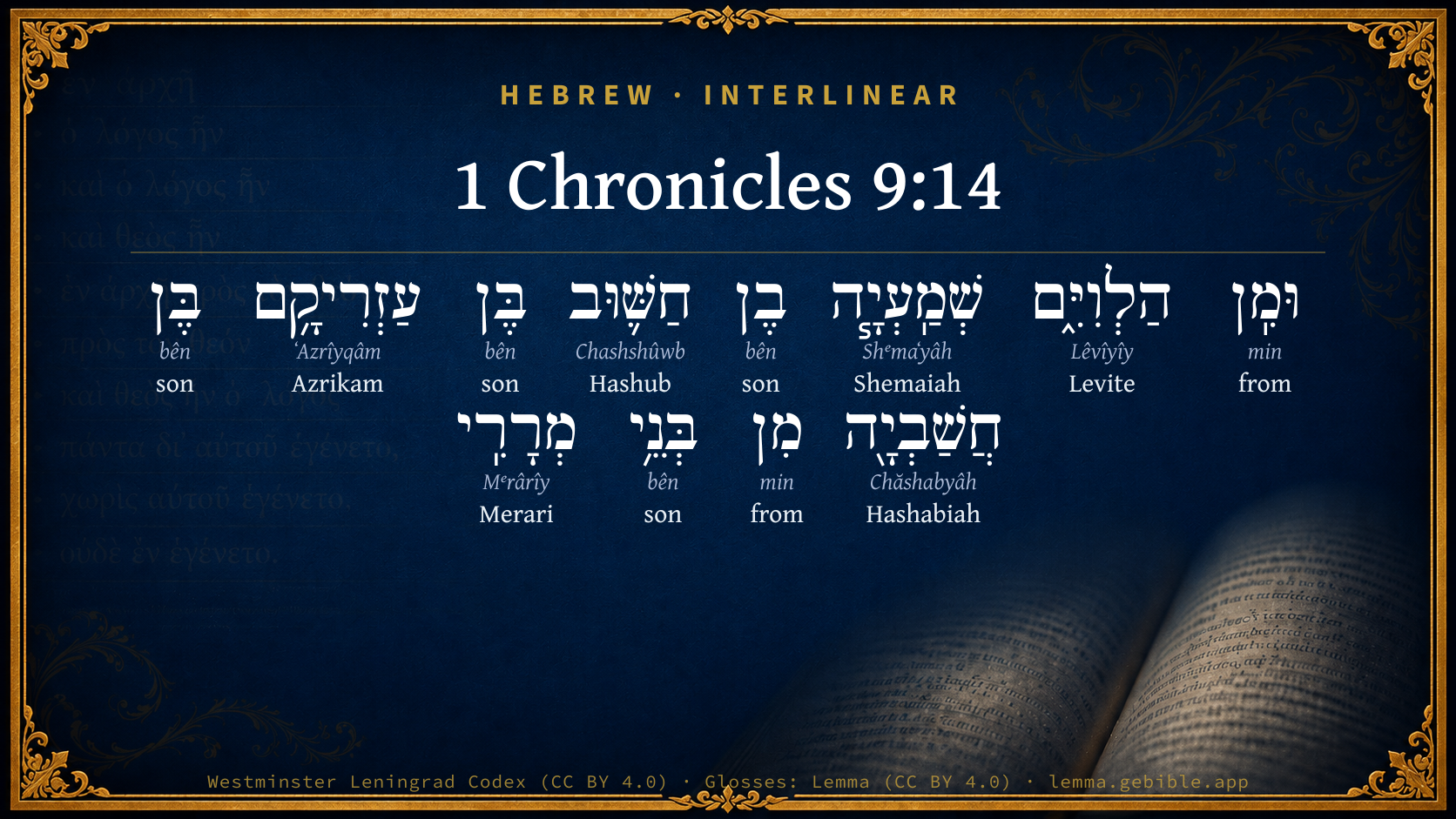
Hebrew (Westminster Leningrad Codex) 1 Chronicles 9:14 appears in the Hebrew Old Testament. The text above is from the Westminster Leningrad Codex. Each word links to its Strong’s number, a concise gloss, and parsing drawn from the Open Scriptures Hebrew Bible morphology. Click any word for its full Brown-Driver-Briggs (BDB) entry.
Download image
Cite this verse

1 Chronicles 9:14 (World English Bible). Public Domain. Lemma interlinear Bible study tool, https://lemma.gebible.app/v/1-chronicles/9/14.

Show BibTeX & RIS
BibTeX
RIS
English Translation
Of the Levites: Shemaiah the son of Hasshub, the son of Azrikam, the son of Hashabiah, of the sons of Merari;
World English Bible · Public Domain
Highlights
  • 1 first appearance in the Hebrew Bible
Full analysis ↓
Download a study sheet

One document with this verse’s original text, its word-by-word gloss line, the meaning frame, cross-references with their text, attributed commentary, and full source and license credits — printable, and it pastes into notes with its structure intact.

This verse Autodidact and up

Study sheet (.html) Plain text (.txt)

A passage Seminary Student

Up to 50 verses in one chapter. A passage sheet keeps up to 6 commentary sources and 12 cross-references per verse, in the order this page ranks them, and says so on the sheet whenever that leaves anything out. Ask for a single verse and you get the Autodidact verse sheet above.

Everything on this page stays free to read, with no account — the sheet is a download of what is already on screen, not access to it.

Want to remove ads? Support Godless Engineer
Compare translations 3

The same verse in 3 English versions, stacked beneath the original-language interlinear above. Click any original word for its lexicon entry.

Each is an independent rendering of the whole verse — the interlinear is not word-aligned to these translations.

Highlighted words mark where these versions differ — a whole-verse word diff, not a word-by-word alignment.

  • World English Bible Public Domain
    Of the Levites: Shemaiah the son of Hasshub, the son of Azrikam, the son of Hashabiah, of the sons of Merari;
  • King James Version Public Domain
    And of the Levites; Shemaiah the son of Hasshub, the son of Azrikam, the son of Hashabiah, of the sons of Merari;
  • unfoldingWord Literal Text CC BY-SA 4.0
    And from the Levites: Shemaiah, the son of Hasshub, the son of Azrikam, the son of Hashabiah, from the sons of Merari,

unfoldingWord Literal Text — © unfoldingWord, licensed CC BY-SA 4.0. Word-aligned USFM3 via Door43 (git.door43.org/unfoldingWord/en_ult).

Versions to compare (up to 4)

3 of 4 selected

Show all 18 translations

Every available English version of this verse, each an independent rendering of the whole verse.

  • World English Bible Public Domain
    Of the Levites: Shemaiah the son of Hasshub, the son of Azrikam, the son of Hashabiah, of the sons of Merari;
  • Berean Standard Bible Public Domain
    From the Levites: Shemaiah son of Hasshub, the son of Azrikam, the son of Hashabiah, a descendant of Merari;
  • Majority Standard Bible Public Domain
    From the Levites: Shemaiah son of Hasshub, the son of Azrikam, the son of Hashabiah, a descendant of Merari;
  • King James Version Public Domain
    And of the Levites; Shemaiah the son of Hasshub, the son of Azrikam, the son of Hashabiah, of the sons of Merari;
  • American Standard Version (1901) Public Domain
    And of the Levites: Shemaiah the son of Hasshub, the son of Azrikam, the son of Hashabiah, of the sons of Merari;
  • Revised Version (1885) Public Domain
    And of the Levites; Shemaiah the son of Hasshub, the son of Azrikam, the son of Hashabiah, of the sons of Merari;
  • Geneva Bible (1599) Public Domain
    And of the Leuites, Shemaiah the sonne of Hasshub, the sonne of Azrikam, the sonne of Hashabiah of the sonnes of Merari,
  • Douay-Rheims (1899) Public Domain
    And of the Levites: Semeia the son of Hassub the son of Ezricam, the son of Hasebia of the sons of Merari.
  • Young's Literal Translation Public Domain
    And of the Levites: Shemaiah son of Hashshub, son of Azrikam, son of Hashabiah, of the sons of Merari;
  • Literal Standard Version CC BY-SA 4.0
    And of the Levites: Shemaiah son of Hashshub, son of Azrikam, son of Hashabiah, of the sons of Merari;
  • Unlocked Literal Bible CC BY-SA 4.0
    Among the Levites, there was Shemaiah son of Hasshub son of Azrikam son of Hashabiah, among the descendants of Merari.
  • unfoldingWord Literal Text CC BY-SA 4.0
    And from the Levites: Shemaiah, the son of Hasshub, the son of Azrikam, the son of Hashabiah, from the sons of Merari,
  • Darby Bible Public Domain
    And of the Levites: Shemaiah the son of Hasshub, the son of Azrikam, the son of Hashabiah, of the sons of Merari;
  • World Messianic Bible Public Domain
    Of the Levites: Shemaiah the son of Hasshub, the son of Azrikam, the son of Hashabiah, of the sons of Merari;
  • Webster's Bible Public Domain
    And of the Levites; Shemaiah the son of Hasshub, the son of Azrikam, the son of Hashabiah, of the sons of Merari;
  • Free Bible Version CC BY-SA 4.0
    From the Levites: Shemaiah, son of Hasshub, son of Azrikam, son of Hashabiah, a descendant of Merari;
  • Bible in Basic English Public Domain
    And of the Levites: Shemaiah, the son of Hasshub, the son of Azrikam, the son of Hashabiah, of the sons of Merari;
  • JPS Tanakh (1917) Public Domain
    And of the Levites: Shemaiah the son of Hasshub, the son of Azrikam, the son of Hashabiah, of the sons of Merari;

Literal Standard Version (2020), Covenant Press — licensed CC BY-SA 4.0. Text via the HelloAO Bible API (eBible.org). Unlocked Literal Bible (unfoldingWord) — licensed CC BY-SA 4.0. Text via the HelloAO Bible API (eBible.org). unfoldingWord Literal Text — © unfoldingWord, licensed CC BY-SA 4.0. Word-aligned USFM3 via Door43 (git.door43.org/unfoldingWord/en_ult). Free Bible Version, Dr. Jonathan Gallagher — licensed CC BY-SA 4.0. Text via the HelloAO Bible API (eBible.org).

Word by word

More ways to search: Search by grammar → Find every occurrence → Compare this word →

Practice this passage: Drill this verse → Learn its vocabulary →

חַשּׁ֛וּב
Chashshûwb
H2815
“Hashub”
Noun, Proper
Part of Speech
Noun
Type
Proper
Full BDB Definition

Origin: from H2803

TWOT: None

Hashub = "considerate" - a Merarite Levite chief, son of Azrikam - a son of Pahath-moab who assisted in the repair of the wall of Jerusalem - a man who assisted in the repair of the wall of Jerusalem; may be same as 2 above - one of the heads of the people who sealed the covenant with Nehemiah
  1. וּמִֽן min H4480 “and · from” Conjunction + Preposition
  2. הַלְוִיִּ֑ם Lêvîyîy H3881 “the · Levites” Particle, Definite Article + Noun, Gentilic, Masculine, Plural, Absolute
  3. שְׁמַֽעְיָ֧ה Shᵉmaʻyâh H8098 “Shemaiah” Noun, Proper
  4. בֶן bên H1121 “son of” Noun, Common, Masculine, Singular, Construct
  5. בֶּן bên H1121 “son of” Noun, Common, Masculine, Singular, Construct
  6. עַזְרִיקָ֥ם ʻAzrîyqâm H5840 “Azrikam” Noun, Proper
  7. בֶּן bên H1121 “son of” Noun, Common, Masculine, Singular, Construct
  8. חֲשַׁבְיָ֖ה Chăshabyâh H2811 “Hashabiah” Noun, Proper
  9. מִן min H4480 “from” Preposition
  10. בְּנֵ֥י bên H1121 “sons of” Noun, Common, Masculine, Plural, Construct
  11. מְרָרִֽי Mᵉrârîy H4847 “Merari” Noun, Proper

About this verse

These counts appear in no published source. They are computed here, from the morphology-tagged text and Lemma’s own curated glosses. What Lemma adds →

12
words
8
distinct lemmas
Historical
section

Notable vocabulary

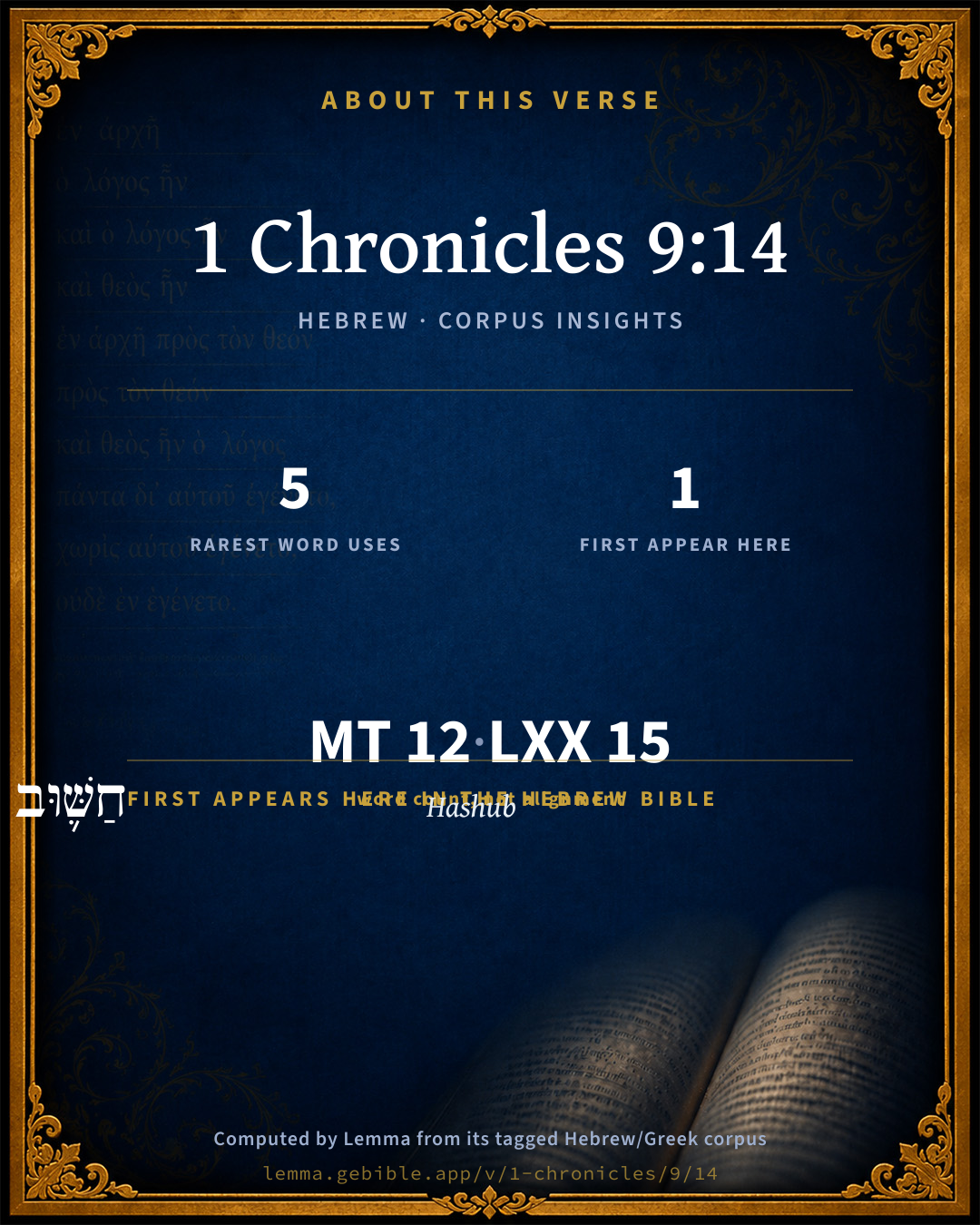
The rarest word here is חַשּׁ֛וּב Hashub H2815 — appearing just 5 times in the whole Hebrew Bible.

First appearance in Scripture

This word makes its first canonical appearance in the Hebrew Bible here:

  • חַשּׁ֛וּב Hashub H2815

Shared distinctive vocabulary

חַשּׁ֛וּב Hashub H2815 occurs in 5 verses of the Hebrew Bible. Also found in:

Grammatical profile

  • 10 nouns
  • 2 prepositions

Repetition

Words recur within this verse — often emphatic in Hebrew:

  • בֶן son H1121 ×4
  • וּמִֽן from H4480 ×2

Hebrew & Septuagint length

In English translation the verse runs 21 words from the Hebrew and 19 from the Septuagint (LXX English) — closely comparable.

A rough comparison of the two English renderings, which tokenize alike — not a word-level alignment.

Word counts can differ between the Hebrew and the Greek without any difference in meaning — e.g. the Hebrew direct-object marker אֵת has no separate Greek word, and Greek often adds the article ὁ.

In the original languages it is 12 Hebrew tokens and 15 Greek tokens — but the two are counted differently (Hebrew bundles its prefixes and suffixes into one token; the Greek is in lemma form), so that isn’t a like-for-like length.

Cross-references

7

Topical passages linked to 1 Chronicles 9:14 in the Treasury of Scripture Knowledge — connected by theme and wording, ordered by reader-vote popularity; previews shown in the World English Bible.

  • Numbers 26:57 These are those who were numbered of the Levites after their families: of Gershon, the family of the Gershonites; of Kohath, the family of the Kohathites; of Merari, the family of the Merarites.
  • 1 Chronicles 6:19 The sons of Merari: Mahli and Mushi. These are the families of the Levites according to their fathers' [houses].
  • 1 Chronicles 6:29 The sons of Merari: Mahli, Libni his son, Shimei his son, Uzzah his son,
  • 1 Chronicles 6:63 To the sons of Merari [were given] by lot, according to their families, out of the tribe of Reuben, and out of the tribe of Gad, and out of the tribe of Zebulun, twelve cities.
  • Nehemiah 10:11 Mica, Rehob, Hashabiah,
  • Nehemiah 11:15–19 Of the Levites: Shemaiah the son of Hasshub, the son of Azrikam, the son of Hashabiah, the son of Bunni;
  • Nehemiah 12:24 The chiefs of the Levites: Hashabiah, Sherebiah, and Jeshua the son of Kadmiel, with their brothers over against them, to praise and give thanks, according to the commandment of David the man of God, watch next to watch.

Cross-references courtesy of OpenBible.info (CC BY 4.0).

Hebrew and Greek witnesses Masoretic Hebrew ↔ Greek Septuagint

The same verse in the two great witnesses to the Old Testament, shown verse-for-verse.

These are two independent witnesses, not word-aligned to each other, and the Septuagint is shown in lemma (dictionary) form.

Hebrew 1 Chronicles 9:14 Masoretic · Westminster Leningrad Codex

וּמִֽן הַלְוִיִּ֑ם שְׁמַֽעְיָ֧ה בֶן חַשּׁ֛וּב בֶּן עַזְרִיקָ֥ם בֶּן חֲשַׁבְיָ֖ה מִן בְּנֵ֥י מְרָרִֽי

Of the Levites: Shemaiah the son of Hasshub, the son of Azrikam, the son of Hashabiah, of the sons of Merari;

World English Bible · Public Domain

Greek LXX 1 Chronicles 9:14 Septuagint · lemma form

καί ἐκ ὁ λευίτης σαμαια υἱός ασωβ υἱός εσρικαμ υἱός ασαβια ἐκ ὁ υἱός μεραρι

And of the Levites; Samaia son of Asob, son of Ezricam, son of Asabia, of the sons of Merari.

LXX2012 (modern English Septuagint) · Public Domain

Hebrew: Westminster Leningrad Codex (CC BY 4.0). Greek: Septuagint (public domain); English from LXX2012 (modern English Septuagint) (Public Domain). How the Septuagint differs from the Hebrew →

Commentary

Notes on 1 Chronicles 9:14 from classic Christian and Jewish commentators (each source and its license shown beneath its notes). The classic Christian expositions comment on the surrounding passage and are grouped to its opening verse, so a note may address several verses; the Jewish commentaries on the Tanakh (Rashi and others) are per-verse, so they appear only where the commentator wrote on this verse.

Lemma curates 59 commentaries, every one of them public domain or Creative Commons licensed, each selected and text-cleaned for this edition rather than reprinted as found. About our sources →

Trapp's Complete Commentary

John Trapp

1Ch 9:14 And of the Levites; Shemaiah the son of Hasshub, the son of Azrikam, the son of Hashabiah, of the sons of Merari;

Ver. 14. And of the Levites.] See 1Ch 9:2; 1Ch 9:10.

John Trapp, A Commentary or Exposition upon All the Books of the Old and New Testament (1647–1656) — public domain. Text from a community e-Sword module.

Matthew Henry's Commentary

We have here a further account of the good posture which the affairs of religion were put into immediately upon the return of the people out of Babylon. They had smarted for their former neglect of ordinances and under the late want of ordinances. Both these considerations made them very zealous and forward in setting up the worship of God among them; so they began their worship of God at the right end. Instances hereof we have here.

I. Before the house of the Lord was built they had the house of the tabernacle, a plain and movable tent, which they made use of in the mean time. Those that cannot yet reach to have a temple must not be without a tabernacle, but be thankful for that and make the best of it. Never let God's work be left undone for want of a place to do it in.

II. In allotting to the priests and Levites their respective employments, they had an eye to the model that was drawn up by David, and Samuel the seer, Ch1 9:22. Samuel, in his time, had drawn the scheme of it, and laid the foundation, though the ark was then in obscurity, and David afterwards finished it, and both acted by immediate direction from God. Or David, as soon as he was anointed had this matter in his mind and consulted Samuel about it, though he was then in his troubles, and the plan was formed in concert between them. This perhaps had been little regarded for many ages; but now, after a long interruption, it was revived. In dividing the work, they observed these ancient land-marks.

III. The most of them dwelt at Jerusalem (Ch1 9:34), yet there were some that dwelt in the villages (Ch1 9:16, Ch1 9:22), because, it may be, there was not yet room for them in Jerusalem. However they were employed in the service of the tabernacle (Ch1 9:25): They were to come after seven days from time to time. They had their week's attendance in their turns.

IV. Many of the Levites were employed as porters at the gates of the house of God, four chief porters (Ch1 9:26), and, under them, others, to the number of 212, Ch1 9:22. They had the oversight of the gates (Ch1 9:23), were keepers of the thresholds, as in the margin (Ch1 9:19), and keepers of the entry. This seemed a mean office; and yet David would rather have it than dwell in the tents of wickedness, Psa 84:10. Their office was, 1. To open the doors of God's house every morning (Ch1 9:27) and shut them at night. 2. To keep off the unclean, and hinder those from thrusting in that were forbidden by the law. 3. To direct and introduce into the courts of the Lord those that came thither to worship, and to show them where to go and what to do, that they might not incur punishment. This required care, and diligence, and constant attendance. Ministers have work to do of this kind.

V. Here is one Phinehas, a son of Eleazar, that is said to be a ruler over them in time past (Ch1 9:20), not the famous high priest of that name, but (as is supposed) an eminent Levite, of whom it is here said that the Lord was with him, or (as the Chaldee reads it) the Word of the Lord was his helper - the eternal Word, who is Jehovah, the mighty one on whom help is laid.

VI. It is said of some of them that, because the charge was upon them, they lodged round about the house of God, Ch1 9:27. It is good for ministers to be near their work, that they may give themselves wholly to it. The Levites pitched about the tabernacle when they marched through the wilderness. Then they were porters in one sense, bearing the burdens of the sanctuary, now porters in another sense, attending the gates and the doors - in both instances keeping the charge of the sanctuary.

VII. Every one knew his charge. Some were entrusted with the plate, the ministering vessels, to bring them in and out by tale, Ch1 9:28. Others were appointed to prepare the fine flour, wine, oil, etc., Ch1 9:29. Others, that were priests, made up the holy anointing oil, Ch1 9:30. Others took care of the meat-offerings, Ch1 9:31. Others of the show-bread, Ch1 9:32. As in other great houses, so in God's house, the work is likely to be done well when every one knows the duty of his place and makes a business of it. God is the God of order: but that which is every body's work will be nobody's work.

VIII. The singers were employed in that work day and night, Ch1 9:33. They were the chief fathers of the Levites that made a business of it, not mean singing-men, that made a trade of it. They remained in the chambers of the temple, that they might closely and constantly attend it, and were therefore excused from all other services. It should seem, some companies were continually singing, at least at stated hours, both day and night. Thus was God continually praised, as it is fit he should be who is continually doing good. Thus devout people might, at any hour, have assistance in their devotion. Thus was the temple a figure of the heavenly one, where they rest not day nor night from praising God, Rev 4:8. Blessed are those that dwell in thy house; they will be still praising thee.

Matthew Henry's Commentary on the Whole Bible (1708–1710) — public domain (CC PDM 1.0). Text via the HelloAO Bible API.

Ellicott's Commentary for English Readers

(14–17) The Levites resident in Jerusalem (Neh_11:15-19).

(14) Word for word the same with Neh. i.e., save that here Shemaiah is ultimately deduced from the clan of the Merarites, whereas there one more ancestor (Banni) follows Hashabiah, and the phrase “of the sons of Merari” is omitted.

A Bible Commentary for English Readers, edited by Charles John Ellicott (1878–1897) — public domain. Text from a community e-Sword module.

The Cambridge Bible for Schools and Colleges

gen. ed. J. J. S. Perowne

14–16 (cp. Neh_11:15-18). The Levites

14. of the sons of Merari] in Neh. the sons of Bunni, which is probably a corruption of the reading of Chron. Otherwise of the three great Levitical families, Merari, Asaph and Jeduthun mentioned here, only the last two appear in Neh.

The Cambridge Bible for Schools and Colleges (gen. ed. J. J. S. Perowne; Cambridge University Press, 1878–1918) — public domain. Text from a community e-Sword module.

John Gill's Exposition

And Obadiah the son of Shemaiah,.... Called Abda the son of Shammua, Neh 11:17.

the son of Galal, the son of Jeduthun; who was Ethan, another of the singers in the time of David:

and Berechiah the son of Asa, the son of Elkanah, that dwelt in the villages of the Netophathites; the villages about Netophah, which was in the tribe of Judah, Ch1 2:54, Neh 7:26 which may be understood either of Elkanah, the ancestor of Berechiah, whose dwelling was there; or of Berechiah, and must be rendered:

who had dwelt there; for now he dwelt at Jerusalem.

John Gill's Exposition of the Whole Bible (1746–1763) — public domain (CC PDM 1.0). Text via the HelloAO Bible API.

Haydock's Catholic Bible Commentary

Levites, established at Jerusalem.

George Leo Haydock (1774–1849), Haydock's Catholic Family Bible and Commentary, 1859 edition — public domain. Excludes Psalms (Douay-Rheims chapter numbering differs from Protestant) and Deuterocanonical books (Catholic canon only).

The Pulpit Commentary

Vers. 14-16. The corresponding account of these Levites (Neh_11:15-18) has some additional details as, for instance, that the number of "the Levites in the holy city were two hundred four score and four;" that two "of the chief of the Levites, Shabbethai and Jozabad," not given here, "had the oversight of the outward business of the house of God;" that "Mattaniah was the principal to begin the thanksgiving in prayer;" and that Bakbukiah (hero called Bakbakkar) was "the second among his brethren." Hashabiah is also stated to be "the son of Bunni." The Netophathites. The town Netophah was either locally near Bethlehem, or in some way closely related to it (1Ch_2:54; Neh_7:26) It is not directly mentioned, though existing long before, till the accounts of those who returned from Babylon with Zerubbabel. (Ezr_2:22) Interesting facts, respecting its people are found in 1Ch_27:13, 1Ch_27:15; Neh_12:28. Though our Authorized Version has the name here in the plural, it is not so in the Hebrew, nor is it there accompanied by the article.

Vers. 14.-34.

Aspects of Christian work.

In the service of the sanctuary there were many offices to be filled, various duties to be discharged. These will bring to our remembrance three aspects of our Christian service.

I THAT LOWLY LABOUR IN THE SERVICE OF THE SAVIOUR IS HONOURABLE WORK. The work of the Nethinims (ver. 2) was not to be despised; they did work which was comparatively menial, but it was work that needed to be done for God, and was accepted by him. Of the Levites, some "had the charge of the ministering vessels" (ver. 28); others of "the fine flour, and the wine, and the oil, and the frankincense, and the spices" (vers. 29, 30); one of them was placed "over the things that were made in the pans" (ver. 31). These offices were humble enough, but they were not counted dishonourable by those who rendered them, and they were esteemed worthy of record in the sacred chronicle. In the cause of Christ and of man there are many duties that are demanded of us, which, to the eye of impiety, may seem servile and mean. If, however, we are looking at things with the eye of faith and filial love, they will not wear this aspect. Loyalty counts nothing too mean to be rendered to its sovereign; love nothing too trivial to be offered to its friend. Our loyalty to the heavenly King, our love to our Divine Friend, should make us not only willing but eager to take any part and do any work in his sacred service.

II THAT A POST OF TRUST IS ONE OF SPECIAL HONOUR. It is very noticeable that so much is said about the porters that kept the gates: "the work of the service" is markedly referred to as "keeping the gates of the tabernacle;" these "over the host of the Lord," were "keepers of the entry" (ver. 19; see vers. 21-24). We read also that "four chief porters were over the chambers and treasuries" (ver. 26). Special provision was made for their entertainment (ver. 27). These actions were simple, mechanical it might be thought lowly, if not menial. But they were places of trust. It was important that none should be admitted to the holy places but those who had the right of entrance. These men had the purity of the sacred courts at their command; they were trusted to see that these were not profaned by unhallowed feet. When we are trusted by our fellows or by our Master to do anything, whether it be in itself serious or slight, we should feel that we are being honoured, and we should put forth all our vigilance, strength, vigour, to prove ourselves worthy of the confidence placed in us. Nothing should make so strong an appeal to our undivided energies as being trusted to see that something is done well in the service of our Saviour.

III THAT CONSTANCY IS A VERY VALUABLE VIRTUE IN CHRISTIAN SERVICE. The singers "were employed in that work day and night" (ver. 33). It was pleasing to the ear of Jehovah to hear ceaseless strains of holy song in the house of the Lord. It is pleasing to the heart of the ascended Saviour to witness spiritual constancy in those that bear his name and profess to be his disciples. He has ordained us that "our fruit should remain". (Joh_15:16) He wishes that we should "continue in his love". (Joh_15:9) We are to continue in the doctrine of Christ (Act_14:22; 1Ti_4:16; Col_1:23) and in brotherly. (Heb_13:1) The secret of constancy in the various graces of Christian character is abiding in Christ himself. (Joh_15:1-7) Abiding in him our spirit trusting, resting, rejoicing, hoping in him our life will not flicker or expire; it will shine, like the lamp in the holy place, like the song in the sanctuary, day and night," steadily, serenely, abidingly, in the presence of God. C.

The Pulpit Commentary (1880–1919), ed. H.D.M. Spence-Jones & Joseph S. Exell — public domain. Text from a community e-Sword module.

Keil & Delitzsch

C. F. Keil & F. Delitzsch

And Obadiah the son of Shemaiah,.... Called Abda the son of Shammua, Neh 11:17.

the son of Galal, the son of Jeduthun; who was Ethan, another of the singers in the time of David:

and Berechiah the son of Asa, the son of Elkanah, that dwelt in the villages of the Netophathites; the villages about Netophah, which was in the tribe of Judah, Ch1 2:54, Neh 7:26 which may be understood either of Elkanah, the ancestor of Berechiah, whose dwelling was there; or of Berechiah, and must be rendered:

who had dwelt there; for now he dwelt at Jerusalem.

Keil & Delitzsch — Biblical Commentary on the Old Testament (1861–1891) — public domain (CC PDM 1.0). Text via the HelloAO Bible API. (Old Testament only.)

unfoldingWord translationNotes

Door43 World Missions Community

General Information:

All of the names here except "Netophathites" are the names of men. The Netophathites were a people group. (See: How to Translate Names)

among the descendants

"one of the descendants"

translationWords

Levi

Asaph

Obadiah

unfoldingWord translationNotes — © Distant Shores Media and the Door43 World Missions Community, licensed CC BY-SA 4.0. Source: git.door43.org/Door43/en_tn.

Lesson kit

Teaching starters — assembled from the data on this page, not authored interpretation. Every prompt links to the verse data it draws on. Edit before teaching.

1 Chronicles, in the Historical, opens this verse with 12 words (8 distinct Hebrew lemmas). Its most distinctive word is Chashshûwb (“Hashub”). A historical commentator’s framing appears above. Read the whole chapter for the surrounding context.

Discussion questions

  1. How does “Hashub” (Chashshûwb) shape what this verse is saying?
  2. This is the first place “Hashub” appears in Scripture (first appears here). What does its debut here establish?
  3. How does Nehemiah 3:11, which shares the word «Hashub», read alongside this verse?
  4. What does the repetition of “son” (4× in this one verse) do in this verse?
  5. Compare how Trapp's Complete Commentary and Matthew Henry's Commentary read this verse. Where do they agree or differ?

Things to notice

Reading settings

Reading text

Shown beneath each verse's original-language words.

Old Testament
Old Testament edition

Read the OT as the Masoretic Hebrew (MT) or the Greek Septuagint (LXX).

English shown for the Greek Septuagint (in the Hebrew ↔ Greek comparison).

Comparing translations? Open the Compare panel on any verse page to stack up to four side by side.