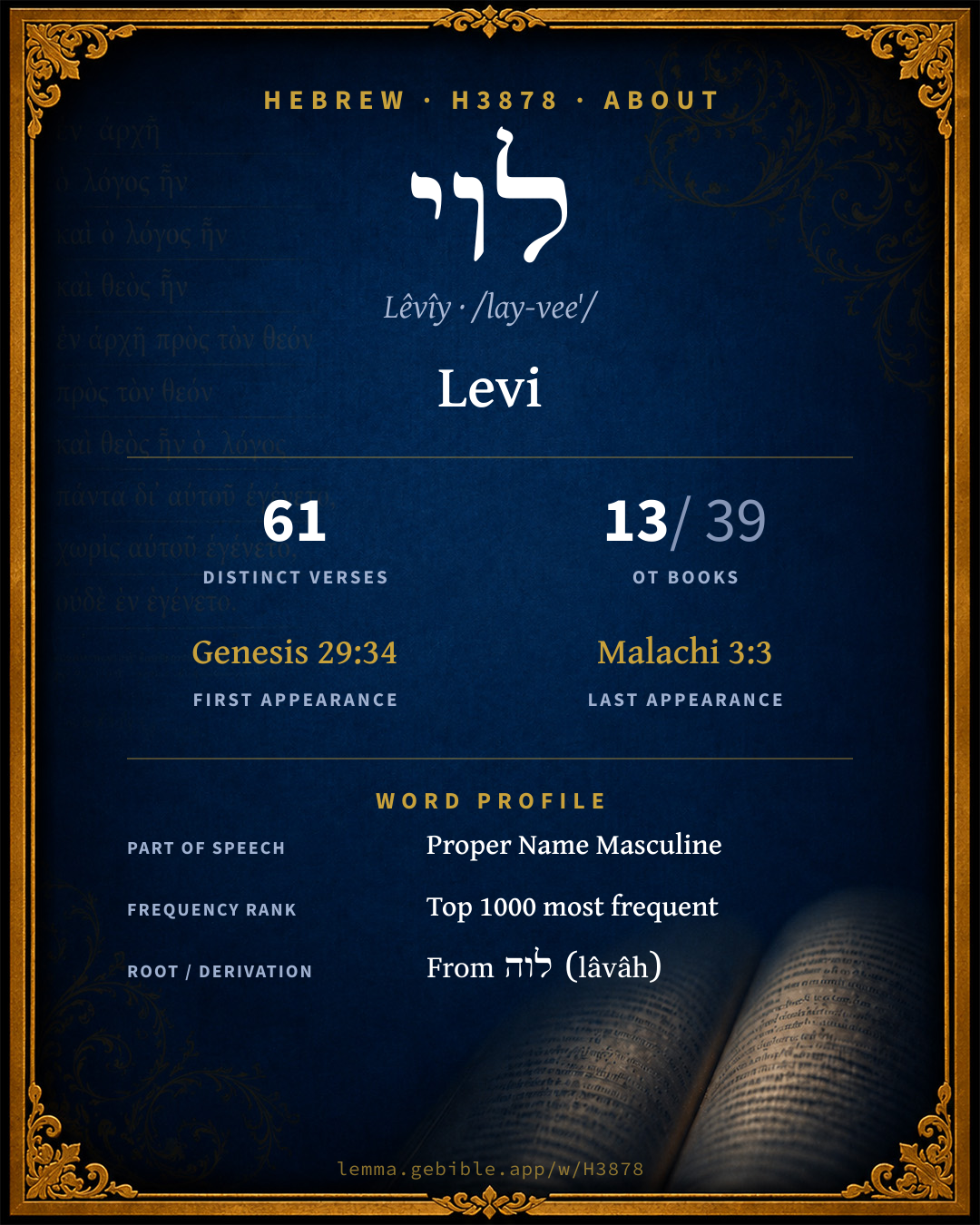
לֵוִי
Levi
BDB lists 2 entries for ‘Levi’ fuller range ↓
Full lexicon entry — Brown-Driver-Briggs (BDB)
From Brown-Driver-Briggs (BDB)
Where this word appears
Grammar key — what these labels mean
Part of speech
- Noun
- A naming word — a person, place, thing, or idea.
Noun type
- Proper
- A name of a specific person, place, or people (e.g. Abraham, Zion, Israel).
- Gentilic
- A noun naming a member of a people, tribe, or region of origin (e.g. an Israelite, a Moabite).
State
- Absolute
- The independent form of a noun, not bound to a following word.
Gender
- Masculine
- Grammatically masculine.
Number
- Singular
- One.
Grammatical forms
- Noun, Proper 58 times (91%)
- Noun, Gentilic, Masculine, Singular, Absolute 6 times (9%)
Parsed forms decoded from the imported morphology (morphhb / Westminster Leningrad Codex — WLC text public domain, morphhb tagging CC BY 4.0), counted across 64 parsed occurrences — not distinct verses.
Every verse where H3878 appears — 61 distinct verses across 13 books. Click any verse to open its interlinear word-by-word view. Verse text shown in the World English Bible for context — . Each verse’s Hebrew form is shown with its reference; the English is not keyword-highlighted, since the data carries no word-level English alignment. Use “Compare translations” on any verse to read it across multiple English versions. This concordance covers the Hebrew Bible; Septuagint (Greek Old Testament) occurrences are not indexed here.
Genesis 6 verses
- Genesis 29:34 לֵוִֽי n Proper She conceived again, and bare a son. Said, "Now this time will my husband be joined to me, because I have borne him three sons." Therefore was his name called Levi.
- Genesis 34:25 וְ/לֵוִ֜י conj + n Proper It happened on the third day, when they were sore, that two of Jacob's sons, Simeon and Levi, Dinah's brothers, each took his sword, came upon the unsuspecting city, and killed all the males.
- Genesis 34:30 לֵוִי֮ n Proper Jacob said to Simeon and Levi, "You have troubled me, to make me odious to the inhabitants of the land, among the Canaanites and the Perizzites. I am few in number. They will gather themselves together against me and strike me, and I will be destroyed, I and my house."
- Genesis 35:23 וְ/לֵוִ֣י conj + n Proper The sons of Leah: Reuben (Jacob's firstborn), Simeon, Levi, Judah, Issachar, and Zebulun.
- Genesis 46:11 לֵוִ֑י n Proper The sons of Levi: Gershon, Kohath, and Merari.
- Genesis 49:5 וְ/לֵוִ֖י conj + n Proper "Simeon and Levi are brothers; Weapons of violence are their swords.
Exodus 6 verses
- Exodus 1:2 לֵוִ֖י n Proper Reuben, Simeon, Levi, and Judah,
- Exodus 2:1 לֵוִ֑י לֵוִֽי n Proper n Proper A man of the house of Levi went and took a daughter of Levi as his wife.
- Exodus 6:16 לֵוִי֙ לֵוִ֔י n Proper n Proper These are the names of the sons of Levi according to their generations: Gershon, and Kohath, and Merari; and the years of the life of Levi were one hundred thirty-seven years.
- Exodus 6:19 הַ/לֵּוִ֖י ptcl def.art + n Gentilic ms The sons of Merari: Mahli and Mushi. These are the families of the Levites according to their generations.
- Exodus 32:26 לֵוִֽי n Proper then Moses stood in the gate of the camp, and said, "Whoever is on Yahweh's side, come to me!" All the sons of Levi gathered themselves together to him.
- Exodus 32:28 לֵוִ֖י n Proper The sons of Levi did according to the word of Moses: and there fell of the people that day about three thousand men.
Numbers 14 verses
- Numbers 1:49 לֵוִי֙ n Proper "Only the tribe of Levi you shall not number, neither shall you take a census of them among the children of Israel;
- Numbers 3:6 לֵוִ֔י n Proper "Bring the tribe of Levi near, and set them before Aaron the priest, that they may minister to him.
- Numbers 3:15 לֵוִ֔י n Proper "Number the children of Levi by their fathers' houses, by their families: every male from a month old and upward shall you number."
- Numbers 3:17 לֵוִ֖י n Proper These were the sons of Levi by their names: Gershon, and Kohath, and Merari.
- Numbers 4:2 לֵוִ֑י n Proper "Take a census of the sons of Kohath from among the sons of Levi, by their families, by their fathers' houses,
- Numbers 16:1 לֵוִ֑י n Proper Now Korah, the son of Izhar, the son of Kohath, the son of Levi, with Dathan and Abiram, the sons of Eliab, and On, the son of Peleth, sons of Reuben, took [men]:
- Numbers 16:7 לֵוִֽי n Proper and put fire in them, and put incense on them before Yahweh tomorrow: and it shall be that the man whom Yahweh does choose, he [shall be] holy: you take too much on you, you sons of Levi.
- Numbers 16:8 לֵוִֽי n Proper Moses said to Korah, Hear now, you sons of Levi:
- Numbers 16:10 לֵוִ֖י n Proper and that he has brought you near, and all your brothers the sons of Levi with you? and seek you the priesthood also?
- Numbers 17:3 לֵוִ֑י n Proper You shall write Aaron's name on the rod of Levi; for there shall be one rod for each head of their fathers' houses.
- Numbers 17:8 לֵוִ֑י n Proper It happened on the next day, that Moses went into the tent of the testimony; and, behold, the rod of Aaron for the house of Levi was budded, and put forth buds, and produced blossoms, and bore ripe almonds.
- Numbers 18:2 לֵוִ֜י n Proper Your brothers also, the tribe of Levi, the tribe of your father, bring you near with you, that they may be joined to you, and minister to you: but you and your sons with you shall be before the tent of the testimony.
- Numbers 18:21 לֵוִ֔י n Proper To the children of Levi, behold, I have given all the tithe in Israel for an inheritance, in return for their service which they serve, even the service of the tent of meeting.
- Numbers 26:59 לֵוִ֔י לְ/לֵוִ֖י n Proper prep + n Proper The name of Amram's wife was Jochebed, the daughter of Levi, who was born to Levi in Egypt: and she bore to Amram Aaron and Moses, and Miriam their sister.
Deuteronomy 7 verses
- Deuteronomy 10:8 הַ/לֵּוִ֔י ptcl def.art + n Gentilic ms At that time Yahweh set apart the tribe of Levi, to bear the ark of the covenant of Yahweh, to stand before Yahweh to minister to him, and to bless in his name, to this day.
- Deuteronomy 10:9 לְ/לֵוִ֛י prep + n Proper Therefore Levi has no portion nor inheritance with his brothers; Yahweh is his inheritance, according as Yahweh your God spoke to him.)
- Deuteronomy 18:1 לֵוִ֛י n Proper The priests the Levites, [even] all the tribe of Levi, shall have no portion nor inheritance with Israel: they shall eat the offerings of Yahweh made by fire, and his inheritance.
- Deuteronomy 21:5 לֵוִי֒ n Proper The priests the sons of Levi shall come near; for them Yahweh your God has chosen to minister to him, and to bless in the name of Yahweh; and according to their word shall every controversy and every stroke be.
- Deuteronomy 27:12 וְ/לֵוִ֣י conj + n Proper These shall stand on Mount Gerizim to bless the people, when you are passed over the Jordan: Simeon, and Levi, and Judah, and Issachar, and Joseph, and Benjamin.
- Deuteronomy 31:9 לֵוִ֔י n Proper Moses wrote this law, and delivered it to the priests the sons of Levi, who bore the ark of the covenant of Yahweh, and to all the elders of Israel.
- Deuteronomy 33:8 וּ/לְ/לֵוִ֣י conj + prep + n Proper Of Levi he said, Your Thummim and your Urim are with your godly one, Whom you did prove at Massah, With whom you did strive at the waters of Meribah;
Joshua 3 verses
- Joshua 13:14 הַ/לֵּוִ֔י ptcl def.art + n Gentilic ms Only to the tribe of Levi he gave no inheritance; the offerings of Yahweh, the God of Israel, made by fire are his inheritance, as he spoke to him.
- Joshua 13:33 הַ/לֵּוִ֔י ptcl def.art + n Gentilic ms But to the tribe of Levi Moses gave no inheritance: Yahweh, the God of Israel, is their inheritance, as he spoke to them.
- Joshua 21:10 לֵוִ֑י n Proper and they were for the children of Aaron, of the families of the Kohathites, who were of the children of Levi; for theirs was the first lot.
1 Kings 1 verse
1 Chronicles 13 verses
- 1 Chronicles 2:1 לֵוִ֣י n Proper These are the sons of Israel: Reuben, Simeon, Levi, and Judah, Issachar, and Zebulun,
- 1 Chronicles 6:1 לֵוִ֑י n Proper The sons of Levi: Gershon, Kohath, and Merari.
- 1 Chronicles 6:16 לֵוִ֑י n Proper The sons of Levi: Gershom, Kohath, and Merari.
- 1 Chronicles 6:38 לֵוִ֖י n Proper the son of Izhar, the son of Kohath, the son of Levi, the son of Israel.
- 1 Chronicles 6:43 לֵוִֽי n Proper the son of Jahath, the son of Gershom, the son of Levi.
- 1 Chronicles 6:47 לֵוִֽי n Proper the son of Mahli, the son of Mushi, the son of Merari, the son of Levi.
- 1 Chronicles 9:18 לֵוִֽי n Proper who hitherto [waited] in the king's gate eastward: they were the porters for the camp of the children of Levi.
- 1 Chronicles 12:26 הַ/לֵּוִ֔י ptcl def.art + n Proper Of the children of Levi four thousand and six hundred.
- 1 Chronicles 21:6 וְ/לֵוִי֙ conj + n Proper But he didn't count Levi and Benjamin among them; for the king's word was abominable to Joab.
- 1 Chronicles 23:6 לֵוִ֔י n Proper David divided them into divisions according to the sons of Levi: Gershon, Kohath, and Merari.
- 1 Chronicles 23:14 הַ/לֵּוִֽי ptcl def.art + n Gentilic ms But as for Moses the man of God, his sons were named among the tribe of Levi.
- 1 Chronicles 23:24 לֵוִי֩ n Proper These were the sons of Levi after their fathers' houses, even the heads of the fathers' [houses] of those of those who were counted, in the number of names by their polls, who did the work for the service of the house of Yahweh, from twenty years old and upward.
- 1 Chronicles 24:20 לֵוִ֖י n Proper Of the rest of the sons of Levi: of the sons of Amram, Shubael; of the sons of Shubael, Jehdeiah.
Ezra 2 verses
- Ezra 8:15 לֵוִ֖י n Proper I gathered them together to the river that runs to Ahava; and there we encamped three days: and I viewed the people, and the priests, and found there none of the sons of Levi.
- Ezra 8:18 לֵוִ֖י n Proper According to the good hand of our God on us they brought us a man of discretion, of the sons of Mahli, the son of Levi, the son of Israel; and Sherebiah, with his sons and his brothers, eighteen;
Nehemiah 2 verses
- Nehemiah 10:39 הַ/לֵּוִ֗י ptcl def.art + n Proper For the children of Israel and the children of Levi shall bring the heave-offering of the grain, of the new wine, and of the oil, to the chambers, where are the vessels of the sanctuary, and the priests who minister, and the porters, and the singers: and we will not forsake the house of our God.
- Nehemiah 12:23 לֵוִי֙ n Proper The sons of Levi, heads of fathers' [houses], were written in the book of the chronicles, even until the days of Johanan the son of Eliashib.
Psalms 1 verse
Ezekiel 2 verses
- Ezekiel 40:46 לֵוִ֛י n Proper and the chamber whose prospect is toward the north is for the priests, the keepers of the charge of the altar: these are the sons of Zadok, who from among the sons of Levi come near to Yahweh to minister to him.
- Ezekiel 48:31 לֵוִ֖י n Proper and the gates of the city shall be after the names of the tribes of Israel, three gates northward: the gate of Reuben, one; the gate of Judah, one; the gate of Levi, one.
Zechariah 1 verse
Malachi 3 verses
- Malachi 2:4 לֵוִ֔י n Proper You will know that I have sent this commandment to you, that my covenant may be with Levi," says Yahweh of Hosts.
- Malachi 2:8 הַ/לֵּוִ֔י ptcl def.art + n Proper But you have turned aside out of the way. You have caused many to stumble in the law. You have corrupted the covenant of Levi," says Yahweh of Hosts.
- Malachi 3:3 לֵוִי֙ n Proper and he will sit as a refiner and purifier of silver, and he will purify the sons of Levi, and refine them as gold and silver; and they shall offer to Yahweh offerings in righteousness.
About this entry
At a glance — auto-summarized from this page’s data, not written by a person. Every figure links to its source below. This summary describes the numbers; it doesn’t interpret them.
At its core, לוי (Lêvîy) means “Levi.” Scripture first uses it in Genesis 29:34. It turns up in 61 verses across 13 books, a moderately common footprint. Dig into 61-verse concordance and the renderings breakdown below.
Gloss history
Strong's 1890 vs modern scholarship
About this word
Strong's H3878 catalogs a Hebrew word from the Hebrew Old Testament.
These counts are not copied from any lexicon or concordance. They are computed here, from the morphology-tagged Hebrew Old Testament. What Lemma adds →
- 61
- distinct verses
- The word appears in 61 distinct verses.
- 13 / 39
- OT books
- The word appears in 13 of 39 Old Testament books.
- #607
- by frequency
- Top 1000 most frequent Hebrew words (rank 607 of 8,640 Hebrew words by occurrence).
View all 61 occurrences in the concordance →
Most concentrated in
- Numbers 14 verses 23%
- 1 Chronicles 13 verses 21%
- Deuteronomy 7 verses 11%
By section of the Old Testament
By traditional corpus
Conventional, traditional groupings — biblical authorship is debated, so this is a traditional corpus grouping, not an authorship claim. Each share is this word’s portion of its verses in that division of the Hebrew canon. Each figure is a share of the word’s 61 distinct verses.
- Torah (Pentateuch) 33 verses · 54%
- Writings (Ketuvim) 18 verses · 30%
- Prophets (Nevi'im) 10 verses · 16%
How translations render this word
Counts come from each version’s own published word-to-Strong’s tagging or interlinear alignment — an approximate guide to how each version renders this word, not a word-level alignment the data otherwise carries. Because each total is that version’s own tagged count, the per-version totals vary from one another and need not match the appearance or distinct-verse counts above. These counts may also differ from a printed concordance because Lemma counts each distinctly tagged rendering and does not collapse phrase taggings into a single head-word total. This is a fixed set of word-tagged versions (KJV, ASV, BSB, ULT) and does not change with the reading translation you choose elsewhere. Each version’s license is shown beside its name below (and on Sources).
BDB lists this Strong’s number as 2 distinct words (homographs). Each count above pools all of them and is not split by sense — see the Senses section below. A low-frequency rendering may belong to a different one of those words, not the primary meaning.
- King James Version†: Levi 62×
- American Standard Version†: Levi 57×, Ye sons of levi 2×
- Berean Standard Bible†: Levi 41×, Levites 4×
- unfoldingWord Literal Text†: Levi 62×
King James Version Public Domain
Renders H3878 across 64† tagged occurrences — most commonly:
Plus 2 renderings that appear only once — usually multi-word phrases or single function words the recovered tagging swept in, not distinct renderings.
American Standard Version Public Domain
Renders H3878 across 64† tagged occurrences — most commonly:
Plus 5 renderings that appear only once — usually multi-word phrases or single function words the recovered tagging swept in, not distinct renderings.
Berean Standard Bible Public Domain
Renders H3878 across 48† tagged occurrences — most commonly:
Plus 3 renderings that appear only once — usually multi-word phrases or single function words the recovered tagging swept in, not distinct renderings. Not rendered by a distinct English word in 11 further occurrences.
unfoldingWord Literal Text CC BY-SA 4.0
Renders H3878 across 66† tagged occurrences — most commonly:
Plus 4 renderings that appear only once — usually multi-word phrases or single function words the recovered tagging swept in, not distinct renderings.
15 senses and sub-senses in the full BDB
What do BDB’s symbols mean?
BDB uses these scholarly abbreviations:
| Symbol | Meaning |
|---|---|
| 𝔊 | the Septuagint (the ancient Greek translation, LXX) |
| 𝔙 | the Vulgate (the Latin translation) |
| 𝔖 | the Syriac version (the Peshitta) |
| 𝔗 | the Targum (the Aramaic translation) |
| ψ | the Psalms |
| √ | root (the underlying root or stem) |
| ‖ | parallel passage (a synonymous or contrasted parallel) |
| † | the dagger: every passage where the word occurs is cited |
The 15 senses and sub-senses the full Brown-Driver-Briggs lexicon distinguishes for this word, in lexicon order (not ranked by frequency), with BDB’s own verbatim wording and sub-sense lettering. Shown in Hebrew script with BDB’s own scholarly abbreviations. The condensed entry is in the Lexicon Entry tab. See also the Forms in the corpus table below.
לוי I m. Levi (√ and meaning dubious
- 1.
- a. Levi, son of Jacob and Leah, as individual, Gn 29:34; 34:25, 30; 35:23; 49:5 (all J); 35:23; 46:11; Ex 1:2; 6:16(×2) Nu 3:17; 16:1 (all P); 1 Ch 2:1; 5:22; 6:1, 4, 23, 28, 32; 23:6 Ezr 8:18; so בַּת־ל׳ [אֶת־] Ex 2:1 (E), Nu 26:59 (P). e.g. Genesis 29:34
- b. as head of a family of descendants, in phr. בֵּית לֵוִי Ex 2:1 (E), and (with ref. to tribe; late) Nu 17:23, מִשְׁפַּחַת בֵּית ל׳ Zc 12:13. e.g. Exodus 2:1
- c. often בְּנֵי(־)ל׳ Ex 32:26, 28 (E), Jos 21:10 (P), בְּנֵי(־)ל׳ with tribal ref. Nu 3:15; 4:2; 18:21 (charged with service of tabern., and hence to receive tithes; all P); as priests הַכֹּהֲנִים בְּנֵי לֵוִי Dt 21:5; 31:9, cf. Mal 3:3, and לֹא הָיוּ מִבְּנֵי ל׳ 1 K 12:31; from the בְּנֵי ל׳ the Zadokites are selected as priests Ez 40:46; according to 1 Ch 9:18 23:24, 27 בְּנֵי ל׳ are subordinate officials in temple (cf. v 28 f.), cf. 24:20; sharply disting. from priests Ezr 8:15, Ne 12:23 (cf. v 22); so also in later stratum of story of Korah’s revolt Nu 16:7, 8, 10 (P2). e.g. Exodus 32:26
- 2. as name of tribe, שֵׁבֶט ל׳ Dt 18:1 (priestly tribe), מַטֵּה ל׳ Nu 1:49 (in charge of tabern.), 3:6; 18:2 (ministers unto Aaron); לֵוִי alone = (tribe of) Levi Dt 27:12; 33:8 (earlier poem), Nu 26:58 (P), Ez 48:31; Mal 2:4 (priestly tribe, cf. v 1), 1 Ch 21:6; 27:17; מַטֵּה ל׳ = rod of (the tribe of) Levi Nu 17:18 (P); also (no inheritance, because charged with service of tabernacle) Dt 10:9. e.g. Deuteronomy 18:1
לוי II Levite
- 1. sg. of individual, אִישׁ ל׳ Ju 19:1 a certain Levite; pred. וְהוּא ל׳ Ju 17:1 and he was a Levite, so v 9; c. art. הַלּ׳ as subst. the Levite Ex 4:14 (J), Ju 17:10, 11, 12, 13 (as priest), Dt 18:6; 2 Ch 20:14; 31:12, 14, Ezr 10:15; הַנַּעַר הַלּ׳ Ju 18:3, 15; הָאִישׁ הַלּ׳ 20:4. e.g. Judges 19:1
- 2. c. art. הַלֵּוִי as subst. coll. the Levites: Ex 6:19; Nu 3:20, 32; 26:57 (all P); 18:23 (P; charged with service of tabern.); especially D, Dt 12:12, 18, 19; 14:27, 29; 16:1, 14; 26:10, 12, 13; also 1 Ch 24:6; Mal 2:8 (as priestly tribe), שֵׁבֶט הַלּ׳ Dt 10:8 tribe of the Levites (set apart for service), cf. Jos 13:14, 33; 1 Ch 23:14; בְּנֵי־הַלֵּוִי 1 Ch 12:27 (van d. H. v 26) sons of the Levites (i.e. of the tribe); so Ne 10:40 (as tithe-collectors); בֵּית הַלֵּוִי ψ 135:20 house (family, tribe) of the Levites e.g. Exodus 6:19
- 3. pl. לְוִיִּם chiefly Chr and P;—always c. art. הַֽלְוִיִּם except sf. לְוִיֵּנוּ Ne 10:1; the art. is om. by 𝔊𝔙 and most in Is 66:21; always = subst. Levites;— e.g. Nehemiah 10:1
- A.
- a. earlier usage:—as bearing the ark 1 S 6:15; 2 S 15:24; Dt 31:25, so (with priests) 1 K 8:4 = 2 Ch 5:5 (ℌ הכהנים הַל׳; read prob. וְהַל׳ as in K, 𝔊𝔖𝔙 cf. Öt VB); also 1 Ch 15:2, 26, 27; 23:26; 2 Ch 5:4 (for הכהנים ‖ 1 K 8:3). e.g. 1 Samuel 6:15
- b. not disting. from priests by D: הַכֹּהֲנִים הַל׳ Dt 17:9, 18; 18:1; 24:8; 27:9, Jos 3:3; 8:33 (both D; as bearing ark), also Je 33:18, 21 (הַל׳ הַכּ׳), Ez 43:19; 44:15; cf. Dt 18:7; 27:14 Je 33:22; הַכּ׳ הַל׳ likewise 2 Ch 23:18; 30:27 (but read prob. וְהַל׳ after 𝔊𝔖𝔙, cf. Öt and infr.) e.g. Deuteronomy 17:9
- c. as tribal designation, Ex 6:25; Nu 3:39; 4:18, 46; Jos 21:1 (all P), 1 Ch 9:33, 34; 15:12; 2 Ch 35:5; Ne 11:15, 16; 12:24; with ref. to share in land Lv 25:32(×2), 33(×2) (H), Nu 1:47; 2:33; Jos 14:3, 4; 21:3, 4, 8, 20, 27, 34, 38, 39 (all P), 18:7 (D), 1 Ch 6:49; cf. also 2 Ch 11:14†. e.g. Exodus 6:25
- d. set apart for service in tabern., Ex 38:21; Nu 1:50, 51(×2), 53(×2); 2:17; 7:5, 6; 8:6 + 18 times Nu 8 (all P), cf. 1 Ch 6:33; 16:4; ministers to Aaron and his sons Nu 3:9; 8:19; 18:6 (P); set apart for י׳ (as redemption for first-born) Nu 3:12(×2) + 7 times Nu 3 (P); with certain perquisites Nu 18:24, 26, 30 + 9 times Nu (P). e.g. Exodus 38:21
- B. in Chr. the tribal idea is in the background, and thought of Levites as official class is prominent:
- a. disting. from priests הַכּ׳ וְהַל׳ 1 Ch 9:14 (cf. v 10), 13:2; 15:4, 11, 14; 23:2; 24:6, 31 + 67 times Chr.; also Is 66:21 (according to Vrss., but dub.), Ez 44:10; 45:5 (cf. v 4), 48:11, 12, 13, 22. e.g. 1 Chronicles 9:14
- b. as porters, 1 Ch 9:26; 26:17, cf. 34:9; as in charge of music, 1 Ch 15:16, 17, 22 2 Ch 5:12; 29:25, 30; 34:12 Ne 12:27; yet disting. from porters and singers, Ne 7:1; 13:5, 10; disting. also from נְתִינִים 1 Ch 9:2; Ezr 8:20; Ne 10:29; further (with various official functions) 1 Ch 9:31 + 29 times Chr.; of groups of individuals, 2 Ch 17:8(×2); 29:12; 34:12 Ezr 2:40 = Ne 7:43, Ezr 8:33; Ne 3:17; 9:5; 10:10; 12:8, also 8:7 (om. וְ; 𝔙 BeRy Ryle). e.g. 1 Chronicles 9:26
- c. בְּנֵי־הַלְוִיִּם 1 Ch 15:15 (bearing ark), 24:30 (tribal designation).—See, on Levites, especially GfGesch. d. Stammes Levi in MeArchiv i. 68 ff. 208 ff. WeProl. Cap. iv RSOTJC. 435 f., 2nd ed., 360 f. BauPriesterthum 50 f., 68 f., and often e.g. 1 Chronicles 15:15
- A.
Senses from the full Brown-Driver-Briggs lexicon (Brown, Driver, Briggs; Oxford 1906 — public domain), digitized via Sefaria, supplemented by the OpenScriptures HebrewLexicon (CC BY 4.0). Full attribution on Sources.
Word origin
I. n.pr.m. Levi (√ and meaning dubious; Gn 29:34 (J) interpr. as joined, i.e. husband to wife; Nu 18:2, 4 (P; appar. in word-play) of Levites as joined to, attendant upon, Aaron; orig. as attached to, accompanying Isr. from Egypt, LagOr ii. 20 f.; as attached to, attending upon the ark, BauPriest. 74; in this case i. לֵוִי would be derived from ii. לֵוִי in priestly sense; HomA. u. A. 1890, 30 f. proposes Minaean לוא, lauʾân, priest, cf. Id.Süd-Arabic Chrest. 127; ag. all such views v. KauSK 1890, 771 f.; WeProl. ed. 5, 141; Hist. Isr. 145 StaZAW i (1881), 112 ff. GrayProp. Names, p. 96, cf. NöZMG xl (1886), 167, make לֵוִי n. gent. from לֵאָה (q.v.); cf. a further sugg. WeSkizzen iii. 114)—𝔊 Λευ(ε)ι(ν);—
II. adj.gent. Levite;—לֵוִי, 40 times; pl. לְוִיִּם 250 times; sf. 1 pl. לְוִיֵּנוּ Ne 10:1;—
— Brown-Driver-Briggs (Oxford 1906, public domain), digitized via Sefaria, supplemented by the OpenScriptures HebrewLexicon (CC BY 4.0). See Sources.
Derived from לוה (lâvâh) (H3867) — to join.
Jastrow Dictionary
A second Hebrew/Aramaic lexicon for comparison, covering Aramaic and post-biblical (Talmudic, Targumic, Midrashic) usage that the biblical-Hebrew BDB does not. Matched by lemma rather than by Strong’s number, so a lemma may carry more than one Jastrow headword (shown separately below), and the entries cover usage well beyond the Bible.
לוי
- (b. h.)
- 1. to join, be connected, v. Piel, a. לְוָיָה.
- 2. (cmp. Sm. Ant. s. v. Nexum) to assume an obligation; to borrow. Shebu. 41ᵇ; Keth. 88ᵃ; B. Bath. 6ᵃ האומר לא לָוִיתִי וכ׳ he who (being sued for a loan duly testified by witnesses) says, ‘I have not contracted any loan’, is considered as admitting that he has not paid. Ḥull. 84ᵃ כגון אנו לווִֹין אוכלין (delicate persons) like ourselves may buy food on credit. B. Mets. 72ᵇ אין לווִֹין על שער וכ׳ (also לוִֹין) you must not borrow money with the choice of repaying in grain at the present price; (another defin., v. Rashi a. l.). Bets. 15ᵇ לְווּ עלי make a loan on my (the Lord’s) account; a. v. fr.—Esp. לווֶֹה, לוֶֹה debtor, opp. to מַלְוֶה creditor. Shebu. 47ᵃ מת ל׳ בחיי מ׳ if the debtor died before the creditor; a. fr.—Pl. לווִֹין. Ib.ᵇ שני מלווין ושני ל׳ two (different) creditors and two debtors.
- , לִי׳
- 1. to order an escort for protection, v. לְוָיָה. Tanḥ. Bal. 12; Num. R. s. 20 ל׳ להם ענני וכ׳ He appointed the clouds of glory to escort them. Sot. 46ᵇ בשביל … של׳ פרעה וכ׳ for the sake of the four steps which Pharaoh ordered his men to escort Abraham &c.
- 2. to escort, to walk a distance with a departing guest; to follow. Sabb. 119ᵇ שני מה"ש מְלַוִּין לו וכ׳ two ministering angels escort man to his house on the Sabbath eve. Sot. l. c. כל שאינו מְלַוֶּה ומִתְלַוֶּה וכ׳ whoever omits to escort a guest or (as a guest) declines an escort, is regarded as if he had shed blood; שאילמלא לִיוּוּהוּ וכ׳ for if the men of Jericho had escorted Elisha &c. Koh. R. to V, 17 ומה מְלַוֵּהוּ וכ׳ and what does escort him (to the grave)? Merits and good deeds; a. fr.
- 1. to join the company of, to associate. Midr. Till. to Ps. CIV, 26 (play on לויתן, ib.) כל מי שמִתְלַוֶּה עמהן עתיד להיעשות וכ׳ whosoever joins them (the Romans) will be made sport of with them in future days. Ib. כל מי שמתלוה עמהן עתיד הקב"ה וכ׳ him who joins them (the scholars), the Lord will cause to rejoice with them &c.; Yalk. ib. 862. Gen. R. s. 63, end; Yalk. ib. 111 שנתלוה עמו קלונו וכ׳ the disgrace of starvation was made his companion. Tanḥ. Vayishl. 3 להִתְלַוּוֹת לו to be his escort; a. fr.
- 2. to be escorted, to accept escort. Sot. l. c., v. supra.
- 1. to escort. Ber. 18ᵃ ואם הִלְוָהוּ if he does escort him (the dead).
- 2. to lend. EX. R. s. 31 מַלְוֶה ברבית lends on interest; מ׳ שלא ברבית without interest. Ib. שלא יַלְווּ וכ׳ that they must not lend &c. Ib. ראו כמה הִלְוֵיתִי ואיני … ומה הִלְוְותָה הארץ וכ׳ see how much I lend (to man,) without taking interest, and what the earth lends &c. B. Mets. V, 1 המלוה סלע בחמשה וכ׳ he who lends a Sela to get five Denars in return. Ib. 62ᵇ הַלְוֵינִי מנה lend me a Maneh.—B. Kam. 94ᵇ מַלְיֵי רבית (a. ברבית) those who lend on interest; B. Mets. 62ᵃ; a. fr.—מַלְוֶה creditor, v. supra.
לְוִי
- 1. to join, cling to. Targ. II Sam. XX, 2 (h. text דבק).
- 2. to join a caravan, travel with.—Ḥull. 7ᵃ ההוא טייעא דלווה בהדייהו an Arab that had been travelling with them.
- 3. to escort, v. infra.
- to escort. Targ. Y. II, Gen. XXVIII, 12 דִּילַוָּון (Y. I והינון לָוָון).—Gen. R. s. 48, end לַוֵּי, v. אֲכַל I. Tosef. Keth. VII, 6 לַוֵּי דִּילַוּוּנָךְ (ed. Zuck. לְוִי, Var. דילוין לך, read: דִילַוּוּן) escort (the dead) that people may escort thee; Y. ib. VII, 31ᵇ bot. לווי דילוון (not לוויי); Bab. ib. 72ᵃ דלַוַּאי יְלַוּוּנֵיח him who escorted, people will escort; a. e.
- same. Targ. Gen. XII, 20. Ib. O. XVIII, 16 לאַלְווֹאֵיהוֹן ed. Berl. (some ed. לאַלְוָיוּתְהוֹן; Y. לאַלְוָאֵיהוֹן; h. text לשלחם); a. e.—Sot. 40ᵇ אַלְוֵיה לר׳ וכ׳ walked with R. A. (on dismissing him) from &c.; Ber. 31ᵃ אַלְוְיֵיה; a. fr.
לְוַי
- , v. אַלְוַאי
לְוָי
- , v. לְוָוי
לֵוִי
- (b. h.) pr. n. Levi,
- 1. the son of Jacob, progenitor of the tribe of Levi. Gen. R. s. 19, a. e. עמד ל׳ וכ׳ Levi arose and brought her (the Shekhinah) down &c. Ex. R. s. 1; a. fr.
- 2. שבט ל׳, or ל׳ the tribe of Levi; בן ל׳ or ל׳ a Levite. Yoma 26ᵃ דאתי משבט ל׳ a descendant of the tribe of Levi.—Hor. III, 8 כהן קודם לל׳ ל׳ וכ׳ a priest goes before a Levite (in religious privileges), a Levite before an Israelite. Gitt. V, 8. Ib. VIII, 5 בת ל׳ if she is the daughter of a Levite. Arakh. IX, 8; a. fr.—Pl. לְוִיִּים, לְוִיִּם Levites. Ḥull. I, 6; a. fr.
- 3. name of several Amoraim, esp. Levi, or L. bar Sisi, disciple of R. Jehudah han-Nasi (v. Fr. M’bo, p. 110ᵇ). Y. Yeb. XII, 13ᵃ top. Pes. 76ᵇ; a. fr.
- 4. (law) a fictitious name. B. Bath. 43ᵇ; a. fr.
A Dictionary of the Targumim, the Talmud Babli and Yerushalmi, and the Midrashic Literature (Marcus Jastrow; London, Luzac, 1903) — Public Domain. Digitized via Sefaria. Digitized via Sefaria. Full attribution on Sources.
Forms in the corpus
The 23 distinct written forms H3878 takes in the Hebrew Bible, most frequent first — each parse links to that state’s occurrences in the concordance. Hebrew forms include their vowel points and cantillation, so a single lemma takes many written forms.
| Form | Parsing | Example | Uses |
|---|---|---|---|
| לֵוִ֑י | Noun, Proper | Exodus 2:1 | 9 |
| לֵוִ֖י | Noun, Proper | Exodus 1:2 | 9 |
| לֵוִֽי | Noun, Proper | Exodus 2:1 | 9 |
| לֵוִ֔י | Noun, Proper | Deuteronomy 31:9 | 8 |
| הַ/לֵּוִ֔י | Noun, Gentilic, Masculine, Singular, Absolute | Deuteronomy 10:8 | 5 |
| לֵוִי֙ | Noun, Proper | Exodus 6:16 | 5 |
| וְ/לֵוִ֣י | Noun, Proper | Deuteronomy 27:12 | 2 |
| לֵוִ֛י | Noun, Proper | Deuteronomy 18:1 | 2 |
| הַ/לֵּוִ֖י | Noun, Gentilic, Masculine, Singular, Absolute | Exodus 6:19 | 1 |
| הַ/לֵּוִ֗י | Noun, Proper | Nehemiah 10:39 | 1 |
| הַ/לֵּוִֽי | Noun, Gentilic, Masculine, Singular, Absolute | 1 Chronicles 23:14 | 1 |
| הַ֭/לֵּוִי | Noun, Gentilic, Masculine, Singular, Absolute | Psalms 135:20 | 1 |
| וְ/לֵוִ֖י | Noun, Proper | Genesis 49:5 | 1 |
| וְ/לֵוִ֜י | Noun, Proper | Genesis 34:25 | 1 |
| וְ/לֵוִי֙ | Noun, Proper | 1 Chronicles 21:6 | 1 |
| וּ/לְ/לֵוִ֣י | Noun, Proper | Deuteronomy 33:8 | 1 |
| לְ/לֵוִ֖י | Noun, Proper | Numbers 26:59 | 1 |
| לְ/לֵוִ֛י | Noun, Proper | Deuteronomy 10:9 | 1 |
| לֵוִ֜י | Noun, Proper | Numbers 18:2 | 1 |
| לֵוִ֣י | Noun, Proper | 1 Chronicles 2:1 | 1 |
| לֵוִי֒ | Noun, Proper | Deuteronomy 21:5 | 1 |
| לֵוִי֩ | Noun, Proper | 1 Chronicles 23:24 | 1 |
| לֵוִי֮ | Noun, Proper | Genesis 34:30 | 1 |
Same root — word family
Other BDB entries built from the same root as H3878, grouped by Strong’s listed origin. These share a root / origin per the lexicon — not necessarily a shared meaning. Each links to that word’s own entry.
Derives from
Shares the same root
Proper names from this root
People and places named from this root — a name, not an additional meaning of the word.
Compare all same-root words → Showing 4 of 7 — not the complete family. 2 of the same-root words are proper names (people or places). They share a root, not necessarily a meaning.
Bible dictionary
Public-domain dictionary articles matched to this entry by name (Levi). A biblical name can be shared by more than one person or place, so an article may treat several.
Easton's Bible Dictionary · M. G. Easton, 1897
Adhesion. (1.) The third son of Jacob by Leah. The origin of the name is found in Leah's words (Gen. 29:34), "This time will my husband be joined [Heb. yillaveh] unto me." He is mentioned as taking a prominent part in avenging his sister Dinah (Gen. 34:25-31). He and his three sons went down with Jacob (46:11) into Egypt, where he died at the age of one hundred and thirty-seven years (Ex. 6:16).
(2.) The father of Matthat, and son of Simeon, of the ancestors of Christ (Luke 3:29).
(3.) Luke 3:24.
(4.) One of the apostles, the son of Alphaeus (Mark 2:14; Luke 5:27, 29), called also Matthew (Matt. 9:9).
Smith's Bible Dictionary · William Smith, 1863
(joined).
+ The name of the third son of Jacob by his wife Leah. (B.C. about 1753.) The name, derived from lavah, "to adhere," gave utterance to the hope of the mother that the affections of her husband, which had hitherto rested on the favored Rachel, would at last be drawn to her: "This time will my husband be joined unto me, because I have borne him three sons." (Genesis 29:34) Levi, with his brother Simeon, avenged with a cruel slaughter the outrage of their sister Dinah. [Dinah] Levi, with his three sons, Gershon, Kohath and Merari, went down to Egypt with his father Jacob. (Genesis 47:11) When Jacob's death draws near, and the sons are gathered round him, Levi and Simeon hear the old crime brought up again to receive its sentence. They no less than Reuben, the incestuous firstborn, had forfeited the privileges of their birthright. (Genesis 49:5-7) [Levites] + Two of the ancestors of Jesus. (Luke 3:24,29) + Son of Alphaeus or Matthew; one of the apostles. (Mark 2:14; Luke 5:27,29) [See Matthew]
Hitchcock's Bible Names Dictionary · Roswell D. Hitchcock, 1869
associated with him
Classic public-domain reference works; full attribution on Sources.
Septuagint verse parallels
This word appears in 58 verses that also exist in the Greek Old Testament (Septuagint), out of the 61 Hebrew verses it occurs in. You can read those verses in Greek by switching the Old Testament edition to the Septuagint.
Read these verses in the Septuagint
- Genesis 29:34
- Exodus 1:2
- Numbers 1:49
- Deuteronomy 10:8
- Joshua 13:14
- 1 Kings 12:31
- 1 Chronicles 2:1
- Ezra 8:15
- Psalms 135:20
- Ezekiel 40:46
- Zechariah 12:13
- Malachi 2:4
This is a verse-level parallel only — the same verses exist in both the Hebrew and Greek Old Testaments. No word-level Hebrew↔Greek correspondence is claimed: the data carries no such alignment, so no Greek word is shown as this Hebrew word’s translation. Coverage is not total — the Septuagint omits the deuterocanon and renumbers the Psalms, so some Hebrew verses have no direct Greek parallel.