
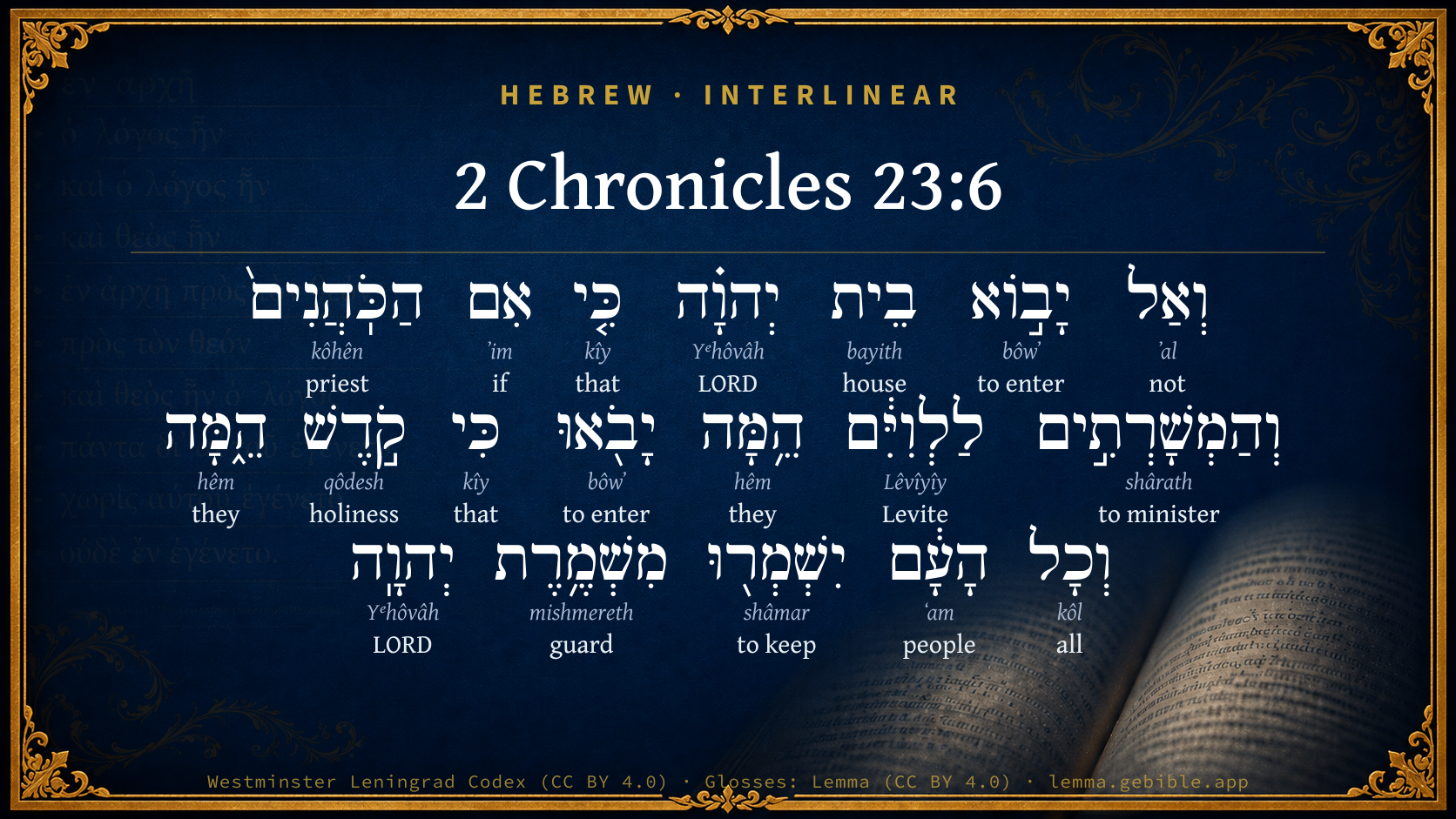
2 Chronicles 23:6

Hebrew (Westminster Leningrad Codex) 2 Chronicles 23:6 appears in the Hebrew Old Testament. The text above is from the Westminster Leningrad Codex. Each word links to its Strong’s number, a concise gloss, and parsing drawn from the Open Scriptures Hebrew Bible morphology. Click any word for its full Brown-Driver-Briggs (BDB) entry.
Download image
Cite this verse

2 Chronicles 23:6 (World English Bible). Public Domain. Lemma interlinear Bible study tool, https://lemma.gebible.app/v/2-chronicles/23/6.

Show BibTeX & RIS
BibTeX
RIS
English Translation
But let none come into the house of Yahweh, save the priests, and those who minister of the Levites; they shall come in, for they are holy: but all the people shall keep the charge of Yahweh.
World English Bible · Public Domain
Download a study sheet

One document with this verse’s original text, its word-by-word gloss line, the meaning frame, cross-references with their text, attributed commentary, and full source and license credits — printable, and it pastes into notes with its structure intact.

This verse Autodidact and up

Study sheet (.html) Plain text (.txt)

A passage Seminary Student

Up to 50 verses in one chapter. A passage sheet keeps up to 6 commentary sources and 12 cross-references per verse, in the order this page ranks them, and says so on the sheet whenever that leaves anything out. Ask for a single verse and you get the Autodidact verse sheet above.

Everything on this page stays free to read, with no account — the sheet is a download of what is already on screen, not access to it.

Want to remove ads? Support Godless Engineer
Compare translations 3

The same verse in 3 English versions, stacked beneath the original-language interlinear above. Click any original word for its lexicon entry.

Each is an independent rendering of the whole verse — the interlinear is not word-aligned to these translations.

Highlighted words mark where these versions differ — a whole-verse word diff, not a word-by-word alignment.

  • World English Bible Public Domain
    But let none come into the house of Yahweh, save the priests, and those who minister of the Levites; they shall come in, for they are holy: but all the people shall keep the charge of Yahweh.
  • King James Version Public Domain
    But let none come into the house of the LORD, save the priests, and they that minister of the Levites; they shall go in, for they are holy: but all the people shall keep the watch of the LORD.
  • unfoldingWord Literal Text CC BY-SA 4.0
    And do not let one enter the house of Yahweh, except the priests and the ministering ones from the Levites; they are entering for sacred are they. And all the people must keep the charge of Yahweh.

unfoldingWord Literal Text — © unfoldingWord, licensed CC BY-SA 4.0. Word-aligned USFM3 via Door43 (git.door43.org/unfoldingWord/en_ult).

Versions to compare (up to 4)

3 of 4 selected

Show all 18 translations

Every available English version of this verse, each an independent rendering of the whole verse.

  • World English Bible Public Domain
    But let none come into the house of Yahweh, save the priests, and those who minister of the Levites; they shall come in, for they are holy: but all the people shall keep the charge of Yahweh.
  • Berean Standard Bible Public Domain
    No one is to enter the house of the LORD except the priests and those Levites who serve; they may enter because they are consecrated, but all the people are to obey the requirement of the LORD.
  • Majority Standard Bible Public Domain
    No one is to enter the house of the LORD except the priests and those Levites who serve; they may enter because they are consecrated, but all the people are to obey the requirement of the LORD.
  • King James Version Public Domain
    But let none come into the house of the LORD, save the priests, and they that minister of the Levites; they shall go in, for they are holy: but all the people shall keep the watch of the LORD.
  • American Standard Version (1901) Public Domain
    But let none come into the house of Jehovah, save the priests, and they that minister of the Levites; they shall come in, for they are holy: but all the people shall keep the charge of Jehovah.
  • Revised Version (1885) Public Domain
    But let none come into the house of the LORD, save the priests, and they that minister of the Levites; they shall come in, for they are holy: but all the people shall keep the watch of the LORD.
  • Geneva Bible (1599) Public Domain
    But let none come into the house of the Lord, saue the Priests, and the Leuites that minister: they shall go in, for they are holy: but all the people shall keepe the watch of the Lord.
  • Douay-Rheims (1899) Public Domain
    And let no one come into the house of the Lord, but the priests, and they that minister of the Levites: let them only come in, because they are sanctified: and let all the rest of the people keep the watches of the Lord.
  • Young's Literal Translation Public Domain
    `And none doth enter the house of Jehovah except the priests, and those ministering of the Levites (they go in for they `are' holy), and all the people keep the watch of Jehovah:
  • Literal Standard Version CC BY-SA 4.0
    And none enter the house of YHWH except the priests, and those ministering of the Levites (they go in for they [are] holy), and all the people keep the watch of YHWH;
  • Unlocked Literal Bible CC BY-SA 4.0
    Allow no one to come into the house of Yahweh, except for the priests and the Levites who are serving. They may enter because they are consecrated. But all the other people must obey the commands of Yahweh.
  • unfoldingWord Literal Text CC BY-SA 4.0
    And do not let one enter the house of Yahweh, except the priests and the ministering ones from the Levites; they are entering for sacred are they. And all the people must keep the charge of Yahweh.
  • Darby Bible Public Domain
    But let none come into the house of Jehovah except the priests and those of the Levites that do the service; they shall go in, for they are holy; but all the people shall keep the watch of Jehovah.
  • World Messianic Bible Public Domain
    But let no one come into the LORD’s house except the priests and those who minister of the Levites. They shall come in, for they are holy, but all the people shall follow the LORD’s instructions.
  • Webster's Bible Public Domain
    But let none come into the house of the LORD, save the priests, and they that minister of the Levites; they shall go in, for they are holy: but all the people shall keep the watch of the LORD.
  • Free Bible Version CC BY-SA 4.0
    No one should enter the Lord's Temple except the priests and those Levites who are serving. They can enter because they have been made holy, but everyone else must follow the Lord's commands.
  • Bible in Basic English Public Domain
    But let no one come into the house of the Lord but only the priests and those of the Levites who have work to do there; they may go in for they are holy; but the rest of the people are to keep the orders of the Lord.
  • JPS Tanakh (1917) Public Domain
    But let none come into the house of the LORD, save the priests, and they that minister of the Levites; they shall come in, for they are holy; but all the people shall keep the charge of the LORD.

Literal Standard Version (2020), Covenant Press — licensed CC BY-SA 4.0. Text via the HelloAO Bible API (eBible.org). Unlocked Literal Bible (unfoldingWord) — licensed CC BY-SA 4.0. Text via the HelloAO Bible API (eBible.org). unfoldingWord Literal Text — © unfoldingWord, licensed CC BY-SA 4.0. Word-aligned USFM3 via Door43 (git.door43.org/unfoldingWord/en_ult). Free Bible Version, Dr. Jonathan Gallagher — licensed CC BY-SA 4.0. Text via the HelloAO Bible API (eBible.org).

Word by word

More ways to search: Search by grammar → Find every occurrence → Compare this word →

Practice this passage: Drill this verse → Learn its vocabulary →

מִשְׁמֶ֥רֶת
mishmereth
H4931
“guard of”
Noun, Common, Feminine, Singular, Construct
Part of Speech
Noun
Type
Common
Gender
Feminine
Number
Singular
State
Construct
Full BDB Definition

Origin: from H4929

TWOT: 2414g

guard, charge, function, obligation, service, watch - guard, watch, house of detention or confinement - keeping, preserving - charge, injunction - office, function (ceremonial)
  1. וְאַל ʼal H408 “and · not” Conjunction + Particle, Negative
  2. יָב֣וֹא bôwʼ H935 “to enter” Verb, Qal, Jussive, 3rd Person, Masculine, Singular
  3. בֵית bayith H1004 “house of” Noun, Common, Masculine, Singular, Construct
  4. יְהוָ֗ה Yᵉhôvâh H3068 “LORD” Noun, Proper
  5. כִּ֤י kîy H3588 “that” Conjunction
  6. אִם ʼim H518 “if” Conjunction
  7. הַכֹּֽהֲנִים֙ kôhên H3548 “the · priests” Particle, Definite Article + Noun, Common, Masculine, Plural, Absolute
  8. וְהַמְשָׁרְתִ֣ים shârath H8334 “and · the · ministering” Conjunction + Particle, Definite Article + Verb, Piel, Participle Active, Masculine, Plural, Absolute
  9. לַלְוִיִּ֔ם Lêvîyîy H3881 “to/for the · Levites” Preposition, Determined + Noun, Gentilic, Masculine, Plural, Absolute
  10. הֵ֥מָּה hêm H1992 “they” Pronoun, Personal, 3rd Person, Masculine, Plural
  11. יָבֹ֖אוּ bôwʼ H935 “to enter” Verb, Qal, Jussive, 3rd Person, Masculine, Plural
  12. כִּי kîy H3588 “that” Conjunction
  13. קֹ֣דֶשׁ qôdesh H6944 “holiness” Noun, Common, Masculine, Singular, Absolute
  14. הֵ֑מָּה hêm H1992 “they” Pronoun, Personal, 3rd Person, Masculine, Plural
  15. וְכָל kôl H3605 “and · all of” Conjunction + Noun, Common, Masculine, Singular, Construct
  16. הָעָ֔ם ʻam H5971 “the · people” Particle, Definite Article + Noun, Common, Masculine, Singular, Absolute
  17. יִשְׁמְר֖וּ shâmar H8104 “to keep” Verb, Qal, Imperfect, 3rd Person, Masculine, Plural
  18. יְהוָֽה Yᵉhôvâh H3068 “LORD” Noun, Proper

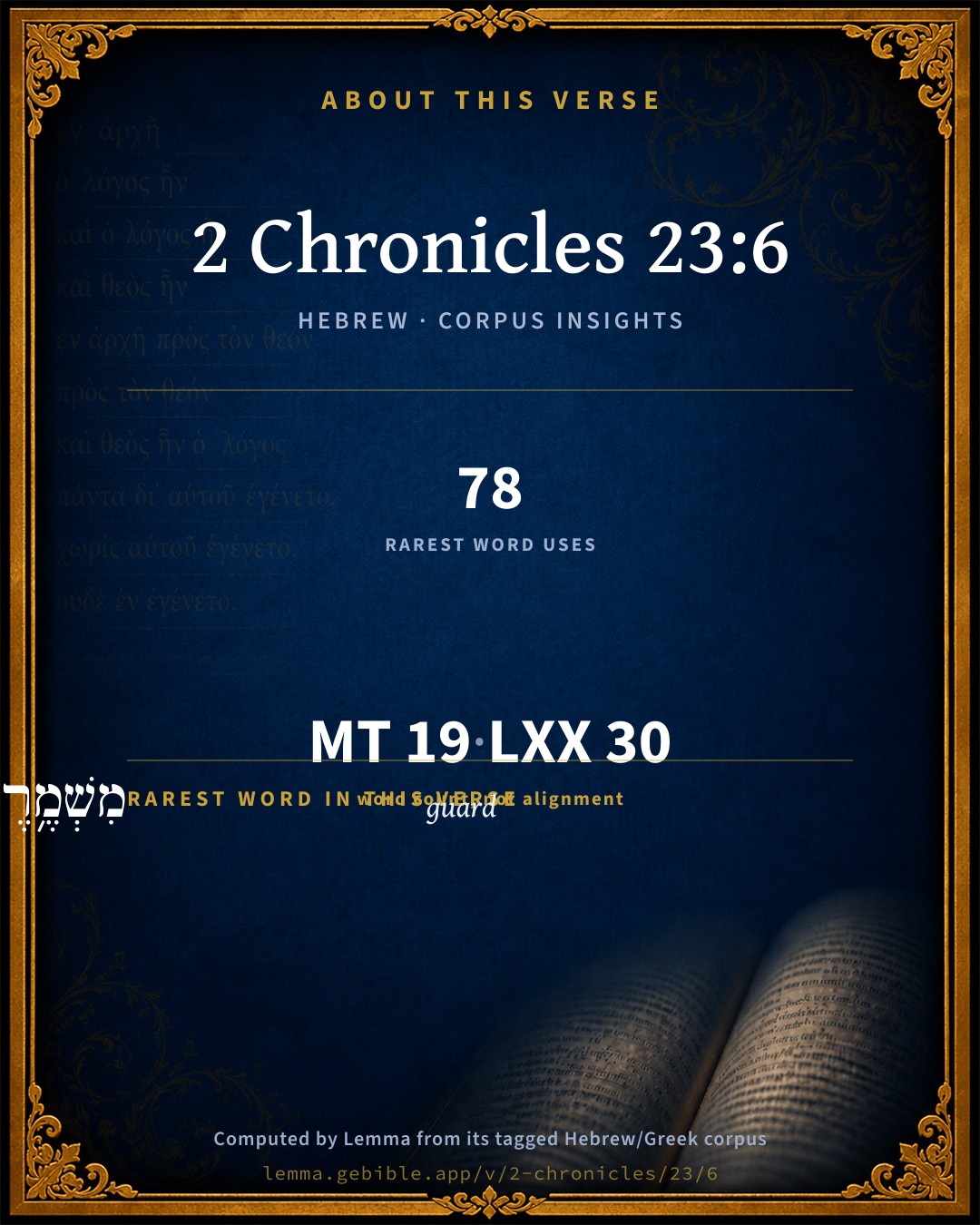
About this verse

These counts appear in no published source. They are computed here, from the morphology-tagged text and Lemma’s own curated glosses. What Lemma adds →

19
words
15
distinct lemmas
Historical
section

Grammatical profile

  • 4 verbs
  • 9 nouns
  • 2 pronouns
  • 3 conjunctions
  • 1 particle

Verb forms

  • יָב֣וֹא Qal · Jussive
  • וְהַמְשָׁרְתִ֣ים Piel · Participle Active
  • יָבֹ֖אוּ Qal · Jussive
  • יִשְׁמְר֖וּ Qal · Imperfect

Repetition

Words recur within this verse — often emphatic in Hebrew:

  • יָב֣וֹא to enter H935 ×2
  • יְהוָ֗ה LORD H3068 ×2
  • כִּ֤י that H3588 ×2
  • הֵ֥מָּה they H1992 ×2

Hebrew & Septuagint length

In English translation the verse runs 37 words from the Hebrew and 43 from the Septuagint (LXX English) — closely comparable.

A rough comparison of the two English renderings, which tokenize alike — not a word-level alignment.

Word counts can differ between the Hebrew and the Greek without any difference in meaning — e.g. the Hebrew direct-object marker אֵת has no separate Greek word, and Greek often adds the article ὁ.

In the original languages it is 19 Hebrew tokens and 30 Greek tokens — but the two are counted differently (Hebrew bundles its prefixes and suffixes into one token; the Greek is in lemma form), so that isn’t a like-for-like length.

Cross-references

2

Topical passages linked to 2 Chronicles 23:6 in the Treasury of Scripture Knowledge — connected by theme and wording, ordered by reader-vote popularity; previews shown in the World English Bible.

  • 1 Chronicles 23:28–32 For their office was to wait on the sons of Aaron for the service of the house of Yahweh, in the courts, and in the chambers, and in the purifying of all holy things, even the work of the service of the house of God;
  • 2 Kings 11:6–7 A third part shall be at the gate Sur; and a third part at the gate behind the guard: so shall you keep the watch of the house, and be a barrier.

Cross-references courtesy of OpenBible.info (CC BY 4.0).

Hebrew and Greek witnesses Masoretic Hebrew ↔ Greek Septuagint

The same verse in the two great witnesses to the Old Testament, shown verse-for-verse.

These are two independent witnesses, not word-aligned to each other, and the Septuagint is shown in lemma (dictionary) form.

Hebrew 2 Chronicles 23:6 Masoretic · Westminster Leningrad Codex

וְאַל יָב֣וֹא בֵית יְהוָ֗ה כִּ֤י אִם הַכֹּֽהֲנִים֙ וְהַמְשָׁרְתִ֣ים לַלְוִיִּ֔ם הֵ֥מָּה יָבֹ֖אוּ כִּי קֹ֣דֶשׁ הֵ֑מָּה וְכָל הָעָ֔ם יִשְׁמְר֖וּ מִשְׁמֶ֥רֶת יְהוָֽה

But let none come into the house of Yahweh, save the priests, and those who minister of the Levites; they shall come in, for they are holy: but all the people shall keep the charge of Yahweh.

World English Bible · Public Domain

Greek LXX 2 Chronicles 23:6 Septuagint · lemma form

καί μή εἰςἔρχομαι εἰς οἶκος κύριος ἐάν μή ὁ ἱερεύς καί ὁ λευείτης καί ὁ λειτουργέω ὁ λευείτης αὐτός εἰςἔρχομαι ὅτι ἅγιος εἰμί καί πᾶς ὁ λαός φυλάσσω φυλακή κύριος

And let not any one enter into the house of the Lord, except the priests and the Levites, and the servants of the Levites; they shall enter in, because they are holy: and let all the people keep the watch of the Lord.

LXX2012 (modern English Septuagint) · Public Domain

Hebrew: Westminster Leningrad Codex (CC BY 4.0). Greek: Septuagint (public domain); English from LXX2012 (modern English Septuagint) (Public Domain). How the Septuagint differs from the Hebrew →

Commentary

Notes on 2 Chronicles 23:6 from classic Christian and Jewish commentators (each source and its license shown beneath its notes). The classic Christian expositions comment on the surrounding passage and are grouped to its opening verse, so a note may address several verses; the Jewish commentaries on the Tanakh (Rashi and others) are per-verse, so they appear only where the commentator wrote on this verse.

Lemma curates 59 commentaries, every one of them public domain or Creative Commons licensed, each selected and text-cleaned for this edition rather than reprinted as found. About our sources →

Trapp's Complete Commentary

John Trapp

2Ch 23:6 But let none come into the house of the LORD, save the priests, and they that minister of the Levites; they shall go in, for they [are] holy: but all the people shall keep the watch of the LORD.

Ver. 6. Shall keep the watch of the Lord.] They shall observe to do in this service of the Lord what is given them in charge. Every man must move in his own orb to promote the work of reformation.

John Trapp, A Commentary or Exposition upon All the Books of the Old and New Testament (1647–1656) — public domain. Text from a community e-Sword module.

Joseph Benson's Commentary

2Ch 23:6. Let none come into the house of the Lord — Strictly so called, and distinguished from the courts just mentioned, namely, into the sanctuary, or holy place. Save the priests, and they that minister of the Levites — Who are to minister in course, or according to my present appointment. They shall go in, for they are holy — They have been consecrated to the service of God, and are bound to attend there. But all the people shall keep the watch of the Lord — That is, of the house of the Lord, as is expressed 2Ki 11:6. The meaning is, Let them stand in their court to prevent and oppose any person that shall endeavour violently to break into the house, to seize upon the king, or to oppose the present work, which he expected Athaliah and her accomplices would do.

Joseph Benson's Commentary on the Old and New Testaments (1811–1818) — public domain. Text from a community e-Sword module.

Tyndale Open Study Notes

Tyndale Open Resources

23:6-7 Because only the priests and Levites on duty may enter the Temple, the Levites were required to prevent anyone else from doing so.

Tyndale Open Study Notes — © Tyndale Open Resources, licensed CC BY-SA 4.0. Text via the HelloAO Bible API.

Ellicott's Commentary for English Readers

(6) But let none come into the house of the Lord.—This verse is not read in Kings. Apparently it is merely an emphatic repetition of the direction of the last verse that all the people were to remain in the courts, and not to break the law by presuming to enter the holy chambers. In 2Ki_11:7 we read instead: “And the two parts among you, all that go out on the Sabbath, they shall keep the watch of the house of the Lord, with regard to the king.” The last words of the present verse, “And all the people shall keep the watch of the Lord” repeat a portion of this, but in a different sense: “Let all the people carefully observe the legal rule against entering the sanctuary.”

A Bible Commentary for English Readers, edited by Charles John Ellicott (1878–1897) — public domain. Text from a community e-Sword module.

The Cambridge Bible for Schools and Colleges

gen. ed. J. J. S. Perowne

6. let none come into the house of the Lord] It is clear on the contrary from Kings (2Ch_23:11) that the royal guards (who were laymen) were brought into the Temple itself under Jehoiada’s directions. Ritual custom was broken through for such a crisis.

all the people] Not mentioned in Kings; but cp. 2Ki_11:14.

The Cambridge Bible for Schools and Colleges (gen. ed. J. J. S. Perowne; Cambridge University Press, 1878–1918) — public domain. Text from a community e-Sword module.

Albert Barnes' Notes on the Bible

Keep the watch of the Lord - i. e. guard against any attempt that might be made by the Baal-worshippers to force their way through the courts into the temple.

Albert Barnes' Notes on the Bible (1834–1885) — public domain. Text from a community e-Sword/MySword module.

Matthew Poole's English Annotations

Into the house of the Lord; strictly so called, as it is distinguished from the courts, into which others were permitted to come, 2Ch 23:5, to wit, into the holy place.

The priests, and they that minister of the Levites; they who are to minister in course, or by my present appointment.

The watch of the Lord, i.e. of the house of the Lord; as the phrase may be filled up out of this place and 2Ki 11:6. The sense is, Let them stand in their court to prevent and oppose any person who shall endeavour violently to break into the house to seize upon the king, or to disturb their present work; which he expected Athaliah and her accomplices would do.

Matthew Poole's English Annotations on the Holy Bible (1683–1685) — public domain. Text from a community e-Sword/MySword module.

The Pulpit Commentary

But let none come save the priests. Through this little chink we get some light confirmatory of the concurrent jurisdiction of the account in the parallel The express caution of this clause shows that there were others about, and others officiating, beside the Levites, who only have been mentioned hitherto in our text, except under the most generic designation (as before, so again in last clause of this verse) of "all the people." The last clause of this verse may cover the contents of ver. 7 in the parallel. The distinction between "the courts of the house of the Lord" (ver. 5), and "the house of the Lord" (ver. 6) is, of course, quite apparent.

The Pulpit Commentary (1880–1919), ed. H.D.M. Spence-Jones & Joseph S. Exell — public domain. Text from a community e-Sword module.

unfoldingWord translationNotes

Door43 World Missions Community

Allow no one to come into the house of Yahweh

"Do not allow anyone to come into the house of Yahweh"

But all the other people must obey the commands of Yahweh

It may be helpful to state that command. AT: "All the others must remain in the courtyard, obeying what Yahweh has commanded" (See: Assumed Knowledge and Implicit Information)

The Levites must surround the king on all sides

"The Levites must surround the king on all sides in order to protect him"

all sides, every man with his weapons in his hand

"all sides, and every temple guard should have his weapons and be ready to fight"

Whoever comes into the house, let him be killed

This did not include the temple guards and the priests. This can be stated explicitly and in active form. AT: "You must kill anyone except the temple guards and the priests who come into the temple" (See: Assumed Knowledge and Implicit Information and Active or Passive)

when he comes in and when he goes out

Possible meanings are 1) "at all times" or 2) "wherever he goes." (See: Idiom)

translationWords

command

unfoldingWord translationNotes — © Distant Shores Media and the Door43 World Missions Community, licensed CC BY-SA 4.0. Source: git.door43.org/Door43/en_tn.

Rashi

Rabbi Shlomo Yitzchaki (Rashi)

and all the people shall keep lest they enter the House of the Lord.

Rashi on the Tanakh — English translations: “The Judaica Press complete Tanach with Rashi, translated by A. J. Rosenberg” (CC BY 4.0); “Pentateuch with Rashi's commentary by M. Rosenbaum and A.M. Silbermann, 1929-1934” (public domain); “The Metsudah Tanach series, Lakewood, N.J” (CC BY 4.0); and “The Book of Joshua, Metsudah Publications, 1997” (CC BY 4.0). Text via Sefaria.

Lesson kit

Teaching starters — assembled from the data on this page, not authored interpretation. Every prompt links to the verse data it draws on. Edit before teaching.

2 Chronicles, in the Historical, opens this verse with 19 words (15 distinct Hebrew lemmas). Its most distinctive word is mishmereth (“guard”). A historical commentator’s framing appears above. Read the whole chapter for the surrounding context.

Discussion questions

  1. The word mishmereth carries the sense “guard.” How does it shape the verse?
  2. How does 1 Chronicles 23:28–32, which shares this passage’s theme, read alongside this verse?
  3. What does the repetition of “to enter” (2× in this one verse) do in this verse?
  4. These translations render this verse differently; the difference is in the English rendering, not the original. What questions does that raise?
  5. «יָב֣וֹא» is a Qal Jussive verb. How does that grammatical form shape the action described?
  6. Compare how Trapp's Complete Commentary and Joseph Benson's Commentary read this verse. Where do they agree or differ?

Things to notice

Reading settings

Reading text

Shown beneath each verse's original-language words.

Old Testament
Old Testament edition

Read the OT as the Masoretic Hebrew (MT) or the Greek Septuagint (LXX).

English shown for the Greek Septuagint (in the Hebrew ↔ Greek comparison).

Comparing translations? Open the Compare panel on any verse page to stack up to four side by side.