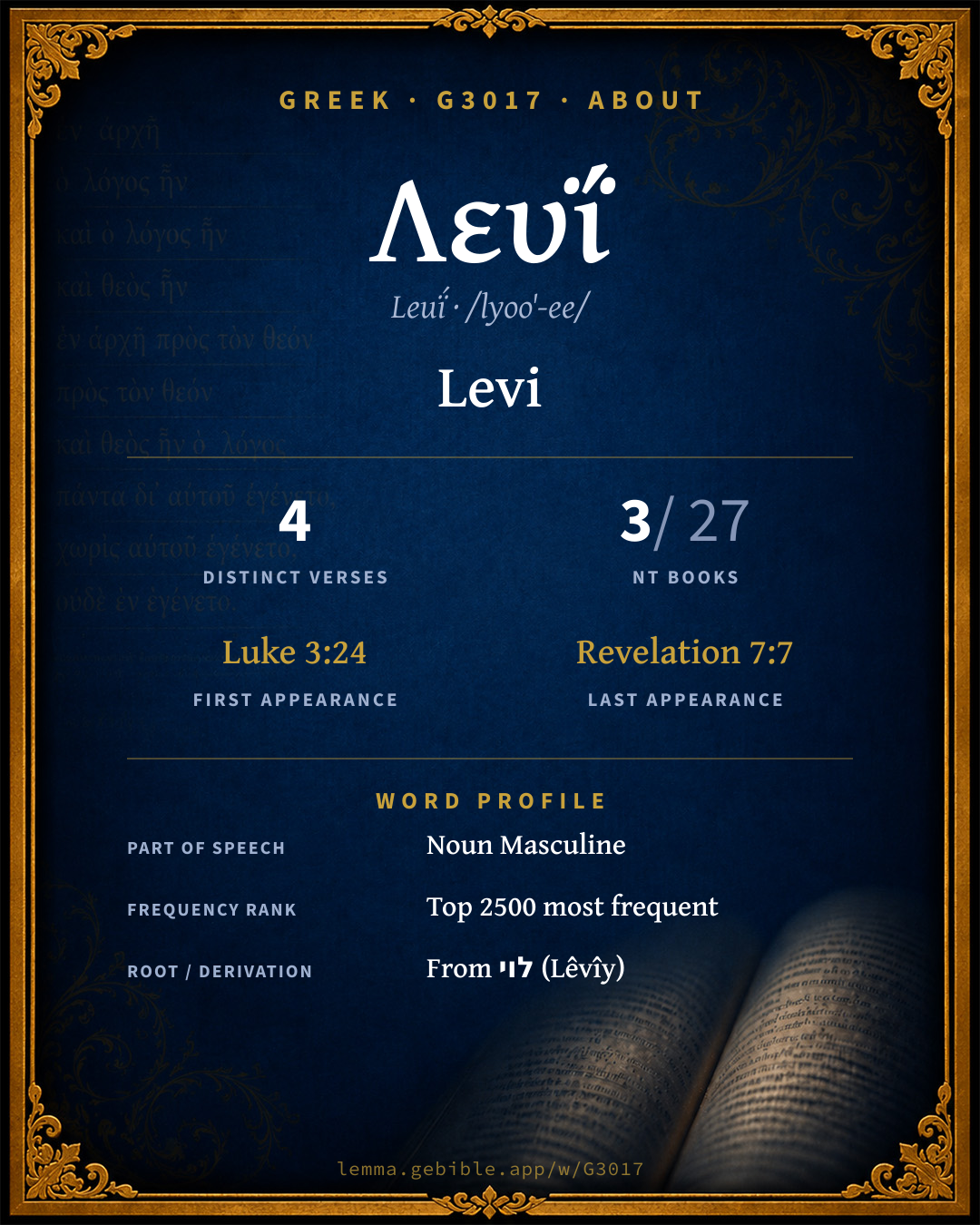
Λευΐ́
Levi
Thayer's lists 4 entries for ‘Levi’ fuller range ↓
Full lexicon entry — Thayer's Greek Lexicon
From Thayer's Greek Lexicon
Where this word appears
Every verse where G3017 appears — 4 distinct verses across 3 books. Click any verse to open its interlinear word-by-word view. Verse text shown in the World English Bible for context — . Each verse’s Greek form is shown with its reference; the English is not keyword-highlighted, since the data carries no word-level English alignment. Use “Compare translations” on any verse to read it across multiple English versions. This concordance covers the Greek New Testament; Septuagint (Greek Old Testament) occurrences of this word are not indexed here.
Luke 2 verses
Hebrews 1 verse
Revelation 1 verse
About this entry
At a glance — auto-summarized from this page’s data, not written by a person. Every figure links to its source below. This summary describes the numbers; it doesn’t interpret them.
“Levi” is the headline sense of the Greek name Λευΐ (Leuḯ). A scarce word — 4 verses in all of the Greek New Testament. It clusters heavily in Luke, which alone accounts for 50% of its uses. First canonically at Luke 3:24, it enters the text early. The sections below give every occurrence and version rendering.
Gloss history
Strong's 1890 vs modern scholarship
About this word
Strong's G3017 catalogs a Greek word from the Greek New Testament.
These counts are not copied from any lexicon or concordance. They are computed here, from the morphology-tagged Greek New Testament. What Lemma adds →
- 4
- distinct verses
- The word appears in 4 distinct verses.
- 3 / 27
- NT books
- The word appears in 3 of 27 New Testament books.
- #1,877
- by frequency
- Top 2500 most frequent Greek words (rank 1,877 of 5,347 Greek words by occurrence).
View all 4 occurrences in the concordance →
Most concentrated in
- Luke 2 verses 50%
- Hebrews 1 verse 25%
- Revelation 1 verse 25%
By section of the New Testament
By traditional corpus
Conventional, traditional groupings — biblical authorship is debated, so this is a traditional corpus grouping, not an authorship claim. Some books belong to more than one corpus (Luke is in both the Gospels and the Lukan corpus, and so on), so these shares overlap and need not total 100%. Each figure is a share of the word’s 4 distinct verses.
- Gospels 2 verses · 50%
- Lukan (Luke–Acts) 2 verses · 50%
- Johannine 1 verse · 25%
- Hebrews 1 verse · 25%
- Revelation 1 verse · 25%
How translations render this word
Counts come from each version’s own published word-to-Strong’s tagging or interlinear alignment — an approximate guide to how each version renders this word, not a word-level alignment the data otherwise carries. Because each total is that version’s own tagged count, the per-version totals vary from one another and need not match the appearance or distinct-verse counts above. These counts may also differ from a printed concordance because Lemma counts each distinctly tagged rendering and does not collapse phrase taggings into a single head-word total. This is a fixed set of word-tagged versions (KJV, ASV, BSB, ULT) and does not change with the reading translation you choose elsewhere. Each version’s license is shown beside its name below (and on Sources).
- King James Version: Levi 3×, Was the son of levi 2×
- American Standard Version: Levi 3×, Son of levi 2×
- Berean Standard Bible: Levi 5×
- unfoldingWord Literal Text: Levi 8×
King James Version Public Domain
Renders G3017 across 5 tagged occurrences — most commonly:
American Standard Version Public Domain
Renders G3017 across 5 tagged occurrences — most commonly:
Berean Standard Bible Public Domain
Renders G3017 across 5 tagged occurrences — most commonly:
unfoldingWord Literal Text CC BY-SA 4.0
Renders G3017 across 8 tagged occurrences — most commonly:
Senses in Thayer's
The 4 senses Thayer's distinguishes for this word, in lexicon order (not ranked by frequency or importance). The full entry — with sub-senses — is in the Lexicon Entry tab.
- Levi = "joined"
- the third son of the patriarch Jacob by his wife Leah, the founder of the tribe of Israelites which bears his name
- the son of Melchi, one of Christ's ancestors
- the son of Simeon, an ancestor of Christ
Word origin
Derived from לוי (Lêvîy) (H3878) — Levi.
Same root — word family
Other Thayer's entries built from the same root as G3017, grouped by Strong’s listed origin. These share a root / origin per the lexicon — not necessarily a shared meaning. Each links to that word’s own entry.
Derives from
Proper names from this root
People and places named from this root — a name, not an additional meaning of the word.
Compare all same-root words → Showing 4 of 5 — not the complete family. 4 of the same-root words are proper names (people or places). They share a root, not necessarily a meaning.
Bible dictionary
Public-domain dictionary articles matched to this entry by name (Levi). A biblical name can be shared by more than one person or place, so an article may treat several.
Easton's Bible Dictionary · M. G. Easton, 1897
Adhesion. (1.) The third son of Jacob by Leah. The origin of the name is found in Leah's words (Gen. 29:34), "This time will my husband be joined [Heb. yillaveh] unto me." He is mentioned as taking a prominent part in avenging his sister Dinah (Gen. 34:25-31). He and his three sons went down with Jacob (46:11) into Egypt, where he died at the age of one hundred and thirty-seven years (Ex. 6:16).
(2.) The father of Matthat, and son of Simeon, of the ancestors of Christ (Luke 3:29).
(3.) Luke 3:24.
(4.) One of the apostles, the son of Alphaeus (Mark 2:14; Luke 5:27, 29), called also Matthew (Matt. 9:9).
Smith's Bible Dictionary · William Smith, 1863
(joined).
+ The name of the third son of Jacob by his wife Leah. (B.C. about 1753.) The name, derived from lavah, "to adhere," gave utterance to the hope of the mother that the affections of her husband, which had hitherto rested on the favored Rachel, would at last be drawn to her: "This time will my husband be joined unto me, because I have borne him three sons." (Genesis 29:34) Levi, with his brother Simeon, avenged with a cruel slaughter the outrage of their sister Dinah. [Dinah] Levi, with his three sons, Gershon, Kohath and Merari, went down to Egypt with his father Jacob. (Genesis 47:11) When Jacob's death draws near, and the sons are gathered round him, Levi and Simeon hear the old crime brought up again to receive its sentence. They no less than Reuben, the incestuous firstborn, had forfeited the privileges of their birthright. (Genesis 49:5-7) [Levites] + Two of the ancestors of Jesus. (Luke 3:24,29) + Son of Alphaeus or Matthew; one of the apostles. (Mark 2:14; Luke 5:27,29) [See Matthew]
Hitchcock's Bible Names Dictionary · Roswell D. Hitchcock, 1869
associated with him
Classic public-domain reference works; full attribution on Sources.
Septuagint usage
The same Greek word Λευΐ appears 73 times in the Greek Old Testament (Septuagint), across 69 verses in 14 books.
- 73
- LXX occurrences
- Tagged occurrences of this Greek word in the Septuagint.
- 69
- verses
- Distinct Septuagint verses containing this word.
- 14 / 39
- OT books
- The word appears in 14 of the 39 Old Testament books.
Sample Septuagint occurrences
- Genesis 29:34 λευί
- Exodus 1:2 λευί
- Numbers 1:49 λευί
- Deuteronomy 10:8 λευί
- Joshua 13:14 λευι
- Judges 15:9 λευι
- 1 Kings 12:31 λευι
- 1 Chronicles 2:1 λευί
- Ezra 8:15 λευί
- Psalms 134:20 λευί
- Jeremiah 38:14 λευί
- Ezekiel 40:46 λευί
Septuagint occurrences (same lexeme)
Every verse where the same Strong’s number (G3017) appears in the Greek Septuagint — showing the first 50 of 69. Verse text shown in the World English Bible for context; the Greek form is the matched word — the English is not keyword-highlighted.
- Genesis 29:34 λευί She conceived again, and bare a son. Said, "Now this time will my husband be joined to me, because I have borne him three sons." Therefore was his name called Levi.
- Genesis 34:14 λευί and said to them, "We can't do this thing, to give our sister to one who is uncircumcised; for that is a reproach to us.
- Genesis 34:25 λευί It happened on the third day, when they were sore, that two of Jacob's sons, Simeon and Levi, Dinah's brothers, each took his sword, came upon the unsuspecting city, and killed all the males.
- Genesis 34:30 λευί Jacob said to Simeon and Levi, "You have troubled me, to make me odious to the inhabitants of the land, among the Canaanites and the Perizzites. I am few in number. They will gather themselves together against me and strike me, and I will be destroyed, I and my house."
- Genesis 35:23 λευί The sons of Leah: Reuben (Jacob's firstborn), Simeon, Levi, Judah, Issachar, and Zebulun.
- Genesis 46:11 λευί The sons of Levi: Gershon, Kohath, and Merari.
- Genesis 49:5 λευί "Simeon and Levi are brothers; Weapons of violence are their swords.
- Exodus 1:2 λευί Reuben, Simeon, Levi, and Judah,
- Exodus 2:1 λευί A man of the house of Levi went and took a daughter of Levi as his wife.
- Exodus 6:16 λευί These are the names of the sons of Levi according to their generations: Gershon, and Kohath, and Merari; and the years of the life of Levi were one hundred thirty-seven years.
- Exodus 6:19 λευί The sons of Merari: Mahli and Mushi. These are the families of the Levites according to their generations.
- Exodus 32:26 λευί then Moses stood in the gate of the camp, and said, "Whoever is on Yahweh's side, come to me!" All the sons of Levi gathered themselves together to him.
- Exodus 32:28 λευί The sons of Levi did according to the word of Moses: and there fell of the people that day about three thousand men.
- Numbers 1:49 λευί "Only the tribe of Levi you shall not number, neither shall you take a census of them among the children of Israel;
- Numbers 3:6 λευί "Bring the tribe of Levi near, and set them before Aaron the priest, that they may minister to him.
- Numbers 3:15 λευί "Number the children of Levi by their fathers' houses, by their families: every male from a month old and upward shall you number."
- Numbers 3:17 λευί These were the sons of Levi by their names: Gershon, and Kohath, and Merari.
- Numbers 4:2 λευί "Take a census of the sons of Kohath from among the sons of Levi, by their families, by their fathers' houses,
- Numbers 16:1 λευί Now Korah, the son of Izhar, the son of Kohath, the son of Levi, with Dathan and Abiram, the sons of Eliab, and On, the son of Peleth, sons of Reuben, took [men]:
- Numbers 16:7 λευί and put fire in them, and put incense on them before Yahweh tomorrow: and it shall be that the man whom Yahweh does choose, he [shall be] holy: you take too much on you, you sons of Levi.
- Numbers 16:8 λευί Moses said to Korah, Hear now, you sons of Levi:
- Numbers 16:10 λευί and that he has brought you near, and all your brothers the sons of Levi with you? and seek you the priesthood also?
- Numbers 17:18 λευί
- Numbers 17:23 λευί
- Numbers 18:2 λευί Your brothers also, the tribe of Levi, the tribe of your father, bring you near with you, that they may be joined to you, and minister to you: but you and your sons with you shall be before the tent of the testimony.
- Numbers 18:21 λευί To the children of Levi, behold, I have given all the tithe in Israel for an inheritance, in return for their service which they serve, even the service of the tent of meeting.
- Numbers 26:57 λευί These are those who were numbered of the Levites after their families: of Gershon, the family of the Gershonites; of Kohath, the family of the Kohathites; of Merari, the family of the Merarites.
- Numbers 26:58 λευί These are the families of Levi: the family of the Libnites, the family of the Hebronites, the family of the Mahlites, the family of the Mushites, the family of the Korahites. Kohath became the father of Amram.
- Numbers 26:59 λευί The name of Amram's wife was Jochebed, the daughter of Levi, who was born to Levi in Egypt: and she bore to Amram Aaron and Moses, and Miriam their sister.
- Deuteronomy 10:8 λευί At that time Yahweh set apart the tribe of Levi, to bear the ark of the covenant of Yahweh, to stand before Yahweh to minister to him, and to bless in his name, to this day.
- Deuteronomy 18:1 λευί The priests the Levites, [even] all the tribe of Levi, shall have no portion nor inheritance with Israel: they shall eat the offerings of Yahweh made by fire, and his inheritance.
- Deuteronomy 27:12 λευί These shall stand on Mount Gerizim to bless the people, when you are passed over the Jordan: Simeon, and Levi, and Judah, and Issachar, and Joseph, and Benjamin.
- Deuteronomy 31:9 λευί Moses wrote this law, and delivered it to the priests the sons of Levi, who bore the ark of the covenant of Yahweh, and to all the elders of Israel.
- Deuteronomy 33:8 λευί Of Levi he said, Your Thummim and your Urim are with your godly one, Whom you did prove at Massah, With whom you did strive at the waters of Meribah;
- Joshua 13:14 λευι Only to the tribe of Levi he gave no inheritance; the offerings of Yahweh, the God of Israel, made by fire are his inheritance, as he spoke to him.
- Joshua 18:7 λευι For the Levites have no portion among you; for the priesthood of Yahweh is their inheritance: and Gad and Reuben and the half-tribe of Manasseh have received their inheritance beyond the Jordan eastward, which Moses the servant of Yahweh gave them.
- Joshua 21:1 λευι Then came near the heads of fathers' [houses] of the Levites to Eleazar the priest, and to Joshua the son of Nun, and to the heads of fathers' [houses] of the tribes of the children of Israel;
- Joshua 21:10 λευι and they were for the children of Aaron, of the families of the Kohathites, who were of the children of Levi; for theirs was the first lot.
- Joshua 21:40 λευι All [these were] the cities of the children of Merari according to their families, even the rest of the families of the Levites; and their lot was twelve cities.
- Judges 15:9 λευι Then the Philistines went up, and encamped in Judah, and spread themselves in Lehi.
- 1 Kings 12:31 λευι He made houses of high places, and made priests from among all the people, who were not of the sons of Levi.
- 1 Chronicles 2:1 λευί These are the sons of Israel: Reuben, Simeon, Levi, and Judah, Issachar, and Zebulun,
- 1 Chronicles 5:27 λευί
- 1 Chronicles 6:1 λευί The sons of Levi: Gershon, Kohath, and Merari.
- 1 Chronicles 6:4 λευί Eleazar became the father of Phinehas, Phinehas became the father of Abishua,
- 1 Chronicles 6:23 λευί Elkanah his son, and Ebiasaph his son, and Assir his son,
- 1 Chronicles 6:28 λευί The sons of Samuel: the firstborn [Joel], and the second Abijah.
- 1 Chronicles 6:32 λευί They ministered with song before the tent of the tent of meeting, until Solomon had built the house of Yahweh in Jerusalem: and they waited on their office according to their order.
- 1 Chronicles 9:18 λευί who hitherto [waited] in the king's gate eastward: they were the porters for the camp of the children of Levi.
- 1 Chronicles 12:27 λευί Jehoiada was the leader of [the house of] Aaron; and with him were three thousand and seven hundred,
These are occurrences of the same Greek lexeme (G3017) in the Septuagint — not a translation of any one Hebrew word. The store carries no word-level Hebrew↔Greek alignment, so no Hebrew original is asserted here. Counts come from the recovered LXX Strong's tagging — high-frequency vocabulary is well covered, while rare or late forms may be untagged — so they reflect tagged occurrences and may slightly undercount.