
Ezra 6:20

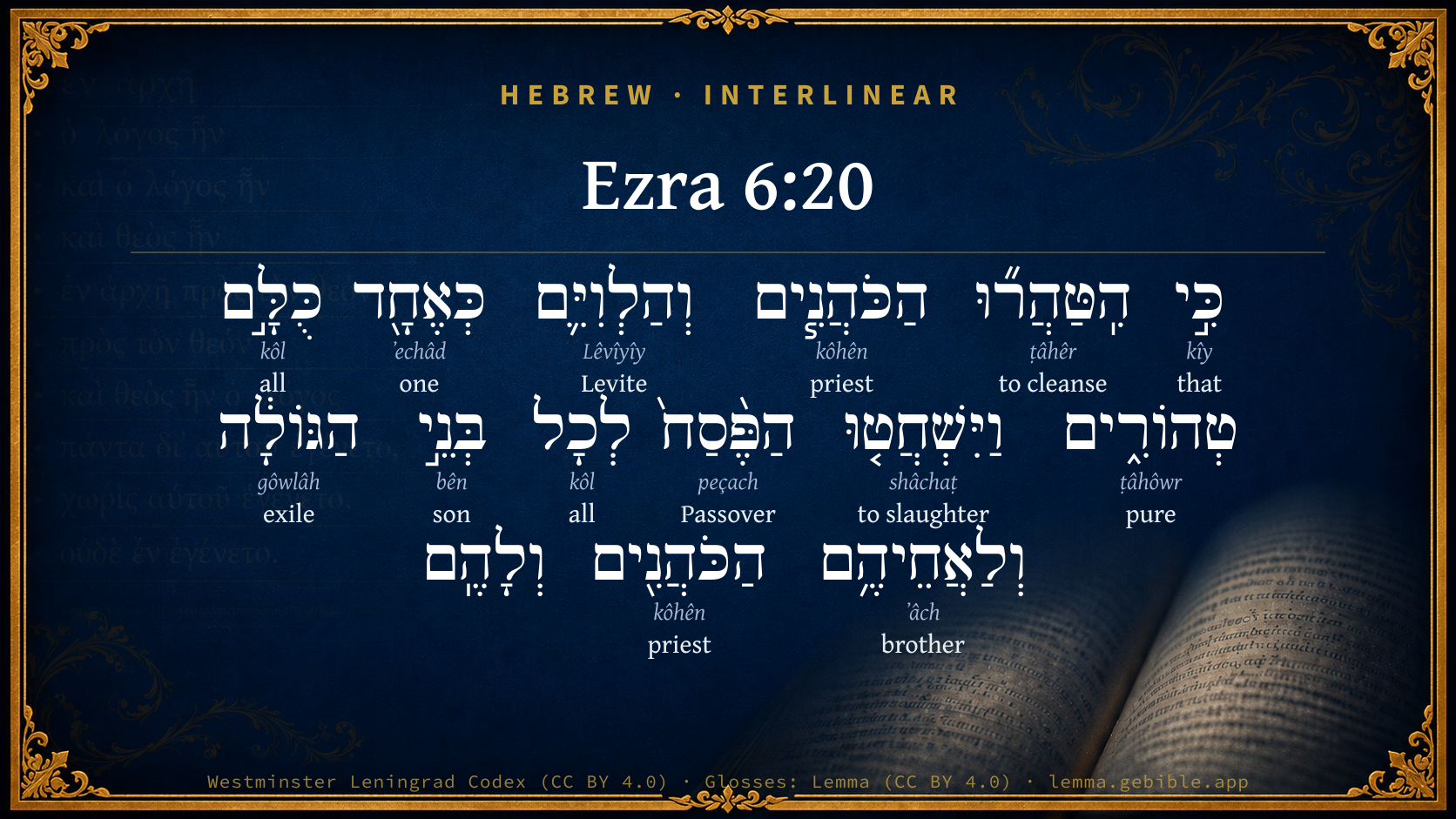
Hebrew (Westminster Leningrad Codex) Ezra 6:20 appears in the Hebrew Old Testament. The text above is from the Westminster Leningrad Codex. Each word links to its Strong’s number, a concise gloss, and parsing drawn from the Open Scriptures Hebrew Bible morphology. Click any word for its full Brown-Driver-Briggs (BDB) entry.
Download image
Cite this verse

Ezra 6:20 (World English Bible). Public Domain. Lemma interlinear Bible study tool, https://lemma.gebible.app/v/ezra/6/20.

Show BibTeX & RIS
BibTeX
RIS
English Translation
For the priests and the Levites had purified themselves together; all of them were pure: and they killed the Passover for all the children of the captivity, and for their brothers the priests, and for themselves.
World English Bible · Public Domain
Download a study sheet

One document with this verse’s original text, its word-by-word gloss line, the meaning frame, cross-references with their text, attributed commentary, and full source and license credits — printable, and it pastes into notes with its structure intact.

This verse Autodidact and up

Study sheet (.html) Plain text (.txt)

A passage Seminary Student

Up to 50 verses in one chapter. A passage sheet keeps up to 6 commentary sources and 12 cross-references per verse, in the order this page ranks them, and says so on the sheet whenever that leaves anything out. Ask for a single verse and you get the Autodidact verse sheet above.

Everything on this page stays free to read, with no account — the sheet is a download of what is already on screen, not access to it.

Want to remove ads? Support Godless Engineer
Compare translations 3

The same verse in 3 English versions, stacked beneath the original-language interlinear above. Click any original word for its lexicon entry.

Each is an independent rendering of the whole verse — the interlinear is not word-aligned to these translations.

Highlighted words mark where these versions differ — a whole-verse word diff, not a word-by-word alignment.

  • World English Bible Public Domain
    For the priests and the Levites had purified themselves together; all of them were pure: and they killed the Passover for all the children of the captivity, and for their brothers the priests, and for themselves.
  • King James Version Public Domain
    For the priests and the Levites were purified together, all of them were pure, and killed the passover for all the children of the captivity, and for their brethren the priests, and for themselves.
  • unfoldingWord Literal Text CC BY-SA 4.0
    For the priests and the Levites had purified themselves as one, all of them were pure. And they slaughtered the Passover for all the sons of the exile, and for their brothers, the priests, and for themselves.

unfoldingWord Literal Text — © unfoldingWord, licensed CC BY-SA 4.0. Word-aligned USFM3 via Door43 (git.door43.org/unfoldingWord/en_ult).

Versions to compare (up to 4)

3 of 4 selected

Show all 18 translations

Every available English version of this verse, each an independent rendering of the whole verse.

  • World English Bible Public Domain
    For the priests and the Levites had purified themselves together; all of them were pure: and they killed the Passover for all the children of the captivity, and for their brothers the priests, and for themselves.
  • Berean Standard Bible Public Domain
    All the priests and Levites had purified themselves and were ceremonially clean. And the Levites slaughtered the Passover lamb for all the exiles, for their priestly brothers, and for themselves.
  • Majority Standard Bible Public Domain
    All the priests and Levites had purified themselves and were ceremonially clean. And the Levites slaughtered the Passover lamb for all the exiles, for their priestly brothers, and for themselves.
  • King James Version Public Domain
    For the priests and the Levites were purified together, all of them were pure, and killed the passover for all the children of the captivity, and for their brethren the priests, and for themselves.
  • American Standard Version (1901) Public Domain
    For the priests and the Levites had purified themselves together; all of them were pure: and they killed the passover for all the children of the captivity, and for their brethren the priests, and for themselves.
  • Revised Version (1885) Public Domain
    For the priests and the Levites had purified themselves together; all of them were pure: and they killed the passover for all the children of the captivity, and for their brethren the priests, and for themselves.
  • Geneva Bible (1599) Public Domain
    (For the Priests and the Leuites were purified altogether) and they killed the Passeouer for all the children of the captiuitie, and for their brethren the Priests, and for themselues.
  • Douay-Rheims (1899) Public Domain
    For all the priests and the Levites were purified as one man: all were clear to kill the phase for all the children of the captivity, and for their brethren the priests, and themselves.
  • Young's Literal Translation Public Domain
    for the priests and the Levites have been purified together -- all of them `are' pure -- and they slaughter the passover for all the sons of the captivity, and for their brethren the priests, and for themselves.
  • Literal Standard Version CC BY-SA 4.0
    for the priests and the Levites have been purified together—all of them [are] pure—and they slaughter the Passover for all the sons of the captivity, and for their brothers the priests, and for themselves.
  • Unlocked Literal Bible CC BY-SA 4.0
    The priests and Levites all purified themselves and slaughtered the Passover sacrifices for all those who had been in exile, including themselves.
  • unfoldingWord Literal Text CC BY-SA 4.0
    For the priests and the Levites had purified themselves as one, all of them were pure. And they slaughtered the Passover for all the sons of the exile, and for their brothers, the priests, and for themselves.
  • Darby Bible Public Domain
    For the priests and the Levites had purified themselves as one [man]: they were all pure; and they killed the passover for all the children of the captivity, and for their brethren the priests, and for themselves.
  • World Messianic Bible Public Domain
    Because the priests and the Levites had purified themselves together, all of them were pure. They killed the Passover for all the children of the captivity, for their brothers the priests, and for themselves.
  • Webster's Bible Public Domain
    For the priests and the Levites were purified together, all of them were pure, and they killed the passover for all the children of the captivity, and for their brethren the priests, and for themselves.
  • Free Bible Version CC BY-SA 4.0
    The priests and Levites had all purified themselves so that they were clean according to the ceremonial law. So they killed the Passover lamb for all the exiles who had returned, for their fellow priests, and for themselves.
  • Bible in Basic English Public Domain
    For the priests and the Levites had made themselves clean together; they were all clean: and they put the Passover lamb to death for all those who had come back, and for their brothers the priests and for themselves.
  • JPS Tanakh (1917) Public Domain
    For the priests and the Levites had purified themselves together; all of them were pure; and they killed the passover lamb for all the children of the captivity, and for their brethren the priests, and for themselves.

Literal Standard Version (2020), Covenant Press — licensed CC BY-SA 4.0. Text via the HelloAO Bible API (eBible.org). Unlocked Literal Bible (unfoldingWord) — licensed CC BY-SA 4.0. Text via the HelloAO Bible API (eBible.org). unfoldingWord Literal Text — © unfoldingWord, licensed CC BY-SA 4.0. Word-aligned USFM3 via Door43 (git.door43.org/unfoldingWord/en_ult). Free Bible Version, Dr. Jonathan Gallagher — licensed CC BY-SA 4.0. Text via the HelloAO Bible API (eBible.org).

Word by word

More ways to search: Search by grammar → Find every occurrence → Compare this word →

Practice this passage: Drill this verse → Learn its vocabulary →

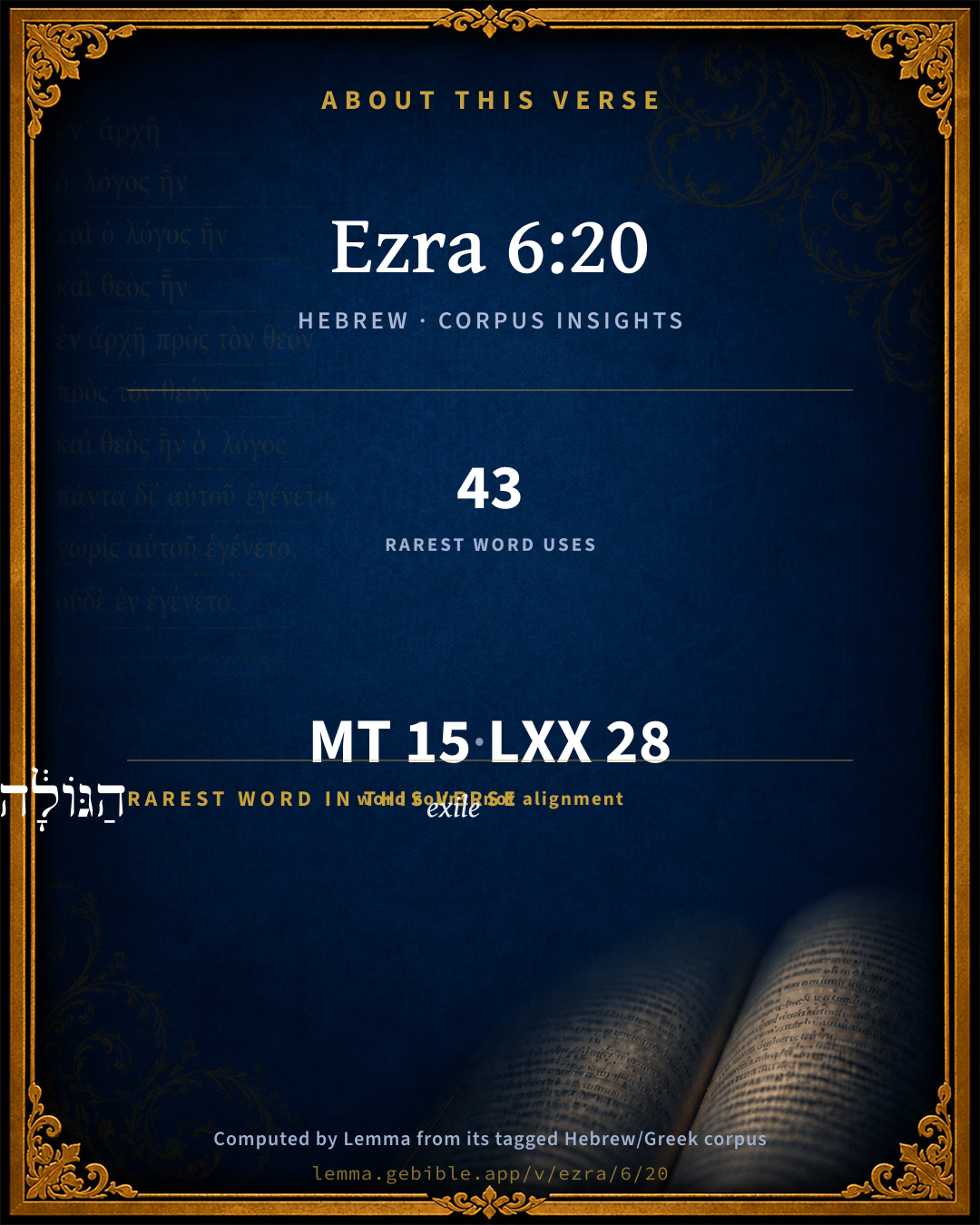
הַגּוֹלָ֔ה
gôwlâh
H1473
“the · exile”
Particle, Definite Article + Noun, Common, Feminine, Singular, Absolute
Part of Speech
Particle + Noun
Type
Common
Gender
Feminine
Number
Singular
State
Absolute
Full BDB Definition

Origin: active participle of H1540

TWOT: 350a

exiles, exile, captivity - exiles (collective) - exile, captivity (abstract)
  1. כִּ֣י kîy H3588 “that” Conjunction
  2. הִֽטַּהֲר֞וּ ṭâhêr H2891 “to cleanse” Verb, Hithpael, Perfect, 3rd Person, Common, Plural
  3. הַכֹּהֲנִ֧ים kôhên H3548 “the · priests” Particle, Definite Article + Noun, Common, Masculine, Plural, Absolute
  4. וְהַלְוִיִּ֛ם Lêvîyîy H3881 “and · the · Levites” Conjunction + Particle, Definite Article + Noun, Gentilic, Masculine, Plural, Absolute
  5. כְּאֶחָ֖ד ʼechâd H259 “like/as · one” Preposition + Adjective, Cardinal number, Masculine, Singular, Absolute
  6. כֻּלָּ֣ם kôl H3605 “all · their” Noun, Common, Masculine, Singular, Construct + Suffix, Personal, 3rd Person, Masculine, Plural
  7. טְהוֹרִ֑ים ṭâhôwr H2889 “pure” Adjective, Adjective, Masculine, Plural, Absolute
  8. וַיִּשְׁחֲט֤וּ shâchaṭ H7819 “and · to slaughter” Conjunction + Verb, Qal, Sequential Imperfect, 3rd Person, Masculine, Plural
  9. הַפֶּ֨סַח֙ peçach H6453 “the · Passover” Particle, Definite Article + Noun, Common, Masculine, Singular, Absolute
  10. לְכָל kôl H3605 “to/for · all of” Preposition + Noun, Common, Masculine, Singular, Construct
  11. בְּנֵ֣י bên H1121 “sons of” Noun, Common, Masculine, Plural, Construct
  12. וְלַאֲחֵיהֶ֥ם ʼâch H251 “and · to/for · brothers · their” Conjunction + Preposition + Noun, Common, Masculine, Plural, Construct + Suffix, Personal, 3rd Person, Masculine, Plural
  13. הַכֹּהֲנִ֖ים kôhên H3548 “the · priests” Particle, Definite Article + Noun, Common, Masculine, Plural, Absolute

About this verse

These counts appear in no published source. They are computed here, from the morphology-tagged text and Lemma’s own curated glosses. What Lemma adds →

15
words
12
distinct lemmas
Historical
section

Shared distinctive vocabulary

הַגּוֹלָ֔ה exile H1473 occurs in 42 verses of the Hebrew Bible. Also found in:

Grammatical profile

  • 2 verbs
  • 9 nouns
  • 2 adjectives
  • 1 preposition
  • 1 conjunction

Verb forms

  • הִֽטַּהֲר֞וּ Hithpael · Perfect
  • וַיִּשְׁחֲט֤וּ Qal · Sequential Imperfect

Repetition

Words recur within this verse — often emphatic in Hebrew:

  • הַכֹּהֲנִ֧ים priest H3548 ×2
  • כֻּלָּ֣ם all H3605 ×2

Hebrew & Septuagint length

In English translation the verse runs 36 words from the Hebrew and 34 from the Septuagint (LXX English) — closely comparable.

A rough comparison of the two English renderings, which tokenize alike — not a word-level alignment.

Word counts can differ between the Hebrew and the Greek without any difference in meaning — e.g. the Hebrew direct-object marker אֵת has no separate Greek word, and Greek often adds the article ὁ.

In the original languages it is 15 Hebrew tokens and 28 Greek tokens — but the two are counted differently (Hebrew bundles its prefixes and suffixes into one token; the Greek is in lemma form), so that isn’t a like-for-like length.

Cross-references

5

Topical passages linked to Ezra 6:20 in the Treasury of Scripture Knowledge — connected by theme and wording, ordered by reader-vote popularity; previews shown in the World English Bible.

  • 2 Chronicles 35:11 They killed the Passover, and the priests sprinkled [the blood which they received] of their hand, and the Levites flayed them.
  • 2 Chronicles 29:34 But the priests were too few, so that they could not flay all the burnt offerings: therefore their brothers the Levites helped them, until the work was ended, and until the priests had sanctified themselves; for the Levites were more upright in heart to sanctify themselves than the priests.
  • Hebrews 7:27 who doesn't need, like those high priests, to daily offer up sacrifices, first for his own sins, and then for the sins of the people. For this he did once for all, when he offered up himself.
  • Exodus 12:21 Then Moses called for all the elders of Israel, and said to them, "Draw out, and take lambs according to your families, and kill the Passover.
  • 2 Chronicles 30:15–17 Then they killed the Passover on the fourteenth [day] of the second month: and the priests and the Levites were ashamed, and sanctified themselves, and brought burnt offerings into the house of Yahweh.

Cross-references courtesy of OpenBible.info (CC BY 4.0).

Hebrew and Greek witnesses Masoretic Hebrew ↔ Greek Septuagint

The same verse in the two great witnesses to the Old Testament, shown verse-for-verse.

These are two independent witnesses, not word-aligned to each other, and the Septuagint is shown in lemma (dictionary) form.

Hebrew Ezra 6:20 Masoretic · Westminster Leningrad Codex

כִּ֣י הִֽטַּהֲר֞וּ הַכֹּהֲנִ֧ים וְהַלְוִיִּ֛ם כְּאֶחָ֖ד כֻּלָּ֣ם טְהוֹרִ֑ים וַיִּשְׁחֲט֤וּ הַפֶּ֨סַח֙ לְכָל בְּנֵ֣י הַגּוֹלָ֔ה וְלַאֲחֵיהֶ֥ם הַכֹּהֲנִ֖ים וְלָהֶֽם

For the priests and the Levites had purified themselves together; all of them were pure: and they killed the Passover for all the children of the captivity, and for their brothers the priests, and for themselves.

World English Bible · Public Domain

Greek LXX Ezra 6:20 Septuagint · lemma form

ὅτι καθαρίζω ὁ ἱερεύς καί ὁ λευείτης ἕως εἷς πᾶς καθαρός καί σφάζω ὁ πασχα ὁ πᾶς υἱός ὁ ἀποικεσία καί ὁ ἀδελφός αὐτός ὁ ἱερεύς καί ἑαυτοῦ

For the priests and Levites were purified, all were clean to a man, and they killed the passover for all the children of the captivity, and for their brethren the priests, and for themselves.

LXX2012 (modern English Septuagint) · Public Domain

In the Septuagint this is one book — Esdras B (2 Esdras): Ezra is chapters 1–10, Nehemiah 11–23.

Hebrew: Westminster Leningrad Codex (CC BY 4.0). Greek: Septuagint (public domain); English from LXX2012 (modern English Septuagint) (Public Domain). How the Septuagint differs from the Hebrew →

Commentary

Notes on Ezra 6:20 from classic Christian and Jewish commentators (each source and its license shown beneath its notes). The classic Christian expositions comment on the surrounding passage and are grouped to its opening verse, so a note may address several verses; the Jewish commentaries on the Tanakh (Rashi and others) are per-verse, so they appear only where the commentator wrote on this verse.

Lemma curates 59 commentaries, every one of them public domain or Creative Commons licensed, each selected and text-cleaned for this edition rather than reprinted as found. About our sources →

Trapp's Complete Commentary

John Trapp

Ezr 6:20 For the priests and the Levites were purified together, all of them [were] pure, and killed the passover for all the children of the captivity, and for their brethren the priests, and for themselves.

Ver. 20. Were purified together] Misery had framed them to unanimity. See 2Ch 29:34.

All of them were pure] Ritually at least, if not really.

And killed the passover] i.e. The paschal lamb, whereof see Exo 12:1-51 with the notes.

For all the children] {See Trapp on "Ezr 6:1"}

And for themselves] For they also were sinners, and needed a Saviour, Heb 7:27. That Popish expositor was utterly out when, from Exo 30:31-32, he will needs infer that priests, when once anointed with the holy oil, were thenceforth angels, spirits, not having human flesh, or infirmities.

John Trapp, A Commentary or Exposition upon All the Books of the Old and New Testament (1647–1656) — public domain. Text from a community e-Sword module.

Joseph Benson's Commentary

Ezr 6:20. The priests and Levites were purified together — Hebrew, כאחד, cheechad, as one man, so the word signifies. They were unanimous, both in their resolutions, and in their endeavours, to make and keep themselves ceremonially clean for this solemnity: and they joined together in their preparations, that they might help one another; so that all of them were legally pure, and, in this respect, excelled the priests and Levites in Hezekiah’s time, who were many of them under blame for not purifying themselves according to the law. The purity of ministers adds much to the beauty and honour of their ministrations, as doth their unity also.

Joseph Benson's Commentary on the Old and New Testaments (1811–1818) — public domain. Text from a community e-Sword module.

Tyndale Open Study Notes

Tyndale Open Resources

6:20 purified themselves: They acted in accord with the law of Moses (see Lev 9; Num 8; 2 Chr 29).

Tyndale Open Study Notes — © Tyndale Open Resources, licensed CC BY-SA 4.0. Text via the HelloAO Bible API.

Adam Clarke's Commentary

Verse 20. The Levites were purified together] They were all ready at one time to observe the proper rites and ceremonies, and had no need of having a second passover, which was appointed by the law for those who had been accidentally defiled, or were at a distance from the tabernacle. See 2Ch 30:3.

Adam Clarke's Commentary on the Bible (1810–1826) — public domain. Text from a community e-Sword/MySword module.

Ellicott's Commentary for English Readers

(20) Purified together.—This verse should be translated as follows, contrary to the present accentuation: “The priests were purified; and the Levites were purified as one man: all were pure; and killed.” In this fact the present Levitical and official purity of both orders surpassed that of Hezekiah’s celebration (2Ch_29:34; 2Ch_30:3). It had come to be the practice that the Levites slaughtered all the paschal lambs.

A Bible Commentary for English Readers, edited by Charles John Ellicott (1878–1897) — public domain. Text from a community e-Sword module.

The Cambridge Bible for Schools and Colleges

gen. ed. J. J. S. Perowne

20. The explanatory ‘for’ means that this celebration of the Passover could take place, because the priests and Levites had duly prepared themselves for it by ceremonial purification.

the priests and the Levites were purified together, all of them were pure] R.V. the priests and the Levites had purified themselves together (Heb. as one); all of them were pure. ‘Had purified themselves’: the reflexive is the accurate rendering of the original.

together] Lit. ‘as one’: see Ezr_2:64, Ezr_3:9.

The rendering of the R.V. represents the ceremonial purification to have been jointly performed by priests and Levites, who were therefore all ‘pure’ and capable of sacrificial acts. The only difficulty arises from the following clause. How can it be said that ‘the priests and Levites killed the passover … for their brethren the priests, and for themselves?’ The words ‘for their brethren the priests’ shew that the subject of the last clause must be the Levites alone; and that the mention of the priests belongs to the two first clauses. Compare 2Ch_29:34, ‘their brethren the Levites did help them, till the work was ended, and until the priests had sanctified themselves: for the Levites were more upright in heart to sanctify themselves than the priests’ (cf. 2Ch_30:3). The small number of Levites who had returned were, we must suppose, more rigid followers of the ceremonial law than their brethren the priests, numerically a far larger body.

for all the children of the captivity, and for their brethren the priests, and for themselves] The triple division of the community: see Ezr_6:16.

The Levites are here represented as slaying the Paschal lamb. Three stages of custom as to the slaughter of the lamb are recorded in Scripture, (a) Originally, the lamb was slain by the head of each household (see Exo_12:6): (b) in the days of Hezekiah (2Ch_30:17) the Levites ‘killed the passovers for every one that was not clean’: (c) in the days of Josiah (2Ch_35:10-14) the Levites seem to have slain all the passover lambs, and roasted them both for the people, and for the priests, and for themselves.

The object of the alteration in the custom was twofold; (1) to secure the ceremonial purity of those entrusted with the duty of slaying the passover, (2) to relieve the priests, who at the season of the feast were busied in other offerings; see 2Ch_35:14, “therefore the Levites prepared for themselves, and for the priests the sons of Aaron”.

The above is a useful illustration of the manner in which the absolute rule of the early law was modified in later times out of regard for considerations of a purely practical character (cf. Ezr_3:8, note on “twenty years old and upward”).

The Cambridge Bible for Schools and Colleges (gen. ed. J. J. S. Perowne; Cambridge University Press, 1878–1918) — public domain. Text from a community e-Sword module.

John Gill's Exposition

And kept the feast of unleavened bread seven days with joy,.... Which immediately followed upon the passover, Exo 12:18,

for the Lord had made them joyful; the building of the temple being finished, and the service of it restored to its original purity:

and turned the heart of the king of Assyria unto them, to strengthen their hands in the work of the house of God, the God of Israel; by giving them leave to go on in building the temple, and by encouraging and assisting them in it till they had finished it; this was Darius Artaxerxes, who, though called king of Persia, was also king of Assyria, being possessed of the Assyrian monarchy, as his predecessors were upon the taking of Babylon, and the same is therefore called also the king of Babylon, Neh 13:6. God, the God of Israel, who has the hearts of all men in his hands, and so the hearts of kings, and can turn them at his pleasure, inclined his heart to do them good, which was matter of joy unto them, see Ezr 7:27.

Next: Ezra Chapter 7

John Gill's Exposition of the Whole Bible (1746–1763) — public domain (CC PDM 1.0). Text via the HelloAO Bible API.

Albert Barnes' Notes on the Bible

Some render, “And the priests were purified; and the Levites, as one man, were all of them pure.” A contrast is drawn between the universal purity of the Levites and the merely general purity of the priests 2Ch 29:34; 2Ch 30:3, which made it fitting that the former should undertake the slaughter of all the Paschal lambs, even of those which the priests were to consume. In later times the ordinary practice was for each head of a family to kill for himself.

Albert Barnes' Notes on the Bible (1834–1885) — public domain. Text from a community e-Sword/MySword module.

Haydock's Catholic Bible Commentary

One man, with zeal and unanimity; so that a second Phase was not to be celebrated, 2 Paralipomenon xxx. 3.

George Leo Haydock (1774–1849), Haydock's Catholic Family Bible and Commentary, 1859 edition — public domain. Excludes Psalms (Douay-Rheims chapter numbering differs from Protestant) and Deuterocanonical books (Catholic canon only).

Whedon's Commentary on the Bible

Daniel D. Whedon

20. For — This introduces the reason why they were able to celebrate the passover so soon after the dedication — they were not obliged to wait for the purifying of the priests and the Levites.

All of them were pure — They had already attended to that matter: unlike the time when Hezekiah held the passover in the second month instead of the first, because the priests had not properly sanctified themselves by ceremonial ablutions, according to the law. See 2Ch_29:34; 2Ch_30:2-3; 2Ch_30:15-18, and notes there.

Daniel D. Whedon (gen. ed.), Commentary on the Old and New Testaments (1874–1909) — public domain. Text from a community e-Sword module.

The Pulpit Commentary

The opening section of this verse is mistranslated. Ezra really makes a distinction between the priests and the Levites, the former of whom, he says, "purified themselves," while the latter "were all pure, as one man;" wherefore the latter killed the paschal lambs, not only for themselves and for the people, but also for their brethren the priests. It would seem that, as in Hezekiah"s time, "the Levites were more upright in heart to sanctify themselves than the priests". (2Ch_29:34)

The Pulpit Commentary (1880–1919), ed. H.D.M. Spence-Jones & Joseph S. Exell — public domain. Text from a community e-Sword module.

Rashi

Rabbi Shlomo Yitzchaki (Rashi)

and for themselves Heb. וְלָהֶם, lit. and for them, and for themselves.

Rashi on the Tanakh — English translations: “The Judaica Press complete Tanach with Rashi, translated by A. J. Rosenberg” (CC BY 4.0); “Pentateuch with Rashi's commentary by M. Rosenbaum and A.M. Silbermann, 1929-1934” (public domain); “The Metsudah Tanach series, Lakewood, N.J” (CC BY 4.0); and “The Book of Joshua, Metsudah Publications, 1997” (CC BY 4.0). Text via Sefaria.

Lesson kit

Teaching starters — assembled from the data on this page, not authored interpretation. Every prompt links to the verse data it draws on. Edit before teaching.

Ezra, in the Historical, opens this verse with 15 words (12 distinct Hebrew lemmas). Its most distinctive word is gôwlâh (“exile”). A historical commentator’s framing appears above. Read the whole chapter for the surrounding context.

Discussion questions

  1. What does “exile” (gôwlâh) contribute to the verse as a whole?
  2. 2 Kings 24:14 shares the word «exile» with this verse. How do the two illuminate each other?
  3. “priest” occurs 2× in this one verse. What is the effect of the repetition?
  4. These translations render this verse differently. What is at stake in choosing one wording over another?
  5. The verb «הִֽטַּהֲר֞וּ» is Hithpael Perfect. How does its form color the action?
  6. Reading how Trapp's Complete Commentary and Joseph Benson's Commentary read this verse, where do the two commentators agree and where do they part?

Things to notice

Reading settings

Reading text

Shown beneath each verse's original-language words.

Old Testament
Old Testament edition

Read the OT as the Masoretic Hebrew (MT) or the Greek Septuagint (LXX).

English shown for the Greek Septuagint (in the Hebrew ↔ Greek comparison).

Comparing translations? Open the Compare panel on any verse page to stack up to four side by side.