
Ezra 2:70

Hebrew (Westminster Leningrad Codex) Ezra 2:70 appears in the Hebrew Old Testament. The text above is from the Westminster Leningrad Codex. Each word links to its Strong’s number, a concise gloss, and parsing drawn from the Open Scriptures Hebrew Bible morphology. Click any word for its full Brown-Driver-Briggs (BDB) entry.
Download image
Cite this verse

Ezra 2:70 (World English Bible). Public Domain. Lemma interlinear Bible study tool, https://lemma.gebible.app/v/ezra/2/70.

Show BibTeX & RIS
BibTeX
RIS
English Translation
So the priests, and the Levites, and some of the people, and the singers, and the porters, and the Nethinim, lived in their cities, and all Israel in their cities.
World English Bible · Public Domain
Download a study sheet

One document with this verse’s original text, its word-by-word gloss line, the meaning frame, cross-references with their text, attributed commentary, and full source and license credits — printable, and it pastes into notes with its structure intact.

This verse Autodidact and up

Study sheet (.html) Plain text (.txt)

A passage Seminary Student

Up to 50 verses in one chapter. A passage sheet keeps up to 6 commentary sources and 12 cross-references per verse, in the order this page ranks them, and says so on the sheet whenever that leaves anything out. Ask for a single verse and you get the Autodidact verse sheet above.

Everything on this page stays free to read, with no account — the sheet is a download of what is already on screen, not access to it.

Want to remove ads? Support Godless Engineer
Compare translations 3

The same verse in 3 English versions, stacked beneath the original-language interlinear above. Click any original word for its lexicon entry.

Each is an independent rendering of the whole verse — the interlinear is not word-aligned to these translations.

Highlighted words mark where these versions differ — a whole-verse word diff, not a word-by-word alignment.

  • World English Bible Public Domain
    So the priests, and the Levites, and some of the people, and the singers, and the porters, and the Nethinim, lived in their cities, and all Israel in their cities.
  • King James Version Public Domain
    So the priests, and the Levites, and some of the people, and the singers, and the porters, and the Nethinims, dwelt in their cities, and all Israel in their cities.
  • unfoldingWord Literal Text CC BY-SA 4.0
    So the priests, and the Levites, and some from the people, and the singers, and the gatekeepers, and the temple servants dwelt in their cities. So all Israel was in their cities.

unfoldingWord Literal Text — © unfoldingWord, licensed CC BY-SA 4.0. Word-aligned USFM3 via Door43 (git.door43.org/unfoldingWord/en_ult).

Versions to compare (up to 4)

3 of 4 selected

Show all 18 translations

Every available English version of this verse, each an independent rendering of the whole verse.

  • World English Bible Public Domain
    So the priests, and the Levites, and some of the people, and the singers, and the porters, and the Nethinim, lived in their cities, and all Israel in their cities.
  • Berean Standard Bible Public Domain
    So the priests, the Levites, the singers, the gatekeepers, and the temple servants, along with some of the people, settled in their own towns; and the rest of the Israelites settled in their towns.
  • Majority Standard Bible Public Domain
    So the priests, the Levites, the singers, the gatekeepers, and the temple servants, along with some of the people, settled in their own towns; and the rest of the Israelites settled in their towns.
  • King James Version Public Domain
    So the priests, and the Levites, and some of the people, and the singers, and the porters, and the Nethinims, dwelt in their cities, and all Israel in their cities.
  • American Standard Version (1901) Public Domain
    So the priests, and the Levites, and some of the people, and the singers, and the porters, and the Nethinim, dwelt in their cities, and all Israel in their cities.
  • Revised Version (1885) Public Domain
    So the priests, and the Levites, and some of the people, and the singers, and the porters, and the Nethinim, dwelt in their cities, and all Israel in their cities.
  • Geneva Bible (1599) Public Domain
    So the Priests and the Leuites, and a certeine of the people, and the singers, and the porters, and the Nethinims dwelt in their cities, and all Israel in their cities.
  • Douay-Rheims (1899) Public Domain
    So the priests and the Levites, and some of the people, and the singing men, and the porters, and the Nathinites dwelt in their cities, and all Israel in their cities.
  • Young's Literal Translation Public Domain
    And the priests dwell, and the Levites, and of the people, and the singers, and the gatekeepers, and the Nethinim, in their cities; even all Israel in their cities.
  • Literal Standard Version CC BY-SA 4.0
    And the priests dwell, and the Levites, and of the people, and the singers, and the gatekeepers, and the Nethinim, in their cities; even all Israel in their cities.
  • Unlocked Literal Bible CC BY-SA 4.0
    So the priests and Levites, the people, the temple singers and gatekeepers, and those assigned to serve in the temple inhabited their cities. All the people in Israel were in their cities.
  • unfoldingWord Literal Text CC BY-SA 4.0
    So the priests, and the Levites, and some from the people, and the singers, and the gatekeepers, and the temple servants dwelt in their cities. So all Israel was in their cities.
  • Darby Bible Public Domain
    And the priests, and the Levites, and [some] of the people, and the singers, and the doorkeepers, and the Nethinim dwelt in their cities, and all Israel in their cities.
  • World Messianic Bible Public Domain
    So the priests and the Levites, with some of the people, the singers, the gatekeepers, and the temple servants, lived in their cities, and all Israel in their cities.
  • Webster's Bible Public Domain
    So the priests, and the Levites, and some of the people, and the singers, and the porters, and the Nethinims, dwelt in their cities, and all Israel in their cities.
  • Free Bible Version CC BY-SA 4.0
    The priests, the Levites, the singers, the gatekeepers, the Temple servants, as well as some of the people went back to live in their specific towns. The others returned to their own towns throughout Israel.
  • Bible in Basic English Public Domain
    So the priests and the Levites and the people and the music-makers and the door-keepers and the Nethinim, took up their places in their towns; even all Israel in their towns.
  • JPS Tanakh (1917) Public Domain
    So the priests, and the Levites, and some of the people, and the singers, and the porters, and the Nethinim, dwelt in their cities, and all Israel in their cities.

Literal Standard Version (2020), Covenant Press — licensed CC BY-SA 4.0. Text via the HelloAO Bible API (eBible.org). Unlocked Literal Bible (unfoldingWord) — licensed CC BY-SA 4.0. Text via the HelloAO Bible API (eBible.org). unfoldingWord Literal Text — © unfoldingWord, licensed CC BY-SA 4.0. Word-aligned USFM3 via Door43 (git.door43.org/unfoldingWord/en_ult). Free Bible Version, Dr. Jonathan Gallagher — licensed CC BY-SA 4.0. Text via the HelloAO Bible API (eBible.org).

Word by word

More ways to search: Search by grammar → Find every occurrence → Compare this word →

Practice this passage: Drill this verse → Learn its vocabulary →

וְהַנְּתִינִ֖ים
Nâthîyn
H5411
“and · the · temple slaves”
Conjunction + Particle, Definite Article + Noun, Common, Masculine, Plural, Absolute
Part of Speech
Conjunction + Particle + Noun
Type
Common
Gender
Masculine
Number
Plural
State
Absolute
Full BDB Definition

Origin: from H5414

TWOT: 1443a

Nethinims - temple slaves assigned to the Levites and priests for service in the sanctuary
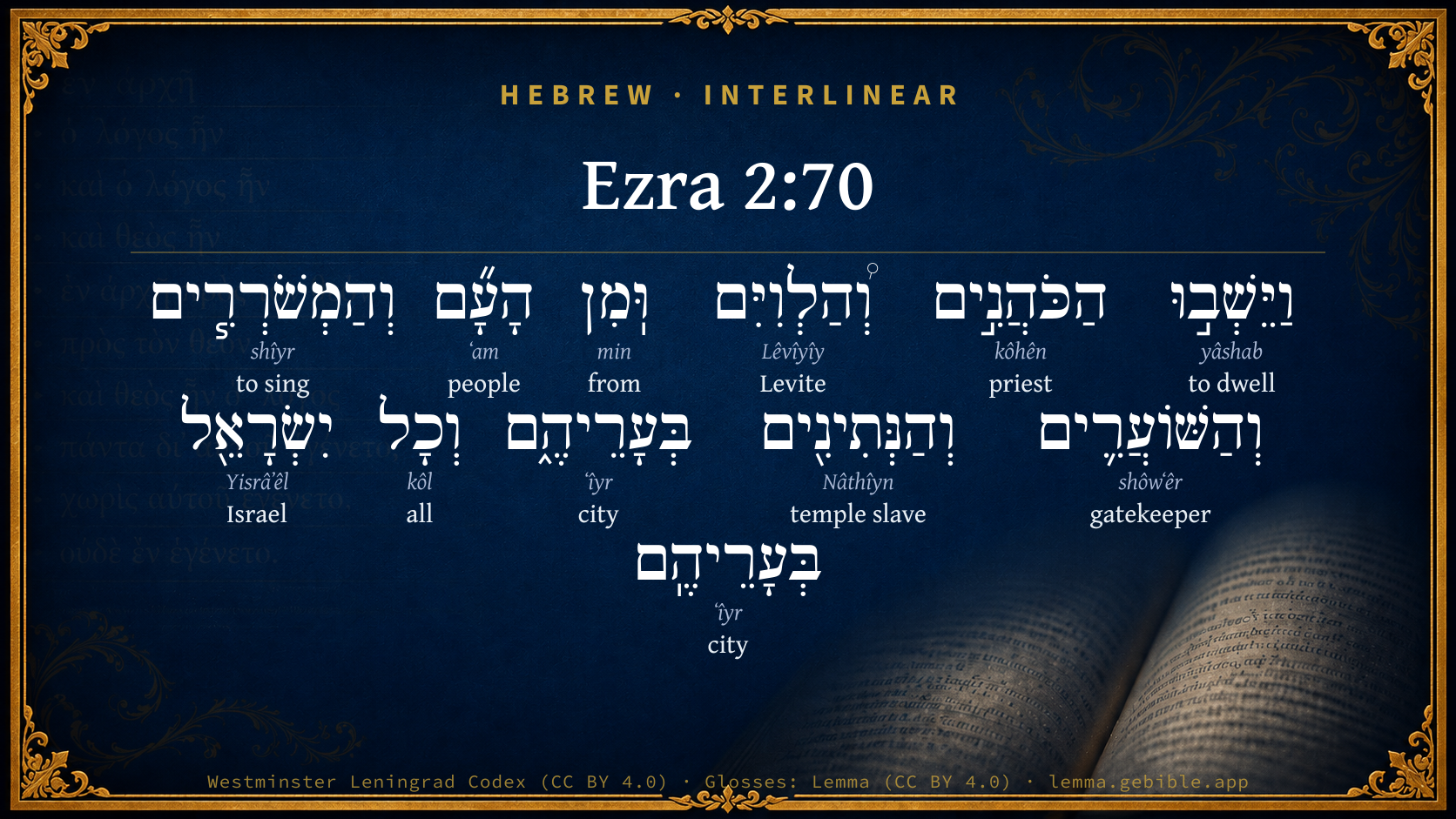
  1. וַיֵּשְׁב֣וּ yâshab H3427 “and · to dwell” Conjunction + Verb, Qal, Sequential Imperfect, 3rd Person, Masculine, Plural
  2. הַכֹּהֲנִ֣ים kôhên H3548 “the · priests” Particle, Definite Article + Noun, Common, Masculine, Plural, Absolute
  3. וְ֠הַלְוִיִּם Lêvîyîy H3881 “and · the · Levites” Conjunction + Particle, Definite Article + Noun, Gentilic, Masculine, Plural, Absolute
  4. וּֽמִן min H4480 “and · from” Conjunction + Preposition
  5. הָעָ֞ם ʻam H5971 “the · people” Particle, Definite Article + Noun, Common, Masculine, Singular, Absolute
  6. וְהַמְשֹׁרְרִ֧ים shîyr H7891 “and · the · singing” Conjunction + Particle, Definite Article + Verb, Polel, Participle Active, Masculine, Plural, Absolute
  7. וְהַשּׁוֹעֲרִ֛ים shôwʻêr H7778 “and · the · gatekeepers” Conjunction + Particle, Definite Article + Noun, Common, Masculine, Plural, Absolute
  8. בְּעָרֵיהֶ֑ם ʻîyr H5892 “in/at · cities · their” Preposition + Noun, Common, Feminine, Plural, Construct + Suffix, Personal, 3rd Person, Masculine, Plural
  9. וְכָל kôl H3605 “and · all of” Conjunction + Noun, Common, Masculine, Singular, Construct
  10. יִשְׂרָאֵ֖ל Yisrâʼêl H3478 “Israel” Noun, Proper
  11. בְּעָרֵיהֶֽם ʻîyr H5892 “in/at · cities · their” Preposition + Noun, Common, Feminine, Plural, Construct + Suffix, Personal, 3rd Person, Masculine, Plural

About this verse

These counts appear in no published source. They are computed here, from the morphology-tagged text and Lemma’s own curated glosses. What Lemma adds →

12
words
11
distinct lemmas
Historical
section

Notable vocabulary

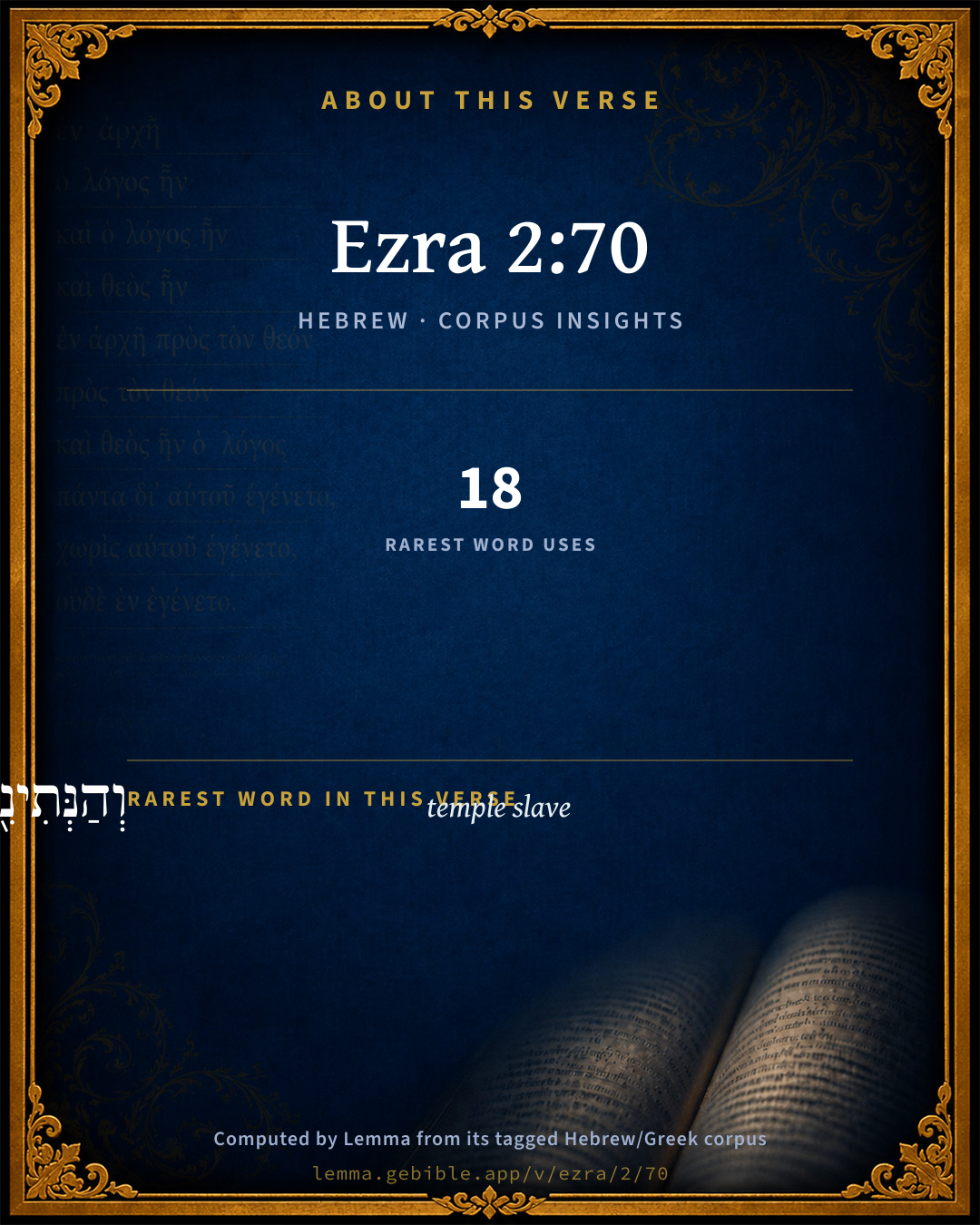
The rarest word here is וְהַנְּתִינִ֖ים temple slave H5411 — appearing just 18 times in the whole Hebrew Bible.

Shared distinctive vocabulary

וְהַנְּתִינִ֖ים temple slave H5411 occurs in 15 verses of the Hebrew Bible. Also found in:

Grammatical profile

  • 2 verbs
  • 9 nouns
  • 1 preposition

Verb forms

  • וַיֵּשְׁב֣וּ Qal · Sequential Imperfect
  • וְהַמְשֹׁרְרִ֧ים Polel · Participle Active

Repetition

A word recurs within this verse — often emphatic in Hebrew:

  • בְּעָרֵיהֶ֑ם city H5892 ×2

Hebrew & Septuagint length

In English translation the verse runs 30 words from the Hebrew and 30 from the Septuagint (LXX English) — the same length.

A rough comparison of the two English renderings, which tokenize alike — not a word-level alignment.

Word counts can differ between the Hebrew and the Greek without any difference in meaning — e.g. the Hebrew direct-object marker אֵת has no separate Greek word, and Greek often adds the article ὁ.

Cross-references

5

Topical passages linked to Ezra 2:70 in the Treasury of Scripture Knowledge — connected by theme and wording, ordered by reader-vote popularity; previews shown in the World English Bible.

  • Nehemiah 7:73 So the priests, and the Levites, and the porters, and the singers, and some of the people, and the Nethinim, and all Israel, lived in their cities. When the seventh month was come, the children of Israel were in their cities.
  • 1 Chronicles 9:2 Now the first inhabitants who lived in their possessions in their cities were Israel, the priests, the Levites, and the Nethinim.
  • 1 Chronicles 11:2 In times past, even when Saul was king, it was you who led out and brought in Israel: and Yahweh your God said to you, You shall be shepherd of my people Israel, and you shall be prince over my people Israel.
  • Ezra 6:16–17 The children of Israel, the priests, and the Levites, and the rest of the children of the captivity, kept the dedication of this house of God with joy.
  • Nehemiah 11:3–36 Now these are the chiefs of the province who lived in Jerusalem: but in the cities of Judah lived everyone in his possession in their cities, [to wit], Israel, the priests, and the Levites, and the Nethinim, and the children of Solomon's servants.

Cross-references courtesy of OpenBible.info (CC BY 4.0).

Hebrew and Greek witnesses Masoretic Hebrew ↔ Greek Septuagint

The same verse in the two great witnesses to the Old Testament, shown verse-for-verse.

These are two independent witnesses, not word-aligned to each other, and the Septuagint is shown in lemma (dictionary) form.

Hebrew Ezra 2:70 Masoretic · Westminster Leningrad Codex

וַיֵּשְׁב֣וּ הַכֹּהֲנִ֣ים וְ֠הַלְוִיִּם וּֽמִן הָעָ֞ם וְהַמְשֹׁרְרִ֧ים וְהַשּׁוֹעֲרִ֛ים וְהַנְּתִינִ֖ים בְּעָרֵיהֶ֑ם וְכָל יִשְׂרָאֵ֖ל בְּעָרֵיהֶֽם

So the priests, and the Levites, and some of the people, and the singers, and the porters, and the Nethinim, lived in their cities, and all Israel in their cities.

World English Bible · Public Domain

Greek LXX Ezra 2:70 Septuagint · lemma form

καί καταἵζω ὁ ἱερεύς καί ὁ λευείτης καί ὁ ἀπό ὁ λαός καί ὁ ᾄδω καί ὁ πυλωρός καί ὁ ναθινιμ ἐν πόλις αὐτός καί πᾶς ἰσραήλ ἐν πόλις αὐτός

So the priests, and the Levites, and some of the people, and the singers, and the porters, and the Nathinim, lived in their cities, and all Israel in their cities.

LXX2012 (modern English Septuagint) · Public Domain

In the Septuagint this is one book — Esdras B (2 Esdras): Ezra is chapters 1–10, Nehemiah 11–23.

Hebrew: Westminster Leningrad Codex (CC BY 4.0). Greek: Septuagint (public domain); English from LXX2012 (modern English Septuagint) (Public Domain). How the Septuagint differs from the Hebrew →

Commentary

Notes on Ezra 2:70 from classic Christian and Jewish commentators (each source and its license shown beneath its notes). The classic Christian expositions comment on the surrounding passage and are grouped to its opening verse, so a note may address several verses; the Jewish commentaries on the Tanakh (Rashi and others) are per-verse, so they appear only where the commentator wrote on this verse.

Lemma curates 59 commentaries, every one of them public domain or Creative Commons licensed, each selected and text-cleaned for this edition rather than reprinted as found. About our sources →

Trapp's Complete Commentary

John Trapp

Ezr 2:70 So the priests, and the Levites, and [some] of the people, and the singers, and the porters, and the Nethinims, dwelt in their cities, and all Israel in their cities.

Ver. 70. And some of the people] For not half of them, as may be probably thought, returned; but condemned the rest of rashness and weakness, to their no small prejudice.

John Trapp, A Commentary or Exposition upon All the Books of the Old and New Testament (1647–1656) — public domain. Text from a community e-Sword module.

Joseph Benson's Commentary

Ezr 2:70. And all Israel in their cities — In the cities which their families had inhabited before their captivity. As to those who could not prove themselves Israelites by any genealogical register, they probably settled in those lands which were not claimed, or followed handicraft employments, of one sort or other, in the cities. Although their cities were out of repair, yea, in a ruinous state, yet, because they were their cities, such as God had assigned them, they were content to dwell in them; and were thankful for liberty and property, though they had little of pomp, plenty, or power. Their poverty was an afflictive cause, but their unity and unanimity were happy effects of it. Here was room enough for them all, and all their substance, so that there was no strife among them, but perfect harmony: a blessed presage of their comfortable settlement, as their discords in the latter times of that state were of their ruin.

Joseph Benson's Commentary on the Old and New Testaments (1811–1818) — public domain. Text from a community e-Sword module.

Adam Clarke's Commentary

Verse 70. Dwelt in their cities] They all went to those cities which belonged originally to their respective families.

Adam Clarke's Commentary on the Bible (1810–1826) — public domain. Text from a community e-Sword/MySword module.

Ellicott's Commentary for English Readers

(70) Some of the people.—Those of the people; placed by Nehemiah after all the others.

All Israel in their cities.—The emphasis lies in the fact that, though Judah and Benjamin contributed the largest part, it was a national revival; and the constant repetition of “in their cities” has in it the same note of triumph.

A Bible Commentary for English Readers, edited by Charles John Ellicott (1878–1897) — public domain. Text from a community e-Sword module.

The Cambridge Bible for Schools and Colleges

gen. ed. J. J. S. Perowne

70. This verse runs more smoothly as it appears in Neh_7:73 ‘So the priests and the Levites, and the porters, and the singers, and some of the people, and the Nethinim, and all Israel dwelt in their cities’.

The verse sums up the whole list.

The words ‘and some of the people’ seem to be in the wrong place between ‘the Levites’ and ‘the singers’; but the mention of ‘the singers’ before ‘the porters’ agrees more closely with the order of the list given in the present chapter than the order given in Neh_7:73.

An awkwardness is presented by the words ‘in their cities’ occurring twice, especially as the distinction drawn between ‘some of the people with the priests and Levites’ and ‘all Israel’ is not obvious. Some have seen in the words ‘all Israel’ an expression intended to combine those who had returned from captivity in Babylon with those who had remained behind in Palestine and had never been carried away captive. Others have seen in it an allusion to representatives of the 10 Tribes who were to be found among the new community, and compare it with the mention of the 12 leaders of the people in Ezr_2:2 (cf. 1Ch_9:3).

Perhaps the most probable explanation is that the text has suffered corruption and that the verse originally ran ‘So the priests, and the Levites, and the singers, and the porters, and the Nethinims, and some of the people, even all Israel, dwelt in their cities’, or as 1Es_8:45.

dwelt in their cities. Cf. ‘returned … every one unto his city’ Ezr_2:1. The document from which this list was extracted contemplates the work of settling into their cities, which must have been a slow and gradual process, as one that had been for some time accomplished. At first only Jerusalem and the towns in the immediate neighbourhood could thus have been occupied.

The Cambridge Bible for Schools and Colleges (gen. ed. J. J. S. Perowne; Cambridge University Press, 1878–1918) — public domain. Text from a community e-Sword module.

Albert Barnes' Notes on the Bible

All Israel - That the Israelites of the ten tribes returned to Palestine with Zerubbabel is apparent:

(1) from 1Ch 9:3;

(2) from the enumeration of twelve chiefs (Neh 7:7; 1 Esd. 5:8); and

(3) from various expressions in Ezra Ezr 2:2, Ezr 2:59; Ezr 3:1.

Albert Barnes' Notes on the Bible (1834–1885) — public domain. Text from a community e-Sword/MySword module.

Haydock's Catholic Bible Commentary

Some. The laics, mentioned from ver. 2., to 35. (Haydock)

George Leo Haydock (1774–1849), Haydock's Catholic Family Bible and Commentary, 1859 edition — public domain. Excludes Psalms (Douay-Rheims chapter numbering differs from Protestant) and Deuterocanonical books (Catholic canon only).

Whedon's Commentary on the Bible

Daniel D. Whedon

70. In their cities — The cities assigned them as their future homes. With many these cities were ancestral homes.

All Israel — The entire community of returned exiles who now represented the Israelitish nation.

Daniel D. Whedon (gen. ed.), Commentary on the Old and New Testaments (1874–1909) — public domain. Text from a community e-Sword module.

The Pulpit Commentary

In their cities. Not in Jerusalem only, but in the neighboring towns also, e.g. Bethlehem, Anathoth, Ramah, Gaba, Michmash, Bethel, Ai, Nebo, and Jericho (see above, comment on ver. 1). All Israel. Ezra very determinately puts forward this aspect of the return that it was participated in by all the tribes (see 2:2; 3:1; 6:16, 17; 7:13; 8:29, 35, etc.). He does not, however, exclude the other aspect, that it was especially a return of Judah, or "Judah and Benjamin". (see Ezr_5:1 Ezr_10:9)

The Pulpit Commentary (1880–1919), ed. H.D.M. Spence-Jones & Joseph S. Exell — public domain. Text from a community e-Sword module.

John Wesley's Explanatory Notes

And all Israel in their cities - And they dwelt in peace, in perfect harmony, a blessed presage of their settlement, as their discord in the latter times of that state, was of their ruin.

John Wesley, Explanatory Notes Upon the Whole Bible (1754–1765) — public domain. Text via the GEBible commentary corpus.

unfoldingWord translationNotes

Door43 World Missions Community

All the people in Israel were in their cities

Everyone went back to their home towns in Judea. Not everyone resettled in Jerusalem.

translationWords

priest

Levi

people group

temple

servant

Israel

unfoldingWord translationNotes — © Distant Shores Media and the Door43 World Missions Community, licensed CC BY-SA 4.0. Source: git.door43.org/Door43/en_tn.

Lesson kit

Teaching starters — assembled from the data on this page, not authored interpretation. Every prompt links to the verse data it draws on. Edit before teaching.

Ezra, in the Historical, opens this verse with 12 words (11 distinct Hebrew lemmas). Its most distinctive word is Nâthîyn (“temple slave”). A historical commentator’s framing appears above. Read the whole chapter for the surrounding context.

Discussion questions

  1. How does “temple slave” (Nâthîyn) shape what this verse is saying?
  2. How does 1 Chronicles 9:2, which shares the word «temple slave», read alongside this verse?
  3. What does the repetition of “city” (2× in this one verse) do in this verse?
  4. These translations render this verse differently; the difference is in the English rendering, not the original. What questions does that raise?
  5. «וַיֵּשְׁב֣וּ» is a Qal Sequential Imperfect verb. How does that grammatical form shape the action described?
  6. Compare how Trapp's Complete Commentary and Joseph Benson's Commentary read this verse. Where do they agree or differ?

Things to notice

Reading settings

Reading text

Shown beneath each verse's original-language words.

Old Testament
Old Testament edition

Read the OT as the Masoretic Hebrew (MT) or the Greek Septuagint (LXX).

English shown for the Greek Septuagint (in the Hebrew ↔ Greek comparison).

Comparing translations? Open the Compare panel on any verse page to stack up to four side by side.