Leviticus 25:32

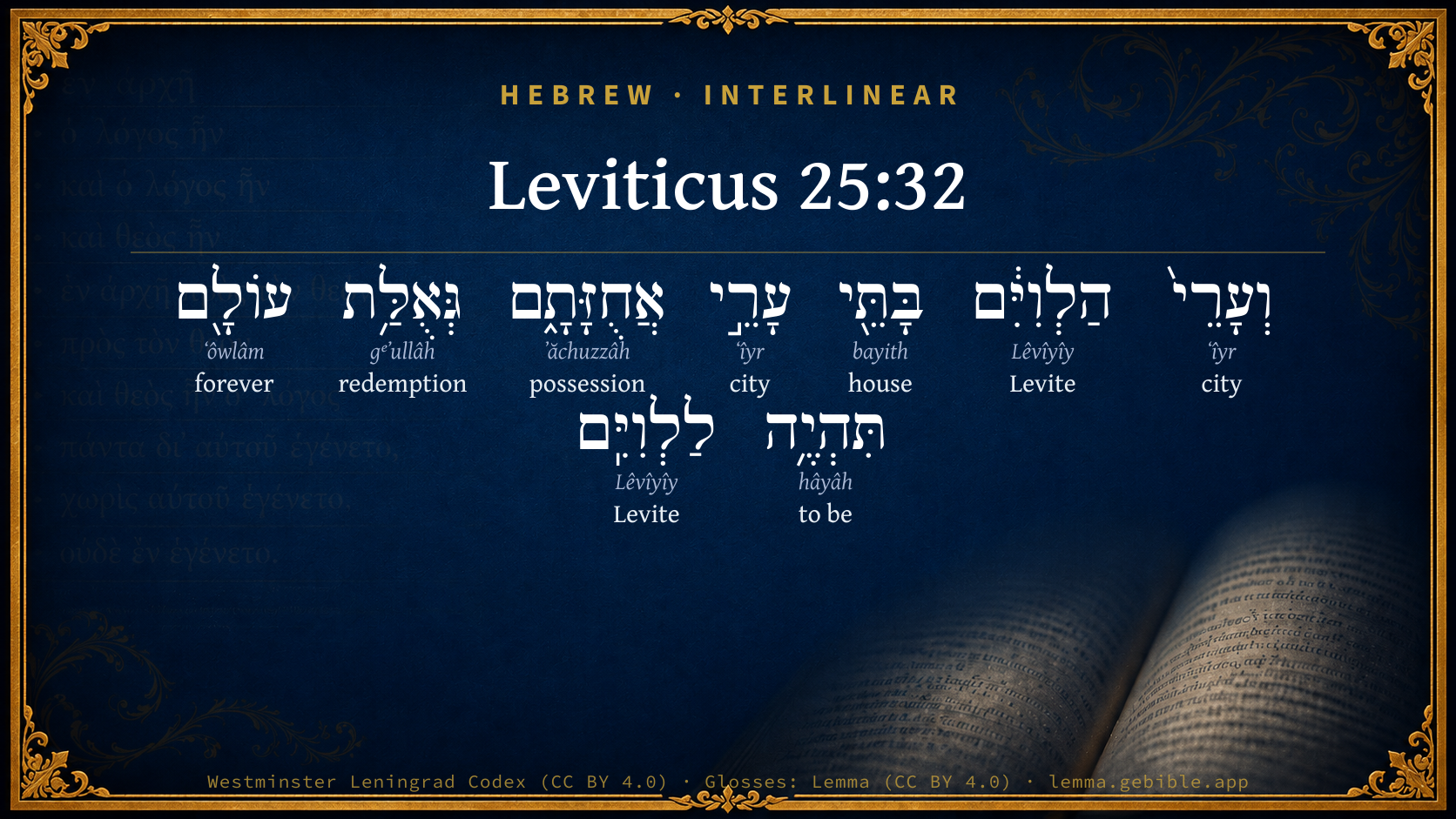
Hebrew (Westminster Leningrad Codex) Leviticus 25:32 appears in the Hebrew Old Testament. The text above is from the Westminster Leningrad Codex. Each word links to its Strong’s number, a concise gloss, and parsing drawn from the Open Scriptures Hebrew Bible morphology. Click any word for its full Brown-Driver-Briggs (BDB) entry.
Download image
Cite this verse

Leviticus 25:32 (World English Bible). Public Domain. Lemma interlinear Bible study tool, https://lemma.gebible.app/v/leviticus/25/32.

Show BibTeX & RIS
BibTeX
RIS
English Translation
"'Nevertheless the cities of the Levites, the houses in the cities of their possession, the Levites may redeem at any time.
World English Bible · Public Domain
Download a study sheet

One document with this verse’s original text, its word-by-word gloss line, the meaning frame, cross-references with their text, attributed commentary, and full source and license credits — printable, and it pastes into notes with its structure intact.

This verse Autodidact and up

Study sheet (.html) Plain text (.txt)

A passage Seminary Student

Up to 50 verses in one chapter. A passage sheet keeps up to 6 commentary sources and 12 cross-references per verse, in the order this page ranks them, and says so on the sheet whenever that leaves anything out. Ask for a single verse and you get the Autodidact verse sheet above.

Everything on this page stays free to read, with no account — the sheet is a download of what is already on screen, not access to it.

Want to remove ads? Support Godless Engineer
Compare translations 3

The same verse in 3 English versions, stacked beneath the original-language interlinear above. Click any original word for its lexicon entry.

Each is an independent rendering of the whole verse — the interlinear is not word-aligned to these translations.

Highlighted words mark where these versions differ — a whole-verse word diff, not a word-by-word alignment.

  • World English Bible Public Domain
    "'Nevertheless the cities of the Levites, the houses in the cities of their possession, the Levites may redeem at any time.
  • King James Version Public Domain
    Notwithstanding the cities of the Levites, and the houses of the cities of their possession, may the Levites redeem at any time.
  • unfoldingWord Literal Text CC BY-SA 4.0
    And the cities of the Levites, the houses of the cities of their possession, a redemption of perpetuity shall be for the Levites.

unfoldingWord Literal Text — © unfoldingWord, licensed CC BY-SA 4.0. Word-aligned USFM3 via Door43 (git.door43.org/unfoldingWord/en_ult).

Versions to compare (up to 4)

3 of 4 selected

Show all 18 translations

Every available English version of this verse, each an independent rendering of the whole verse.

  • World English Bible Public Domain
    "'Nevertheless the cities of the Levites, the houses in the cities of their possession, the Levites may redeem at any time.
  • Berean Standard Bible Public Domain
    As for the cities of the Levites, the Levites always have the right to redeem their houses in the cities they possess.
  • Majority Standard Bible Public Domain
    As for the cities of the Levites, the Levites always have the right to redeem their houses in the cities they possess.
  • King James Version Public Domain
    Notwithstanding the cities of the Levites, and the houses of the cities of their possession, may the Levites redeem at any time.
  • American Standard Version (1901) Public Domain
    Nevertheless the cities of the Levites, the houses of the cities of their possession, may the Levites redeem at any time.
  • Revised Version (1885) Public Domain
    Nevertheless the cities of the Levites, the houses of the cities of their possession, may the Levites redeem at any time.
  • Geneva Bible (1599) Public Domain
    Notwithstanding, the cities of the Leuites, and the houses of the cities of their possession, may the Leuites redeeme at all seasons.
  • Douay-Rheims (1899) Public Domain
    The houses of Levites, which are in cities, may always be redeemed:
  • Young's Literal Translation Public Domain
    `As to cities of the Levites -- houses of the cities of their possession -- redemption age-during is to the Levites;
  • Literal Standard Version CC BY-SA 4.0
    As for cities of the Levites—houses of the cities of their possession—continuous redemption is for the Levites;
  • Unlocked Literal Bible CC BY-SA 4.0
    However, the houses owned by the Levites in their cities may be redeemed at any time.
  • unfoldingWord Literal Text CC BY-SA 4.0
    And the cities of the Levites, the houses of the cities of their possession, a redemption of perpetuity shall be for the Levites.
  • Darby Bible Public Domain
    But as to the cities of the Levites, the houses in the cities of their possession, the Levites shall have a perpetual right of redemption.
  • World Messianic Bible Public Domain
    “‘Nevertheless, in the cities of the Levites, the Levites may redeem the houses in the cities of their possession at any time.
  • Webster's Bible Public Domain
    Notwithstanding the cities of the Levites, and the houses of the cities of their possession, may the Levites redeem at any time.
  • Free Bible Version CC BY-SA 4.0
    However, the Levites always have the right to buy back their houses in the towns that belong to them.
  • Bible in Basic English Public Domain
    But the houses in the towns of the Levites may be got back by the Levites at any time.
  • JPS Tanakh (1917) Public Domain
    But as for the cities of the Levites, the houses of the cities of their possession, the Levites shall have a perpetual right of redemption.

Literal Standard Version (2020), Covenant Press — licensed CC BY-SA 4.0. Text via the HelloAO Bible API (eBible.org). Unlocked Literal Bible (unfoldingWord) — licensed CC BY-SA 4.0. Text via the HelloAO Bible API (eBible.org). unfoldingWord Literal Text — © unfoldingWord, licensed CC BY-SA 4.0. Word-aligned USFM3 via Door43 (git.door43.org/unfoldingWord/en_ult). Free Bible Version, Dr. Jonathan Gallagher — licensed CC BY-SA 4.0. Text via the HelloAO Bible API (eBible.org).

Word by word

More ways to search: Search by grammar → Find every occurrence → Compare this word →

Practice this passage: Drill this verse → Learn its vocabulary →

גְּאֻלַּ֥ת
gᵉʼullâh
H1353
“redemption of”
Noun, Common, Feminine, Singular, Construct
Part of Speech
Noun
Type
Common
Gender
Feminine
Number
Singular
State
Construct
Full BDB Definition

Origin: pass. participle of H1350

TWOT: 300b

kindred, redemption, right of redemption, price of redemption - kin, kindred - redemption - right of redemption - price of redemption, redemption price
  1. וְעָרֵי֙ ʻîyr H5892 “and · cities of” Conjunction + Noun, Common, Feminine, Plural, Construct
  2. הַלְוִיִּ֔ם Lêvîyîy H3881 “the · Levites” Particle, Definite Article + Noun, Gentilic, Masculine, Plural, Absolute
  3. בָּתֵּ֖י bayith H1004 “houses of” Noun, Common, Masculine, Plural, Construct
  4. עָרֵ֣י ʻîyr H5892 “cities of” Noun, Common, Feminine, Plural, Construct
  5. אֲחֻזָּתָ֑ם ʼăchuzzâh H272 “possession · their” Noun, Common, Feminine, Singular, Construct + Suffix, Personal, 3rd Person, Masculine, Plural
  6. עוֹלָ֖ם ʻôwlâm H5769 “forever” Noun, Common, Masculine, Singular, Absolute
  7. תִּהְיֶ֥ה hâyâh H1961 “to be” Verb, Qal, Imperfect, 3rd Person, Feminine, Singular
  8. לַלְוִיִּֽם Lêvîyîy H3881 “to/for the · Levites” Preposition, Determined + Noun, Gentilic, Masculine, Plural, Absolute

About this verse

These counts appear in no published source. They are computed here, from the morphology-tagged text and Lemma’s own curated glosses. What Lemma adds →

9
words
7
distinct lemmas
Pentateuch
section

Notable vocabulary

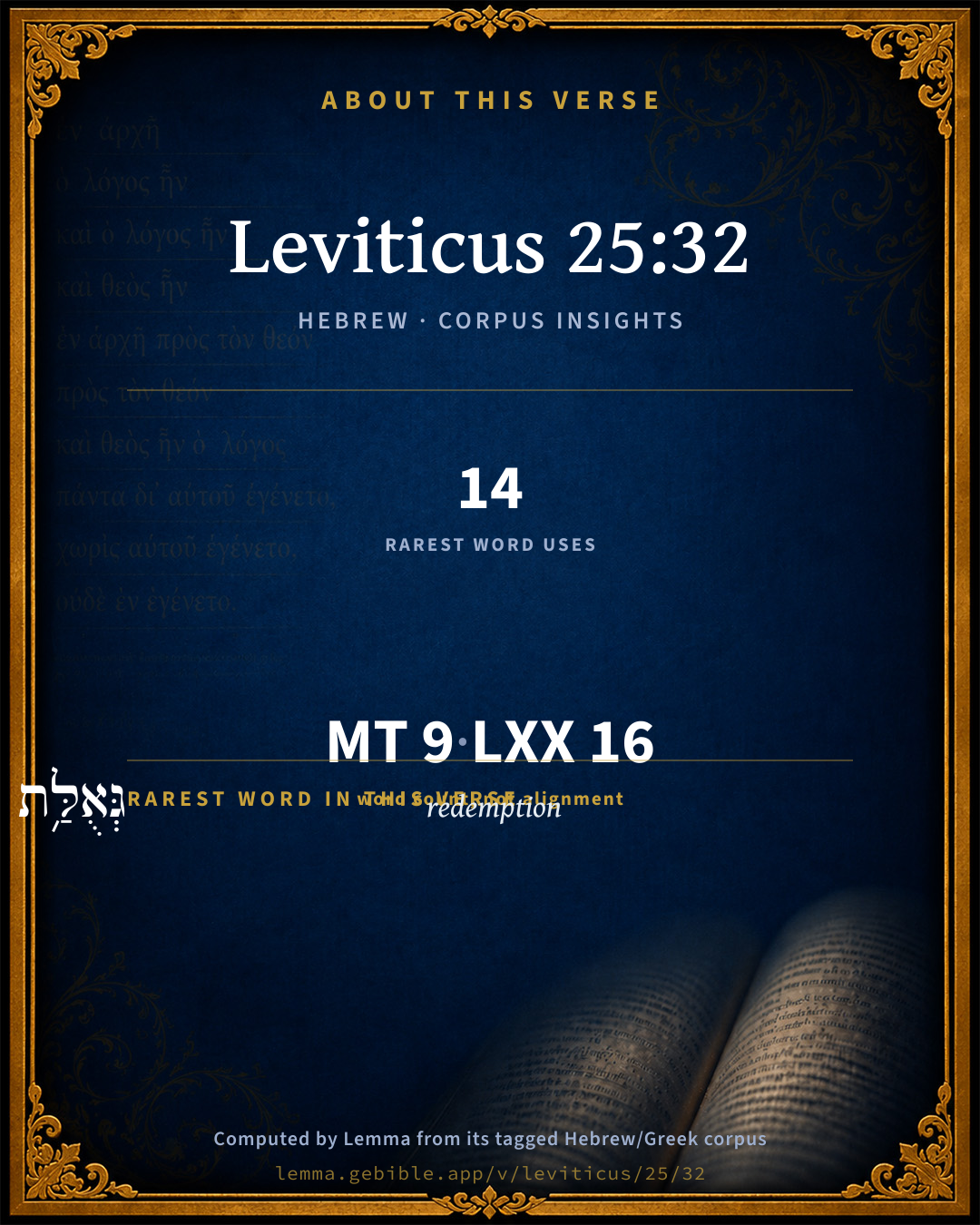
The rarest word here is גְּאֻלַּ֥ת redemption H1353 — appearing just 14 times in the whole Hebrew Bible.

Shared distinctive vocabulary

גְּאֻלַּ֥ת redemption H1353 occurs in 13 verses of the Hebrew Bible. Also found in:

Grammatical profile

  • 1 verb
  • 8 nouns

Verb forms

  • תִּהְיֶ֥ה Qal · Imperfect

Repetition

Words recur within this verse — often emphatic in Hebrew:

  • וְעָרֵי֙ city H5892 ×2
  • הַלְוִיִּ֔ם Levite H3881 ×2

Hebrew & Septuagint length

In English translation the verse runs 21 words from the Hebrew and 21 from the Septuagint (LXX English) — the same length.

A rough comparison of the two English renderings, which tokenize alike — not a word-level alignment.

Word counts can differ between the Hebrew and the Greek without any difference in meaning — e.g. the Hebrew direct-object marker אֵת has no separate Greek word, and Greek often adds the article ὁ.

In the original languages it is 9 Hebrew tokens and 16 Greek tokens — but the two are counted differently (Hebrew bundles its prefixes and suffixes into one token; the Greek is in lemma form), so that isn’t a like-for-like length.

Cross-references

2

Topical passages linked to Leviticus 25:32 in the Treasury of Scripture Knowledge — connected by theme and wording, ordered by reader-vote popularity; previews shown in the World English Bible.

  • Numbers 35:1–8 Yahweh spoke to Moses in the plains of Moab by the Jordan at Jericho, saying,
  • Joshua 21:1–45 Then came near the heads of fathers' [houses] of the Levites to Eleazar the priest, and to Joshua the son of Nun, and to the heads of fathers' [houses] of the tribes of the children of Israel;

Cross-references courtesy of OpenBible.info (CC BY 4.0).

Hebrew and Greek witnesses Masoretic Hebrew ↔ Greek Septuagint

The same verse in the two great witnesses to the Old Testament, shown verse-for-verse.

These are two independent witnesses, not word-aligned to each other, and the Septuagint is shown in lemma (dictionary) form.

Hebrew Leviticus 25:32 Masoretic · Westminster Leningrad Codex

וְעָרֵי֙ הַלְוִיִּ֔ם בָּתֵּ֖י עָרֵ֣י אֲחֻזָּתָ֑ם גְּאֻלַּ֥ת עוֹלָ֖ם תִּהְיֶ֥ה לַלְוִיִּֽם

"'Nevertheless the cities of the Levites, the houses in the cities of their possession, the Levites may redeem at any time.

World English Bible · Public Domain

Greek LXX Leviticus 25:32 Septuagint · lemma form

καί ὁ πόλις ὁ λευίτης οἰκία ὁ πόλις αὐτός κατάσχεσις λυτρωτής διά πᾶς εἰμί ὁ λευίτης

And the cities of the Levites, the houses of the cities in their possession, shall be always redeemable to the Levites.

LXX2012 (modern English Septuagint) · Public Domain

Hebrew: Westminster Leningrad Codex (CC BY 4.0). Greek: Septuagint (public domain); English from LXX2012 (modern English Septuagint) (Public Domain). How the Septuagint differs from the Hebrew →

Targum (Aramaic paraphrase)

2

The Targum is the ancient Jewish Aramaic paraphrase of the Hebrew Scriptures — an interpretive translation, not the Hebrew text itself. Onkelos (literal) and Pseudo-Jonathan (expansive) render the Torah, and Jonathan the Prophets. Coverage is partial: where no permissively-licensed English translation exists for a verse, only the Aramaic is shown. This is verse-level text, not a word-by-word alignment to the Hebrew.

  1. Targum Onkelos Torah (Genesis–Deuteronomy)
    וְקִרְוֵי לֵיוָאֵי בָּתֵּי קִרְוֵי אַחֲסַנְתְּהוֹן פּוּרְקַן עָלָם תְּהֵי לְלֵיוָאֵי

    (no public-domain English translation for this verse)

    Targum Onkelos — Aramaic: “Onkelos Genesis” (public domain); “Onkelos Exodus” (public domain); “Onkelos Leviticus” (public domain); “Onkelos Numbers” (public domain); “Onkelos Deuteronomy” (public domain). English: “Sefaria Community Translation” (CC0 1.0 (public-domain dedication)); “J.W. Etheridge. The Targums of Onkelos and Jonathan Ben Uzziel on the Pentateuch. London: Longmans, Green, 1862” (public domain). Text via Sefaria.

  2. Targum Pseudo-Jonathan Torah (Genesis–Deuteronomy)
    וְקִרְוֵי לֵיוָאֵי בָּתֵּי קִירְוֵי אַחְסַנְתְּהוֹן פּוּרְקַן עֲלַם יְהֵי לְלֵיוָאֵי

    But the cities of the Levites, the houses of the cities of their possession may be always redeemable by the Levites.

    Targum Pseudo-Jonathan — Aramaic: “Targum Jonathan on Genesis” (public domain); “Targum Jonathan on Exodus” (public domain); “Targum Jonathan on Leviticus” (public domain); “Targum Jonathan on Numbers” (public domain); “Targum Jonathan on Deuteronomy” (public domain). English: “The Targum of Jonathan ben Uzziel, trans. J. W. Etheridge, London, 1862” (public domain). Text via Sefaria.

Commentary

Notes on Leviticus 25:32 from classic Christian and Jewish commentators (each source and its license shown beneath its notes). The classic Christian expositions comment on the surrounding passage and are grouped to its opening verse, so a note may address several verses; the Jewish commentaries on the Tanakh (Rashi and others) are per-verse, so they appear only where the commentator wrote on this verse.

Lemma curates 59 commentaries, every one of them public domain or Creative Commons licensed, each selected and text-cleaned for this edition rather than reprinted as found. About our sources →

John Gill's Exposition

Notwithstanding, the cities of the Levites,.... The six cities of refuge, and forty two others; these and the houses in them are excepted from the above law, and only they; not such as they might purchase elsewhere; wherefore it follows:

and the houses of the cities of their possession; which were in cities possessed by them, and which was their possession, and given them as such:

may the Levites redeem at any time; they were not restrained to a year, as houses in walled towns, but they might redeem them as they pleased or could; and if they did not redeem them within the year, they might redeem them afterwards, even years after, and any time before the year of jubilee; so it is said in the Misnah (l) the priests and the Levites sell always, and they redeem always, as it is said, Lev 25:32; on which one of the commentators says (m) "they sell always", not as the Israelites, who cannot sell less than two years before the jubilee; but the Levites can sell near the jubilee: "and they redeem always"; if they sell houses in walled cities, they are not confirmed at the end of the year, as the houses of Israelites; and if they sell fields, it is not necessary they should remain in the hands of the buyer two years, but they may redeem them immediately if they will: this redemption was peculiar to the Levites; for if an Israelite has an inheritance from his father's mother, a Levite, he might not redeem according to the manner Levites did, but according to Israelites; and so a Levite that inherited from his father's mother, an Israelite, was obliged to redeem as an Israelite and not as a Levite (n); for this perpetual redemption respected only houses that were in the cities of the Levites.

(l) Eracin, c. 9. sect. 8. (m) Bartenora in ib. (n) Misn. Eracin, c. 9. sect. 8.

John Gill's Exposition of the Whole Bible (1746–1763) — public domain (CC PDM 1.0). Text via the HelloAO Bible API.

Trapp's Complete Commentary

John Trapp

Lev 25:32 Notwithstanding the cities of the Levites, [and] the houses of the cities of their possession, may the Levites redeem at any time.

Ver. 32. May the Levites redeem at any time.] They were ever counted privileged persons: and it was but reason. See Lev 25:33-34.

John Trapp, A Commentary or Exposition upon All the Books of the Old and New Testament (1647–1656) — public domain. Text from a community e-Sword module.

Tyndale Open Study Notes

Tyndale Open Resources

25:32-34 The tribe of Levi could not inherit tribal territory because, as the priestly tribe, they were scattered throughout the land (Deut 18:1; see Gen 49:5-7; Num 35:1-8; Josh 21:1-42). The Levites could inherit only certain cities and the pasturelands surrounding them (Num 35:2). Therefore, they were an exception to the rules regarding land ownership, and their meager holdings were carefully protected. Their houses could be redeemed even in walled cities, and the pasturelands outside their towns could not be sold.

Tyndale Open Study Notes — © Tyndale Open Resources, licensed CC BY-SA 4.0. Text via the HelloAO Bible API.

Geneva Bible (1599)

Geneva Bible translators

Hebrew, forever.

Geneva Bible (1599) marginal notes — public domain. Text via Bolls.life.

Jamieson, Fausset & Brown

Robert Jamieson, A. R. Fausset & David Brown

Notwithstanding the cities of the Levites, &c.--The Levites, having no possessions but their towns and their houses, the law conferred on them the same privileges that were granted to the lands of the other Israelites. A certain portion of the lands surrounding the Levitical cities was appropriated to them for the pasturage of their cattle and flocks (Num 35:4-5). This was a permanent endowment for the support of the ministry and could not be alienated for any time. The Levites, however, were at liberty to make exchanges among themselves; and a priest might sell his house, garden, and right of pasture to another priest, but not to an Israelite of another tribe (Jer 41:7-9).

Jamieson, Fausset & Brown — Commentary Critical and Explanatory on the Whole Bible (1871) — public domain (CC PDM 1.0). Text via the HelloAO Bible API.

Adam Clarke's Commentary

Verse 32. The cities of the Levites] The law in this and the following verses was also a very wise one. A Levite could not ultimately sell his house: if sold he could redeem it at any time tn the interim between the two jubilees; but if not redeemed, it must go out at the following jubilee. And why? "Because Moses framed his laws so much in favour of the priesthood, that they had peculiar privileges?" &c. Just the reverse: they were so far from being peculiarly favoured that they had no inheritance in Israel, only their cities, to dwell in: and because their houses in these cities were the whole that they could call their own, therefore these houses could not be ultimately alienated. All that they had to live on besides was from that most precarious source of support, the freewill-offerings of the people, which depended on the prevalence of pure religion in the land.

Adam Clarke's Commentary on the Bible (1810–1826) — public domain. Text from a community e-Sword/MySword module.

Ellicott's Commentary for English Readers

(32) Notwithstanding the cities of the Levites, and the houses.—Better, And as to the cities of the Levites, the houses, that is, the houses which belong to the Levites, in the forty-eight cities given to them (see Num_35:1-8; Jos_21:1-3), are to be exempt from this general law of house property.

May the Levites redeem at any time.—Having the same value to the Levites as landed property has to the other tribes, these houses are to be subject to the jubile laws for fields, and hence may be redeemed at any time.

A Bible Commentary for English Readers, edited by Charles John Ellicott (1878–1897) — public domain. Text from a community e-Sword module.

Albert Barnes' Notes on the Bible

Rather, And concerning the cities of the Levites, the houses in the cities of their possession, etc. If one of the Levites redeems a house in the city, etc. The meaning appears to be, if a Levite redeemed a house which had been sold to a person of a different tribe by another Levite, it was to revert in the Jubilee to the latter Levite as its original possessor. The purchaser of a Levite’s house was in fact only in the condition of a tenant at will, while the fields attached to the Levitical cities could never be alienated, even for a time.

For the application of the law of Jubilee to lands dedicated to the service of the sanctuary, see Lev 27:16-25.

Albert Barnes' Notes on the Bible (1834–1885) — public domain. Text from a community e-Sword/MySword module.

Whedon's Commentary on the Bible

Daniel D. Whedon

32. The Levites may redeem — Here is the first hint of the mode of maintaining the Levites in cities. This exception to the statute concerning walled cities is grounded on the fact that the Levites, if their houses could be irredeemably sold, might become utterly homeless, since they had no landed inheritance, but only city houses. Jehovah is not honored by a mendicant ministry.

Daniel D. Whedon (gen. ed.), Commentary on the Old and New Testaments (1874–1909) — public domain. Text from a community e-Sword module.

The Pulpit Commentary

Vers. 32-34. The houses of the Levites are, by an exception, subject to the law of jubilee. They constituted the share of the national property which was assigned to the tribe of Levi, and so far stood in the same relation to them as the land did to the other tribes. They therefore returned to the original possessor or his representative in the year of jubilee, and might at any earlier time be redeemed. The words, Notwithstanding the cities of the Levites, should rather be rendered, But in respect to the cities of the Levites. There is a difficulty also as to the translation of the clause, And if a man purchase of the Levites, for the word rendered purchase menus elsewhere redeem; but here the Authorized Version would seem to be correct. The sense that it gives is that if any one bought a house of the Levites, he had to render it back in the year of jubilee, just as though it had been land. On the other hand, the land belonging to the Levites, in the suburbs of the Levitical cities, which was used for the pasturage of the flocks of the Levites, could not be sold except to a Levite, and therefore no question between the Levites and members of the other tribes could arise regarding it. The phrase, the house that was sold, and the city of his possession, must be understood, by a hendiadys, to mean, the house that was sold in the city of his possession (see Gesenius, "Lex.," s.v. l i.b.).

The Pulpit Commentary (1880–1919), ed. H.D.M. Spence-Jones & Joseph S. Exell — public domain. Text from a community e-Sword module.

Rashi

Rabbi Shlomo Yitzchaki (Rashi)

וערי הלוים THE CITIES OF THE LEVITES… [MAY BE REDEEMED AT ANY TIME] — This refers only to the forty-eight cities which had been given to them (cf. Numbers 35:6. 7). (But if the Levites built another city for themselves, or if a Levite possesses a house in a city inhabited by Israelites these do not come under this law).

גאלת עולם [THE LEVITES SHALL HAVE] THE RIGHT OF REDEMPTION AT ANY TIME — This means that they (Levites) may redeem at once — even before the end of two years — if they sold a field of those fields which had been given to them within the two thousand cubits round about the cities (cf. Numbers 25:5) (whilst an ordinary Israelite’s field must remain at least two years in the hand of the purchaser), or if they sold “a house in a city which has a wall” they may redeem it at any time and it does not become irredeemable at the end of one year (as is the case with such houses belonging to Israelites; cf. v. 30) (Arakhin 33b).

Rashi on the Tanakh — English translations: “The Judaica Press complete Tanach with Rashi, translated by A. J. Rosenberg” (CC BY 4.0); “Pentateuch with Rashi's commentary by M. Rosenbaum and A.M. Silbermann, 1929-1934” (public domain); “The Metsudah Tanach series, Lakewood, N.J” (CC BY 4.0); and “The Book of Joshua, Metsudah Publications, 1997” (CC BY 4.0). Text via Sefaria.

Lesson kit

Teaching starters — assembled from the data on this page, not authored interpretation. Every prompt links to the verse data it draws on. Edit before teaching.

Leviticus, in the Pentateuch, opens this verse with 9 words (7 distinct Hebrew lemmas). Its most distinctive word is gᵉʼullâh (“redemption”). A historical commentator’s framing appears above. Read the whole chapter for the surrounding context.

Discussion questions

  1. What does “redemption” (gᵉʼullâh) contribute to the verse as a whole?
  2. Leviticus 25:24 shares the word «redemption» with this verse. How do the two illuminate each other?
  3. “city” occurs 2× in this one verse. What is the effect of the repetition?
  4. The translations on this page render this verse differently — a whole-verse word diff, not a word-by-word alignment. What might account for the different wordings?
  5. The verb «תִּהְיֶ֥ה» is Qal Imperfect. How does its form color the action?
  6. Reading how John Gill's Exposition and Trapp's Complete Commentary read this verse, where do the two commentators agree and where do they part?

Things to notice

Reading settings

Reading text

Shown beneath each verse's original-language words.

Old Testament
Old Testament edition

Read the OT as the Masoretic Hebrew (MT) or the Greek Septuagint (LXX).

English shown for the Greek Septuagint (in the Hebrew ↔ Greek comparison).

Comparing translations? Open the Compare panel on any verse page to stack up to four side by side.