
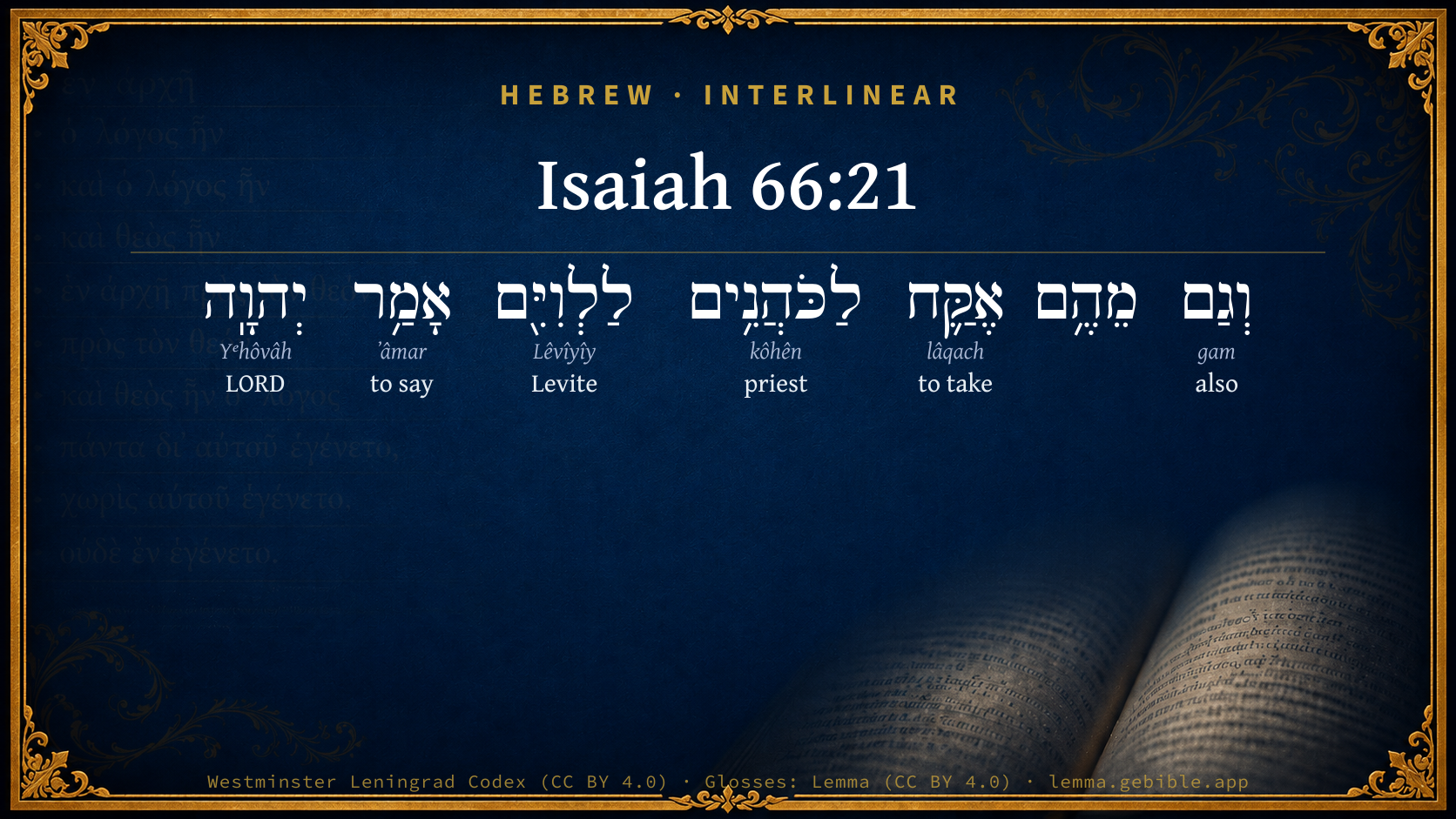
Isaiah 66:21

Hebrew (Westminster Leningrad Codex) Isaiah 66:21 appears in the Hebrew Old Testament. The text above is from the Westminster Leningrad Codex. Each word links to its Strong’s number, a concise gloss, and parsing drawn from the Open Scriptures Hebrew Bible morphology. Click any word for its full Brown-Driver-Briggs (BDB) entry.
Download image
Cite this verse

Isaiah 66:21 (World English Bible). Public Domain. Lemma interlinear Bible study tool, https://lemma.gebible.app/v/isaiah/66/21.

Show BibTeX & RIS
BibTeX
RIS
English Translation
Of them also will I take for priests [and] for Levites, says Yahweh.
World English Bible · Public Domain
Download a study sheet

One document with this verse’s original text, its word-by-word gloss line, the meaning frame, cross-references with their text, attributed commentary, and full source and license credits — printable, and it pastes into notes with its structure intact.

This verse Autodidact and up

Study sheet (.html) Plain text (.txt)

A passage Seminary Student

Up to 50 verses in one chapter. A passage sheet keeps up to 6 commentary sources and 12 cross-references per verse, in the order this page ranks them, and says so on the sheet whenever that leaves anything out. Ask for a single verse and you get the Autodidact verse sheet above.

Everything on this page stays free to read, with no account — the sheet is a download of what is already on screen, not access to it.

Want to remove ads? Support Godless Engineer
Compare translations 3

The same verse in 3 English versions, stacked beneath the original-language interlinear above. Click any original word for its lexicon entry.

Each is an independent rendering of the whole verse — the interlinear is not word-aligned to these translations.

Highlighted words mark where these versions differ — a whole-verse word diff, not a word-by-word alignment.

  • World English Bible Public Domain
    Of them also will I take for priests [and] for Levites, says Yahweh.
  • King James Version Public Domain
    And I will also take of them for priests and for Levites, saith the LORD.
  • unfoldingWord Literal Text CC BY-SA 4.0
    And I will also take from them as priests, as Levites,” says Yahweh. q1

unfoldingWord Literal Text — © unfoldingWord, licensed CC BY-SA 4.0. Word-aligned USFM3 via Door43 (git.door43.org/unfoldingWord/en_ult).

Versions to compare (up to 4)

3 of 4 selected

Show all 18 translations

Every available English version of this verse, each an independent rendering of the whole verse.

  • World English Bible Public Domain
    Of them also will I take for priests [and] for Levites, says Yahweh.
  • Berean Standard Bible Public Domain
    “And I will select some of them as priests and Levites,” says the LORD.
  • Majority Standard Bible Public Domain
    “And I will select some of them as priests and Levites,” says the LORD.
  • King James Version Public Domain
    And I will also take of them for priests and for Levites, saith the LORD.
  • American Standard Version (1901) Public Domain
    And of them also will I take for priests `and' for Levites, saith Jehovah.
  • Revised Version (1885) Public Domain
    And of them also will I take for priests and for Levites, saith the LORD.
  • Geneva Bible (1599) Public Domain
    And I will take of them for Priestes, and for Leuites, saith the Lord.
  • Douay-Rheims (1899) Public Domain
    And I will take of them to be priests, and Levites, saith the Lord.
  • Young's Literal Translation Public Domain
    And also of them I take for priests, For Levites, said Jehovah.
  • Literal Standard Version CC BY-SA 4.0
    And I also take of them for priests, || For Levites,” said YHWH.
  • Unlocked Literal Bible CC BY-SA 4.0
    Some of these I will even choose as priests and Levites—says Yahweh.
  • unfoldingWord Literal Text CC BY-SA 4.0
    And I will also take from them as priests, as Levites,” says Yahweh. q1
  • Darby Bible Public Domain
    And I will also take of them for priests [and] for Levites, saith Jehovah.
  • World Messianic Bible Public Domain
    Of them I will also select priests and Levites,” says the LORD.
  • Webster's Bible Public Domain
    And I will also take of them for priests and for Levites, saith the LORD.
  • Free Bible Version CC BY-SA 4.0
    I will choose some of them as priests and Levites, says the Lord.
  • Bible in Basic English Public Domain
    And some of them will I take for priests and Levites, says the Lord.
  • JPS Tanakh (1917) Public Domain
    And of them also will I take for the priests and for the Levites, saith the LORD.

Literal Standard Version (2020), Covenant Press — licensed CC BY-SA 4.0. Text via the HelloAO Bible API (eBible.org). Unlocked Literal Bible (unfoldingWord) — licensed CC BY-SA 4.0. Text via the HelloAO Bible API (eBible.org). unfoldingWord Literal Text — © unfoldingWord, licensed CC BY-SA 4.0. Word-aligned USFM3 via Door43 (git.door43.org/unfoldingWord/en_ult). Free Bible Version, Dr. Jonathan Gallagher — licensed CC BY-SA 4.0. Text via the HelloAO Bible API (eBible.org).

Word by word

More ways to search: Search by grammar → Find every occurrence → Compare this word →

Practice this passage: Drill this verse → Learn its vocabulary →

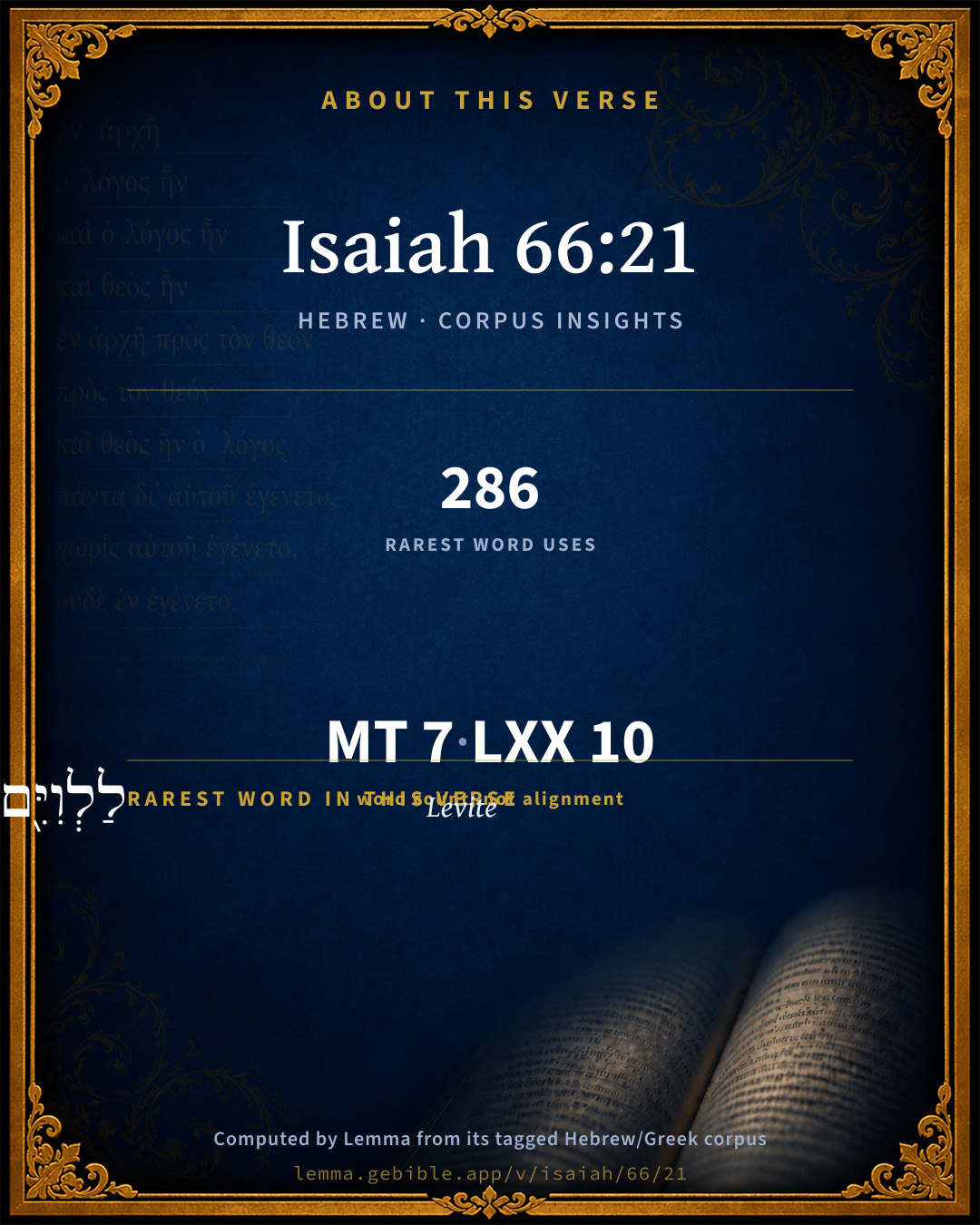
לַלְוִיִּ֖ם
Lêvîyîy
H3881
“to/for the · Levites”
Preposition, Determined + Noun, Gentilic, Masculine, Plural, Absolute
Part of Speech
Preposition + Noun
Type
Gentilic
Gender
Masculine
Number
Plural
State
Absolute
Full BDB Definition

Origin: patronymically from H3878

TWOT: None

Levite = see Levi " joined to" - the descendants of Levi, the 3rd son of Jacob by Leah - the tribe descended from Levi specially set aside by God for His service
  1. וְגַם gam H1571 “and · also” Conjunction + Particle, Accusative
  2. אֶקַּ֛ח lâqach H3947 “to take” Verb, Qal, Imperfect, 1st Person, Common, Singular
  3. לַכֹּהֲנִ֥ים kôhên H3548 “to/for the · priests” Preposition, Determined + Noun, Common, Masculine, Plural, Absolute
  4. אָמַ֥ר ʼâmar H559 “to say” Verb, Qal, Perfect, 3rd Person, Masculine, Singular
  5. יְהוָֽה Yᵉhôvâh H3068 “LORD” Noun, Proper

About this verse

These counts appear in no published source. They are computed here, from the morphology-tagged text and Lemma’s own curated glosses. What Lemma adds →

7
words
6
distinct lemmas
Prophets
section

Grammatical profile

  • 2 verbs
  • 3 nouns
  • 1 preposition
  • 1 particle

Verb forms

  • אֶקַּ֛ח Qal · Imperfect
  • אָמַ֥ר Qal · Perfect

Hebrew & Septuagint length

In English translation the verse runs 13 words from the Hebrew and 12 from the Septuagint (LXX English) — closely comparable.

A rough comparison of the two English renderings, which tokenize alike — not a word-level alignment.

Word counts can differ between the Hebrew and the Greek without any difference in meaning — e.g. the Hebrew direct-object marker אֵת has no separate Greek word, and Greek often adds the article ὁ.

In the original languages it is 7 Hebrew tokens and 10 Greek tokens — but the two are counted differently (Hebrew bundles its prefixes and suffixes into one token; the Greek is in lemma form), so that isn’t a like-for-like length.

Cross-references

8

Topical passages linked to Isaiah 66:21 in the Treasury of Scripture Knowledge — connected by theme and wording, ordered by reader-vote popularity; previews shown in the World English Bible.

  • 1 Peter 2:9 But you are a chosen race, a royal priesthood, a holy nation, a people for God's own possession, that you may show forth the excellencies of him who called you out of darkness into his marvelous light:
  • Exodus 19:6 and you shall be to me a kingdom of priests, and a holy nation.' These are the words which you shall speak to the children of Israel."
  • Isaiah 61:6 But you shall be named the priests of Yahweh; men shall call you the ministers of our God: you shall eat the wealth of the nations, and in their glory shall you boast yourselves.
  • 1 Peter 2:5 You also, as living stones, are built up as a spiritual house, to be a holy priesthood, to offer up spiritual sacrifices, acceptable to God through Jesus Christ.
  • Revelation 1:6 and he made us to be a Kingdom, priests to his God and Father; to him be the glory and the dominion forever and ever. Amen.
  • Revelation 5:10 And made them kings and priests to our God, And they reign on earth."
  • Revelation 20:6 Blessed and holy is he who has part in the first resurrection. Over these, the second death has no power, but they will be priests of God and of Christ, and will reign with him one thousand years.
  • Jeremiah 13:18–22 Say you to the king and to the queen-mother, Humble yourselves, sit down; for your headdresses are come down, even the crown of your glory.

Cross-references courtesy of OpenBible.info (CC BY 4.0).

Hebrew and Greek witnesses Masoretic Hebrew ↔ Greek Septuagint

The same verse in the two great witnesses to the Old Testament, shown verse-for-verse.

These are two independent witnesses, not word-aligned to each other, and the Septuagint is shown in lemma (dictionary) form.

Hebrew Isaiah 66:21 Masoretic · Westminster Leningrad Codex

וְגַם מֵהֶ֥ם אֶקַּ֛ח לַכֹּהֲנִ֥ים לַלְוִיִּ֖ם אָמַ֥ר יְהוָֽה

Of them also will I take for priests [and] for Levites, says Yahweh.

World English Bible · Public Domain

Greek LXX Isaiah 66:21 Septuagint · lemma form

καί ἀπό αὐτός λαμβάνω ἐγώ ἱερεύς καί λευίτης εἶπον κύριος

And I will take of them priests and Levites, says the Lord.

LXX2012 (modern English Septuagint) · Public Domain

Hebrew: Westminster Leningrad Codex (CC BY 4.0). Greek: Septuagint (public domain); English from LXX2012 (modern English Septuagint) (Public Domain). How the Septuagint differs from the Hebrew →

Targum (Aramaic paraphrase)

1

The Targum is the ancient Jewish Aramaic paraphrase of the Hebrew Scriptures — an interpretive translation, not the Hebrew text itself. Onkelos (literal) and Pseudo-Jonathan (expansive) render the Torah, and Jonathan the Prophets. Coverage is partial: where no permissively-licensed English translation exists for a verse, only the Aramaic is shown. This is verse-level text, not a word-by-word alignment to the Hebrew.

  1. Targum Jonathan Prophets (Joshua–Malachi)
    וְאַף מִנְהוֹן אֲקָרֵב לְמֶהֱוֵי כַהֲנַיָא וְלֵוָאֵי אֲמַר יְיָ:

    And I will also take of them to be priests and Levites, saith the Lord.

    Targum Jonathan — Aramaic: “Mikraot Gedolot” (public domain). English: “Sefaria Community Translation” (CC0 1.0 (public-domain dedication)); “London "Chaldee Paraphrase," 1871” (public domain). Text via Sefaria.

Commentary

Notes on Isaiah 66:21 from classic Christian and Jewish commentators (each source and its license shown beneath its notes). The classic Christian expositions comment on the surrounding passage and are grouped to its opening verse, so a note may address several verses; the Jewish commentaries on the Tanakh (Rashi and others) are per-verse, so they appear only where the commentator wrote on this verse.

Lemma curates 59 commentaries, every one of them public domain or Creative Commons licensed, each selected and text-cleaned for this edition rather than reprinted as found. About our sources →

Trapp's Complete Commentary

John Trapp

Isa 66:21 And I will also take of them for priests [and] for Levites, saith the LORD.

Ver. 21. And I will also take of them for priests and for Levites.] For evangelical pastors and teachers, who have a distinct function and employment in the Church of the New Testament, as the priests and Levites had in that of the Old, to teach, instruct, and edify God’s people.

John Trapp, A Commentary or Exposition upon All the Books of the Old and New Testament (1647–1656) — public domain. Text from a community e-Sword module.

The Biblical Illustrator

Joseph S. Exell

Isa_66:21

And I will also take of them for priests and for Levites

Taken for priests and for Levites

Those taken to be priests and Levites might be the Gentiles who bring back the dispersed of Israel, or the restored Israelites themselves.

The latter is the more probable meaning. (A. B.Davidson, D. D.)

From them refers to the converted heathen, by whom the Israelites were brought back to their home. (F. Delitzsch,. D.D.)

Incorporated in Jehovahs priestly Church (Isa_61:6), the heathen are not now excluded even from priestly and Levitical service in the temple. (F. Delitzsch,. D.D.)

A new order of priests and Levites

Under the Gospel dispensation God will select both out of Jews and Gentiles a chosen people, who shall stand before Him spiritually as the priests and the Levites stood before him typically. The connection leads us to see that not only a great promise but likewise a great privilege is herein implied. It is that we shall be priests and Levites. Now, the priests or Levites were persons set apart to be Gods peculiar property. Being thus set apart they lived only for Divine service. Further, they enjoyed the privilege of drawing near to God--nearer than the rest of people in that typical dispensation. In like manner there is a people to be found on earth at this day whom God has chosen to draw near unto Him. But priests and Levites had two works to do. They were engaged to do something towards God for men, and so they offered the sacrifices that were brought to the door of the tabernacle, whether according to the general ordinances, or to any special vows. Spiritually minded, they much engaged in intercession for the rest of Israel. So there is a people to be found this day who offer unto God acceptable prayer and praise, and in answer to their prayer, unnumbered blessings come down upon the sons of men. Another ,part of their office consisted in speaking for God to the people: For the priests lips should keep knowledge. As for the Levites, they were as ushers in the schools and tutors in the families of Israel. Amongst the Levites were found those scribes who became the instructors of the people, the copyists of the law, and the expounders of its statutes and ordinances; ministers who opened up to the people, as Ezra did, the knotty points of the old covenant, and expounded the Word. So, not all of us in the same degree, but all of us in a measure, are to be teachers of Gods revealed truth, even as He has taught us. The great point is this. It seems to be mentioned here as a matter of surprise that God should take any of the persons here mentioned--of the sinful, backsliding, transgressing Jews, or of the blinded, dark, benighted, heathen Gentiles--and make them to be priests and Levites before Him. That is parallel to the fact that God does take some of the most unlikely persons, who seem to be the most unsuitable of all, and make these to be His faithful and honoured servants among the sons of men.

I. THE FACT. According to the text, men have nothing to do with the selection; for it is said, I will also take of them--not, their parents shall bring them up to it; not, those who shall be looked out as the most fit and proper men on account of some natural bent and bias, or gift and talent, but, I will take. Gods priesthood in the world is a priesthood of His own choosing, of His own setting apart, of His own anointing. He hath made us kings and priests unto God. In their case, it appears that whatever was unfit in their character has been overcome by Divine grace. If God takes them for Levites, He makes them Levites; if He chooses them for priests, He makes them priests.

II. THE REASON OF THE FACT. Does not He do this to display His infinite mercy? And His power? And His sovereignty? Does He not thereby secure to Himself the most loving service? Another reason why the Lord takes the vilest of men to make them the saintliest is, that He might openly triumph over Satan. And do not you think this is done very much for the encouragement of the Church of God?

III. WHAT IS THE LESSON FROM THIS? Remember what state you were in before Gods grace took you in hand. Then consider what you are called to be; you are made priests and Levites. Then ask yourself what you would soon become if His grace were to depart from you. And what humility this vocation of God should produce! However high we may be raised, we must remember whence the honour cometh. And since He hath taken us for priests and for Levites, let us do every office heartily as unto the Lord. Let us serve Him with great thankfulness and joy. (C. H. Spurgeon.)

The Biblical Illustrator, edited by Joseph S. Exell (c. 1880s–1900s) — public domain. Text from a community e-Sword module.

Joseph Benson's Commentary

Isa 66:21. I will also take of them for priests and for Levites — God will find among the converted Gentiles those who, though they are not of the tribe of Levi, yet shall do the true work of the priests and Levites. They shall minister in holy things, preside in the religious assemblies, teach the people, and bless in the name of the Lord. They shall be stewards of the mysteries of God, as the priests and Levites were under the law; angels or messengers of the churches, pastors overseeing and feeding their several flocks, elders, presbyters, or bishops, giving themselves to the word of God and prayer, (Act 6:2-4,) and wholly occupied in these holy duties. The apostles were all Jews, and so were the seventy disciples; the great apostle of the Gentiles was himself a Hebrew of the Hebrews. But when churches were planted among the Gentiles, they had ministers appointed them who were, of themselves, elders in every church, Act 14:23; Tit 1:5; which made the ministry to spread the more easily, and to be the more familiar, and, if not the more venerable, yet the more acceptable. God saith, I will take, not all them, though they are all, in a spiritual sense, made to our God kings and priests, but of them, that is, some of them. It is God’s work to choose ministers, by qualifying them for, and inclining them to, the service, as well as to make ministers, by giving them their commission. I will take them — That is, I will admit them, though Gentiles, and will accept of them and their ministrations. This is a great honour and advantage to the Gentile Church, as it was to the Jewish Church, that God raised up of their sons for prophets, and their young men for Nazarites, Amo 2:11.

Joseph Benson's Commentary on the Old and New Testaments (1811–1818) — public domain. Text from a community e-Sword module.

Keil & Delitzsch

C. F. Keil & F. Delitzsch

The latter, having been incorporated into the priestly congregation of Jehovah (Isa 61:6), are not even excluded from the priestly and Levitical service of the sanctuary. "And I will also add some of them to the priests, to the Levites, saith Jehovah." Hitzig and Knobel suppose mēhem to refer to the Israelites thus brought home. But in this case something would be promised, which needed no promise at all, since the right of the native cohen and Levites to take part in the priesthood and temple service was by no means neutralized by their sojourn in a foreign land. And even if the meaning were that Jehovah would take those who were brought home for priests and Levites, without regard to their Aaronic or priestly descent, or (as Jewish commentators explain it) without regard to the apostasy, of which through weakness they had made themselves guilty among the heathen; this ought to be expressly stated. But as there is nothing said about any such disregard of priestly descent or apostasy, and what is here promised must be something extraordinary, and not self-evident, meehem must refer to the converted heathen, by whom the Israelites had been brought home. Many Jewish commentators even are unable to throw off the impression thus made by the expression mēhem (of them); but they attempt to get rid of the apparent discrepancy between this statement and the Mosaic law, by understanding by the Gentiles those who had been originally Israelites of Levitical and Aaronic descent, and whom Jehovah would single out again. David Friedlnder and David Ottensosser interpret it quite correctly thus: "Mēhem, i.e., of those heathen who bring them home, will He take for priests and Levites, for all will be saints of Jehovah; and therefore He has just compared them to a clean vessel, and the Israelites offered by their hand to a minchâh." The majority of commentators do not even ask the question, in what sense the prophet uses lakkōhănı̄m lalevayyim (to the priests, to the Levites) with the article. Joseph Kimchi, however, explains it thus: "הכהנים לצורך, to the service of the priests, the Levites, so that they (the converted heathen) take the place of the Gibeonites (cf., Zac 14:21), and therefore of the former Cananaean nethı̄nı̄m" (see Khler, Nach-exil. Proph. iii. p. 39). But so interpreted, the substance of the promise falls behind the expectation aroused by מהם וגם. Hofmann has adopted a more correct explanation, viz.: "God rewards them for this offering, by taking priests to Himself out of the number of the offering priests, who are added as such to the Levitical priests." Apart, however, from the fact that ללוים לכהנים cannot well signify "for Levitical priests" according to the Deuteronomic הכהנים, since this would require הלוים לכהנים (inasmuch as such permutative and more precisely defining expressions as Gen 19:9; Jos 8:24 cannot be brought into comparison); the idea "in addition to the priests, to the Levites," is really implied in the expression (cf., Isa 56:8), as they would say לאשּׁה לקח and not לאשׁה, and would only use לנּשׁים לקח in the sense of adding to those already there. The article presupposes the existence of priests, Levites (asyndeton, as in Isa 38:14; Isa 41:29; Isa 66:5), to whom Jehovah adds some taken from the heathen. When the heathen shall be converted, and Israel brought back, the temple service will demand a more numerous priesthood and Levitehood than ever before; and Jehovah will then increase the number of those already existing, not only from the מובאים, but from the מביאים also. The very same spirit, which broke through all the restraints of the law in Isa 56:1-12, is to be seen at work here as well. Those who suppose mēhem to refer to the Israelites are wrong in saying that there is no other way, in which the connection with Isa 66:22 can be made intelligible. Friedlnder had a certain feeling of what was right, when he took Isa 66:21 to be a parenthesis and connected Isa 66:22 with Isa 66:20. There is no necessity for any parenthesis, however. The reason which follows, relates to the whole of the previous promise, including Isa 66:21; the election of Israel, as Hofmann observes, being equally confirmed by the fact that the heathen exert themselves to bring back the diaspora of Israel to their sacred home, and also by the fact that the highest reward granted to them is, that some of them are permitted to take part in the priestly and Levitical service of the sanctuary.

Keil & Delitzsch — Biblical Commentary on the Old Testament (1861–1891) — public domain (CC PDM 1.0). Text via the HelloAO Bible API. (Old Testament only.)

Tyndale Open Study Notes

Tyndale Open Resources

66:21 That some of the Gentiles would serve as priests and Levites signifies the removal of God’s distinction between Hebrews and Gentiles (see 56:7; see also Gal 6:15; Eph 4:11-13).

Tyndale Open Study Notes — © Tyndale Open Resources, licensed CC BY-SA 4.0. Text via the HelloAO Bible API.

Geneva Bible (1599)

Geneva Bible translators

To wit, of the Gentiles, as he did Luke, Timothy, and Titus first, and others after to preach his word.

Geneva Bible (1599) marginal notes — public domain. Text via Bolls.life.

Jamieson, Fausset & Brown

Robert Jamieson, A. R. Fausset & David Brown

of them--the Gentiles.

priests . . . Levites--for spiritual worship: enjoying the direct access to God which was formerly enjoyed by the ministers of the temple alone (Pe1 2:9; Rev 1:6).

Jamieson, Fausset & Brown — Commentary Critical and Explanatory on the Whole Bible (1871) — public domain (CC PDM 1.0). Text via the HelloAO Bible API.

Adam Clarke's Commentary

Verse 21. And for Levites] For ללוים laleviyim, fifty-nine MSS., (eight ancient,) have וללוים velaleviyim, adding the conjunction ו vau, which the sense seems necessarily to require: and so read all the ancient versions. See Jos 3:3, and the various readings on that place in Kennicott's Bible.

Adam Clarke's Commentary on the Bible (1810–1826) — public domain. Text from a community e-Sword/MySword module.

Ellicott's Commentary for English Readers

(21) I will also take of them for priests . . .—We are left to determine whether the promise is that even Gentile converts should be enrolled among the priests and Levites of the new Jerusalem, or that Israelites of the non-priestly tribes should be so enrolled. Was the prophet breaking down in thought the middle wall of partition, or clinging to its maintenance? Isa_61:6 seems in favour of the latter view, and we are probably right in looking on this thought, that of all Israel being eligible for the priesthood, as that which was in the prophet’s mind. Like other such thoughts, however, it was capable of expansion, so as to include the whole Israel of God, who were by faith the children of Abraham. (Comp. 1Pe_2:5; 1Pe_2:9, with Exo_19:6.)

A Bible Commentary for English Readers, edited by Charles John Ellicott (1878–1897) — public domain. Text from a community e-Sword module.

The Cambridge Bible for Schools and Colleges

gen. ed. J. J. S. Perowne

21. And of them also will I take &c. (R.V.). Commentators differ in opinion as to whether the ministers of the sanctuary are to be taken from the restored exiles or from the Gentiles who bring them back; the language is consistent with either supposition. The latter is thought by some to be excluded by Isa_56:6 f. (shewing the utmost limit of concession to foreigners), and Isa_61:6 (where a priestly standing is assigned to the Jews). These considerations, however, are not decisive; and the emphasis of the statement is perhaps better explained by the bolder conception. In any case the prophet seems to contemplate a suspension of the provisions of the Law, for the words “I will take” suggest something more than that those who are priests and Levites by birth shall be permitted to exercise their hereditary functions.

for priests and for Levites] Strictly, “for the priests, for the Levites,” implying that they were to be given for the service of the priests and Levites. But the article should probably be omitted, and the rendering of E.V. retained. The conjunction “and” is supplied by all the Versions and some MSS. The duplication of the preposition distinguishes the expression from a characteristic phrase of Deuteronomy (see Driver on Deu_18:1), so that we cannot (without a change of text) render “for Levitical priests.” Nothing would be gained by such an alteration, for the adj. “Levitical” in this connexion would be a meaningless addition.

The Cambridge Bible for Schools and Colleges (gen. ed. J. J. S. Perowne; Cambridge University Press, 1878–1918) — public domain. Text from a community e-Sword module.

John Gill's Exposition

And I will also take of them for priests,.... That is, of the Gentiles, the brethren brought as an offering to the Lord; and therefore must respect Gospel times, when the Aaronic priesthood would be changed and cease, which admitted not of Gentiles, nor any of any other tribe in Israel, but the tribe of Levi; nor is this to be understood of the spiritual priesthood common to all believers, Pe1 2:5 since of those converted Gentiles brought, not all, but only some of them, would be taken for priests; and therefore can only be interpreted of the ministers of the word, who, in Old Testament language, are called priests, though never in the New Testament; but elders, bishops, overseers, pastors, and teachers. The first preachers of the Gospel were Jews, as the twelve apostles, the seventy disciples, Paul and Barnabas, and others; but when the Gospel was preached, and churches planted in the Gentile world, then priests, or pastors, or elders, were taken out from among them, and ordained over the churches everywhere; and which have continued, more or less, ever since; and will be more abundant in the latter day; whose work and office is not to offer up slain beasts, as the priests of old; but to point to the sacrifice of Christ, to the Lamb of God, that takes away the sins of men; and to teach the knowledge of crucified Christ, and the several doctrines and duties of the Christian religion, as the priests formerly taught the knowledge of the law, Mal 2:7,

and for Levites, saith the Lord; this still more clearly shows that the prophecy belongs to the Gospel dispensation, and is to be understood figuratively and spiritually; for none but those of the tribe of Levi could be taken for Levites in a literal sense; but here Gentiles are said to be taken for such, and design men in Gospel churches. The Levites, as their name signifies, were such as were "joined" to others; they ministered to the priests, and assisted them, and had the charge of the temple, and the vessels of it, to whom deacons now answer; who are helps and assistants to the ministers of the word: their business is to serve tables, and to take care of the secular affairs of the church; so that this is a prophecy of the churches in the latter day being truly organized, and filled with proper officers, as well as with numerous members.

John Gill's Exposition of the Whole Bible (1746–1763) — public domain (CC PDM 1.0). Text via the HelloAO Bible API.

Albert Barnes' Notes on the Bible

And I will also take of them for priests - I will give to them an honorable place in my public service; that is, I will make them ministers of religion as if they were priests and Levites. This cannot be taken literally - because the priests and Levites among the Jews were determined by law, and by regular genealogical descent, and there was no provision for substituting any in their place. But it must mean that under the condition of things described here, those who should be brought from the distant pagan world would perform the same offices in the service of God which had been performed formerly by the priests and Levites that is, they would be ministers of religion. The services of God would no longer be performed by the descendants of Aaron, or be limited to them, but would be performed by others who should be called to this office from the pagan world.

Albert Barnes' Notes on the Bible (1834–1885) — public domain. Text from a community e-Sword/MySword module.

Haydock's Catholic Bible Commentary

Of them, Gentiles; (ver. 19.) some of whom alone will be properly priests, though all enjoy the title in a figurative sense, 1 Peter ii. 9. The Jews strive in vain to elude this text. (Calmet) --- Under the law, one family alone enjoyed this honour: but Christ chooses the most deserving pastors. (Worthington)

George Leo Haydock (1774–1849), Haydock's Catholic Family Bible and Commentary, 1859 edition — public domain. Excludes Psalms (Douay-Rheims chapter numbering differs from Protestant) and Deuterocanonical books (Catholic canon only).

Matthew Poole's English Annotations

Lest the Jews, being assured that the tribe of Levi, which God anciently chose to minister before him, was among them, should say, Alas, if the Gentiles should be brought in, where would they have priests or Levites? God here by his prophet tells them he would provide priests, he would take

of them, of these converted heathens. for priests and Levites, that is, for gospel ministers, to teach and to instruct people, which was the priest’s work of old, Deu 33:10; 2Ch 17:7,9; Mal 2:6; for they are mightily mistaken that think the priests among the Jews had nothing to do but to sacrifice and burn incense, which work is ceased. Saith the prophet, God will find amongst the converted Gentiles those who, though they be not of the tribe of Levi, or house of Aaron, yet they shall do the true work of priests and Levites.

Matthew Poole's English Annotations on the Holy Bible (1683–1685) — public domain. Text from a community e-Sword/MySword module.

Whedon's Commentary on the Bible

Daniel D. Whedon

21, 22. And I will… take of them — These words connect closely with the heathen converts of the preceding verse. “Of them,” together with the “and,” show this clearly enough.

For priests… for Levites — These are preachers of the atonement and reconciliation through the Messiah and Redeemer. Into the new Zion they are admitted, not by a Mosaic installation, but in virtue of their being made “kings and priests unto God” with all the believers in Jesus Christ — himself the great High Priest, Prophet, and King, in the new order of things — the new heavens and… new earth. So shall your seed and your name remain — This new order and constitution of the thoroughly established Messianic age has an unchangeable priesthood in Christ, and a perpetual seed and name in the body — the Church of Christ, of which he is head — with no distinction of Jew or Gentile. This view is fully substantiated by the unity of sense in the terms of this text or verse and the immediate context.

Daniel D. Whedon (gen. ed.), Commentary on the Old and New Testaments (1874–1909) — public domain. Text from a community e-Sword module.

The Pulpit Commentary

And I will also take of them for priests and for Levites; literally, and I will also take of them unto the priests and unto the Levites; i.e. I will add to the existing body of priests and Levites, who are prosumably Jews, fresh members from the newly converted Gentiles. The existence of a sacerdotal order, with distinctions of ranks, in the Church of the redeemed, is implied, and the gracious declaration is made that the privilege of furnishing members to both ranks of the order shall be conferred upon the Gentile proselytes.

The Pulpit Commentary (1880–1919), ed. H.D.M. Spence-Jones & Joseph S. Exell — public domain. Text from a community e-Sword module.

John Wesley's Explanatory Notes

For priests - God will find among the converted Gentiles those who though they are not of the tribe of Levi, yet shall do the true work of priests and Levites.

John Wesley, Explanatory Notes Upon the Whole Bible (1754–1765) — public domain. Text via the GEBible commentary corpus.

J. A. Alexander on Isaiah

Joseph Addison Alexander

“And also of them will I take for Priests for Levites, saith Jehovah.” Many manuscripts supply ‘and’ before the second ‘for’. The peculiar form of the common text may be intended to identify the two classes, as in point of fact the Priests were all without exception Levites. It seems at least to be implied that the distinction is in this case of no consequence, both names being given lest either should appear to be excluded. The only question here is to what the pronoun them refers. The Jews of course refuse to understand it of the Gentiles, except as meaning for the Priests and Levites, for their service, as hewers of wood and drawers of water! Of those who adopt the natural construction which refers of them to Gentile converts, some understand this as a promise that they shall all be admitted to the spiritual priesthood common to believers. But others, on the ground that the expressions, ‘I will take’ and ‘of them’, both imply selection and discrimination, refer it to the Christian ministry, to which the Gentiles have as free access as Jews. There can be no doubt that this office might be so described in a strongly figurative context, where the functions of the ministry were represented in the same connection as sacerdotal functions. But the only offering here mentioned is the offering of the Gentile converts as an oblation to Jehovah, and the priesthood meant seems to be merely the ministry of those by whom their conversion is effected. The most natural interpretation seems to be as follows. The mass of the Jewish people was to be cast off from all connection with the church; but the elect who should escape were to be sent among the nations and to bring them for an offering to Jehovah, as the Priests and Levites offered the oblation at Jerusalem. But this agency was not to be confined to the Jews who were first entrusted with it; not only of them, but also of the Gentiles themselves, priests and Levites should be chosen to offer this oblation, (i.e., to complete the vocation of the Gentiles). Should the context be supposed to require a still more general meaning, it may be that the sacerdotal mediation of the ancient Israel between Jehovah and the other nations, which was symbolized by the Levitical and Aaronic priesthood, was to cease with the necessity that brought it into being, and to leave the divine presence as accessible to one race as another.

Joseph Addison Alexander, The Prophecies of Isaiah (1846–1847; New York: Scribner, 1870–1878) — public domain. Text from a community e-Sword module.

Rashi

Rabbi Shlomo Yitzchaki (Rashi)

And from them too From the peoples bringing them and from those brought, I will take priests and Levites, for they are now assimilated among the heathens (nations [Mss. and K’li Paz]) under coercion, and before Me the priests and the Levites among them are revealed, and I will select them from among them, and they shall minister before Me,

said the Lord. Now where did He say it? (Deut. 29:28) “The hidden things are for the Lord our God.” In this manner it is explained in the Aggadah of Psalms (87:6).

Rashi on the Tanakh — English translations: “The Judaica Press complete Tanach with Rashi, translated by A. J. Rosenberg” (CC BY 4.0); “Pentateuch with Rashi's commentary by M. Rosenbaum and A.M. Silbermann, 1929-1934” (public domain); “The Metsudah Tanach series, Lakewood, N.J” (CC BY 4.0); and “The Book of Joshua, Metsudah Publications, 1997” (CC BY 4.0). Text via Sefaria.

Ibn Ezra

Rabbi Abraham ibn Ezra

Also of them whom they will bring, I shall take some to be priests and Levites before me.

Ibn Ezra on the Tanakh — English translations: “Sefaria Community Translation” (CC0 1.0 (public-domain dedication)); “Yalkut, Sifsei Chachomim Chumash, Metsudah Publications, 2009” (CC BY 4.0); and “Commentary of Ibn Ezra on Isaiah - trans. by M. Friedlander, 1873” (public domain). Text via Sefaria.

Lesson kit

Teaching starters — assembled from the data on this page, not authored interpretation. Every prompt links to the verse data it draws on. Edit before teaching.

Isaiah, in the Prophets, opens this verse with 7 words (6 distinct Hebrew lemmas). Its most distinctive word is Lêvîyîy (“Levite”). A historical commentator’s framing appears above. Read the whole chapter for the surrounding context.

Discussion questions

  1. How does “Levite” (Lêvîyîy) shape what this verse is saying?
  2. 1 Peter 2:9 shares this passage’s theme. How do the two illuminate each other?
  3. These translations render this verse differently. What is at stake in choosing one wording over another?
  4. The verb «אֶקַּ֛ח» is Qal Imperfect. How does its form color the action?
  5. Reading how Trapp's Complete Commentary and The Biblical Illustrator read this verse, where do the two commentators agree and where do they part?

Things to notice

Reading settings

Reading text

Shown beneath each verse's original-language words.

Old Testament
Old Testament edition

Read the OT as the Masoretic Hebrew (MT) or the Greek Septuagint (LXX).

English shown for the Greek Septuagint (in the Hebrew ↔ Greek comparison).

Comparing translations? Open the Compare panel on any verse page to stack up to four side by side.