Numbers 8:11

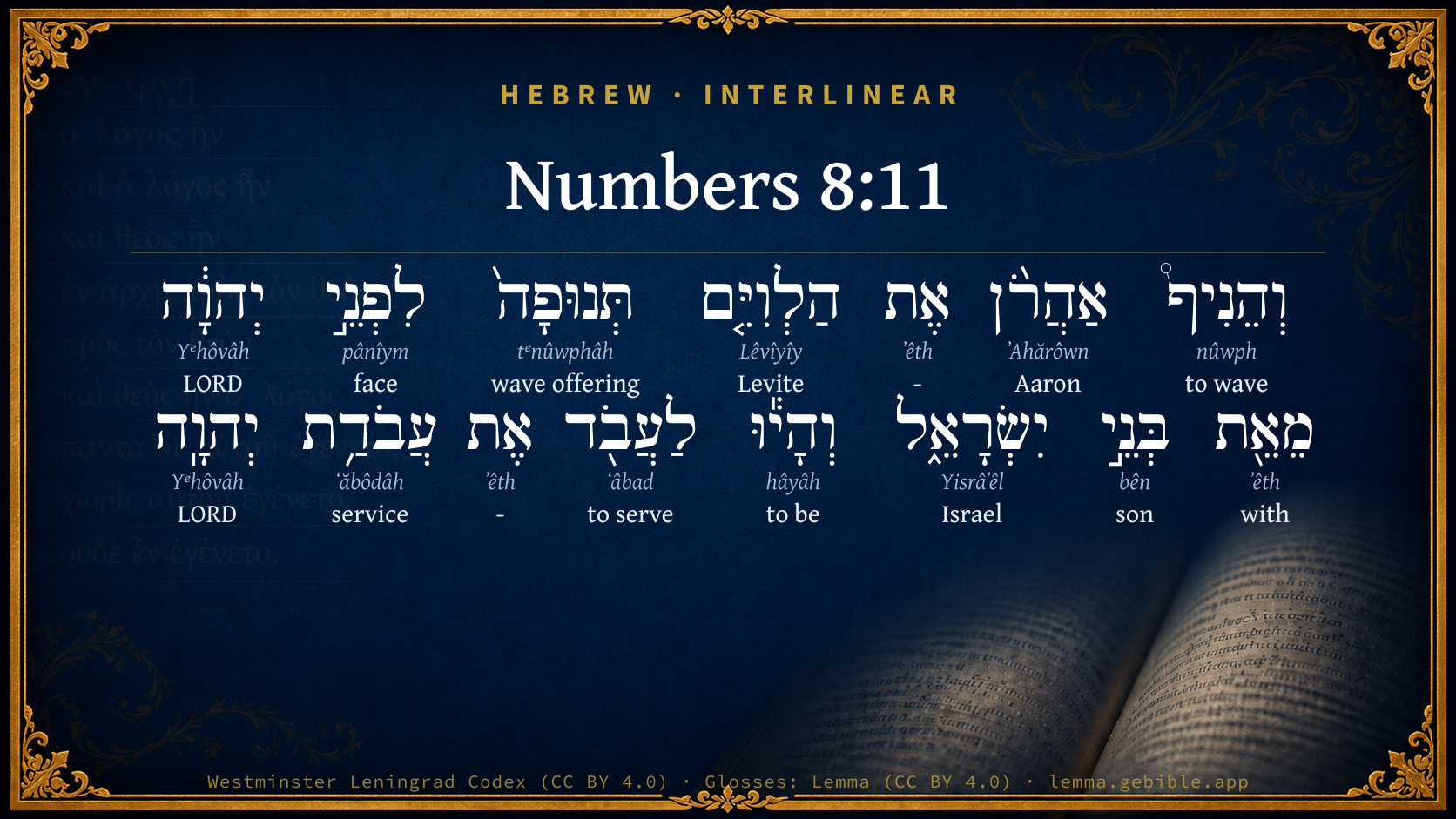
Hebrew (Westminster Leningrad Codex) Numbers 8:11 appears in the Hebrew Old Testament. The text above is from the Westminster Leningrad Codex. Each word links to its Strong’s number, a concise gloss, and parsing drawn from the Open Scriptures Hebrew Bible morphology. Click any word for its full Brown-Driver-Briggs (BDB) entry.
Download image
Cite this verse

Numbers 8:11 (World English Bible). Public Domain. Lemma interlinear Bible study tool, https://lemma.gebible.app/v/numbers/8/11.

Show BibTeX & RIS
BibTeX
RIS
English Translation
and Aaron shall offer the Levites before Yahweh for a wave offering, on the behalf of the children of Israel, that it may be theirs to do the service of Yahweh.
World English Bible · Public Domain
Download a study sheet

One document with this verse’s original text, its word-by-word gloss line, the meaning frame, cross-references with their text, attributed commentary, and full source and license credits — printable, and it pastes into notes with its structure intact.

This verse Autodidact and up

Study sheet (.html) Plain text (.txt)

A passage Seminary Student

Up to 50 verses in one chapter. A passage sheet keeps up to 6 commentary sources and 12 cross-references per verse, in the order this page ranks them, and says so on the sheet whenever that leaves anything out. Ask for a single verse and you get the Autodidact verse sheet above.

Everything on this page stays free to read, with no account — the sheet is a download of what is already on screen, not access to it.

Want to remove ads? Support Godless Engineer
Compare translations 3

The same verse in 3 English versions, stacked beneath the original-language interlinear above. Click any original word for its lexicon entry.

Each is an independent rendering of the whole verse — the interlinear is not word-aligned to these translations.

Highlighted words mark where these versions differ — a whole-verse word diff, not a word-by-word alignment.

  • World English Bible Public Domain
    and Aaron shall offer the Levites before Yahweh for a wave offering, on the behalf of the children of Israel, that it may be theirs to do the service of Yahweh.
  • King James Version Public Domain
    And Aaron shall offer the Levites before the LORD for an offering of the children of Israel, that they may execute the service of the LORD.
  • unfoldingWord Literal Text CC BY-SA 4.0
    And Aaron shall raise the Levites a raised offering to the face of Yahweh from with the sons of Israel. And they shall be to serve the service of Yahweh.

unfoldingWord Literal Text — © unfoldingWord, licensed CC BY-SA 4.0. Word-aligned USFM3 via Door43 (git.door43.org/unfoldingWord/en_ult).

Versions to compare (up to 4)

3 of 4 selected

Show all 18 translations

Every available English version of this verse, each an independent rendering of the whole verse.

  • World English Bible Public Domain
    and Aaron shall offer the Levites before Yahweh for a wave offering, on the behalf of the children of Israel, that it may be theirs to do the service of Yahweh.
  • Berean Standard Bible Public Domain
    Aaron is to present the Levites before the LORD as a wave offering from the sons of Israel, so that they may perform the service of the LORD.
  • Majority Standard Bible Public Domain
    Aaron is to present the Levites before the LORD as a wave offering from the sons of Israel, so that they may perform the service of the LORD.
  • King James Version Public Domain
    And Aaron shall offer the Levites before the LORD for an offering of the children of Israel, that they may execute the service of the LORD.
  • American Standard Version (1901) Public Domain
    and Aaron shall offer the Levites before Jehovah for a wave-offering, on the behalf of the children of Israel, that it may be theirs to do the service of Jehovah.
  • Revised Version (1885) Public Domain
    and Aaron shall offer the Levites before the LORD for a wave offering, on the behalf of the children of Israel, that they may be to do the service of the LORD.
  • Geneva Bible (1599) Public Domain
    And Aaron shall offer the Leuites before the Lord, as a shake offring of ye childre of Israel, that they may execute the seruice of the Lord.
  • Douay-Rheims (1899) Public Domain
    And Aaron shall offer the Levites, as a gift in the sight of the Lord from the children of Israel, that they may serve in his ministry.
  • Young's Literal Translation Public Domain
    and Aaron hath waved the Levites -- a wave-offering before Jehovah, from the sons of Israel, and they have been -- for doing the service of Jehovah.
  • Literal Standard Version CC BY-SA 4.0
    and Aaron has waved the Levites [as] a wave-offering before YHWH, from the sons of Israel, and they have been [consecrated] for doing the service of YHWH.
  • Unlocked Literal Bible CC BY-SA 4.0
    Aaron must offer the Levites before Yahweh, as a wave offering from the people of Israel so that they may do the service of Yahweh.
  • unfoldingWord Literal Text CC BY-SA 4.0
    And Aaron shall raise the Levites a raised offering to the face of Yahweh from with the sons of Israel. And they shall be to serve the service of Yahweh.
  • Darby Bible Public Domain
    And Aaron shall offer the Levites as a wave-offering before Jehovah from the children of Israel, and they shall perform the service of Jehovah.
  • World Messianic Bible Public Domain
    and Aaron shall offer the Levites before the LORD for a wave offering on the behalf of the children of Israel, that it may be theirs to do the service of the LORD.
  • Webster's Bible Public Domain
    And Aaron shall offer the Levites before the LORD for an offering of the children of Israel, that they may execute the service of the LORD.
  • Free Bible Version CC BY-SA 4.0
    Aaron shall present the Levites to the Lord as a wave offering from the Israelites so that they can do the Lord's work.
  • Bible in Basic English Public Domain
    And Aaron is to give the Levites to the Lord as a wave offering from the children of Israel, so that they may do the Lord's work.
  • JPS Tanakh (1917) Public Domain
    And Aaron shall offer the Levites before the LORD for a wave-offering from the children of Israel, that they may be to do the service of the LORD.

Literal Standard Version (2020), Covenant Press — licensed CC BY-SA 4.0. Text via the HelloAO Bible API (eBible.org). Unlocked Literal Bible (unfoldingWord) — licensed CC BY-SA 4.0. Text via the HelloAO Bible API (eBible.org). unfoldingWord Literal Text — © unfoldingWord, licensed CC BY-SA 4.0. Word-aligned USFM3 via Door43 (git.door43.org/unfoldingWord/en_ult). Free Bible Version, Dr. Jonathan Gallagher — licensed CC BY-SA 4.0. Text via the HelloAO Bible API (eBible.org).

Word by word

More ways to search: Search by grammar → Find every occurrence → Compare this word →

Practice this passage: Drill this verse → Learn its vocabulary →

תְּנוּפָה֙
tᵉnûwphâh
H8573
“wave offering”
Noun, Common, Feminine, Singular, Absolute
Part of Speech
Noun
Type
Common
Gender
Feminine
Number
Singular
State
Absolute
Full BDB Definition

Origin: from H5130

TWOT: 1330b

swinging, waving, wave offering, offering - a swinging, brandishing - of God's hand, weapons - waving, wave-offering (technical term of sacrifice) - offering (of gold or brass)
  1. וְהֵנִיף֩ nûwph H5130 “and · to wave” Conjunction + Verb, Hiphil, Sequential Perfect, 3rd Person, Masculine, Singular
  2. אַהֲרֹ֨ן ʼAhărôwn H175 “Aaron” Noun, Proper
  3. אֶת ʼêth H853 “-” Particle, Direct Object
  4. הַלְוִיִּ֤ם Lêvîyîy H3881 “the · Levites” Particle, Definite Article + Noun, Gentilic, Masculine, Plural, Absolute
  5. לִפְנֵ֣י pânîym H6440 “to/for · face(s) of” Preposition + Noun, Common, Both, Plural, Construct
  6. יְהוָ֔ה Yᵉhôvâh H3068 “LORD” Noun, Proper
  7. מֵאֵ֖ת ʼêth H854 “from · with” Preposition + Preposition
  8. בְּנֵ֣י bên H1121 “sons of” Noun, Common, Masculine, Plural, Construct
  9. יִשְׂרָאֵ֑ל Yisrâʼêl H3478 “Israel” Noun, Proper
  10. וְהָי֕וּ hâyâh H1961 “and · to be” Conjunction + Verb, Qal, Sequential Perfect, 3rd Person, Common, Plural
  11. לַעֲבֹ֖ד ʻâbad H5647 “to serve” Preposition + Verb, Qal, Infinitive Construct
  12. אֶת ʼêth H853 “-” Particle, Direct Object
  13. עֲבֹדַ֥ת ʻăbôdâh H5656 “service of” Noun, Common, Feminine, Singular, Construct
  14. יְהוָֽה Yᵉhôvâh H3068 “LORD” Noun, Proper

About this verse

These counts appear in no published source. They are computed here, from the morphology-tagged text and Lemma’s own curated glosses. What Lemma adds →

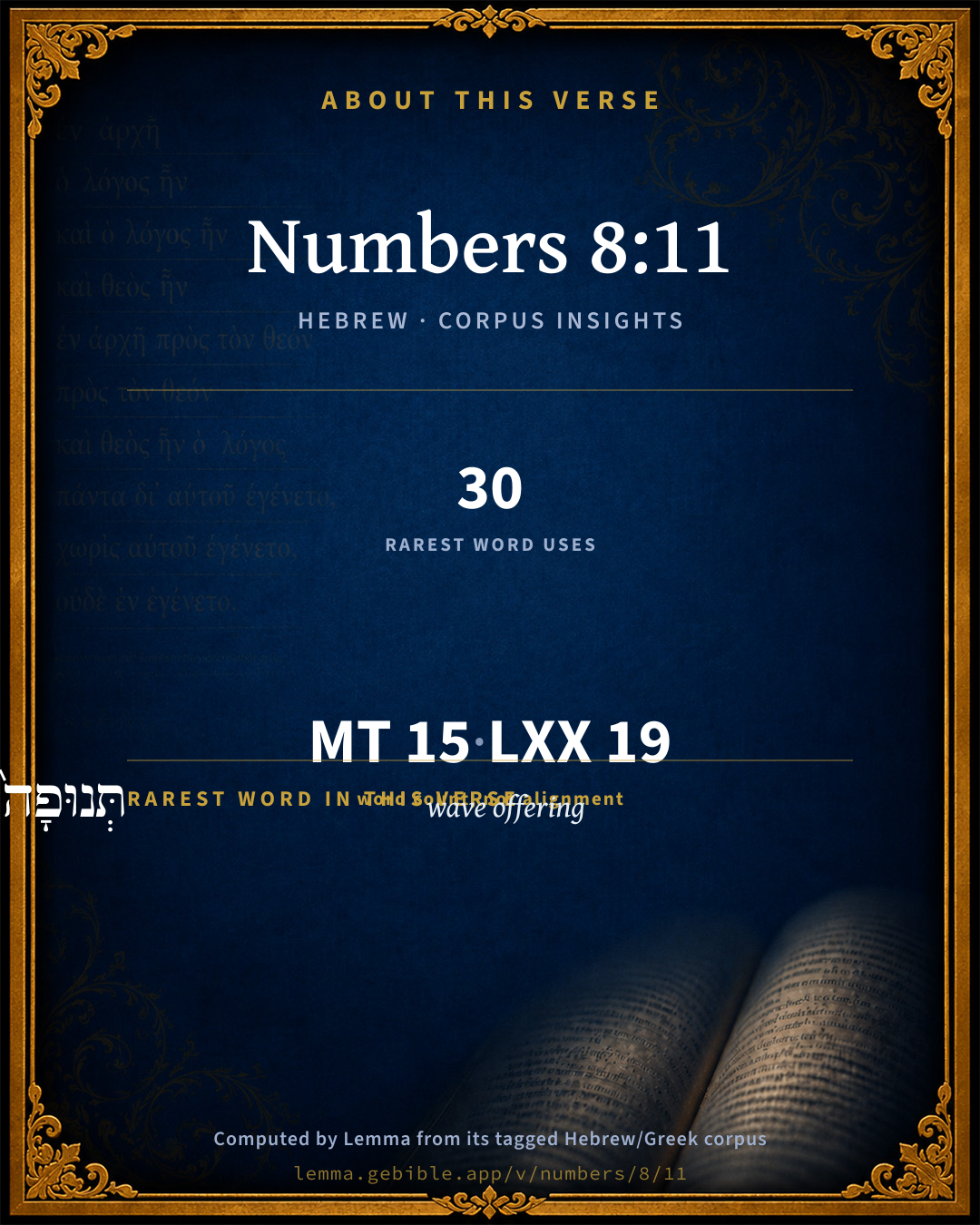
15
words
13
distinct lemmas
Pentateuch
section

Shared distinctive vocabulary

תְּנוּפָה֙ wave offering H8573 occurs in 28 verses of the Hebrew Bible. Also found in:

Grammatical profile

  • 3 verbs
  • 9 nouns
  • 1 preposition
  • 2 particles

Verb forms

  • וְהֵנִיף֩ Hiphil · Sequential Perfect
  • וְהָי֕וּ Qal · Sequential Perfect
  • לַעֲבֹ֖ד Qal · Infinitive Construct

Repetition

A word recurs within this verse — often emphatic in Hebrew:

  • יְהוָ֔ה LORD H3068 ×2

Hebrew & Septuagint length

In English translation the verse runs 31 words from the Hebrew and 29 from the Septuagint (LXX English) — closely comparable.

A rough comparison of the two English renderings, which tokenize alike — not a word-level alignment.

Word counts can differ between the Hebrew and the Greek without any difference in meaning — e.g. the Hebrew direct-object marker אֵת has no separate Greek word, and Greek often adds the article ὁ.

In the original languages it is 15 Hebrew tokens and 19 Greek tokens — but the two are counted differently (Hebrew bundles its prefixes and suffixes into one token; the Greek is in lemma form), so that isn’t a like-for-like length.

Cross-references

7

Topical passages linked to Numbers 8:11 in the Treasury of Scripture Knowledge — connected by theme and wording, ordered by reader-vote popularity; previews shown in the World English Bible.

  • Leviticus 7:30 With his own hands he shall bring the offerings of Yahweh made by fire. He shall bring the fat with the breast, that the breast may be waved for a wave offering before Yahweh.
  • Exodus 29:24 You shall put all of this in Aaron's hands, and in his sons' hands, and shall wave them for a wave-offering before Yahweh.
  • Leviticus 8:27 He put all these in Aaron's hands and in his sons' hands, and waved them for a wave offering before Yahweh.
  • Leviticus 8:29 Moses took the breast, and waved it for a wave offering before Yahweh. It was Moses' portion of the ram of consecration, as Yahweh commanded Moses.
  • Numbers 1:49–53 "Only the tribe of Levi you shall not number, neither shall you take a census of them among the children of Israel;
  • Numbers 3:5–43 Yahweh spoke to Moses, saying,
  • Numbers 6:20 and the priest shall wave them for a wave offering before Yahweh. This is holy for the priest, together with the breast that is waved and the thigh that is offered. After that the Nazirite may drink wine.

Cross-references courtesy of OpenBible.info (CC BY 4.0).

Hebrew and Greek witnesses Masoretic Hebrew ↔ Greek Septuagint

The same verse in the two great witnesses to the Old Testament, shown verse-for-verse.

These are two independent witnesses, not word-aligned to each other, and the Septuagint is shown in lemma (dictionary) form.

Hebrew Numbers 8:11 Masoretic · Westminster Leningrad Codex

וְהֵנִיף֩ אַהֲרֹ֨ן אֶת הַלְוִיִּ֤ם תְּנוּפָה֙ לִפְנֵ֣י יְהוָ֔ה מֵאֵ֖ת בְּנֵ֣י יִשְׂרָאֵ֑ל וְהָי֕וּ לַעֲבֹ֖ד אֶת עֲבֹדַ֥ת יְהוָֽה

and Aaron shall offer the Levites before Yahweh for a wave offering, on the behalf of the children of Israel, that it may be theirs to do the service of Yahweh.

World English Bible · Public Domain

Greek LXX Numbers 8:11 Septuagint · lemma form

καί ἀποὁρίζω ἀαρών ὁ λευίτης ἀπόδομα ἔναντι κύριος παρά ὁ υἱός ἰσραήλ καί εἰμί ὥστε ἐργάζομαι ὁ ἔργον κύριος

And Aaron shall separate the Levites for a gift before the Lord from the children of Israel: and they shall be prepared to perform the works of the Lord.

LXX2012 (modern English Septuagint) · Public Domain

Hebrew: Westminster Leningrad Codex (CC BY 4.0). Greek: Septuagint (public domain); English from LXX2012 (modern English Septuagint) (Public Domain). How the Septuagint differs from the Hebrew →

Targum (Aramaic paraphrase)

2

The Targum is the ancient Jewish Aramaic paraphrase of the Hebrew Scriptures — an interpretive translation, not the Hebrew text itself. Onkelos (literal) and Pseudo-Jonathan (expansive) render the Torah, and Jonathan the Prophets. Coverage is partial: where no permissively-licensed English translation exists for a verse, only the Aramaic is shown. This is verse-level text, not a word-by-word alignment to the Hebrew.

  1. Targum Onkelos Torah (Genesis–Deuteronomy)
    וִירִים אַהֲרֹן יָת לֵוָאֵי אֲרָמָא קֳדָם יְיָ מִן בְּנֵי יִשְׂרָאֵל וִיהוֹן לְמִפְלַח יָת פֻּלְחָנָא דַיְיָ

    (no public-domain English translation for this verse)

    Targum Onkelos — Aramaic: “Onkelos Genesis” (public domain); “Onkelos Exodus” (public domain); “Onkelos Leviticus” (public domain); “Onkelos Numbers” (public domain); “Onkelos Deuteronomy” (public domain). English: “Sefaria Community Translation” (CC0 1.0 (public-domain dedication)); “J.W. Etheridge. The Targums of Onkelos and Jonathan Ben Uzziel on the Pentateuch. London: Longmans, Green, 1862” (public domain). Text via Sefaria.

  2. Targum Pseudo-Jonathan Torah (Genesis–Deuteronomy)
    וְיָרִים אַהֲרן יַת לֵיוָאֵי אֲרָמָא קֳדָם יְיָ מִן בְּנֵי יִשְרָאֵל וִיהוֹן לְמִפְלַח יַת פּוּלְחָנָא דַיְיָ

    And Aharon shall present the Levites, (as) an elevation before the Lord from the sons of Israel, and they shall be for the work of the service of the Lord.

    Targum Pseudo-Jonathan — Aramaic: “Targum Jonathan on Genesis” (public domain); “Targum Jonathan on Exodus” (public domain); “Targum Jonathan on Leviticus” (public domain); “Targum Jonathan on Numbers” (public domain); “Targum Jonathan on Deuteronomy” (public domain). English: “The Targum of Jonathan ben Uzziel, trans. J. W. Etheridge, London, 1862” (public domain). Text via Sefaria.

Commentary

Notes on Numbers 8:11 from classic Christian and Jewish commentators (each source and its license shown beneath its notes). The classic Christian expositions comment on the surrounding passage and are grouped to its opening verse, so a note may address several verses; the Jewish commentaries on the Tanakh (Rashi and others) are per-verse, so they appear only where the commentator wrote on this verse.

Lemma curates 59 commentaries, every one of them public domain or Creative Commons licensed, each selected and text-cleaned for this edition rather than reprinted as found. About our sources →

Trapp's Complete Commentary

John Trapp

Num 8:11 And Aaron shall offer the Levites before the LORD [for] an offering of the children of Israel, that they may execute the service of the LORD.

Ver. 11. And Aaron shall offer the Levites.] Heb., Wave the Levites; which might figure, ministers’ miseries and afflictions, by Satan’s sifting them, and wicked men’s turmoiling them, as Jeremiah, that "man of contentions." {Jer 15:12}

John Trapp, A Commentary or Exposition upon All the Books of the Old and New Testament (1647–1656) — public domain. Text from a community e-Sword module.

Joseph Benson's Commentary

Num 8:11. Aaron shall offer — Hebrew, Shall wave the Levites for a wave- offering; not that Aaron did so wave them, which be could not do, but it is probable that he lifted up his hands, and turned to all quarters of the heavens, as he did when he offered a wave-offering; and that he caused them to imitate his motions, and to wave themselves toward the several parts of the world; in order that they might hereby signify their readiness to serve God, according to their capacity, wheresoever they should be.

Joseph Benson's Commentary on the Old and New Testaments (1811–1818) — public domain. Text from a community e-Sword module.

Keil & Delitzsch

C. F. Keil & F. Delitzsch

This transfer was to be completed by Aaron's waving the Levites as a wave-offering before Jehovah on behalf of the children of Israel, i.e., by his offering them symbolically to the Lord as a sacrifice presented on the part of the Israelites. The ceremony of waving consisted no doubt in his conducting the Levites solemnly up to the altar, and then back again. On the signification of the verb, see at Lev 7:30. The design of the waving is given in Num 8:11, viz., "that they might be to perform the service of Jehovah" (Num 8:24-26 compared with Num 4:4-33).

Keil & Delitzsch — Biblical Commentary on the Old Testament (1861–1891) — public domain (CC PDM 1.0). Text via the HelloAO Bible API. (Old Testament only.)

Tyndale Open Study Notes

Tyndale Open Resources

8:11 The reference to Aaron’s raised hands suggests that Israel offered the Levites to the Lord as a “wave offering”—the type of offering lifted up to the Lord (cp. Lev 7:30). The Levites were dedicated to duties that made them “living and holy sacrifices” (cp. Rom 12:1).

Tyndale Open Study Notes — © Tyndale Open Resources, licensed CC BY-SA 4.0. Text via the HelloAO Bible API.

Jamieson, Fausset & Brown

Robert Jamieson, A. R. Fausset & David Brown

And Aaron shall offer the Levites--Hebrew, "as a wave offering"; and it has been thought probable that the high priest, in bringing the Levites one by one to the altar, directed them to make some simple movements of their persons, analogous to what was done at the presentation of the wave offerings before the Lord. Thus were they first devoted as an offering to God, and by Him surrendered to the priests to be employed in His service. The consecration ceremonial was repeated in the case of every Levite who was taken (as was done at a later period) to assist the priests in the tabernacle and temple. (See on Ch2 29:34).

Jamieson, Fausset & Brown — Commentary Critical and Explanatory on the Whole Bible (1871) — public domain (CC PDM 1.0). Text via the HelloAO Bible API.

Ellicott's Commentary for English Readers

(11) And Aaron shall offer the Levites before the Lord for an offering.—Literally, and Aaron shall wave the Levites as a wave-offering before the Lord. The manner in which the Levites were thus set apart to the Lord is not expressed. It may have been done by leading them backwards and forwards in front of the Tabernacle and in the presence of the people, or by the waving of Aaron’s hands. The same word is used elsewhere in reference to offerings of different kinds—as, e.g., of gold in Exo_35:22. (Comp. Num_8:13; Num_8:15; Num_8:21 of this chapter.) The symbolical meaning of the ceremony is obvious from the concluding words of the verse, and is further explained in Num_8:13-14. (Comp. Lev_7:30 and Note.)

A Bible Commentary for English Readers, edited by Charles John Ellicott (1878–1897) — public domain. Text from a community e-Sword module.

The Cambridge Bible for Schools and Colleges

gen. ed. J. J. S. Perowne

11. offer] wave, as R.V. marg.; see Num_8:13; Num_8:15; Num_8:21. The literal significance of the term (see on Num_5:25) is here lost, but the underlying thought remains that, having been given to Jehovah, the Levites were given back by Him for ritual service to the priests and the congregation.

The Cambridge Bible for Schools and Colleges (gen. ed. J. J. S. Perowne; Cambridge University Press, 1878–1918) — public domain. Text from a community e-Sword module.

John Gill's Exposition

And Aaron shall offer the Levites before the Lord,.... Or "wave" (r) them, as a wave offering, which was moved to and fro, backwards and forwards; not that they were actually so waved and moved to and fro by Aaron, which could not be done by him; though it is possible he might make such a motion himself, and they might do the like after him, thereby signifying that they belonged unto the Lord of the whole earth; and some think this testified their readiness to serve the Lord; to which may be added their constant employment in his service, being always in motion, doing one piece of service or another continually; as the people of God, and especially the ministers of the word, should be always abounding: in the work of the Lord. Ainsworth supposes that the troubles and afflictions of the ministers of God are figured hereby:

for an offering of the children of Israel; to the Lord, hereby devoting them to his service:

that they may execute the service of the Lord; for them, in their room and stead, do what otherwise they must have done; see Num 3:7; with this compare Isa 66:20.

(r) "et motabit", Tigurine version; "et faciet elevare", Pagninus, Montanus, Vatablus; "et agitabit", Drusius; "et agitato", Piscator.

John Gill's Exposition of the Whole Bible (1746–1763) — public domain (CC PDM 1.0). Text via the HelloAO Bible API.

Haydock's Catholic Bible Commentary

A gift. Hebrew, "he shall heave them as a heave-offering before the Lord." Some assert, that Aaron lifted each of them towards the four quarters of the world; (ver. 21,) or he made them go up towards the altar, and on each side. This ceremony was performed whenever a Levite was taken into the ministry, 2 Paralipomenon xxix. 34.

George Leo Haydock (1774–1849), Haydock's Catholic Family Bible and Commentary, 1859 edition — public domain. Excludes Psalms (Douay-Rheims chapter numbering differs from Protestant) and Deuterocanonical books (Catholic canon only).

Matthew Poole's English Annotations

For an offering, Heb. for a wave-offering. Of which see Exo 29:24. Not that Aaron did so wave them, which he could not do, but that he caused or commanded them to imitate that motion, and to wave themselves towards the several parts of the world; whereby they might signify their readiness to serve God according to their capacity wheresoever they should be; though the word may be taken more generally for any offering made to God, as Exo 35:22.

Matthew Poole's English Annotations on the Holy Bible (1683–1685) — public domain. Text from a community e-Sword/MySword module.

Whedon's Commentary on the Bible

Daniel D. Whedon

11. Aaron shall offer the Levites — Literally, wave the Levites. In the wave offering portions of the victims were waved to and fro at the altar, (Lev_7:30, note,) but in the case of men they no doubt were solemnly led backward and forward before the altar.

Daniel D. Whedon (gen. ed.), Commentary on the Old and New Testaments (1874–1909) — public domain. Text from a community e-Sword module.

The Pulpit Commentary

And Aaron shall offer the Levites before the Lord for an offering. Rather, "Aaron shall wave" them "for a wave offering"; (Hebrew, nuph; see Exo_29:24) and so in verses 13, 15, and 21. This injunction seems conclusive that the whole ceremonial was to be symbolically per. formed, for the Levites could not possibly be waved in any literal sense. Some have supposed that they were marched up and down before the altar, forgetting that the court would scarcely afford standing room for 1000 people, while the Levites between thirty and fifty numbered more than 8000. It is certain that the Levites could only be brought before the Lord, could only be waved (howsoever that was done), could only lay their hands upon the bullocks, by representation. If we suppose, e.g., that a hundred men of position and command among them entered the court as representatives of the tribe, then we can understand how the ceremonial here commanded might have been effectively carried out. That they may execute the service of the Lord. Literally, "that they may be to execute the service of the Lord." Their being waved made them over in a figure to the Lord to be wholly his, and to live only for his service, and at his command. But just as wave offerings were assigned by Divine permission to the use of the priests, so were the Levites given to Aaron and his sons for ever.

The Pulpit Commentary (1880–1919), ed. H.D.M. Spence-Jones & Joseph S. Exell — public domain. Text from a community e-Sword module.

John Wesley's Explanatory Notes

For an offering - Hebrew. for a wave-offering. Not that Aaron did so wave them, which he could not do, but that he caused them to imitate that motion, and to wave themselves toward the several parts of the world: whereby they might signify their readiness to serve God, according to their capacity wheresoever they should be.

John Wesley, Explanatory Notes Upon the Whole Bible (1754–1765) — public domain. Text via the GEBible commentary corpus.

Rashi

Rabbi Shlomo Yitzchaki (Rashi)

והניף אהרן את הלוים תנופה AND AARON SHALL MAKE A WAVING WITH THE LEVITES — just as the guilt offering of the leper (to whom the Levites are compared in some respect; cf. Rashi on v. 7) required waving whilst alive. — Three times is the command of waving the Levites mentioned in this section (vv. 11, 13, 15): the first refers to the sons of Kohath; therefore (because it is they who are referred to) Scripture adds with regard to them, “that they may execute the service of the Lord” — for it was upon them (the sons of Kohath) that the service of the most holy objects: the Ark, the table, etc., devolved. The second refers to the sons of Gershon, and therefore Scripture adds with regard to them, “a waving for the Lord”, for upon them devolved the service of the holy (though not the most holy) objects: the hangings and the catches which were visible in the Holy of Holies. The third refers to the sons of Merari.

Rashi on the Tanakh — English translations: “The Judaica Press complete Tanach with Rashi, translated by A. J. Rosenberg” (CC BY 4.0); “Pentateuch with Rashi's commentary by M. Rosenbaum and A.M. Silbermann, 1929-1934” (public domain); “The Metsudah Tanach series, Lakewood, N.J” (CC BY 4.0); and “The Book of Joshua, Metsudah Publications, 1997” (CC BY 4.0). Text via Sefaria.

Lesson kit

Teaching starters — assembled from the data on this page, not authored interpretation. Every prompt links to the verse data it draws on. Edit before teaching.

Numbers, in the Pentateuch, opens this verse with 15 words (13 distinct Hebrew lemmas). Its most distinctive word is tᵉnûwphâh (“wave offering”). A historical commentator’s framing appears above. Read the whole chapter for the surrounding context.

Discussion questions

  1. How does “wave offering” (tᵉnûwphâh) shape what this verse is saying?
  2. Exodus 29:24 shares the word «wave offering» with this verse. How do the two illuminate each other?
  3. “LORD” occurs 2× in this one verse. What is the effect of the repetition?
  4. These translations render this verse differently. What is at stake in choosing one wording over another?
  5. The verb «וְהֵנִיף֩» is Hiphil Sequential Perfect. How does its form color the action?
  6. Reading how Trapp's Complete Commentary and Joseph Benson's Commentary read this verse, where do the two commentators agree and where do they part?

Things to notice

Reading settings

Reading text

Shown beneath each verse's original-language words.

Old Testament
Old Testament edition

Read the OT as the Masoretic Hebrew (MT) or the Greek Septuagint (LXX).

English shown for the Greek Septuagint (in the Hebrew ↔ Greek comparison).

Comparing translations? Open the Compare panel on any verse page to stack up to four side by side.