
2 Chronicles 29:12

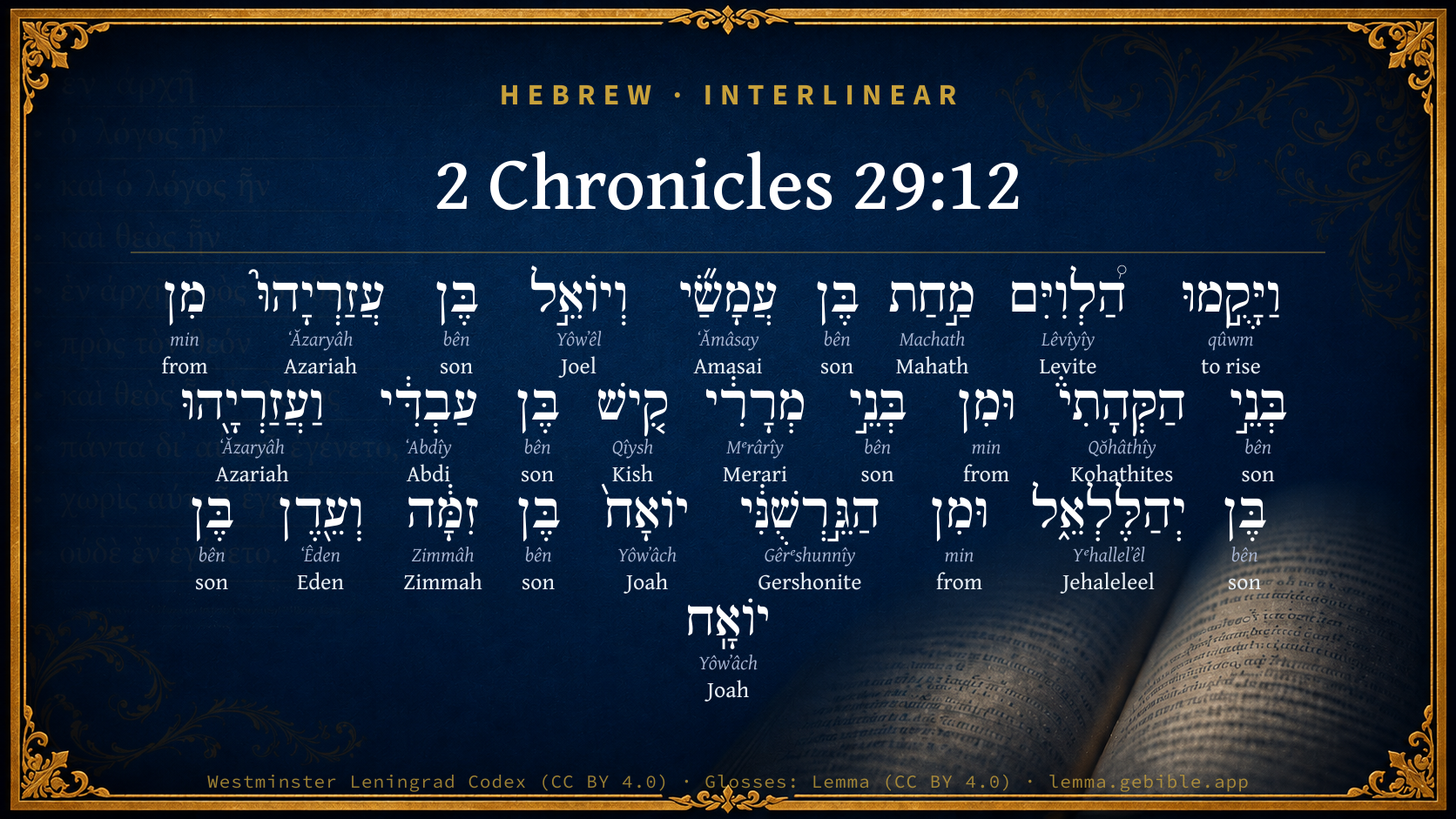
Hebrew (Westminster Leningrad Codex) 2 Chronicles 29:12 appears in the Hebrew Old Testament. The text above is from the Westminster Leningrad Codex. Each word links to its Strong’s number, a concise gloss, and parsing drawn from the Open Scriptures Hebrew Bible morphology. Click any word for its full Brown-Driver-Briggs (BDB) entry.
Download image
Cite this verse

2 Chronicles 29:12 (World English Bible). Public Domain. Lemma interlinear Bible study tool, https://lemma.gebible.app/v/2-chronicles/29/12.

Show BibTeX & RIS
BibTeX
RIS
English Translation
Then the Levites arose, Mahath, the son of Amasai, and Joel the son of Azariah, of the sons of the Kohathites; and of the sons of Merari, Kish the son of Abdi, and Azariah the son of Jehallelel; and of the Gershonites, Joah the son of Zimmah, and Eden the son of Joah;
World English Bible · Public Domain
Download a study sheet

One document with this verse’s original text, its word-by-word gloss line, the meaning frame, cross-references with their text, attributed commentary, and full source and license credits — printable, and it pastes into notes with its structure intact.

This verse Autodidact and up

Study sheet (.html) Plain text (.txt)

A passage Seminary Student

Up to 50 verses in one chapter. A passage sheet keeps up to 6 commentary sources and 12 cross-references per verse, in the order this page ranks them, and says so on the sheet whenever that leaves anything out. Ask for a single verse and you get the Autodidact verse sheet above.

Everything on this page stays free to read, with no account — the sheet is a download of what is already on screen, not access to it.

Want to remove ads? Support Godless Engineer
Compare translations 3

The same verse in 3 English versions, stacked beneath the original-language interlinear above. Click any original word for its lexicon entry.

Each is an independent rendering of the whole verse — the interlinear is not word-aligned to these translations.

Highlighted words mark where these versions differ — a whole-verse word diff, not a word-by-word alignment.

  • World English Bible Public Domain
    Then the Levites arose, Mahath, the son of Amasai, and Joel the son of Azariah, of the sons of the Kohathites; and of the sons of Merari, Kish the son of Abdi, and Azariah the son of Jehallelel; and of the Gershonites, Joah the son of Zimmah, and Eden the son of Joah;
  • King James Version Public Domain
    Then the Levites arose, Mahath the son of Amasai, and Joel the son of Azariah, of the sons of the Kohathites: and of the sons of Merari, Kish the son of Abdi, and Azariah the son of Jehalelel: and of the Gershonites; Joah the son of Zimmah, and Eden the son of Joah:
  • unfoldingWord Literal Text CC BY-SA 4.0
    And the Levites arose: Mahath the son of Amasai, and Joel the son of Azariah, from the sons of the Kohathites; and from the sons of Merari, Kish the son of Abdi, and Azariah the son of Jehallelel; and from the Gershonites, Joah the son of Zimmah, and Eden the son of Joah;

unfoldingWord Literal Text — © unfoldingWord, licensed CC BY-SA 4.0. Word-aligned USFM3 via Door43 (git.door43.org/unfoldingWord/en_ult).

Versions to compare (up to 4)

3 of 4 selected

Show all 18 translations

Every available English version of this verse, each an independent rendering of the whole verse.

  • World English Bible Public Domain
    Then the Levites arose, Mahath, the son of Amasai, and Joel the son of Azariah, of the sons of the Kohathites; and of the sons of Merari, Kish the son of Abdi, and Azariah the son of Jehallelel; and of the Gershonites, Joah the son of Zimmah, and Eden the son of Joah;
  • Berean Standard Bible Public Domain
    Then the Levites set to work: Mahath son of Amasai and Joel son of Azariah from the Kohathites; Kish son of Abdi and Azariah son of Jehallelel from the Merarites; Joah son of Zimmah and Eden son of Joah from the Gershonites;
  • Majority Standard Bible Public Domain
    Then the Levites set to work: Mahath son of Amasai and Joel son of Azariah from the Kohathites; Kish son of Abdi and Azariah son of Jehallelel from the Merarites; Joah son of Zimmah and Eden son of Joah from the Gershonites;
  • King James Version Public Domain
    Then the Levites arose, Mahath the son of Amasai, and Joel the son of Azariah, of the sons of the Kohathites: and of the sons of Merari, Kish the son of Abdi, and Azariah the son of Jehalelel: and of the Gershonites; Joah the son of Zimmah, and Eden the son of Joah:
  • American Standard Version (1901) Public Domain
    Then the Levites arose, Mahath, the son of Amasai, and Joel the son of Azariah, of the sons of the Kohathites; and of the sons of Merari, Kish the son of Abdi, and Azariah the son of Jehallelel; and of the Gershonites, Joah the son of Zimmah, and Eden the son of Joah;
  • Revised Version (1885) Public Domain
    Then the Levites arose, Mahath the son of Amasai, and Joel the son of Azariah, of the sons of the Kohathites: and of the sons of Merari, Kish the son of Abdi, and Azariah the son of Jehallelel: and of the Gershonites, Joah the son of Zimmah, and Eden the son of Joah:
  • Geneva Bible (1599) Public Domain
    Then the Leuites arose, Mahath ye sonne of Amashai, and Ioel the sonne of Azariah of the sonnes of the Kohathites: and of the sonnes of Merari, Kish the sonne of Abdi, and Azariah the sonne of Iehalelel: and of the Gershonites, Ioah the sonne of Zimmah, and Eden the sonne of Ioah:
  • Douay-Rheims (1899) Public Domain
    Then the Levites arose, Mahath the son of Amasai, and Joel the son of Azarias, of the sons of Caath: and of the sons of Merari, Cis the son of Abdi, and Azarias the son of Jalaleel. And of the sons of Gerson, Joah the son of Zemma, and Eden the son of Joah.
  • Young's Literal Translation Public Domain
    And the Levites rise -- Mahath son of Amasai, and Joel son of Azariah, of the sons of the Kohathite; and of the sons of Merari: Kish son of Abdi, and Azariah son of Jehalelel; and of the Gershonite: Joah son of Zimmah, and Eden son of Joah;
  • Literal Standard Version CC BY-SA 4.0
    And the Levites rise—Mahath son of Amasai, and Joel son of Azariah, of the sons of the Kohathite; and of the sons of Merari: Kish son of Abdi, and Azariah son of Jehalelel; and of the Gershonite: Joah son of Zimmah, and Eden son of Joah;
  • Unlocked Literal Bible CC BY-SA 4.0
    Then the Levites arose: Mahath son of Amasai, and Joel son of Azariah, of the people of the Kohathites; and of the people of Merari, Kish son of Abdi, and Azariah son of Jehallelel; and of the Gershonites, Joah son of Zimmah, and Eden son of Joah;
  • unfoldingWord Literal Text CC BY-SA 4.0
    And the Levites arose: Mahath the son of Amasai, and Joel the son of Azariah, from the sons of the Kohathites; and from the sons of Merari, Kish the son of Abdi, and Azariah the son of Jehallelel; and from the Gershonites, Joah the son of Zimmah, and Eden the son of Joah;
  • Darby Bible Public Domain
    Then the Levites rose up, Mahath the son of Amasai, and Joel the son of Azariah, of the sons of the Kohathites; and of the sons of Merari, Kish the son of Abdi, and Azariah the son of Jehalleleel; and of the Gershonites, Joah the son of Zimmah, and Eden the son of Joah;
  • World Messianic Bible Public Domain
    Then the Levites arose: Mahath, the son of Amasai, and Joel the son of Azariah, of the sons of the Kohathites; and of the sons of Merari, Kish the son of Abdi, and Azariah the son of Jehallelel; and of the Gershonites, Joah the son of Zimmah, and Eden the son of Joah;
  • Webster's Bible Public Domain
    Then the Levites arose, Mahath the son of Amasai, and Joel the son of Azariah, of the sons of the Kohathites: and of the sons of Merari, Kish the son of Abdi, and Azariah the son of Jehalelel: and of the Gershonites; Joah the son of Zimmah, and Eden the son of Joah:
  • Free Bible Version CC BY-SA 4.0
    Then the Levites went to work. They were Mahath, son of Amasai, and Joel, son of Azariah, from the Kohathites; Kish, son of Abdi, and Azariah, son of Jehallelel, from the Merarites; Joah, son of Zimmah, and Eden, son of Joah, from the Gershonites;
  • Bible in Basic English Public Domain
    Then the Levites took their places; Mahath, the son of Amasai, and Joel, the son of Azariah, among the Kohathites; and of the sons of Merari, Kish, the son of Abdi, and Azariah, the son of Jehallelel; and of the Gershonites, Joah, the son of Zimmah, and Eden, the son of Joah;
  • JPS Tanakh (1917) Public Domain
    Then the Levites arose, Mahath the son of Amasai, and Joel the son of Azariah, of the sons of the Kohathites; and of the sons of Merari, Kish the son of Abdi, and Azariah the son of Jehallelel; and of the Gershonites, Joah the son of Zimmah, and Eden the son of Joah;

Literal Standard Version (2020), Covenant Press — licensed CC BY-SA 4.0. Text via the HelloAO Bible API (eBible.org). Unlocked Literal Bible (unfoldingWord) — licensed CC BY-SA 4.0. Text via the HelloAO Bible API (eBible.org). unfoldingWord Literal Text — © unfoldingWord, licensed CC BY-SA 4.0. Word-aligned USFM3 via Door43 (git.door43.org/unfoldingWord/en_ult). Free Bible Version, Dr. Jonathan Gallagher — licensed CC BY-SA 4.0. Text via the HelloAO Bible API (eBible.org).

Word by word

More ways to search: Search by grammar → Find every occurrence → Compare this word →

Practice this passage: Drill this verse → Learn its vocabulary →

יְהַלֶּלְאֵ֑ל
Yᵉhallelʼêl
H3094
“Jehaleleel”
Noun, Proper
Part of Speech
Noun
Type
Proper
Full BDB Definition

Origin: from H1984 and H410

TWOT: None

Jehaleleel or Jehalelel = "God is praised" - a Calebite descendant of Judah - father of Azariah and a Merarite Levite in the time of Hezekiah
  1. וַיָּקֻ֣מוּ qûwm H6965 “and · to rise” Conjunction + Verb, Qal, Sequential Imperfect, 3rd Person, Masculine, Plural
  2. הַ֠לְוִיִּם Lêvîyîy H3881 “the · Levites” Particle, Definite Article + Noun, Gentilic, Masculine, Plural, Absolute
  3. מַ֣חַת Machath H4287 “Mahath” Noun, Proper
  4. בֶּן bên H1121 “son of” Noun, Common, Masculine, Singular, Construct
  5. עֲמָשַׂ֞י ʻĂmâsay H6022 “Amasai” Noun, Proper
  6. וְיוֹאֵ֣ל Yôwʼêl H3100 “and · Joel” Conjunction + Noun, Proper
  7. בֶּן bên H1121 “son of” Noun, Common, Masculine, Singular, Construct
  8. עֲזַרְיָהוּ֮ ʻĂzaryâh H5838 “Azariah” Noun, Proper
  9. מִן min H4480 “from” Preposition
  10. בְּנֵ֣י bên H1121 “sons of” Noun, Common, Masculine, Plural, Construct
  11. הַקְּהָתִי֒ Qŏhâthîy H6956 “the · Kohathites” Particle, Definite Article + Noun, Gentilic, Masculine, Singular, Absolute
  12. וּמִן min H4480 “and · from” Conjunction + Preposition
  13. בְּנֵ֣י bên H1121 “sons of” Noun, Common, Masculine, Plural, Construct
  14. מְרָרִ֔י Mᵉrârîy H4847 “Merari” Noun, Proper
  15. קִ֚ישׁ Qîysh H7027 “Kish” Noun, Proper
  16. בֶּן bên H1121 “son of” Noun, Common, Masculine, Singular, Construct
  17. עַבְדִּ֔י ʻAbdîy H5660 “Abdi” Noun, Proper
  18. וַעֲזַרְיָ֖הוּ ʻĂzaryâh H5838 “and · Azariah” Conjunction + Noun, Proper
  19. בֶּן bên H1121 “son of” Noun, Common, Masculine, Singular, Construct
  20. וּמִן min H4480 “and · from” Conjunction + Preposition
  21. הַגֵּ֣רְשֻׁנִּ֔י Gêrᵉshunnîy H1649 “the · Gershonite” Particle, Definite Article + Noun, Gentilic, Masculine, Singular, Absolute
  22. יוֹאָח֙ Yôwʼâch H3098 “Joah” Noun, Proper
  23. בֶּן bên H1121 “son of” Noun, Common, Masculine, Singular, Construct
  24. זִמָּ֔ה Zimmâh H2155 “Zimmah” Noun, Proper
  25. וְעֵ֖דֶן ʻÊden H5731 “and · Eden” Conjunction + Noun, Proper
  26. בֶּן bên H1121 “son of” Noun, Common, Masculine, Singular, Construct
  27. יוֹאָֽח Yôwʼâch H3098 “Joah” Noun, Proper

About this verse

These counts appear in no published source. They are computed here, from the morphology-tagged text and Lemma’s own curated glosses. What Lemma adds →

28
words
17
distinct lemmas
Historical
section

Notable vocabulary

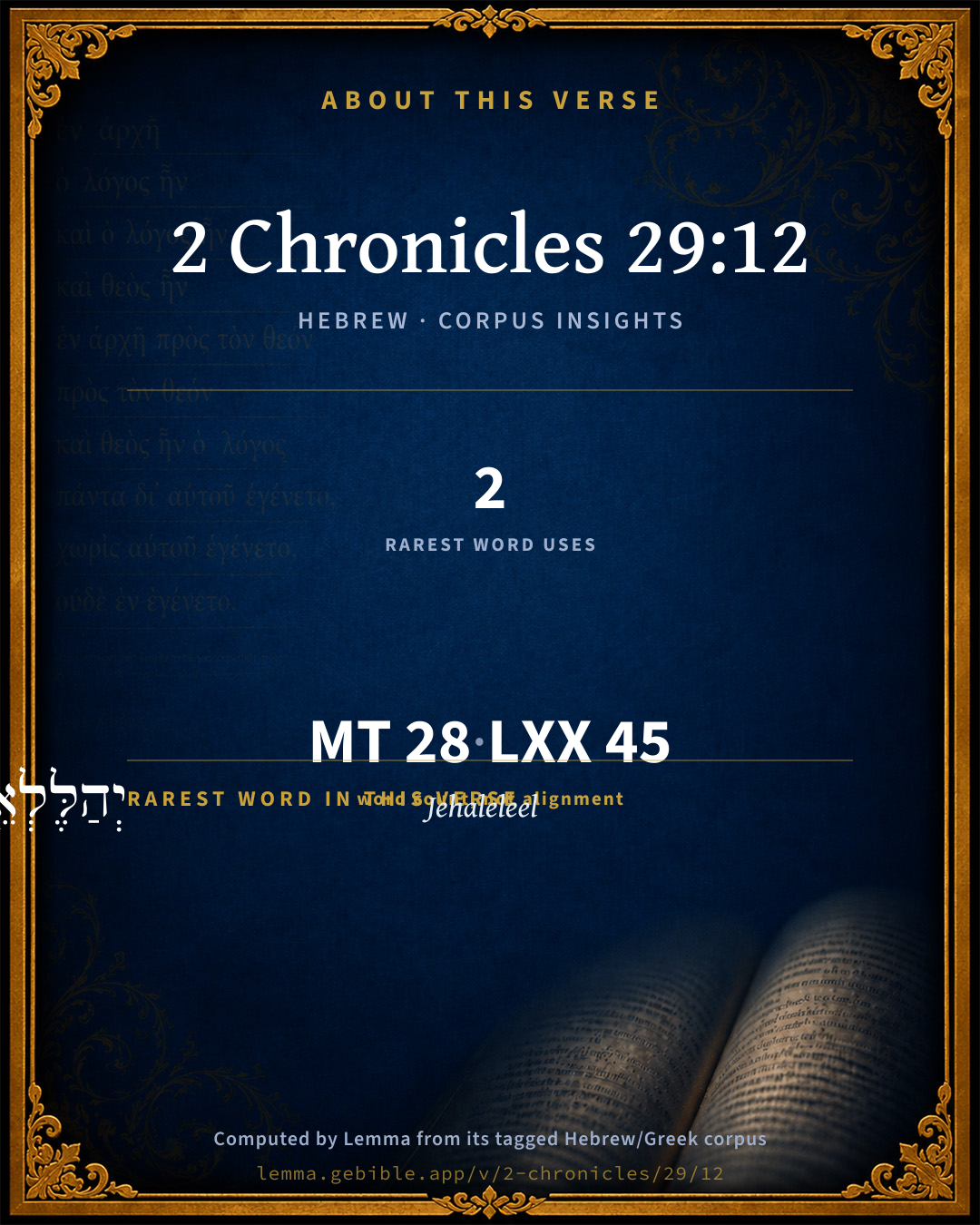
The rarest word here is יְהַלֶּלְאֵ֑ל Jehaleleel H3094 — appearing just 2 times in the whole Hebrew Bible.

Shared distinctive vocabulary

יְהַלֶּלְאֵ֑ל Jehaleleel H3094 occurs in 2 verses of the Hebrew Bible. Also found in:

Grammatical profile

  • 1 verb
  • 24 nouns
  • 3 prepositions

Verb forms

  • וַיָּקֻ֣מוּ Qal · Sequential Imperfect

Repetition

Words recur within this verse — often emphatic in Hebrew:

  • בֶּן son H1121 ×8
  • עֲזַרְיָהוּ֮ Azariah H5838 ×2
  • יוֹאָח֙ Joah H3098 ×2
  • מִן from H4480 ×3

Hebrew & Septuagint length

In English translation the verse runs 53 words from the Hebrew and 57 from the Septuagint (LXX English) — closely comparable.

A rough comparison of the two English renderings, which tokenize alike — not a word-level alignment.

Word counts can differ between the Hebrew and the Greek without any difference in meaning — e.g. the Hebrew direct-object marker אֵת has no separate Greek word, and Greek often adds the article ὁ.

In the original languages it is 28 Hebrew tokens and 45 Greek tokens — but the two are counted differently (Hebrew bundles its prefixes and suffixes into one token; the Greek is in lemma form), so that isn’t a like-for-like length.

Cross-references

9

Topical passages linked to 2 Chronicles 29:12 in the Treasury of Scripture Knowledge — connected by theme and wording, ordered by reader-vote popularity; previews shown in the World English Bible.

  • Exodus 6:16–25 These are the names of the sons of Levi according to their generations: Gershon, and Kohath, and Merari; and the years of the life of Levi were one hundred thirty-seven years.
  • Numbers 3:17 These were the sons of Levi by their names: Gershon, and Kohath, and Merari.
  • Numbers 3:19–20 The sons of Kohath by their families: Amram, and Izhar, Hebron, and Uzziel.
  • Numbers 4:2–20 "Take a census of the sons of Kohath from among the sons of Levi, by their families, by their fathers' houses,
  • 1 Chronicles 6:16–21 The sons of Levi: Gershom, Kohath, and Merari.
  • 1 Chronicles 6:44 On the left hand their brothers the sons of Merari: Ethan the son of Kishi, the son of Abdi, the son of Malluch,
  • 1 Chronicles 15:5–7 of the sons of Kohath, Uriel the chief, and his brothers one hundred twenty;
  • 1 Chronicles 23:7–23 Of the Gershonites: Ladan and Shimei.
  • 2 Chronicles 31:13 Jehiel, and Azaziah, and Nahath, and Asahel, and Jerimoth, and Jozabad, and Eliel, and Ismachiah, and Mahath, and Benaiah, were overseers under the hand of Conaniah and Shimei his brother, by the appointment of Hezekiah the king, and Azariah the ruler of the house of God.

Cross-references courtesy of OpenBible.info (CC BY 4.0).

Hebrew and Greek witnesses Masoretic Hebrew ↔ Greek Septuagint

The same verse in the two great witnesses to the Old Testament, shown verse-for-verse.

These are two independent witnesses, not word-aligned to each other, and the Septuagint is shown in lemma (dictionary) form.

Hebrew 2 Chronicles 29:12 Masoretic · Westminster Leningrad Codex

וַיָּקֻ֣מוּ הַ֠לְוִיִּם מַ֣חַת בֶּן עֲמָשַׂ֞י וְיוֹאֵ֣ל בֶּן עֲזַרְיָהוּ֮ מִן בְּנֵ֣י הַקְּהָתִי֒ וּמִן בְּנֵ֣י מְרָרִ֔י קִ֚ישׁ בֶּן עַבְדִּ֔י וַעֲזַרְיָ֖הוּ בֶּן יְהַלֶּלְאֵ֑ל וּמִן הַגֵּ֣רְשֻׁנִּ֔י יוֹאָח֙ בֶּן זִמָּ֔ה וְעֵ֖דֶן בֶּן יוֹאָֽח

Then the Levites arose, Mahath, the son of Amasai, and Joel the son of Azariah, of the sons of the Kohathites; and of the sons of Merari, Kish the son of Abdi, and Azariah the son of Jehallelel; and of the Gershonites, Joah the son of Zimmah, and Eden the son of Joah;

World English Bible · Public Domain

Greek LXX 2 Chronicles 29:12 Septuagint · lemma form

καί ἀναἵστημι ὁ λευείτης μααθ ὁ ὁ αμασι καί ιωηλ ὁ ὁ αζαριας ἐκ ὁ υἱός κααθ καί ἐκ ὁ υἱός μεραρι κις ὁ ὁ αβδι καί αζαριας ὁ ὁ ιαλλεληλ καί ἀπό ὁ υἱός γεδσωνι ιωα ὁ ὁ ζεμμαθ καί ιωδαν ὁ ὁ ιωαχα

Then the Levites rose up, Maath the son of Amasi, and Joel the son of Azarias, of the sons of Caath: and of the sons of Merari, Kis the son of Abdi, and Azarias the son of Haelel: and of the sons of Gedsoni, Jodaad the son of Zemmath, and Joadam: these were the sons of Joacha.

LXX2012 (modern English Septuagint) · Public Domain

Hebrew: Westminster Leningrad Codex (CC BY 4.0). Greek: Septuagint (public domain); English from LXX2012 (modern English Septuagint) (Public Domain). How the Septuagint differs from the Hebrew →

Commentary

Notes on 2 Chronicles 29:12 from classic Christian and Jewish commentators (each source and its license shown beneath its notes). The classic Christian expositions comment on the surrounding passage and are grouped to its opening verse, so a note may address several verses; the Jewish commentaries on the Tanakh (Rashi and others) are per-verse, so they appear only where the commentator wrote on this verse.

Lemma curates 59 commentaries, every one of them public domain or Creative Commons licensed, each selected and text-cleaned for this edition rather than reprinted as found. About our sources →

Matthew Henry's Commentary

We have here busy work, good work, and needful work, the cleansing of the house of the Lord.

I. The persons employed in this work were the priests and Levites, who should have kept the temple clean, but, not having done that, were concerned to make it clean. Several of the Levites are here named, two of each of the three principal houses, Kohath, Gershon, and Merari (Ch2 29:12), and two of each of the three families of singers, Asaph, Heman, and Jeduthun, Ch2 29:13, Ch2 29:14. We cannot think these are named merely because they were chief in place (for then surely the high priest, or some of the heads of the courses of the priests, would have been mentioned), but because they were more zealous and active than the rest. When God has work to do he will raise up leading men to preside in it. And it is not always that the first in place and rank are most fit for service or most forward to it. These Levites not only bestirred themselves, but gathered their brethren, and quickened them to do according to the commandment of the king by the word of the Lord. Observe, They did according to the king's command, but with an eye to God's word. The king commanded them what was already their duty by the word of God, and, in doing it, they regarded God's word as a rule to them and the king's commandment as a spur to them.

II. The work was cleansing the house of God, 1. From the common dirt it had contracted while it was shut up - dust, and cobwebs, and the rust of the vessels. 2. From the idols and idolatrous altars that were set up in it, which, though kept ever so neat, were a greater pollution to it than if it had been made the common sewer of the city. The priests were none of them mentioned as leading men in this work, yet none but they durst go into the inner part of the house, no, not to cleanse it, which they did, and perhaps the high priest into the holy of holies, to cleanse that. And, though the Levites had the honour to be the leaders in the work, they did not disdain to be servitors to the priests according to their office; for what filth the priests brought into the court the Levites carried to the brook Kidron. Let not men's usefulness, be it ever so eminent, make them forget their place.

III. The expedition with which they did this work was very remarkable. They began on the first day of the first month, a happy beginning of the new-year, and one that promised a good year. Thus should every year begin with the reformation of what is amiss, and the purging away, by true repentance, of all the defilements contracted the foregoing year. In eight days they cleared and cleansed the temple, and in eight days more the courts of the temple, Ch2 29:17. Let those that do good work learn to rid work and get it done. Let what is amiss be amended quickly.

IV. The report they made of it to Hezekiah was very agreeable, Ch2 29:18, Ch2 29:19. They gave him an account of what they had done, because it was he that set them on work, boasted not of their own care and pains, nor did they come to him to be paid, but to let him know that all things that had been profaned were now sanctified according to law, and were ready to be used again whenever he pleased. They knew the good king had set his heart upon God's altar, and longed to be attending that, and therefore they insisted most upon the readiness they had put that into - that the vessels for the altar were scoured and brightened. Those vessels which Ahaz, in his transgression, had cast away as vessels in which there was no pleasure, they gathered together, sanctified them, and laid them in their place before the altar. Though the vessels of the sanctuary may be profaned for a while, God will find a time and a way to sanctify them. Neither his ordinances nor his people shall be suffered to fail for ever.

Matthew Henry's Commentary on the Whole Bible (1708–1710) — public domain (CC PDM 1.0). Text via the HelloAO Bible API.

Jamieson, Fausset & Brown

Robert Jamieson, A. R. Fausset & David Brown

THE HOUSE OF GOD CLEANSED. (2Ch. 29:12-36)

Then the Levites arose--Fourteen chiefs undertook the duty of collecting and preparing their brethren for the important work of cleansing the Lord's house. Beginning with the outer courts--that of the priests and that of the people--the cleansing of these occupied eight days, after which they set themselves to purify the interior; but as the Levites were not allowed to enter within the walls of the temple, the priest brought all the sweepings out to the porch, where they were received by the Levites and thrown into the brook Kedron. This took eight days more. At the end of this period they repaired to the palace and announced that not only had the whole of the sacred edifice, within and without, undergone a thorough purification, but all the vessels which the late king had taken away and applied to a common use in his palace, had been restored, "and sanctified."

Jamieson, Fausset & Brown — Commentary Critical and Explanatory on the Whole Bible (1871) — public domain (CC PDM 1.0). Text via the HelloAO Bible API.

Trapp's Complete Commentary

John Trapp

2Ch 29:12 Then the Levites arose, Mahath the son of Amasai, and Joel the son of Azariah, of the sons of the Kohathites: and of the sons of Merari, Kish the son of Abdi, and Azariah the son of Jehalelel: and of the Gershonites; Joah the son of Zimmah, and Eden the son of Joah:

Ver. 12. Then the Levite, arose.] How could they do less? The Popish clergy, pressed by their prince to a reformation, would have boasted of their immunities, and have given out that the king had not to do in matters of religion, &c. In the colloquy at Possiacum, a Spanish Jesuit told the queen-mother of France to her face that she did ill to meddle in matters that belonged not to her, but to the Pope, cardinals, and bishops: the zeal of which Jesuit pleased the Pope, who said he might be compared to the ancient saints, having, without respect of the young king and princes there present, maintained God’s cause, and upbraided the queen to her face. {a}

Mahath the son of Amasai, &c.] These were renowned reformers then, as of late years were Luther, Melanchthon, Bucer, Farellus, Calvin, Cranmer, Knox, and others, whose names are written in the book of life.

{a} Hist. of Coun. of Trent, 455.

John Trapp, A Commentary or Exposition upon All the Books of the Old and New Testament (1647–1656) — public domain. Text from a community e-Sword module.

Tyndale Open Study Notes

Tyndale Open Resources

29:12-36 To begin the process of sanctifying the Temple, these Levites began with their own sanctification. First, they all purified themselves, probably by bringing offerings (cp. 30:15); then they began to cleanse the Temple. Two separate acts were required to restore the Temple: purification (the removal of pollution, 29:15-17) and sanctification (the rededication of the Temple for holy worship, 29:20-36).

29:12 Kohath . . . Merari . . . Gershon were the three sons of Levi; their descendants had become the three main clans of the tribe of Levites (see Exod 6:16).

Tyndale Open Study Notes — © Tyndale Open Resources, licensed CC BY-SA 4.0. Text via the HelloAO Bible API.

Ellicott's Commentary for English Readers

(12) Mahath the son of Amasai.—The verse enumerates two members of each of the three great Levitical subtribes—Kohath, Merari, and Gershon. Mahath and Eden recur (2Ch_31:13; 2Ch_31:15). Kish ben Abdi and Joah ben Zimmah occurred (1Ch_6:21; 1Ch_6:44). They appear to be family rather than personal names.

(12-14) The names of the Levites who received the royal charge.

A Bible Commentary for English Readers, edited by Charles John Ellicott (1878–1897) — public domain. Text from a community e-Sword module.

The Cambridge Bible for Schools and Colleges

gen. ed. J. J. S. Perowne

12. the Levites] The fourteen persons mentioned in these three verses comprise (a) two representatives each of the three great branches of Levi, namely, Kohath, Merari, and Gershon, (b) two representatives of the great Kohathite family of Elizaphan (cp. Num_3:30 and 1Ch_15:8), (c) two representatives each of the three divisions of the singers, Asaph, Heman, and Jeduthun (1Ch_25:1).

12–19 (not in 2 Kin.). The Cleansing of the Temple

With this passage cp. 1Ma_4:36-51 (the cleansing of the Temple by Judas Maccabaeus).

The Cambridge Bible for Schools and Colleges (gen. ed. J. J. S. Perowne; Cambridge University Press, 1878–1918) — public domain. Text from a community e-Sword module.

John Gill's Exposition

And the priests went into the inner part of the house of the Lord, to cleanse it,.... Into the holy place, where the candlesticks and shewbread tables stood, into which none but priests might enter, but not into the most holy place, the innermost of all; for none but the high priest might go into that, and only on the day of atonement; though in case of necessity, as for repairs, others might go into it, and so perhaps now to cleanse it, if any pollution was there:

and brought out all the uncleanness that they found in the temple of the Lord into the court of the house of the Lord; into the court of the priests, where the Levites might be, and were:

and the Levites took it, to carry it out abroad into the brook Kidron; which ran through the valley of the son of Hinnom, into which all unclean things, and the filth of the temple and sacrifices, were usually carried and cast, see Kg2 18:12.

John Gill's Exposition of the Whole Bible (1746–1763) — public domain (CC PDM 1.0). Text via the HelloAO Bible API.

Albert Barnes' Notes on the Bible

On the triple division of the Levites, see 1Ch 23:6; and on the musical Levites, see 1Ch 25:1-6.

2Ch 29:13

The descendants of Elizaphan - a grandson of Kohath Exo 6:22, and chief of the Kohathites at the time of the census in the wilderness Num 3:30 - appear at all times to have formed a distinct branch of the Kohathites with special privileges 1Ch 15:8.

Albert Barnes' Notes on the Bible (1834–1885) — public domain. Text from a community e-Sword/MySword module.

The Pulpit Commentary

Then the Levites arose. This verse gives two apiece of the three divisions or "families Gershon, Kohath, and Merari, "sons of 1Ch_6:1, 1Ch_6:2, 16-20 23:6, 7, 12, 21, 24; comp. (Gen_46:11; Exo_6:16) Though some of the names of this and the following two verses are known, they do not designate, of course, the same persons. Through many a generation of Levites, the same names were, no doubt intentionally, reproduced.

Vers. 12-19.

Doing duty.

The way in which these Levites received and executed the commission of the king may indicate to us the way in which we should enter upon and discharge our duty.

I UNDERTAKE IT IN A RIGHT SPIRIT. These men "arose" and went forth to do what Hezekiah called upon them to execute. It will not be presuming much if, judging from the account which follows, we conclude that they undertook their work in a spirit of

(1) obedience to the king, and

(2) devotion to their God. Certainly that would have become them and have honoured them.

And that is, undoubtedly, the spirit in which we should go forth to any duty with which we are charged; we should

(1) realize our obligation to man to do what is just and fair toward him;

(2) our responsibility to God; for in diligence and fidelity we may do everything unto him also. (Col_3:23)

II BE UNDISTURBED BY ITS UNPLEASANTNESS. This duty laid upon the Levites and upon the priests was not inviting work. To "bring out all the uncleanness" from the temple, and to "carry it out into the brook Kidron," could not be very agreeable occupation. But they did not hesitate to do it. And, indeed, they could not possibly have been better occupied. In that act they were carrying forth a curse; they were bearing away the wrath of their God. They were not merely cleansing an edifice; they were clearing their conscience; they were righting their record in the books of heaven.

No fair hand was doing that week in Jerusalem any work of refinement that more graced its owner than did the hands of those Levites as they stripped the false altar of its clothing, or as they swept the accumulated dust from the courts of the sanctuary. Let us not despise any true work of any kind. Even if it is not of a kind that answers to our taste or to our training; even if it should be uncongenial to our spirit. If it be that work which the emergency requires of us, or if it be that which Divine providence assigns us at the time; if it be that which our Master himself asks of us in order to serve his cause or to help one of his little ones, it is honourable employment, it should be accounted holy in our esteem.

Do thy little; though it be Dreariness and drudgery. They whom Christ apostles made Gathered fragments when he bade.

The twelve apostles gathering broken bits of bread and fish, or Paul going about the island of Malta gathering sticks, in these incidents we have illustrations of the truth that all work which is timely and helpful is work that is honourable and excellent.

III CALL TO OUR AID EVERY WILLING WORKER. It may be taken that those whose names are given (vers. 12-14) were the foremost in offering themselves for the work required. But they did not propose to do it by themselves; they called in all who would join them (ver. 15), and then, as a strong united band, they set about their task. In the work of the Lord we should engage all who have a heart and a hand to help. We should do so:

1. For the works sake; that it may be more rapidly and more effectually done.

2. For their sake; because they will be blessed in their deed, and after 2:3. For our own sake; that we may not be overburdened, and may do all that we do more carefully and thoroughly.

IV KNOW WHEN TO STOP, AND WHEN TO PROCEED; when to draw a boundary-line, and when to cross it. These dutiful Levites understood their duty well.

1. They did not intrude into the priests" domain; they stopped short "at theinner part of the house" (ver. 16).

2. At the same time, they went beyond the actual letter of instruction by"preparing and sanctifying the vessels which Ahaz had cast away," and by bringing these "before the altar of the Lord." It is a great thing to know what are the limits beyond which it is not right or wise for us to go. But it is a still greater thing to have so deep an interest in our work and so fervent a love for our Lord that we are not to be confined to any limits by literal instructions; that we gladly and eagerly go beyond these, if we can only render a larger and fuller service to our Master and to his cause.

V DO OUR WORK THOROUGHLY AND SPEEDILY. "They sanctified the house of the Lord in eight days" (ver. 17). "We have cleansed all the house of the Lord, with all the vessels thereof" (ver. 18). To do all that is required, leaving nothing undone because it is trivial or because it is not likely to be observed; and to do all without delay, losing no time, accomplishing everything within the days expected of us; this is the way to do Christian work, to do our duty as disciples of Jesus Christ.

VI HAVE THE DAY OF ACCOUNT IN VIEW. "They went in to Hezekiah the king," etc. (ver. 18). We may not be accountable to any human master; but to a Divine One we are (Rom_14:12; 2Co_5:10) Then "every work" will be "brought into judgment." Let us therefore labour, that we may then be "accepted of him. C.

The Pulpit Commentary (1880–1919), ed. H.D.M. Spence-Jones & Joseph S. Exell — public domain. Text from a community e-Sword module.

unfoldingWord translationNotes

Door43 World Missions Community

General Information:

These verses list the names of the Levites who began to do the work that Hezekiah had ordered them to do. These are all men's names. (See: How to Translate Names)

the Levites arose

Here the word "arose" is an idiom that means that the Levites began to act. AT: "the Levites began to work" (See: Idiom)

translationWords

Levi

people group

Azariah

unfoldingWord translationNotes — © Distant Shores Media and the Door43 World Missions Community, licensed CC BY-SA 4.0. Source: git.door43.org/Door43/en_tn.

Lesson kit

Teaching starters — assembled from the data on this page, not authored interpretation. Every prompt links to the verse data it draws on. Edit before teaching.

2 Chronicles, in the Historical, opens this verse with 28 words (17 distinct Hebrew lemmas). Its most distinctive word is Yᵉhallelʼêl (“Jehaleleel”). A historical commentator’s framing appears above. Read the whole chapter for the surrounding context.

Discussion questions

  1. The word Yᵉhallelʼêl carries the sense “Jehaleleel.” How does it shape the verse?
  2. 1 Chronicles 4:16 shares the word «Jehaleleel» with this verse. How do the two illuminate each other?
  3. “son” occurs 8× in this one verse. What is the effect of the repetition?
  4. These translations render this verse differently; the difference is in the English rendering, not the original. What questions does that raise?
  5. The verb «וַיָּקֻ֣מוּ» is Qal Sequential Imperfect. How does its form color the action?
  6. Reading how Matthew Henry's Commentary and Jamieson, Fausset & Brown read this verse, where do the two commentators agree and where do they part?

Things to notice

Reading settings

Reading text

Shown beneath each verse's original-language words.

Old Testament
Old Testament edition

Read the OT as the Masoretic Hebrew (MT) or the Greek Septuagint (LXX).

English shown for the Greek Septuagint (in the Hebrew ↔ Greek comparison).

Comparing translations? Open the Compare panel on any verse page to stack up to four side by side.