
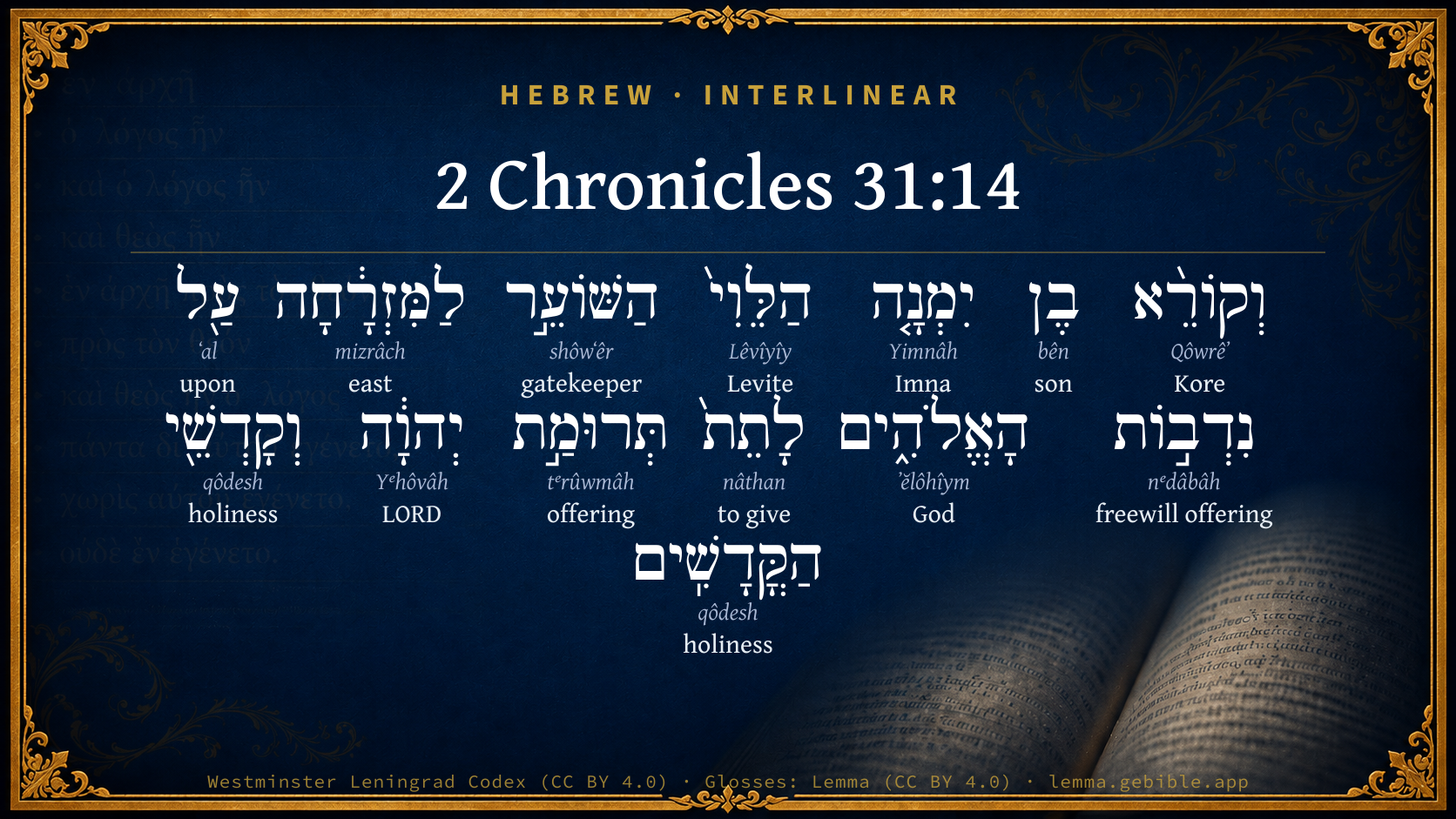
2 Chronicles 31:14

Hebrew (Westminster Leningrad Codex) 2 Chronicles 31:14 appears in the Hebrew Old Testament. The text above is from the Westminster Leningrad Codex. Each word links to its Strong’s number, a concise gloss, and parsing drawn from the Open Scriptures Hebrew Bible morphology. Click any word for its full Brown-Driver-Briggs (BDB) entry.
Download image
Cite this verse

2 Chronicles 31:14 (World English Bible). Public Domain. Lemma interlinear Bible study tool, https://lemma.gebible.app/v/2-chronicles/31/14.

Show BibTeX & RIS
BibTeX
RIS
English Translation
Kore the son of Imnah the Levite, the porter at the east [gate], was over the freewill-offerings of God, to distribute the offerings of Yahweh, and the most holy things.
World English Bible · Public Domain
Download a study sheet

One document with this verse’s original text, its word-by-word gloss line, the meaning frame, cross-references with their text, attributed commentary, and full source and license credits — printable, and it pastes into notes with its structure intact.

This verse Autodidact and up

Study sheet (.html) Plain text (.txt)

A passage Seminary Student

Up to 50 verses in one chapter. A passage sheet keeps up to 6 commentary sources and 12 cross-references per verse, in the order this page ranks them, and says so on the sheet whenever that leaves anything out. Ask for a single verse and you get the Autodidact verse sheet above.

Everything on this page stays free to read, with no account — the sheet is a download of what is already on screen, not access to it.

Want to remove ads? Support Godless Engineer
Compare translations 3

The same verse in 3 English versions, stacked beneath the original-language interlinear above. Click any original word for its lexicon entry.

Each is an independent rendering of the whole verse — the interlinear is not word-aligned to these translations.

Highlighted words mark where these versions differ — a whole-verse word diff, not a word-by-word alignment.

  • World English Bible Public Domain
    Kore the son of Imnah the Levite, the porter at the east [gate], was over the freewill-offerings of God, to distribute the offerings of Yahweh, and the most holy things.
  • King James Version Public Domain
    And Kore the son of Imnah the Levite, the porter toward the east, was over the freewill offerings of God, to distribute the oblations of the LORD, and the most holy things.
  • unfoldingWord Literal Text CC BY-SA 4.0
    And Kore the son of Imnah the Levite, the gatekeeper to the east was over the free will offering of God, to give the contribution of Yahweh and the most holy things,

unfoldingWord Literal Text — © unfoldingWord, licensed CC BY-SA 4.0. Word-aligned USFM3 via Door43 (git.door43.org/unfoldingWord/en_ult).

Versions to compare (up to 4)

3 of 4 selected

Show all 18 translations

Every available English version of this verse, each an independent rendering of the whole verse.

  • World English Bible Public Domain
    Kore the son of Imnah the Levite, the porter at the east [gate], was over the freewill-offerings of God, to distribute the offerings of Yahweh, and the most holy things.
  • Berean Standard Bible Public Domain
    Kore son of Imnah the Levite, the keeper of the East Gate, was in charge of the freewill offerings given to God, distributing the contributions to the LORD and the consecrated gifts.
  • Majority Standard Bible Public Domain
    Kore son of Imnah the Levite, the keeper of the East Gate, was in charge of the freewill offerings given to God, distributing the contributions to the LORD and the consecrated gifts.
  • King James Version Public Domain
    And Kore the son of Imnah the Levite, the porter toward the east, was over the freewill offerings of God, to distribute the oblations of the LORD, and the most holy things.
  • American Standard Version (1901) Public Domain
    And Kore the son of Imnah the Levite, the porter at the east `gate', was over the freewill-offerings of God, to distribute the oblations of Jehovah, and the most holy things.
  • Revised Version (1885) Public Domain
    And Kore the son of Imnah the Levite, the porter at the east gate, was over the freewill offerings of God, to distribute the oblations of the LORD, and the most holy things.
  • Geneva Bible (1599) Public Domain
    And Kore the sonne of Imnah the Leuite porter towarde the East, was ouer the things that were willingly offred vnto God, to distribute the oblations of the Lord, and the holy things that were consecrate.
  • Douay-Rheims (1899) Public Domain
    But Core the son of Jemna the Levite, the porter of the east gate, was overseer of the things which were freely offered to the Lord, and of the firstfruits and the things dedicated for the holy of holies.
  • Young's Literal Translation Public Domain
    And Kore son of Imnah the Levite, the gatekeeper at the east, `is' over the willing-offerings of God, to give the heave-offering of Jehovah, and the most holy things.
  • Literal Standard Version CC BY-SA 4.0
    And Kore son of Imnah the Levite, the gatekeeper at the east, [is] over the willing-offerings of God, to give the raised-offering of YHWH, and the most holy things.
  • Unlocked Literal Bible CC BY-SA 4.0
    Kore son of Imnah the Levite, the porter at the east gate, was over the free will offerings of God, in charge of distributing the offerings to Yahweh and the most holy offerings.
  • unfoldingWord Literal Text CC BY-SA 4.0
    And Kore the son of Imnah the Levite, the gatekeeper to the east was over the free will offering of God, to give the contribution of Yahweh and the most holy things,
  • Darby Bible Public Domain
    And Kore the son of Jimnah the Levite, the doorkeeper toward the east, was over the voluntary-offerings of God, to distribute the heave-offerings of Jehovah, and the most holy things.
  • World Messianic Bible Public Domain
    Kore the son of Imnah the Levite, the gatekeeper at the east gate, was over the free will offerings of God, to distribute the LORD’s offerings and the most holy things.
  • Webster's Bible Public Domain
    And Kore the son of Imnah the Levite, the porter towards the east, was over the free-will-offerings of God, to distribute the oblations of the LORD, and the most holy things.
  • Free Bible Version CC BY-SA 4.0
    Kore, son of Imnah, the Levite, the gatekeeper of the East Gate, was responsible for receiving the freewill offerings given to God. He also distributed the offerings given to the Lord, together with the consecrated gifts.
  • Bible in Basic English Public Domain
    And Kore, the son of Imnah the Levite, the keeper of the east door, had control of the offerings freely given to God, and the distribution of the offerings of the Lord and the most holy things.
  • JPS Tanakh (1917) Public Domain
    And Kore the son of Imnah the Levite, the porter at the east gate, was over the freewill-offerings of God, to distribute the offerings of the LORD, and the most holy things.

Literal Standard Version (2020), Covenant Press — licensed CC BY-SA 4.0. Text via the HelloAO Bible API (eBible.org). Unlocked Literal Bible (unfoldingWord) — licensed CC BY-SA 4.0. Text via the HelloAO Bible API (eBible.org). unfoldingWord Literal Text — © unfoldingWord, licensed CC BY-SA 4.0. Word-aligned USFM3 via Door43 (git.door43.org/unfoldingWord/en_ult). Free Bible Version, Dr. Jonathan Gallagher — licensed CC BY-SA 4.0. Text via the HelloAO Bible API (eBible.org).

Word by word

More ways to search: Search by grammar → Find every occurrence → Compare this word →

Practice this passage: Drill this verse → Learn its vocabulary →

וְקוֹרֵ֨א
Qôwrêʼ
H6981
“and · Kore”
Conjunction + Noun, Proper
Part of Speech
Conjunction + Noun
Type
Proper
Full BDB Definition

Origin: act part of H7121

TWOT: None

Kore = "crier" - a Korahite Levite, ancestor of Shallum and Meshelemiah, chief porters in the reign of David - a Levite, son of Imnah, in the reign of king Hezekiah of Judah
  1. בֶן bên H1121 “son of” Noun, Common, Masculine, Singular, Construct
  2. יִמְנָ֤ה Yimnâh H3232 “Imna” Noun, Proper
  3. הַלֵּוִי֙ Lêvîyîy H3881 “the · Levite” Particle, Definite Article + Noun, Gentilic, Masculine, Singular, Absolute
  4. הַשּׁוֹעֵ֣ר shôwʻêr H7778 “the · gatekeeper” Particle, Definite Article + Noun, Common, Masculine, Singular, Absolute
  5. לַמִּזְרָ֔חָה mizrâch H4217 “to/for the · east · toward” Preposition, Determined + Noun, Common, Masculine, Singular, Absolute + Suffix, Demonstrative
  6. עַ֖ל ʻal H5921 “upon” Preposition
  7. נִדְב֣וֹת nᵉdâbâh H5071 “freewill offerings of” Noun, Common, Feminine, Plural, Construct
  8. הָאֱלֹהִ֑ים ʼĕlôhîym H430 “the · God(s)” Particle, Definite Article + Noun, Common, Masculine, Plural, Absolute
  9. לָתֵת֙ nâthan H5414 “to give” Preposition + Verb, Qal, Infinitive Construct
  10. תְּרוּמַ֣ת tᵉrûwmâh H8641 “offering of” Noun, Common, Feminine, Singular, Construct
  11. יְהוָ֔ה Yᵉhôvâh H3068 “LORD” Noun, Proper
  12. וְקָדְשֵׁ֖י qôdesh H6944 “and · holy things of” Conjunction + Noun, Common, Masculine, Plural, Construct
  13. הַקֳּדָשִֽׁים qôdesh H6944 “the · holy things” Particle, Definite Article + Noun, Common, Masculine, Plural, Absolute

About this verse

These counts appear in no published source. They are computed here, from the morphology-tagged text and Lemma’s own curated glosses. What Lemma adds →

14
words
13
distinct lemmas
Historical
section

Notable vocabulary

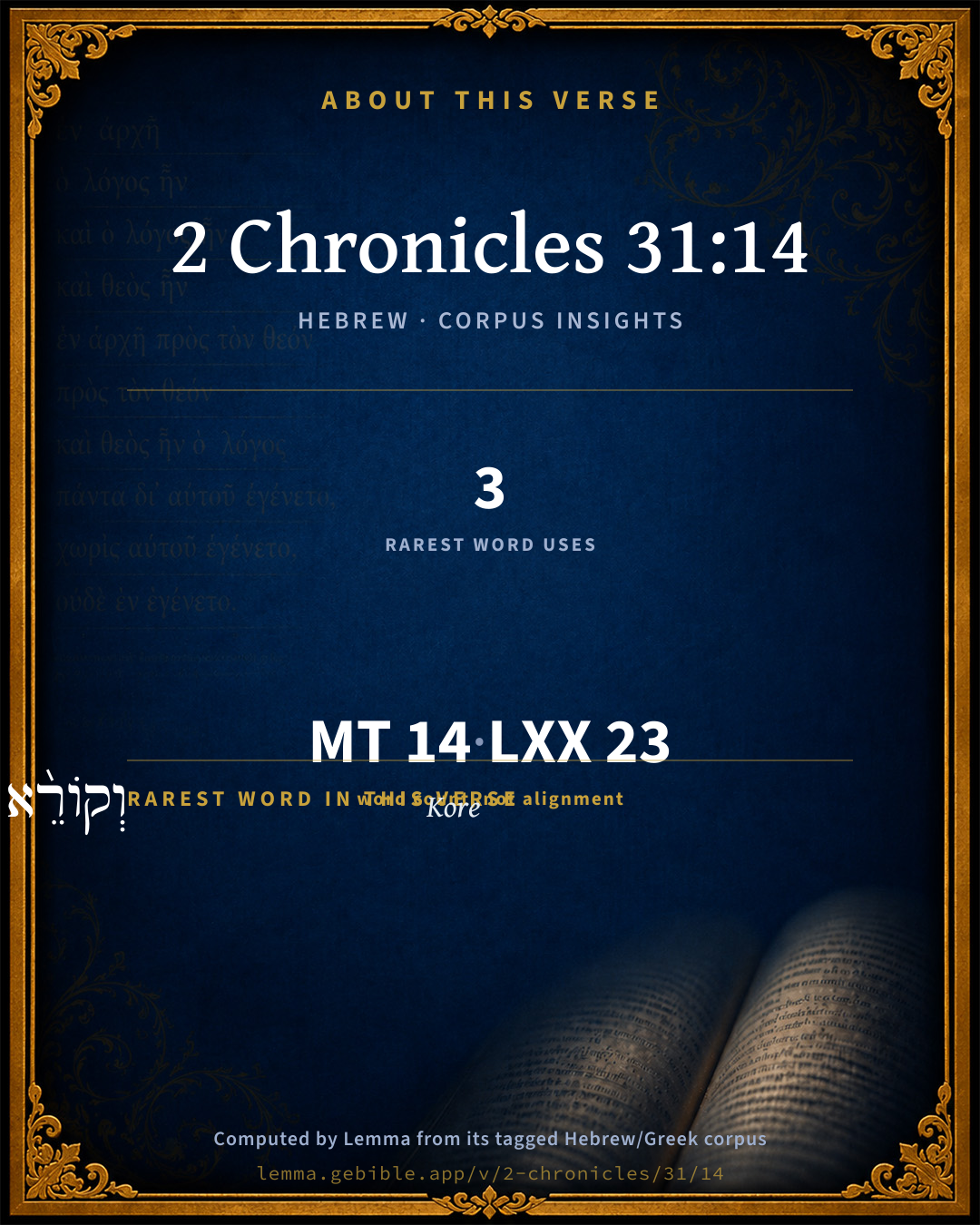
The rarest word here is וְקוֹרֵ֨א Kore H6981 — appearing just 3 times in the whole Hebrew Bible.

Shared distinctive vocabulary

וְקוֹרֵ֨א Kore H6981 occurs in 3 verses of the Hebrew Bible. Also found in:

Grammatical profile

  • 1 verb
  • 12 nouns
  • 1 preposition

Verb forms

  • לָתֵת֙ Qal · Infinitive Construct

Repetition

A word recurs within this verse — often emphatic in Hebrew:

  • וְקָדְשֵׁ֖י holiness H6944 ×2

Hebrew & Septuagint length

In English translation the verse runs 30 words from the Hebrew and 28 from the Septuagint (LXX English) — closely comparable.

A rough comparison of the two English renderings, which tokenize alike — not a word-level alignment.

Word counts can differ between the Hebrew and the Greek without any difference in meaning — e.g. the Hebrew direct-object marker אֵת has no separate Greek word, and Greek often adds the article ὁ.

In the original languages it is 14 Hebrew tokens and 23 Greek tokens — but the two are counted differently (Hebrew bundles its prefixes and suffixes into one token; the Greek is in lemma form), so that isn’t a like-for-like length.

Cross-references

19

Topical passages linked to 2 Chronicles 31:14 in the Treasury of Scripture Knowledge — connected by theme and wording, ordered by reader-vote popularity; previews shown in the World English Bible.

  • Leviticus 2:10 That which is left of the meal offering shall be Aaron's and his sons'. It is a thing most holy of the offerings of Yahweh made by fire.
  • Leviticus 6:16–17 That which is left of it Aaron and his sons shall eat. It shall be eaten without yeast in a holy place. They shall eat it in the court of the Tent of Meeting
  • Leviticus 7:1–6 "'This is the law of the trespass offering. It is most holy.
  • Leviticus 10:12–13 Moses spoke to Aaron, and to Eleazar and to Ithamar, his sons who were left, "Take the meal offering that remains of the offerings of Yahweh made by fire, and eat it without yeast beside the altar; for it is most holy;
  • Leviticus 22:18 "Speak to Aaron, and to his sons, and to all the children of Israel, and say to them, 'Whoever is of the house of Israel, or of the foreigners in Israel, who offers his offering, whether it be any of their vows, or any of their freewill offerings, which they offer to Yahweh for a burnt offering;
  • Leviticus 23:38 besides the Sabbaths of Yahweh, and besides your gifts, and besides all your vows, and besides all your freewill offerings, which you give to Yahweh.
  • Leviticus 27:28 "'Notwithstanding, no devoted thing, that a man shall devote to Yahweh of all that he has, whether of man or animal, or of the field of his possession, shall be sold or redeemed: every devoted thing is most holy to Yahweh.
  • Numbers 29:39 These you shall offer to Yahweh in your set feasts, besides your vows, and your freewill-offerings, for your burnt offerings, and for your meal-offerings, and for your drink-offerings, and for your peace-offerings.
  • Deuteronomy 12:6 and there you shall bring your burnt offerings, and your sacrifices, and your tithes, and the heave-offering of your hand, and your vows, and your freewill-offerings, and the firstborn of your herd and of your flock:
  • Deuteronomy 12:17 You may not eat within your gates the tithe of your grain, or of your new wine, or of your oil, or the firstborn of your herd or of your flock, nor any of your vows which you vow, nor your freewill-offerings, nor the heave-offering of your hand;
  • Deuteronomy 16:10 You shall keep the feast of weeks to Yahweh your God with a tribute of a freewill-offering of your hand, which you shall give, according as Yahweh your God blesses you:
  • 1 Chronicles 26:12 Of these were the divisions of the doorkeepers, even of the chief men, having offices like their brothers, to minister in the house of Yahweh.
  • 1 Chronicles 26:14 The lot eastward fell to Shelemiah. Then for Zechariah his son, a wise counselor, they cast lots; and his lot came out northward.
  • 1 Chronicles 26:17 Eastward were six Levites, northward four a day, southward four a day, and for the store-house two and two.
  • Ezra 1:4 Whoever is left, in any place where he sojourns, let the men of his place help him with silver, and with gold, and with goods, and with animals, besides the freewill-offering for the house of God which is in Jerusalem.
  • Ezra 3:5 and afterward the continual burnt-offering, and [the offerings] of the new moons, and of all the set feasts of Yahweh that were consecrated, and of everyone who willingly offered a freewill-offering to Yahweh.
  • Ezra 7:16 and all the silver and gold that you shall find in all the province of Babylon, with the freewill-offering of the people, and of the priests, offering willingly for the house of their God which is in Jerusalem;
  • Nehemiah 13:13 I made treasurers over the treasuries, Shelemiah the priest, and Zadok the scribe, and of the Levites, Pedaiah: and next to them was Hanan the son of Zaccur, the son of Mattaniah; for they were counted faithful, and their business was to distribute to their brothers.
  • Psalms 119:108 Accept, I beg you, the willing offerings of my mouth. Yahweh, teach me your ordinances.

Cross-references courtesy of OpenBible.info (CC BY 4.0).

Hebrew and Greek witnesses Masoretic Hebrew ↔ Greek Septuagint

The same verse in the two great witnesses to the Old Testament, shown verse-for-verse.

These are two independent witnesses, not word-aligned to each other, and the Septuagint is shown in lemma (dictionary) form.

Hebrew 2 Chronicles 31:14 Masoretic · Westminster Leningrad Codex

וְקוֹרֵ֨א בֶן יִמְנָ֤ה הַלֵּוִי֙ הַשּׁוֹעֵ֣ר לַמִּזְרָ֔חָה עַ֖ל נִדְב֣וֹת הָאֱלֹהִ֑ים לָתֵת֙ תְּרוּמַ֣ת יְהוָ֔ה וְקָדְשֵׁ֖י הַקֳּדָשִֽׁים

Kore the son of Imnah the Levite, the porter at the east [gate], was over the freewill-offerings of God, to distribute the offerings of Yahweh, and the most holy things.

World English Bible · Public Domain

Greek LXX 2 Chronicles 31:14 Septuagint · lemma form

καί κωρη ὁ ὁ ιεμνα ὁ λευείτης ὁ πυλωρός κατά ἀνατολή ἐπί ὁ δόμα δίδωμι ὁ ἀπαρχή κύριος καί ὁ ἅγιος ὁ ἅγιος

And Core, the son of Jemna the Levite, the porter eastward, was over the gifts, to distribute the first fruits of the Lord, and the most holy things,

LXX2012 (modern English Septuagint) · Public Domain

Hebrew: Westminster Leningrad Codex (CC BY 4.0). Greek: Septuagint (public domain); English from LXX2012 (modern English Septuagint) (Public Domain). How the Septuagint differs from the Hebrew →

Commentary

Notes on 2 Chronicles 31:14 from classic Christian and Jewish commentators (each source and its license shown beneath its notes). The classic Christian expositions comment on the surrounding passage and are grouped to its opening verse, so a note may address several verses; the Jewish commentaries on the Tanakh (Rashi and others) are per-verse, so they appear only where the commentator wrote on this verse.

Lemma curates 59 commentaries, every one of them public domain or Creative Commons licensed, each selected and text-cleaned for this edition rather than reprinted as found. About our sources →

Trapp's Complete Commentary

John Trapp

2Ch 31:14 And Kore the son of Imnah the Levite, the porter toward the east, [was] over the freewill offerings of God, to distribute the oblations of the LORD, and the most holy things.

Ver. 14. Was over the freewill offerings of God.] Super liberalitates Dei, called also the most holy things or sanctities of sanctities. See 2Ch 31:6.

John Trapp, A Commentary or Exposition upon All the Books of the Old and New Testament (1647–1656) — public domain. Text from a community e-Sword module.

Joseph Benson's Commentary

2Ch 31:14-15. The porter toward the east — At the east gate of the Lord’s house; of which see 2Ch 23:5. To distribute the oblations —

To the priests and Levites, to whom they were appropriated by God; and the most holy things — The remainders of the free-will-offerings, the sin- offerings, and trespass-offerings, and the show-bread; to see that all had a competent maintenance for themselves and their families. And next him were Eden, &c. — These were intrusted with receiving and distributing the several portions belonging to the priests, who abode in their several cities, while their brethren came up to Jerusalem.

Joseph Benson's Commentary on the Old and New Testaments (1811–1818) — public domain. Text from a community e-Sword module.

Tyndale Open Study Notes

Tyndale Open Resources

31:14-19 A great number of Levites, most from provincial towns, were eligible for service. Small groups of them came to Jerusalem on a rotation system for short terms of office (see 1 Chr 24:1-19). All Levites were entitled to portions of the offerings given at the Temple.

Tyndale Open Study Notes — © Tyndale Open Resources, licensed CC BY-SA 4.0. Text via the HelloAO Bible API.

Ellicott's Commentary for English Readers

(14) The porter toward the east.—Compare 1Ch_9:18. Korê had charge of “the freewill offerings of God,” or voluntary gifts (Deu_12:17); and it was his duty “to distribute the oblations of the Lord and the most holy things" to the priests.

To distribute the oblations.—To give the Terûmah of Jehovah—i.e., the portion of the offerings which, though consecrated to Jehovah, was transferred by Him to the priests (Lev_7:14; Lev_7:32; Lev_10:14-15).

And the most holy things—i.e., that part of the sin and trespass offerings (Lev_6:10; Lev_6:22; Lev_7:6) and of the meat offerings (Lev_2:3; Lev_2:10) which were to be eaten by the priests in the sanctuary.

A Bible Commentary for English Readers, edited by Charles John Ellicott (1878–1897) — public domain. Text from a community e-Sword module.

The Cambridge Bible for Schools and Colleges

gen. ed. J. J. S. Perowne

14. toward the east] R.V. at the east gate.

the most holy things] To this class belonged the shewbread (Lev_24:9), the meal offering (Lev_2:2-3; Lev_6:14-18 [7–11, Heb.]), the sin offering (Lev_6:25-30), and the trespass offering (Lev_7:1-7). These could be eaten by the priests only, and in the holy place only.

The Cambridge Bible for Schools and Colleges (gen. ed. J. J. S. Perowne; Cambridge University Press, 1878–1918) — public domain. Text from a community e-Sword module.

John Gill's Exposition

And next to him were Eden and Mijamin, and Jeshua, and Shemaiah, Amariah, and Shecaniah,.... As Kore was the principal, and his business lay chiefly with the priests in the temple, and in Jerusalem, these men under him were employed in distributing to the priests:

in the cities of the priests; in the several parts of the country:

in their set office; or faithfully:

to give to their brethren by courses, as well to the great as to the small; to communicate of the stores under their hands, according to their several courses, both priests and Levites, and to all in their families, small and great.

John Gill's Exposition of the Whole Bible (1746–1763) — public domain (CC PDM 1.0). Text via the HelloAO Bible API.

Albert Barnes' Notes on the Bible

The porter toward the east - i. e. the chief door-keeper at the east gate, where the proper number of the porters was six 1Ch 26:17.

The most holy things - The sin-offerings and trespass-offerings Lev 6:25; Lev 7:1-6.

Albert Barnes' Notes on the Bible (1834–1885) — public domain. Text from a community e-Sword/MySword module.

Haydock's Catholic Bible Commentary

And of. Prot. "To distribute the oblations of the Lord, and the most holy things," (H.) to the priests.

George Leo Haydock (1774–1849), Haydock's Catholic Family Bible and Commentary, 1859 edition — public domain. Excludes Psalms (Douay-Rheims chapter numbering differs from Protestant) and Deuterocanonical books (Catholic canon only).

Matthew Poole's English Annotations

Toward the east; at the east gate of the Lord’s house; of which See Poole "2Ch 23:5".

To distribute to the priests and Levites, to whom they were appropriated by God.

The most holy things, to wit, the remainders of the free-will-offering, Lev 2:3,10, the sin-offering and trespass-offering, Lev 6:18,22; Le 7:1, and the shew-bread, Lev 24:9.

Matthew Poole's English Annotations on the Holy Bible (1683–1685) — public domain. Text from a community e-Sword/MySword module.

Whedon's Commentary on the Bible

Daniel D. Whedon

14. The porter toward the east — The chief Levite who was stationed at the east gate. 1Ch_26:14; 1Ch_26:17.

The oblations of the Lord — Such parts of the offerings as belonged to the priests. Lev_2:3; Lev_2:10; Lev_7:14.

The most holy things — See Lev_7:1; Lev_7:6.

Daniel D. Whedon (gen. ed.), Commentary on the Old and New Testaments (1874–1909) — public domain. Text from a community e-Sword module.

The Pulpit Commentary

Kore. The name one with the grandson of Korah. (1Ch_9:19 1Ch_26:17)

The Pulpit Commentary (1880–1919), ed. H.D.M. Spence-Jones & Joseph S. Exell — public domain. Text from a community e-Sword module.

John Wesley's Explanatory Notes

Most holy things - The remainders of the freewill-offering, the sin-offering, and trespass-offering, and the shew-bread; to see that all had a competent maintenance for themselves and their families.

John Wesley, Explanatory Notes Upon the Whole Bible (1754–1765) — public domain. Text via the GEBible commentary corpus.

unfoldingWord translationNotes

Door43 World Missions Community

Kore son of Imnah ... Eden, Miniamin, Jeshua, Shemaiah, Amariah, and Shecaniah

These are names of men. (See: How to Translate Names)

the porter at the east gate

"the gatekeeper at the east gate of the temple"

Under him were Eden ... in the cities of the priests

Here "under" is an idiom that means to be under someone's authority. AT: "Eden ... assisted Kore in the cities of the priests" (See: Idiom)

They filled offices of trust, in order to give

"Their duty was to give" or "They faithfully gave"

to their brothers

Here "brothers" is a metaphor for "fellow priests." AT: "to their fellow priests" (See: Metaphor)

division by division

"group by group"

to both the important and the unimportant

Here "important" and "unimportant" are used together to mean "everyone." AT: "to everyone, including the important and the unimportant" (See: Merism)

the important and the unimportant

This seems to imply the old and the young. This can be restated to removed the nominal adjectives. AT: "those who are old and those who are young" (See: Assumed Knowledge and Implicit Information and Nominal Adjectives)

translationWords

gate

freewill offering

sacrifice

trust

unfoldingWord translationNotes — © Distant Shores Media and the Door43 World Missions Community, licensed CC BY-SA 4.0. Source: git.door43.org/Door43/en_tn.

Lesson kit

Teaching starters — assembled from the data on this page, not authored interpretation. Every prompt links to the verse data it draws on. Edit before teaching.

2 Chronicles, in the Historical, opens this verse with 14 words (13 distinct Hebrew lemmas). Its most distinctive word is Qôwrêʼ (“Kore”). A historical commentator’s framing appears above. Read the whole chapter for the surrounding context.

Discussion questions

  1. What does “Kore” (Qôwrêʼ) contribute to the verse as a whole?
  2. How does 1 Chronicles 9:19, which shares the word «Kore», read alongside this verse?
  3. What does the repetition of “holiness” (2× in this one verse) do in this verse?
  4. These translations render this verse differently. What is at stake in choosing one wording over another?
  5. «לָתֵת֙» is a Qal Infinitive Construct verb. How does that grammatical form shape the action described?
  6. Compare how Trapp's Complete Commentary and Joseph Benson's Commentary read this verse. Where do they agree or differ?

Things to notice

Reading settings

Reading text

Shown beneath each verse's original-language words.

Old Testament
Old Testament edition

Read the OT as the Masoretic Hebrew (MT) or the Greek Septuagint (LXX).

English shown for the Greek Septuagint (in the Hebrew ↔ Greek comparison).

Comparing translations? Open the Compare panel on any verse page to stack up to four side by side.