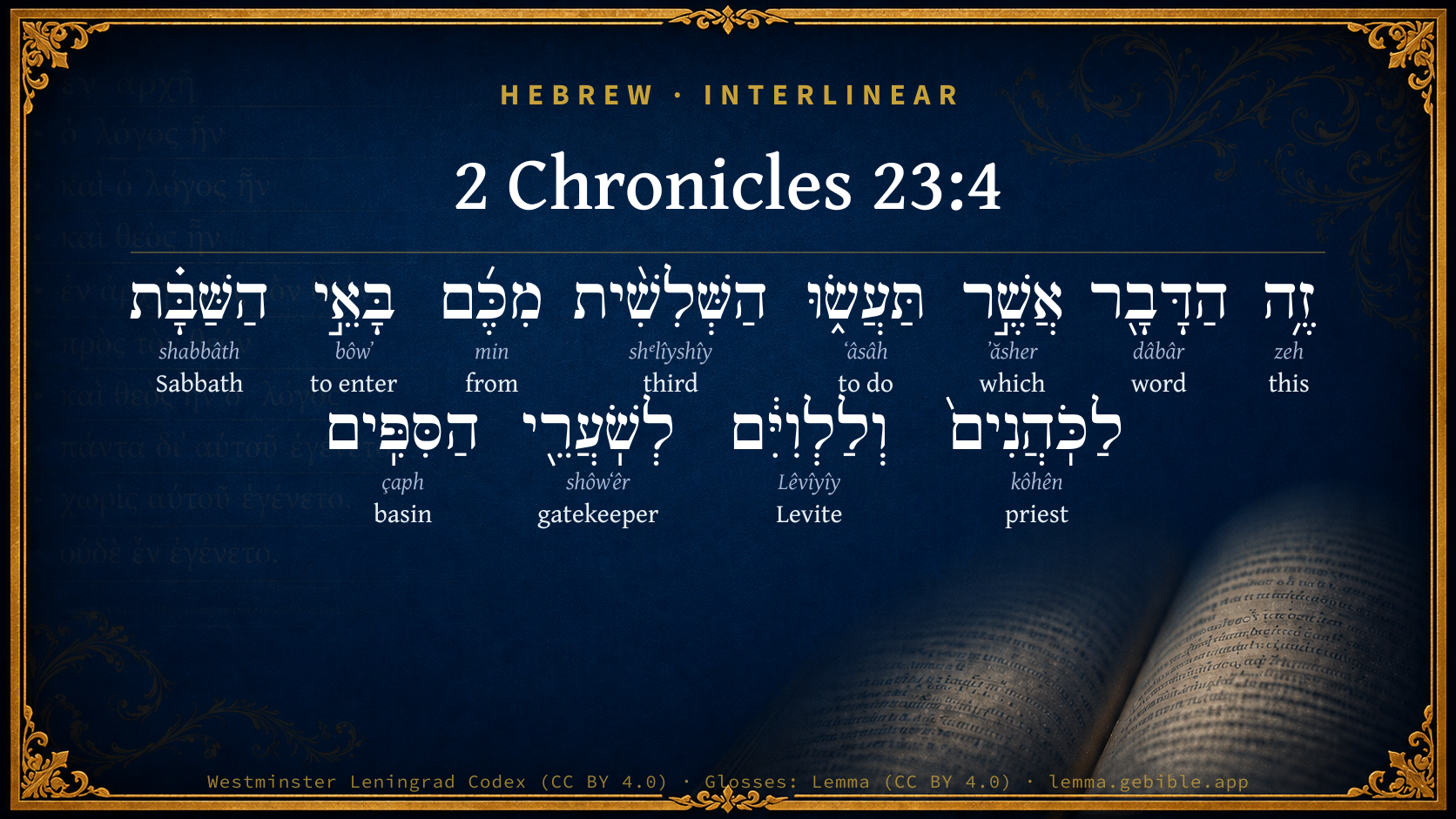
2 Chronicles 23:4

Hebrew (Westminster Leningrad Codex) 2 Chronicles 23:4 appears in the Hebrew Old Testament. The text above is from the Westminster Leningrad Codex. Each word links to its Strong’s number, a concise gloss, and parsing drawn from the Open Scriptures Hebrew Bible morphology. Click any word for its full Brown-Driver-Briggs (BDB) entry.
Download image
Cite this verse

2 Chronicles 23:4 (World English Bible). Public Domain. Lemma interlinear Bible study tool, https://lemma.gebible.app/v/2-chronicles/23/4.

Show BibTeX & RIS
BibTeX
RIS
English Translation
This is the thing that you shall do: a third part of you, who come in on the Sabbath, of the priests and of the Levites, shall be porters of the thresholds;
World English Bible · Public Domain
Download a study sheet

One document with this verse’s original text, its word-by-word gloss line, the meaning frame, cross-references with their text, attributed commentary, and full source and license credits — printable, and it pastes into notes with its structure intact.

This verse Autodidact and up

Study sheet (.html) Plain text (.txt)

A passage Seminary Student

Up to 50 verses in one chapter. A passage sheet keeps up to 6 commentary sources and 12 cross-references per verse, in the order this page ranks them, and says so on the sheet whenever that leaves anything out. Ask for a single verse and you get the Autodidact verse sheet above.

Everything on this page stays free to read, with no account — the sheet is a download of what is already on screen, not access to it.

Want to remove ads? Support Godless Engineer
Compare translations 3

The same verse in 3 English versions, stacked beneath the original-language interlinear above. Click any original word for its lexicon entry.

Each is an independent rendering of the whole verse — the interlinear is not word-aligned to these translations.

Highlighted words mark where these versions differ — a whole-verse word diff, not a word-by-word alignment.

  • World English Bible Public Domain
    This is the thing that you shall do: a third part of you, who come in on the Sabbath, of the priests and of the Levites, shall be porters of the thresholds;
  • King James Version Public Domain
    This is the thing that ye shall do; A third part of you entering on the sabbath, of the priests and of the Levites, shall be porters of the doors;
  • unfoldingWord Literal Text CC BY-SA 4.0
    This is the thing that you must do: A third from you all who come in on the Sabbath, of the priests and of the Levites, will be gatekeepers at the threshold.

unfoldingWord Literal Text — © unfoldingWord, licensed CC BY-SA 4.0. Word-aligned USFM3 via Door43 (git.door43.org/unfoldingWord/en_ult).

Versions to compare (up to 4)

3 of 4 selected

Show all 18 translations

Every available English version of this verse, each an independent rendering of the whole verse.

  • World English Bible Public Domain
    This is the thing that you shall do: a third part of you, who come in on the Sabbath, of the priests and of the Levites, shall be porters of the thresholds;
  • Berean Standard Bible Public Domain
    This is what you are to do: A third of you priests and Levites who come on duty on the Sabbath shall keep watch at the doors,
  • Majority Standard Bible Public Domain
    This is what you are to do: A third of you priests and Levites who come on duty on the Sabbath shall keep watch at the doors,
  • King James Version Public Domain
    This is the thing that ye shall do; A third part of you entering on the sabbath, of the priests and of the Levites, shall be porters of the doors;
  • American Standard Version (1901) Public Domain
    This is the thing that ye shall do: a third part of you, that come in on the sabbath, of the priests and of the Levites, shall be porters of the thresholds;
  • Revised Version (1885) Public Domain
    This is the thing that ye shall do: a third part of you, that come in on the sabbath, of the priests and of the Levites, shall be porters of the doors;
  • Geneva Bible (1599) Public Domain
    This is it that ye shall do, The third part of you that come on the Sabbath of the Priests, and the Leuites, shalbe porters of the doores.
  • Douay-Rheims (1899) Public Domain
    And this is the thing that you shall do:
  • Young's Literal Translation Public Domain
    `This `is' the thing that ye do: The third of you, going in on the sabbath, of the priests, and of the Levites, `are' for gatekeepers of the thresholds,
  • Literal Standard Version CC BY-SA 4.0
    This [is] the thing that you do: the third of you, going in on the Sabbath, of the priests, and of the Levites, [are] for gatekeepers of the thresholds,
  • Unlocked Literal Bible CC BY-SA 4.0
    This is what you must do: A third of you priests and Levites who come to serve on the Sabbath will be guards at the doors.
  • unfoldingWord Literal Text CC BY-SA 4.0
    This is the thing that you must do: A third from you all who come in on the Sabbath, of the priests and of the Levites, will be gatekeepers at the threshold.
  • Darby Bible Public Domain
    This is the thing which ye shall do: a third part of you that come in on the sabbath, of the priests and of the Levites, shall be keepers of the doors;
  • World Messianic Bible Public Domain
    This is the thing that you must do: a third part of you, who come in on the Sabbath, of the priests and of the Levites, shall be gatekeepers of the thresholds.
  • Webster's Bible Public Domain
    This is the thing that ye shall do: A third part of you entering on the sabbath, of the priests, and of the Levites, shall be porters of the doors;
  • Free Bible Version CC BY-SA 4.0
    Here's what you have to do. One third of you priests and Levites who enter on the Sabbath shall guard the entrances.
  • Bible in Basic English Public Domain
    This is what you are to do: let a third of you, of the priests and Levites, who come in on the Sabbath, keep the doors;
  • JPS Tanakh (1917) Public Domain
    This is the thing that ye shall do: a third part of you, that come in on the sabbath, of the priests and of the Levites, shall be porters of the doors;

Literal Standard Version (2020), Covenant Press — licensed CC BY-SA 4.0. Text via the HelloAO Bible API (eBible.org). Unlocked Literal Bible (unfoldingWord) — licensed CC BY-SA 4.0. Text via the HelloAO Bible API (eBible.org). unfoldingWord Literal Text — © unfoldingWord, licensed CC BY-SA 4.0. Word-aligned USFM3 via Door43 (git.door43.org/unfoldingWord/en_ult). Free Bible Version, Dr. Jonathan Gallagher — licensed CC BY-SA 4.0. Text via the HelloAO Bible API (eBible.org).

Word by word

More ways to search: Search by grammar → Find every occurrence → Compare this word →

Practice this passage: Drill this verse → Learn its vocabulary →

הַסִּפִּֽים
çaph
H5592
“the · basins”
Particle, Definite Article + Noun, Common, Masculine, Plural, Absolute
Part of Speech
Particle + Noun
Type
Common
Gender
Masculine
Number
Plural
State
Absolute
Full BDB Definition

Origin: from H5605 , in its original sense of containing

TWOT: 1538a , 1538b

a spreading out, basin, goblet, bowl - basin, goblet - threshold, sill - threshold, sill, door-keeper
  1. זֶ֥ה zeh H2088 “this” Pronoun, Demonstrative, Masculine, Singular
  2. הַדָּבָ֖ר dâbâr H1697 “the · word” Particle, Definite Article + Noun, Common, Masculine, Singular, Absolute
  3. אֲשֶׁ֣ר ʼăsher H834 “which” Particle, Relative
  4. תַּעֲשׂ֑וּ ʻâsâh H6213 “to do” Verb, Qal, Imperfect, 2nd Person, Masculine, Plural
  5. הַשְּׁלִשִׁ֨ית shᵉlîyshîy H7992 “the · third” Particle, Definite Article + Noun, Common, Feminine, Singular, Absolute
  6. מִכֶּ֜ם min H4480 “from · you” Preposition + Suffix, Personal, 2nd Person, Masculine, Plural
  7. בָּאֵ֣י bôwʼ H935 “entering” Verb, Qal, Participle Active, Masculine, Plural, Construct
  8. הַשַּׁבָּ֗ת shabbâth H7676 “the · Sabbath” Particle, Definite Article + Noun, Common, Both, Singular, Absolute
  9. לַכֹּֽהֲנִים֙ kôhên H3548 “to/for the · priests” Preposition, Determined + Noun, Common, Masculine, Plural, Absolute
  10. וְלַלְוִיִּ֔ם Lêvîyîy H3881 “and · to/for the · Levites” Conjunction + Preposition, Determined + Noun, Gentilic, Masculine, Plural, Absolute
  11. לְשֹֽׁעֲרֵ֖י shôwʻêr H7778 “to/for · gatekeepers of” Preposition + Noun, Common, Masculine, Plural, Construct

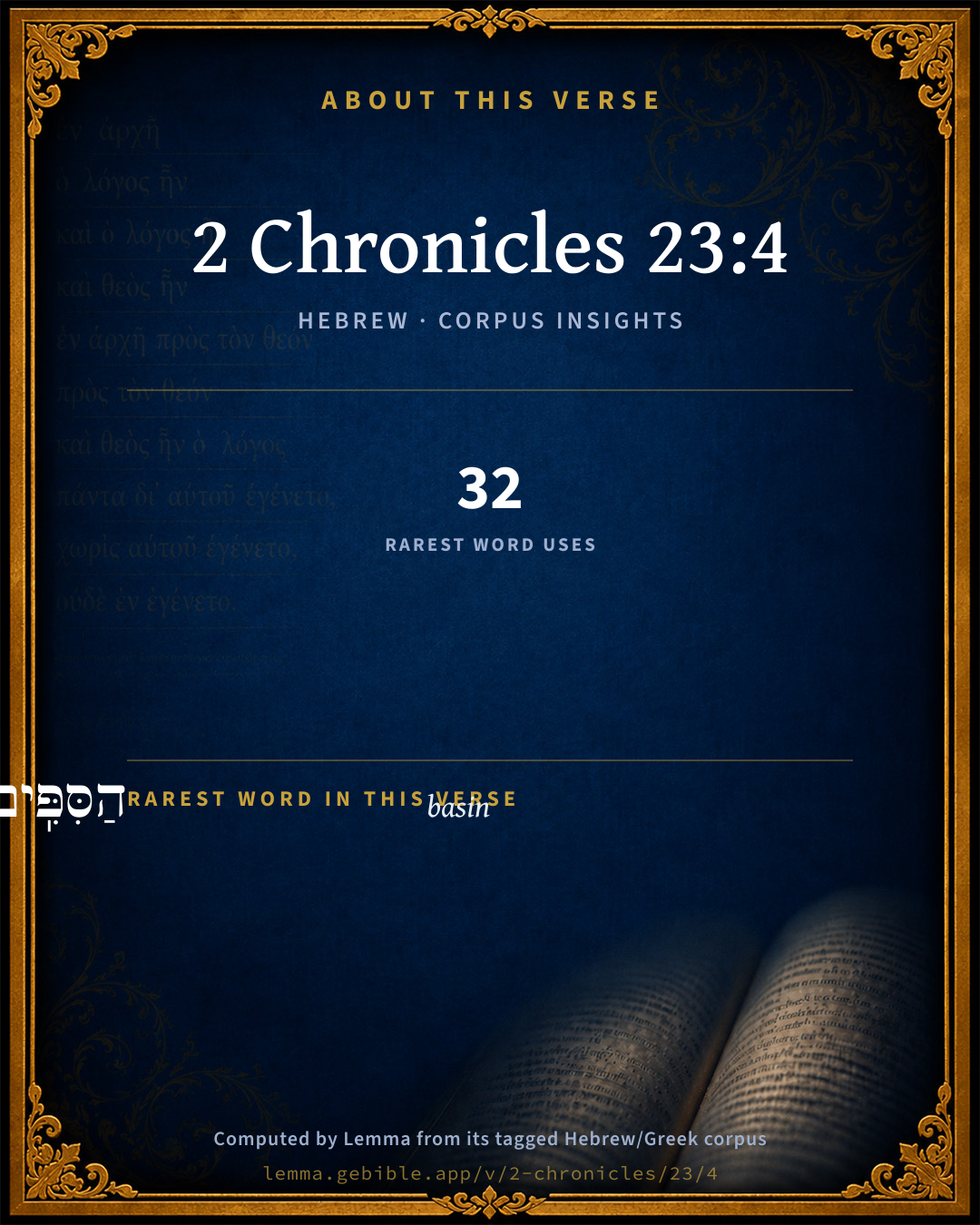
About this verse

These counts appear in no published source. They are computed here, from the morphology-tagged text and Lemma’s own curated glosses. What Lemma adds →

12
words
12
distinct lemmas
Historical
section

Shared distinctive vocabulary

הַסִּפִּֽים basin H5592 occurs in 28 verses of the Hebrew Bible. Also found in:

Grammatical profile

  • 2 verbs
  • 7 nouns
  • 1 pronoun
  • 1 preposition
  • 1 particle

Verb forms

  • תַּעֲשׂ֑וּ Qal · Imperfect
  • בָּאֵ֣י Qal · Participle Active

Hebrew & Septuagint length

In English translation the verse runs 32 words from the Hebrew and 35 from the Septuagint (LXX English) — closely comparable.

A rough comparison of the two English renderings, which tokenize alike — not a word-level alignment.

Word counts can differ between the Hebrew and the Greek without any difference in meaning — e.g. the Hebrew direct-object marker אֵת has no separate Greek word, and Greek often adds the article ὁ.

Cross-references

5

Topical passages linked to 2 Chronicles 23:4 in the Treasury of Scripture Knowledge — connected by theme and wording, ordered by reader-vote popularity; previews shown in the World English Bible.

  • 1 Chronicles 9:25 Their brothers, in their villages, were to come in every seven days from time to time to be with them:
  • 1 Chronicles 23:3–6 The Levites were numbered from thirty years old and upward: and their number by their polls, man by man, was thirty-eight thousand.
  • 1 Chronicles 24:3–6 David with Zadok of the sons of Eleazar, and Ahimelech of the sons of Ithamar, divided them according to their ordering in their service.
  • 1 Chronicles 26:13–16 They cast lots, the small as well as the great, according to their fathers' houses, for every gate.
  • Luke 1:8–9 Now it happened, while he executed the priest's office before God in the order of his division,

Cross-references courtesy of OpenBible.info (CC BY 4.0).

Hebrew and Greek witnesses Masoretic Hebrew ↔ Greek Septuagint

The same verse in the two great witnesses to the Old Testament, shown verse-for-verse.

These are two independent witnesses, not word-aligned to each other, and the Septuagint is shown in lemma (dictionary) form.

Hebrew 2 Chronicles 23:4 Masoretic · Westminster Leningrad Codex

זֶ֥ה הַדָּבָ֖ר אֲשֶׁ֣ר תַּעֲשׂ֑וּ הַשְּׁלִשִׁ֨ית מִכֶּ֜ם בָּאֵ֣י הַשַּׁבָּ֗ת לַכֹּֽהֲנִים֙ וְלַלְוִיִּ֔ם לְשֹֽׁעֲרֵ֖י הַסִּפִּֽים

This is the thing that you shall do: a third part of you, who come in on the Sabbath, of the priests and of the Levites, shall be porters of the thresholds;

World English Bible · Public Domain

Greek LXX 2 Chronicles 23:4 Septuagint · lemma form

νῦν ὁ λόγος οὗτος ὅς ποιέω ὁ τρίτος ἐκ σύ εἰςπορεύομαι ὁ σάββατον ὁ ἱερεύς καί ὁ λευείτης καί εἰς ὁ πύλη ὁ εἴσοδος

Now this is the thing which you⌃ shall do. Let a third part of you, even of the priests and of the Levites, enter in on the sabbath, even into the gates of the entrances;

LXX2012 (modern English Septuagint) · Public Domain

Hebrew: Westminster Leningrad Codex (CC BY 4.0). Greek: Septuagint (public domain); English from LXX2012 (modern English Septuagint) (Public Domain). How the Septuagint differs from the Hebrew →

Commentary

Notes on 2 Chronicles 23:4 from classic Christian and Jewish commentators (each source and its license shown beneath its notes). The classic Christian expositions comment on the surrounding passage and are grouped to its opening verse, so a note may address several verses; the Jewish commentaries on the Tanakh (Rashi and others) are per-verse, so they appear only where the commentator wrote on this verse.

Lemma curates 59 commentaries, every one of them public domain or Creative Commons licensed, each selected and text-cleaned for this edition rather than reprinted as found. About our sources →

The Cambridge Bible for Schools and Colleges

gen. ed. J. J. S. Perowne

4. This is the thing that ye shall do] The main features of the arrangement as given here and in 2 Kin. are clear, although some details are obscure. From Kings it appears that it was the custom on the Sabbath for two-thirds of the royal guards to be free and for one-third to be on duty at the palace. In order to avoid arousing suspicion this last third was, according to Jehoiada’s directions, to be at the palace as usual, but it was to be subdivided into thirds and so distributed as to close the various means of communication between the palace and the rest of the city. Thus Athaliah was to be held as in a trap by her own guards (2Ki_11:5-6). The two-thirds who were free from duty on the Sabbath were to be stationed in the Temple about the young king to guard him at his coronation.

The arrangements are differently (and no doubt less accurately) stated in Chron. In the first place Levitical Temple guards take the place of the royal guards, secondly, the only division of the guards recognised is a simple division into thirds, finally, the stations of the different divisions are differently given, viz., one-third in the Temple, one-third in the palace, and one-third at “the gate of the foundation.”

Using the modern terms “battalion” and “company” for the divisions and subdivisions given in Kings, the arrangements may be stated in a form which allows easy comparison between Kings and Chron., as fallows:—

(A) 2Ki_11:5-7.

(Royal guards in three battalions.)

1st battalion on duty at the king’s house (palace).

A company within the palace (2Ch_23:5),

B company at the gate of Sur (SVR Heb.),

C company at another gate (“behind the guard,” 2Ch_23:6).

2nd and 3rd battalions off duty, but brought into the house of the Lord (the Temple) by Jehoiada (2Ch_23:7).

(B) 2Ch_23:4-5.

(Levites in three bands.)

Band I. (= 1st battalion C company of 2 Kin.) in the house of God, the Chronicler supposing that “the house” (2Ki_11:6) means the house of the Lord. More probably it means “the house of the king” (2Ki_11:5).

Band II. (= 1st battalion A company of 2 Kin.) at the king’s house (so 2 Kin.).

Band III. (= 1st battalion B company of 2 Kin.) at the gate of “the foundation” (JSVD Heb.).

(The Chronicler passes over the 2nd and 3rd battalions, because he has already assigned their duty to 1st battalion C company.)

of the priests and of the Levites] Not in Kings. The words are a mistaken gloss of the Chronicler, for it is clear that in Kings lay guards are meant.

porters of the doors] R.V. mg., of the thresholds, i.e. of the Temple acc. to the Chronicler, for the word for “doors” (or “thresholds,” sippim in Heb.) is always used for the thresholds of some sanctuary, e.g. of the Tabernacle (1Ch_9:19; 1Ch_9:22), of the Temple of Solomon (2Ch_3:7), of (apparently) some Israelite shrine (Amo_9:1). In the parallel passage (2Ki_11:6) however “the watch of the house” clearly means “the watch of the king’s house” (ibid. 2Ki_11:5).

5. a third part shall be at the king’s house; and a third part at the gate of the foundation] These two-thirds according to the scheme given above were both stationed about the palace, but they are not to be reckoned as two-thirds of the whole guard.

the gate of the foundation] “Gate of JSVD” (Heb.). This is certainly the “Gate of Sur” (SVR in Heb.) of 2Ki_11:6. Probably however we should read “Gate of SVS (or SVSIM),” i.e. “Horse Gate” (2Ch_23:15; cp. 2Ki_11:16) both here and in Kings.

The Cambridge Bible for Schools and Colleges (gen. ed. J. J. S. Perowne; Cambridge University Press, 1878–1918) — public domain. Text from a community e-Sword module.

Trapp's Complete Commentary

John Trapp

2Ch 23:4 This [is] the thing that ye shall do; A third part of you entering on the sabbath, of the priests and of the Levites, [shall be] porters of the doors;

Ver. 4. This is the thing that ye shall do.] See 2Ki 11:9.

Entering on the sabbath day.] The better day the better deed.

John Trapp, A Commentary or Exposition upon All the Books of the Old and New Testament (1647–1656) — public domain. Text from a community e-Sword module.

Joseph Benson's Commentary

2Ch 23:4-5. A third part of you shall be porters of the doors — Or rather, guards at the gates, to prevent any of Athaliah’s party from entering into the temple. At the gate of the foundation — So called, because it stood lower than the rest of the doors, at the foot of the steps by which they went up from the king’s house to the temple. And all the people shall be in the courts — In the two courts; for by the people here he seems to intend both the generality of the Levites, who had no particular station assigned them, such as their brethren had, and who were to be in the court of the priests, and the people who were in the court of the people.

Joseph Benson's Commentary on the Old and New Testaments (1811–1818) — public domain. Text from a community e-Sword module.

Tyndale Open Study Notes

Tyndale Open Resources

23:4-6 The most logical time for the coup was at the changing of the Temple guard, when there would be large movements of people. A third of the guards were coming on duty; they were stationed in three locations to perform their regular duties and to watch for any activity from the palace. The remainder of the armed force was stationed in the courtyards of the Lord’s Temple, providing a human wall to protect the king.

Tyndale Open Study Notes — © Tyndale Open Resources, licensed CC BY-SA 4.0. Text via the HelloAO Bible API.

Jamieson, Fausset & Brown

Robert Jamieson, A. R. Fausset & David Brown

This is the thing that ye shall do--The arrangements made for defense are here described. The people were divided into three bodies; one attended as guards to the king, while the other two were posted at all the doors and gates, and the captains and military officers who entered the temple unarmed to lull suspicion, were furnished with weapons out of the sacred armory, where David had deposited his trophies of victory and which was reopened on this occasion.

Jamieson, Fausset & Brown — Commentary Critical and Explanatory on the Whole Bible (1871) — public domain (CC PDM 1.0). Text via the HelloAO Bible API.

Ellicott's Commentary for English Readers

(4) This is the thing that ye shall do.—2Ki_11:5 : “And he charged them saying, This is the thing,” (&c. There he charges the captains of the guard as being the leaders of the conspiracy.

A third.—The third. So 2Ch_23:5. “The third of you who come in on the Sabbath” is read also in 2Ki_11:5. The chronicler has added the explanatory words: “belonging to the priests and to the Levites.” This can hardly be harmonised with 2Ki_12:4-12 - The chronicler may have misunderstood the words, which in the older account designate the royal guard; and it might have appeared to him impossible that any but members of the sacred orders would be called together in the Temple by the high priest. (Comp. 2Ch_23:5-6 with 2Ki_11:4 : “brought them into the house of the Lord.”) But he may also have had before him an account in which the part taken by the sacerdotal caste in the revolution was made much more of than m the account of Kings. Moreover the priests and Levites would be likely to play a considerable part in a movement tending to the overthrow of a cultus antagonistic to their own, especially when that movement originated with their own spiritual head, and was transacted in the sanctuary to which they were attached. The chronicler, therefore, cannot with fairness be accused of “arbitrary alterations,” unless it be presupposed that his sole authority in writing this account was the Second Book of Kings. The priests and Levites used to do duty in the Temple from Sabbath to Sabbath, so that one course relieved another at the end of each week. (See 1 Chronicles 24; Luk_1:5.) That the companies of the royal guards succeeded each other on duty in the same fashion is clear from the parallel narrative.

Shall be porters of the doors.—Warders of the thresholds, that is, of the Temple (1Ch_9:19; 1Ch_9:22). 1Ki_11:5 says: “The third of you that come in on the Sabbath, they shall keep the guard of the king’s house; “the latter part of which answers to the first sentence of the next verse: “And the third part (shall be) at the king’s house.” The king’s “house” in Kings means the royal palace; the chronicler appears to mean by it his temporary dwelling within the Temple precincts.

A Bible Commentary for English Readers, edited by Charles John Ellicott (1878–1897) — public domain. Text from a community e-Sword module.

Albert Barnes' Notes on the Bible

The writer of Chronicles relates the orders that were given to the Levites, the author of Kings those received by the royal body-guard (2Ki 11:5 note).

Albert Barnes' Notes on the Bible (1834–1885) — public domain. Text from a community e-Sword/MySword module.

Haydock's Catholic Bible Commentary

Do. Though God’s promise was absolute, human means were to be used. W.

George Leo Haydock (1774–1849), Haydock's Catholic Family Bible and Commentary, 1859 edition — public domain. Excludes Psalms (Douay-Rheims chapter numbering differs from Protestant) and Deuterocanonical books (Catholic canon only).

Matthew Poole's English Annotations

Both that of Sur, 2Ki 11:6, and other doors adjoining or leading to it.

Matthew Poole's English Annotations on the Holy Bible (1683–1685) — public domain. Text from a community e-Sword/MySword module.

The Pulpit Commentary

The first thing that is to be observed is the distinct and repeated mention of the Levites, as those on whom the critical and onerous service that came of Jehoiada"s resolution was devolved, while the parallel does not so much as mention them. It may next be noted that our first and second verses state the part that "the captains of hundreds" were called to perform in collecting the requisite number of Levites from the provincial cities of Judah. And once more it may be noted that whereas, while we abide close by our own text alone, nothing in the description of our vers. 410 occasions material difficulty, even when the perplexity, which is considerable, does enter, on consulting and endeavouring to reconcile the parallel, it is with extreme probability due to our not making sufficient allowance for the fact that the matter of the two accounts does not so much offer itself for reconciliation as for concurrent acceptance. We have now to follow the description of our own text. Of you entering on the sabbath; i.e. of you who enter on your period of duty on such a sabbath. See ver. 8, the "men that were to come in on the sabbath, with them that were to go out on the sabbath." This alludes, as the next clause definitely says, to the weekly courses of the Levites, as described in 1Ch_9:25 1Ch_24:25. the incoming and outgoing companies. Porters of the doors; i.e. "keepers of the doors of the temple". (1Ch_9:19) This may correspond with the middle clause of ver. 6 in the parallel.

The Pulpit Commentary (1880–1919), ed. H.D.M. Spence-Jones & Joseph S. Exell — public domain. Text from a community e-Sword module.

unfoldingWord translationNotes

Door43 World Missions Community

A third ... Another third ... the other third

"One-third ... Another one-third ... the other one-third" (See: Ordinal Numbers)

will be guards at the doors

"will be guards at the temple doors"

the Foundation Gate

This gate may have also been called the "Middle Gate" or the "Sur Gate." It was apparently an inner gate that was near the king's palace.

All the people

This is a generalization that refers to all the people who are present. AT: "All the other people who are present" (See: Hyperbole and Generalization)

translationWords

servant

Sabbath

found

gate

court

unfoldingWord translationNotes — © Distant Shores Media and the Door43 World Missions Community, licensed CC BY-SA 4.0. Source: git.door43.org/Door43/en_tn.

Rashi

Rabbi Shlomo Yitzchaki (Rashi)

of those coming in on the Sabbath And also those leaving on the Sabbath, as is written below (verse 8): “and each one took his men, those coming in on the Sabbath with those leaving on the Sabbath.” The watches were renewed on the Sabbath (See Taanith 2:6,7), viz. the priests and the Levites; one [watch] would leave and one would come in. Jehoiada detained the watch that was leaving with the watch that was coming in, and divided them into three divisions.

Rashi on the Tanakh — English translations: “The Judaica Press complete Tanach with Rashi, translated by A. J. Rosenberg” (CC BY 4.0); “Pentateuch with Rashi's commentary by M. Rosenbaum and A.M. Silbermann, 1929-1934” (public domain); “The Metsudah Tanach series, Lakewood, N.J” (CC BY 4.0); and “The Book of Joshua, Metsudah Publications, 1997” (CC BY 4.0). Text via Sefaria.

Lesson kit

Teaching starters — assembled from the data on this page, not authored interpretation. Every prompt links to the verse data it draws on. Edit before teaching.

2 Chronicles, in the Historical, opens this verse with 12 words (12 distinct Hebrew lemmas). Its most distinctive word is çaph (“basin”). A historical commentator’s framing appears above. Read the whole chapter for the surrounding context.

Discussion questions

  1. What does “basin” (çaph) contribute to the verse as a whole?
  2. How does Exodus 12:22, which shares the word «basin», read alongside this verse?
  3. The translations on this page render this verse differently — a whole-verse word diff, not a word-by-word alignment. What might account for the different wordings?
  4. «תַּעֲשׂ֑וּ» is a Qal Imperfect verb. How does that grammatical form shape the action described?
  5. Compare how The Cambridge Bible for Schools and Colleges and Trapp's Complete Commentary read this verse. Where do they agree or differ?

Things to notice

Reading settings

Reading text

Shown beneath each verse's original-language words.

Old Testament
Old Testament edition

Read the OT as the Masoretic Hebrew (MT) or the Greek Septuagint (LXX).

English shown for the Greek Septuagint (in the Hebrew ↔ Greek comparison).

Comparing translations? Open the Compare panel on any verse page to stack up to four side by side.