1 Chronicles 9:34

Hebrew (Westminster Leningrad Codex) 1 Chronicles 9:34 appears in the Hebrew Old Testament. The text above is from the Westminster Leningrad Codex. Each word links to its Strong’s number, a concise gloss, and parsing drawn from the Open Scriptures Hebrew Bible morphology. Click any word for its full Brown-Driver-Briggs (BDB) entry.
Download image
Cite this verse

1 Chronicles 9:34 (World English Bible). Public Domain. Lemma interlinear Bible study tool, https://lemma.gebible.app/v/1-chronicles/9/34.

Show BibTeX & RIS
BibTeX
RIS
English Translation
These were heads of fathers' [houses] of the Levites, throughout their generations, chief men: these lived at Jerusalem.
World English Bible · Public Domain
Download a study sheet

One document with this verse’s original text, its word-by-word gloss line, the meaning frame, cross-references with their text, attributed commentary, and full source and license credits — printable, and it pastes into notes with its structure intact.

This verse Autodidact and up

Study sheet (.html) Plain text (.txt)

A passage Seminary Student

Up to 50 verses in one chapter. A passage sheet keeps up to 6 commentary sources and 12 cross-references per verse, in the order this page ranks them, and says so on the sheet whenever that leaves anything out. Ask for a single verse and you get the Autodidact verse sheet above.

Everything on this page stays free to read, with no account — the sheet is a download of what is already on screen, not access to it.

Want to remove ads? Support Godless Engineer
Compare translations 3

The same verse in 3 English versions, stacked beneath the original-language interlinear above. Click any original word for its lexicon entry.

Each is an independent rendering of the whole verse — the interlinear is not word-aligned to these translations.

Highlighted words mark where these versions differ — a whole-verse word diff, not a word-by-word alignment.

  • World English Bible Public Domain
    These were heads of fathers' [houses] of the Levites, throughout their generations, chief men: these lived at Jerusalem.
  • King James Version Public Domain
    These chief fathers of the Levites were chief throughout their generations; these dwelt at Jerusalem.
  • unfoldingWord Literal Text CC BY-SA 4.0
    These, heads of fathers of the Levites according to their generations, heads. These dwelled in Jerusalem.

unfoldingWord Literal Text — © unfoldingWord, licensed CC BY-SA 4.0. Word-aligned USFM3 via Door43 (git.door43.org/unfoldingWord/en_ult).

Versions to compare (up to 4)

3 of 4 selected

Show all 18 translations

Every available English version of this verse, each an independent rendering of the whole verse.

  • World English Bible Public Domain
    These were heads of fathers' [houses] of the Levites, throughout their generations, chief men: these lived at Jerusalem.
  • Berean Standard Bible Public Domain
    All these were heads of Levite families, chiefs according to their genealogies, and they lived in Jerusalem.
  • Majority Standard Bible Public Domain
    All these were heads of Levite families, chiefs according to their genealogies, and they lived in Jerusalem.
  • King James Version Public Domain
    These chief fathers of the Levites were chief throughout their generations; these dwelt at Jerusalem.
  • American Standard Version (1901) Public Domain
    These were heads of fathers' `houses' of the Levites, throughout their generations, chief men: these dwelt at Jerusalem.
  • Revised Version (1885) Public Domain
    These were heads of fathers’ houses of the Levites, throughout their generations, chief men: these dwelt at Jerusalem.
  • Geneva Bible (1599) Public Domain
    These were the chiefe fathers of the Leuites according to their generations, and the principall which dwelt at Ierusalem.
  • Douay-Rheims (1899) Public Domain
    The heads of the Levites, princes in their families, abode in Jerusalem.
  • Young's Literal Translation Public Domain
    These heads of the fathers of the Levites throughout their generations `are' heads. These have dwelt in Jerusalem.
  • Literal Standard Version CC BY-SA 4.0
    These heads of the fathers of the Levites [are] heads throughout their generations. These have dwelt in Jerusalem.
  • Unlocked Literal Bible CC BY-SA 4.0
    These were leaders of fathers' houses among the Levites, as listed in their genealogical records, chief men. They lived in Jerusalem.
  • unfoldingWord Literal Text CC BY-SA 4.0
    These, heads of fathers of the Levites according to their generations, heads. These dwelled in Jerusalem.
  • Darby Bible Public Domain
    These are the chief fathers of the Levites, heads according to their families; these dwelt in Jerusalem.
  • World Messianic Bible Public Domain
    These were heads of fathers’ households of the Levites, throughout their generations, chief men. They lived at Jerusalem.
  • Webster's Bible Public Domain
    These chief fathers of the Levites were chief throughout their generations; these dwelt at Jerusalem.
  • Free Bible Version CC BY-SA 4.0
    These were all heads of Levite families, leaders as recorded in their genealogies, and they lived in Jerusalem.
  • Bible in Basic English Public Domain
    These were heads of families of the Levites in their generations, chief men; they were living at Jerusalem.
  • JPS Tanakh (1917) Public Domain
    These were heads of fathers' houses of the Levites, by their generations, chief men; these dwelt at Jerusalem.

Literal Standard Version (2020), Covenant Press — licensed CC BY-SA 4.0. Text via the HelloAO Bible API (eBible.org). Unlocked Literal Bible (unfoldingWord) — licensed CC BY-SA 4.0. Text via the HelloAO Bible API (eBible.org). unfoldingWord Literal Text — © unfoldingWord, licensed CC BY-SA 4.0. Word-aligned USFM3 via Door43 (git.door43.org/unfoldingWord/en_ult). Free Bible Version, Dr. Jonathan Gallagher — licensed CC BY-SA 4.0. Text via the HelloAO Bible API (eBible.org).

Word by word

More ways to search: Search by grammar → Find every occurrence → Compare this word →

Practice this passage: Drill this verse → Learn its vocabulary →

לְתֹלְדוֹתָ֖ם
tôwlᵉdâh
H8435
“to/for · generations · their”
Preposition + Noun, Common, Feminine, Plural, Construct + Suffix, Personal, 3rd Person, Masculine, Plural
Part of Speech
Preposition + Noun
Type
Common
Gender
Feminine
Number
Plural
State
Construct
Full BDB Definition

Origin: from H3205

TWOT: 867g

descendants, results, proceedings, generations, genealogies - account of men and their descendants - genealogical list of one's descendants - one's contemporaries - course of history (of creation etc) - begetting or account of heaven (metaphorically)
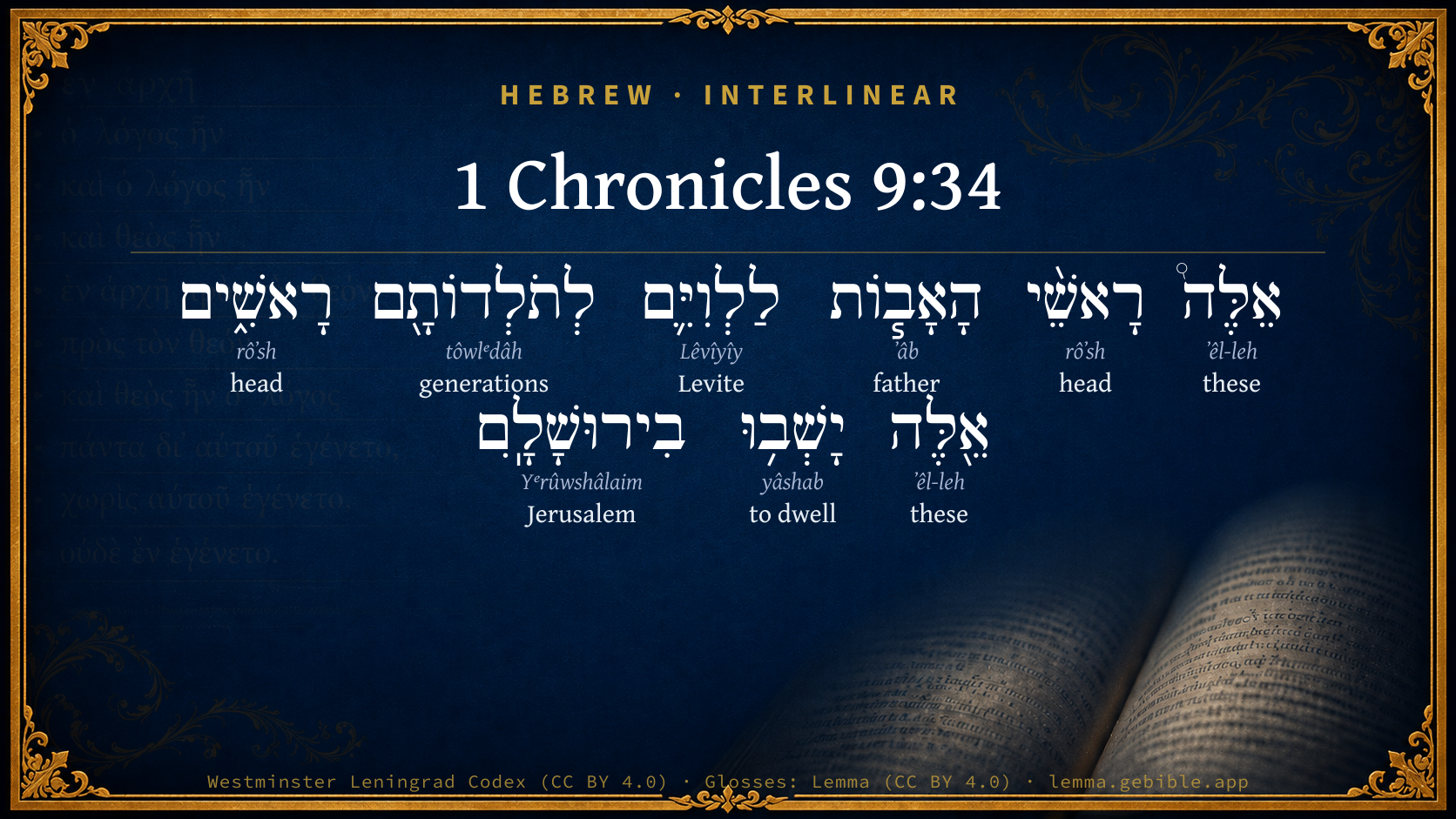
  1. אֵלֶּה֩ ʼêl-leh H428 “these” Pronoun, Demonstrative, Common, Plural
  2. רָאשֵׁ֨י rôʼsh H7218 “heads of” Noun, Common, Masculine, Plural, Construct
  3. הָאָב֧וֹת ʼâb H1 “the · fathers” Particle, Definite Article + Noun, Common, Masculine, Plural, Absolute
  4. לַלְוִיִּ֛ם Lêvîyîy H3881 “to/for the · Levites” Preposition, Determined + Noun, Gentilic, Masculine, Plural, Absolute
  5. רָאשִׁ֑ים rôʼsh H7218 “heads” Noun, Common, Masculine, Plural, Absolute
  6. אֵ֖לֶּה ʼêl-leh H428 “these” Pronoun, Demonstrative, Common, Plural
  7. יָשְׁב֥וּ yâshab H3427 “to dwell” Verb, Qal, Perfect, 3rd Person, Common, Plural
  8. בִירוּשָׁלִָֽם Yᵉrûwshâlaim H3389 “in/at · Jerusalem” Preposition + Noun, Proper

About this verse

These counts appear in no published source. They are computed here, from the morphology-tagged text and Lemma’s own curated glosses. What Lemma adds →

9
words
7
distinct lemmas
Historical
section

Shared distinctive vocabulary

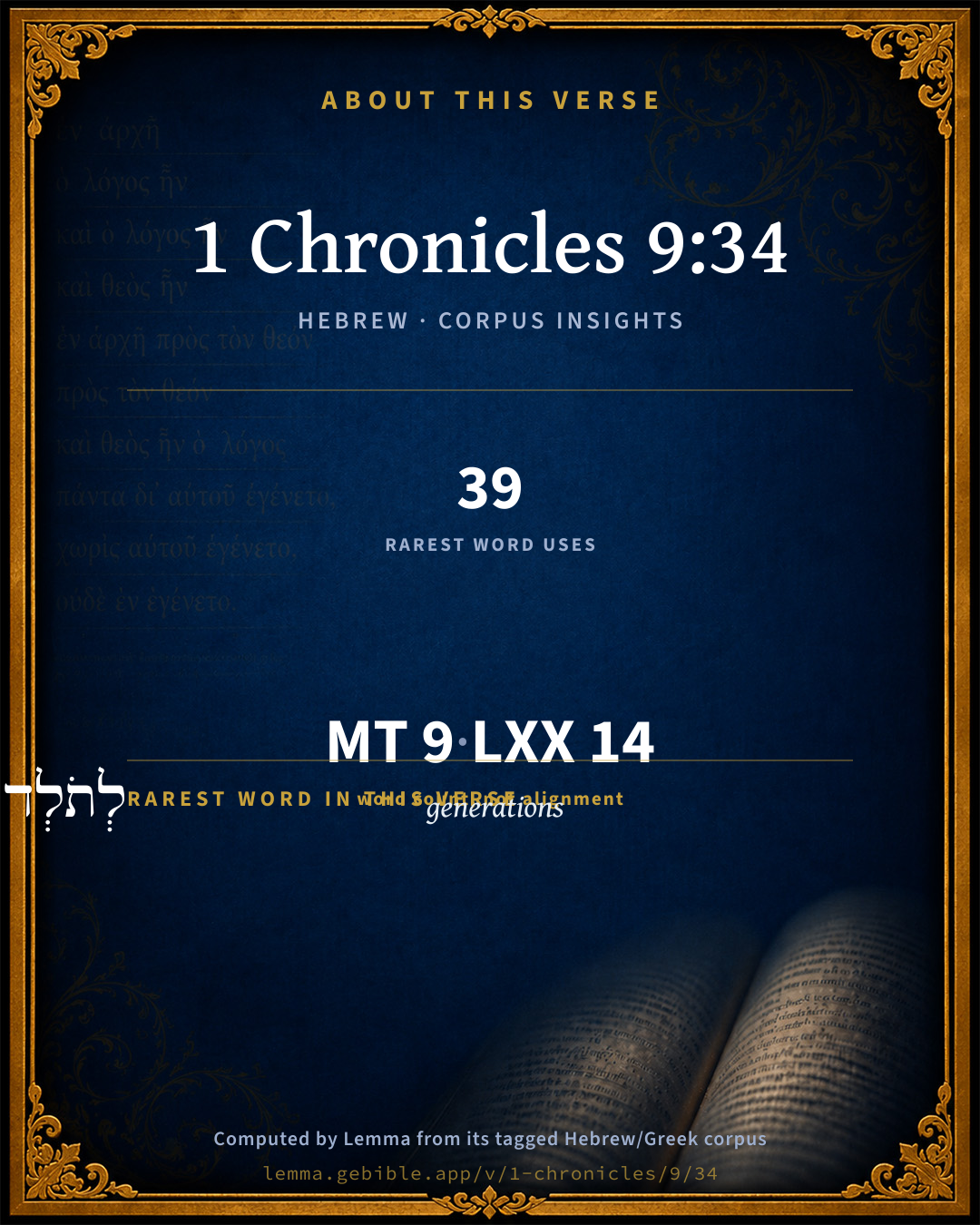
לְתֹלְדוֹתָ֖ם generations H8435 occurs in 39 verses of the Hebrew Bible. Also found in:

Grammatical profile

  • 1 verb
  • 6 nouns
  • 2 pronouns

Verb forms

  • יָשְׁב֥וּ Qal · Perfect

Repetition

Words recur within this verse — often emphatic in Hebrew:

  • רָאשֵׁ֨י head H7218 ×2
  • אֵלֶּה֩ these H428 ×2

Hebrew & Septuagint length

In English translation the verse runs 18 words from the Hebrew and 19 from the Septuagint (LXX English) — closely comparable.

A rough comparison of the two English renderings, which tokenize alike — not a word-level alignment.

Word counts can differ between the Hebrew and the Greek without any difference in meaning — e.g. the Hebrew direct-object marker אֵת has no separate Greek word, and Greek often adds the article ὁ.

In the original languages it is 9 Hebrew tokens and 14 Greek tokens — but the two are counted differently (Hebrew bundles its prefixes and suffixes into one token; the Greek is in lemma form), so that isn’t a like-for-like length.

Cross-references

2

Topical passages linked to 1 Chronicles 9:34 in the Treasury of Scripture Knowledge — connected by theme and wording, ordered by reader-vote popularity; previews shown in the World English Bible.

  • 1 Chronicles 9:13 and their brothers, heads of their fathers' houses, one thousand seven hundred sixty; very able men for the work of the service of the house of God.
  • Nehemiah 11:1–15 The princes of the people lived in Jerusalem: the rest of the people also cast lots, to bring one of ten to dwell in Jerusalem the holy city, and nine parts in the [other] cities.

Cross-references courtesy of OpenBible.info (CC BY 4.0).

Hebrew and Greek witnesses Masoretic Hebrew ↔ Greek Septuagint

The same verse in the two great witnesses to the Old Testament, shown verse-for-verse.

These are two independent witnesses, not word-aligned to each other, and the Septuagint is shown in lemma (dictionary) form.

Hebrew 1 Chronicles 9:34 Masoretic · Westminster Leningrad Codex

אֵלֶּה֩ רָאשֵׁ֨י הָאָב֧וֹת לַלְוִיִּ֛ם לְתֹלְדוֹתָ֖ם רָאשִׁ֑ים אֵ֖לֶּה יָשְׁב֥וּ בִירוּשָׁלִָֽם

These were heads of fathers' [houses] of the Levites, throughout their generations, chief men: these lived at Jerusalem.

World English Bible · Public Domain

Greek LXX 1 Chronicles 9:34 Septuagint · lemma form

οὗτος ἄρχων ὁ πατριά ὁ λευίτης κατά γένεσις αὐτός ἄρχων οὗτος καταοἰκέω ἐν ἰερουσαλήμ

These were the heads of the families of the Levites according to their generations; these chiefs lived in Jerusalem.

LXX2012 (modern English Septuagint) · Public Domain

Hebrew: Westminster Leningrad Codex (CC BY 4.0). Greek: Septuagint (public domain); English from LXX2012 (modern English Septuagint) (Public Domain). How the Septuagint differs from the Hebrew →

Commentary

Notes on 1 Chronicles 9:34 from classic Christian and Jewish commentators (each source and its license shown beneath its notes). The classic Christian expositions comment on the surrounding passage and are grouped to its opening verse, so a note may address several verses; the Jewish commentaries on the Tanakh (Rashi and others) are per-verse, so they appear only where the commentator wrote on this verse.

Lemma curates 59 commentaries, every one of them public domain or Creative Commons licensed, each selected and text-cleaned for this edition rather than reprinted as found. About our sources →

Joseph Benson's Commentary

1Ch 9:34-35. These dwelt at Jerusalem — Upon their return from Babylon they were not suffered to choose their habitations in the country, as others were, but were obliged to settle themselves at Jerusalem, that they might constantly attend upon God’s service there. Whose wife’s name was Maachah — In this and the following verses he repeats Saul’s genealogy, that he might make way for the following history.

Joseph Benson's Commentary on the Old and New Testaments (1811–1818) — public domain. Text from a community e-Sword module.

Tyndale Open Study Notes

Tyndale Open Resources

9:34 The reference to Jerusalem draws readers back to the beginning (9:3) and defines all Israel in terms of its representatives living in that city. • In detailing the responsibilities of the priests and Levites, the Chronicler’s primary focus was the heads of Levite families (9:10-33).

Tyndale Open Study Notes — © Tyndale Open Resources, licensed CC BY-SA 4.0. Text via the HelloAO Bible API.

Ellicott's Commentary for English Readers

(34) These chief . . . generations.—Literally, These are the heads of the Levitical houses, according to their birth-rolls, heads. (Comp. 1Ch_8:28 for the meaning.)

These dwelt in Jerusalem.—A final remark concerning all the Levites of 1Ch_9:14-32. The proper names are regarded as chiefs, under whom their numerous clansmen are subsumed.

A Bible Commentary for English Readers, edited by Charles John Ellicott (1878–1897) — public domain. Text from a community e-Sword module.

The Cambridge Bible for Schools and Colleges

gen. ed. J. J. S. Perowne

34. These chief … generations] R.V. These were heads of fathers’ houses of the Levites, throughout their generations, chief men.

The Cambridge Bible for Schools and Colleges (gen. ed. J. J. S. Perowne; Cambridge University Press, 1878–1918) — public domain. Text from a community e-Sword module.

Albert Barnes' Notes on the Bible

Chief throughout their generations - The superintendents, that is, were the genealogical head of the different Levitical divisions, and bore special rule, each over those of his own blood and race. The hereditary principle prevailed, not only in the high priesthood, but also in the priestly offices of the second rank.

Albert Barnes' Notes on the Bible (1834–1885) — public domain. Text from a community e-Sword/MySword module.

Haydock's Catholic Bible Commentary

Jerusalem, having no substitute; (chap. xxvi.; Haydock) or the chiefs of each family resided there. (Menochius)

George Leo Haydock (1774–1849), Haydock's Catholic Family Bible and Commentary, 1859 edition — public domain. Excludes Psalms (Douay-Rheims chapter numbering differs from Protestant) and Deuterocanonical books (Catholic canon only).

Matthew Poole's English Annotations

Upon their return from Babylon they were not suffered to choose their habitations in the country, as others were, but were obliged to settle themselves at Jerusalem, that they might constantly attend upon God’s service there, and be ready to instruct the younger Levites in their office, as they needed or desired it.

Matthew Poole's English Annotations on the Holy Bible (1683–1685) — public domain. Text from a community e-Sword/MySword module.

The Pulpit Commentary

This verse can scarcely be other than a closing general comment respecting all the chief fathers of the Levites, who have been spoken of; (1Ch_8:28) and it purports to say that the same order and principle obtained in the offices referred to from generation to generation of families.

The Pulpit Commentary (1880–1919), ed. H.D.M. Spence-Jones & Joseph S. Exell — public domain. Text from a community e-Sword module.

John Wesley's Explanatory Notes

Jerusalem - Upon their return from Babylon they were not suffered to chuse their habitations in the country, as others were, but were obliged to settle themselves at Jerusalem, that they might constantly attend upon God's service there.

John Wesley, Explanatory Notes Upon the Whole Bible (1754–1765) — public domain. Text via the GEBible commentary corpus.

Lesson kit

Teaching starters — assembled from the data on this page, not authored interpretation. Every prompt links to the verse data it draws on. Edit before teaching.

1 Chronicles, in the Historical, opens this verse with 9 words (7 distinct Hebrew lemmas). Its most distinctive word is tôwlᵉdâh (“generations”). A historical commentator’s framing appears above. Read the whole chapter for the surrounding context.

Discussion questions

  1. What does “generations” (tôwlᵉdâh) contribute to the verse as a whole?
  2. How does Genesis 2:4, which shares the word «generations», read alongside this verse?
  3. What does the repetition of “head” (2× in this one verse) do in this verse?
  4. The translations on this page render this verse differently — a whole-verse word diff, not a word-by-word alignment. What might account for the different wordings?
  5. «יָשְׁב֥וּ» is a Qal Perfect verb. How does that grammatical form shape the action described?
  6. Compare how Joseph Benson's Commentary and Tyndale Open Study Notes read this verse. Where do they agree or differ?

Things to notice

Reading settings

Reading text

Shown beneath each verse's original-language words.

Old Testament
Old Testament edition

Read the OT as the Masoretic Hebrew (MT) or the Greek Septuagint (LXX).

English shown for the Greek Septuagint (in the Hebrew ↔ Greek comparison).

Comparing translations? Open the Compare panel on any verse page to stack up to four side by side.