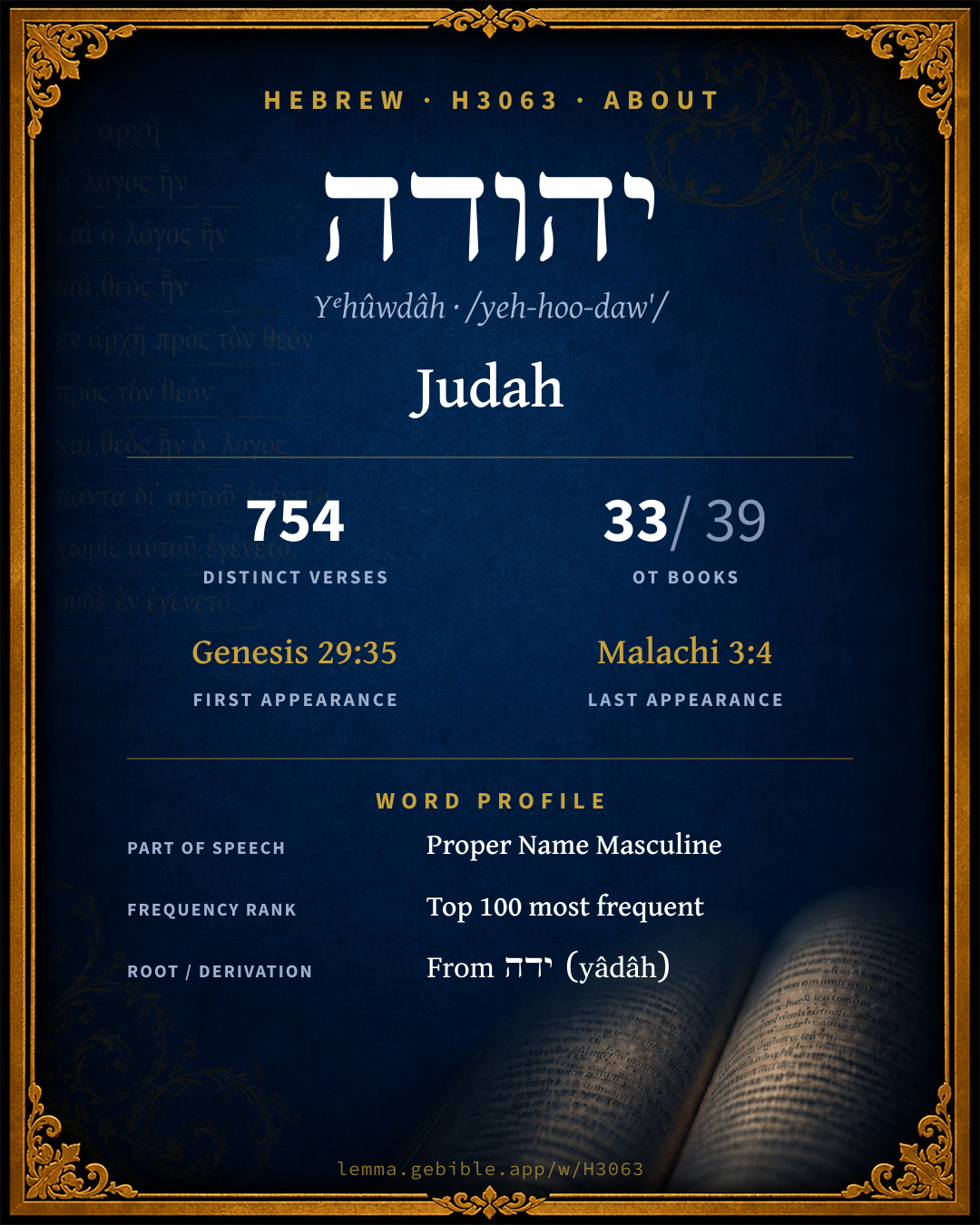
יְהוּדָה
Judah
BDB lists 9 entries for ‘Judah’ fuller range ↓
Full lexicon entry — Brown-Driver-Briggs (BDB)
From Brown-Driver-Briggs (BDB)
Where this word appears
Grammar key — what these labels mean
Part of speech
- Noun
- A naming word — a person, place, thing, or idea.
Noun type
- Proper
- A name of a specific person, place, or people (e.g. Abraham, Zion, Israel).
Every verse where H3063 appears in the Book of Joshua — 22 distinct verses. Click any verse to open its interlinear word-by-word view. Verse text shown in the World English Bible for context — . Each verse’s Hebrew form is shown with its reference; the English is not keyword-highlighted, since the data carries no word-level English alignment. Use “Compare translations” on any verse to read it across multiple English versions. This concordance covers the Hebrew Bible; Septuagint (Greek Old Testament) occurrences are not indexed here.
Joshua
- Joshua 7:1 יְהוּדָה֙ n Proper But the children of Israel committed a trespass in the devoted thing; for Achan, the son of Carmi, the son of Zabdi, the son of Zerah, of the tribe of Judah, took of the devoted thing: and the anger of Yahweh was kindled against the children of Israel.
- Joshua 7:16 יְהוּדָֽה n Proper So Joshua rose up early in the morning, and brought Israel near by their tribes; and the tribe of Judah was taken:
- Joshua 7:17 יְהוּדָ֔ה n Proper and he brought near the family of Judah; and he took the family of the Zerahites: and he brought near the family of the Zerahites man by man; and Zabdi was taken:
- Joshua 7:18 יְהוּדָֽה n Proper and he brought near his household man by man; and Achan, the son of Carmi, the son of Zabdi, the son of Zerah, of the tribe of Judah, was taken.
- Joshua 11:21 יְהוּדָ֔ה n Proper Joshua came at that time, and cut off the Anakim from the hill-country, from Hebron, from Debir, from Anab, and from all the hill-country of Judah, and from all the hill-country of Israel: Joshua utterly destroyed them with their cities.
- Joshua 14:6 יְהוּדָ֤ה n Proper Then the children of Judah drew near to Joshua in Gilgal: and Caleb the son of Jephunneh the Kenizzite said to him, You know the thing that Yahweh spoke to Moses the man of God concerning me and concerning you in Kadesh-barnea.
- Joshua 15:1 יְהוּדָ֖ה n Proper The lot for the tribe of the children of Judah according to their families was to the border of Edom, even to the wilderness of Zin southward, at the uttermost part of the south.
- Joshua 15:12 יְהוּדָ֛ה n Proper The west border was to the great sea, and the border [of it]. This is the border of the children of Judah round about according to their families.
- Joshua 15:13 יְהוּדָ֔ה n Proper To Caleb the son of Jephunneh he gave a portion among the children of Judah, according to the commandment of Yahweh to Joshua, even Kiriath Arba, [which Arba was] the father of Anak (the same is Hebron).
- Joshua 15:20 יְהוּדָ֖ה n Proper This is the inheritance of the tribe of the children of Judah according to their families.
- Joshua 15:21 יְהוּדָ֔ה n Proper The uttermost cities of the tribe of the children of Judah toward the border of Edom in the South were Kabzeel, and Eder, and Jagur,
- Joshua 15:63 יְהוּדָ֖ה יְהוּדָה֙ n Proper n Proper As for the Jebusites, the inhabitants of Jerusalem, the children of Judah couldn't drive them out: but the Jebusites dwell with the children of Judah at Jerusalem to this day.
- Joshua 18:5 יְהוּדָ֞ה n Proper They shall divide it into seven portions: Judah shall abide in his border on the south, and the house of Joseph shall abide in their border on the north.
- Joshua 18:11 יְהוּדָ֔ה n Proper The lot of the tribe of the children of Benjamin came up according to their families: and the border of their lot went out between the children of Judah and the children of Joseph.
- Joshua 18:14 יְהוּדָ֑ה n Proper The border extended [there], and turned about on the west quarter southward, from the mountain that lies before Beth Horon southward; and the goings out of it were at Kiriath Baal (the same is Kiriath Jearim), a city of the children of Judah: this was the west quarter.
- Joshua 19:1 יְהוּדָֽה n Proper The second lot came out for Simeon, even for the tribe of the children of Simeon according to their families: and their inheritance was in the midst of the inheritance of the children of Judah.
- Joshua 19:9 יְהוּדָ֔ה יְהוּדָה֙ n Proper n Proper Out of the part of the children of Judah was the inheritance of the children of Simeon; for the portion of the children of Judah was too much for them: therefore the children of Simeon had inheritance in the midst of their inheritance.
- Joshua 19:34 וּ/בִ֣/יהוּדָ֔ה conj + prep + n Proper and the border turned westward to Aznoth Tabor, and went out from there to Hukkok; and it reached to Zebulun on the south, and reached to Asher on the west, and to Judah at the Jordan toward the sunrise.
- Joshua 20:7 יְהוּדָֽה n Proper They set apart Kedesh in Galilee in the hill-country of Naphtali, and Shechem in the hill-country of Ephraim, and Kiriath Arba (the same is Hebron) in the hill-country of Judah.
- Joshua 21:4 יְ֠הוּדָה n Proper The lot came out for the families of the Kohathites: and the children of Aaron the priest, who were of the Levites, had by lot out of the tribe of Judah, and out of the tribe of the Simeonites, and out of the tribe of Benjamin, thirteen cities.
- Joshua 21:9 יְהוּדָ֔ה n Proper They gave out of the tribe of the children of Judah, and out of the tribe of the children of Simeon, these cities which are [here] mentioned by name:
- Joshua 21:11 יְהוּדָ֑ה n Proper They gave them Kiriath Arba, [which Arba was] the father of Anak (the same is Hebron), in the hill-country of Judah, with the suburbs of it round about it.
About this entry
At a glance — auto-summarized from this page’s data, not written by a person. Every figure links to its source below. This summary describes the numbers; it doesn’t interpret them.
יהודה (Yᵉhûwdâh) is a Hebrew name most often rendered “Judah.” Debuting at Genesis 29:35, it then recurs through the corpus. With 754 verses in 33 books, it is one of the most common word in the Hebrew Bible. For the data behind this summary, explore 754-verse concordance and the renderings breakdown below.
Gloss history
Strong's 1890 vs modern scholarship
About this word
Strong's H3063 catalogs a Hebrew word from the Hebrew Old Testament.
These counts are not copied from any lexicon or concordance. They are computed here, from the morphology-tagged Hebrew Old Testament. What Lemma adds →
- 754
- distinct verses
- The word appears in 754 distinct verses.
- 33 / 39
- OT books
- The word appears in 33 of 39 Old Testament books.
- #56
- by frequency
- Top 100 most frequent Hebrew words (rank 56 of 8,640 Hebrew words by occurrence).
View all 754 occurrences in the concordance →
Most concentrated in
- Jeremiah 165 verses 22%
- 2 Chronicles 145 verses 19%
- 2 Kings 88 verses 12%
By section of the Old Testament
By traditional corpus
Conventional, traditional groupings — biblical authorship is debated, so this is a traditional corpus grouping, not an authorship claim. Each share is this word’s portion of its verses in that division of the Hebrew canon. Each figure is a share of the word’s 754 distinct verses.
- Prophets (Nevi'im) 477 verses · 63%
- Writings (Ketuvim) 232 verses · 31%
- Torah (Pentateuch) 45 verses · 6%
How translations render this word
Counts come from each version’s own published word-to-Strong’s tagging or interlinear alignment — an approximate guide to how each version renders this word, not a word-level alignment the data otherwise carries. Because each total is that version’s own tagged count, the per-version totals vary from one another and need not match the appearance or distinct-verse counts above. These counts may also differ from a printed concordance because Lemma counts each distinctly tagged rendering and does not collapse phrase taggings into a single head-word total. This is a fixed set of word-tagged versions (KJV, ASV, BSB, ULT) and does not change with the reading translation you choose elsewhere. Each version’s license is shown beside its name below (and on Sources).
- King James Version: Judah 705×, All judah 24×, Against judah 12×
- American Standard Version: Judah 689×, All judah 22×, Against judah 11×
- Berean Standard Bible: Judah 746×, Over judah 21×, Judah’s 7×
- unfoldingWord Literal Text: Judah 698×, Against judah 8×, Is to judah 4×
King James Version Public Domain
Renders H3063 across 808 tagged occurrences — most commonly:
Plus 31 renderings that appear only once — usually multi-word phrases or single function words the recovered tagging swept in, not distinct renderings. Not rendered by a distinct English word in 10 further occurrences.
American Standard Version Public Domain
Renders H3063 across 806 tagged occurrences — most commonly:
Plus 52 renderings that appear only once — usually multi-word phrases or single function words the recovered tagging swept in, not distinct renderings.
Berean Standard Bible Public Domain
Renders H3063 across 812 tagged occurrences — most commonly:
Plus 22 renderings that appear only once — usually multi-word phrases or single function words the recovered tagging swept in, not distinct renderings. Not rendered by a distinct English word in 7 further occurrences.
unfoldingWord Literal Text CC BY-SA 4.0
Renders H3063 across 728 tagged occurrences — most commonly:
Plus 11 renderings that appear only once — usually multi-word phrases or single function words the recovered tagging swept in, not distinct renderings.
9 senses and sub-senses in the full BDB
What do BDB’s symbols mean?
BDB uses these scholarly abbreviations:
| Symbol | Meaning |
|---|---|
| 𝔊 | the Septuagint (the ancient Greek translation, LXX) |
| 𝔙 | the Vulgate (the Latin translation) |
| 𝔖 | the Syriac version (the Peshitta) |
| 𝔗 | the Targum (the Aramaic translation) |
| ψ | the Psalms |
| √ | root (the underlying root or stem) |
| ‖ | parallel passage (a synonymous or contrasted parallel) |
| † | the dagger: every passage where the word occurs is cited |
The 9 senses and sub-senses the full Brown-Driver-Briggs lexicon distinguishes for this word, in lexicon order (not ranked by frequency), with BDB’s own verbatim wording and sub-sense lettering. Shown in Hebrew script with BDB’s own scholarly abbreviations. The condensed entry is in the Lexicon Entry tab. See also the Forms in the corpus table below.
- I. n.pr.m.
- 1. son of Jacob and Leah, expl. by Leah’s words I will praise י׳ Gn 29:35 (J); cf. Jacob’s prediction, thy brethren shall praise thee Gn 49:8 (poem in JE), see also v 9, 10; elsewhere Gn 37:26; 38:1 + 14 times Gn 38, 43:3, 8; 44:14, 16, 18; 46:28 (all J), 35:23 (P), 1 Ch 2:1, 3 Ru 4:12; בְּנֵי יְהוּדָה sons of Judah Gn 46:12 Nu 26:19 (P), 1 Ch 2:3, 4; 4:1. e.g. Genesis 29:35
- 2. tribe descended from Judah Dt 33:7 (poem), Nu 1:7 (P), Dt 27:12 +; בְּנֵי יהודה Nu 1:26 (P), Jos 14:6 (D), Ju 1:8 +; שֵׁבֶט יהודה Jos 7:16 (J), 1 K 12:20 2 K 17:18 ψ 78:68; מַטֵּה בְנֵי יהודה Jos 15:1, 20, 21; 21:9 (all P), 1 Ch 6:50; elsewhere מַטֵּה יהודה Ex 31:2; 35:30; 38:22 Nu 1:27; 7:12; 13:6; 34:19 Jos 7:1, 18; 21:4 (all P); אישׁ יהודה Ju 15:10 +; אנשׁי יהודה 2 S 2:4 +, (cf. amelûti [ṣabê] Ia-u-du Tel el-AmarnaNo. 39 JastrJBL xii, 1893, 64). e.g. Deuteronomy 33:7
- 3. nation, of southern kingdom under dynasty of David, as distinguished from northern kingdom of Ephraim or Israel: Ho 4:15 Je 2:28 2 Ch 12:12 +; of the returned exiles Ne 4:4; עַם יהודה 2 K 14:21 = 2 Ch 26:1, Je 25:1, 2 Ezr 4:4; בְּנֵי יהודה Ho 2:2 Je 7:30 2 Ch 13:18; 25:12; 28:10; בֵּית יהודה Ho 1:7 Je 3:18 Ez 4:6 +; מַלְכוּת יהודה 2 Ch 11:17; personified, בַּת י׳ La 1:15; 2:2, 5. e.g. Hosea 4:15
- 4. Levite, Ezra’s time, Ezr 10:23. e.g. Ezra 10:23
- 5. an overseer of Jerus. Ne 11:9. e.g. Nehemiah 11:9
- 6. Levite musician Ne 12:8. e.g. Nehemiah 12:8
- 7. priest Ne 12:36. e.g. Nehemiah 12:36
- II. n.pr.terr. land of Judah, f. Is 7:6 Je 23:6 = 33:16, Jo 4:30 ψ 114:2 +; ארץ יְהוּדֶה 1 S 22:5 2 K 23:24 +; אדמת יהודה Is 19:17; עָרֵי יהודה 2 S 2:1 1 K 12:17 2 K 18:13; 23:5, 8 Is 40:9; 44:26 Zc 1:12 ψ 69:36 La 5:11; also 15 times Chr., 23 times Jer.; בִּיהודה Jos 19:34 Ju 15:9 +; מיהודה 1 K 13:1 +; הר יהודה the hill-country of Judah Jos 11:21 (D), 20:7; 21:11 (P), 2 Ch 27:4; נֶגֶב יהודה the south (country) of Judah 1 S 27:10. 2 S 24:7; מדבר יהודה Ju 1:16 ψ 63:1 (title). e.g. Isaiah 7:6
Senses from the full Brown-Driver-Briggs lexicon (Brown, Driver, Briggs; Oxford 1906 — public domain), digitized via Sefaria, supplemented by the OpenScriptures HebrewLexicon (CC BY 4.0). Full attribution on Sources.
Word origin
n.pr.m. et terr. Judah (treated Gn 29:35; 49:8 (q.v. infr.) as if der. from Hoph. of ידה = praised, object of praise (on ה cf. Hiph. אֲהוֹדֶ֑נּוּ ψ 28:7, יְהוֹדֶה Ne 11:17), but this dubious; relation to יְהֻד, ii. יְהוּדִית unexpl.; v. further JastrJBL xii, 1893, 61 ff.; Assyrian Ia-u-du, of land; Ia-u-da-ai, Judaean COTGloss)—
— Brown-Driver-Briggs (Oxford 1906, public domain), digitized via Sefaria, supplemented by the OpenScriptures HebrewLexicon (CC BY 4.0). See Sources.
Derived from ידה (yâdâh) (H3034) — to throw.
Jastrow Dictionary
A second Hebrew/Aramaic lexicon for comparison, covering Aramaic and post-biblical (Talmudic, Targumic, Midrashic) usage that the biblical-Hebrew BDB does not. Matched by lemma rather than by Strong’s number, so a lemma may carry more than one Jastrow headword (shown separately below), and the entries cover usage well beyond the Bible.
יְהוּדָה
- (b. h.) pr. n. Judah,
- 1. son of Jacob; tribe of Judah. Pes. 50ᵃ. Yoma 12ᵃ, a. e. מחלקו של י׳ from the area of Judah.—Gen. R. s. 85; a. v. fr.
- 2. name of several Tannaim; a) R. J. b. B’thera in Babylonia Ber. 22ᵃ; a. fr.—b) J. b. Tabbai, chief of the Sanhedrin in the days of queen Salome. Ab. I, 8. Ḥag. II, 2; a. fr.—c) R. J. the priest. Eduy. VIII, 3.—d) R. J. b. Baba. Ib. 2. Sabb. 62ᵇ; a. fr.—e) R. J. b. Ilai, usu. mentioned in the Mishnah as R. J. only. Ber. 63ᵇ; Sabb. 33ᵇ. Men. 103ᵇ; a. v. fr.—f) R. J. b. Tema. Ab. V, 20. Erub. 17ᵃ; Tosef. ib. III (II), 6 (ed. Zuck. בתירה). Tosef. Gitt. VII (V), 8; a. fr.; a. others (v. Fr. Darkhé, p. 42; p. 137).—Esp. R. J. han-Nasi I a. II, surnamed Rabbi, v. רַבִּי.
- 3. name of several Amoraim, the most renowned of whom is R. J. (b. Ezekiel), a Babylonian. Keth. 110ᵇ bot.—Y. Taan. I, 64ᵇ top; a. fr.—V. Fr. M’bo p. 91ᵃ
- 4. Judaea, the southern province of Palestine. Keth. I, 5 (12ᵃ); Tosef. ib. I, 4. Kidd. 6ᵃ; a. v. fr.
יוּדָה
- Y. Ber. III, 6ᵃ bot.; a. fr.—V. Frank. M’bo, p. 92ᵃ, sq. V. יוּדָן.
יוּדָן
- q. v. Y. Ber. III, 6ᵃ bot., a. fr. ר׳ י׳ נשייא R. J. (II), the Nasi; (V. Fr. M’bo p. 92ᵃ, sq.).—Pesik. R. s. 14 ר׳ י׳.—Gen. R. s. 10 אבא י׳ (abbr. אַבְדָּן q. v.).—Y. Ber. II, 5ᵃ top. Ib. IX, 14ᵃ top; a. v. fr.
A Dictionary of the Targumim, the Talmud Babli and Yerushalmi, and the Midrashic Literature (Marcus Jastrow; London, Luzac, 1903) — Public Domain. Digitized via Sefaria. Digitized via Sefaria. Full attribution on Sources.
Forms in the corpus
The 84 distinct written forms H3063 takes in the Hebrew Bible, most frequent first — each parse links to that state’s occurrences in the concordance. Hebrew forms include their vowel points and cantillation, so a single lemma takes many written forms.
| Form | Parsing | Example | Uses |
|---|---|---|---|
| יְהוּדָ֔ה | Noun, Proper | Amos 2:4 | 146 |
| יְהוּדָ֑ה | Noun, Proper | Amos 7:12 | 111 |
| יְהוּדָ֖ה | Noun, Proper | Ezekiel 8:1 | 95 |
| יְהוּדָֽה | Noun, Proper | Exodus 31:2 | 88 |
| יְהוּדָה֙ | Noun, Proper | Daniel 9:7 | 67 |
| יְהוּדָ֗ה | Noun, Proper | Amos 1:1 | 65 |
| יְהוּדָ֛ה | Noun, Proper | Genesis 38:2 | 25 |
| יְהוּדָ֜ה | Noun, Proper | Genesis 38:20 | 23 |
| יְהוּדָ֤ה | Noun, Proper | Genesis 44:14 | 11 |
| בִּֽ/יהוּדָ֔ה | Noun, Proper | 2 Chronicles 12:12 | 9 |
| יְהוּדָ֣ה | Noun, Proper | 2 Chronicles 11:23 | 9 |
| בִּֽ/יהוּדָ֑ה | Noun, Proper | Amos 2:5 | 6 |
| וִ/יהוּדָֽה | Noun, Proper | Exodus 1:2 | 6 |
| וִֽ/יהוּדָ֔ה | Noun, Proper | Deuteronomy 27:12 | 6 |
| יְהוּדָ֥ה | Noun, Proper | Ezekiel 21:20 | 6 |
| יְהוּדָה֩ | Noun, Proper | Ezra 10:9 | 6 |
| לִֽ/יהוּדָ֑ה | Noun, Proper | 1 Kings 19:3 | 6 |
| יְ֠הוּדָה | Noun, Proper | 2 Chronicles 30:24 | 5 |
| לִֽ/יהוּדָה֙ | Noun, Proper | Ezra 1:5 | 5 |
| בִּ/יהוּדָֽה | Noun, Proper | 2 Chronicles 11:5 | 4 |
| וִֽ/יהוּדָה֙ | Noun, Proper | Ezekiel 9:9 | 4 |
| יְהוּדָ֕ה | Noun, Proper | Hosea 6:11 | 4 |
| יְהוּדָה֮ | Noun, Proper | 2 Chronicles 25:18 | 4 |
| בִֽ/יהוּדָה֙ | Noun, Proper | 1 Chronicles 28:4 | 3 |
| בִּ/יהוּדָ֑ה | Noun, Proper | Ezra 1:3 | 3 |
| בִּֽ/יהוּדָ֖ה | Noun, Proper | Ezra 9:9 | 3 |
| בִּֽ/יהוּדָ֣ה | Noun, Proper | 2 Chronicles 2:7 | 3 |
| וִֽ/יהוּדָ֑ה | Noun, Proper | 2 Chronicles 36:8 | 3 |
| וִֽ/יהוּדָ֖ה | Noun, Proper | Ezra 2:1 | 3 |
| וִֽ/יהוּדָ֗ה | Noun, Proper | Hosea 11:12 | 3 |
| יְהוּדָ֞ה | Noun, Proper | Genesis 46:28 | 3 |
| יְהוּדָ֧ה | Noun, Proper | 2 Chronicles 19:1 | 3 |
| יְהוּדָה֒ | Noun, Proper | 2 Chronicles 31:1 | 3 |
| לִ/יהוּדָ֖ה | Noun, Proper | 2 Chronicles 11:14 | 3 |
| לִ/יהוּדָֽה | Noun, Proper | Ezra 1:8 | 3 |
| לִֽ/יהוּדָ֔ה | Noun, Proper | Ezekiel 37:16 | 3 |
| בִ/יהוּדָ֖ה | Noun, Proper | 2 Chronicles 28:17 | 2 |
| בִֽ/יהוּדָ֗ה | Noun, Proper | 2 Chronicles 32:1 | 2 |
| בִּ/יהוּדָ֗ה | Noun, Proper | 1 Kings 12:32 | 2 |
| בִּ/יהוּדָ֥ה | Noun, Proper | 2 Chronicles 11:3 | 2 |
| בִּֽ/יהוּדָ֗ה | Noun, Proper | 2 Chronicles 28:6 | 2 |
| וִ/יהוּדָ֔ה | Noun, Proper | 1 Chronicles 2:1 | 2 |
| וִ/יהוּדָ֖ה | Noun, Proper | Isaiah 3:8 | 2 |
| וִ/יהוּדָ֥ה | Noun, Proper | 2 Chronicles 25:19 | 2 |
| וִֽ/יהוּדָ֕ה | Noun, Proper | Hosea 8:14 | 2 |
| וּ/בִ֣/יהוּדָ֔ה | Noun, Proper | 2 Kings 24:20 | 2 |
| יְ֝הוּדָ֗ה | Noun, Proper | Psalms 60:7 | 2 |
| יְהוּדָ֡ה | Noun, Proper | 1 Kings 22:10 | 2 |
| יְהוּדָ֨ה | Noun, Proper | 1 Kings 4:25 | 2 |
| לִ/יהוּדָ֑ה | Noun, Proper | 1 Chronicles 13:6 | 2 |
| לִֽ/יהוּדָ֕ה | Noun, Proper | 1 Chronicles 27:18 | 2 |
| לִֽ/יהוּדָ֖ה | Noun, Proper | 1 Samuel 30:14 | 2 |
| לִֽ/יהוּדָ֤ה | Noun, Proper | Genesis 38:24 | 2 |
| לִֽ/יהוּדָה֒ | Noun, Proper | 2 Chronicles 28:18 | 2 |
| מִ/יהוּדָֽה | Noun, Proper | 1 Kings 13:12 | 2 |
| מִֽ/יהוּדָ֔ה | Noun, Proper | Genesis 49:10 | 2 |
| מִֽ/יהוּדָה֙ | Noun, Proper | 1 Kings 13:21 | 2 |
| בִֽ/יהוּדָ֣ה | Noun, Proper | Nehemiah 13:15 | 1 |
| בִּ/יהוּדָ֖ה | Noun, Proper | 2 Chronicles 11:10 | 1 |
| בִּ/יהוּדָ֣ה | Noun, Proper | Ezra 10:7 | 1 |
The 60 most common forms are shown; 24 rarer forms follow in the full concordance.
Same root — word family
Other BDB entries built from the same root as H3063, grouped by Strong’s listed origin. These share a root / origin per the lexicon — not necessarily a shared meaning. Each links to that word’s own entry.
Derives from
Shares the same root
Proper names from this root
People and places named from this root — a name, not an additional meaning of the word.
- ידו Yiddôw H3035 Iddo
- ידון Yâdôwn H3036 Jadon
- ידותון Yᵉdûwthûwn H3038 Jeduthun
- ידיה Yᵉdâyâh H3042 Jedaiah
- Ιουδα Ioudá G2448 Judah
- Ιουδας Ioúdas G2455 Judas
- יהוד Yᵉhûwd H3061 Judah
- יהודי Yᵉhûwdîy H3064 Jew
Compare all same-root words → Showing 4 of 13 — not the complete family. 8 of the same-root words are proper names (people or places). They share a root, not necessarily a meaning.
Bible dictionary
Public-domain dictionary articles matched to this entry by name (Judah). A biblical name can be shared by more than one person or place, so an article may treat several.
Easton's Bible Dictionary · M. G. Easton, 1897
Praise, the fourth son of Jacob by Leah. The name originated in Leah's words of praise to the Lord on account of his birth: "Now will I praise [Heb. odeh] Jehovah, and she called his name Yehudah" (Gen. 29:35).
It was Judah that interposed in behalf of Joseph, so that his life was spared (Gen. 37:26, 27). He took a lead in the affairs of the family, and "prevailed above his brethren" (Gen. 43:3-10; 44:14, 16-34; 46:28; 1 Chr. 5:2).
Soon after the sale of Joseph to the Ishmaelites, Judah went to reside at Adullam, where he married a woman of Canaan. (See ONAN; TAMAR.) After the death of his wife Shuah, he returned to his father's house, and there exercised much influence over the patriarch, taking a principal part in the events which led to the whole family at length going down into Egypt. We hear nothing more of him till he received his father's blessing (Gen. 49:8-12).
Smith's Bible Dictionary · William Smith, 1863
(praised, celebrated), the fourth son of Jacob and the fourth of Leah. (B.C. after 1753.) Of Judah's personal character more traits are preserved than of any other of the patriarchs, with the exception of Joseph, whose life he in conjunction with Reuben saved. (Genesis 37:26-28) During the second visit to Egypt for corn it was Judah who understood to be responsible for the safety of Benjamin, ch. (Genesis 43:3-10) and when, through Joseph's artifice, the brothers were brought back to the palace, he is again the leader and spokesman of the band. So too it is Judah who is sent before Jacob to smooth the way for him in the land of Goshen. ch. (Genesis 46:28) This ascendancy over his brethren is reflected in the last words addressed to him by his father. The families of Judah occupy a position among the tribes similar to that which their progenitor had taken among the patriarchs. The numbers of the tribe at the census at Sinai were 74,600. (Numbers 1:26,27) On the borders of the promised land they were 76,500. (Genesis 26:22) The boundaries and contents of the territory allotted to Judah are narrated at great length, and with greater minuteness than the others, in (Joshua 15:20-63) The north boundary, for the most part coincident with the south boundary of Benjamin, began at the embouchure of the Jordan and ended on the west at Jabneel on the coast of the Mediterranean, four miles south of Joppa. On the east the Dead Sea, and on the west the Mediterranean, formed the boundaries. The southern line is hard to determine, since it is denoted by places many of which have not been identified. It left the Dead Sea at its extreme south end, and joined the Mediterranean at the Wady el-Arish. This territory is in average length about 45 miles, and in average breadth about 50.
Hitchcock's Bible Names Dictionary · Roswell D. Hitchcock, 1869
the praise of the Lord; confession
Classic public-domain reference works; full attribution on Sources.
Septuagint verse parallels
This word appears in 680 verses that also exist in the Greek Old Testament (Septuagint), out of the 754 Hebrew verses it occurs in. You can read those verses in Greek by switching the Old Testament edition to the Septuagint.
Read these verses in the Septuagint
- Genesis 29:35
- Exodus 1:2
- Numbers 1:7
- Deuteronomy 27:12
- Joshua 7:1
- Judges 1:2
- Ruth 1:1
- 1 Samuel 11:8
- 2 Samuel 1:18
- 1 Kings 1:9
- 2 Kings 1:17
- 1 Chronicles 2:1
This is a verse-level parallel only — the same verses exist in both the Hebrew and Greek Old Testaments. No word-level Hebrew↔Greek correspondence is claimed: the data carries no such alignment, so no Greek word is shown as this Hebrew word’s translation. Coverage is not total — the Septuagint omits the deuterocanon and renumbers the Psalms, so some Hebrew verses have no direct Greek parallel.