
2 Chronicles 28:17

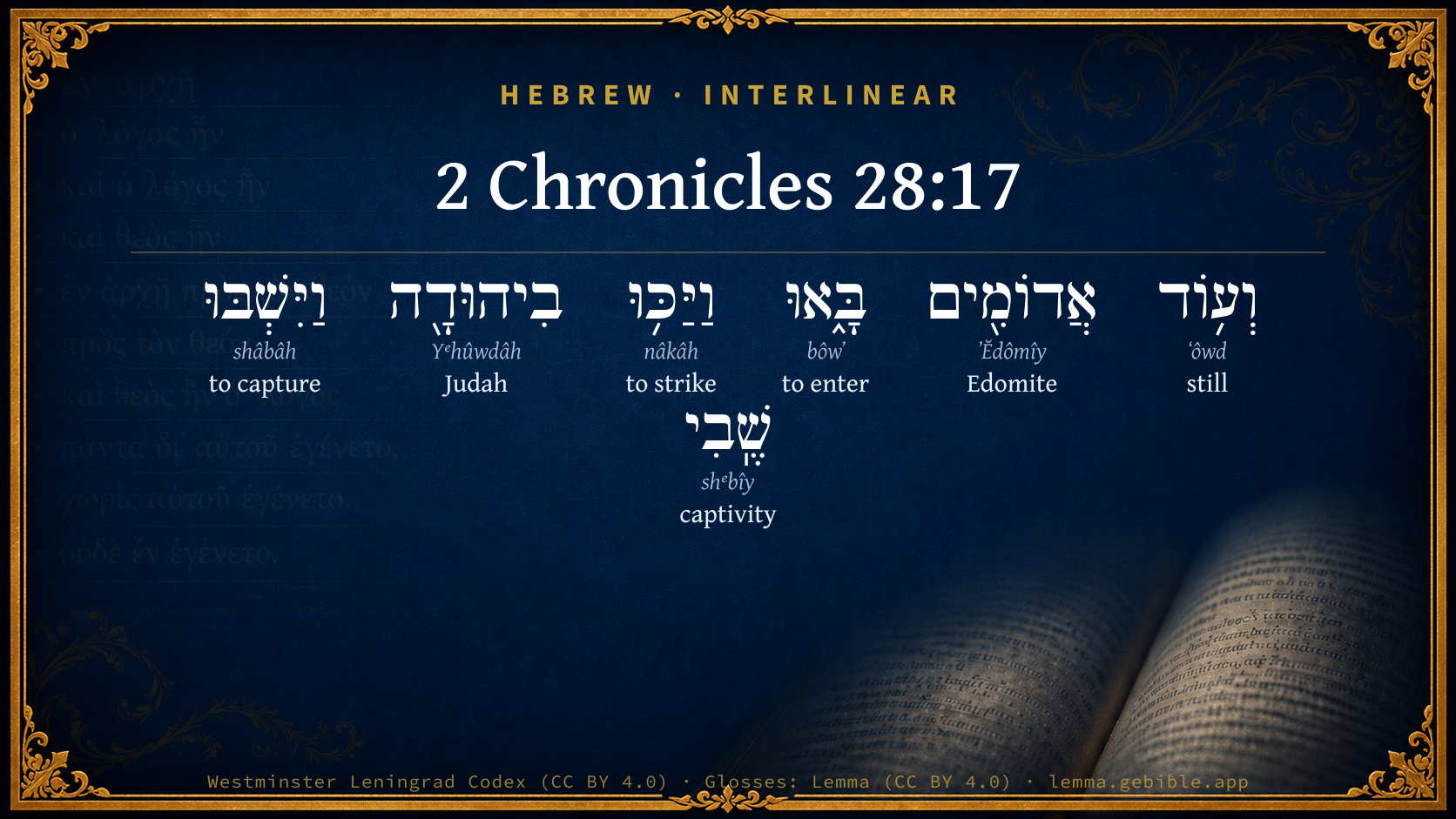
Hebrew (Westminster Leningrad Codex) 2 Chronicles 28:17 appears in the Hebrew Old Testament. The text above is from the Westminster Leningrad Codex. Each word links to its Strong’s number, a concise gloss, and parsing drawn from the Open Scriptures Hebrew Bible morphology. Click any word for its full Brown-Driver-Briggs (BDB) entry.
Download image
Cite this verse

2 Chronicles 28:17 (World English Bible). Public Domain. Lemma interlinear Bible study tool, https://lemma.gebible.app/v/2-chronicles/28/17.

Show BibTeX & RIS
BibTeX
RIS
English Translation
For again the Edomites had come and struck Judah, and carried away captives.
World English Bible · Public Domain
Download a study sheet

One document with this verse’s original text, its word-by-word gloss line, the meaning frame, cross-references with their text, attributed commentary, and full source and license credits — printable, and it pastes into notes with its structure intact.

This verse Autodidact and up

Study sheet (.html) Plain text (.txt)

A passage Seminary Student

Up to 50 verses in one chapter. A passage sheet keeps up to 6 commentary sources and 12 cross-references per verse, in the order this page ranks them, and says so on the sheet whenever that leaves anything out. Ask for a single verse and you get the Autodidact verse sheet above.

Everything on this page stays free to read, with no account — the sheet is a download of what is already on screen, not access to it.

Want to remove ads? Support Godless Engineer
Compare translations 3

The same verse in 3 English versions, stacked beneath the original-language interlinear above. Click any original word for its lexicon entry.

Each is an independent rendering of the whole verse — the interlinear is not word-aligned to these translations.

Highlighted words mark where these versions differ — a whole-verse word diff, not a word-by-word alignment.

  • World English Bible Public Domain
    For again the Edomites had come and struck Judah, and carried away captives.
  • King James Version Public Domain
    For again the Edomites had come and smitten Judah, and carried away captives.
  • unfoldingWord Literal Text CC BY-SA 4.0
    And again the Edomites had come, and they struck Judah. And they took captive captives.

unfoldingWord Literal Text — © unfoldingWord, licensed CC BY-SA 4.0. Word-aligned USFM3 via Door43 (git.door43.org/unfoldingWord/en_ult).

Versions to compare (up to 4)

3 of 4 selected

Show all 18 translations

Every available English version of this verse, each an independent rendering of the whole verse.

  • World English Bible Public Domain
    For again the Edomites had come and struck Judah, and carried away captives.
  • Berean Standard Bible Public Domain
    The Edomites had again come and attacked Judah and carried away captives.
  • Majority Standard Bible Public Domain
    The Edomites had again come and attacked Judah and carried away captives.
  • King James Version Public Domain
    For again the Edomites had come and smitten Judah, and carried away captives.
  • American Standard Version (1901) Public Domain
    For again the Edomites had come and smitten Judah, and carried away captives.
  • Revised Version (1885) Public Domain
    For again the Edomites had come and smitten Judah, and carried away captives.
  • Geneva Bible (1599) Public Domain
    (For the Edomites came moreouer, and slew of Iudah, and caryed away captiues.
  • Douay-Rheims (1899) Public Domain
    And the Edomites came and slew many of Juda, and took a great booty.
  • Young's Literal Translation Public Domain
    and again the Edomites have come, and smite in Judah, and take captive a captivity.
  • Literal Standard Version CC BY-SA 4.0
    and again the Edomites have come, and strike in Judah, and take captive a captivity.
  • Unlocked Literal Bible CC BY-SA 4.0
    For once again the Edomites had come and attacked Judah, carrying prisoners away.
  • unfoldingWord Literal Text CC BY-SA 4.0
    And again the Edomites had come, and they struck Judah. And they took captive captives.
  • Darby Bible Public Domain
    And again the Edomites came and smote Judah, and carried away captives.
  • World Messianic Bible Public Domain
    For again the Edomites had come and struck Judah, and carried away captives.
  • Webster's Bible Public Domain
    For again the Edomites had come and smitten Judah, and carried away captives.
  • Free Bible Version CC BY-SA 4.0
    The armies of Edom had once again invaded Judah and taken people prisoner,
  • Bible in Basic English Public Domain
    For the Edomites had come again, attacking Judah and taking away prisoners.
  • JPS Tanakh (1917) Public Domain
    For again the Edomites had come and smitten Judah, and carried away captives.

Literal Standard Version (2020), Covenant Press — licensed CC BY-SA 4.0. Text via the HelloAO Bible API (eBible.org). Unlocked Literal Bible (unfoldingWord) — licensed CC BY-SA 4.0. Text via the HelloAO Bible API (eBible.org). unfoldingWord Literal Text — © unfoldingWord, licensed CC BY-SA 4.0. Word-aligned USFM3 via Door43 (git.door43.org/unfoldingWord/en_ult). Free Bible Version, Dr. Jonathan Gallagher — licensed CC BY-SA 4.0. Text via the HelloAO Bible API (eBible.org).

Word by word

More ways to search: Search by grammar → Find every occurrence → Compare this word →

Practice this passage: Drill this verse → Learn its vocabulary →

About this verse

These counts appear in no published source. They are computed here, from the morphology-tagged text and Lemma’s own curated glosses. What Lemma adds →

7
words
7
distinct lemmas
Historical
section

Notable vocabulary

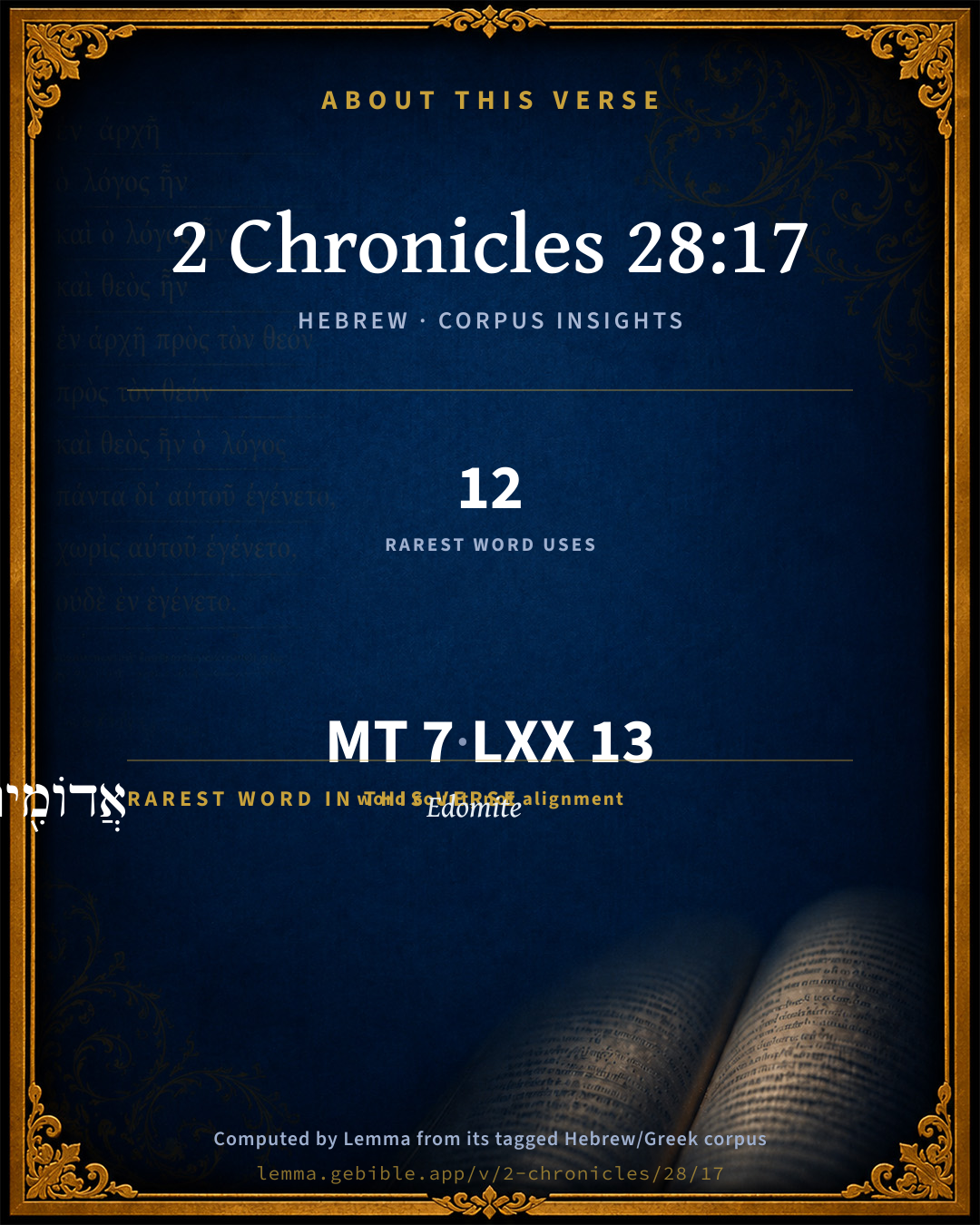
The rarest word here is אֲדוֹמִ֖ים Edomite H130 — appearing just 12 times in the whole Hebrew Bible.

Shared distinctive vocabulary

אֲדוֹמִ֖ים Edomite H130 occurs in 12 verses of the Hebrew Bible. Also found in:

Grammatical profile

  • 3 verbs
  • 3 nouns
  • 1 adverb

Verb forms

  • בָּ֑אוּ Qal · Perfect
  • וַיַּכּ֥וּ Hiphil · Sequential Imperfect
  • וַיִּשְׁבּוּ Qal · Sequential Imperfect

Hebrew & Septuagint length

In English translation the verse runs 13 words from the Hebrew and 15 from the Septuagint (LXX English) — closely comparable.

A rough comparison of the two English renderings, which tokenize alike — not a word-level alignment.

Word counts can differ between the Hebrew and the Greek without any difference in meaning — e.g. the Hebrew direct-object marker אֵת has no separate Greek word, and Greek often adds the article ὁ.

In the original languages it is 7 Hebrew tokens and 13 Greek tokens — but the two are counted differently (Hebrew bundles its prefixes and suffixes into one token; the Greek is in lemma form), so that isn’t a like-for-like length.

Cross-references

4

Topical passages linked to 2 Chronicles 28:17 in the Treasury of Scripture Knowledge — connected by theme and wording, ordered by reader-vote popularity; previews shown in the World English Bible.

  • Obadiah 1:10 For the violence done to your brother Jacob, shame will cover you, and you will be cut off forever.
  • Leviticus 26:18 "'If you in spite of these things will not listen to me, then I will chastise you seven times more for your sins.
  • 2 Chronicles 25:11–12 Amaziah took courage, and led forth his people, and went to the Valley of Salt, and struck of the children of Seir ten thousand.
  • Obadiah 1:13–14 Don't enter into the gate of my people in the day of their calamity. Don't look down on their affliction in the day of their calamity, neither seize their wealth on the day of their calamity.

Cross-references courtesy of OpenBible.info (CC BY 4.0).

Hebrew and Greek witnesses Masoretic Hebrew ↔ Greek Septuagint

The same verse in the two great witnesses to the Old Testament, shown verse-for-verse.

These are two independent witnesses, not word-aligned to each other, and the Septuagint is shown in lemma (dictionary) form.

Hebrew 2 Chronicles 28:17 Masoretic · Westminster Leningrad Codex

וְע֥וֹד אֲדוֹמִ֖ים בָּ֑אוּ וַיַּכּ֥וּ בִיהוּדָ֖ה וַיִּשְׁבּוּ שֶֽׁבִי

For again the Edomites had come and struck Judah, and carried away captives.

World English Bible · Public Domain

Greek LXX 2 Chronicles 28:17 Septuagint · lemma form

καί ἐν οὗτος ὅτι ιδουμαία ἐπιτίθημι καί πατάσσω ἐν ἰουδά καί αἰχμαλωτίζω αἰχμαλωσία

because the Idumeans had attacked him, and struck Juda, and taken a number of prisoners.

LXX2012 (modern English Septuagint) · Public Domain

On this verse, John Gill's Exposition discusses the Septuagint’s reading. Read the note in Commentary ↓

Hebrew: Westminster Leningrad Codex (CC BY 4.0). Greek: Septuagint (public domain); English from LXX2012 (modern English Septuagint) (Public Domain). How the Septuagint differs from the Hebrew →

Commentary

Notes on 2 Chronicles 28:17 from classic Christian and Jewish commentators (each source and its license shown beneath its notes). The classic Christian expositions comment on the surrounding passage and are grouped to its opening verse, so a note may address several verses; the Jewish commentaries on the Tanakh (Rashi and others) are per-verse, so they appear only where the commentator wrote on this verse.

Lemma curates 59 commentaries, every one of them public domain or Creative Commons licensed, each selected and text-cleaned for this edition rather than reprinted as found. About our sources →

Trapp's Complete Commentary

John Trapp

2Ch 28:17 For again the Edomites had come and smitten Judah, and carried away captives.

Ver. 17. For again the Edomites.] "Many sorrows shall be to the wicked; whenas he that trusteth in the Lord" - which Ahaz would not hear of - "mercy shall compass him round about," {Psa 32:10} as it did his good son Hezekiah.

John Trapp, A Commentary or Exposition upon All the Books of the Old and New Testament (1647–1656) — public domain. Text from a community e-Sword module.

Tyndale Open Study Notes

Tyndale Open Resources

28:17-18 The Edomites and the Philistines were natural enemies of Judah. The towns captured by these armies were all along the Aijalon, Sorek, and Elah valleys in the buffer zone of the foothills of Judah or the Negev.

Tyndale Open Study Notes — © Tyndale Open Resources, licensed CC BY-SA 4.0. Text via the HelloAO Bible API.

Jamieson, Fausset & Brown

Robert Jamieson, A. R. Fausset & David Brown

again the Edomites had come and smitten Judah--This invasion must have been after Rezin (at the beginning of the recent Syro-Israelitish war), had released that people from the yoke of Judah (Ch2 15:11; compare Kg2 16:6).

Jamieson, Fausset & Brown — Commentary Critical and Explanatory on the Whole Bible (1871) — public domain (CC PDM 1.0). Text via the HelloAO Bible API.

Ellicott's Commentary for English Readers

(17) For again.—And moreover.

Smitten Judah.—Smitten in Judah, i.e., inflicted a defeat upon her. After their reduction by Uzziah, the Edomites had probably remained subject to Judah, until Rezin of Syria expelled the Jews from Elath (2Ki_16:6), and restored it to them. After that event, the disasters of Ahaz seem to have encouraged them to make a raid upon his territory.

A Bible Commentary for English Readers, edited by Charles John Ellicott (1878–1897) — public domain. Text from a community e-Sword module.

John Gill's Exposition

For the Lord brought Judah low because of Ahaz king of Israel,.... Because of his impieties and idolatries, which the people by his example went into; he is called king of Israel, because he walked in the ways of the kings of Israel, and because he ruled over two of the tribes of Israel, and of right was king over all Israel, as David and Solomon his ancestors were; though the Vulgate Latin, Septuagint, and Syriac versions, read, king of Judah; and so the Targum: "for he made Judah naked"; stripped them of their religion, and the worship of God, and so of the divine protection, whereby they were exposed to their enemies, see Exo 32:25 the Targum is,"for the house of Judah ceased from the worship of the Lord;"

transgressed sore against the Lord; by committing gross idolatry the same Targum is,"they dealt falsely with the Word of the Lord.''

John Gill's Exposition of the Whole Bible (1746–1763) — public domain (CC PDM 1.0). Text via the HelloAO Bible API.

Albert Barnes' Notes on the Bible

The Edomites took advantage of the reverses of Ahaz, and were perhaps in league with Rezin (see 2Ki 16:6 note). The pitilessness of Edom, and her readiness to turn against Judah in any severe distress, is noticed and sternly rebuked by the prophets (Amo 1:11; Eze 35:5; Oba 1:10-14, etc.).

Albert Barnes' Notes on the Bible (1834–1885) — public domain. Text from a community e-Sword/MySword module.

Haydock's Catholic Bible Commentary

And. Sept. "Because the Edomites had come,...and taken many prisoners." Prot. "for again," &c. H.

George Leo Haydock (1774–1849), Haydock's Catholic Family Bible and Commentary, 1859 edition — public domain. Excludes Psalms (Douay-Rheims chapter numbering differs from Protestant) and Deuterocanonical books (Catholic canon only).

The Pulpit Commentary

The Edomites. So the work of Amaziah (2Ch_25:11, 2Ch_25:14; 2Ki_14:7) in reducing Edom was again undone. (see also 2Ki_16:7, where "Edom" should be read for "Aram

Vers. 17-19.

Blow upon blow.

Ahaz was a very great transgressor, and he was (as we might expect he would be) a very great sufferer. He received blow upon blow from the righteous hand of that holy Ruler who by present and temporal visitations was educating his people in the ways of heavenly wisdom. First Rezin King of Syria defeated him, and carried away many captives to Damascus (ver. 5). Then Pekah King of Israel slew his army with a great and pitiless slaughter (ver. 6). Then the Edomites smote Judah, and went away with the usual spoil (ver. 17). Then the Philistines "invaded the cities of the low country," and took several important places (ver. 18). Thus "the Lord brought Judah low because of Ahaz." One blow fell after another, until the land was thoroughly smitten and stripped, left "naked to its enemies" (ver. 19). We are reminded by these successive inflictions of

I THE ACCUMULATING PENALTY WHICH SIN ALWAYS PAYS.

1. This often comes in the form of obvious and apparent losses. The trangressor who "fears not God, neither regards man," finds himself subjected to a series of adversities, which he regards as misfortunes, but which we recognize as penalties. He loses the confidence and esteem of his worthier neighbours; then he loses custom, trade, support, and then and thus he loses money; then he loses his substance by extravagance and, it may be, by one or more expensive vices and vice is a very expensive thing; then he loses health and spirit and hope; then he loses the regard of his neighbours generally. So, step by step, he goes down, until "the Lord brings Judah low," until he has "made the land naked.

2. Or penalty may come in the way of inward and spiritual deterioration. We cannot pretend to say in what order this proceeds; it varies with individual souls; but blow upon blow descends; bruise upon bruise is suffered by the soul; one defence after another is taken away from the citadel until the land is "naked." It may be that the fine sense of truthfulness goes first; then, perhaps, the spirit of reverence; then the loss of thorough rectitude; then the loss of purity; then may come an indifference to the judgment of the good and wise; then the decay of self-respect; and what then is left? Let the man who, like Ahaz, hardens himself against God understand this, that as he goes on his guilty way, even if outward prosperity remains to him, there is descending upon his spiritual nature, upon himself if not upon his circumstances, blow upon blow of righteous penalty blows which are bruising and slaying him, beneath which he is surely perishing.

II THE MULTIPLIED SORROWS WHICH RIGHTEOUSNESS SOMETIMES ENDURES. "Many are the afflictions (even) of the righteous". (Psa_34:19) To the patient Job, to the faithful Jeremiah, to the devoted Paul, they come in large number and in great strength. Even to the purest and loveliest of the sons and daughters of God there sometimes falls a sad succession of trials; it may be in the heart and on the lips of the most worthy to say, "All thy waves and thy billows are gone over me." Blow upon blow descends upon their head. What does it mean? It simply means that the branch which is bearing fruit the Lord of the vineyard is pruning, "that it may bring forth more fruit;" it means that "whom the Lord loveth he chasteneth," in order that he may make them to be "partakers of his holiness;" it means that the Divine Master is refining and cultivating his servant, to prepare him for a far broader and nobler sphere and for higher and heavenlier,work hereafter; it means that affliction is working out an "exceeding weight of glory. C.

The Pulpit Commentary (1880–1919), ed. H.D.M. Spence-Jones & Joseph S. Exell — public domain. Text from a community e-Sword module.

Lesson kit

Teaching starters — assembled from the data on this page, not authored interpretation. Every prompt links to the verse data it draws on. Edit before teaching.

2 Chronicles, in the Historical, opens this verse with 7 words (7 distinct Hebrew lemmas). Its most distinctive word is ʼĔdômîy (“Edomite”). A historical commentator’s framing appears above. Read the whole chapter for the surrounding context.

Discussion questions

  1. How does “Edomite” (ʼĔdômîy) shape what this verse is saying?
  2. Deuteronomy 23:7 shares the word «Edomite» with this verse. How do the two illuminate each other?
  3. These translations render this verse differently; the difference is in the English rendering, not the original. What questions does that raise?
  4. The verb «בָּ֑אוּ» is Qal Perfect. How does its form color the action?
  5. Reading how Trapp's Complete Commentary and Tyndale Open Study Notes read this verse, where do the two commentators agree and where do they part?

Things to notice

Reading settings

Reading text

Shown beneath each verse's original-language words.

Old Testament
Old Testament edition

Read the OT as the Masoretic Hebrew (MT) or the Greek Septuagint (LXX).

English shown for the Greek Septuagint (in the Hebrew ↔ Greek comparison).

Comparing translations? Open the Compare panel on any verse page to stack up to four side by side.