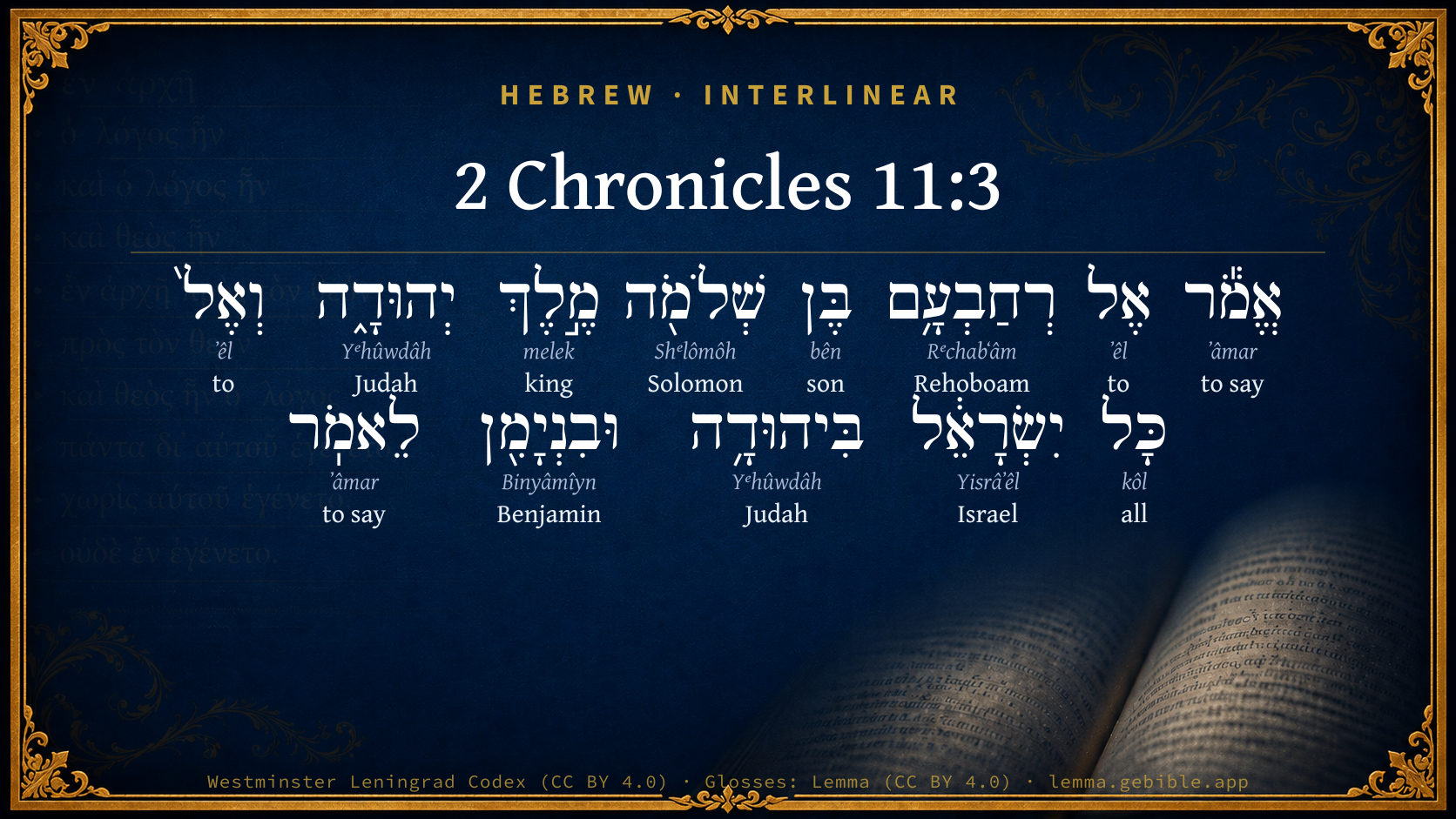
2 Chronicles 11:3

Hebrew (Westminster Leningrad Codex) 2 Chronicles 11:3 appears in the Hebrew Old Testament. The text above is from the Westminster Leningrad Codex. Each word links to its Strong’s number, a concise gloss, and parsing drawn from the Open Scriptures Hebrew Bible morphology. Click any word for its full Brown-Driver-Briggs (BDB) entry.
Download image
Cite this verse

2 Chronicles 11:3 (World English Bible). Public Domain. Lemma interlinear Bible study tool, https://lemma.gebible.app/v/2-chronicles/11/3.

Show BibTeX & RIS
BibTeX
RIS
English Translation
Speak to Rehoboam the son of Solomon, king of Judah, and to all Israel in Judah and Benjamin, saying,
World English Bible · Public Domain
Download a study sheet

One document with this verse’s original text, its word-by-word gloss line, the meaning frame, cross-references with their text, attributed commentary, and full source and license credits — printable, and it pastes into notes with its structure intact.

This verse Autodidact and up

Study sheet (.html) Plain text (.txt)

A passage Seminary Student

Up to 50 verses in one chapter. A passage sheet keeps up to 6 commentary sources and 12 cross-references per verse, in the order this page ranks them, and says so on the sheet whenever that leaves anything out. Ask for a single verse and you get the Autodidact verse sheet above.

Everything on this page stays free to read, with no account — the sheet is a download of what is already on screen, not access to it.

Want to remove ads? Support Godless Engineer
Compare translations 3

The same verse in 3 English versions, stacked beneath the original-language interlinear above. Click any original word for its lexicon entry.

Each is an independent rendering of the whole verse — the interlinear is not word-aligned to these translations.

Highlighted words mark where these versions differ — a whole-verse word diff, not a word-by-word alignment.

  • World English Bible Public Domain
    Speak to Rehoboam the son of Solomon, king of Judah, and to all Israel in Judah and Benjamin, saying,
  • King James Version Public Domain
    Speak unto Rehoboam the son of Solomon, king of Judah, and to all Israel in Judah and Benjamin, saying,
  • unfoldingWord Literal Text CC BY-SA 4.0
    “Say to Rehoboam the son of Solomon, king of Judah, and to all Israel in Judah and Benjamin, saying,

unfoldingWord Literal Text — © unfoldingWord, licensed CC BY-SA 4.0. Word-aligned USFM3 via Door43 (git.door43.org/unfoldingWord/en_ult).

Versions to compare (up to 4)

3 of 4 selected

Show all 18 translations

Every available English version of this verse, each an independent rendering of the whole verse.

  • World English Bible Public Domain
    Speak to Rehoboam the son of Solomon, king of Judah, and to all Israel in Judah and Benjamin, saying,
  • Berean Standard Bible Public Domain
    “Tell Rehoboam son of Solomon king of Judah and all the Israelites in Judah and Benjamin
  • Majority Standard Bible Public Domain
    “Tell Rehoboam son of Solomon king of Judah and all the Israelites in Judah and Benjamin
  • King James Version Public Domain
    Speak unto Rehoboam the son of Solomon, king of Judah, and to all Israel in Judah and Benjamin, saying,
  • American Standard Version (1901) Public Domain
    Speak unto Rehoboam the son of Solomon, king of Judah, and to all Israel in Judah and Benjamin, saying,
  • Revised Version (1885) Public Domain
    Speak unto Rehoboam the son of Solomon, king of Judah, and to all Israel in Judah and Benjamin, saying,
  • Geneva Bible (1599) Public Domain
    Speake vnto Rehoboam, the sonne of Salomon King of Iudah, and to all Israel that are in Iudah, and Beniamin, saying,
  • Douay-Rheims (1899) Public Domain
    Speak to Roboam the son of Solomon the king of Juda, and to all Israel, in Juda and Benjamin:
  • Young's Literal Translation Public Domain
    `Speak unto Rehoboam son of Solomon king of Judah, and unto all Israel in Judah and Benjamin, saying,
  • Literal Standard Version CC BY-SA 4.0
    “Speak to Rehoboam son of Solomon king of Judah, and to all Israel in Judah and Benjamin, saying,
  • Unlocked Literal Bible CC BY-SA 4.0
    “Say to Rehoboam son of Solomon, king of Judah, and to all Israel in Judah and Benjamin,
  • unfoldingWord Literal Text CC BY-SA 4.0
    “Say to Rehoboam the son of Solomon, king of Judah, and to all Israel in Judah and Benjamin, saying,
  • Darby Bible Public Domain
    Speak unto Rehoboam, the son of Solomon, king of Judah, and unto all Israel in Judah and Benjamin, saying,
  • World Messianic Bible Public Domain
    “Speak to Rehoboam the son of Solomon, king of Judah, and to all Israel in Judah and Benjamin, saying,
  • Webster's Bible Public Domain
    Speak to Rehoboam the son of Solomon, king of Judah, and to all Israel in Judah and Benjamin, saying,
  • Free Bible Version CC BY-SA 4.0
    “Tell Rehoboam, son of Solomon, king of Judah, and all the Israelites living in Judah and Benjamin:
  • Bible in Basic English Public Domain
    Say to Rehoboam, the son of Solomon, king of Judah, and to all Israel in Judah and Benjamin,
  • JPS Tanakh (1917) Public Domain
    'Speak unto Rehoboam the son of Solomon, king of Judah, and to all Israel in Judah and Benjamin, saying:

Literal Standard Version (2020), Covenant Press — licensed CC BY-SA 4.0. Text via the HelloAO Bible API (eBible.org). Unlocked Literal Bible (unfoldingWord) — licensed CC BY-SA 4.0. Text via the HelloAO Bible API (eBible.org). unfoldingWord Literal Text — © unfoldingWord, licensed CC BY-SA 4.0. Word-aligned USFM3 via Door43 (git.door43.org/unfoldingWord/en_ult). Free Bible Version, Dr. Jonathan Gallagher — licensed CC BY-SA 4.0. Text via the HelloAO Bible API (eBible.org).

Word by word

More ways to search: Search by grammar → Find every occurrence → Compare this word →

Practice this passage: Drill this verse → Learn its vocabulary →

About this verse

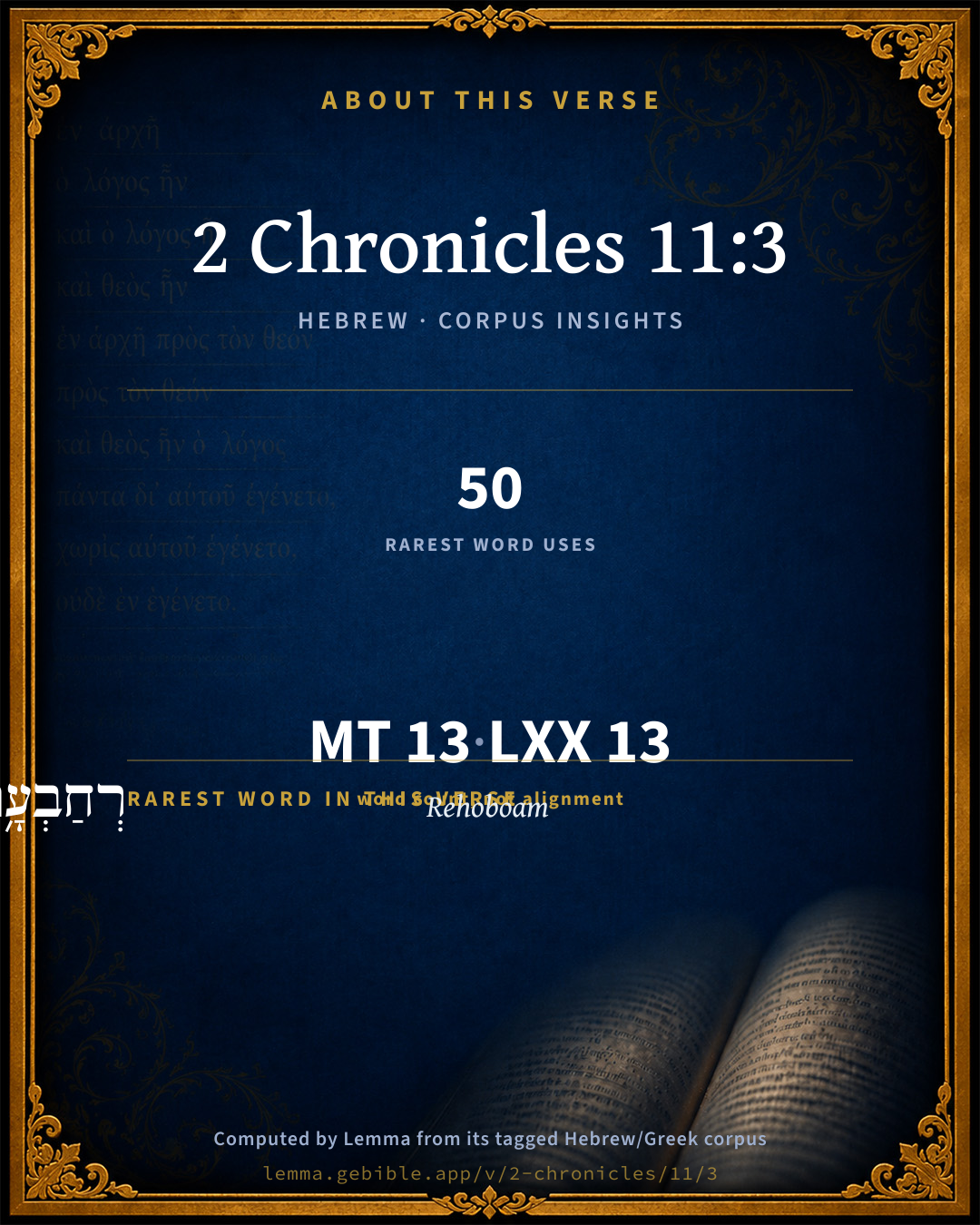
These counts appear in no published source. They are computed here, from the morphology-tagged text and Lemma’s own curated glosses. What Lemma adds →

13
words
10
distinct lemmas
Historical
section

Shared distinctive vocabulary

רְחַבְעָ֥ם Rehoboam H7346 occurs in 41 verses of the Hebrew Bible. Also found in:

Grammatical profile

  • 2 verbs
  • 9 nouns
  • 2 prepositions

Verb forms

  • אֱמֹ֕ר Qal · Imperative
  • לֵאמֹֽר Qal · Infinitive Construct

Repetition

Words recur within this verse — often emphatic in Hebrew:

  • אֱמֹ֕ר to say H559 ×2
  • יְהוּדָ֑ה Judah H3063 ×2
  • אֶל to H413 ×2

Hebrew & Septuagint length

In English translation the verse runs 19 words from the Hebrew and 14 from the Septuagint (LXX English) — closely comparable.

A rough comparison of the two English renderings, which tokenize alike — not a word-level alignment.

Word counts can differ between the Hebrew and the Greek without any difference in meaning — e.g. the Hebrew direct-object marker אֵת has no separate Greek word, and Greek often adds the article ὁ.

In the original languages it is 13 Hebrew tokens and 13 Greek tokens — but the two are counted differently (Hebrew bundles its prefixes and suffixes into one token; the Greek is in lemma form), so that isn’t a like-for-like length.

Cross-references

5

Topical passages linked to 2 Chronicles 11:3 in the Treasury of Scripture Knowledge — connected by theme and wording, ordered by reader-vote popularity; previews shown in the World English Bible.

  • Genesis 49:28 All these are the twelve tribes of Israel, and this is what their father spoke to them and blessed them. He blessed everyone according to his blessing.
  • Exodus 24:4 Moses wrote all the words of Yahweh, and rose up early in the morning, and built an altar under the mountain, and twelve pillars for the twelve tribes of Israel.
  • 2 Kings 17:34 To this day they do after the former manner: they don't fear Yahweh, neither do they after their statutes, or after their ordinances, or after the law or after the commandment which Yahweh commanded the children of Jacob, whom he named Israel;
  • Philippians 3:5 circumcised the eighth day, of the stock of Israel, of the tribe of Benjamin, a Hebrew of Hebrews; concerning the law, a Pharisee;
  • Revelation 7:4–8 I heard the number of those who were sealed, one hundred forty-four thousand, sealed out of every tribe of the children of Israel:

Cross-references courtesy of OpenBible.info (CC BY 4.0).

Hebrew and Greek witnesses Masoretic Hebrew ↔ Greek Septuagint

The same verse in the two great witnesses to the Old Testament, shown verse-for-verse.

These are two independent witnesses, not word-aligned to each other, and the Septuagint is shown in lemma (dictionary) form.

Hebrew 2 Chronicles 11:3 Masoretic · Westminster Leningrad Codex

אֱמֹ֕ר אֶל רְחַבְעָ֥ם בֶּן שְׁלֹמֹ֖ה מֶ֣לֶךְ יְהוּדָ֑ה וְאֶל֙ כָּל יִשְׂרָאֵ֔ל בִּיהוּדָ֥ה וּבִנְיָמִ֖ן לֵאמֹֽר

Speak to Rehoboam the son of Solomon, king of Judah, and to all Israel in Judah and Benjamin, saying,

World English Bible · Public Domain

Greek LXX 2 Chronicles 11:3 Septuagint · lemma form

εἶπον πρός ροβοαμ ὁ ὁ σαλωμών καί πρός πᾶς ἰούδας καί βενιαμίν λέγω

Speak to Roboam the son of Solomon, and to all Juda and Benjamin, saying,

LXX2012 (modern English Septuagint) · Public Domain

On this verse, Ellicott's Commentary for English Readers discusses the Septuagint’s reading. Read the note in Commentary ↓

Hebrew: Westminster Leningrad Codex (CC BY 4.0). Greek: Septuagint (public domain); English from LXX2012 (modern English Septuagint) (Public Domain). How the Septuagint differs from the Hebrew →

Commentary

Notes on 2 Chronicles 11:3 from classic Christian and Jewish commentators (each source and its license shown beneath its notes). The classic Christian expositions comment on the surrounding passage and are grouped to its opening verse, so a note may address several verses; the Jewish commentaries on the Tanakh (Rashi and others) are per-verse, so they appear only where the commentator wrote on this verse.

Lemma curates 59 commentaries, every one of them public domain or Creative Commons licensed, each selected and text-cleaned for this edition rather than reprinted as found. About our sources →

Joseph Benson's Commentary

2Ch 11:3. Speak unto Rehoboam the son of Solomon — Intimating that this was determined for the sin of Solomon, and therefore could not be reversed. But for all explanation of this paragraph, see notes on 1Ki 12:21-24.

Joseph Benson's Commentary on the Old and New Testaments (1811–1818) — public domain. Text from a community e-Sword module.

Ellicott's Commentary for English Readers

(3) King of Judah.—By this significant expression accomplished facts receive at the outset the seal of Divine assent.

All Israel in Judah and Benjamin.—Kings, “all the house of Judah and Benjamin, and the remnant of the people;” where the second phrase seems to define the first, for the house of Judah and Benjamin was the remnant of Israel that continued loyal to David. In that case, the chronicler’s phrase is a mere abbreviation, denoting whatever of Israel was comprised in the two faithful tribes. (Comp. 2Ch_10:17.) But there may be a hint that Judah and Benjamin were the true Israel, and that the apostate North had forfeited its right to that honourable name. Others suppose a reference to members of Northern tribes dwelling in the territory of Judah and Benjamin. Syriac, “to Rehoboam . . . and to the house of Benjamin, and to all Israel, and to the remnant of the people.” LXX., “to all Judah and Benjamin” simply.

A Bible Commentary for English Readers, edited by Charles John Ellicott (1878–1897) — public domain. Text from a community e-Sword module.

The Cambridge Bible for Schools and Colleges

gen. ed. J. J. S. Perowne

3. to all Israel in Judah and Benjamin] The Chronicler does not hesitate to use the term “Israel” in speaking of Judah. Thus the princes of the Southern Kingdom are called “the princes of Israel” (2Ch_12:6; 2Ch_21:4), the populace as a whole is called “Israel” (2Ch_12:1; 2Ch_15:17), Jehoshaphat and Ahaz are each called “king of Israel” (2Ch_21:2; 2Ch_28:19), and the sepulchres of the kings at Jerusalem are called the “sepulchres of the kings of Israel” (2Ch_28:27). (Cp. Driver, Joel, p. 9 note, for a similar use of the word.) Israel in Chron. then = the covenant-people. In Kings on the contrary Israel generally means the Northern Kingdom.

The Cambridge Bible for Schools and Colleges (gen. ed. J. J. S. Perowne; Cambridge University Press, 1878–1918) — public domain. Text from a community e-Sword module.

The Pulpit Commentary

To all Israel in Judah and Benjamin. There is difference of opinion as to who are intended in the expression, "all Israel," already confessedly ambiguous in two other passages. When we consider the mention of Rehoboam personally in the former clause of the verse, it would seem most probable that the meaning is all the people of the nation, resident in the Judah and Benjamin allotments, i.e. the nation called collectively Israel. This will include "the remnant" spoken of in the parallel. (1Ki_12:23, compared with 17)

The Pulpit Commentary (1880–1919), ed. H.D.M. Spence-Jones & Joseph S. Exell — public domain. Text from a community e-Sword module.

John Wesley's Explanatory Notes

Son of Solomon - Intimating, that this was determined for the sin of Solomon, and therefore could not be reversed.

John Wesley, Explanatory Notes Upon the Whole Bible (1754–1765) — public domain. Text via the GEBible commentary corpus.

Lesson kit

Teaching starters — assembled from the data on this page, not authored interpretation. Every prompt links to the verse data it draws on. Edit before teaching.

2 Chronicles, in the Historical, opens this verse with 13 words (10 distinct Hebrew lemmas). Its most distinctive word is Rᵉchabʻâm (“Rehoboam”). A historical commentator’s framing appears above. Read the whole chapter for the surrounding context.

Discussion questions

  1. What does “Rehoboam” (Rᵉchabʻâm) contribute to the verse as a whole?
  2. How does 1 Kings 11:43, which shares the word «Rehoboam», read alongside this verse?
  3. What does the repetition of “to say” (2× in this one verse) do in this verse?
  4. These translations render this verse differently. What is at stake in choosing one wording over another?
  5. «אֱמֹ֕ר» is a Qal Imperative verb. How does that grammatical form shape the action described?
  6. Compare how Joseph Benson's Commentary and Ellicott's Commentary for English Readers read this verse. Where do they agree or differ?

Things to notice

Reading settings

Reading text

Shown beneath each verse's original-language words.

Old Testament
Old Testament edition

Read the OT as the Masoretic Hebrew (MT) or the Greek Septuagint (LXX).

English shown for the Greek Septuagint (in the Hebrew ↔ Greek comparison).

Comparing translations? Open the Compare panel on any verse page to stack up to four side by side.