Nehemiah 12:8

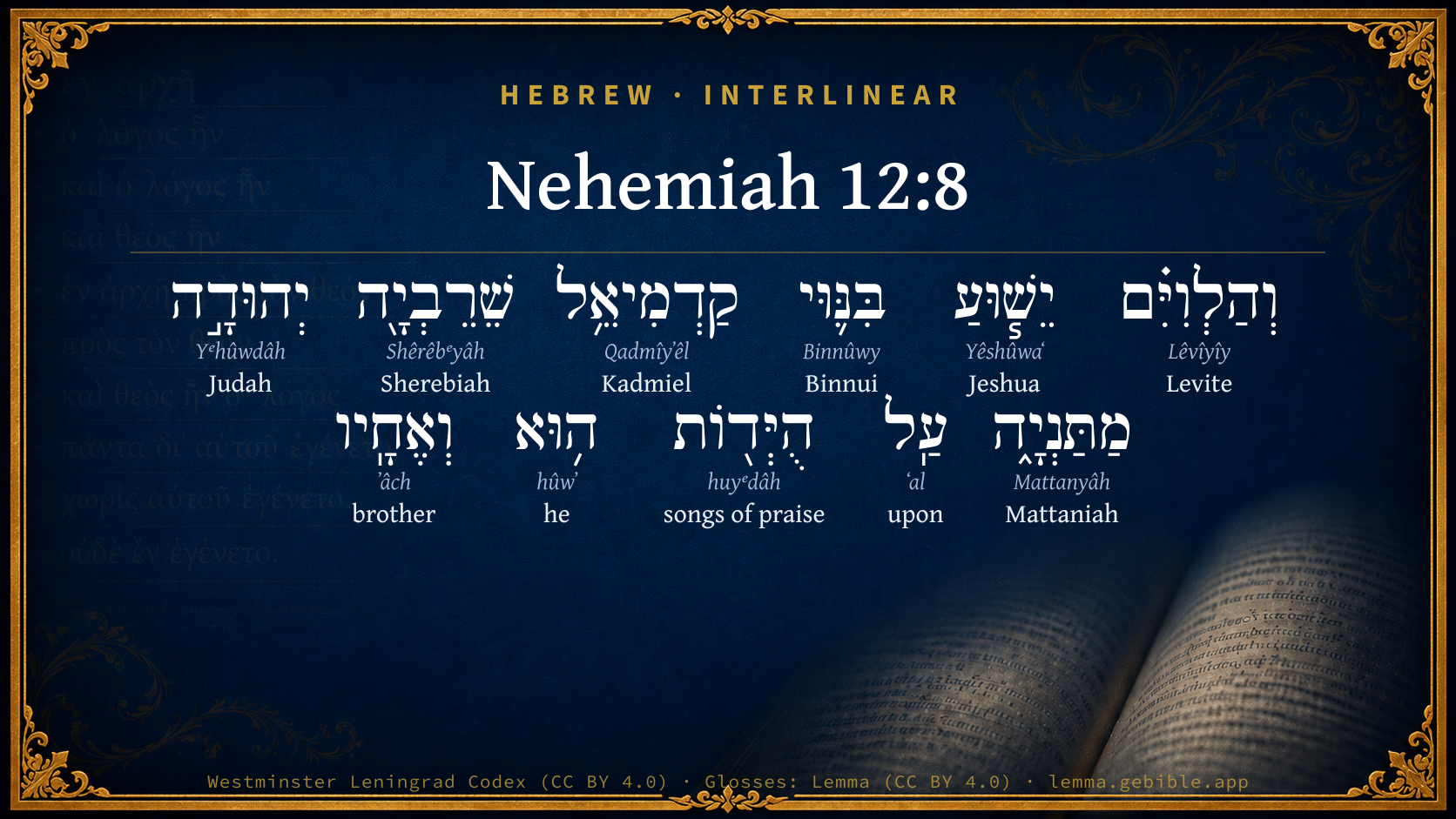
Hebrew (Westminster Leningrad Codex) Nehemiah 12:8 appears in the Hebrew Old Testament. The text above is from the Westminster Leningrad Codex. Each word links to its Strong’s number, a concise gloss, and parsing drawn from the Open Scriptures Hebrew Bible morphology. Click any word for its full Brown-Driver-Briggs (BDB) entry.
Download image
Cite this verse

Nehemiah 12:8 (World English Bible). Public Domain. Lemma interlinear Bible study tool, https://lemma.gebible.app/v/nehemiah/12/8.

Show BibTeX & RIS
BibTeX
RIS
English Translation
Moreover the Levites: Jeshua, Binnui, Kadmiel, Sherebiah, Judah, [and] Mattaniah, who was over the thanksgiving, he and his brothers.
World English Bible · Public Domain
Highlights
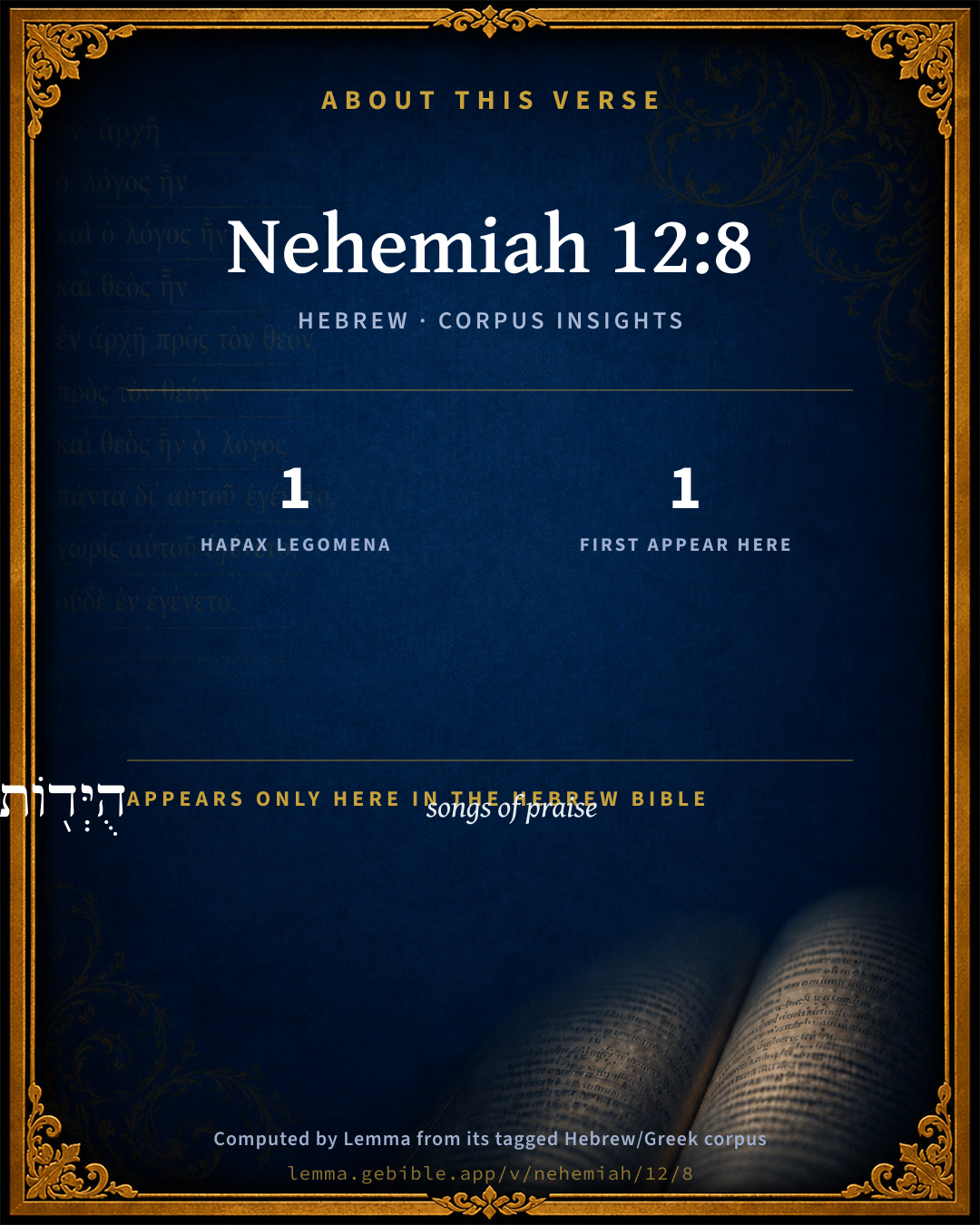
  • 1 hapax legomenon — only here in the Hebrew Bible
  • 1 first appearance in the Hebrew Bible
Full analysis ↓
Download a study sheet

One document with this verse’s original text, its word-by-word gloss line, the meaning frame, cross-references with their text, attributed commentary, and full source and license credits — printable, and it pastes into notes with its structure intact.

This verse Autodidact and up

Study sheet (.html) Plain text (.txt)

A passage Seminary Student

Up to 50 verses in one chapter. A passage sheet keeps up to 6 commentary sources and 12 cross-references per verse, in the order this page ranks them, and says so on the sheet whenever that leaves anything out. Ask for a single verse and you get the Autodidact verse sheet above.

Everything on this page stays free to read, with no account — the sheet is a download of what is already on screen, not access to it.

Want to remove ads? Support Godless Engineer
Compare translations 3

The same verse in 3 English versions, stacked beneath the original-language interlinear above. Click any original word for its lexicon entry.

Each is an independent rendering of the whole verse — the interlinear is not word-aligned to these translations.

Highlighted words mark where these versions differ — a whole-verse word diff, not a word-by-word alignment.

  • World English Bible Public Domain
    Moreover the Levites: Jeshua, Binnui, Kadmiel, Sherebiah, Judah, [and] Mattaniah, who was over the thanksgiving, he and his brothers.
  • King James Version Public Domain
    Moreover the Levites: Jeshua, Binnui, Kadmiel, Sherebiah, Judah, and Mattaniah, which was over the thanksgiving, he and his brethren.
  • unfoldingWord Literal Text CC BY-SA 4.0
    And the Levites were: Jeshua; Binnui; Kadmiel; Sherebiah; Judah; Mattaniah, he and his brothers were over the thanksgiving songs;

unfoldingWord Literal Text — © unfoldingWord, licensed CC BY-SA 4.0. Word-aligned USFM3 via Door43 (git.door43.org/unfoldingWord/en_ult).

Versions to compare (up to 4)

3 of 4 selected

Show all 18 translations

Every available English version of this verse, each an independent rendering of the whole verse.

  • World English Bible Public Domain
    Moreover the Levites: Jeshua, Binnui, Kadmiel, Sherebiah, Judah, [and] Mattaniah, who was over the thanksgiving, he and his brothers.
  • Berean Standard Bible Public Domain
    The Levites were Jeshua, Binnui, Kadmiel, Sherebiah, Judah, and Mattaniah, who, with his associates, led the songs of thanksgiving.
  • Majority Standard Bible Public Domain
    The Levites were Jeshua, Binnui, Kadmiel, Sherebiah, Judah, and Mattaniah, who, with his associates, led the songs of thanksgiving.
  • King James Version Public Domain
    Moreover the Levites: Jeshua, Binnui, Kadmiel, Sherebiah, Judah, and Mattaniah, which was over the thanksgiving, he and his brethren.
  • American Standard Version (1901) Public Domain
    Moreover the Levites: Jeshua, Binnui, Kadmiel, Sherebiah, Judah, `and' Mattaniah, who was over the thanksgiving, he and his brethren.
  • Revised Version (1885) Public Domain
    Moreover the Levites: Jeshua, Binnui, Kadmiel, Sherebiah, Judah, and Mattaniah, which was over the thanksgiving, he and his brethren.
  • Geneva Bible (1599) Public Domain
    And the Leuites, Ieshua, Binnui, Kadmiel, Sherebiah, Iudah, Mattaniah were ouer the thankesgiuings, he, and his brethren.
  • Douay-Rheims (1899) Public Domain
    And the Levites, Jesua, Bennui, Cedmihel, Sarebia, Juda, Mathanias, they and their brethren were over the hymns:
  • Young's Literal Translation Public Domain
    And the Levites `are' Jeshua, Binnui, Kadmiel, Sherebiah, Judah, Mattaniah, he `is' over the thanksgiving, and his brethren,
  • Literal Standard Version CC BY-SA 4.0
    And the Levites: Jeshua, Binnui, Kadmiel, Sherebiah, Judah, Mattaniah, he [is] over the thanksgiving, and his brothers,
  • Unlocked Literal Bible CC BY-SA 4.0
    The Levites were Jeshua, Binnui, Kadmiel, Sherebiah, Judah, and Mattaniah, who was in charge of the thanksgiving songs, along with his associates.
  • unfoldingWord Literal Text CC BY-SA 4.0
    And the Levites were: Jeshua; Binnui; Kadmiel; Sherebiah; Judah; Mattaniah, he and his brothers were over the thanksgiving songs;
  • Darby Bible Public Domain
    And the Levites: Jeshua, Binnui, Kadmiel, Sherebiah, Judah, Mattaniah, [who was] over the thanksgiving, he and his brethren;
  • World Messianic Bible Public Domain
    Moreover the Levites were Yeshua, Binnui, Kadmiel, Sherebiah, Judah, and Mattaniah, who was over the thanksgiving songs, he and his brothers.
  • Webster's Bible Public Domain
    Moreover the Levites: Jeshua, Binnui, Kadmiel, Sherebiah, Judah, and Mattaniah, who was over the thanksgiving, he and his brethren.
  • Free Bible Version CC BY-SA 4.0
    The Levites were Jeshua, Binnui, Kadmiel, Sherebiah, Judah, and Mattaniah, who with his fellow Levites was in charge of the songs of praise.
  • Bible in Basic English Public Domain
    And the Levites: Jeshua, Binnui, Kadmiel, Sherebiah, Judah, and Mattaniah, who was over the music-makers, he and his brothers.
  • JPS Tanakh (1917) Public Domain
    Moreover the Levites: Jeshua, Binnui, Kadmiel, Sherebiah, Judah, and Mattaniah, who was over the thanksgiving, he and his brethren.

Literal Standard Version (2020), Covenant Press — licensed CC BY-SA 4.0. Text via the HelloAO Bible API (eBible.org). Unlocked Literal Bible (unfoldingWord) — licensed CC BY-SA 4.0. Text via the HelloAO Bible API (eBible.org). unfoldingWord Literal Text — © unfoldingWord, licensed CC BY-SA 4.0. Word-aligned USFM3 via Door43 (git.door43.org/unfoldingWord/en_ult). Free Bible Version, Dr. Jonathan Gallagher — licensed CC BY-SA 4.0. Text via the HelloAO Bible API (eBible.org).

Word by word

More ways to search: Search by grammar → Find every occurrence → Compare this word →

Practice this passage: Drill this verse → Learn its vocabulary →

About this verse

These counts appear in no published source. They are computed here, from the morphology-tagged text and Lemma’s own curated glosses. What Lemma adds →

11
words
11
distinct lemmas
Historical
section

Notable vocabulary

1 hapax legomenon — a word that appears only here in the entire Hebrew Bible:

  • הֻיְּד֖וֹת songs of praise H1960

First appearance in Scripture

This word makes its first canonical appearance in the Hebrew Bible here:

  • הֻיְּד֖וֹת songs of praise H1960

Shared distinctive vocabulary

בִּנּ֛וּי Binnui H1131 occurs in 7 verses of the Hebrew Bible. Also found in:

Grammatical profile

  • 9 nouns
  • 1 pronoun
  • 1 preposition

Cross-references

7

Topical passages linked to Nehemiah 12:8 in the Treasury of Scripture Knowledge — connected by theme and wording, ordered by reader-vote popularity; previews shown in the World English Bible.

  • Nehemiah 11:17 and Mattaniah the son of Mica, the son of Zabdi, the son of Asaph, who was the chief to begin the thanksgiving in prayer, and Bakbukiah, the second among his brothers; and Abda the son of Shammua, the son of Galal, the son of Jeduthun.
  • Nehemiah 12:24 The chiefs of the Levites: Hashabiah, Sherebiah, and Jeshua the son of Kadmiel, with their brothers over against them, to praise and give thanks, according to the commandment of David the man of God, watch next to watch.
  • 1 Chronicles 9:33 These are the singers, heads of fathers' [houses] of the Levites, [who lived] in the chambers [and were] free [from other service]; for they were employed in their work day and night.
  • Nehemiah 7:48 the children of Lebana, the children of Hagaba, the children of Salmai,
  • Nehemiah 9:4 Then stood up on the stairs of the Levites, Jeshua, and Bani, Kadmiel, Shebaniah, Bunni, Sherebiah, Bani, [and] Chenani, and cried with a loud voice to Yahweh their God.
  • Nehemiah 10:9–13 The Levites: namely, Jeshua the son of Azaniah, Binnui of the sons of Henadad, Kadmiel;
  • Nehemiah 11:22 The overseer also of the Levites at Jerusalem was Uzzi the son of Bani, the son of Hashabiah, the son of Mattaniah, the son of Mica, of the sons of Asaph, the singers, over the business of the house of God.

Cross-references courtesy of OpenBible.info (CC BY 4.0).

Hebrew and Greek witnesses Masoretic Hebrew ↔ Greek Septuagint

The same verse in the two great witnesses to the Old Testament, shown verse-for-verse.

These are two independent witnesses, not word-aligned to each other, and the Septuagint is shown in lemma (dictionary) form.

Hebrew Nehemiah 12:8 Masoretic · Westminster Leningrad Codex

וְהַלְוִיִּ֗ם יֵשׁ֧וּעַ בִּנּ֛וּי קַדְמִיאֵ֥ל שֵׁרֵבְיָ֖ה יְהוּדָ֣ה מַתַּנְיָ֑ה עַֽל הֻיְּד֖וֹת ה֥וּא וְאֶחָֽיו

Moreover the Levites: Jeshua, Binnui, Kadmiel, Sherebiah, Judah, [and] Mattaniah, who was over the thanksgiving, he and his brothers.

World English Bible · Public Domain

Greek LXX Structure differs

The Septuagint has no separate book of Nehemiah. Its Greek text is the second half of Esdras B (2 Esdras), chapters 11–23; Ezra is the first half (1–10).

A verse-for-verse comparison isn’t shown here because the chapters and verses don’t line up. Switch to the LXX edition with the MT / LXX toggle above to read the Greek directly.

On this verse, The Cambridge Bible for Schools and Colleges discusses the Septuagint’s reading. Read the note in Commentary ↓

Hebrew: Westminster Leningrad Codex (CC BY 4.0). Greek: Septuagint (public domain); English from a public-domain English Septuagint. How the Septuagint differs from the Hebrew →

Commentary

Notes on Nehemiah 12:8 from classic Christian and Jewish commentators (each source and its license shown beneath its notes). The classic Christian expositions comment on the surrounding passage and are grouped to its opening verse, so a note may address several verses; the Jewish commentaries on the Tanakh (Rashi and others) are per-verse, so they appear only where the commentator wrote on this verse.

Lemma curates 59 commentaries, every one of them public domain or Creative Commons licensed, each selected and text-cleaned for this edition rather than reprinted as found. About our sources →

Trapp's Complete Commentary

John Trapp

Neh 12:8 Moreover the Levites: Jeshua, Binnui, Kadmiel, Sherebiah, Judah, [and] Mattaniah, [which was] over the thanksgiving, he and his brethren.

Ver. 8. Which was over the thanksgiving] Praefectus Musicus, before doing the music. See Neh 11:17.

John Trapp, A Commentary or Exposition upon All the Books of the Old and New Testament (1647–1656) — public domain. Text from a community e-Sword module.

Joseph Benson's Commentary

Neh 12:8-9. Moreover the Levites, which were over the thanksgiving — Appointed to see that the psalms of thanksgiving were continually sung in the temple, in due time and manner. Also, their brethren were over against them in the watches — That is, in the places where they were appointed to stand, and wait, and perform their office, which was to keep the guard of the gates, while the others sung.

Joseph Benson's Commentary on the Old and New Testaments (1811–1818) — public domain. Text from a community e-Sword module.

Tyndale Open Study Notes

Tyndale Open Resources

12:8-9 Their associates . . . stood opposite: To provide antiphonal singing (12:24; Ezra 3:1-11).

Tyndale Open Study Notes — © Tyndale Open Resources, licensed CC BY-SA 4.0. Text via the HelloAO Bible API.

Geneva Bible (1599)

Geneva Bible translators

Had charge of them that sang the Psalms.

Geneva Bible (1599) marginal notes — public domain. Text via Bolls.life.

Adam Clarke's Commentary

Verse 8. Over the thanksgiving] The principal singers: See Clarke on Ne 11:17.

Adam Clarke's Commentary on the Bible (1810–1826) — public domain. Text from a community e-Sword/MySword module.

The Cambridge Bible for Schools and Colleges

gen. ed. J. J. S. Perowne

8. Moreover the Levites] This list of Levite houses which returned along with Zerubbabel consists of eight names, Jeshua, Binnui, Kadmiel, Sherebiah, Judah, Mattaniah, Bakbukiah, Unni. In Ezr_2:40-42, the list of the Levites and singers that returned consists of Jeshua, Kadmiel, Hodaviah (?), and the children of Asaph. Other Levitical lists occur in Neh_10:9-14, Neh_12:24-26. Jeshua and Kadmiel occur in all the lists. Binnui represents ‘the sons of Henadad’, cf. Ezr_3:9 with Neh_3:24; Neh_10:10, who probably returned to Jerusalem in the year after Zerubbabel. Sherebiah’s name occurs in Neh_8:7, Neh_9:4, Neh_10:13. Judah is probably to be identified with Hodijah in Neh_10:10. Mattaniah is mentioned in Neh_11:17 as an Asaphite chief. It is probable therefore that he represents ‘the children of Asaph’ in Ezr_2:41, while other families of ‘the singers’ are represented by Bakbukiah (? = Bukkiah of the sons of Heman, 1Ch_25:4), who is mentioned in Neh_11:17, and by Unno = Unni (1Ch_15:18; 1Ch_15:20).

the thanksgiving] R.V. marg. ‘Or, the choirs’. The Hebrew word only occurs here; and the LXX. not understanding it renders ἐπὶ τῶν χειρῶν. The Vulgate gives ‘super hymnos.’ Compare the description of Mattaniah, the Asaphite, in Neh_11:17, ‘the chief to begin the thanksgiving in prayer.’

The Cambridge Bible for Schools and Colleges (gen. ed. J. J. S. Perowne; Cambridge University Press, 1878–1918) — public domain. Text from a community e-Sword module.

John Gill's Exposition

Moreover the Levites,.... Who lived in the same times: were

Jeshua, Binnui, Kadmiel, Sherebiah, Judah, and Mattaniah; most of these are made mention of in Neh 8:7, the last of them is said to be

over the thanksgiving, he and his brethren; he was the precentor, or had the directing and conducting of the songs of the temple, particularly the thanksgiving song at the daily sacrifices; Jarchi takes the word here used to be the name of a musical instrument.

John Gill's Exposition of the Whole Bible (1746–1763) — public domain (CC PDM 1.0). Text via the HelloAO Bible API.

Albert Barnes' Notes on the Bible

Of the Levitical houses here mentioned, three only returned at first, those of Jeshua, Kadmiel, and Judah or Hodevah Neh 7:43. The others must have returned subsequently.

Albert Barnes' Notes on the Bible (1834–1885) — public domain. Text from a community e-Sword/MySword module.

Haydock's Catholic Bible Commentary

Hymns. To preside over the bands, chap. xi. 17. (Calmet)

George Leo Haydock (1774–1849), Haydock's Catholic Family Bible and Commentary, 1859 edition — public domain. Excludes Psalms (Douay-Rheims chapter numbering differs from Protestant) and Deuterocanonical books (Catholic canon only).

The Pulpit Commentary

Moreover the Levites: Jeshua, Binnui, Kadmiel, etc. Here again families are probably intended, as in Ezr_2:40 Ezr_3:9 Neh_9:4, Neh_9:5, etc., though it is possible that the founders of the families actually returned with Zerubbabel. Jeshua, Binnui, and Kadmiel appear as the leading Levitical families at the sealing of the covenant. (Neh_10:9) On Mattaniah see the comment upon Neh_11:17.

The Pulpit Commentary (1880–1919), ed. H.D.M. Spence-Jones & Joseph S. Exell — public domain. Text from a community e-Sword module.

John Wesley's Explanatory Notes

Moreover, &c. - He was to see, that the Psalms of thanksgiving were continually sung in the temple, in due time and manner.

John Wesley, Explanatory Notes Upon the Whole Bible (1754–1765) — public domain. Text via the GEBible commentary corpus.

unfoldingWord translationNotes

Door43 World Missions Community

Jeshua ... Binnui ... Kadmiel ... Sherebiah ... Judah ... Mattaniah ... Bakbukiah ... Unni

These are names of men. (See: How to Translate Names)

stood opposite them during the service

Possible meanings are 1) this was during a worship service and these were two groups of singers or other worshipers, or 2) these groups guarded the temple at different times, or "took turns guarding the temple."

translationWords

Levi

unfoldingWord translationNotes — © Distant Shores Media and the Door43 World Missions Community, licensed CC BY-SA 4.0. Source: git.door43.org/Door43/en_tn.

Rashi

Rabbi Shlomo Yitzchaki (Rashi)

huyedoth [This was] a type of musical instrument which accompanied the songs.

Rashi on the Tanakh — English translations: “The Judaica Press complete Tanach with Rashi, translated by A. J. Rosenberg” (CC BY 4.0); “Pentateuch with Rashi's commentary by M. Rosenbaum and A.M. Silbermann, 1929-1934” (public domain); “The Metsudah Tanach series, Lakewood, N.J” (CC BY 4.0); and “The Book of Joshua, Metsudah Publications, 1997” (CC BY 4.0). Text via Sefaria.

Lesson kit

Teaching starters — assembled from the data on this page, not authored interpretation. Every prompt links to the verse data it draws on. Edit before teaching.

Nehemiah, in the Historical, opens this verse with 11 words (11 distinct Hebrew lemmas). Its most distinctive word is huyᵉdâh (“songs of praise”). A historical commentator’s framing appears above. Read the whole chapter for the surrounding context.

Discussion questions

  1. What does “songs of praise” (huyᵉdâh) contribute to the verse as a whole?
  2. This verse holds 1 word here found nowhere else in the Hebrew Bible. What might the rare word draw attention to?
  3. The word “songs of praise” first appears here in Scripture. What is being introduced at this debut?
  4. Ezra 8:33 shares the word «Binnui» with this verse. How do the two illuminate each other?
  5. The translations on this page render this verse differently — a whole-verse word diff, not a word-by-word alignment. What might account for the different wordings?
  6. Reading how Trapp's Complete Commentary and Joseph Benson's Commentary read this verse, where do the two commentators agree and where do they part?

Things to notice

  • 1 word in this verse appears nowhere else in the Hebrew Bible.
  • 1 word makes its first canonical appearance in Scripture here.
  • These translations choose different wording for 6 words in this verse.
  • 11 distinct Hebrew lemmas span 11 words in this verse.

Reading settings

Reading text

Shown beneath each verse's original-language words.

Old Testament
Old Testament edition

Read the OT as the Masoretic Hebrew (MT) or the Greek Septuagint (LXX).

English shown for the Greek Septuagint (in the Hebrew ↔ Greek comparison).

Comparing translations? Open the Compare panel on any verse page to stack up to four side by side.