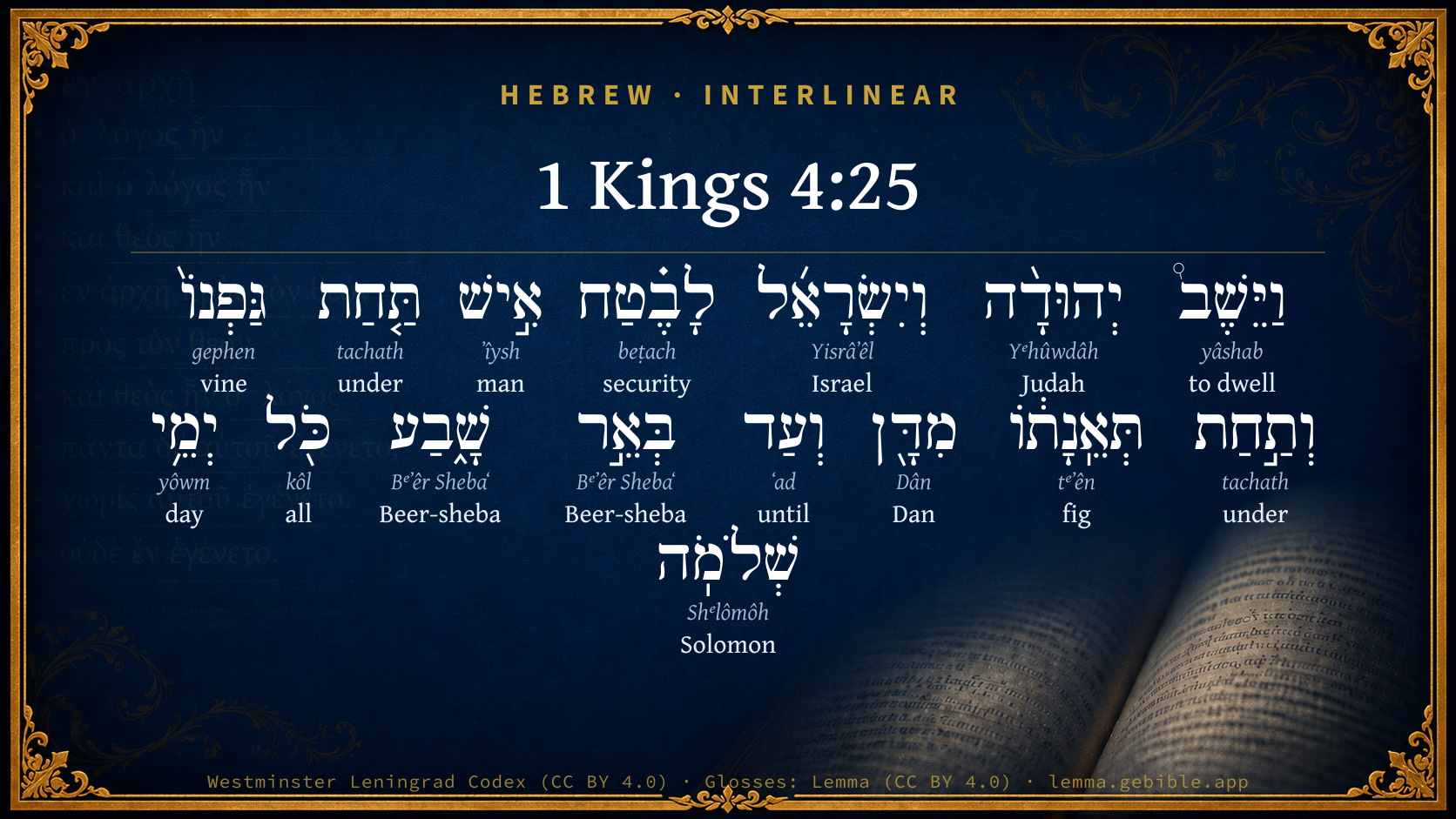
1 Kings 4:25

Hebrew (Westminster Leningrad Codex) 1 Kings 4:25 appears in the Hebrew Old Testament. The text above is from the Westminster Leningrad Codex. Each word links to its Strong’s number, a concise gloss, and parsing drawn from the Open Scriptures Hebrew Bible morphology. Click any word for its full Brown-Driver-Briggs (BDB) entry.
Download image
Cite this verse

1 Kings 4:25 (World English Bible). Public Domain. Lemma interlinear Bible study tool, https://lemma.gebible.app/v/1-kings/4/25.

Show BibTeX & RIS
BibTeX
RIS
English Translation
Judah and Israel lived safely, every man under his vine and under his fig tree, from Dan even to Beersheba, all the days of Solomon.
World English Bible · Public Domain
Download a study sheet

One document with this verse’s original text, its word-by-word gloss line, the meaning frame, cross-references with their text, attributed commentary, and full source and license credits — printable, and it pastes into notes with its structure intact.

This verse Autodidact and up

Study sheet (.html) Plain text (.txt)

A passage Seminary Student

Up to 50 verses in one chapter. A passage sheet keeps up to 6 commentary sources and 12 cross-references per verse, in the order this page ranks them, and says so on the sheet whenever that leaves anything out. Ask for a single verse and you get the Autodidact verse sheet above.

Everything on this page stays free to read, with no account — the sheet is a download of what is already on screen, not access to it.

Want to remove ads? Support Godless Engineer
Compare translations 3

The same verse in 3 English versions, stacked beneath the original-language interlinear above. Click any original word for its lexicon entry.

Each is an independent rendering of the whole verse — the interlinear is not word-aligned to these translations.

Highlighted words mark where these versions differ — a whole-verse word diff, not a word-by-word alignment.

  • World English Bible Public Domain
    Judah and Israel lived safely, every man under his vine and under his fig tree, from Dan even to Beersheba, all the days of Solomon.
  • King James Version Public Domain
    And Judah and Israel dwelt safely, every man under his vine and under his fig tree, from Dan even to Beersheba, all the days of Solomon.
  • unfoldingWord Literal Text CC BY-SA 4.0
    And Judah and Israel dwelled in safety, a man under his vine and under his fig tree, from Dan and to Beersheba, all of the days of Solomon.

unfoldingWord Literal Text — © unfoldingWord, licensed CC BY-SA 4.0. Word-aligned USFM3 via Door43 (git.door43.org/unfoldingWord/en_ult).

Versions to compare (up to 4)

3 of 4 selected

Show all 18 translations

Every available English version of this verse, each an independent rendering of the whole verse.

  • World English Bible Public Domain
    Judah and Israel lived safely, every man under his vine and under his fig tree, from Dan even to Beersheba, all the days of Solomon.
  • Berean Standard Bible Public Domain
    Throughout the days of Solomon, Judah and Israel dwelt securely from Dan to Beersheba, each man under his own vine and his own fig tree.
  • Majority Standard Bible Public Domain
    Throughout the days of Solomon, Judah and Israel dwelt securely from Dan to Beersheba, each man under his own vine and his own fig tree.
  • King James Version Public Domain
    And Judah and Israel dwelt safely, every man under his vine and under his fig tree, from Dan even to Beersheba, all the days of Solomon.
  • American Standard Version (1901) Public Domain
    And Judah and Israel dwelt safely, every man under his vine and under his fig-tree, from Dan even to Beer-sheba, all the days of Solomon.
  • Revised Version (1885) Public Domain
    And Judah and Israel dwelt safely, every man under his vine and under his fig tree, from Dan even to Beer-sheba, all the days of Solomon.
  • Geneva Bible (1599) Public Domain
    And Iudah and Israel dwelt without feare, euery man vnder his vine, and vnder his fig tree, from Dan, euen to Beer-sheba, all the dayes of Salomon.
  • Douay-Rheims (1899) Public Domain
    And Juda and Israel dwelt without any fear, every one under his vine, and under his fig tree, from Dan to Bersabee, all the days of Solomon.
  • Young's Literal Translation Public Domain
    And Judah dwelleth -- and Israel -- in confidence, each under his vine, and under his fig-tree, from Dan even unto Beer-Sheba, all the days of Solomon.
  • Literal Standard Version CC BY-SA 4.0
    And Judah dwells—and Israel—in confidence, each under his vine, and under his fig tree, from Dan even to Beer-Sheba, all the days of Solomon.
  • Unlocked Literal Bible CC BY-SA 4.0
    Judah and Israel lived in safety, every man under his vine and under his fig tree, from Dan to Beersheba, all the days of Solomon.
  • unfoldingWord Literal Text CC BY-SA 4.0
    And Judah and Israel dwelled in safety, a man under his vine and under his fig tree, from Dan and to Beersheba, all of the days of Solomon.
  • Darby Bible Public Domain
    And Judah and Israel dwelt safely, every man under his vine and under his fig-tree, from Dan even to Beer-sheba, all the days of Solomon.
  • World Messianic Bible Public Domain
    Judah and Israel lived safely, every man under his vine and under his fig tree, from Dan even to Beersheba, all the days of Solomon.
  • Webster's Bible Public Domain
    And Judah and Israel dwelt safely, every man under his vine and under his fig-tree, from Dan even to Beer-sheba, all the days of Solomon.
  • Free Bible Version CC BY-SA 4.0
    During Solomon's lifetime, everyone in Judah and Israel lived in safety, from Dan to Beersheba. Each one had their own vine and fig tree.
  • Bible in Basic English Public Domain
    So Judah and Israel were living safely, every man under his vine and his fig-tree, from Dan as far as Beer-sheba, all the days of Solomon.
  • JPS Tanakh (1917) Public Domain
    (5-5) And Judah and Israel dwelt safely, every man under his vine and under his fig-tree, from Dan even to Beer-sheba, all the days of Solomon.

Literal Standard Version (2020), Covenant Press — licensed CC BY-SA 4.0. Text via the HelloAO Bible API (eBible.org). Unlocked Literal Bible (unfoldingWord) — licensed CC BY-SA 4.0. Text via the HelloAO Bible API (eBible.org). unfoldingWord Literal Text — © unfoldingWord, licensed CC BY-SA 4.0. Word-aligned USFM3 via Door43 (git.door43.org/unfoldingWord/en_ult). Free Bible Version, Dr. Jonathan Gallagher — licensed CC BY-SA 4.0. Text via the HelloAO Bible API (eBible.org).

Word by word

More ways to search: Search by grammar → Find every occurrence → Compare this word →

Practice this passage: Drill this verse → Learn its vocabulary →

תְּאֵֽנָת֔וֹ
tᵉʼên
H8384
“fig · his”
Noun, Common, Feminine, Singular, Construct + Suffix, Personal, 3rd Person, Masculine, Singular
Part of Speech
Noun
Type
Common
Gender
Feminine
Number
Singular
State
Construct
Full BDB Definition

Origin: perhaps of foreign derivation

TWOT: 2490

fig, fig tree
  1. וַיֵּשֶׁב֩ yâshab H3427 “and · to dwell” Conjunction + Verb, Qal, Sequential Imperfect, 3rd Person, Masculine, Singular
  2. יְהוּדָ֨ה Yᵉhûwdâh H3063 “Judah” Noun, Proper
  3. וְיִשְׂרָאֵ֜ל Yisrâʼêl H3478 “and · Israel” Conjunction + Noun, Proper
  4. לָבֶ֗טַח beṭach H983 “to/for · security” Preposition + Noun, Common, Masculine, Singular, Absolute
  5. אִ֣ישׁ ʼîysh H376 “man” Noun, Common, Masculine, Singular, Absolute
  6. תַּ֤חַת tachath H8478 “under” Preposition
  7. גַּפְנוֹ֙ gephen H1612 “vine · his” Noun, Common, Both, Singular, Construct + Suffix, Personal, 3rd Person, Masculine, Singular
  8. וְתַ֣חַת tachath H8478 “and · under” Conjunction + Preposition
  9. מִדָּ֖ן Dân H1835 “from · Dan” Preposition + Noun, Proper
  10. וְעַד ʻad H5704 “and · until” Conjunction + Preposition
  11. בְּאֵ֣ר Bᵉʼêr Shebaʻ H884 “Beer-sheba” Noun, Proper
  12. שָׁ֑בַע Bᵉʼêr Shebaʻ H884 “Beer-sheba” Noun, Proper
  13. כֹּ֖ל kôl H3605 “all of” Noun, Common, Masculine, Singular, Construct
  14. יְמֵ֥י yôwm H3117 “days of” Noun, Common, Masculine, Plural, Construct
  15. שְׁלֹמֹֽה Shᵉlômôh H8010 “Solomon” Noun, Proper

About this verse

These counts appear in no published source. They are computed here, from the morphology-tagged text and Lemma’s own curated glosses. What Lemma adds →

16
words
14
distinct lemmas
Historical
section

Shared distinctive vocabulary

תְּאֵֽנָת֔וֹ fig H8384 occurs in 35 verses of the Hebrew Bible. Also found in:

Grammatical profile

  • 1 verb
  • 12 nouns
  • 3 prepositions

Verb forms

  • וַיֵּשֶׁב֩ Qal · Sequential Imperfect

Repetition

Words recur within this verse — often emphatic in Hebrew:

  • תַּ֤חַת under H8478 ×2
  • בְּאֵ֣ר Beer-sheba H884 ×2

Cross-references

10

Topical passages linked to 1 Kings 4:25 in the Treasury of Scripture Knowledge — connected by theme and wording, ordered by reader-vote popularity; previews shown in the World English Bible.

  • Micah 4:4 But they will sit every man under his vine and under his fig tree; And no one will make them afraid: For the mouth of Yahweh of Hosts has spoken.
  • Zechariah 3:10 In that day,' says Yahweh of hosts, 'you will invite every man his neighbor under the vine and under the fig tree.'"
  • Judges 20:1 Then all the children of Israel went out, and the congregation was assembled as one man, from Dan even to Beersheba, with the land of Gilead, to Yahweh at Mizpah.
  • 2 Kings 18:31 Don't listen to Hezekiah: for thus says the king of Assyria, Make your peace with me, and come out to me; and eat you everyone of his vine, and everyone of his fig tree, and everyone drink the waters of his own cistern;
  • Jeremiah 23:5–6 Behold, the days come, says Yahweh, that I will raise to David a righteous Branch, and he shall reign as king and deal wisely, and shall execute justice and righteousness in the land.
  • Jeremiah 33:15–16 In those days, and at that time, will I cause a Branch of righteousness to grow up to David; and he shall execute justice and righteousness in the land.
  • 2 Samuel 17:11 But I counsel that all Israel be gathered together to you, from Dan even to Beersheba, as the sand that is by the sea for multitude; and that you go to battle in your own person.
  • 2 Samuel 24:15 So Yahweh sent a pestilence on Israel from the morning even to the time appointed; and there died of the people from Dan even to Beersheba seventy thousand men.
  • Isaiah 60:18 Violence shall no more be heard in your land, desolation nor destruction within your borders; but you shall call your walls Salvation, and your gates Praise.
  • Ezekiel 38:11 and you shall say, I will go up to the land of unwalled villages; I will go to those who are at rest, who dwell securely, all of them dwelling without walls, and having neither bars nor gates;

Cross-references courtesy of OpenBible.info (CC BY 4.0).

Hebrew and Greek witnesses Masoretic Hebrew ↔ Greek Septuagint

The same verse in the two great witnesses to the Old Testament, shown verse-for-verse.

These are two independent witnesses, not word-aligned to each other, and the Septuagint is shown in lemma (dictionary) form.

Hebrew 1 Kings 4:25 Masoretic · Westminster Leningrad Codex

וַיֵּשֶׁב֩ יְהוּדָ֨ה וְיִשְׂרָאֵ֜ל לָבֶ֗טַח אִ֣ישׁ תַּ֤חַת גַּפְנוֹ֙ וְתַ֣חַת תְּאֵֽנָת֔וֹ מִדָּ֖ן וְעַד בְּאֵ֣ר שָׁ֑בַע כֹּ֖ל יְמֵ֥י שְׁלֹמֹֽה

Judah and Israel lived safely, every man under his vine and under his fig tree, from Dan even to Beersheba, all the days of Solomon.

World English Bible · Public Domain

Hebrew: Westminster Leningrad Codex (CC BY 4.0). Greek: Septuagint (public domain); English from a public-domain English Septuagint. How the Septuagint differs from the Hebrew →

Commentary

Notes on 1 Kings 4:25 from classic Christian and Jewish commentators (each source and its license shown beneath its notes). The classic Christian expositions comment on the surrounding passage and are grouped to its opening verse, so a note may address several verses; the Jewish commentaries on the Tanakh (Rashi and others) are per-verse, so they appear only where the commentator wrote on this verse.

Lemma curates 59 commentaries, every one of them public domain or Creative Commons licensed, each selected and text-cleaned for this edition rather than reprinted as found. About our sources →

Trapp's Complete Commentary

John Trapp

1Ki 4:25 And Judah and Israel dwelt safely, every man under his vine and under his fig tree, from Dan even to Beersheba, all the days of Solomon.

Ver. 25. And Judah and Israel dwelt safely.] Heb., Confidently or securely, without fear of foreign invasions, or danger of homebred conspiracies: yet were they discontented at the present government, and therefore came crying to his son and successor, Alleva iugum, Ease our yoke laid upon us by thy father. So true is that saying of Thucydides, Aει τπ παραν βαρυ, the present government, though never so good, is ever grievous to the vulgar, who can neither rule well, nor obey willingly.

John Trapp, A Commentary or Exposition upon All the Books of the Old and New Testament (1647–1656) — public domain. Text from a community e-Sword module.

The Biblical Illustrator

Joseph S. Exell

1Ki_4:25

Judah and Israel dwelt safely.

Prosperity under the reign of wisdom

The text presents to us a perfect picture of a peaceful and prosperous commonwealth. It is painted with few touches, but they are all full of expression. We have before our eyes a fruitful land. Cities, of different but united tribes, shine at a distance. Quiet fields repose between. Families are grouped here and there under the shadow of the leaves and the wealth of the fruit. And over all spreads the rule of the prince, whose name has been but another name for wisdom over the eastern and western world. The text invites us to draw a parallel between the Hebrew commonwealth, at this highest point it ever reached of growth and refinement, and our own country.

1. First, then, it enjoyed the most perfect political independence. It was in itself an empire; compact at home, respected abroad. Its commerce spread its sail to all the winds, and extended its traffic as far as the Spanish coast and the pillars of Hercules. It was independent of the customs of others, as well as of their dictation; for it was a peculiar people. It was independent of the teaching of others; for it was Divinely instructed.

2. Though one, it was composed of several well-defined parts. It was a confederacy of states, owning a common chief.

3. The third particular that calls for our notice in this pleasant scene is the safety, the content, the enjoyment, of each individual citizen--protected in his rights, and surrounded with the bounties which his industry had gathered, or which fortune, without any effort of his own, had bequeathed to him. Every man under his vine and fig-tree. Here, after all, is the test of a truly flourishing state: what is done for the private person, and what his opportunities are, in point of civilisation and enjoyment. For such persons is the state appointed, and not they for the state. The improvement and happiness of its members must be its leading aim. Such was the happy position of Jacobs united states during the reign of the third of their kings. Though hardly even the third who could be truly called so, he was the last that ruled over their associated people. Irreligion first made its inroads. The service of the Lord was neglected or defiled. The customs of the heathen were adopted. The nations that could not withstand their arms inflicted upon them their superstitions, and so were avenged for their overthrow. Then came the insolence of despotic sway. Oppression provoked resistance. Ten tribes revolted, and two adhered. The bond of political brotherhood was cut through by the sword, and Judah and Israel, so prosperous together, fell wretchedly apart, and became rivals and foes. Where was now their independence? They were intriguing at foreign courts, and seeking disastrous alliances--so unlike their own--with the North and the South. Where was their peace? It was sacrificed in civil strife--that most monstrous of iniquities, and mother of sorrows. Where was their glory? It was all extinguished, except that which burnt in the lamps of the sanctuary, and glowed upon the lips of prophets and holy men. Where was their abundance? It flowed away among their divisions and their sins. The fig ripened for the invader. The wine-press was dabbled with blood. (N. L. Frothingham.)

National prosperity

I. That it is God who bestows national peace. This, God claims as His peculiar prerogative. I form the light and create darkness: I make peace and create evil. I the Lord do all these things. The voice of Scripture here concurs with the voice of reason. National peace is one of the links in the great chain of providence, and of consequence comes under the Divine direction. It belongs to God to determine when and where national peace shall be enjoyed. And it is easy to see how God can give this blessing to different nations, notwithstanding their native pride and selfishness.

1. God can make it the mutual interest of native and foreign nations to be at peace with each other. This was the ease in the days of Solomon. Just so God is able to unite the hearts of other nations, by uniting their interests. It has long been a maxim in politics, that national interest is the first principle of national policy. It is only for God, therefore, to make it the mutual interest of different nations to be at peace with each other, and they themselves will naturally seek and promote this agreeable object.

2. God is able to govern the hearts of nations, and in that way dispose them to mutual peace and harmony. It was a proverb in Israel, The kings heart is in the hand of the Lord, as the rivers of water: He turneth it whithersoever He will. There is a supreme power in every nation; and the men who possess that power, have the right of making war or peace.

II. That national peace is a great national blessing, So long as Solomon had peace on all sides round about him, it diffused universal happiness through his widely extended kingdom. National peace is naturally productive of the greatest national prosperity.

1. National peace naturally tends to increase the numbers of a people. It is almost incredible how fast a people will increase in numbers, while they are free from public and wasting calamities. And the increase of numbers not only adds to the happiness of a people, but to the glory of their government. So Solomon thought, and so he said: In the multitude of people, is the kings honour: but in the want of people is the destruction of the prince.

2. National peace directly tends to promote national wealth. Wealth is a temporal favour to nations, as well as to individuals, though it be often perverted and abused by both. Solomon says, The blessing of the Lord it maketh rich, and He addeth no sorrow with it. Peace is the parent of wealth. For peace promotes industry, industry promotes commerce, and commerce promotes the wealth of any nation.

3. National peace has a happy influence upon every branch of human knowledge. Leisure and learning go together.

4. National peace affords a favourable opportunity for forming public designs and performing public works. Every rising nation finds that, in order to be happy as well as respectable, it must build cities, erect churches, endow colleges, open canals, make bridges, repair highways, remove public nuisances, and perform many other expensive works of general utility. To promote such national objects was highly reputable among the Romans in the zenith of their prosperity. Pliny congratulates one of his friends upon being appointed a surveyor of the highways; an office to which he, and even Caesar himself, had been promoted. It is only when nations are settled in peace that they can form and execute public designs.

5. It is the direct tendency of national peace to promote personal as well as public prosperity. There is no other national blessing so extensive in its kindly influence.

6. National peace is very friendly to the interests of religion. During the peaceful reign of Solomon, religion greatly flourished.

III. Improvement.

1. If peace be the greatest national blessing, then war is the greatest national calamity. War and peace are diametrically- opposite to each other in their nature and tendency. War tends to destroy all that prosperity which peace tends to produce.

2. If peace be the greatest of national blessings, then it is the wisdom of those who possess the supreme power in any nation, to promote and maintain this desirable and important object.

3. If it be the natural tendency of national peace to promote national prosperity, then it is the wisdom of a people to do all in their power to retain this invaluable blessing. A prosperous people are very prone to forget the source of their prosperity, and to become extremely stupid, avaricious, and revengeful

4. We learn, from what has been said, that we are under peculiar obligations to God for the bestowment and continuance of our national peace. (N. Emmons, D. D.)

The Biblical Illustrator, edited by Joseph S. Exell (c. 1880s–1900s) — public domain. Text from a community e-Sword module.

Joseph Benson's Commentary

1Ki 4:25. Under his vine — Enjoying the fruit of his own labour with safety and comfort. Under these two trees, which were most used and cultivated by the Israelites, he understands all other fruit-bearing trees, and all other comforts. And they are brought in as sitting or dwelling under these trees, partly for recreation or delight in the shade, and partly for the comfort or advantage of the fruit; and withal, to signify their great security, not only in their strong cities, but even in the country, where the vines and fig-trees grew, which was most open to the incursions of their enemies.

Joseph Benson's Commentary on the Old and New Testaments (1811–1818) — public domain. Text from a community e-Sword module.

MacLaren's Expositions of Holy Scripture

Alexander MacLaren

1 Kings

THE GREAT GAIN OF GODLINESS

1Ki 4:25 - 1Ki 4:34.

The glories of Solomon’s reign kindle the writer of this Book of Kings to patriotic enthusiasm, all the more touching if, as is probable, he wrote during Israel’s exile. The fair vision of the past would make the sad present still sadder. But it is not patriotism only which guides his pen; he recognises that Solomon’s glory was the result of Solomon’s religion, and by portraying it he would teach the eternal truth that godliness hath ‘promise of the life that now is’ as well as ‘of that which is to come.’ The passage brings out three characteristics of Solomon’s reign and character: the peace enjoyed by Israel during his time, his wealth, and his wisdom.

I. That beautiful phrase for a time of secure enjoyment of modest, material good in a simple state of agricultural society, ‘dwelt safely, every man under his vine and under his fig tree’ occurs frequently in the Old Testament, and breathes the very essence of a calm life of rural felicity and restful enjoyment of wholesome joys. How different from the feverish ideal predominant in our great cities to-day! Which is the nobler and the more likely to yield abiding content and to be the ally of high and serious thought-this antique picture of leisurely, unambitious lives, or the scramble for wealth which destroys repose, and is so busy getting that it has no time either rightly to enjoy, or nobly to expend, its wealth? Those who have their country’s truest prosperity at heart may well sigh for the return of the vanished ideal of Solomon’s days; and those who would make the most of themselves must in some measure seek to conform their own lives to it.

But another view may be taken of this picture of national prosperity. Remember the time at which it was painted,-a time when the prosperity of a nation was thought to consist in conquest, and when the arts of peace were despised. How far beyond his era was the king who set his highest glory in securing for his people tranquil lives on their fertile homesteads, and condemned the vulgar glory of the conqueror! How far beyond his era was the writer who felt that the fairest page in his book was not that which told of battles and triumphs, but that which portrayed a peaceful reign, when swords were turned into ploughshares! The world has not yet learned that the highest function of government is to promote individual prosperity. The vulgar, wicked notion of ‘glory’ bewitches the nations still. A Europe, armed to the teeth and staggering under the weight of its weapons, has need to go to school to this old Hebrew ideal. ‘They didn’t know everything down in Judee,’ but they knew that peace has nobler victories than war has. The people who see nothing in the world’s history but natural evolution have a hard nut to crack in accounting for the singular fact that the Jew somehow or other had got hold of a truth to which the most advanced nations to-day have scarcely grown up.

II. The wealth of Solomon is illustrated by his large equipment of chariots and horsemen. The older habits of the nation had not favoured the use of either, and their employment by Solomon was a sign of growing luxury, which had the seeds of evil in it. But the novelty was characteristic of the change coming over Israel in his day, and of its closer intercourse with other nations. The number of forty thousand for the stalls of the horses is an evident clerical error, which is corrected in the parallel passage in 2Ch 9:25 to the more probable number of four thousand. A well-organised staff looked after provisioning the cavalry and chariot horses wherever they were quartered. This one instance of Solomon’s resources should be connected with the other details of these. The intention of all is, not only to magnify his wealth, but to bring out the fulfilment of the promise made to him as part of the reward of his prayer for wisdom, that he should have the inferior good which he had not asked, ‘both riches and honour.’

The principle which the writer of this book would confirm and exemplify is, that to the man who seeks first the kingdom of God and His righteousness all these things shall be added. Now the whole order of supernatural providences in the Old Testament was directed to making material prosperity depend on obedience to God. And we cannot assert that the New Testament order has the same purpose in view. ‘Prosperity was the blessing of the Old Testament; adversity is the blessing of the New.’ But even in Old Testament times outward prosperity did not always follow godliness, and the problem which has tortured all generations had already been raised, as the Book of Job and Psalm lxxiii show.

Undoubtedly, religion does contribute to prosperity. The natural tendency of the course of life which Christianity enjoins is to lead to moderate, modest success in a worldly point of view. Not many millionaires owe their millions to the practice of Christian virtues, but many a man owes his elevation from poverty to modest competence to the character and habits which his religion has stamped on him. People who get converted in the slums soon get out of the slums.

But, whether Christianity helps a man to worldly success or not, it helps him to get all the good out of the world that the world can give. It may, or may not, give dainties, but it will make brown bread sweet. It may, or may not, give wealth, but it will make the ‘little that a righteous man hath better than the riches of many wicked.’ They who know no higher good than earth can yield know not the highest good of earth; they who put worldly prosperity and treasure second find them far more precious and sweet than when they ranked them as first.

III. But the crown of Solomon’s gifts was his wisdom. And his elevation of intellectual and moral endowments above material good is as remarkable as his similar elevation of peace above warlike fame, and suggests the same questions as to the source of ideas so far ahead of what was then the world’s point of view. Observe that Solomon’s ‘wisdom’ in all its departments is traced to God its giver. Observe, too, that expression ‘largeness of heart,’ by which is meant, not width of quick sympathy or generosity, but what we should call comprehensive intellect. The ‘heart’ is the centre of the personal being, from which thoughts as well as affections flow, and the phrase here points to thoughts rather than to affections.

Solomon, then, was a many-sided student, and his ‘genius’ showed itself in very various forms. He lived before the days of specialists. The region of knowledge was so limited that a man could be master in many departments. Nowadays the mass has become so unmanageable that, to know one subject thoroughly, we have to be ignorant of many, like the scholar who had given his life to the study of the Greek noun, and, dying, lamented that he had not confined himself to the dative case! Practical wisdom, which had its field In doing justice between his subjects; shrewd observation of life, with wit to discern resemblances and to put wisdom into homely, short sayings; poetic sensibility and the gift of melodious speech; and, added to these manifold endowments, interest in, and rudimentary knowledge of, natural history and botany, make the points specified as Solomon’s wisdom.

‘A man so various that he seemed to be

Not one, but all mankind’s epitome,’-

the first and greatest of the few students or philosophers who have sat on thrones.

But the main thing to notice is that in Solomon we see exemplified the normal relation between religion and intellectual power and learning. Judge, artist, scientist, and all other thinkers and students, draw their power from God, and should use it for Him. And, on the other hand, Solomon’s example is a rebuke to those narrow-minded Christians who look askance at men of learning, letters, or science, as well as to those still more narrow-minded men of intellectual ability who think that science and religion must be sworn foes. If our religion is what it should be, it will widen our understanding all round.

‘Let knowledge grow from more to more, But more of reverence in us dwell.’

Alexander MacLaren, Expositions of Holy Scripture (1904–1910) — public domain. Text from a community e-Sword module.

Geneva Bible (1599)

Geneva Bible translators

Throughout all Israel.

Geneva Bible (1599) marginal notes — public domain. Text via Bolls.life.

Jamieson, Fausset & Brown

Robert Jamieson, A. R. Fausset & David Brown

every man under his vine and . . . fig tree--This is a common and beautiful metaphor for peace and security (Mic 4:4; Zac 3:10), founded on the practice, still common in modern Syria, of training these fruit trees up the walls and stairs of houses, so as to make a shady arbor, beneath which the people sit and relax.

Jamieson, Fausset & Brown — Commentary Critical and Explanatory on the Whole Bible (1871) — public domain (CC PDM 1.0). Text via the HelloAO Bible API.

Adam Clarke's Commentary

Verse 25. Every man under his vine] They were no longer obliged to dwell in fortified cities for fear of their enemies; they spread themselves over all the country, which they everywhere cultivated; and had always the privilege of eating the fruits of their own labours. This is the meaning of the phrase.

Adam Clarke's Commentary on the Bible (1810–1826) — public domain. Text from a community e-Sword/MySword module.

The Cambridge Bible for Schools and Colleges

gen. ed. J. J. S. Perowne

25. Judah and Israel] Clearly marked off from one another, though no separation had yet taken place.

under his vine and under his fig tree] A sort of proverbial description of a state of peace and prosperity. Cp. Mic_4:4. On the contrary, for a scene of desolation we have (Joe_1:12) ‘the vine is dried, and the fig tree languisheth.’ Cp. also Hab_3:17.

The Cambridge Bible for Schools and Colleges (gen. ed. J. J. S. Perowne; Cambridge University Press, 1878–1918) — public domain. Text from a community e-Sword module.

John Gill's Exposition

Barley also, and straw for the horses and dromedaries,.... Or rather mules, by comparing the passage with Ch2 9:24; the particular kind of creatures meant is not agreed on; though all take them to be a swifter sort of creatures than horses; or the swifter of horses, as race horses or posts horses: barley was for their provender, that being the common food of horses in those times and countries, and in others, as Bochart (h) has shown from various writers; and in the Misnah (i) it is called the food of beasts; and Solomon is said to have every day his own horses two hundred thousand Neapolitan measures of called "tomboli" (k); so the Roman soldiers, the horse were allowed a certain quantity of barley for their horses every morning, and sometimes they had money instead of it, which they therefore called "hordiarium" (l) and the "straw" was for the litter of them: these

brought they unto the place; where the officers were; not where the king was, as the Vulgate Latin version; where Solomon was, as the Arabic version, that is, in Jerusalem; nor

where the officers were; in their respective jurisdictions, as our version supplies it, which would be bringing them to themselves; but to the place where the beasts were, whether in Jerusalem, or in any, other parts of the kingdom:

every man according to his charge: which he was monthly to perform.

(h) Hierozoic. par. 1. l. 2. c. 9. col. 158, 159. Vid. Homer. Iliad. 4. ver. 196. and Iliad. 8. ver. 560. (i) Sotah, c. 2. sect. 1. (k) Shalshalet Hakabala, fol. 10. 2. (l) Vid. Valtrinum de re Militar. Roman. l. 3. c. 15. p. 236.

John Gill's Exposition of the Whole Bible (1746–1763) — public domain (CC PDM 1.0). Text via the HelloAO Bible API.

Albert Barnes' Notes on the Bible

Under his vine ... - This phrase seems to have been common among the Jews, and even among neighboring nations 2Ki 18:31, to express a time of quiet and security. It is used by the prophets in descriptions of the Messianic kingdom (marginal references).

Albert Barnes' Notes on the Bible (1834–1885) — public domain. Text from a community e-Sword/MySword module.

Haydock's Catholic Bible Commentary

CHAPTER IV.

Vine. this expression is often used to imply a state of peace and happiness. The people were then content with rural pleasures. (Calmet)

George Leo Haydock (1774–1849), Haydock's Catholic Family Bible and Commentary, 1859 edition — public domain. Excludes Psalms (Douay-Rheims chapter numbering differs from Protestant) and Deuterocanonical books (Catholic canon only).

Matthew Poole's English Annotations

Under his vine and under his fig tree; enjoying the fruit of his own labours with safety and comfort. Under these two trees, which were most used and cultivated by the Israelites, he understands all other fruit-bearing trees, and all other comforts, by a synecdoche. And they are brought in as sitting or dwelling under these trees, partly, for recreation or delight in the shade; and partly, for the comfort or advantage of the fruit; and withal, to note their great security, not only in their strong cities, but even in the country, where the vines and fig trees grew, which were most open to the incursions of their enemies.

Matthew Poole's English Annotations on the Holy Bible (1683–1685) — public domain. Text from a community e-Sword/MySword module.

Whedon's Commentary on the Bible

Daniel D. Whedon

25. Dwelt safely — In security and confidence, as opposed to continuous alarms from war or civil discord.

Every man under his vine and under his fig tree — A picture of the utmost national and domestic tranquillity, happiness, and comfort; and used by the prophets to portray the peace and happiness of Messiah’s day. Compare marginal references.

From Dan even to Beersheba — The common designation of the whole extent of the land from north to south. See at Jdg_20:1.

Daniel D. Whedon (gen. ed.), Commentary on the Old and New Testaments (1874–1909) — public domain. Text from a community e-Sword module.

The Pulpit Commentary

And Judah and Israel here we have the copula, the absence of which in ver. 20 suggests a corruption or confusion of the text dwelt safely Heb. confidently. Cf. Jud_1:8:11; 1Sa_12:11 every man under his vine and under his fig tree. A proverbial expression (see 2Ki_18:31, where it is used by Rabshakeh; Mic_4:4; Zec_3:10) to denote rest and the undisturbed enjoyment of the fruits of the earth, not necessarily, as Keil, "the most costly products of the land." In invasions, raids, etc., it is still the custom of the East to cut and carry off all the crops, and fruits. Wordsworth notices that the vine often" clustered on the walls of houses, (Psa_128:3) or around and over the courtyards", from Dan even to Beersheba i.e., from the extreme northern to the extreme southern (not eastern, as the American translator of Bahr) boundary, Jud_1:20:1; 1Sa_3:20; 2Sa_3:10.

The Pulpit Commentary (1880–1919), ed. H.D.M. Spence-Jones & Joseph S. Exell — public domain. Text from a community e-Sword module.

John Wesley's Explanatory Notes

Under his vine - Enjoying the fruit of his own labour with safety and comfort. Under these two trees, which were most used and cultivated by the Israelites, he understands all other fruit- bearing trees, and all other comforts. And they are brought in as fitting or dwelling under these trees, partly for recreation or delight in the shade; and partly, for the comfort or advantage of the fruit; and withal, to note their great security, not only in their strong cities, but even in the country, where the vines and fig-trees grew, which was most open to the incursions of their enemies.

John Wesley, Explanatory Notes Upon the Whole Bible (1754–1765) — public domain. Text via the GEBible commentary corpus.

Lesson kit

Teaching starters — assembled from the data on this page, not authored interpretation. Every prompt links to the verse data it draws on. Edit before teaching.

1 Kings, in the Historical, opens this verse with 16 words (14 distinct Hebrew lemmas). Its most distinctive word is tᵉʼên (“fig”). A historical commentator’s framing appears above. Read the whole chapter for the surrounding context.

Discussion questions

  1. The word tᵉʼên carries the sense “fig.” How does it shape the verse?
  2. Genesis 3:7 shares the word «fig» with this verse. How do the two illuminate each other?
  3. “under” occurs 2× in this one verse. What is the effect of the repetition?
  4. These translations render this verse differently; the difference is in the English rendering, not the original. What questions does that raise?
  5. The verb «וַיֵּשֶׁב֩» is Qal Sequential Imperfect. How does its form color the action?
  6. Reading how Trapp's Complete Commentary and The Biblical Illustrator read this verse, where do the two commentators agree and where do they part?

Things to notice

Reading settings

Reading text

Shown beneath each verse's original-language words.

Old Testament
Old Testament edition

Read the OT as the Masoretic Hebrew (MT) or the Greek Septuagint (LXX).

English shown for the Greek Septuagint (in the Hebrew ↔ Greek comparison).

Comparing translations? Open the Compare panel on any verse page to stack up to four side by side.