Isaiah 7:6

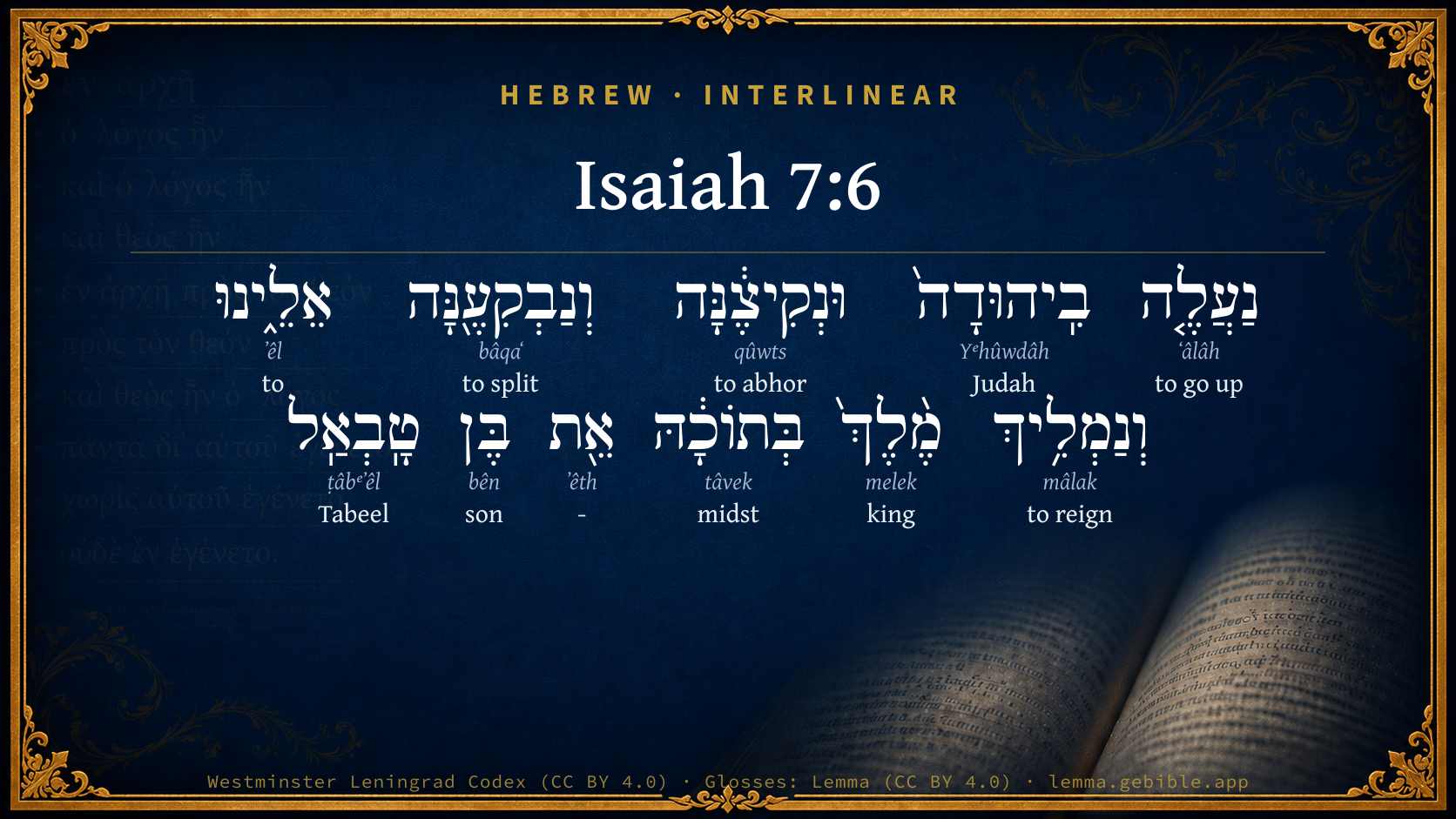
Hebrew (Westminster Leningrad Codex) Isaiah 7:6 appears in the Hebrew Old Testament. The text above is from the Westminster Leningrad Codex. Each word links to its Strong’s number, a concise gloss, and parsing drawn from the Open Scriptures Hebrew Bible morphology. Click any word for its full Brown-Driver-Briggs (BDB) entry.
Download image
Cite this verse

Isaiah 7:6 (World English Bible). Public Domain. Lemma interlinear Bible study tool, https://lemma.gebible.app/v/isaiah/7/6.

Show BibTeX & RIS
BibTeX
RIS
English Translation
"Let's go up against Judah, and tear it apart, and let's divide it among ourselves, and set up a king in the midst of it, even the son of Tabeel."
World English Bible · Public Domain
Download a study sheet

One document with this verse’s original text, its word-by-word gloss line, the meaning frame, cross-references with their text, attributed commentary, and full source and license credits — printable, and it pastes into notes with its structure intact.

This verse Autodidact and up

Study sheet (.html) Plain text (.txt)

A passage Seminary Student

Up to 50 verses in one chapter. A passage sheet keeps up to 6 commentary sources and 12 cross-references per verse, in the order this page ranks them, and says so on the sheet whenever that leaves anything out. Ask for a single verse and you get the Autodidact verse sheet above.

Everything on this page stays free to read, with no account — the sheet is a download of what is already on screen, not access to it.

Want to remove ads? Support Godless Engineer
Compare translations 3

The same verse in 3 English versions, stacked beneath the original-language interlinear above. Click any original word for its lexicon entry.

Each is an independent rendering of the whole verse — the interlinear is not word-aligned to these translations.

Highlighted words mark where these versions differ — a whole-verse word diff, not a word-by-word alignment.

  • World English Bible Public Domain
    "Let's go up against Judah, and tear it apart, and let's divide it among ourselves, and set up a king in the midst of it, even the son of Tabeel."
  • King James Version Public Domain
    Let us go up against Judah, and vex it, and let us make a breach therein for us, and set a king in the midst of it, even the son of Tabeal:
  • unfoldingWord Literal Text CC BY-SA 4.0
    “Let us go up against Judah, and let us make it dread, and let us break it open for ourselves, and let us make a king reign in the midst of it, the son of Tabeel,”

unfoldingWord Literal Text — © unfoldingWord, licensed CC BY-SA 4.0. Word-aligned USFM3 via Door43 (git.door43.org/unfoldingWord/en_ult).

Versions to compare (up to 4)

3 of 4 selected

Show all 18 translations

Every available English version of this verse, each an independent rendering of the whole verse.

  • World English Bible Public Domain
    "Let's go up against Judah, and tear it apart, and let's divide it among ourselves, and set up a king in the midst of it, even the son of Tabeel."
  • Berean Standard Bible Public Domain
    ‘Let us invade Judah, terrorize it, and divide it among ourselves. Then we can install the son of Tabeal over it as king.’
  • Majority Standard Bible Public Domain
    ‘Let us invade Judah, terrorize it, and divide it among ourselves. Then we can install the son of Tabeal over it as king.’
  • King James Version Public Domain
    Let us go up against Judah, and vex it, and let us make a breach therein for us, and set a king in the midst of it, even the son of Tabeal:
  • American Standard Version (1901) Public Domain
    Let us go up against Judah, and vex it, and let us make a breach therein for us, and set up a king in the midst of it, even the son of Tabeel;
  • Revised Version (1885) Public Domain
    Let us go up against Judah, and vex it, and let us make a breach therein for us, and set up a king in the midst of it, even the son of Tabeel:
  • Geneva Bible (1599) Public Domain
    Let vs goe vp against Iudah, and let vs waken them vp, and make a breach therein for vs, and set a King in the mids thereof, euen the sonne of Tabeal.
  • Douay-Rheims (1899) Public Domain
    Let us go up to Juda, and rouse it up, and draw it away to us, and make the son of Tabeel king in the midst thereof.
  • Young's Literal Translation Public Domain
    We go up into Judah, and we vex it, And we rend it unto ourselves, And we cause a king to reign in its midst -- The son of Tabeal.
  • Literal Standard Version CC BY-SA 4.0
    We go up into Judah, and we distress it, || And we divide it to ourselves, || And we cause a king to reign in its midst—The son of Tabeal.
  • Unlocked Literal Bible CC BY-SA 4.0
    “Let us attack Judah and terrify her, and let us break into her and set up our king there, the son of Tabeel.”
  • unfoldingWord Literal Text CC BY-SA 4.0
    “Let us go up against Judah, and let us make it dread, and let us break it open for ourselves, and let us make a king reign in the midst of it, the son of Tabeel,”
  • Darby Bible Public Domain
    Let us go up against Judah, and harass it, and make a breach therein for us, and set up a king therein -- the son of Tabeal;
  • World Messianic Bible Public Domain
    “Let’s go up against Judah, and tear it apart, and let’s divide it among ourselves, and set up a king within it, even the son of Tabeel.”
  • Webster's Bible Public Domain
    Let us go up against Judah, and harass it, and let us make a breach therein for us, and set a king in the midst of it, even the son of Tabeal:
  • Free Bible Version CC BY-SA 4.0
    Let's go and attack Judah! We'll terrorize it and conquer it for ourselves, and make Tabeel's son its king.’”
  • Bible in Basic English Public Domain
    Let us go up against Judah, troubling her, and forcing our way into her, and let us put up a king in her, even the son of Tabeel:
  • JPS Tanakh (1917) Public Domain
    Let us go up against Judah, and vex it, and let us make a breach therein for us, and set up a king in the midst of it, even the son of Tabeel;

Literal Standard Version (2020), Covenant Press — licensed CC BY-SA 4.0. Text via the HelloAO Bible API (eBible.org). Unlocked Literal Bible (unfoldingWord) — licensed CC BY-SA 4.0. Text via the HelloAO Bible API (eBible.org). unfoldingWord Literal Text — © unfoldingWord, licensed CC BY-SA 4.0. Word-aligned USFM3 via Door43 (git.door43.org/unfoldingWord/en_ult). Free Bible Version, Dr. Jonathan Gallagher — licensed CC BY-SA 4.0. Text via the HelloAO Bible API (eBible.org).

Word by word

More ways to search: Search by grammar → Find every occurrence → Compare this word →

Practice this passage: Drill this verse → Learn its vocabulary →

טָֽבְאַֽל
ṭâbᵉʼêl
H2870
“Tabeel”
Noun, Proper
Part of Speech
Noun
Type
Proper
Full BDB Definition

Origin: from H2895 and H410

TWOT: None

Tabeel = "God is good" - a man whose son was either in the army of Pekah or the army of Rezin and whom Pekah and Rezin proposed to make king of Israel - an officer of the Persian government in Samaria in the reign of Artaxerxes
  1. נַעֲלֶ֤ה ʻâlâh H5927 “to go up” Verb, Qal, Imperfect, 1st Person, Common, Plural
  2. בִֽיהוּדָה֙ Yᵉhûwdâh H3063 “in/at · Judah” Preposition + Noun, Proper
  3. וּנְקִיצֶ֔נָּה qûwts H6973 “and · to abhor · her” Conjunction + Verb, Hiphil, Imperfect, 1st Person, Common, Plural + Suffix, Personal, 3rd Person, Feminine, Singular
  4. וְנַבְקִעֶ֖נָּה bâqaʻ H1234 “and · to split · her” Conjunction + Verb, Hiphil, Imperfect, 1st Person, Common, Plural + Suffix, Personal, 3rd Person, Feminine, Singular
  5. אֵלֵ֑ינוּ ʼêl H413 “to · us” Preposition + Suffix, Personal, 1st Person, Common, Plural
  6. וְנַמְלִ֥יךְ mâlak H4427 “and · to reign” Conjunction + Verb, Hiphil, Imperfect, 1st Person, Common, Plural
  7. מֶ֨לֶךְ֙ melek H4428 “king” Noun, Common, Masculine, Singular, Absolute
  8. בְּתוֹכָ֔הּ tâvek H8432 “in/at · midst · her” Preposition + Noun, Common, Masculine, Singular, Construct + Suffix, Personal, 3rd Person, Feminine, Singular
  9. אֵ֖ת ʼêth H853 “-” Particle, Direct Object
  10. בֶּן bên H1121 “son of” Noun, Common, Masculine, Singular, Construct

About this verse

These counts appear in no published source. They are computed here, from the morphology-tagged text and Lemma’s own curated glosses. What Lemma adds →

11
words
11
distinct lemmas
Prophets
section

Notable vocabulary

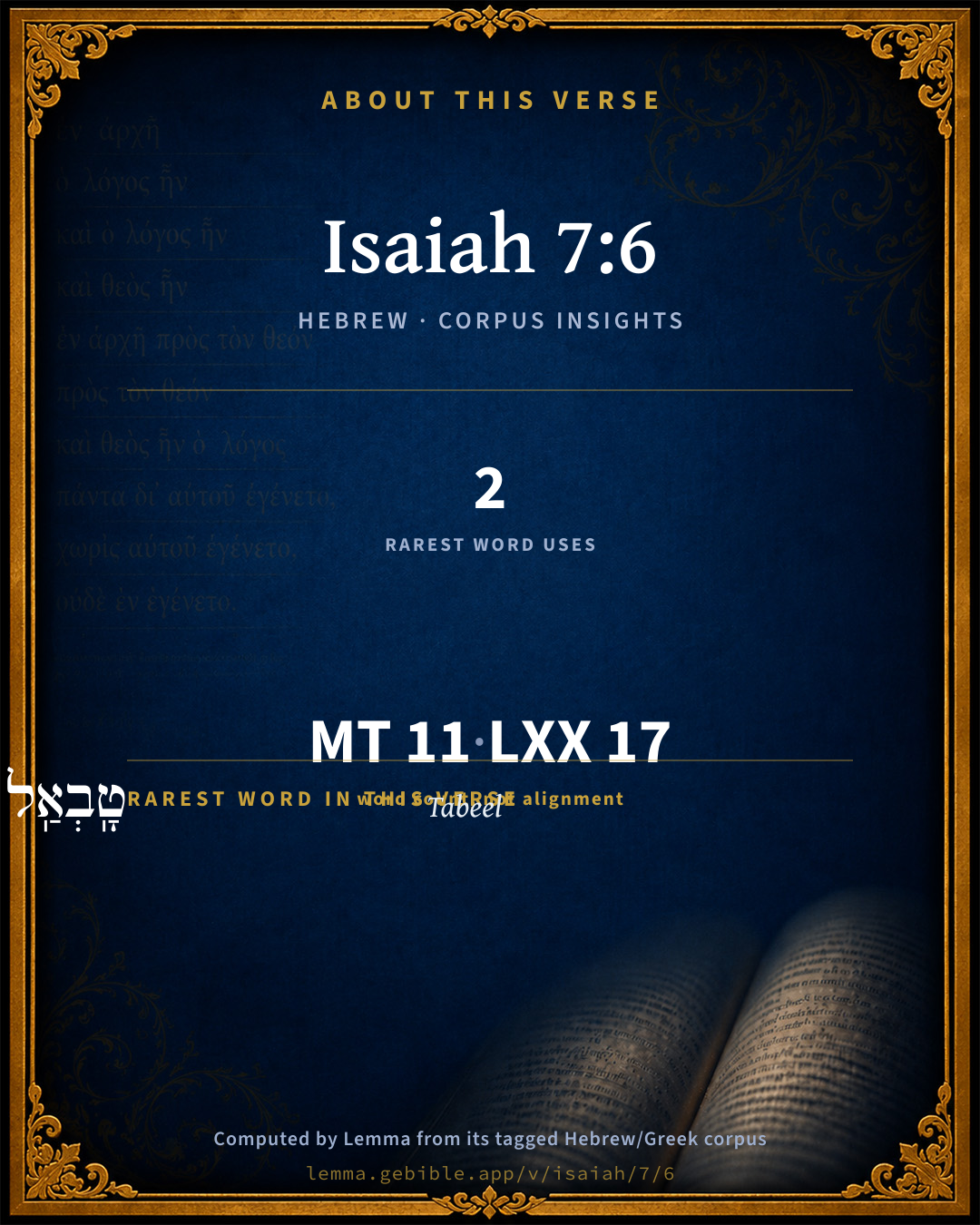
The rarest word here is טָֽבְאַֽל Tabeel H2870 — appearing just 2 times in the whole Hebrew Bible.

Shared distinctive vocabulary

טָֽבְאַֽל Tabeel H2870 occurs in 2 verses of the Hebrew Bible. Also found in:

Grammatical profile

  • 4 verbs
  • 5 nouns
  • 1 preposition
  • 1 particle

Verb forms

  • נַעֲלֶ֤ה Qal · Imperfect
  • וּנְקִיצֶ֔נָּה Hiphil · Imperfect
  • וְנַבְקִעֶ֖נָּה Hiphil · Imperfect
  • וְנַמְלִ֥יךְ Hiphil · Imperfect

Hebrew & Septuagint length

In English translation the verse runs 30 words from the Hebrew and 30 from the Septuagint (LXX English) — the same length.

A rough comparison of the two English renderings, which tokenize alike — not a word-level alignment.

Word counts can differ between the Hebrew and the Greek without any difference in meaning — e.g. the Hebrew direct-object marker אֵת has no separate Greek word, and Greek often adds the article ὁ.

In the original languages it is 11 Hebrew tokens and 17 Greek tokens — but the two are counted differently (Hebrew bundles its prefixes and suffixes into one token; the Greek is in lemma form), so that isn’t a like-for-like length.

Hebrew and Greek witnesses Masoretic Hebrew ↔ Greek Septuagint

The same verse in the two great witnesses to the Old Testament, shown verse-for-verse.

These are two independent witnesses, not word-aligned to each other, and the Septuagint is shown in lemma (dictionary) form.

Hebrew Isaiah 7:6 Masoretic · Westminster Leningrad Codex

נַעֲלֶ֤ה בִֽיהוּדָה֙ וּנְקִיצֶ֔נָּה וְנַבְקִעֶ֖נָּה אֵלֵ֑ינוּ וְנַמְלִ֥יךְ מֶ֨לֶךְ֙ בְּתוֹכָ֔הּ אֵ֖ת בֶּן טָֽבְאַֽל

"Let's go up against Judah, and tear it apart, and let's divide it among ourselves, and set up a king in the midst of it, even the son of Tabeel."

World English Bible · Public Domain

Greek LXX Isaiah 7:6 Septuagint · lemma form

ἀναβαίνω εἰς ὁ ἰουδαία καί συνλαλέω αὐτός ἀποστρέφω αὐτός πρός ἐγώ καί βασιλεύω αὐτός ὁ υἱός ταβεηλ

We will go up against Judea, and having conferred with them we will turn them away to our side, and we will make the son of Tabeel king of it;

LXX2012 (modern English Septuagint) · Public Domain

Hebrew: Westminster Leningrad Codex (CC BY 4.0). Greek: Septuagint (public domain); English from LXX2012 (modern English Septuagint) (Public Domain). How the Septuagint differs from the Hebrew →

Targum (Aramaic paraphrase)

1

The Targum is the ancient Jewish Aramaic paraphrase of the Hebrew Scriptures — an interpretive translation, not the Hebrew text itself. Onkelos (literal) and Pseudo-Jonathan (expansive) render the Torah, and Jonathan the Prophets. Coverage is partial: where no permissively-licensed English translation exists for a verse, only the Aramaic is shown. This is verse-level text, not a word-by-word alignment to the Hebrew.

  1. Targum Jonathan Prophets (Joshua–Malachi)
    נִסַק בְּאַרְעָא דְבֵית יְהוּדָה וּנְחַבְּרִינוּן וּנְשַׁוִינוּן עִמָנָא וְנַמְלִיךְ מַלְכָּא בְּגַוָהּ יַת מַן דְכָשַׁר לָנָא:

    We will go up into the land of the house of Judah, and let us be united together, and make them profitable unto us. We will make a king in it whom we shall think proper.

    Targum Jonathan — Aramaic: “Mikraot Gedolot” (public domain). English: “Sefaria Community Translation” (CC0 1.0 (public-domain dedication)); “London "Chaldee Paraphrase," 1871” (public domain). Text via Sefaria.

Commentary

Notes on Isaiah 7:6 from classic Christian and Jewish commentators (each source and its license shown beneath its notes). The classic Christian expositions comment on the surrounding passage and are grouped to its opening verse, so a note may address several verses; the Jewish commentaries on the Tanakh (Rashi and others) are per-verse, so they appear only where the commentator wrote on this verse.

Lemma curates 59 commentaries, every one of them public domain or Creative Commons licensed, each selected and text-cleaned for this edition rather than reprinted as found. About our sources →

Trapp's Complete Commentary

John Trapp

Isa 7:6 Let us go up against Judah, and vex it, and let us make a breach therein for us, and set a king in the midst of it, [even] the son of Tabeal:

Ver. 6. Let us go up against Judah and vex it.] So they had done separately, and so they think much more to do jointly. Sed aliter Deo visum est. There is a council in heaven that dasheth the mould of all contrary counsels upon earth. {as Psa 2:4}

And let us make a breach therein for us.] Or, Let us divide it, and share it between us, or set a king over it that may be a vassal to us both. Thus the Pope gave away England primo occupaturo, to him that should first take it in Henry VIII’s days; but he reckoned without his host, as they say.

Even the son of Tabeal.] A Syrian, likely, as Tabrimmon; {1Ki 15:18} a good Rimmonite; {2Ki 5:18} so Tabeal a good god. Rimmon was the Syrian’s god. The Chaldee expoundeth it, good, or right for us.

John Trapp, A Commentary or Exposition upon All the Books of the Old and New Testament (1647–1656) — public domain. Text from a community e-Sword module.

Tyndale Open Study Notes

Tyndale Open Resources

7:6 The son of Tabeel, otherwise unknown, was obviously sympathetic to Israel’s and Syria’s resistance against Assyria.

Tyndale Open Study Notes — © Tyndale Open Resources, licensed CC BY-SA 4.0. Text via the HelloAO Bible API.

Geneva Bible (1599)

Geneva Bible translators

Which was an Israelite, and as seemeth, enemy to the house of David.

Geneva Bible (1599) marginal notes — public domain. Text via Bolls.life.

Jamieson, Fausset & Brown

Robert Jamieson, A. R. Fausset & David Brown

vex--rather, "throw into consternation" [GESENIUS].

make a breach--rather, "cleave it asunder." Their scheme was to divide a large portion of the territory between themselves, and set up a vassal king of their own over the rest.

son of Tabeal--unknown; a Syrian-sounding name, perhaps favored by a party in Jerusalem (Isa 3:6, Isa 3:9, Isa 3:12).

Jamieson, Fausset & Brown — Commentary Critical and Explanatory on the Whole Bible (1871) — public domain (CC PDM 1.0). Text via the HelloAO Bible API.

Ellicott's Commentary for English Readers

(6) Let us make a breach therein for us . . .—The words imply an assault on the line of fortresses that defended Judah (2Ch_26:9-10; 2Ch_32:1). If they were won the issue of the war would be practically decided. Jerusalem itself does not appear to have been actually besieged.

The son of Tabeal.—The mode of description, as in the last verse, indicates that the man was of low origin. The name “good is God” is Aramaic, and points to his being an officer in Rezin’s army. It meets us again in Ezr_4:7, among the Aramæan adversaries of Israel, and appears in the term Tibil in Assyrian inscriptions, which give us his actual name as Ashariah (Schrader, Keil Inschrift., p. 118). Tubaal appears in an inscription of Sennacherib as appointed by him as governor of Zidon (Records of the Past, i. 35). Dr. Kay, connecting the name with Tab-rimmon (“Rimmon is good”), conjectures that the substitution of El (“God”) for the name of the Syrian deity may indicate that he was the representative of the family of Naaman, and, like him, a proselyte to the faith of Israel.

A Bible Commentary for English Readers, edited by Charles John Ellicott (1878–1897) — public domain. Text from a community e-Sword module.

The Cambridge Bible for Schools and Colleges

gen. ed. J. J. S. Perowne

6. and vex it] Rather frighten it (cf. Isa_7:16, where the Qal of the same verb means “cower”), unless we adopt a conjecture of Gesenius giving the sense “press it hard.” The idea, however, is probably that the allies trusted greatly to the panic caused by the suddenness of their attack.

make a breach therein] break into it, by forcing the passes; as in 2Ch_21:17, &c.

the son of Tabeal] Another obscure adventurer like the son of Remaliah. The form of the name (Tâb’çl, cf. Tab-rimmon, 1Ki_15:18) suggests that the protégé of the allies was a Syrian. Their plan is very complete; the successor of Ahaz is already nominated.

The Cambridge Bible for Schools and Colleges (gen. ed. J. J. S. Perowne; Cambridge University Press, 1878–1918) — public domain. Text from a community e-Sword module.

John Gill's Exposition

Let us go up against Judah, and vex it,.... By besieging or distressing it; or "stir it up" to war, as Jarchi interprets it:

and let us make a breach therein for us; in the walls of the city of Jerusalem, and enter in at it; the Targum is,

"let us join, and put it to us;''

and so Jarchi, let us level it with us, as this valley, which is even: the sense may be, let us make a breach and division among them, and then part the kingdom between us (c); or if we cannot agree on that, let us set up a king of our own, as follows:

and set a king in the midst of it, even the son of Tabeal; which Jarchi, by a situation of the alphabet the Jews call "albam", makes it to be the same with Remala, that is, Remaliah; and so supposes, that the intention was to set Pekah, son of Remaliah, king of Israel, over Judah; but it is not reasonable to think that the king of Syria should join in such a design; and besides, the method of interpretation, Aben Ezra says, is mere vanity; and whose sense of the words is much preferable, taking Tabeal to be the name of some great prince, either of Israel or of Syria; and so Kimchi thinks that he was a man of the children of Ephraim, whom they thought to make king in Jerusalem. The Targum understands not any particular person, but anyone that should be thought proper; and paraphrases it thus,

"let us appoint a king in the midst of it, who is right for us,''

or pleases us; the name seems to be Syriac, see Ezr 4:7. Dr. Lightfoot thinks it is the same with Tabrimmon, the name of some famous family in Syria. One signifies "good God": and the other "good Rimmon", which was the name of the idol of the Syrians, Kg2 5:18.

(c) So Noldius, Elr. Concord. Part. p. 62. renders its "let us divide it among us".

John Gill's Exposition of the Whole Bible (1746–1763) — public domain (CC PDM 1.0). Text via the HelloAO Bible API.

Albert Barnes' Notes on the Bible

And vex it - Margin, ‘Weaken it.’ Probably the word means to throw into consternation or fear, by besieging it - “Gesenius.”

And let us make a breach therein - Let us break down the walls, etc.

And set a king - Subdue it, and make it tributary to the allied kingdoms of Syria and Ephraim.

The son of Tabeal - Nothing more is known of this person. He might have been some disaffected member of the royal family of David, who had sought the aid of Rezin and Pekah, and who would be allied to them, or tributary to them. It is possible that he had already a party in Jerusalem in his favor; compare Isa 8:12. Probably, the two kings wished to cut off such portions of the territory of Judah as should be convenient to them, and to set a king over the remainder, who should be under their control; or to divide the whole between themselves, by setting up a king who would be tributary to both.

Albert Barnes' Notes on the Bible (1834–1885) — public domain. Text from a community e-Sword/MySword module.

Haydock's Catholic Bible Commentary

Tabeel. Chaldean, "whom we shall think proper." He will not so much as name him.

George Leo Haydock (1774–1849), Haydock's Catholic Family Bible and Commentary, 1859 edition — public domain. Excludes Psalms (Douay-Rheims chapter numbering differs from Protestant) and Deuterocanonical books (Catholic canon only).

Matthew Poole's English Annotations

Let us make a breach therein; either,

1. Break and divide that country into two parts, one for time, and another for me; or rather,

2. Break their power and kingdom, and subdue it to ourselves: for,

1. The same word and phrase is so used 2Ch 32:1, where there was no such division intended.

2. Because the next clause intimates that the kingdom of Judah was still to be united under another king, who should pay tribute to them severally, as they should agree.

The son of Tabeal; some considerable captain, in whose fidelity both of them had good confidence; but whether he was an Israelite or Syrian is uncertain, and not material.

Matthew Poole's English Annotations on the Holy Bible (1683–1685) — public domain. Text from a community e-Sword/MySword module.

Whedon's Commentary on the Bible

Daniel D. Whedon

6. Make a breach — In the wall, by which the city of Jerusalem could be taken.

Son of Tabeal — An individual otherwise unknown. Probably a foreign pretender, whom these invaders meant to enthrone, so as to overthrow “the house of David.”

Daniel D. Whedon (gen. ed.), Commentary on the Old and New Testaments (1874–1909) — public domain. Text from a community e-Sword module.

The Pulpit Commentary

Make a breach therein. The word employed means properly "making a breach in a city wall", (2Ki_25:4 Jer_39:2 Eze_26:10) but is used also in a metaphorical sense for injuring and ruining a country. (see especially 2Ch_21:17) The son of Tabeal; or, Tubal. "Tab-ill" appears to be a Syrian name, founded upon the same pattern as Tab-rimmon, (1Ki_15:18) rite one meaning "God is good, "the other "Rimmon is good." We cannot, however, conclude from the name that the family of Tabeal was monotheistic (Kay), for El was one of the many Syrian gods as much as Rimmon (see Max Mailer, "Science of Religion," pp. 177, 178).

The Pulpit Commentary (1880–1919), ed. H.D.M. Spence-Jones & Joseph S. Exell — public domain. Text from a community e-Sword module.

John Wesley's Explanatory Notes

Let us - Break their power and kingdom and subdue it to ourselves.

John Wesley, Explanatory Notes Upon the Whole Bible (1754–1765) — public domain. Text via the GEBible commentary corpus.

J. A. Alexander on Isaiah

Joseph Addison Alexander

The invaders themselves are now introduced as consulting or addressing one another, not at the present moment, but at the time when their plan was first concerted. “We will go up, or let us go up, into Judah, or against it,” although this is rather implied than expressed, “and vex (i.e., harass or distress) it, and make a breach in it (thereby subduing it) to ourselves, and let us make a king in the midst of it, to wit, the son of Tabeal”, or Tabeel, as the name is written in Ezr 4:7. The reference to Jerusalem is required by the history, according to which they did succeed in their attack upon the kingdom, but were foiled in their main design of conquering the royal city. The entrance into Judah was proposed only as a means to this end, and it is the failure of this end that is predicted in the next verse. The creation of tributary kings by conquerors is mentioned elsewhere in the sacred history (e. g. 2Ki 23:34; 2Ki 24:17). This familiar reference en passant to the names of persons now forgotten, as if familiar to contemporary readers, is a strong incidental proof of authenticity.

Joseph Addison Alexander, The Prophecies of Isaiah (1846–1847; New York: Scribner, 1870–1878) — public domain. Text from a community e-Sword module.

Rashi

Rabbi Shlomo Yitzchaki (Rashi)

and provoke it Let us provoke them to war.

and annex it to us Heb. וְנַבְקִיעֶנָּה. Let us even it out with us like a valley (בִּקְעָה) that is even. And so does Jonathan render: And let us even them with us, that they should be even with the ten tribes under one king.

one who is good for us Heb. בֶּן טָבְאַל [a combination of the words: טוֹב אֶל,] good for us; so did Jonathan render it. It is also possible to interpret it as: טוֹב אַל, not good in the eyes of the Omnipresent, and according to the calculation of the letters of ‘al-bam,’ Tov’al is Ramla. ‘Teth’ equals ‘resh’; ‘beth’ equals ‘mem’; ‘aleph’ equals ‘lammed.’ Hence, “ben tov’al” equals ‘ben Ramla.’

Rashi on the Tanakh — English translations: “The Judaica Press complete Tanach with Rashi, translated by A. J. Rosenberg” (CC BY 4.0); “Pentateuch with Rashi's commentary by M. Rosenbaum and A.M. Silbermann, 1929-1934” (public domain); “The Metsudah Tanach series, Lakewood, N.J” (CC BY 4.0); and “The Book of Joshua, Metsudah Publications, 1997” (CC BY 4.0). Text via Sefaria.

Ibn Ezra

Rabbi Abraham ibn Ezra

ונקיצנה Transitive verb, let us cause her to be distressed because of us; the suffix נה her, refers to Jerusalem; the following, Let us make a breach therein, proves the correctness of this interpretation. The son of Tobel. According to some

טבאל is by a certain interchange of letters the same as רמלא, and בן טבאל therefore the same as בן רמליהו; this is nonsense, because Ben Remaliahu is mentioned before, and he says with Aram, Let us set a king in the midst of it, the son of Tobel. Others say that טָבְאַל means טׂב אֵלֵינוּ good for us, but אַל can only be taken as equal to לא, and בן טבאל would then be בן טבלא ═ good for nothing; but I conclude that it is the name of some famous prince in Israel or Aram.

Ibn Ezra on the Tanakh — English translations: “Sefaria Community Translation” (CC0 1.0 (public-domain dedication)); “Yalkut, Sifsei Chachomim Chumash, Metsudah Publications, 2009” (CC BY 4.0); and “Commentary of Ibn Ezra on Isaiah - trans. by M. Friedlander, 1873” (public domain). Text via Sefaria.

Lesson kit

Teaching starters — assembled from the data on this page, not authored interpretation. Every prompt links to the verse data it draws on. Edit before teaching.

Isaiah, in the Prophets, opens this verse with 11 words (11 distinct Hebrew lemmas). Its most distinctive word is ṭâbᵉʼêl (“Tabeel”). A historical commentator’s framing appears above. Read the whole chapter for the surrounding context.

Discussion questions

  1. How does “Tabeel” (ṭâbᵉʼêl) shape what this verse is saying?
  2. Ezra 4:7 shares the word «Tabeel» with this verse. How do the two illuminate each other?
  3. These translations render this verse differently; the difference is in the English rendering, not the original. What questions does that raise?
  4. The verb «נַעֲלֶ֤ה» is Qal Imperfect. How does its form color the action?
  5. Reading how Trapp's Complete Commentary and Tyndale Open Study Notes read this verse, where do the two commentators agree and where do they part?

Things to notice

Reading settings

Reading text

Shown beneath each verse's original-language words.

Old Testament
Old Testament edition

Read the OT as the Masoretic Hebrew (MT) or the Greek Septuagint (LXX).

English shown for the Greek Septuagint (in the Hebrew ↔ Greek comparison).

Comparing translations? Open the Compare panel on any verse page to stack up to four side by side.