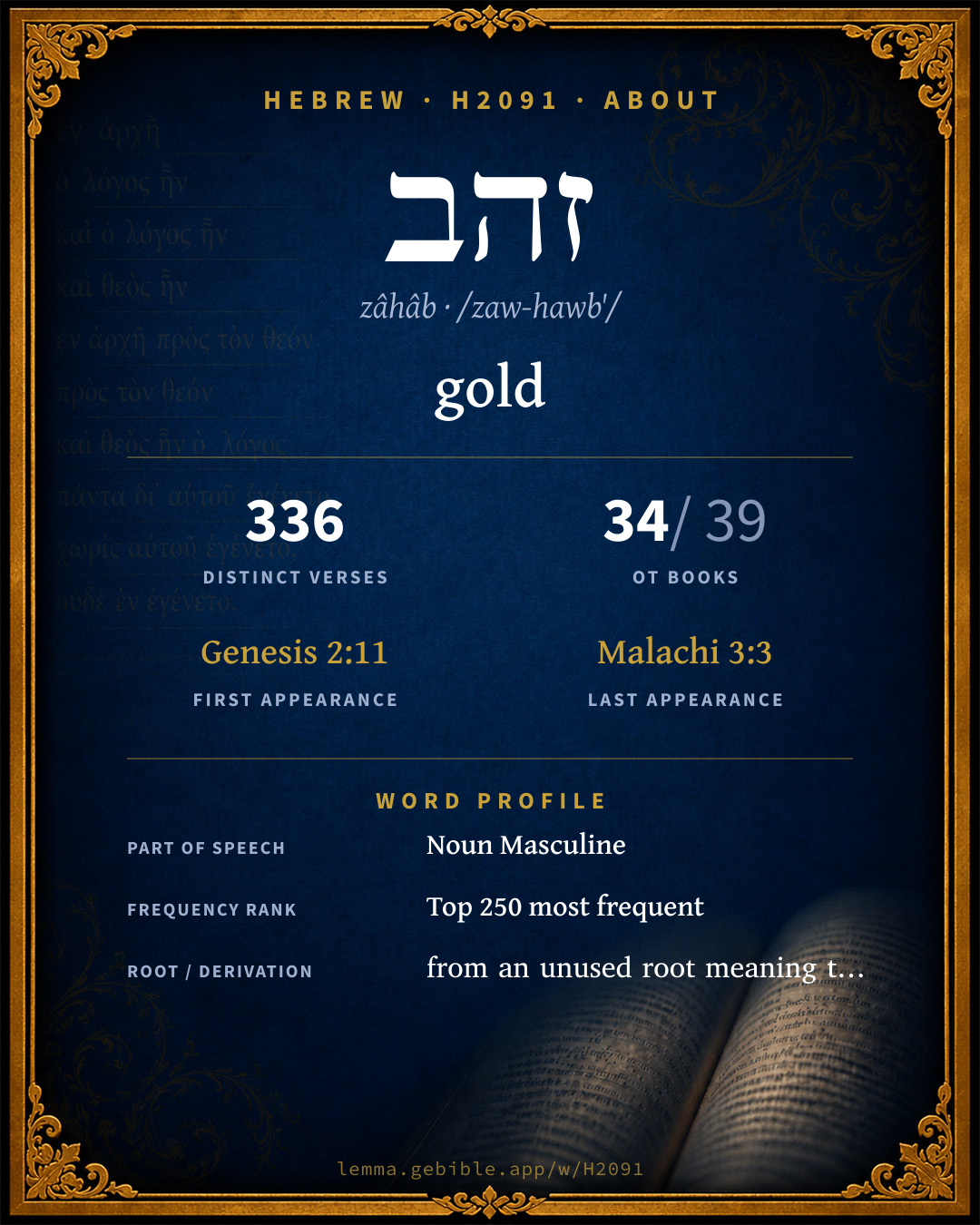
זָהָב
gold
‘gold’ is one of 4 main senses fuller range ↓
Full lexicon entry — Brown-Driver-Briggs (BDB)
From Brown-Driver-Briggs (BDB)
Where this word appears
See every Absolute-state word in the Hebrew Bible →
Grammar key — what these labels mean
Part of speech
- Noun
- A naming word — a person, place, thing, or idea.
Noun type
- Common
- A common noun — a general class of person, place, or thing (“king,” “city,” “water”), not a specific name.
State
- Absolute
- The independent form of a noun, not bound to a following word.
- Construct
- A noun bound to a following noun in a possessive / “of” relationship (the construct chain).
Gender
- Masculine
- Grammatically masculine.
Number
- Singular
- One.
Every verse where H2091 appears in the Book of Isaiah — 11 distinct verses. Click any verse to open its interlinear word-by-word view. Verse text shown in the World English Bible for context — . Each verse’s Hebrew form is shown with its reference; the English is not keyword-highlighted, since the data carries no word-level English alignment. Use “Compare translations” on any verse to read it across multiple English versions. This concordance covers the Hebrew Bible; Septuagint (Greek Old Testament) occurrences are not indexed here.
Isaiah
- Isaiah 2:7 וְ/זָהָ֔ב conj + n c ms Their land is full of silver and gold, Neither is there any end of their treasures. Their land also is full of horses, Neither is there any end of their chariots.
- Isaiah 2:20 זְהָב֑/וֹ n c ms cs + sfx pers 3ms In that day, men shall cast away their idols of silver, And their idols of gold, Which have been made for themselves to worship, To the moles and to the bats;
- Isaiah 13:17 וְ/זָהָ֖ב conj + n c ms Behold, I will stir up the Medes against them, who shall not regard silver, and as for gold, they shall not delight in it.
- Isaiah 30:22 זְהָבֶ֑/ךָ n c ms cs + sfx pers 2ms You shall defile the overlaying of your engraved images of silver, and the plating of your molten images of gold: you shall cast them away as an unclean thing; you shall tell it, Get you hence.
- Isaiah 31:7 זְהָב֑/וֹ n c ms cs + sfx pers 3ms For in that day they shall cast away every man his idols of silver, and his idols of gold, which your own hands have made to you for a sin.
- Isaiah 39:2 הַ/זָּהָ֨ב ptcl def.art + n c ms Hezekiah was glad of them, and shown them the house of his precious things, the silver, and the gold, and the spices, and the precious oil, and all the house of his armor, and all that was found in his treasures: there was nothing in his house, nor in all his dominion, that Hezekiah didn't show them.
- Isaiah 40:19 בַּ/זָּהָ֣ב prep det + n c ms The image, a workman has cast [it], and the goldsmith overlays it with gold, and casts [for it] silver chains.
- Isaiah 46:6 זָהָב֙ n c ms Some pour out gold from the bag, and weigh silver in the balance. They hire a goldsmith, and he makes it a god. They fall down--yes, they worship.
- Isaiah 60:6 זָהָ֤ב n c ms The multitude of camels shall cover you, the dromedaries of Midian and Ephah; all they from Sheba shall come; they shall bring gold and frankincense, and shall proclaim the praises of Yahweh.
- Isaiah 60:9 וּ/זְהָבָ֖/ם conj + n c ms cs + sfx pers 3mp Surely the isles shall wait for me, and the ships of Tarshish first, to bring your sons from far, their silver and their gold with them, for the name of Yahweh your God, and for the Holy One of Israel, because he has glorified you.
- Isaiah 60:17 זָהָ֗ב n c ms For brass I will bring gold, and for iron I will bring silver, and for wood brass, and for stones iron. I will also make your officers peace, and righteousness your ruler.
About this entry
At a glance — auto-summarized from this page’s data, not written by a person. Every figure links to its source below. This summary describes the numbers; it doesn’t interpret them.
זהב — transliterated zâhâb — is a Hebrew noun carrying the sense “gold.” The lexicon spreads it across several senses; see its full sense range. Spanning 336 verses in 34 books, it ranks among the common words of the Hebrew Bible. Its uses concentrate in Exodus (26% of all occurrences). Its earliest occurrence is Genesis 2:11. Each statement above links to its evidence; the full detail follows below.
Gloss history
Strong's 1890 vs modern scholarship
About this word
Strong's H2091 catalogs a Hebrew word from the Hebrew Old Testament.
These counts are not copied from any lexicon or concordance. They are computed here, from the morphology-tagged Hebrew Old Testament. What Lemma adds →
- 336
- distinct verses
- The word appears in 336 distinct verses.
- 34 / 39
- OT books
- The word appears in 34 of 39 Old Testament books.
- #129
- by frequency
- Top 250 most frequent Hebrew words (rank 129 of 8,640 Hebrew words by occurrence).
View all 336 occurrences in the concordance →
Most concentrated in
- Exodus 88 verses 26%
- 2 Chronicles 41 verses 12%
- 1 Kings 33 verses 10%
By section of the Old Testament
By traditional corpus
Conventional, traditional groupings — biblical authorship is debated, so this is a traditional corpus grouping, not an authorship claim. Each share is this word’s portion of its verses in that division of the Hebrew canon. Each figure is a share of the word’s 336 distinct verses.
- Torah (Pentateuch) 124 verses · 37%
- Writings (Ketuvim) 111 verses · 33%
- Prophets (Nevi'im) 101 verses · 30%
How translations render this word
Counts come from each version’s own published word-to-Strong’s tagging or interlinear alignment — an approximate guide to how each version renders this word, not a word-level alignment the data otherwise carries. Because each total is that version’s own tagged count, the per-version totals vary from one another and need not match the appearance or distinct-verse counts above. These counts may also differ from a printed concordance because Lemma counts each distinctly tagged rendering and does not collapse phrase taggings into a single head-word total. This is a fixed set of word-tagged versions (KJV, ASV, BSB, ULT) and does not change with the reading translation you choose elsewhere. Each version’s license is shown beside its name below (and on Sources).
- King James Version: Gold 300×, Golden 33×, All the gold 5×
- American Standard Version: Gold 282×, Golden 38×, All the gold 5×
- Berean Standard Bible: Gold 340×, Golden 8×, Had gold 2×
- unfoldingWord Literal Text: Gold 367×, With 9×, Gold of 5×
King James Version Public Domain
Renders H2091 across 389 tagged occurrences — most commonly:
Plus 32 renderings that appear only once — usually multi-word phrases or single function words the recovered tagging swept in, not distinct renderings.
American Standard Version Public Domain
Renders H2091 across 389 tagged occurrences — most commonly:
Plus 41 renderings that appear only once — usually multi-word phrases or single function words the recovered tagging swept in, not distinct renderings.
Berean Standard Bible Public Domain
Renders H2091 across 377 tagged occurrences — most commonly:
Plus 19 renderings that appear only once — usually multi-word phrases or single function words the recovered tagging swept in, not distinct renderings. Not rendered by a distinct English word in 11 further occurrences.
unfoldingWord Literal Text CC BY-SA 4.0
Renders H2091 across 406 tagged occurrences — most commonly:
Plus 7 renderings that appear only once — usually multi-word phrases or single function words the recovered tagging swept in, not distinct renderings.
25 senses and sub-senses in the full BDB
What do BDB’s symbols mean?
BDB uses these scholarly abbreviations:
| Symbol | Meaning |
|---|---|
| 𝔊 | the Septuagint (the ancient Greek translation, LXX) |
| 𝔙 | the Vulgate (the Latin translation) |
| 𝔖 | the Syriac version (the Peshitta) |
| 𝔗 | the Targum (the Aramaic translation) |
| ψ | the Psalms |
| √ | root (the underlying root or stem) |
| ‖ | parallel passage (a synonymous or contrasted parallel) |
| † | the dagger: every passage where the word occurs is cited |
The 25 senses and sub-senses the full Brown-Driver-Briggs lexicon distinguishes for this word, in lexicon order (not ranked by frequency), with BDB’s own verbatim wording and sub-sense lettering. Shown in Hebrew script with BDB’s own scholarly abbreviations. The condensed entry is in the Lexicon Entry tab. See also the Forms in the corpus table below.
- 1. = gold-ore, gold in a raw state, Gn 2:11, 12 Je 10:9 Pr 17:3; 27:21 Jb 28:1 +; perhaps also 1 K 9:28; 10:11; 22:49 etc.; cf. עַפְרֹת ז׳ Jb 28:6 gold-dust v. also Zc 13:9 (sim. of tried people of י׳) and cf. Mal 3:3; likewise Jb 23:10 (sim. of Job’s purity, as shewn by divine tests); מִצָּפוֹן זָהָב Jb 37:22 is dub.; Ew De al. out of the North comes gold; others, however, golden light, brightness, of sun after clouds dispersed by north wind, 𝔊 Rabb. Da al.; or golden splendour of God coming from north BöÄ 76 Hi al.; Siegf conj. יהוה for זהב read perhaps זֹהַר Du and Dr. e.g. Genesis 2:11
- 2. gold as wealth Gn 13:2 (J; + מִקְנֶה, כֶּסֶף) 24:34 (J; + צֹאן, בָּקָר, כֶּסֶף, עֲבָדִם, שְׁפָחֹת, גְּמַלִּים, חֲמֹרִים) cf. Ho 2:8 Is 2:7 Dt 8:13; 17:17 Jb 3:15; 31:24 Zc 14:14 Ezr 1:4, 6 +; in gen., as precious: נִבְחָר שֵׁם מֵעשֶׁר רָ֑ב מִכֶּסֶף וּמִזָּהָב חֵן טוֹב Pr 22:1 to be chosen is a name more than great riches, and good favour more than silver and than gold; Jb 28:17 (of wisdom) gold and glass do not equal it; ψ 19:10 (ordinances of י׳) which are more to be desired than gold; cf. 119:72, 127; also metaph. of princes and chief men of Zion La 4:1 (cf. v 2). e.g. Genesis 13:2
- 3. gold as spoil of war Jos 6:19 (+ כֶּסֶף, כְּלֵי־נְחשֶׁת, בַּרְזֶל) so v 24, cf. 7:21, 24; 22:8 2 K 7:8 +. e.g. Joshua 6:19
- 4. gold as merchandise Ez 27:22 (+ אֶבֶן יְקָרָה, רֹאשׁ כָּל־בֹּשֶׂם), cf. also gold from Ophir 1 K 9:28 etc. (v. sub 7 infr.) e.g. Ezekiel 27:22
- 5. gold as costly gift: to a prophet מְלֹא בֵּיתוֹ כֶּסֶף וְז׳ (hypothet.), Nu 22:18; 24:13 (both E); brought by queen of Sheba to Solomon 1 K 10:2, 10 (both + אֶבֶן יְקָרָה and בְּשָׂמִים) = 2 Ch 9:1, 9; as tribute 2 K 23:35(×2) (cf. v 33; all + כֶּסֶף); as satisfaction for murder 2 S 21:4 (+ כֶּסֶף). e.g. Numbers 22:18
- 6. gold as material: of (nose- or ear-)ring, נֶזֶם Gn 24:22 Ex 32:2, 3 Ju 8:24, 26 Pr 11:22; 25:12 Jb 42:11; of chain Gn 41:42, shields 2 S 8:7, images of emerods 1 S 6:4, 17 and mice v 4, 11, 18; תַּפּוּחֵי ז׳ בְּמַשְׂכִּיּוֹת כֶּסֶף Pr 25:11; גֻּלַּת ז׳ Ec 12:6; כְּלֵי־ז׳ Ex 3:22; 11:2; 12:35 1 S 6:8 ψ 105:37 etc.; כְּלֵי־כֶסֶף וּכְלֵי זָהָב Gn 24:53 as presents to a bride (+ בְּגָדִים); so of presents to secure king’s favour 2 S 8:10 (+ כְּלֵי נְחשֶׁת), and in list of yearly gifts or tribute to Sol. 1 K 10:25 = 2 Ch 9:24; as material of idols אֱלֹהֵי כֶסֶף וֵאלֹהֵי ז׳ Ex 20:23 cf. 32:31 Ho 8:4 Is 2:20; 30:22; 31:7 Dt 29:16 ψ 115:4; 135:15; as plating of idols Dt 7:25; especially as material of the furnishings of Solomon’s temple, or (oftener) the platings of temple, or parts thereof, or of its furnishings 1 K 6:20, 21(×3), 22(×2), 28; 7:48 + 10 times 1 K 6:7; also 2 Ch 3:5(×2), 6 + 14 times 2 Ch 3:4; cf. 1 Ch 28:14(×2) + 14 times 1 Ch 28. 29 (David’s preparation for temple); v. also 2 K 24:13 cf. 14:14 = 2 Ch 25:24, 2 K 25:15 = Je 52:19 (in accounts of plundering temple etc.); but more often still of furnishing and utensils of tabernacle, insignia of high-priest etc., Ex 25:3, 11, 24 + 97 times Ex 25–40, Lv 8:9 Nu 4:11; 8:4; (in case of large objects frequently of plating or sheathing, cf. 12 c infr.) Note the expressions תְּנוּפַת ז׳ ליהוה Ex 35:22 a wave-offering of gold, זְהַב הַתְּנוּפָה 38:24; also זְהַב הַתְּרוּמָה Nu 31:52 (all P) cf. Ezr 8:25, and (of offering to heathen god) יְכַבֵּד בְּזָהָב Dn 11:38. e.g. Genesis 24:22
- 7. gold described by its source, especially gold from Ophir (cf. GlasSkizze ii. 357, ff. 368) 1 K 9:28; 10:11; 22:49 1 Ch 29:4 2 Ch 8:18; 9:10; so perhaps Je 10:9 (read אוֹפִיר for אוּפַז Ew Klo al.); זְהַב שְׁבָא ψ 72:15; on ז׳ פַּרְוָ֑יִם 2 Ch 3:6 v. פרוים; cf. further Gn 2:11, 12. e.g. 1 Kings 9:28
- 8. gold defined By var. adj. and pts.: ז׳ שָׁחוּט beaten gold (v. שָׁחַט) 1 K 10:16, 17 = 2 Ch 9:15(×2), 16; ז׳ סָגוּר 1 K 6:20, 21; also 7:49, 50 10:21 = 2 Ch 4:20, 22; 9:21 (on meaning v. סָגַר); especially (but only P & Ch) ז׳ טָהוֹר pure gold Ex 25:11, 17, 24 + 21 times Ex 25, 28, 30, 37, 39 (of equipments of tabernacle and high priest’s insignia), 1 Ch 28:17 2 Ch 3:4; 9:17; cf. ז׳ טוֹב 2 Ch 3:5, 8; on ז׳ מוּפָז 1 K 10:18, AV best gold, cf. אוּפָז, פָּזַז. e.g. 1 Kings 10:16
- 9. ז׳ as measure of weight and value:
- a. = gold-shekel, עֲשָׂרָה ז׳ מִשְׁקָלָם Gn 24:22; כַּף אַחַת עֲשָׂרָה ז׳ Nu 7:14 + 11 times Nu 7; אֶלֶף וּשְׁבַע־מֵאוֹת ז׳ Ju 8:26, cf. 1 K 10:16 2 K 5:5 2 Ch 9:15, 16; אַלְפֵי ז׳ וָכָ֑סֶף ψ 119:72; comp. further Jos 7:21; but also (only Ch) שֶׁקֶל expressed: שִׁקְלֵי ז׳ מִשְׁקַל שֵׁשׁ מֵאוֹת 1 Ch 21:25 (50 shekels of silver in ‖ 2 S 24:24); וּמִשְׁקָל לְמִסְמְרוֹת לִשְׁקָלִים חֲמִשִּׁים ז׳ 2 Ch 3:9. e.g. Genesis 24:22
- b. שְׁלשֶׁת מָנִים ז׳ 1 K 10:17 three minas of gold (v. מָנֶה). e.g. 1 Kings 10:17
- c. כִּכַּר ז׳ talent of gold 2 S 12:30 1 K 9:14 + (v. כִּכָּר). e.g. 2 Samuel 12:30
- d. זָהָב דַּרְכְּמוֹנִים שֵׁשׁ־רִבֹּאוֹת וָאֶלֶף Ezr 2:69 cf. Ne 7:69, 70, 71; also וּכפֹרֵי ז׳ עֶשְׂרִים לַאֲדַרְכֹּנִים אָ֑לֶף Ezr 8:27 (v. דַּרְכְּמוֹן);—with the above should perhaps be compared הַזָּלִים ז׳ מִכִּיס Is 46:6 i.e. the gold used in making the god was the coin carried in the bag. e.g. Ezra 2:69
- 10. ז׳ = golden oil, from colour, Zc 4:12. e.g. Zechariah 4:12
- 11. ז׳ often named with כֶּסֶף, and then, in earlier and sometimes in later writings, follows it: בַּכֶּסֶף וּבַזָּהָב Gn 13:2 (J), cf. 24:35, 53; 44:8 (all J), Ex 3:22; 11:2; 12:35 Nu 22:18; 24:13 (all E), Jos 6:19, 24 (JE), Dt 7:25; 17:17; 29:16 2 S 8:11; 21:4 1 K 7:51; 15:15, 18, 19 2 K 7:8; 16:8; 18:14; 20:13; 23:33, 35(×2) Ho 2:10; 8:4 Is 2:7; 60:9 Je 10:4 Zp 1:18 Ez 7:19; 38:13 Zc 6:11 Jo 4:5, Pr 22:1 ψ 105:37; 115:4; 135:15 2 Ch 1:15; 5:1 Ezr 1:4; 8:25 Dn 11:8 Ec 2:8 +; in later writings ז׳ often precedes Ez 28:4 Zc 14:14 Mal 3:3 1 Ch 18:10; 22:14, 16; 28:15, 16; 29:3, 4, 5, 7 2 Ch 9:14, 21; 24:14; 25:24 Ezr 1:11 ψ 119:72 Ct 1:11 Dn 11:38 +, and so in P, Ex 25:3; 31:4; 35:5, 32 Nu 31:32; yet also as early as Hb 2:19 1 K 10:22 2 K 25:15. e.g. Genesis 13:2
- 12. the chief vbs. used with ז׳ are:
- a. עָשָׂה make of (c. 2 acc.) 1 K 7:48 (cf. v 49(×2), 50(×2)) 10:6; 12:28; 14:26 2 Ch 4:7, 8, 19; 12:9; 13:8, and especially in P (tabern.) Ex 25:11, 17, 18 + 35 times Ex 25–39; also sq. בְּ work in gold, לַעֲשׂוֹת בַּזּ׳ וּבַכֶּסֶף וּבַנְּחשֶׁת Ex 31:4; 35:32, also (+ בַּבַּרְזֶל, etc.), 2 Ch 2:6, 13; e.g. 1 Kings 7:48
- b. יָצַק (obj. טַבְּעֹת ז׳) Ex 25:12; 37:3, 13 (all P); e.g. Exodus 25:12
- c. צִפָּה overlay with (c. 2 acc.) 1 K 6:20, 21(×2), 22, 28, 30, 32, 35 (v 32, 35 one acc. om.), 10:18 2 Ch 3:4, 10; 9:17, and especially P (tabern.) Ex 25:11, 13, 24, 28 + 15 times Ex 26–37; in same sense e.g. 1 Kings 6:20
- d. וַיְחַפֵּהוּ ז׳ 2 Ch 3:5 cf. v 7, 8, 9, and e.g. 2 Chronicles 3:5
- e. תָּפוּשׂ ז׳ וָכֶסֶף Hb 2:19 encased in gold and silver; also e.g. Habakkuk 2:19
- f. בַּזּ׳ יְרַקְּעֶנּוּ Is 40:19; e.g. Isaiah 40:19
- g. רדד Hiph., וַיָּ֫רֶדּ עַל־הַכְּרוּבִים וְעַל־הַתִּמֹּרוֹת אֶת־הַזּ׳ 1 K 6:32and he spread upon the cherubim and upon the palm-trees the gold; further e.g. 1 Kings 6:32
- h. בָּחַן try, Zc 13:9, cf. e.g. Zechariah 13:9
- i. זִקַּק Mal 3:3.—On דִּי זָהָב, n.pr. v. p. 191; on מֵי זָהָב n.pr. v. sub מַיִם. e.g. Malachi 3:3
Senses from the full Brown-Driver-Briggs lexicon (Brown, Driver, Briggs; Oxford 1906 — public domain), digitized via Sefaria, supplemented by the OpenScriptures HebrewLexicon (CC BY 4.0). Full attribution on Sources.
Word origin
n.m. Gn 2:12 gold (NH id.; Arabic ذَهَبٌ, Sab. דֿהב e.g. Os29 DHMZMG 1883, 338; Aramaic דְּהַב, ܕܗܰܒ, Palm. דהבא VogNo. 23)—ז׳ abs. Gn 2:11 + 364 times; cstr. Gn 2:12 + 6 times; sf. זְהָבִי 1 K 20:7 + 2 times; זְהָֽבְךָ 1 K 20:3, 5; זְהָבֶ֑ךָ Is 30:22; זְהָבוֹ Is 2:20; 31:7; זְהָבָם Ho 8:4 + 4 times;—gold,
— Brown-Driver-Briggs (Oxford 1906, public domain), digitized via Sefaria, supplemented by the OpenScriptures HebrewLexicon (CC BY 4.0). See Sources.
Origin: from an unused root meaning to shimmer
Jastrow Dictionary
A second Hebrew/Aramaic lexicon for comparison, covering Aramaic and post-biblical (Talmudic, Targumic, Midrashic) usage that the biblical-Hebrew BDB does not. Matched by lemma rather than by Strong’s number, so a lemma may carry more than one Jastrow headword (shown separately below), and the entries cover usage well beyond the Bible.
זָהַב
- , Hif. הִזְהִיב (denom. of זָהָב) to glitter, contrad. to הצהיב (v. צָהַב). Ḥull. 22ᵇ משיַזְהִיבוּ when their plumage is glittering.—Part. Hof. מוּזְהָב, f. מוּזְהֶבֶת gold-embroidered. Sabb. 59ᵇ.—Pl. f. מוּזְהָבוֹת. Tosef. Sot. XV, 9, v. זְהוֹרִית.
זָהָב
- (b. h.) gold, gold coin, v. דִּינָר. Snh. 92ᵇ יוצק ז׳ רותח וכ׳ molten gold be poured into &c. Ex. R. s. 33 מכל עשרך … ושל ז׳ than all thy (Korah’s) wealth of silver and gold; a. fr.—B. Mets. IV, 1 הז׳ קונה את הכסף וכ׳ the delivery of gold coin effects the purchase of silver &c., i.e. in an exchange of coined gold for silver &c., the superior metal is the merchandise and the inferior the money; Y. ed. הכסף קונה את הז׳; v. Bab. ib. 44ᵃ; a. fr.—Pl. זְהָבִים, זְהָבִין. Ex. R. s. 35; Cant. R. to III, 10 שבעה (מיני) ז׳ וכ׳ seven kinds of gold were used in the Temple. Yoma 44ᵇ שבעה ז׳ וכ׳ there are seven &c.—Erub. 53ᵇ (in allegorical speech) והרקיעו לז׳ וכ׳ Ms. M. (ed. ארקיעו) make the gold (glowing coals) sky-blue (fan them so as to give blue flames) and prepare for me two tellers in the dark (cocks).
A Dictionary of the Targumim, the Talmud Babli and Yerushalmi, and the Midrashic Literature (Marcus Jastrow; London, Luzac, 1903) — Public Domain. Digitized via Sefaria. Digitized via Sefaria. Full attribution on Sources.
Forms in the corpus
The 89 distinct written forms H2091 takes in the Hebrew Bible, most frequent first — each parse links to that state’s occurrences in the concordance. Hebrew forms include their vowel points and cantillation, so a single lemma takes many written forms.
The 60 most common forms are shown; 29 rarer forms follow in the full concordance.
Same root — word family
Other BDB entries built from the same root as H2091, grouped by Strong’s listed origin. These share a root / origin per the lexicon — not necessarily a shared meaning. Each links to that word’s own entry.
Derived from this word
Compare all same-root words → They share a root, not necessarily a meaning.
Septuagint verse parallels
This word appears in 313 verses that also exist in the Greek Old Testament (Septuagint), out of the 336 Hebrew verses it occurs in. You can read those verses in Greek by switching the Old Testament edition to the Septuagint.
Read these verses in the Septuagint
- Genesis 2:11
- Exodus 3:22
- Leviticus 8:9
- Numbers 4:11
- Deuteronomy 7:25
- Joshua 6:19
- Judges 8:24
- 1 Samuel 6:4
- 2 Samuel 1:24
- 1 Kings 6:20
- 2 Kings 5:5
- 1 Chronicles 18:7
This is a verse-level parallel only — the same verses exist in both the Hebrew and Greek Old Testaments. No word-level Hebrew↔Greek correspondence is claimed: the data carries no such alignment, so no Greek word is shown as this Hebrew word’s translation. Coverage is not total — the Septuagint omits the deuterocanon and renumbers the Psalms, so some Hebrew verses have no direct Greek parallel.