
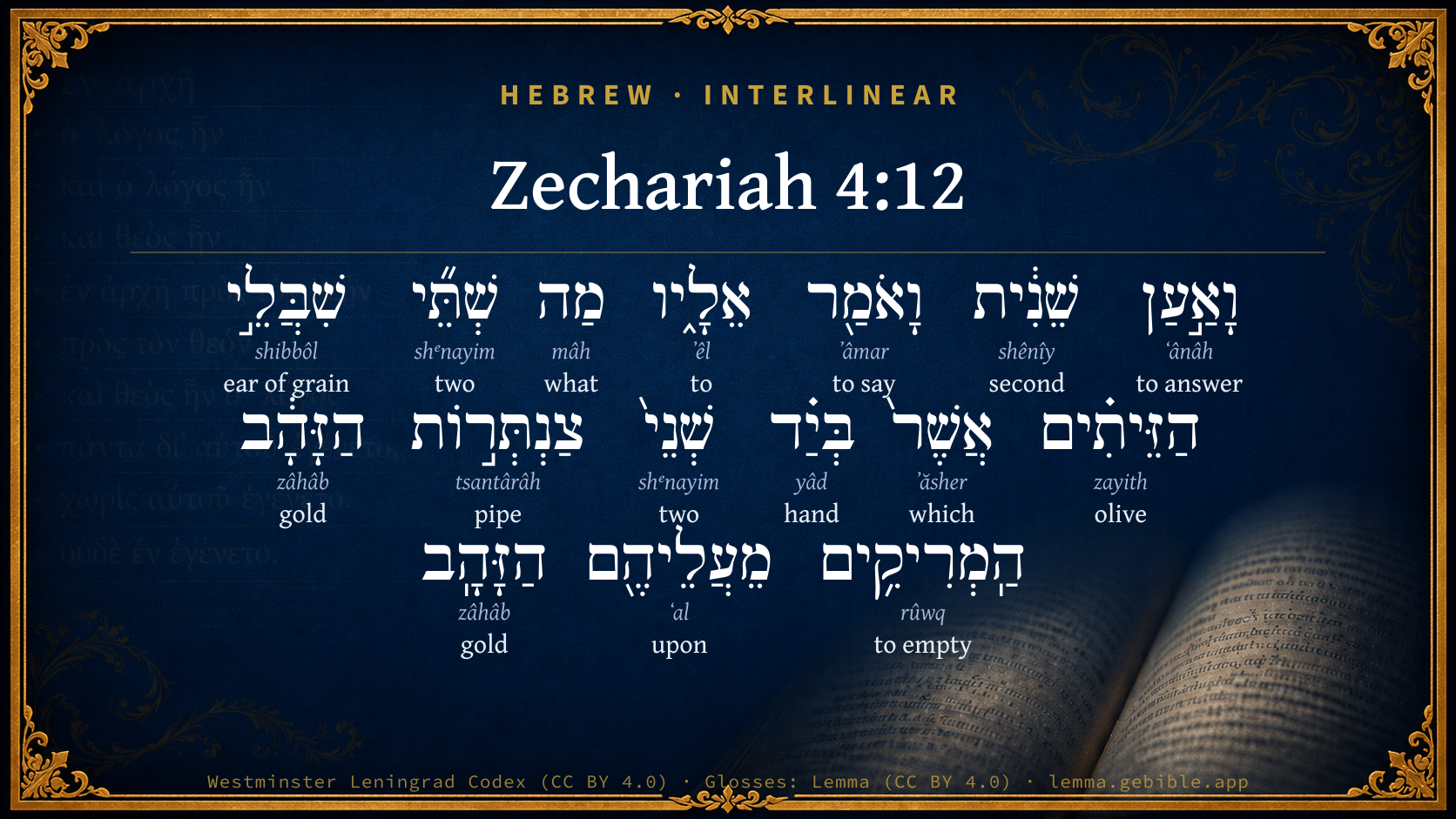
Zechariah 4:12

Hebrew (Westminster Leningrad Codex) Zechariah 4:12 appears in the Hebrew Old Testament. The text above is from the Westminster Leningrad Codex. Each word links to its Strong’s number, a concise gloss, and parsing drawn from the Open Scriptures Hebrew Bible morphology. Click any word for its full Brown-Driver-Briggs (BDB) entry.
Download image
Cite this verse

Zechariah 4:12 (World English Bible). Public Domain. Lemma interlinear Bible study tool, https://lemma.gebible.app/v/zechariah/4/12.

Show BibTeX & RIS
BibTeX
RIS
English Translation
I asked him the second time, "What are these two olive-branches, which are beside the two golden spouts, that pour the golden oil out of themselves?"
World English Bible · Public Domain
Highlights Full analysis ↓
Download a study sheet

One document with this verse’s original text, its word-by-word gloss line, the meaning frame, cross-references with their text, attributed commentary, and full source and license credits — printable, and it pastes into notes with its structure intact.

This verse Autodidact and up

Study sheet (.html) Plain text (.txt)

A passage Seminary Student

Up to 50 verses in one chapter. A passage sheet keeps up to 6 commentary sources and 12 cross-references per verse, in the order this page ranks them, and says so on the sheet whenever that leaves anything out. Ask for a single verse and you get the Autodidact verse sheet above.

Everything on this page stays free to read, with no account — the sheet is a download of what is already on screen, not access to it.

Want to remove ads? Support Godless Engineer
Compare translations 3

The same verse in 3 English versions, stacked beneath the original-language interlinear above. Click any original word for its lexicon entry.

Each is an independent rendering of the whole verse — the interlinear is not word-aligned to these translations.

Highlighted words mark where these versions differ — a whole-verse word diff, not a word-by-word alignment.

  • World English Bible Public Domain
    I asked him the second time, "What are these two olive-branches, which are beside the two golden spouts, that pour the golden oil out of themselves?"
  • King James Version Public Domain
    And I answered again, and said unto him, What be these two olive branches which through the two golden pipes empty the golden oil out of themselves?
  • unfoldingWord Literal Text CC BY-SA 4.0
    And I answered a second time and said to him, “What the two branches of the olives that beside the two pipes of gold that are emptying the gold from upon them?”

unfoldingWord Literal Text — © unfoldingWord, licensed CC BY-SA 4.0. Word-aligned USFM3 via Door43 (git.door43.org/unfoldingWord/en_ult).

Versions to compare (up to 4)

3 of 4 selected

Show all 18 translations

Every available English version of this verse, each an independent rendering of the whole verse.

  • World English Bible Public Domain
    I asked him the second time, "What are these two olive-branches, which are beside the two golden spouts, that pour the golden oil out of themselves?"
  • Berean Standard Bible Public Domain
    And I questioned him further, “What are the two olive branches beside the two gold pipes from which the golden oil pours?”
  • Majority Standard Bible Public Domain
    And I questioned him further, “What are the two olive branches beside the two gold pipes from which the golden oil pours?”
  • King James Version Public Domain
    And I answered again, and said unto him, What be these two olive branches which through the two golden pipes empty the golden oil out of themselves?
  • American Standard Version (1901) Public Domain
    And I answered the second time, and said unto him, What are these two olive-branches, which are beside the two golden spouts, that empty the golden `oil' out of themselves?
  • Revised Version (1885) Public Domain
    And I answered the second time, and said unto him, What be these two olive branches, which are beside the two golden spouts, that empty the golden oil out of themselves?
  • Geneva Bible (1599) Public Domain
    And I spake moreouer, and said vnto him, What bee these two oliue branches, which thorowe the two golden pipes emptie themselues into the golde?
  • Douay-Rheims (1899) Public Domain
    And I answered again, and said to him: What are the two olive branches, that are by the two golden beaks, in which are the funnels of gold?
  • Young's Literal Translation Public Domain
    And I answer a second time, and say unto him, `What `are' the two branches of the olive trees that, by means of the two golden pipes, are emptying out of themselves the oil?'
  • Literal Standard Version CC BY-SA 4.0
    And I answer a second time, and say to him, “What [are] the two branches of the olive trees that, by means of the two golden pipes, are emptying out of themselves the oil?”
  • Unlocked Literal Bible CC BY-SA 4.0
    Once more I asked him, “What are these two olive branches beside the two gold pipes that have golden oil pouring out of them?”
  • unfoldingWord Literal Text CC BY-SA 4.0
    And I answered a second time and said to him, “What the two branches of the olives that beside the two pipes of gold that are emptying the gold from upon them?”
  • Darby Bible Public Domain
    And I answered the second time and said unto him, What are the two olive-branches which are beside the two golden tubes that empty the gold out of themselves?
  • World Messianic Bible Public Domain
    I asked him the second time, “What are these two olive branches, which are beside the two golden spouts that pour the golden oil out of themselves?”
  • Webster's Bible Public Domain
    And I answered again, and said to him, What are these two olive branches which through the two golden pipes empty the golden oil out of themselves?
  • Free Bible Version CC BY-SA 4.0
    And I also asked him, “What are the two olive branches from which the golden oil pours out from through golden pipes?”
  • Bible in Basic English Public Domain
    And answering a second time, I said to him, What are these two olive branches, through whose gold pipes the oil is drained out?
  • JPS Tanakh (1917) Public Domain
    And I answered the second time, and said unto him: 'What are these two olive branches, which are beside the two golden spouts, that empty the golden oil out of themselves?'

Literal Standard Version (2020), Covenant Press — licensed CC BY-SA 4.0. Text via the HelloAO Bible API (eBible.org). Unlocked Literal Bible (unfoldingWord) — licensed CC BY-SA 4.0. Text via the HelloAO Bible API (eBible.org). unfoldingWord Literal Text — © unfoldingWord, licensed CC BY-SA 4.0. Word-aligned USFM3 via Door43 (git.door43.org/unfoldingWord/en_ult). Free Bible Version, Dr. Jonathan Gallagher — licensed CC BY-SA 4.0. Text via the HelloAO Bible API (eBible.org).

Word by word

More ways to search: Search by grammar → Find every occurrence → Compare this word →

Practice this passage: Drill this verse → Learn its vocabulary →

צַנְתְּר֣וֹת
tsantârâh
H6804
“pipes of”
Noun, Common, Masculine, Plural, Construct
Part of Speech
Noun
Type
Common
Gender
Masculine
Number
Plural
State
Construct
Full BDB Definition

Origin: probably from the same as H6794

TWOT: 1942b

pipe - pipes feeding lamps with oil
  1. וָאַ֣עַן ʻânâh H6030 “and · to answer” Conjunction + Verb, Qal, Sequential Imperfect, 1st Person, Common, Singular
  2. שֵׁנִ֔ית shênîy H8145 “second” Adjective, Ordinal number, Feminine, Singular, Absolute
  3. וָאֹמַ֖ר ʼâmar H559 “and · to say” Conjunction + Verb, Qal, Sequential Imperfect, 1st Person, Common, Singular
  4. אֵלָ֑יו ʼêl H413 “to · him” Preposition + Suffix, Personal, 3rd Person, Masculine, Singular
  5. מַה mâh H4100 “what” Particle, Interrogative
  6. שְׁתֵּ֞י shᵉnayim H8147 “two” Adjective, Cardinal number, Feminine, Dual, Construct
  7. שִׁבֲּלֵ֣י shibbôl H7641 “ears of grain of” Noun, Common, Feminine, Plural, Construct
  8. הַזֵּיתִ֗ים zayith H2132 “the · olives” Particle, Definite Article + Noun, Common, Masculine, Plural, Absolute
  9. אֲשֶׁר֙ ʼăsher H834 “which” Particle, Relative
  10. בְּיַ֗ד yâd H3027 “in/at · hand of” Preposition + Noun, Common, Both, Singular, Construct
  11. שְׁנֵי֙ shᵉnayim H8147 “two” Adjective, Cardinal number, Masculine, Dual, Construct
  12. הַזָּהָ֔ב zâhâb H2091 “the · gold” Particle, Definite Article + Noun, Common, Masculine, Singular, Absolute
  13. הַֽמְרִיקִ֥ים rûwq H7324 “the · emptying” Particle, Definite Article + Verb, Hiphil, Participle Active, Masculine, Plural, Absolute
  14. מֵעֲלֵיהֶ֖ם ʻal H5921 “from · upon · them” Preposition + Preposition + Suffix, Personal, 3rd Person, Masculine, Plural
  15. הַזָּהָֽב zâhâb H2091 “the · gold” Particle, Definite Article + Noun, Common, Masculine, Singular, Absolute

About this verse

These counts appear in no published source. They are computed here, from the morphology-tagged text and Lemma’s own curated glosses. What Lemma adds →

16
words
14
distinct lemmas
Prophets
section

Notable vocabulary

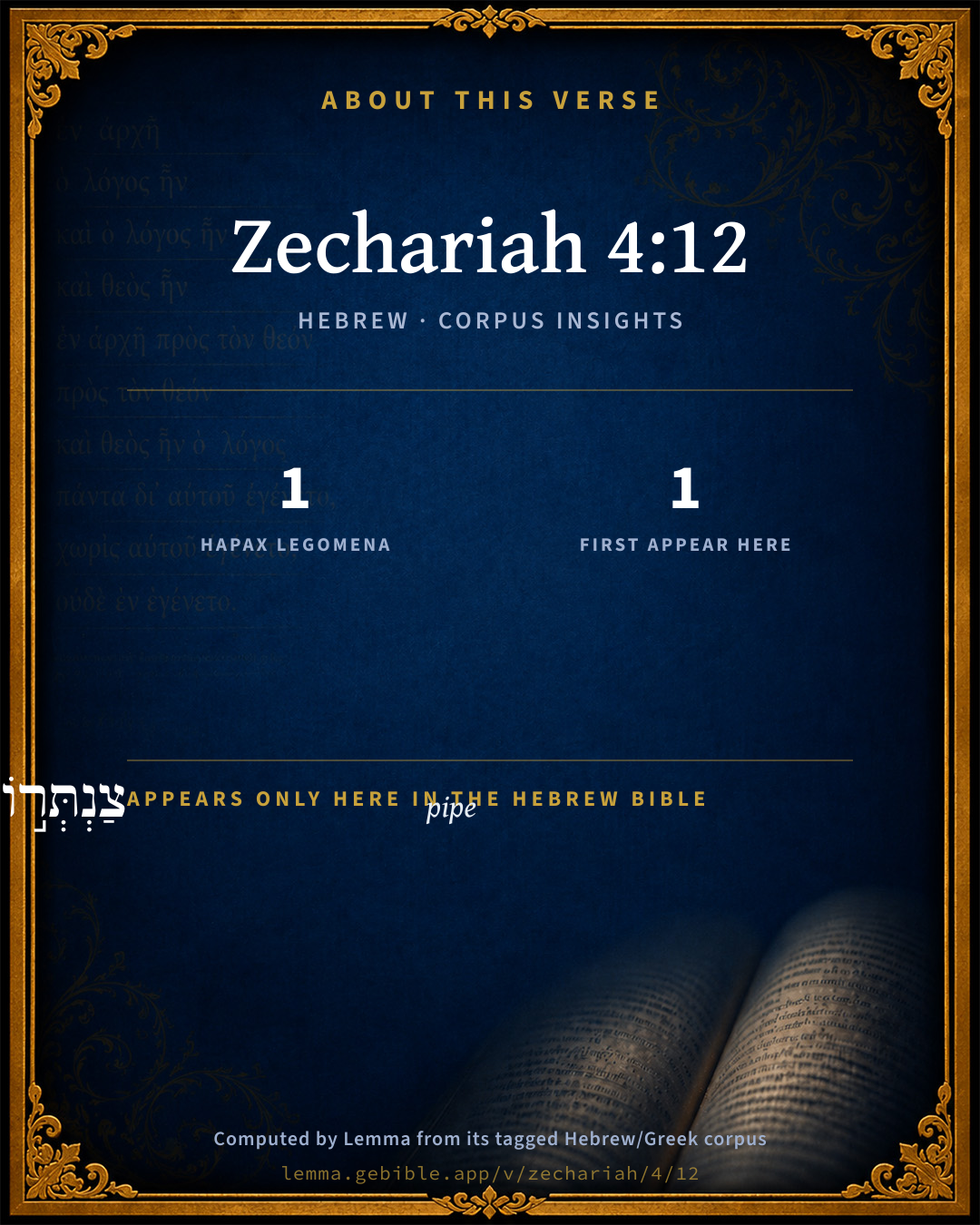
1 hapax legomenon — a word that appears only here in the entire Hebrew Bible:

  • צַנְתְּר֣וֹת pipe H6804

First appearance in Scripture

This word makes its first canonical appearance in the Hebrew Bible here:

  • צַנְתְּר֣וֹת pipe H6804

Shared distinctive vocabulary

שִׁבֲּלֵ֣י ear of grain H7641 occurs in 16 verses of the Hebrew Bible. Also found in:

Grammatical profile

  • 3 verbs
  • 6 nouns
  • 3 adjectives
  • 2 prepositions
  • 2 particles

Verb forms

  • וָאַ֣עַן Qal · Sequential Imperfect
  • וָאֹמַ֖ר Qal · Sequential Imperfect
  • הַֽמְרִיקִ֥ים Hiphil · Participle Active

Repetition

Words recur within this verse — often emphatic in Hebrew:

  • שְׁתֵּ֞י two H8147 ×2
  • הַזָּהָ֔ב gold H2091 ×2

Hebrew & Septuagint length

In English translation the verse runs 26 words from the Hebrew and 38 from the Septuagint (LXX English) — the Septuagint runs noticeably longer here. See the side-by-side →

A rough comparison of the two English renderings, which tokenize alike — not a word-level alignment.

Word counts can differ between the Hebrew and the Greek without any difference in meaning — e.g. the Hebrew direct-object marker אֵת has no separate Greek word, and Greek often adds the article ὁ.

Cross-references

3

Topical passages linked to Zechariah 4:12 in the Treasury of Scripture Knowledge — connected by theme and wording, ordered by reader-vote popularity; previews shown in the World English Bible.

  • Matthew 20:23 He said to them, "You will indeed drink my cup, and be baptized with the baptism that I am baptized with, but to sit on my right hand and on my left hand is not mine to give; but it is for whom it has been prepared by my Father."
  • Revelation 11:4 These are the two olive trees and the two lampstands, standing before the Lord of the earth.
  • Haggai 1:1 In the second year of Darius the king, in the sixth month, in the first day of the month, the Word of Yahweh came by Haggai, the prophet, to Zerubbabel, the son of Shealtiel, governor of Judah, and to Joshua, the son of Jehozadak, the high priest, saying,

Cross-references courtesy of OpenBible.info (CC BY 4.0).

Hebrew and Greek witnesses Masoretic Hebrew ↔ Greek Septuagint

The same verse in the two great witnesses to the Old Testament, shown verse-for-verse.

Here the Septuagint runs noticeably longer than the Hebrew — LXX2012 (modern English Septuagint) 38 words vs World English Bible 26. A rough length comparison of the two English translations, not a word-level alignment — read both below.

These are two independent witnesses, not word-aligned to each other, and the Septuagint is shown in lemma (dictionary) form.

Hebrew Zechariah 4:12 Masoretic · Westminster Leningrad Codex

וָאַ֣עַן שֵׁנִ֔ית וָאֹמַ֖ר אֵלָ֑יו מַה שְׁתֵּ֞י שִׁבֲּלֵ֣י הַזֵּיתִ֗ים אֲשֶׁר֙ בְּיַ֗ד שְׁנֵי֙ צַנְתְּר֣וֹת הַזָּהָ֔ב הַֽמְרִיקִ֥ים מֵעֲלֵיהֶ֖ם הַזָּהָֽב

I asked him the second time, "What are these two olive-branches, which are beside the two golden spouts, that pour the golden oil out of themselves?"

World English Bible · Public Domain

Greek LXX Zechariah 4:12 Septuagint · lemma form

καί ἐπιἐρωτάω ἐκ δεύτερος καί εἶπον πρός αὐτός τίς ὁ δύο κλάδος ὁ ἐλαία ὁ ἐν ὁ χείρ ὁ δύο μυξωτήρ ὁ χρυσοῦς ὁ ἐπιχέω καί ἐπι ἀναἄγω ὁ ἐπαρυστρίς ὁ χρυσοῦς

And I asked the second time, and said to him, What are the two branches of the olive-trees that are by the side of the two golden pipes that pour into and communicate with the golden oil funnels?

LXX2012 (modern English Septuagint) · Public Domain

On this verse, Ellicott's Commentary for English Readers discusses the Septuagint’s reading. Read the note in Commentary ↓

Hebrew: Westminster Leningrad Codex (CC BY 4.0). Greek: Septuagint (public domain); English from LXX2012 (modern English Septuagint) (Public Domain). How the Septuagint differs from the Hebrew →

Targum (Aramaic paraphrase)

1

The Targum is the ancient Jewish Aramaic paraphrase of the Hebrew Scriptures — an interpretive translation, not the Hebrew text itself. Onkelos (literal) and Pseudo-Jonathan (expansive) render the Torah, and Jonathan the Prophets. Coverage is partial: where no permissively-licensed English translation exists for a verse, only the Aramaic is shown. This is verse-level text, not a word-by-word alignment to the Hebrew.

  1. Targum Jonathan Prophets (Joshua–Malachi)
    וַאֲתִיבֵית תִּנְיָנוּת וַאֲמָרֵית לֵיהּ מָא תְּרֵין שׁוּבְלֵי זֵיתַיָא דִבְיַד תְּרֵין אִסְקְרִיטְוָן דִדְהַב דִמְרִיקִין מִנְהוֹן מִשְׁחָא לְבוֹצִינֵי דַהֲבָא:

    (no public-domain English translation for this verse)

    Targum Jonathan — Aramaic: “Mikraot Gedolot” (public domain). English: “Sefaria Community Translation” (CC0 1.0 (public-domain dedication)); “London "Chaldee Paraphrase," 1871” (public domain). Text via Sefaria.

Commentary

Notes on Zechariah 4:12 from classic Christian and Jewish commentators (each source and its license shown beneath its notes). The classic Christian expositions comment on the surrounding passage and are grouped to its opening verse, so a note may address several verses; the Jewish commentaries on the Tanakh (Rashi and others) are per-verse, so they appear only where the commentator wrote on this verse.

Lemma curates 59 commentaries, every one of them public domain or Creative Commons licensed, each selected and text-cleaned for this edition rather than reprinted as found. About our sources →

Trapp's Complete Commentary

John Trapp

Zec 4:12 And I answered again, and said unto him, What [be these] two olive branches which through the two golden pipes empty the golden [oil] out of themselves?

Ver. 12. What be these two olive branches, &c.] {See Trapp on "Zec 4:3"} {See Trapp on "Zec 4:7"}

John Trapp, A Commentary or Exposition upon All the Books of the Old and New Testament (1647–1656) — public domain. Text from a community e-Sword module.

Jamieson, Fausset & Brown

Robert Jamieson, A. R. Fausset & David Brown

through--literally, "by the hand of," that is, by the agency of.

branches--literally, "ears"; so the olive branches are called, because as ears are full of grain, so the olive branches are full of olives.

golden oil--literally, "gold," that is, gold-like liquor.

out of themselves--Ordinances and ministers are channels of grace, not the grace itself. The supply comes not from a dead reservoir of oil, but through living olive trees (Psa 52:8; Rom 12:1) fed by God.

Jamieson, Fausset & Brown — Commentary Critical and Explanatory on the Whole Bible (1871) — public domain (CC PDM 1.0). Text via the HelloAO Bible API.

Adam Clarke's Commentary

Verse 12. What be these two olive branches] That is, two boughs laden with branches of olive berries.

Adam Clarke's Commentary on the Bible (1810–1826) — public domain. Text from a community e-Sword/MySword module.

John Calvin's Commentaries

I have said that there is some difference in the visions though the angel relates hardly anything new, except respecting the flowing and the tubes; but as a new explanation is given, Zechariah no doubt more fully considered what he had slightly looked on before. The more attentive then to the vision the Prophet became, the more confirmed he was; for God showed to him now what he had not sufficiently observed before, namely, that there were pipes or tubes through which the oil flowed into each of the pourers, and further, that these flowing or a continual running of the oil, was like that of a river, which runs through its own channel. But God intended to instruct his Prophet by degrees, that we may learn at this day to apply our thoughts to the understanding of his doctrine; for the instruction to be derived from it is not of an ordinary kind, as I have already reminded you. Indeed the state of things in our time is nearly the same with that of his time: for Christ now renews by the power of his Spirit that spiritual temple which had been pulled down and wholly demolished; for what has been the dignity of the Church for many ages? Doubtless, it has been for a long time in a dilapidated state; and now when God begins to give some hope of a new building, Satan collects together many forces from all parts to prevent the progress of the work. We are also tender and soft, and even faint-hearted, so that hardly one in a hundred labors so courageously as he ought.

We hence then learn how necessary for us is this doctrine: it was not, therefore, to no purpose that the Prophet did not apprehend at once and in an instant what was presented to him in the vision, but made progress by degrees.

John Calvin's Commentaries (1540-1563) — public domain. Text from the Calvin Translation Society English edition (1840s-50s) via the Christian Classics Ethereal Library (ccel.org). Calvin's coverage is partial (roughly two-thirds of the Bible); uncommented books and verses are honest gaps, never fabricated. The 19th-century editor's footnotes and remarks are omitted so the notes are faithfully Calvin's own voice.

Ellicott's Commentary for English Readers

(12) Olive branches.—Better, bunches of olives. Two important points in the vision are here incidentally introduced for the first time: viz., the bunch of fruits on each olive-tree, and the “two golden pipes,” or rather, spouts.

Which through . . . themselves.—Better, Which are resting in the two golden spouts, which pour out from themselves the gold [en oil]. The meaning appears to be that on each side of the golden bowl at the top of the candlestick was a golden spout turned upwards, into which the two clusters of olives poured their oil spontaneously, and from which the oil flowed into the bowl, and thence through the forty-nine pipes to the seven lamps. “The gold” stands for pure bright oil. Though the word which we render “resting in” (LXX., ἐν ταῖς χερσὶ, “in the hands “) might mean “through”—i.e., “by means of”—the rendering of the English version is inadmissible, because the definite article (equivalent here to the relative) is prefixed to the participle, “empty,” or “pour out.” LXX., τῶν ἐπιχεόντων καὶ ὰπαναγόντων τας ἐπαρυστρίδας τὰς χρυσᾶς, “which pour into, and lead up into the golden funnels,” taking the words “from themselves as” an active participle, and understanding “the gold” as “golden funnels,” and not “golden oil,” as we do.

A Bible Commentary for English Readers, edited by Charles John Ellicott (1878–1897) — public domain. Text from a community e-Sword module.

The Cambridge Bible for Schools and Colleges

gen. ed. J. J. S. Perowne

12. olive branches] Having seen the vision (1–3), and received a general explanation of it (4–10), Zechariah now desires a further explanation of one particular feature (11–14). What, he asks, are the two olive trees (11)? and then, immediately recasting his question in more exact terms, the two olive branches? The word is allied to, if not identical with, that used for “ears of corn.” It may refer to the pointed shape of the twigs of the olive tree, or to the fact that these branches were studded thick with berries, like the grains in an ear of corn. (Kimchi.)

pipes] Rather tubes, or spouts; the word being different from that translated “pipes,” Zec_4:2. Which are beside the two golden spouts, that empty, &c. R. V.

The Cambridge Bible for Schools and Colleges (gen. ed. J. J. S. Perowne; Cambridge University Press, 1878–1918) — public domain. Text from a community e-Sword module.

John Gill's Exposition

And he answered me, and said,.... That is, the angel answered to the prophet's questions:

Knowest thou not what these be? And I said, No, my lord; See Gill on Zac 4:5.

John Gill's Exposition of the Whole Bible (1746–1763) — public domain (CC PDM 1.0). Text via the HelloAO Bible API.

Albert Barnes' Notes on the Bible

What are the two spikes of the olive? - Comparing the extreme branches of the olive-tree, laden with their fruit, to the ears of corn, which “were by or in the hand of the golden pipes, which empty forth the golden oil from themselves.” Zechariah’s expression, in the hand of or, if so be, by the hand of the two pipes, shows that these two were symbols of living agents, for it is nowhere, used except of a living agent, or of that which it personified as such.

Albert Barnes' Notes on the Bible (1834–1885) — public domain. Text from a community e-Sword/MySword module.

Haydock's Catholic Bible Commentary

Branches: the divine and human nature in Christ. (Worthington) --- They are the same with the two trees, ver. 11. (Calmet)

George Leo Haydock (1774–1849), Haydock's Catholic Family Bible and Commentary, 1859 edition — public domain. Excludes Psalms (Douay-Rheims chapter numbering differs from Protestant) and Deuterocanonical books (Catholic canon only).

Matthew Poole's English Annotations

I answered; I went on to discourse, which is the signification of the Hebrew phrase here used.

Again, Heb. a second time. Said unto him, the angel that talked with the prophet.

What be these two olive branches? two principal branches, one in each tree, fuller of berries, higher than the rest, and hanging over the golden pipes.

Which through the two golden pipes: these were fastened to the golden bowl, on each side one, with a hole through the sides of the bowl, to let the oil that distilled into them from those olive branches run into the bowl, and out of that bowl it was, through so many golden pipes, conveyed into the seven lamps.

Empty; freely, without any violence offered, drop the oil out of themselves, yet so that still they are full of oil for perpetual supply to the lamps.

Golden oil, because of its preciousness, or from its colour.

Out of themselves: a supernatural work, and, emblem of supernatural grace: these branches, filled from the true olive tree, ever empty themselves, and are ever full; so are the gospel ordinances, filled by Christ, always filling his members, true Christians, and ever full for all believers.

Matthew Poole's English Annotations on the Holy Bible (1683–1685) — public domain. Text from a community e-Sword/MySword module.

The Pulpit Commentary

The prophet perceives the chief point in the mystic olive trees, so he alters his question the second time, asking, What be these two olive branches? (shibbolim); Vulgate, spicae, "ears," as of corn, so called, as Kimchi supposes, because they were full of berries, as the ears are full of grains of corn. Which through the two golden pipes, etc.; rather, which by means of two golden tubes are emptying the golden oil out of themselves. The oil dropped of itself from the fruit-bearing branches into two tubes, spouts, or channels, which conveyed it to the central reservoir. The Revised Version renders, "which are beside the two golden spouts;" like the Vulgate, quae sunt juxta duo rostra aurea. The LXX has, oi kladoi oi en taiv ceroi twn duo muxwthrwn ("beaks," "noses") twn cruswn where "in the hands" or "by the hands" may be a Hebraism for "by means of." The golden oil; Hebrew, the gold. The oil is so called from its colour. The Greek and Latin versions lose this idea altogether, In quibus sunt suffusoria ex auro (Vulgate); "leading to the golden vessels" (Septuagint).

The Pulpit Commentary (1880–1919), ed. H.D.M. Spence-Jones & Joseph S. Exell — public domain. Text from a community e-Sword module.

John Wesley's Explanatory Notes

I answered - l went on to discourse. Unto him - The angel. What be these - Two principal branches, one in each tree, fuller of berries, and hanging over the golden pipes. Through the pipes - These were fastened to the bowl, on each side one, with a hole through the sides of the bowl, to let the oil that distilled from those olive-branches run into the bowl. Out of themselves - An emblem of supernatural grace; these branches filled from the true olive-tree, ever empty themselves, and are ever full; so are the gospel-ordinances.

John Wesley, Explanatory Notes Upon the Whole Bible (1754–1765) — public domain. Text via the GEBible commentary corpus.

unfoldingWord translationNotes

Door43 World Missions Community

What are these two olive branches

Here Zechariah changes his question and asks about branches that are connected to the two olive trees.

the two gold pipes

These pipes were not mentioned in the previous description of Zechariah's vision. It is possible that they are connected to the bowl on top of the lampstand and provide the oil with which the lampstand burns.

golden oil

Here "golden" refers to the color of the oil and does not mean that the oil was made of gold.

Do you not know what these are?

The angel asks this rhetorical question to emphasize that Zechariah should have known what these things mean. This question can be translated as a statement. AT: "Surely you know what these are." (See: Rhetorical Question)

translationWords

olive

oil

lord

unfoldingWord translationNotes — © Distant Shores Media and the Door43 World Missions Community, licensed CC BY-SA 4.0. Source: git.door43.org/Door43/en_tn.

Rashi

Rabbi Shlomo Yitzchaki (Rashi)

beside the two golden vats i.e., beside the two golden vats, as in (II Sam. 14:30): “See, Joab’s field is near mine.”

that empty out the gold[en oil] from themselves This oil that is clear and good to illuminate like gold, as in (Job 37:22): “From the north comes gold.”

Rashi on the Tanakh — English translations: “The Judaica Press complete Tanach with Rashi, translated by A. J. Rosenberg” (CC BY 4.0); “Pentateuch with Rashi's commentary by M. Rosenbaum and A.M. Silbermann, 1929-1934” (public domain); “The Metsudah Tanach series, Lakewood, N.J” (CC BY 4.0); and “The Book of Joshua, Metsudah Publications, 1997” (CC BY 4.0). Text via Sefaria.

Lesson kit

Teaching starters — assembled from the data on this page, not authored interpretation. Every prompt links to the verse data it draws on. Edit before teaching.

Zechariah, in the Prophets, opens this verse with 16 words (14 distinct Hebrew lemmas). Its most distinctive word is tsantârâh (“pipe”). The Greek Septuagint runs longer here. A historical commentator’s framing appears above. Read the whole chapter for the surrounding context.

Discussion questions

  1. The word tsantârâh carries the sense “pipe.” How does it shape the verse?
  2. This verse holds 1 word here found nowhere else in the Hebrew Bible. What might the rare word draw attention to?
  3. The word “pipe” first appears here in Scripture. What is being introduced at this debut?
  4. Genesis 41:5 shares the word «ear of grain» with this verse. How do the two illuminate each other?
  5. “two” occurs 2× in this one verse. What is the effect of the repetition?
  6. Compared with the Hebrew, the Septuagint runs longer here. What questions does that raise?
  7. The translations on this page render this verse differently — a whole-verse word diff, not a word-by-word alignment. What might account for the different wordings?
  8. The verb «וָאַ֣עַן» is Qal Sequential Imperfect. How does its form color the action?

Things to notice

  • 1 word in this verse appears nowhere else in the Hebrew Bible.
  • 1 word makes its first canonical appearance in Scripture here.
  • These translations choose different wording for 24 words in this verse.
  • “two” occurs 2× in this single verse.
  • 14 distinct Hebrew lemmas span 16 words in this verse.

Reading settings

Reading text

Shown beneath each verse's original-language words.

Old Testament
Old Testament edition

Read the OT as the Masoretic Hebrew (MT) or the Greek Septuagint (LXX).

English shown for the Greek Septuagint (in the Hebrew ↔ Greek comparison).

Comparing translations? Open the Compare panel on any verse page to stack up to four side by side.