
Isaiah 2:7

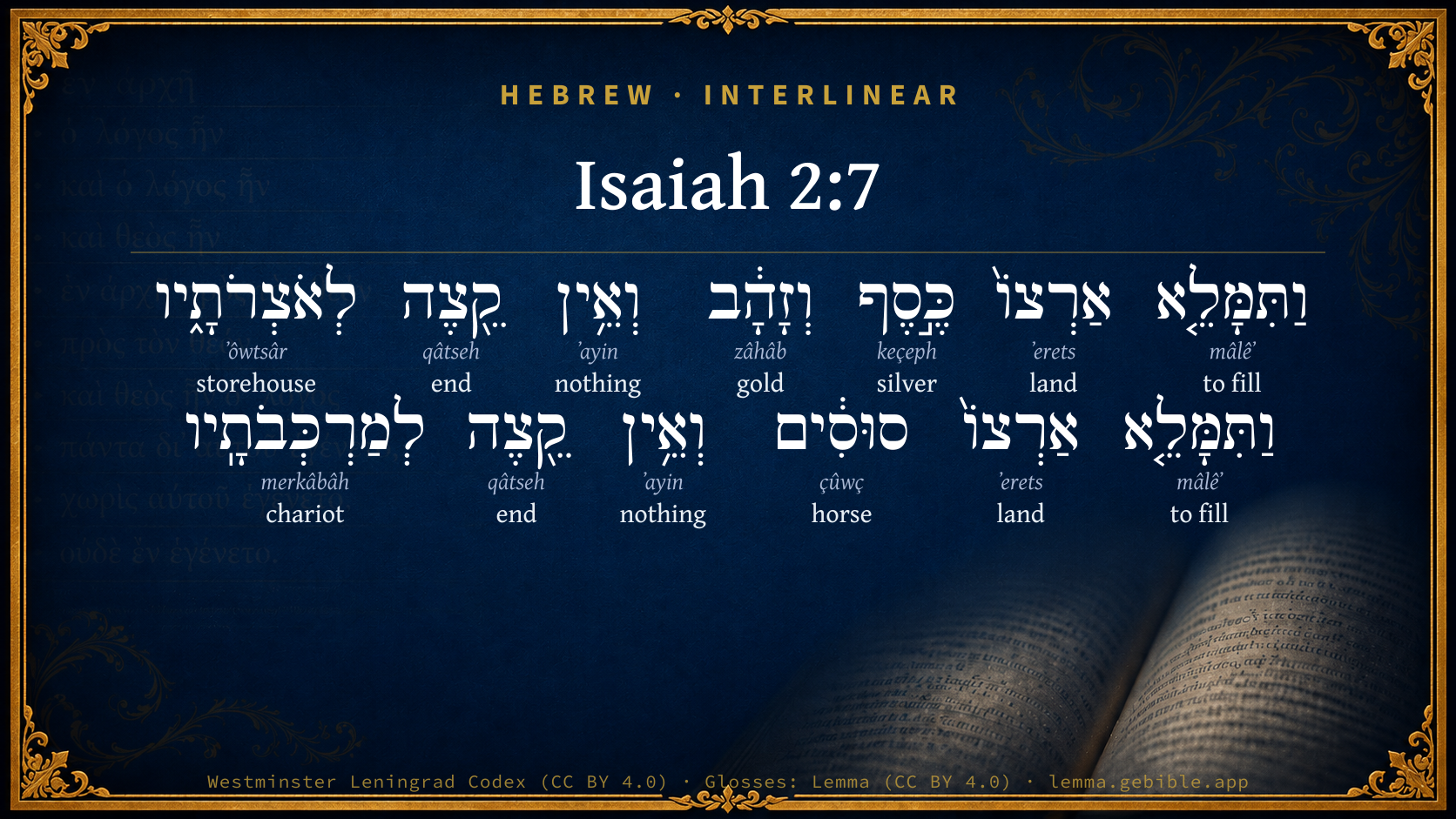
Hebrew (Westminster Leningrad Codex) Isaiah 2:7 appears in the Hebrew Old Testament. The text above is from the Westminster Leningrad Codex. Each word links to its Strong’s number, a concise gloss, and parsing drawn from the Open Scriptures Hebrew Bible morphology. Click any word for its full Brown-Driver-Briggs (BDB) entry.
Download image
Cite this verse

Isaiah 2:7 (World English Bible). Public Domain. Lemma interlinear Bible study tool, https://lemma.gebible.app/v/isaiah/2/7.

Show BibTeX & RIS
BibTeX
RIS
English Translation
Their land is full of silver and gold, Neither is there any end of their treasures. Their land also is full of horses, Neither is there any end of their chariots.
World English Bible · Public Domain
Download a study sheet

One document with this verse’s original text, its word-by-word gloss line, the meaning frame, cross-references with their text, attributed commentary, and full source and license credits — printable, and it pastes into notes with its structure intact.

This verse Autodidact and up

Study sheet (.html) Plain text (.txt)

A passage Seminary Student

Up to 50 verses in one chapter. A passage sheet keeps up to 6 commentary sources and 12 cross-references per verse, in the order this page ranks them, and says so on the sheet whenever that leaves anything out. Ask for a single verse and you get the Autodidact verse sheet above.

Everything on this page stays free to read, with no account — the sheet is a download of what is already on screen, not access to it.

Want to remove ads? Support Godless Engineer
Compare translations 3

The same verse in 3 English versions, stacked beneath the original-language interlinear above. Click any original word for its lexicon entry.

Each is an independent rendering of the whole verse — the interlinear is not word-aligned to these translations.

Highlighted words mark where these versions differ — a whole-verse word diff, not a word-by-word alignment.

  • World English Bible Public Domain
    Their land is full of silver and gold, Neither is there any end of their treasures. Their land also is full of horses, Neither is there any end of their chariots.
  • King James Version Public Domain
    Their land also is full of silver and gold, neither is there any end of their treasures; their land is also full of horses, neither is there any end of their chariots:
  • unfoldingWord Literal Text CC BY-SA 4.0
    And his land is filled silver and gold, and there is no end to his treasures. And his land is filled horses, and there is no end to his chariots.

unfoldingWord Literal Text — © unfoldingWord, licensed CC BY-SA 4.0. Word-aligned USFM3 via Door43 (git.door43.org/unfoldingWord/en_ult).

Versions to compare (up to 4)

3 of 4 selected

Show all 18 translations

Every available English version of this verse, each an independent rendering of the whole verse.

  • World English Bible Public Domain
    Their land is full of silver and gold, Neither is there any end of their treasures. Their land also is full of horses, Neither is there any end of their chariots.
  • Berean Standard Bible Public Domain
    Their land is full of silver and gold, with no limit to their treasures; their land is full of horses, with no limit to their chariots.
  • Majority Standard Bible Public Domain
    Their land is full of silver and gold, with no limit to their treasures; their land is full of horses, with no limit to their chariots.
  • King James Version Public Domain
    Their land also is full of silver and gold, neither is there any end of their treasures; their land is also full of horses, neither is there any end of their chariots:
  • American Standard Version (1901) Public Domain
    And their land is full of silver and gold, neither is there any end of their treasures; their land also is full of horses, neither is there any end of their chariots.
  • Revised Version (1885) Public Domain
    Their land also is full of silver and gold, neither is there any end of their treasures; their land also is full of horses, neither is there any end of their chariots.
  • Geneva Bible (1599) Public Domain
    Their land also was full of siluer and golde, and there was none ende of their treasures: and their land was full of horses, and their charets were infinite.
  • Douay-Rheims (1899) Public Domain
    Their land is filled with silver and gold: and there is no end of their treasures.
  • Young's Literal Translation Public Domain
    And its land is full of silver and gold, And there is no end to its treasures, And its land is full of horses, And there is no end to its chariots,
  • Literal Standard Version CC BY-SA 4.0
    And its land is full of silver and gold, || And there is no end to its treasures, || And its land is full of horses, || And there is no end to its chariots,
  • Unlocked Literal Bible CC BY-SA 4.0
    Their land is full of silver and gold, and is there no limit to their wealth; their land also is full of horses, nor is there limit to their chariots.
  • unfoldingWord Literal Text CC BY-SA 4.0
    And his land is filled silver and gold, and there is no end to his treasures. And his land is filled horses, and there is no end to his chariots.
  • Darby Bible Public Domain
    And their land is full of silver and gold, and there is no end of their treasures: their land also is full of horses, and there is no end of their chariots.
  • World Messianic Bible Public Domain
    Their land is full of silver and gold, neither is there any end of their treasures. Their land also is full of horses, neither is there any end of their chariots.
  • Webster's Bible Public Domain
    Their land also is full of silver and gold, neither is there any end of their treasures; their land is also full of horses, neither is there any end of their chariots:
  • Free Bible Version CC BY-SA 4.0
    Their country is full of silver and gold, and endless wealth. Their land is full of horses; and they have an endless amount of chariots.
  • Bible in Basic English Public Domain
    And their land is full of silver and gold, and there is no end to their stores; their land is full of horses, and there is no end to their carriages.
  • JPS Tanakh (1917) Public Domain
    Their land also is full of silver and gold, neither is there any end of their treasures; their land also is full of horses, neither is there any end of their chariots.

Literal Standard Version (2020), Covenant Press — licensed CC BY-SA 4.0. Text via the HelloAO Bible API (eBible.org). Unlocked Literal Bible (unfoldingWord) — licensed CC BY-SA 4.0. Text via the HelloAO Bible API (eBible.org). unfoldingWord Literal Text — © unfoldingWord, licensed CC BY-SA 4.0. Word-aligned USFM3 via Door43 (git.door43.org/unfoldingWord/en_ult). Free Bible Version, Dr. Jonathan Gallagher — licensed CC BY-SA 4.0. Text via the HelloAO Bible API (eBible.org).

Word by word

More ways to search: Search by grammar → Find every occurrence → Compare this word →

Practice this passage: Drill this verse → Learn its vocabulary →

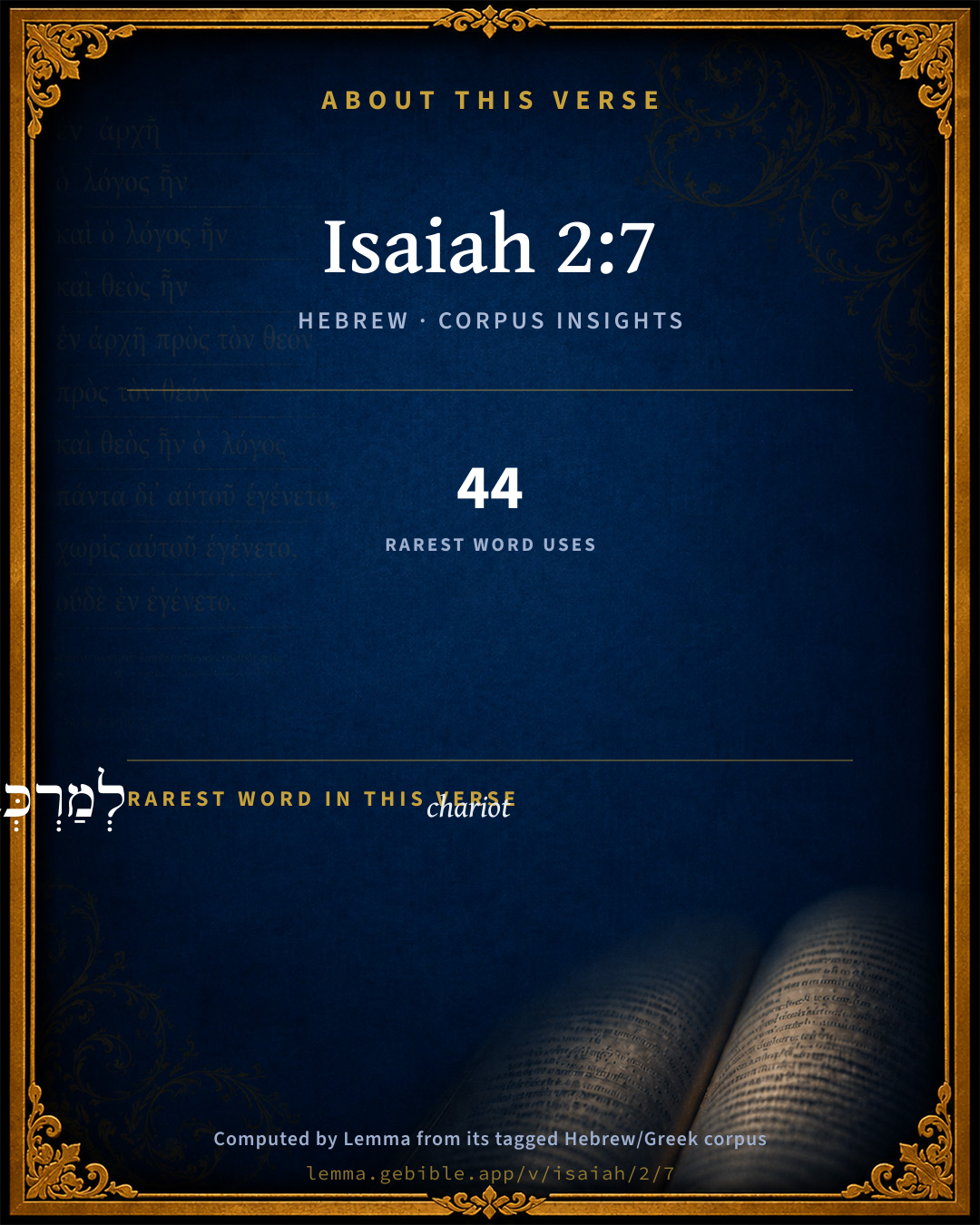
לְמַרְכְּבֹתָֽיו
merkâbâh
H4818
“to/for · chariots · his”
Preposition + Noun, Common, Feminine, Plural, Construct + Suffix, Personal, 3rd Person, Masculine, Singular
Part of Speech
Preposition + Noun
Type
Common
Gender
Feminine
Number
Plural
State
Construct
Full BDB Definition

Origin: from H4817

TWOT: 2163f

chariot
  1. וַתִּמָּלֵ֤א mâlêʼ H4390 “and · to fill” Conjunction + Verb, Niphal, Sequential Imperfect, 3rd Person, Feminine, Singular
  2. אַרְצוֹ֙ ʼerets H776 “land · his” Noun, Common, Both, Singular, Construct + Suffix, Personal, 3rd Person, Masculine, Singular
  3. כֶּ֣סֶף keçeph H3701 “silver” Noun, Common, Masculine, Singular, Absolute
  4. וְזָהָ֔ב zâhâb H2091 “and · gold” Conjunction + Noun, Common, Masculine, Singular, Absolute
  5. וְאֵ֥ין ʼayin H369 “and · nothing” Conjunction + Particle, Negative
  6. קֵ֖צֶה qâtseh H7097 “end” Noun, Common, Both, Singular, Absolute
  7. לְאֹצְרֹתָ֑יו ʼôwtsâr H214 “to/for · storehouses · his” Preposition + Noun, Common, Masculine, Plural, Construct + Suffix, Personal, 3rd Person, Masculine, Singular
  8. וַתִּמָּלֵ֤א mâlêʼ H4390 “and · to fill” Conjunction + Verb, Niphal, Sequential Imperfect, 3rd Person, Feminine, Singular
  9. אַרְצוֹ֙ ʼerets H776 “land · his” Noun, Common, Both, Singular, Construct + Suffix, Personal, 3rd Person, Masculine, Singular
  10. סוּסִ֔ים çûwç H5483 “horses” Noun, Common, Masculine, Plural, Absolute
  11. וְאֵ֥ין ʼayin H369 “and · nothing” Conjunction + Particle, Negative
  12. קֵ֖צֶה qâtseh H7097 “end” Noun, Common, Both, Singular, Absolute

About this verse

These counts appear in no published source. They are computed here, from the morphology-tagged text and Lemma’s own curated glosses. What Lemma adds →

13
words
9
distinct lemmas
Prophets
section

Shared distinctive vocabulary

לְמַרְכְּבֹתָֽיו chariot H4818 occurs in 41 verses of the Hebrew Bible. Also found in:

Grammatical profile

  • 2 verbs
  • 9 nouns
  • 2 particles

Verb forms

  • וַתִּמָּלֵ֤א Niphal · Sequential Imperfect
  • וַתִּמָּלֵ֤א Niphal · Sequential Imperfect

Repetition

Words recur within this verse — often emphatic in Hebrew:

  • וַתִּמָּלֵ֤א to fill H4390 ×2
  • אַרְצוֹ֙ land H776 ×2
  • וְאֵ֥ין nothing H369 ×2
  • קֵ֖צֶה end H7097 ×2

Hebrew & Septuagint length

In English translation the verse runs 31 words from the Hebrew and 31 from the Septuagint (LXX English) — the same length.

A rough comparison of the two English renderings, which tokenize alike — not a word-level alignment.

Word counts can differ between the Hebrew and the Greek without any difference in meaning — e.g. the Hebrew direct-object marker אֵת has no separate Greek word, and Greek often adds the article ὁ.

Cross-references

13

Topical passages linked to Isaiah 2:7 in the Treasury of Scripture Knowledge — connected by theme and wording, ordered by reader-vote popularity; previews shown in the World English Bible.

  • Deuteronomy 17:16–17 Only he shall not multiply horses to himself, nor cause the people to return to Egypt, to the end that he may multiply horses; because Yahweh has said to you, You shall henceforth return no more that way.
  • Psalms 20:7 Some trust in chariots, and some in horses, But we trust the name of Yahweh our God.
  • Isaiah 30:16 but you said, No, for we will flee on horses; therefore shall you flee: and, We will ride on the swift; therefore shall those who pursue you be swift.
  • Isaiah 31:1 Woe to those who go down to Egypt for help, and rely on horses, and trust in chariots because they are many, and in horsemen because they are very strong, but they don't look to the Holy One of Israel, neither seek Yahweh!
  • Micah 5:10 "It will happen in that day," says Yahweh, "That I will cut off your horses out of the midst of you, And will destroy your chariots.
  • 1 Kings 4:26 Solomon had forty thousand stalls of horses for his chariots, and twelve thousand horsemen.
  • 1 Kings 10:21–27 All king Solomon's drinking vessels were of gold, and all the vessels of the house of the forest of Lebanon were of pure gold: none were of silver; it was nothing accounted of in the days of Solomon.
  • 2 Chronicles 9:20–25 All king Solomon's drinking vessels were of gold, and all the vessels of the house of the forest of Lebanon were of pure gold: silver was nothing accounted of in the days of Solomon.
  • Jeremiah 5:27–28 As a cage is full of birds, so are their houses full of deceit: therefore they are become great, and grew rich.
  • Hosea 14:3 Assyria can't save us. We won't ride on horses; Neither will we say any more to the work of our hands, 'Our gods!' For in you the fatherless finds mercy."
  • James 5:1–3 Come now, you rich, weep and howl for your miseries that are coming on you.
  • Revelation 18:3 For all the nations have drunk of the wine of the wrath of her sexual immorality, the kings of the earth committed sexual immorality with her, and the merchants of the earth grew rich from the abundance of her luxury."
  • Revelation 18:11–17 The merchants of the earth weep and mourn over her, for no one buys their merchandise any more;

Cross-references courtesy of OpenBible.info (CC BY 4.0).

Hebrew and Greek witnesses Masoretic Hebrew ↔ Greek Septuagint

The same verse in the two great witnesses to the Old Testament, shown verse-for-verse.

These are two independent witnesses, not word-aligned to each other, and the Septuagint is shown in lemma (dictionary) form.

Hebrew Isaiah 2:7 Masoretic · Westminster Leningrad Codex

וַתִּמָּלֵ֤א אַרְצוֹ֙ כֶּ֣סֶף וְזָהָ֔ב וְאֵ֥ין קֵ֖צֶה לְאֹצְרֹתָ֑יו וַתִּמָּלֵ֤א אַרְצוֹ֙ סוּסִ֔ים וְאֵ֥ין קֵ֖צֶה לְמַרְכְּבֹתָֽיו

Their land is full of silver and gold, Neither is there any end of their treasures. Their land also is full of horses, Neither is there any end of their chariots.

World English Bible · Public Domain

Greek LXX Isaiah 2:7 Septuagint · lemma form

ἐνπίμπλημι γάρ ὁ χώρα αὐτός ἀργύριον καί χρυσίον καί οὐ εἰμί ἀριθμός ὁ θησαυρός αὐτός καί ἐνπίμπλημι ὁ γῆ ἵππος καί οὐ εἰμί ἀριθμός ὁ ἅρμα αὐτός

For their land is filled with silver and gold, and there was no number of their treasures; their land also is filled with horses, and there was no number of chariots.

LXX2012 (modern English Septuagint) · Public Domain

Hebrew: Westminster Leningrad Codex (CC BY 4.0). Greek: Septuagint (public domain); English from LXX2012 (modern English Septuagint) (Public Domain). How the Septuagint differs from the Hebrew →

Targum (Aramaic paraphrase)

1

The Targum is the ancient Jewish Aramaic paraphrase of the Hebrew Scriptures — an interpretive translation, not the Hebrew text itself. Onkelos (literal) and Pseudo-Jonathan (expansive) render the Torah, and Jonathan the Prophets. Coverage is partial: where no permissively-licensed English translation exists for a verse, only the Aramaic is shown. This is verse-level text, not a word-by-word alignment to the Hebrew.

  1. Targum Jonathan Prophets (Joshua–Malachi)
    וְאִתְמְלִיאַת אַרְעֲהוֹן כְּסַף וּדְהַב וְלֵית סוֹף לְגִנְזוֹהִי וְאִתְמְלִיאַת אַרְעֲהוֹן סוּסְוָן וְלֵית סוֹף לִרְתִיכוֹהִי:

    Also their land is full of silver and gold, and there is no end of their treasures; their land is also full of horses, and there is no end of their chariots.

    Targum Jonathan — Aramaic: “Mikraot Gedolot” (public domain). English: “Sefaria Community Translation” (CC0 1.0 (public-domain dedication)); “London "Chaldee Paraphrase," 1871” (public domain). Text via Sefaria.

Commentary

Notes on Isaiah 2:7 from classic Christian and Jewish commentators (each source and its license shown beneath its notes). The classic Christian expositions comment on the surrounding passage and are grouped to its opening verse, so a note may address several verses; the Jewish commentaries on the Tanakh (Rashi and others) are per-verse, so they appear only where the commentator wrote on this verse.

Lemma curates 59 commentaries, every one of them public domain or Creative Commons licensed, each selected and text-cleaned for this edition rather than reprinted as found. About our sources →

The Cambridge Bible for Schools and Colleges

gen. ed. J. J. S. Perowne

7. Their land also is full …] Lit. and its (the people’s) land has become filled (and so throughout Isa_2:7-8). silver and gold … treasures] The wealth of the country had increased enormously through commercial activity and the control of the Red Sea traffic (2Ki_14:22) in the reigns of Uzziah and Jotham. These “treasures” were partly expended in procuring “horses and chariots,” as in the time of Solomon. The prophets condemn all such accumulation of earthly resources, as tending to lead the nation away from reliance on the help of Jehovah. Cf. Deu_17:16-17; Deu_20:1; Isa_31:1; Mic_5:10; Zec_9:10.

The Cambridge Bible for Schools and Colleges (gen. ed. J. J. S. Perowne; Cambridge University Press, 1878–1918) — public domain. Text from a community e-Sword module.

Trapp's Complete Commentary

John Trapp

Isa 2:7 Their land also is full of silver and gold, neither [is there any] end of their treasures; their land is also full of horses, neither [is there any] end of their chariots:

Ver. 7. Their land also is full of silver.] They had forsaken the fountain of living waters, and now they hew them out broken cisterns; they have made their gold their god, which is a more subtle kind of idolatry, {Col 3:5} dum sibi ipsis numen quoddam larariura constant. But though their houses were full of silver and gold, their hearts were not; for they were vexed with the curse of dissatisfaction. {Ecc 5:10}

“ Auri nempe fames parto fit maior ab auro. ” - Prudentius.

Neither is there any end of their treasures.] Josephus saith that there was a world of money found at Jerusalem when taken by the Romans; so there was at Constantinople when taken by the Turks; and therefore taken, because the inhabitants could not find in their hearts to part with it, though for their own defence.

Their land also is full of horses.] And their hearts of creature confidence, - trust in the arm of flesh; as Josephus testifieth that the Jews were this way very faulty about the time of the last devastation.

John Trapp, A Commentary or Exposition upon All the Books of the Old and New Testament (1647–1656) — public domain. Text from a community e-Sword module.

The Biblical Illustrator

Joseph S. Exell

Isa_2:7

Their land also is full of silver and gold

An up-to-date inventory

There is something startlingly modern about this chapter; if you sit down to analyse it, you feel that there is something startlingly up-to-date about the Inventory.

What did this proud people make their boast about?

1. The abundance of their treasure; their land also is full of silver and gold, neither is there any end of their treasures.

2. Their shipping and their active commerce all the ships of Tarshish.

3. Their military equipment; their land is also full of horses, neither is there any end of their chariots.

4. Their natural defences; all the high mountains, all the hills that are lifted up.

5. Their artificial defences; every high tower, every fenced wall.

6. The wealth of their timber; all the cedars of Lebanon, all the oaks of Bashan.

7. They boasted even of the treasures of their art; all pleasant pictures. (J. H.Jowett, M. A.)

Gold may shut out the vision of God

An old proverb runs, The sixpence in the mans eye prevented him from seeing the sovereign at the end of his nose. And some men allow the passion money to become so all-absorbing that the coin fills all their vision and shuts out God and His heaven. (W. C. Bonner.)

The Biblical Illustrator, edited by Joseph S. Exell (c. 1880s–1900s) — public domain. Text from a community e-Sword module.

Joseph Benson's Commentary

Isa 2:7. Their land also is full of silver, &c. — They have heaped up riches immoderately, and still are greedily pursuing after more. Lowth thinks the prophet is especially reproving those who, in the midst of the public calamities, made no conscience of enriching themselves by oppression and injustice. Their land also is full of horses — Which even their kings were forbidden to multiply, (as they were also forbidden to multiply gold and silver,) and much more the people. In the original this verse consists of a stanza of four lines, in which the construction of the two members is alternate, the first line answering to the third, and the second to the fourth.

Joseph Benson's Commentary on the Old and New Testaments (1811–1818) — public domain. Text from a community e-Sword module.

Keil & Delitzsch

C. F. Keil & F. Delitzsch

In Isa 2:7, Isa 2:8 he describes still further how the land of the people of Jehovah, in consequence of all this (on the future consec. see Ges. 129, 2, a), was crammed full of objects of luxury, of self-confidence, of estrangement from God: "And their land is filled with silver and gold, and there is no end of their treasures; and their land is filled with horses, and there is no end of their chariots. And their land is filled with - idols; the work of their own hands they worship, that which their own fingers have made." The glory of Solomon, which revived under Uzziah's fifty-two years' reign, and was sustained through Jotham's reign of sixteen years, carried with it the curse of the law; for the law of the king, in Deu 17:14., prohibited the multiplying of horses, and also the accumulation of gold and silver. Standing armies, and stores of national treasures, like everything else which ministers to carnal self-reliance, were opposed to the spirit of the theocracy. Nevertheless Judaea was immeasurably full of such seductions to apostasy; and not of those alone, but also of things which plainly revealed it, viz., of elilim, idols (the same word is used in Lev 19:4; Lev 26:1, from elil, vain or worthless; it is therefore equivalent to "not-gods"). They worshipped the work of "their own" hands, what "their own" fingers had made: two distributive singulars, as in Isa 5:23, the hands and fingers of every individual (vid., Mic 5:12-13, where the idols are classified). The condition of the land, therefore, was not only opposed to the law of the king, but at variance with the decalogue also. The existing glory was the most offensive caricature of the glory promised to the nation; for the people, whose God was one day to become the desire and salvation of all nations, had exchanged Him for the idols of the nations, and was vying with them in the appropriation of heathen religion and customs.

Keil & Delitzsch — Biblical Commentary on the Old Testament (1861–1891) — public domain (CC PDM 1.0). Text via the HelloAO Bible API. (Old Testament only.)

Tyndale Open Study Notes

Tyndale Open Resources

2:7-8 Isaiah pointed out all the things that people substitute for the true God: material achievements and securities (silver . . . treasures), military strength (warhorses . . . chariots), and objects of affection (idols). Such wealth and military strength characterized the reign of King Uzziah (2 Chr 26:6-21). Elsewhere, Isaiah pointed out the sheer folly of worshiping anything that is made with one’s own hands (see Isa 44:9-20; 45:16).

Tyndale Open Study Notes — © Tyndale Open Resources, licensed CC BY-SA 4.0. Text via the HelloAO Bible API.

Geneva Bible (1599)

Geneva Bible translators

The Prophet first condemned their superstition and idolatry: next their covetousness, and thirdly their vain trust in worldly means.

Geneva Bible (1599) marginal notes — public domain. Text via Bolls.life.

Jamieson, Fausset & Brown

Robert Jamieson, A. R. Fausset & David Brown

gold--forbidden to be heaped together (Deu 17:17). Solomon disobeyed (Kg1 10:21, Kg1 10:27).

horses . . . chariots--forbidden (Deu 17:16). But Solomon disobeyed (Kg1 20:26). Horses could be used effectively for war in the plains of Egypt; not so in the hilly Judea. God designed there should be as wide as possible a distinction between Israel and the Egyptians. He would have His people wholly dependent on Him, rather than on the ordinary means of warfare (Psa 20:7). Also horses were connected with idolatry (Kg2 23:11); hence His objection: so the transition to "idols" (Isa 2:8) is natural.

Jamieson, Fausset & Brown — Commentary Critical and Explanatory on the Whole Bible (1871) — public domain (CC PDM 1.0). Text via the HelloAO Bible API.

Adam Clarke's Commentary

Verse 7. Their land is also full of horses - "And his land is filled with horses"] This was in direct contradiction to God's command in the law: "But he (the king) shall not multiply horses to himself; nor cause the people to return to Egypt, to the end that he should multiply horses; neither shall he greatly multiply to himself silver and gold," De 17:16-17. Uzziah seems to have followed the example of Solomon, see 1Kg 10:26-29, who first transgressed in these particulars; he recovered the port of Elath on the Red Sea, and with it that commerce which in Solomon's days had "made silver and gold as plenteous at Jerusalem as stones," 2Ch 1:15. He had an army of 307,500 men, in which, as we may infer from the testimony of Isaiah, the chariots and horse made a considerable part. "The law above mentioned was to be a standing trial of prince and people, whether they had trust and confidence in God their deliverer." See Bp. Sherlock's Discourses on Prophecy. Dissert. iv., where he has excellently explained the reason and effect of the law, and the influence which the observance or neglect of it had on the affairs of the Israelites.

Adam Clarke's Commentary on the Bible (1810–1826) — public domain. Text from a community e-Sword/MySword module.

Ellicott's Commentary for English Readers

(7) Their land also is full of silver and gold.—The long and prosperous reign of Uzziah, especially his trade with Ophir, had reproduced the wealth of the days of Solomon. Tribute came from the Arabians and Ammonites (2Ch_26:8). The words point to an earlier date than that at which Ahaz was left” naked and distressed” (2Ch_28:19). Even under Hezekiah, Sennacherib records in the inscription on the Taylor cylinder that the tribute paid by that king amounted to 30 talents of gold, and 800 talents of silver, besides wrought metal; and a like profusion of wealth, prior to Sennacherib’s invasion, is shown in the account of Hezekiah’s display of his treasures, in Isa_39:2 (Cheyne, in loc.; Records of the Past, i. 38).

Their land is also full of . . . chariots.—Here also the reign of Uzziah was like that of Solomon (1Ki_10:26-28). Chariots were used probably both for state pageants (Son_1:9; Son_3:9-10) and as part of the matériel of war (2Ch_1:14; 2Ch_9:25). Isaiah here also agrees with Micah (Mic_1:13) in looking on this as “the beginning of sin” (see Deu_17:16; 1Sa_8:11). For him, as for Zechariah (Zec_9:9), the true King was to come, not with chariots and horses, but riding, as the judges of Israel had ridden (Jdg_5:10; Jdg_10:4; Jdg_12:14), on “a colt, the foal of an ass.”

A Bible Commentary for English Readers, edited by Charles John Ellicott (1878–1897) — public domain. Text from a community e-Sword module.

John Gill's Exposition

Their land also is full of silver and gold,.... Procured by pardons, indulgences, masses, praying souls out of purgatory, tithes, annates, Peter's pence, &c.

neither is there any end of their treasures; laid up in the pope's coffers, in their churches, monasteries, and convents:

their land is also full of horses, neither is there any end of their chariots; for the cardinals, archbishops, bishops, &c. to ride on and in. Horses and chariots are mentioned among the wares and merchandise of Rome, in Rev 18:13.

John Gill's Exposition of the Whole Bible (1746–1763) — public domain (CC PDM 1.0). Text via the HelloAO Bible API.

Albert Barnes' Notes on the Bible

Their land also is full of silver and gold - This “gold” was brought chiefly from Ophir. Solomon imported vast quantities of silver and gold from foreign places; 2Ch 8:18; 2Ch 9:10; 1Ch 29:4; compare Job 28:16; 1Ki 10:21, 1Ki 10:27; 2Ch 9:20. ‘And the king made silver to be in Jerusalem as stones.’ ‘It was nothing accounted of in the days of Solomon.’ From these expressions we see the force of the language of Isaiah - ‘their land is full,’ etc. This accumulation of silver and gold was expressly forbidden by the law of Moses; Deu 17:17 : ‘Neither shall he (the king of Israel) greatly multiply to himself silver and gold.’ The reason of this prohibition was, that it tended to produce luxury, effeminacy, profligacy, the neglect of religion, and vice. It is on this account that it is brought by the prophet as an “accusation” against them that their land was thus filled.

Treasures - Wealth of all kinds; but chiefly silver, gold, precious stones, garments, etc.; compare the note at Mat 6:19.

Their land also is full of horses - This was also forbidden in the law of Moses; Deu 17:16 : ‘But he shall not multiply horses to himself, nor cause the people to return to Egypt, to the end that he should multiply horses.’ This law, however, was grossly violated by Solomon; 1Ki 10:26 : ‘And Solomon gathered together chariots and horsemen; he had a thousand and four hundred chariots, and twelve thousand horsemen.’ It is not quite clear “why” the use of horses was forbidden to the Jews. Perhaps several reasons might have concurred:

(1) Egypt was distinguished for producing fine horses, and the Egyptians used them much in war Deu 17:16; and one design of God was to make the Jews distinguished in all respects from the Egyptians, and to keep them from commerce with them.

(2) Horses were chiefly used “in war,” and the tendency of keeping them would be to produce the love of war and conquest.

(3) The tendency of keeping them would be to lead them to put “trust” in them rather than in God for protection. This is hinted at in Psa 20:7 : ‘Some trust in chariots, and some in horses; but we will remember the name of Yahweh our God.’

(4) “Horses” were regarded as consecrated “to the sun;” see “Univ. Hist. Anc. P.,” vol. x., 177. Ed. 1780. They were sacrificed in various nations to the sun, their swiftness being supposed to render them an appropriate offering to that luminary. There is no evidence, however, that they were used for sacrifice among the Hebrews. They were probably employed to draw the chariots in the solemn processions in the worship of the sun. The ancient Persians, who were sun-worshippers, dedicated white horses and chariots to the sun, and it is supposed that other nations derived the practice from them. The sun was supposed to be drawn daily in a chariot by four wondrous coursers, and the fate of Phaeton, who undertook to guide that chariot and to control those coursers, is known to all. The use of horses, therefore, among the Hebrews in the time of Ahaz, when Isaiah lived, was connected with idolatry, and it was mainly on this account that the prophet rebuked their use with so much severity; 2Ki 23:11. It may be added, that in a country like Judea, abounding in hills and mountains, cavalry could not be well employed even in war. On the plains of Egypt it could be employed to advantage; or in predatory excursions, as among the Arabs, horses could be used with great success and effect, and Egypt and Arabia therefore abounded with them. Indeed, these may be regarded as the native countries of the horse. As it was the design of God to separate, as much as possible, the Jews from the surrounding nations, the use of horses was forbidden.

Chariots - “Chariots” were chiefly used in war, though they were sometimes used for pleasure. Of those intended for war there were two kinds; one for the generals and princes to ride in, the other to break the enemy’s ranks. These last were commonly armed with hooks or scythes. They were much used by the ancients; Jos 11:4; Jdg 1:19. The Philistines, in their war against Saul, had 30,000 chariots, and 6000 horsemen; 1Sa 13:5. There is no evidence, however, that the Jews used chariots for war. Solomon had many of them 1Ki 10:26, but they do not appear to have been used in any military expedition, but to have been kept for display and pleasure. Judea was a mountainous country, and chariots would have been of little or no use in war.

Albert Barnes' Notes on the Bible (1834–1885) — public domain. Text from a community e-Sword/MySword module.

Matthew Poole's English Annotations

Neither is there any end of their treasures; they have heaped up riches immoderately, (which was forbidden even to their king, Deu 17:17) and by wicked practices; they are never satisfied, but still greedily pursuing after more and more wealth, making this their chief business and joy. Their land also is full of horses; which even their king was forbidden to multiply, Deu 17:16, much more his subjects.

Matthew Poole's English Annotations on the Holy Bible (1683–1685) — public domain. Text from a community e-Sword/MySword module.

Whedon's Commentary on the Bible

Daniel D. Whedon

7. Another effect of the intercourse with foreign peoples which the prophet inveighed against, was foreign money and foreign troops.

Their land — The land of Judah, a rich agricultural land, under great cultivation, (for Uzziah loved husbandry, 2Ch_26:10,) and produced abundant commerce, and a great influx of gold and silver at this time.

Silver and gold — It was not for gold as such, but the love of it for forbidden luxury, that is lamented.

Horses… chariots — The law of Moses against the multiplication of these, (Deu_17:16,) was clearly to encourage peaceful agricultural habits among the people. “Chariots” and “horses,” however, became very common. But how about highways for chariots? At the present time no such roads exist in Palestine — nor can they be made, except at very large expense, over parts of the main bridle-path thoroughfares: neither have they ever prevailed there under Mohammedan rule. Civilization, in the Bible ages of Palestine, must have been vastly in advance of the present.

Daniel D. Whedon (gen. ed.), Commentary on the Old and New Testaments (1874–1909) — public domain. Text from a community e-Sword module.

The Pulpit Commentary

Full of silver and gold. The results of the commercial activity not evil things in themselves, but probably acquired by sharp dealing, and leading to undue softness and luxury. The Law had given a warning against "greatly multiplying silver and gold". (Deu_17:17) For the fact of the vast abundance of the precious metals in Judaea at this time, 2Ki_14:16 2Ki_20:13 2Ch_32:27; and compare Sennacherib"s inscription on the Taylor Cylinder ("Ancient Monarchies," vol. it. p. 163, 2nd edit.). Full of horses... chariots. (comp. Mic_5:10) There is no reason to believe that the Jews or Israelites ever possessed (unless it were under Solomon) any considerable cavalry or chariot force. But from the time of David horses and chariots were imported for convenience and for show by the kings, the princes, and the nobles. (see 2Sa_15:1 1Ki_4:26 1Ki_10:28, 29 22:31 Ecc_10:7) Like the silver and the gold, they were signs of luxury and ostentation.

The Pulpit Commentary (1880–1919), ed. H.D.M. Spence-Jones & Joseph S. Exell — public domain. Text from a community e-Sword module.

John Wesley's Explanatory Notes

Treasures - They have heaped up riches, and still are greedily pursuing after more.

John Wesley, Explanatory Notes Upon the Whole Bible (1754–1765) — public domain. Text via the GEBible commentary corpus.

J. A. Alexander on Isaiah

Joseph Addison Alexander

The second proof of undue intercourse with heathen nations, which the Prophet mentions, is the influx of foreign money and of foreign troops, with which he represents the land as filled. “And his land” (referring to the singular noun people in v. 6) “is filled with silver and gold, and there is no end to his treasures; and his land is filled with horses, and there is no end to his chariots.” The common interpretation makes this verse descriptive of domestic wealth and luxury. But these would hardly have been placed between the superstitions and the idols, with which Judah had been flooded from abroad. Besides, this interpretation fails to account for gold and silver being here combined with horses and chariots. Some suppose the latter to be mentioned only as articles of luxury; but as such they are never mentioned elsewhere, not even in the case of Absalom and Naaman, both of whom were military chiefs as well as nobles. Even the chariots of the peaceful Solomon were probably designed for martial show. The horses and chariots of the Old Testament are horses and chariots of war. The common riding animals were mules and asses, the latter of which, as contrasted with the horse, are emblematic of peace (Isa 9:9; Mat 21:7). But on the supposition that the verse has reference to undue dependence upon foreign powers, the money and the armies of the latter would be naturally named together. Thus understood, this verse affords no proof that the prophecy belongs to the prosperous reign of Uzziah or Jotham, since it merely represents the land as flooded with foreign gold and foreign troops, a description rather applicable to the reign of Ahaz. The form of expression, too, suggests the idea of a recent acquisition, as the strict sense of the verb is not it is full, nor even it is filled, but it was or has been filled.

Joseph Addison Alexander, The Prophecies of Isaiah (1846–1847; New York: Scribner, 1870–1878) — public domain. Text from a community e-Sword module.

unfoldingWord translationNotes

Door43 World Missions Community

General Information:

Isaiah speaks to Yahweh in the form of a poem. (See: Parallelism)

Their land is full of silver ... their land also is full of horses ... Their land also is full of idols

Isaiah speaks as if the land were a container in which someone had placed silver, horses, and idols. The word "land" is a metonym for the people themselves, and the words "is full of" is a metaphor for the people possessing these items. AT: "They possess much silver ... they also possess many horses ... They also possess many idols" (See: Metaphor and Metonymy)

the craftsmanship of their own hands, things that their own fingers have made

These two phrases mean almost the same thing and emphasize that these are not real gods. If your language has no general word for something someone has made, you can combine these two phrases into one. AT: "things that they themselves have made" (See: Parallelism)

craftsmanship of their own hands

The word "hands" is a synecdoche for the people themselves. AT: "their own craftsmanship" or "their own work" or "things they have made with their hands" (See: Synecdoche)

things that their own fingers have made

The word "fingers" is a synecdoche for the people themselves. AT: "things that they have made with their own fingers" (See: Synecdoche)

translationWords

silver

gold

horse

chariot

false god

worship

hand

unfoldingWord translationNotes — © Distant Shores Media and the Door43 World Missions Community, licensed CC BY-SA 4.0. Source: git.door43.org/Door43/en_tn.

Rashi

Rabbi Shlomo Yitzchaki (Rashi)

end Heb. קָצֶה, an expression derived from קץ.

Rashi on the Tanakh — English translations: “The Judaica Press complete Tanach with Rashi, translated by A. J. Rosenberg” (CC BY 4.0); “Pentateuch with Rashi's commentary by M. Rosenbaum and A.M. Silbermann, 1929-1934” (public domain); “The Metsudah Tanach series, Lakewood, N.J” (CC BY 4.0); and “The Book of Joshua, Metsudah Publications, 1997” (CC BY 4.0). Text via Sefaria.

Ibn Ezra

Rabbi Abraham ibn Ezra

Full of silver and gold. Silver is mentioned before gold, because it is in quantity more abundant.

קצה End. ה is paragogic, like ה in לילה night; the accent is therefore on the penultima.

In the preceding verse Israel is described as wise, in this as rich and mighty; in the same order Jeremiah enumerates these qualities (Jer. 9:23)

Ibn Ezra on the Tanakh — English translations: “Sefaria Community Translation” (CC0 1.0 (public-domain dedication)); “Yalkut, Sifsei Chachomim Chumash, Metsudah Publications, 2009” (CC BY 4.0); and “Commentary of Ibn Ezra on Isaiah - trans. by M. Friedlander, 1873” (public domain). Text via Sefaria.

Lesson kit

Teaching starters — assembled from the data on this page, not authored interpretation. Every prompt links to the verse data it draws on. Edit before teaching.

Isaiah, in the Prophets, opens this verse with 13 words (9 distinct Hebrew lemmas). Its most distinctive word is merkâbâh (“chariot”). A historical commentator’s framing appears above. Read the whole chapter for the surrounding context.

Discussion questions

  1. What does “chariot” (merkâbâh) contribute to the verse as a whole?
  2. Genesis 41:43 shares the word «chariot» with this verse. How do the two illuminate each other?
  3. “to fill” occurs 2× in this one verse. What is the effect of the repetition?
  4. The translations on this page render this verse differently — a whole-verse word diff, not a word-by-word alignment. What might account for the different wordings?
  5. The verb «וַתִּמָּלֵ֤א» is Niphal Sequential Imperfect. How does its form color the action?
  6. Reading how The Cambridge Bible for Schools and Colleges and Trapp's Complete Commentary read this verse, where do the two commentators agree and where do they part?

Things to notice

  • These translations choose different wording for 5 words in this verse.
  • “to fill” occurs 2× in this single verse.
  • 9 distinct Hebrew lemmas span 13 words in this verse.

Reading settings

Reading text

Shown beneath each verse's original-language words.

Old Testament
Old Testament edition

Read the OT as the Masoretic Hebrew (MT) or the Greek Septuagint (LXX).

English shown for the Greek Septuagint (in the Hebrew ↔ Greek comparison).

Comparing translations? Open the Compare panel on any verse page to stack up to four side by side.