
Isaiah 60:6

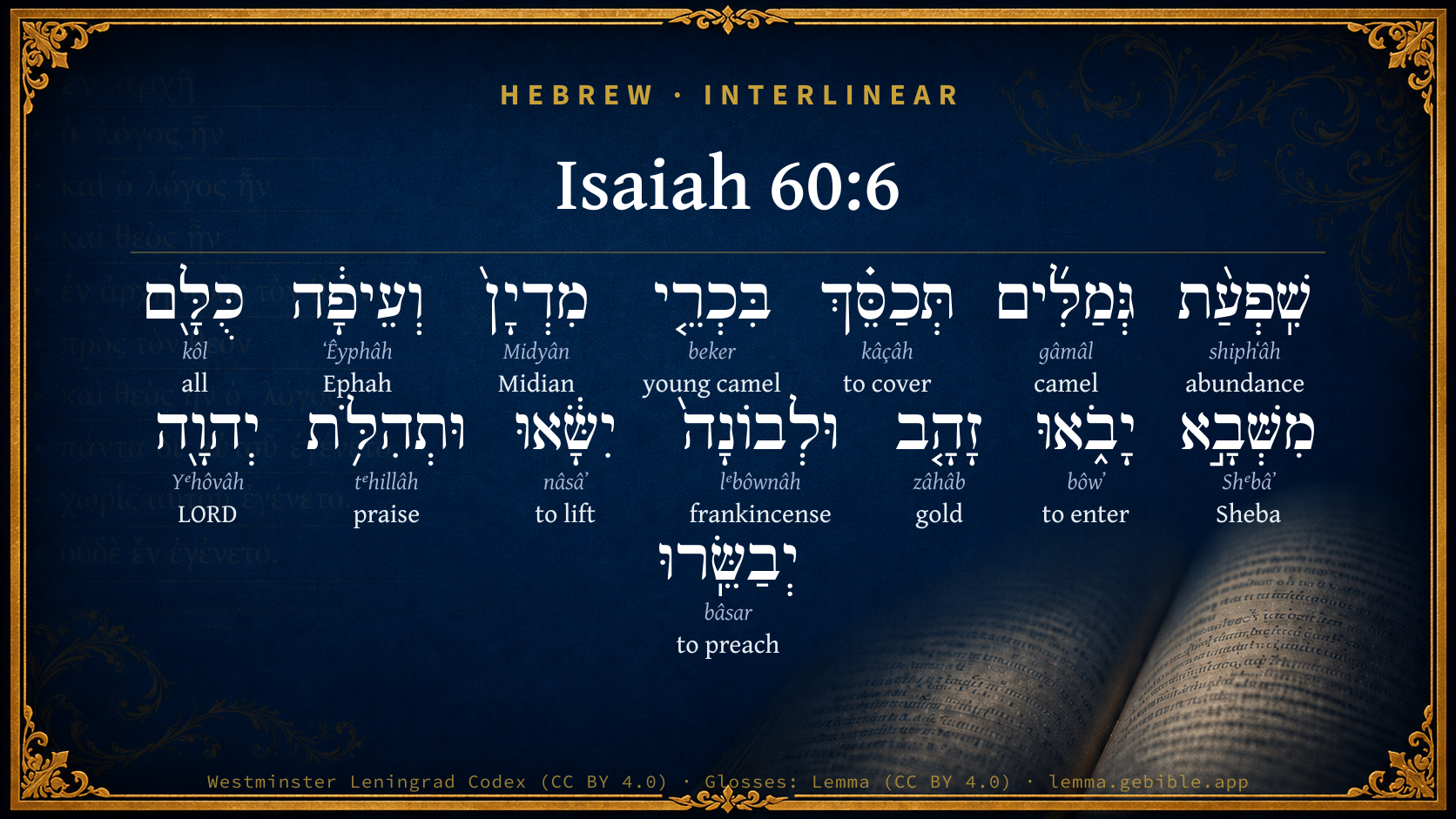
Hebrew (Westminster Leningrad Codex) Isaiah 60:6 appears in the Hebrew Old Testament. The text above is from the Westminster Leningrad Codex. Each word links to its Strong’s number, a concise gloss, and parsing drawn from the Open Scriptures Hebrew Bible morphology. Click any word for its full Brown-Driver-Briggs (BDB) entry.
Download image
Cite this verse

Isaiah 60:6 (World English Bible). Public Domain. Lemma interlinear Bible study tool, https://lemma.gebible.app/v/isaiah/60/6.

Show BibTeX & RIS
BibTeX
RIS
English Translation
The multitude of camels shall cover you, the dromedaries of Midian and Ephah; all they from Sheba shall come; they shall bring gold and frankincense, and shall proclaim the praises of Yahweh.
World English Bible · Public Domain
Highlights
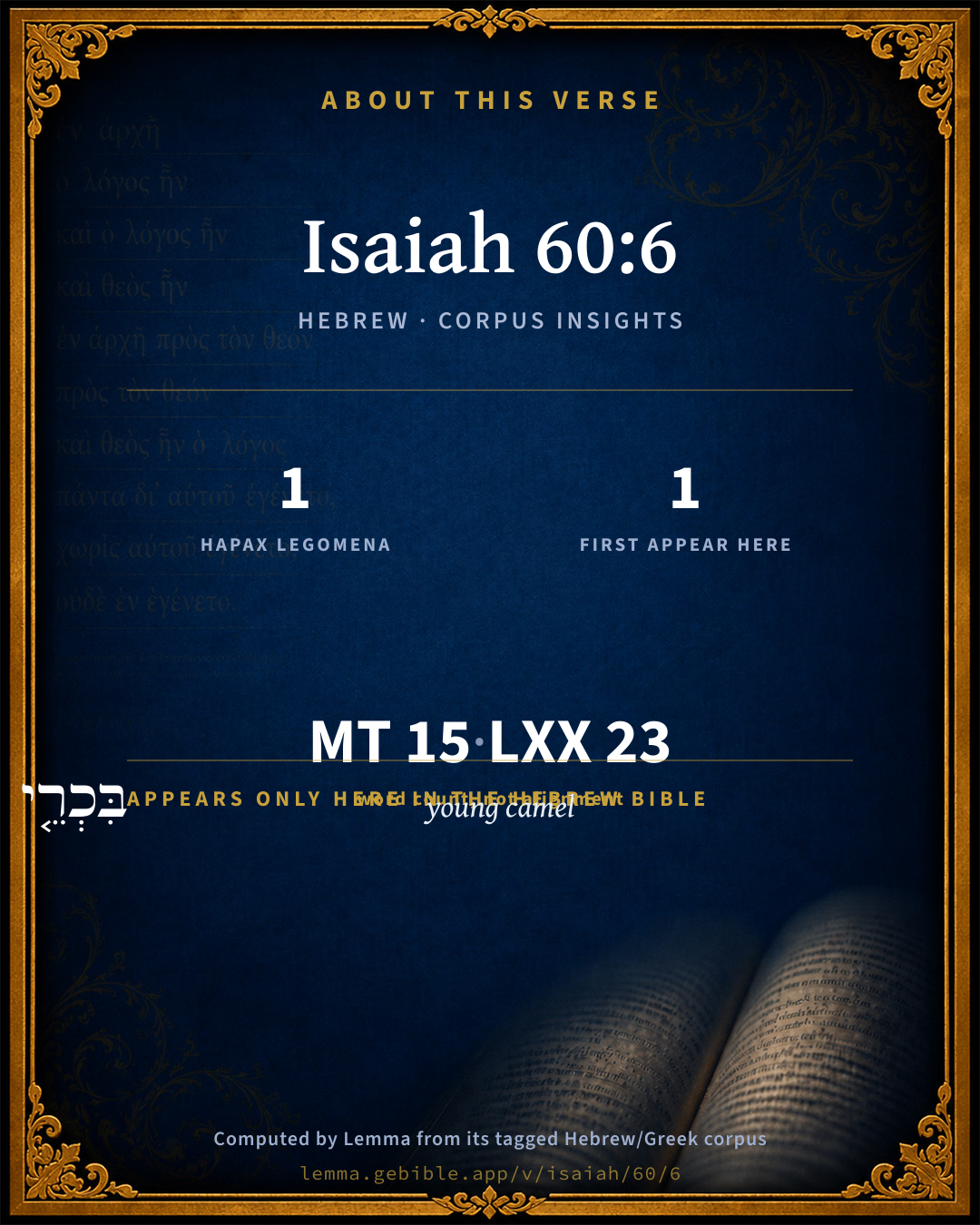
  • 1 hapax legomenon — only here in the Hebrew Bible
  • 1 first appearance in the Hebrew Bible
Full analysis ↓
Download a study sheet

One document with this verse’s original text, its word-by-word gloss line, the meaning frame, cross-references with their text, attributed commentary, and full source and license credits — printable, and it pastes into notes with its structure intact.

This verse Autodidact and up

Study sheet (.html) Plain text (.txt)

A passage Seminary Student

Up to 50 verses in one chapter. A passage sheet keeps up to 6 commentary sources and 12 cross-references per verse, in the order this page ranks them, and says so on the sheet whenever that leaves anything out. Ask for a single verse and you get the Autodidact verse sheet above.

Everything on this page stays free to read, with no account — the sheet is a download of what is already on screen, not access to it.

Want to remove ads? Support Godless Engineer
Compare translations 3

The same verse in 3 English versions, stacked beneath the original-language interlinear above. Click any original word for its lexicon entry.

Each is an independent rendering of the whole verse — the interlinear is not word-aligned to these translations.

Highlighted words mark where these versions differ — a whole-verse word diff, not a word-by-word alignment.

  • World English Bible Public Domain
    The multitude of camels shall cover you, the dromedaries of Midian and Ephah; all they from Sheba shall come; they shall bring gold and frankincense, and shall proclaim the praises of Yahweh.
  • King James Version Public Domain
    The multitude of camels shall cover thee, the dromedaries of Midian and Ephah; all they from Sheba shall come: they shall bring gold and incense; and they shall shew forth the praises of the LORD.
  • unfoldingWord Literal Text CC BY-SA 4.0
    A multitude of camels will cover you, young camels of Midian and Ephah. All of them will come from Sheba; they will carry gold and frankincense, and they will proclaim the praises of Yahweh.

unfoldingWord Literal Text — © unfoldingWord, licensed CC BY-SA 4.0. Word-aligned USFM3 via Door43 (git.door43.org/unfoldingWord/en_ult).

Versions to compare (up to 4)

3 of 4 selected

Show all 18 translations

Every available English version of this verse, each an independent rendering of the whole verse.

  • World English Bible Public Domain
    The multitude of camels shall cover you, the dromedaries of Midian and Ephah; all they from Sheba shall come; they shall bring gold and frankincense, and shall proclaim the praises of Yahweh.
  • Berean Standard Bible Public Domain
    Caravans of camels will cover your land, young camels of Midian and Ephah, and all from Sheba will come, bearing gold and frankincense and proclaiming the praises of the LORD.
  • Majority Standard Bible Public Domain
    Caravans of camels will cover your land, young camels of Midian and Ephah, and all from Sheba will come, bearing gold and frankincense and proclaiming the praises of the LORD.
  • King James Version Public Domain
    The multitude of camels shall cover thee, the dromedaries of Midian and Ephah; all they from Sheba shall come: they shall bring gold and incense; and they shall shew forth the praises of the LORD.
  • American Standard Version (1901) Public Domain
    The multitude of camels shall cover thee, the dromedaries of Midian and Ephah; all they from Sheba shall come; they shall bring gold and frankincense, and shall proclaim the praises of Jehovah.
  • Revised Version (1885) Public Domain
    The multitude of camels shall cover thee, the dromedaries of Midian and Ephah; they all shall come from Sheba: they shall bring gold and frankincense, and shall proclaim the praises of the LORD.
  • Geneva Bible (1599) Public Domain
    The multitude of camels shall couer thee: and the dromedaries of Midian and of Ephah: all they of Sheba shall come: they shall bring golde and incense, and shewe foorth the prayses of the Lord.
  • Douay-Rheims (1899) Public Domain
    The multitude of camels shall cover thee, the dromedaries of Madian and Epha: all they from Saba shall come, bringing gold and frankincense: and shewing forth praise to the Lord.
  • Young's Literal Translation Public Domain
    A company of camels covereth thee, Dromedaries of Midian and Ephah, All of them from Sheba do come, Gold and frankincense they bear, And of the praises of Jehovah they proclaim the tidings.
  • Literal Standard Version CC BY-SA 4.0
    A multitude of camels covers you, || Dromedaries of Midian and Ephah, || All of them from Sheba come, || They carry gold and frankincense, || And they proclaim the praises of YHWH.
  • Unlocked Literal Bible CC BY-SA 4.0
    Camel caravans will cover you, the dromedaries of Midian and Ephah; all of them will come from Sheba; they will bring gold and frankincense, and will sing the praises of Yahweh.
  • unfoldingWord Literal Text CC BY-SA 4.0
    A multitude of camels will cover you, young camels of Midian and Ephah. All of them will come from Sheba; they will carry gold and frankincense, and they will proclaim the praises of Yahweh.
  • Darby Bible Public Domain
    A multitude of camels shall cover thee, young camels of Midian and Ephah; all they from Sheba shall come: they shall bring gold and incense; and they shall publish the praises of Jehovah.
  • World Messianic Bible Public Domain
    A multitude of camels will cover you, the dromedaries of Midian and Efah. All from Sheba will come. They will bring gold and frankincense, and will proclaim the praises of the LORD.
  • Webster's Bible Public Domain
    The multitude of camels shall cover thee, the dromedaries of Midian and Ephah; all they from Sheba shall come: they shall bring gold and incense; and they shall show forth the praises of the LORD.
  • Free Bible Version CC BY-SA 4.0
    Long caravans of camels will cover the land, young camels of Midian and Ephah. All the people of Sheba will come to you carrying gold and frankincense, shouting praises to the Lord.
  • Bible in Basic English Public Domain
    You will be full of camel-trains, even the young camels of Midian and Ephah; all from Sheba will come, with gold and spices, giving word of the great acts of the Lord.
  • JPS Tanakh (1917) Public Domain
    The caravan of camels shall cover thee, and of the young camels of Midian and Ephah, all coming from Sheba; they shall bring gold and incense, and shall proclaim the praises of the LORD.

Literal Standard Version (2020), Covenant Press — licensed CC BY-SA 4.0. Text via the HelloAO Bible API (eBible.org). Unlocked Literal Bible (unfoldingWord) — licensed CC BY-SA 4.0. Text via the HelloAO Bible API (eBible.org). unfoldingWord Literal Text — © unfoldingWord, licensed CC BY-SA 4.0. Word-aligned USFM3 via Door43 (git.door43.org/unfoldingWord/en_ult). Free Bible Version, Dr. Jonathan Gallagher — licensed CC BY-SA 4.0. Text via the HelloAO Bible API (eBible.org).

Word by word

More ways to search: Search by grammar → Find every occurrence → Compare this word →

Practice this passage: Drill this verse → Learn its vocabulary →

בִּכְרֵ֤י
beker
H1070
“young camels of”
Noun, Common, Masculine, Plural, Construct
Part of Speech
Noun
Type
Common
Gender
Masculine
Number
Plural
State
Construct
Full BDB Definition

Origin: from H1069

TWOT: 244b

young camel, dromedary
  1. שִֽׁפְעַ֨ת shiphʻâh H8229 “abundance of” Noun, Common, Feminine, Singular, Construct
  2. גְּמַלִּ֜ים gâmâl H1581 “camels” Noun, Common, Masculine, Plural, Absolute
  3. תְּכַסֵּ֗ךְ kâçâh H3680 “to cover · you” Verb, Piel, Imperfect, 3rd Person, Feminine, Singular + Suffix, Personal, 2nd Person, Feminine, Singular
  4. מִדְיָן֙ Midyân H4080 “Midian” Noun, Proper
  5. וְעֵיפָ֔ה ʻÊyphâh H5891 “and · Ephah” Conjunction + Noun, Proper
  6. כֻּלָּ֖ם kôl H3605 “all · their” Noun, Common, Masculine, Singular, Construct + Suffix, Personal, 3rd Person, Masculine, Plural
  7. מִשְּׁבָ֣א Shᵉbâʼ H7614 “from · Sheba” Preposition + Noun, Proper
  8. יָבֹ֑אוּ bôwʼ H935 “to enter” Verb, Qal, Imperfect, 3rd Person, Masculine, Plural
  9. זָהָ֤ב zâhâb H2091 “gold” Noun, Common, Masculine, Singular, Absolute
  10. וּלְבוֹנָה֙ lᵉbôwnâh H3828 “and · frankincense” Conjunction + Noun, Common, Feminine, Singular, Absolute
  11. יִשָּׂ֔אוּ nâsâʼ H5375 “to lift” Verb, Qal, Imperfect, 3rd Person, Masculine, Plural
  12. וּתְהִלֹּ֥ת tᵉhillâh H8416 “and · praises of” Conjunction + Noun, Common, Feminine, Plural, Construct
  13. יְהוָ֖ה Yᵉhôvâh H3068 “LORD” Noun, Proper
  14. יְבַשֵּֽׂרוּ bâsar H1319 “to preach” Verb, Piel, Imperfect, 3rd Person, Masculine, Plural

About this verse

These counts appear in no published source. They are computed here, from the morphology-tagged text and Lemma’s own curated glosses. What Lemma adds →

15
words
15
distinct lemmas
Prophets
section

Notable vocabulary

1 hapax legomenon — a word that appears only here in the entire Hebrew Bible:

  • בִּכְרֵ֤י young camel H1070

First appearance in Scripture

This word makes its first canonical appearance in the Hebrew Bible here:

  • בִּכְרֵ֤י young camel H1070

Shared distinctive vocabulary

וְעֵיפָ֔ה Ephah H5891 occurs in 5 verses of the Hebrew Bible. Also found in:

Grammatical profile

  • 4 verbs
  • 11 nouns

Verb forms

  • תְּכַסֵּ֗ךְ Piel · Imperfect
  • יָבֹ֑אוּ Qal · Imperfect
  • יִשָּׂ֔אוּ Qal · Imperfect
  • יְבַשֵּֽׂרוּ Piel · Imperfect

Hebrew & Septuagint length

In English translation the verse runs 32 words from the Hebrew and 30 from the Septuagint (LXX English) — closely comparable.

A rough comparison of the two English renderings, which tokenize alike — not a word-level alignment.

Word counts can differ between the Hebrew and the Greek without any difference in meaning — e.g. the Hebrew direct-object marker אֵת has no separate Greek word, and Greek often adds the article ὁ.

In the original languages it is 15 Hebrew tokens and 23 Greek tokens — but the two are counted differently (Hebrew bundles its prefixes and suffixes into one token; the Greek is in lemma form), so that isn’t a like-for-like length.

Cross-references

22

Topical passages linked to Isaiah 60:6 in the Treasury of Scripture Knowledge — connected by theme and wording, ordered by reader-vote popularity; previews shown in the World English Bible.

  • Matthew 2:11 They came into the house and saw the young child with Mary, his mother, and they fell down and worshiped him. Opening their treasures, they offered to him gifts: gold, frankincense, and myrrh.
  • Psalms 72:10 The kings of Tarshish and of the isles will bring tribute. The kings of Sheba and Seba shall offer gifts.
  • Psalms 72:15 They shall live, and to him shall be given of the gold of Sheba. Men shall pray for him continually. They shall bless him all day long.
  • Genesis 25:3–4 Jokshan became the father of Sheba, and Dedan. The sons of Dedan were Asshurim, Letushim, and Leummim.
  • Judges 6:5 For they came up with their cattle and their tents; they came in as locusts for multitude; both they and their camels were without number: and they came into the land to destroy it.
  • 1 Peter 2:9 But you are a chosen race, a royal priesthood, a holy nation, a people for God's own possession, that you may show forth the excellencies of him who called you out of darkness into his marvelous light:
  • 1 Peter 2:5 You also, as living stones, are built up as a spiritual house, to be a holy priesthood, to offer up spiritual sacrifices, acceptable to God through Jesus Christ.
  • Revelation 5:9–10 They sang a new song, saying, "You are worthy to take the book, And to open its seals: For you were killed, And bought us for God with your blood, Out of every tribe, language, people, and nation,
  • Philippians 2:17 Yes, and if I am poured out on the sacrifice and service of your faith, I rejoice, and rejoice with you all.
  • Revelation 7:9–12 After these things I looked, and behold, a great multitude, which no man could number, out of every nation and of all tribes, peoples, and languages, standing before the throne and before the Lamb, dressed in white robes, with palm branches in their hands.
  • Genesis 10:7 The sons of Cush: Seba, Havilah, Sabtah, Raamah, and Sabteca. The sons of Raamah: Sheba and Dedan.
  • 1 Kings 10:2 She came to Jerusalem with a very great train, with camels that bore spices, and very much gold, and precious stones; and when she was come to Solomon, she talked with him of all that was in her heart.
  • Isaiah 42:10 Sing to Yahweh a new song, and his praise from the end of the earth; you who go down to the sea, and all that is therein, the isles, and the inhabitants of it.
  • Isaiah 45:14 Thus says Yahweh: "The labor of Egypt, and the merchandise of Ethiopia, and the Sabeans, men of stature, shall come over to you, and they shall be yours. They shall go after you. In chains they shall come over; and they shall fall down to you. They shall make supplication to you: 'Surely God is in you; and there is none else, there is no other god.
  • Isaiah 61:6 But you shall be named the priests of Yahweh; men shall call you the ministers of our God: you shall eat the wealth of the nations, and in their glory shall you boast yourselves.
  • Malachi 1:11 For from the rising of the sun even to the going down of the same, my name is great among the nations, and in every place incense will be offered to my name, and a pure offering: for my name is great among the nations," says Yahweh of Hosts.
  • Genesis 25:13 These are the names of the sons of Ishmael, by their names, according to the order of their birth: the firstborn of Ishmael, Nebaioth, then Kedar, Adbeel, Mibsam,
  • Judges 7:12 The Midianites and the Amalekites and all the children of the east lay along in the valley like locusts for multitude; and their camels were without number, as the sand which is on the sea-shore for multitude.
  • 2 Kings 8:9 So Hazael went to meet him, and took a present with him, even of every good thing of Damascus, forty camels' burden, and came and stood before him, and said, Your son Benhadad king of Syria has sent me to you, saying, Shall I recover of this sickness?
  • Isaiah 30:6 The burden of the animals of the South. Through the land of trouble and anguish, from whence come the lioness and the lion, the viper and fiery flying serpent, they carry their riches on the shoulders of young donkeys, and their treasures on the humps of camels, to a people that shall not profit [them].
  • Romans 15:9 and that the Gentiles might glorify God for his mercy. As it is written, "Therefore will I give praise to you among the Gentiles, And sing to your name."
  • 2 Chronicles 9:1 When the queen of Sheba heard of the fame of Solomon, she came to prove Solomon with hard questions at Jerusalem, with a very great train, and camels that bore spices, and gold in abundance, and precious stones: and when she was come to Solomon, she talked with him of all that was in her heart.

Cross-references courtesy of OpenBible.info (CC BY 4.0).

Hebrew and Greek witnesses Masoretic Hebrew ↔ Greek Septuagint

The same verse in the two great witnesses to the Old Testament, shown verse-for-verse.

These are two independent witnesses, not word-aligned to each other, and the Septuagint is shown in lemma (dictionary) form.

Hebrew Isaiah 60:6 Masoretic · Westminster Leningrad Codex

שִֽׁפְעַ֨ת גְּמַלִּ֜ים תְּכַסֵּ֗ךְ בִּכְרֵ֤י מִדְיָן֙ וְעֵיפָ֔ה כֻּלָּ֖ם מִשְּׁבָ֣א יָבֹ֑אוּ זָהָ֤ב וּלְבוֹנָה֙ יִשָּׂ֔אוּ וּתְהִלֹּ֥ת יְהוָ֖ה יְבַשֵּֽׂרוּ

The multitude of camels shall cover you, the dromedaries of Midian and Ephah; all they from Sheba shall come; they shall bring gold and frankincense, and shall proclaim the praises of Yahweh.

World English Bible · Public Domain

Greek LXX Isaiah 60:6 Septuagint · lemma form

ἀγέλη κάμηλος καί καλύπτω σύ κάμηλος μαδιαμ καί γαιφα πᾶς ἐκ σαβα ἥκω φέρω χρυσίον καί λίβανος φέρω καί ὁ σωτήριον κύριος εὐαγγελίζω

and the camels of Madiam and Gaepha shall cover you: all from Saba shall come bearing gold, and shall bring frankincense, and they shall publish the salvation of the Lord.

LXX2012 (modern English Septuagint) · Public Domain

On this verse, Albert Barnes' Notes on the Bible discusses the Septuagint’s reading. Read the note in Commentary ↓

Hebrew: Westminster Leningrad Codex (CC BY 4.0). Greek: Septuagint (public domain); English from LXX2012 (modern English Septuagint) (Public Domain). How the Septuagint differs from the Hebrew →

Targum (Aramaic paraphrase)

1

The Targum is the ancient Jewish Aramaic paraphrase of the Hebrew Scriptures — an interpretive translation, not the Hebrew text itself. Onkelos (literal) and Pseudo-Jonathan (expansive) render the Torah, and Jonathan the Prophets. Coverage is partial: where no permissively-licensed English translation exists for a verse, only the Aramaic is shown. This is verse-level text, not a word-by-word alignment to the Hebrew.

  1. Targum Jonathan Prophets (Joshua–Malachi)
    שְׁיָרֵת עַרְבָאֵי תַּחֲפֵי סַחֲרָנִיךְ הוֹגְנֵי מִדְיָן וְהוֹלַד כּוּלְהוֹן מִשְׁבָא יֵיתוּן דְהַב וּלְבוֹנָה יְהוֹן טְעִינִין וּדְאָתָן עִמְהוֹן בְּתוּשְׁבַּחְתָּא דַייָ יְהוֹן מִשְׁתְּעָן:

    A multitude of Arabians shall cover thee round about, the dromedaries of Midian and Holad, all of them from Sheba shall come: they shall be laden with gold and frankincense, and those that are coming with them, shall shew forth the praises of the Lord.

    Targum Jonathan — Aramaic: “Mikraot Gedolot” (public domain). English: “Sefaria Community Translation” (CC0 1.0 (public-domain dedication)); “London "Chaldee Paraphrase," 1871” (public domain). Text via Sefaria.

Commentary

Notes on Isaiah 60:6 from classic Christian and Jewish commentators (each source and its license shown beneath its notes). The classic Christian expositions comment on the surrounding passage and are grouped to its opening verse, so a note may address several verses; the Jewish commentaries on the Tanakh (Rashi and others) are per-verse, so they appear only where the commentator wrote on this verse.

Lemma curates 59 commentaries, every one of them public domain or Creative Commons licensed, each selected and text-cleaned for this edition rather than reprinted as found. About our sources →

Trapp's Complete Commentary

John Trapp

Isa 60:6 The multitude of camels shall cover thee, the dromedaries of Midian and Ephah; all they from Sheba shall come: they shall bring gold and incense; and they shall shew forth the praises of the LORD.

Ver. 6. The multitude of camels shall cover thee,] i.e., Of such peoples as usually ride upon camels, viz., the Arabians and the adjacent countries; these shall come flocking and flowing to the Church with their precious and pleasant riches.

The dromedaries.] A lesser and lower kind of camels, commended for their swiftness. {Jer 2:23} We call slow people dromedaries by antiphrasis, and for this, that they can travel four days together without water. Bajazet, beaten by Tamerlane, fled for his life, and might have escaped, had he not stayed to water his mare by the way, which thereupon went the more slowly, and was overtaken by the Tartars.

They shall bring gold and incense.] This the ancients interpret as those wise men from the east, {Mat 2:11} which was indeed a small essay of this prophecy. But why should the Papists call them the three kings of Cullen?

And they shall shew forth the praises of the Lord.] This is more than all their rich gifts. A thankful {a} man is worth his weight in the gold of Ophir.

{a} Gratanti animo.

John Trapp, A Commentary or Exposition upon All the Books of the Old and New Testament (1647–1656) — public domain. Text from a community e-Sword module.

The Biblical Illustrator

Joseph S. Exell

Isa_60:6-9

The multitude of camels shall cover thee

Commercial nations and nomad tribes aiding the Church

The nations engaged in commerce bring their wares to the Church; the tribe of Midian, descended from Abraham and Keturah (Gen_25:2), and of which the Ephaens formed a branch, dwelling on the east coast of the Elanitic Gulf in the town of Madyan, lying five days journey south from Aria (according to the Arabic geographers)--these come in caravans so numerous and so long that the country round Jerusalem swarms with camels.

All these, Midianites and Ephaens, come from Sheba, of which Viral says, solis est turea virga Sabaeis, and which, according to Strabo, was a populous country of ample resources, producing myrrh, incense and cinnamon. There (viz in Yemen), where spices, precious stones and gold are found, they have brought gold and incense; and these valuable gifts they now bring to Jerusalem, not as unwilling tribute, but with cheerful proclamation of the glorious doings and attributes of Jehovah, the God of Israel. As the trading nations come, so also do the nomad tribes: Kedar, i.e the Kedarenes, armed with bows (Isa_21:17), and dwelling infortified settlements (Isa_42:11) in the desert between Babylon and Syria; and Nebaioth (likewise of Ishmaelitish origin, according to Gen_25:23), a nomad tribe which, though still of no importance during the Israelitish monarchy, rose in the first century B.C. to eminence as a civilized nation, whose territory extended from the Elanitic Gulf to the country lying east of the Jordan, across Belka and as far as Hauran--for the monumental inscriptions they have left behind reach from Egypt to Babylon, though Arabia Petrcea is the chief place where they are found. The Kedarenes drive their flocks of small cattle, when collected, to Jerusalem, and the rams of the Naboteans, brought by this nation, ere placed at the service of the Church, and ascend, for good pleasure, the altar of Jehovah. (F. Delitzsch, D. D.)

Dromedaries

Properly young camels. The word does not occur in the Old Testament elsewhere; amongst the Arabs it denotes, according to some of the native lexicographers, a camel less than nine years old. (Prof. J. Skinner, D. D.)

The Biblical Illustrator, edited by Joseph S. Exell (c. 1880s–1900s) — public domain. Text from a community e-Sword module.

Joseph Benson's Commentary

Isa 60:6-7. The multitude of camels — The treasure that is brought upon camels. By these, and such like figurative expressions in several verses of this chapter, is implied the coming in of all nations to Christ, and therefore they are brought in as presenting the chief commodities of their respective countries. The dromedaries — Or, also, or, even the dromedaries; which are a sort of lesser camel, so called from their swiftness in running. For it is said by the Arabs that they will run as far in one day as their best horses will do in nine; and therefore they are chiefly used for riding: for which they are the more fit, because, as Pliny observes, they can endure the want of water four days together. Of Midian and Ephah — The Midianites and Ephahites were descended from Abraham, by Keturah, and dwelt beyond Arabia, where camels were very numerous, Jdg 7:12. All they from Sheba — A country in Arabia Felix, whose queen it was that came to visit Solomon, and her bringing gifts might be a type of this. They shall bring gold and incense — The principal commodities with which this country abounded, by which we are to understand whatever is precious. All the flocks of Kedar — Arabia Petrea, or stony Arabia, the people inhabiting which being principally shepherds. They shall come up with acceptance — They shall not now, as heretofore, be rejected. I will glorify the house of my glory — He alludes to the temple, but must be understood as intending the gospel church, built of living stones, of which the temple at Jerusalem, with all the splendour of its ornaments, and the whole multitude of its sacrifices and oblations, was but a typical or shadowy representation.

Joseph Benson's Commentary on the Old and New Testaments (1811–1818) — public domain. Text from a community e-Sword module.

The Preacher's Complete Homiletical Commentary

Joseph S. Exell (gen. ed.)

THE GLORY OF THE GOSPEL CHURCH

(Missionary Sermon.)

Isa_60:6. The multitude of camels shall cover thee, &c.

The primary reference is to the change in Jerusalem after the captivity. Instead of desolation there would be return of the life of a prosperous capital. The merchandise which had deserted it because there was no market would find its way back from all quarters. Arabia would again send its swift camels and dromedaries laden with spices and other products, &c. But glorious as this primary reference to material prosperity, it is surpassed by the secondary. Many of the terms can only be understood as contemplating the glory of the Gospel Church, which was to arise in consequence of the appearance of the Messiah and the accomplishment of His long-predicted work. View the text in this light, and observe some circumstances respecting the converts of the Gospel.

I. THEY SHALL BE DRAWN FROM AN EXTENDED AREA.

Keeping in view the wide geographical sweep of this chapter, it cannot be regarded as saying less than that the converts of the Gospel shall be derived from all the ends of the earth. Christianity is the true gospel of humanity.

1. It is needed by man universally.

2. It is adequate to man.

3. It is adapted to man.

4. It is intended for man.

II. THEY SHALL COME NUMEROUSL TO ITS ATTRACTION.

The prophet sees in vision these multitudes coming from various quarters. What is the centre to which they are attracted by an invisible but irresistible power? It is Christ (Joh_12:32). Already, to a large extent, has this declaration been fulfilled. What multitudes have come to Him during many ages! In connection with the modern missionary enterprise, there is no quarter of the world from which representatives are not, in growing numbers, coming to the cross.

III. THEY SHALL BRING THEIR OF FERINGS TO His FEET.

They receive, indeed, a free salvation. But it is not intended to minister to their selfishness. It aims to destroy the old selfishness by the excitement of gratitude and love. Love wishes to requite the benefactor. Moreover, the experience of Christ’s salvation, contact with His love, begets a corresponding benevolence, which looks forth to the needs of others. “They shall bring gold and incense.” Each country and each man brings his own proper production and possession, and lays it at the feet of Him who emptied Himself of His riches for us. In the light of His redeeming love let each ask, “How much owest thou unto my Lord?”

IV. THEY SHALL CONTRIBUTE TO THE CELEBRATION OF HIS PRAISE.

Is not praise the expression of joyfulness? Is not joyfulness the experience of the Church when most fully consecrated to Christ? They shall show it—

1. By their songs. The first love of the Church expressed itself in songs of praise. So did the Reformation. So does every revival. Missionary converts speedily develop a love of sacred Song of Solomon 2. By their lives. The changed life of every convert that walks consistently with his new profession is a perpetual showing forth of God’s praise. The worldling, the impure, the indifferent, the idolater changed.

3. By their testimony. In their turn testify for God and the Gospel. From personal experience speak confidently. Every separate convert a fresh seed of salvation.

By coming to Christ, consecration to Christ, living to His praise, will this be fulfilled.—J. Rawlinson.

The Preacher's Complete Homiletical Commentary (gen. ed. Joseph S. Exell; Funk & Wagnalls, c. 1892) — public domain (pre-1929). A full-Bible homiletical/sermon-outline anthology covering 65 of 66 books (2 John is absent from the source module). Text from a community e-Sword module.

Tyndale Open Study Notes

Tyndale Open Resources

60:6 Midian and Ephah were Midianite tribes located southeast of Israel. • Sheba was a region in southern Arabia (see 1 Kgs 10:1-2) famed for frankincense (Jer 6:20). • These were real nations—the restoration would be a historical reality, not just an idealistic vision. Many nations would submit themselves to and worship the Lord.

Tyndale Open Study Notes — © Tyndale Open Resources, licensed CC BY-SA 4.0. Text via the HelloAO Bible API.

Geneva Bible (1599)

Geneva Bible translators

Meaning, that everyone shall honor the Lord with what wherewith he is able: signifying, that it is no true serving of God, except we offer ourselves to serve his glory, and all that we have.

Geneva Bible (1599) marginal notes — public domain. Text via Bolls.life.

Jamieson, Fausset & Brown

Robert Jamieson, A. R. Fausset & David Brown

camels--laden with merchandise; the camel is "the ship of the desert" (compare Isa 30:6).

cover thee--so many of them shall there be.

dromedaries--They have one hunch on the back, whereas the camel has two: distinguished for swiftness (Jer 2:23).

Midian--east of the Elanitic branch of the Red Sea, and stretching northward along Mount Seir. Associated with the Ishmaelites in traffic (Gen 37:25, Gen 37:28).

Ephah--part of Midian, east of the Dead Sea. It abounded in camels (Jdg 6:5).

Sheba--in Arabia-Felix, famed for frankincense and gold (Psa 72:15; Jer 6:20), which they traded in (Isa 45:14; Job 6:19; Eze 27:22).

Jamieson, Fausset & Brown — Commentary Critical and Explanatory on the Whole Bible (1871) — public domain (CC PDM 1.0). Text via the HelloAO Bible API.

Adam Clarke's Commentary

Verse 6. The praises of the Lord - "And the praise of JEHOVAH."] Thirty-three MSS. and three editions have ותהלת uthehillath, in the singular number; and so read the ancient versions, and one of my own MSS.

Adam Clarke's Commentary on the Bible (1810–1826) — public domain. Text from a community e-Sword/MySword module.

Ellicott's Commentary for English Readers

(6) The multitude of camels . . .—The verse paints the commerce of the East, as Isa_60:5 had described that of the West. For the camels and riches of Midian, see Jdg_6:5; Jdg_8:26. “Ephah” appears in Gen_25:4 among the sons of Midian. “Sheba” keeps up its traditional fame for gold and incense (Psa_72:10; Strabo xvi. 4, 19).

A Bible Commentary for English Readers, edited by Charles John Ellicott (1878–1897) — public domain. Text from a community e-Sword module.

The Cambridge Bible for Schools and Colleges

gen. ed. J. J. S. Perowne

6. A multitude of camels] Cf. Eze_26:10; Job_22:11. The word for “multitude” is used of Jehu’s small escort in 2Ki_9:17. Perhaps “train of camels.”

dromedaries] properly “young camels.” The word does not occur in the O.T. elsewhere; amongst the Arabs it denotes, according to some of the native lexicographers, a camel less than nine years old (Lane’s Lexicon).

Ephah] a Midianite tribe (Gen_25:4). The Midianites are often mentioned in the O.T., although nearly always (except Hab_3:7) in connexion with the early history. In Gen_37:28; Gen_37:36 they appear as traders between the desert and Egypt (in another source—Gen_37:25; Gen_37:28—they are called Ishmaelites); in Exodus 2, 18 we find them occupying the Sinaitic peninsula; in Numbers 22, 25, 31 on the east of the Jordan; in Judges 6-8 their hordes invade Palestine. Their proper territory is said to have been east of the Gulf of Akaba, where Ptolemy and the Arabian geographers mention a city of Madian.

all they from Sheba] i.e. (probably) all those of Sheba; although the Hebrew accentuation implies that the subject is the “dromedaries of Midian”; hence R.V. “they all shall come from Sheba.” The meaning would then be that the produce of Sheba was conveyed by Midianite caravans. Sheba (Gen_10:7 &c.) is a people and country in Arabia Felix (Yemen).

gold and incense] See 1Ki_10:2; Eze_27:22; Psa_72:15; Jer_6:20.

shew forth the praises of the Lord] Lit. “proclaim the glad tidings of” His praiseworthy deeds; cf. ch. Isa_63:7.

6, 7. The promise of Isa_60:5 is expanded in two pictures, seen from Jerusalem’s commanding position between the desert and the sea. The first is a procession of camels and flocks representing the tribute of the East.

The Cambridge Bible for Schools and Colleges (gen. ed. J. J. S. Perowne; Cambridge University Press, 1878–1918) — public domain. Text from a community e-Sword module.

John Gill's Exposition

The multitudes of camels shall cover thee, the dromedaries of Midian and Ephah,.... That is, multitudes of people riding on these creatures from the parts mentioned, which, abounded with them, should come and cover or fill Jerusalem, and the places about it. Midian was a son of Abraham by Keturah, and a son of Midian, Gen 25:4 these and their posterity inhabit Arabia; and so this is a prophecy of the conversion of the Arabians that dwell in Arabia Felix, Petraea, and Deserts; and so the Targum,

"a multitude of Arabians shall cover thee round about.''

A dromedary is a lesser camel, and swifter than the others; and both are very frequent in these countries, and used in travelling. Strabo (y) calls the Arabian Scenites feeders of camels.

All they from Sheba shall come: they shall bring gold and incense; Sheba was another of the posterity of Abraham by Keturah, Gen 25:3 and lived near the others; the queen of this country came to hear the wisdom of Solomon; but the people of it in the latter, day will come to a greater than he; even to Christ and to his church, and bring their gold and incense, as the wise men did to Christ, and shall honour the Lord with their substance; see Psa 72:10,

and they shall show forth the praises of the Lord; who has called them by his grace out of Mahometan darkness, into the marvellous light of the Gospel. These were the things the Sabaeans abounded with. Strabo (z) says, that frankincense, myrrh, and cinnamon, grew with them; and that they have such an abundance of spices, that they use the branches of cinnamon, cassia, and other things, for fuel; and that some of them are so rich through merchandise, that they have very sumptuous houses, and much furniture of gold and silver, as vessels, beds, tripods, cups with covers; and even that their gates, and walls, and roofs, are adorned with ivory, gold and silver, and precious stones. And so Pliny (a) observes: that the Sabaeans are very rich in fruitful and odoriferous woods, and in mines of gold, and other things; see Eze 27:22. Vitringa understands both these clauses of the camels bringing gold and incense, and praising the Lord in their way, or being the occasion of it.

(y) Geograph. l. 16. p. 528. Ed. Casaub. (z) Geograph. I. 16. p. 535. (a) Nat. Hist. l. 6. c. 28.

John Gill's Exposition of the Whole Bible (1746–1763) — public domain (CC PDM 1.0). Text via the HelloAO Bible API.

Albert Barnes' Notes on the Bible

The multitude of camels - Lowth renders this, ‘An inundation of camels.’ The Hebrew word properly denotes an inundation or overflowing of waters, but it is not improperly applied to a numerous caravan or company of animals. The camel is a well-known useful animal that constitutes the principal beast of burden in Arabia, and that may, indeed, be said to constitute its wealth. It is frequently spoken of as ‘the ship of the desert.’ The description here is strictly applicable to Arabia; and, undoubtedly, the prophet meant to say, that that country would be blessed with the true religion, and that her merchandise and wealth would become tributary to the church of God.

Shall cover thee - Shall come in such multitudes as to fill thee. and to be spread out all over thee. Thus we speak of a land being covered with flocks and herds.

The dromedaries - The dromedary is a species of camel that is found principally in Arabia, with one bunch or protuberance on its back, in distinction from the Bactrian camel, which has two bunches (Webster). ‘It is found,’ says Dr. Shaw, ‘in Barbary, though much more rarely there than in the Levant. It is chiefly remarkable for its prodigious swiftness; the Arabs affirming that it will run over as much ground in one day as one of their best horses will perform in eight or ten. The Shiekh who conducted us to Mount Sinai rode upon a camel of this kind, and would frequently divert us with an instance of its great abilities. For he would depart from our caravan, reconnoitre another just in view, and return to us again in less than a quarter of an hour. It differeth from the common camel in being of a finer and rounder shape, and in having on its back a lesser bunch or protuberance.’ (Shaw’s Travels, p. 240.) Hence, in Jer 2:23, the prophet speaks of the ‘swift dromedary.’ The idea here is, that these fleet animals, so valuable to the inhabitants of Arabia, would come bringing their merchandise for the service of the church of God; that is, the wealth of Midian and Ephah would be devoted to him.

Midian - Midian was the fourth son of Abraham and Keturah Gen 25:2, and was the father of the Midianites. The Midianites are frequently mentioned in the Scriptures (Gen 37:28-36; Num 25:17; Num 31:2; Jdg 6:7-16; Jdg 7:23, Jdg 7:25, et al.) As early as the time of Jacob they were employed in traffic, and were associated with the Ishmaelites in this business, for it was to a company of these people that Joseph was sold by his brethren Gen 37:28. ‘The original and appropriate district of the Midianites seems to have been on the east side of the Elanitic branch of the Red Sea, where the Arabian geographers place the city of Madian. But they appear to have spread themselves northward, probably along the desert coast of Mount Seir, to the vicinity of the Moabites; and on the other side, also, they covered a territory extending to the neighborhood of Mount Sinai’ (Robinson’s Calmet). Generally, the names Midianites and Ishmaelites seem to have been nearly synonymous.

Ephah - Ephah was the oldest son of Midian Gen 25:4, and dwelt in Arabia Petraea, and gave name to the city of Ephah, called here by the Septuagint, Γαιφά Gaipha (Goepha). This city, and the small extent of country around it, constituted a part of Midian on the eastern shore of the Dead Sea, to which the territories of Midian extended. It abounded in dromedaries and camels Jdg 6:6.

All they from Sheba shall come - Sheba is celebrated in the Scriptures chiefly as the place from where the Queen of that country came to visit Solomon 1Ki 10:1; 2Ch 9:1. That it abounded in wealth, may be inferred from the train which accompanied her, and from the presents with which she came to Solomon. ‘And she came to Jerusalem with a very great train, with camels that bare spices, and much fine gold, and precious stones’ 1Ki 10:2. Whether it was the same country as Seba has been a matter of uncertainty (compare the notes at Isa 43:3). It is elsewhere Psa 72:10 mentioned as a place from where presents should be brought to Solomon:

The kings of Tarshish and of the isles shall bring presents;

The kings of Sheba and Seha shall offer gifts.

It is usually mentioned as a place in which gold and incense abounded. ‘To him shall be given the gold of Sheba Psa 72:15; ‘To what purpose cometh there to me incense from Sheba’ Jer 6:20; ‘The merchants of Sheba were thy merchants’ Eze 27:22. According to Bruce, it was situated in Abyssinia in Ethiopa, and this has been the common opinion. It was south of Egypt, and the contact between Sheba and Jerusalem was not difficult; and probably a constant traffic was maintained between the two countries. In the time of the Mamclukes, before the conquest of Egypt and Arabia by Selim, a caravan constantly set out from Abyssinia for Jerusalem (compare the notes at Isa 45:14).

They shall bring gold and incense - That this country abounded in incense, see the passages of Scripture referred to above. On the meaning of the wood ‘incense,’ see the notes at Isa 1:13. The idea is, that they would bring the most valuable productions of their country and devote them to God - perhaps designed to show that the wealth of Africa should yet be consecrated to the cause of the true religion.

And they shall show forth - These distant lands shall join in the worship of Yahweh.

Albert Barnes' Notes on the Bible (1834–1885) — public domain. Text from a community e-Sword/MySword module.

Haydock's Catholic Bible Commentary

Epha. Abraham’s grandson, who dwelt near his father, Madian, in Arabia, which was famous for camels. (Calmet) --- Saba. India mittit ebur, molles sua thura Sabæi? (Geor. i.) --- The Arabians embraced the gospel, but never brought their treasures to Jerusalem. (Calmet) --- The three kings came on swift beasts to adore Christ, and fulfilled his prophecy, Matthew ii. (Worthington)

George Leo Haydock (1774–1849), Haydock's Catholic Family Bible and Commentary, 1859 edition — public domain. Excludes Psalms (Douay-Rheims chapter numbering differs from Protestant) and Deuterocanonical books (Catholic canon only).

Matthew Poole's English Annotations

The multitude of camels, i.e. the abundance of wealth and treasure that is brought upon camels; this being the creature the Eastern people used for carriage of their gold and spice, and other rich treasure, which are said to cover them; the like phrase with that Jdg 6:5; or whereby is understood those people that did use to ride on camels, as the Arabians and the bordering countries; for by these and such-like figurative and borrowed expressions in several verses, of this chapter is particularized several nations, and by them is implied the coming in of all nations unto Christ; and therefore they are brought in as presenting the choicest commodities of their respective countries, so that we may be the better excused from speaking particularly to them in their respective places.

The dromedaries; or, also or even the dromedaries, which are a lesser sort of camel, so called from their swiftness in running, to which they are the better enabled, because, as Pliny observes, they can endure thirst four days together: q.d. They shall make all the haste imaginable in bringing their riches to thee. Of Midian and Ephah: both these Midianites and Ephaites descended from Abraham by Keturah, Gen 25:2,4; they dwelt beyond Arabia; and camels are mentioned coming from hence, because of all places they were the most numerous here, Jdg 7:12.

Sheba: this Sheba descended from Cush, the son of cursed Ham, the son of Noah, Gen 10:6,7, from whom a certain country in Arabia Felix took its name, whose queen it was that came to visit Solomon 1Ki 10:1; and her bringing gifts might be a type of this, Solomon being a type of Christ, of which the wise men might be the first-fruits, Mt 2.

Shall bring gold and incense; the principal commodities with which this country abounded, and by which we are to understand whatever is precious; and frankincense is only peculiar to Arabia.

They shall show forth the praises of the Lord; the motive drawing them thither being more for religion than trade.

Matthew Poole's English Annotations on the Holy Bible (1683–1685) — public domain. Text from a community e-Sword/MySword module.

Whedon's Commentary on the Bible

Daniel D. Whedon

6, 7. Multitude — That is, a stream of camels, bearing presents to enrich Zion.

Dromedaries — The camel is used for burden-bearing; the dromedary for fast travelling. Here presents are brought in reward for spiritual hospitalities, and glad tidings thereof are promptly sent afar.

Midian… Ephah… Sheba — The two first named are thought to represent Northern and Central Arabia, and the latter Arabia Felix. Here the descendants of Abraham and Keturah were settled. Midian was their son, and Ephah their grandson. (Gen_25:2; Gen_25:4; Gen_38:28.)

Kedar… Nebaioth — (See Smith’s Bible Dictionary on these names.) These bring altar-victims, instead of seeking gain as formerly; and they all now volunteer themselves as spiritual tributaries. Their gifts, therefore, are received with acceptance — With gladness, because unselfishly offered.

Daniel D. Whedon (gen. ed.), Commentary on the Old and New Testaments (1874–1909) — public domain. Text from a community e-Sword module.

The Pulpit Commentary

The multitude of camels; rather, a multitude a continual stream of caravans (Kay). These would be composed of merchants from Midian and Ephah, and would bring goods from Sheba. The Midianite caravans of camels are mentioned as early as the time of Jacob, when they carried "spicery and balm and myrrh" from the land of Gilead into Egypt. (Gen_37:25, Gen_37:28, Gen_37:36) Ephah is a sub-tribe of Midian. (Gen_25:4) These nomads would visit the distant Sheba, in Happy Arabia, for purposes of trade, and would procure there gold and incense, which they would convey to Palestine. The "Sheba" intended is doubtless that whose queen visited Solomon, and brought with her gold in abundance, and "of spices very great store, and precious stones". (1Ki_10:10) The Egyptians appear to have called the kingdom of the Shebaim (Sabaeans) "Punt," and to have traded with it from a very early time, especially for frankincense ("Records of the Past," vol. 10. pp. 14-19; Rawlinson, "History of Ancient Egypt," vol. it. pp. 132-134, 221-224). The dromedaries; rather, the young camels, or the camel colts. All they from Sheba shall come; rather, they (i.e. the camels of Midian and Ephah) shall come all together from Sheba.

The Pulpit Commentary (1880–1919), ed. H.D.M. Spence-Jones & Joseph S. Exell — public domain. Text from a community e-Sword module.

John Wesley's Explanatory Notes

The multitude - The treasure, that is brought upon camels. By these, and such like figurative expressions in several verses of this chapter is implied the coming in of all nations to Christ, and therefore they are brought in as presenting the chief commodities of their respective countries. Dromedaries - A smaller sort of camel. Ephah - The Midianites, and Ephahites dwelt beyond Arabia. Sheba - A country in Arabia Felix, whose queen it was, that came to visit Solomon, and her bringing gifts might be a type of this, Solomon being a type of Christ. Gold - The principal commodities with which this country abounded, by which we are to understand whatever is precious.

John Wesley, Explanatory Notes Upon the Whole Bible (1754–1765) — public domain. Text via the GEBible commentary corpus.

Keil & Delitzsch

C. F. Keil & F. Delitzsch

The nations engaged in commerce, and those possessing cattle, vie with one another in enriching the church. "A swarm of camels will cover thee, the foals of Midian and Ephah: they come all together from Saba; they bring gold and incense, and they joyfully make known the praises of Jehovah. All the flocks, of Kedar gather together unto thee, the rams of Nebaioth will serve thee: they will come up with acceptance upon mine altar, and I will adorn the house of my adorning." The trading nations bring their wares to the church. The tribe of Midian, which sprang from Abraham and Keturah (Gen 25:2), and of which Ephah (Targ. Hōlâd, the Hutheilites?) formed one of the several branches (Gen 25:4), had its seat on the eastern coast of the Elanitic Gulf, which is still indicated by the town of Madyan, situated, according to the geographers of Arabia, five days' journey to the south of Aila. These come in such long and numerous caravans, that all the country round Jerusalem swarms with camels. שׁפעת as in Job 22:11; and בּכרי (parallel to גּמלּים) from בּכר = Arabic bakr or bikr, a young male camel, or generally a camel's foal (up to the age of not more than nine years; see Lane's Lexicon, i. 240). All of these, both Midianites and Ephaeans, come out of Sheba, which Strabo (xvi. 4, 10) describes as "the highly blessed land of the Sabaeans, in which myrrh, frankincense, and cinnamon grow." There, viz., in Yemen,

(Note: Seba (סבא, Isa 43:3; Isa 45:14) is Meroe generally, or (according to Strabo and Steph. Byz.) more especially a port in northern Ethiopia; Sheba (שׁבא), the principal tribe of southern Arabia, more especially its capital Marib (Mariaba), which, according to an Arabian legend, contained the palace of Bilkis, the שׁבא מלכּת (see Exc. iv. in Krger's Feldzug von Aelius Gallus, 1862). It is true that the following passage of Strabo (xvi. 14, 21) is apparently at variance with the opinion that the seat of the Sabaeans was in southern Arabia. "First of all," he says, "above Syria, Arabia Felix is inhabited by the Nabataeans and Sabaeans, who frequently marched through the former before it belonged to the Romans." But as, according to every other account given by Strabo, the Sabaeans had their home in Arabia Felix, and the Nabataeans at the northern extremity of the Red Sea, in Arabia Petraea, all that this passage can imply is, that at that part of Arabia which stretches towards the Syrian boundary, the expeditions of the Sabaeans came upon the Nabataeans.))

where spices, jewels, and gold abound, they have purchased gold and frankincense, and these valuable gifts they now bring to Jerusalem, not as unwilling tribute, but with the joyful proclamation of the glorious deeds and attributes of Jehovah, the God of Israel.

And not only do the trading nations come, but the nomad tribes also: viz., Kedar, the Kedarenes, with their bows (Isa 21:17), who lived in the desert, between Babylonia and Syria, in חצרים (Isa 42:11), i.e., fixed settlements; and Nebaitoh, also in Ishmaelitish tribe (according to the incontrovertible account of Gen 25:13), a nomad tribe, which was still of no note even in the time of the kings of Israel, but which rose into a highly cultivated nation in the centuries just before Christ, and had a kingdom extending from the Elanitic Gulf to the land on the east of the Jordan, and across Belka as far as Hauran; for the monuments reach from Egypt to Babylonia, though Arabia Petraea is the place where they chiefly abound.

(Note: Quatremre rejects the identity of the Nabataeans and the Ishmaelitish Nebaioth; but it has been justly defended by Winer, Kless, Knobel, and Krehl (Religion der vorisl. Araber, p. 51).)

The Kedarenes drive their collected flocks to Jerusalem, and the rams (אילי, arietes, not principes) of the Nabataeans, being brought by them, are at the service of the church (ישׁרתוּנך a verbal form with a toneless contracted suffix, as in Isa 47:10), and ascend על־רצון, according to good pleasure = acceptably (with the על used to form adverbs, Ewald, 217, i; cf., lerâtsōn in Isa 66:7), the altar of Jehovah (âlâh with the local object in the accusative, as in Gen 49:4; Num 13:17). The meaning is, that Jehovah will graciously accept the sacrifices which the church offers from the gifts of the Nabataeans (and Kedarenes) upon His altar. It would be quite wrong to follow Antistes Hess and Baumgarten, and draw the conclusion from such prophecies as these, that animal sacrifices will be revived again. The sacrifice of animals has been abolished once for all by the self-sacrifice of the "Servant of Jehovah;" and by the spiritual revolution which Christianity, i.e., the Messianic religion, as produced, so far as the consciousness of modern times is concerned, even in Israel itself, it is once for all condemned (see Holdheim's Schrift ber das Ceremonial-gesetz im Messiasreich, 1845). The prophet, indeed, cannot describe even what belongs to the New Testament in any other than Old Testament colours, because he is still within the Old Testament limits. But from the standpoint of the New Testament fulfilment, that which was merely educational and preparatory, and of which there will be no revival, is naturally transformed into the truly essential purpose at which the former aimed; so that all that was real in the prophecy remains unaffected and pure, after the dedication of what was merely the unessential medium employed to depict it. The very same Paul who preaches Christ as the end of the law, predicts the conversion of Israel as the topstone of the gracious counsels of God as they unfold themselves in the history of salvation, and describes the restoration of Israel as "the riches of the Gentiles;" and the very same John who wrote the Gospel was also the apocalyptist, by whom the distinction between Israel and the Gentiles was seen in vision as still maintained even in the New Jerusalem. It must therefore be possible (though we cannot form any clear idea of the manner in which it will be carried out), that the Israel of the future may have a very prominent position in the perfect church, and be, as it were, the central leader of its worship, though without the restoration of the party-wall of particularism and ceremonial shadows, which the blood of the crucified One has entirely washed away. The house of God in Jerusalem, as the prophet has already stated in Isa 56:7, will be a house of prayer (bēth tephillâh) for all nations. Here Jehovah calls the house built in His honour, and filled with His gracious presence, "the house of my glory." He will make its inward glory like the outward, by adorning it with the gifts presented by the converted Gentile world.

Keil & Delitzsch — Biblical Commentary on the Old Testament (1861–1891) — public domain (CC PDM 1.0). Text via the HelloAO Bible API. (Old Testament only.)

J. A. Alexander on Isaiah

Joseph Addison Alexander

“A flood of camels shall cover thee, young camels (or dromedaries) of Midian and Ephah, all of them from Sheba shall come, gold and incense shall they bear, and the praises of Jehovah, as good news.” This last form of expression is adopted in order to convey the full force of the Hebrew verb, which does not mean simply to announce or even to announce with joy, but to announce glad tidings. (See above, on Isa 40:9) Retaining this sense here, the word would seem to signify not the direct praise of God, but the announcement of the fact that others praised Him, and the messengers would be described as bringing to Jerusalem the news of the conversion of their people. The literal translation of the first word throws light upon the phrase ‘shall cover thee’, a term elsewhere applied to water (e. g. Isa 11:9), and suggesting here the poetical idea of a city not merely thronged but flooded with Arabian caravans. The camel has been always so peculiarly associated with the Arabs that they are described by Strabo as skenitai kameloboskoi. They are here, according to Isaiah’s practice, represented by a group of ancestral names. Ephah was the eldest son of Midian, who was himself the son of Abraham by Keturah and the brother of Jokshan the father of Sheba (Gen 25:1-4). The first two represent northern and central Arabia, the third Arabia Felix, so called by the old geographers because of the rich products which it furnished to the northern traders, either from its own resources or as an entrepot of Indian commerce. The queen of this country, by whom Solomon was visited, brought with her gold, gems, and spices in abundance (1Ki 10:2), and we read elsewhere of its frankincense (Jer 6:20), its Phoenician commerce (Eze 27:29), and its caravans (Job 6:19), while those of Midian are mentioned even in the patriarchal history (Gen 37:28). It is a common opinion of interpreters that this verse represents the east as joining in the acts of homage and of tribute which the one before it had ascribed to the west; but it may well be doubted whether this distinctive meaning can be put upon the terms ‘sea’ and ‘nations’ there employed, and the antithesis would hardly be in keeping with another which appears to be designed between these two verses and the eighth, as will be explained below.

Joseph Addison Alexander, The Prophecies of Isaiah (1846–1847; New York: Scribner, 1870–1878) — public domain. Text from a community e-Sword module.

unfoldingWord translationNotes

Door43 World Missions Community

General Information:

Yahweh continues speaking to the people of Israel.

the dromedaries

"the young camels"

Ephah ... Kedar ... Nebaioth

These are the names of areas in Arabia. (See: How to Translate Names)

All the flocks of Kedar will be gathered together to you

This can be stated in active form. AT: "The people of Kedar will gather their flocks for you" (See: Active or Passive)

the rams of Nebaioth will serve your needs

This refers to their need for sacrifices.

they will be acceptable offerings on my altar

"I, Yahweh, will accept them on my altar"

translationWords

camel

Midian

Sheba

gold

frankincense

praise

Yahweh

flocks

ewe

servant

sacrifice

altar

glory

glory

house

unfoldingWord translationNotes — © Distant Shores Media and the Door43 World Missions Community, licensed CC BY-SA 4.0. Source: git.door43.org/Door43/en_tn.

Rashi

Rabbi Shlomo Yitzchaki (Rashi)

A multitude Heb. שִׁפְעַת, A multiplicity.

the young camels of Midian Heb. בִּכְרֵי. [Jonathan renders:] הוֹגְנֵי. They are young camels. Comp. (Jer. 2:23) “a swift young camel (בִּכְרָה).”

and Ephah They, too, are of the sons of Midian. Comp. (Gen. 25:4) “Ephah and Epher.”

Rashi on the Tanakh — English translations: “The Judaica Press complete Tanach with Rashi, translated by A. J. Rosenberg” (CC BY 4.0); “Pentateuch with Rashi's commentary by M. Rosenbaum and A.M. Silbermann, 1929-1934” (public domain); “The Metsudah Tanach series, Lakewood, N.J” (CC BY 4.0); and “The Book of Joshua, Metsudah Publications, 1997” (CC BY 4.0). Text via Sefaria.

Ibn Ezra

Rabbi Abraham ibn Ezra

שפעת A company. Comp. 2 Kgs. 9:17.

בכרי With dromedairies. The ב is a preposition; comp. בר the swift (16:1). They shall bring for a present.

Ibn Ezra on the Tanakh — English translations: “Sefaria Community Translation” (CC0 1.0 (public-domain dedication)); “Yalkut, Sifsei Chachomim Chumash, Metsudah Publications, 2009” (CC BY 4.0); and “Commentary of Ibn Ezra on Isaiah - trans. by M. Friedlander, 1873” (public domain). Text via Sefaria.

Lesson kit

Teaching starters — assembled from the data on this page, not authored interpretation. Every prompt links to the verse data it draws on. Edit before teaching.

Isaiah, in the Prophets, opens this verse with 15 words (15 distinct Hebrew lemmas). Its most distinctive word is beker (“young camel”). A historical commentator’s framing appears above. Read the whole chapter for the surrounding context.

Discussion questions

  1. How does “young camel” (beker) shape what this verse is saying?
  2. 1 word here appears nowhere else in the Hebrew Bible. Why might the author reach for such rare wording?
  3. This is the first place “young camel” appears in Scripture (first appears here). What does its debut here establish?
  4. How does Genesis 25:4, which shares the word «Ephah», read alongside this verse?
  5. These translations render this verse differently; the difference is in the English rendering, not the original. What questions does that raise?
  6. «תְּכַסֵּ֗ךְ» is a Piel Imperfect verb. How does that grammatical form shape the action described?
  7. Compare how Trapp's Complete Commentary and The Biblical Illustrator read this verse. Where do they agree or differ?

Things to notice

Reading settings

Reading text

Shown beneath each verse's original-language words.

Old Testament
Old Testament edition

Read the OT as the Masoretic Hebrew (MT) or the Greek Septuagint (LXX).

English shown for the Greek Septuagint (in the Hebrew ↔ Greek comparison).

Comparing translations? Open the Compare panel on any verse page to stack up to four side by side.