1 Kings 10:16

Hebrew (Westminster Leningrad Codex) 1 Kings 10:16 appears in the Hebrew Old Testament. The text above is from the Westminster Leningrad Codex. Each word links to its Strong’s number, a concise gloss, and parsing drawn from the Open Scriptures Hebrew Bible morphology. Click any word for its full Brown-Driver-Briggs (BDB) entry.
Download image
Cite this verse

1 Kings 10:16 (World English Bible). Public Domain. Lemma interlinear Bible study tool, https://lemma.gebible.app/v/1-kings/10/16.

Show BibTeX & RIS
BibTeX
RIS
English Translation
King Solomon made two hundred bucklers of beaten gold; six hundred [shekels] of gold went to one buckler.
World English Bible · Public Domain
Highlights
  • 1 first appearance in the Hebrew Bible
Full analysis ↓
Download a study sheet

One document with this verse’s original text, its word-by-word gloss line, the meaning frame, cross-references with their text, attributed commentary, and full source and license credits — printable, and it pastes into notes with its structure intact.

This verse Autodidact and up

Study sheet (.html) Plain text (.txt)

A passage Seminary Student

Up to 50 verses in one chapter. A passage sheet keeps up to 6 commentary sources and 12 cross-references per verse, in the order this page ranks them, and says so on the sheet whenever that leaves anything out. Ask for a single verse and you get the Autodidact verse sheet above.

Everything on this page stays free to read, with no account — the sheet is a download of what is already on screen, not access to it.

Want to remove ads? Support Godless Engineer
Compare translations 3

The same verse in 3 English versions, stacked beneath the original-language interlinear above. Click any original word for its lexicon entry.

Each is an independent rendering of the whole verse — the interlinear is not word-aligned to these translations.

Highlighted words mark where these versions differ — a whole-verse word diff, not a word-by-word alignment.

  • World English Bible Public Domain
    King Solomon made two hundred bucklers of beaten gold; six hundred [shekels] of gold went to one buckler.
  • King James Version Public Domain
    And king Solomon made two hundred targets of beaten gold: six hundred shekels of gold went to one target.
  • unfoldingWord Literal Text CC BY-SA 4.0
    And King Solomon made 200 beaten-gold large shields, 600 gold went up onto one large shield,

unfoldingWord Literal Text — © unfoldingWord, licensed CC BY-SA 4.0. Word-aligned USFM3 via Door43 (git.door43.org/unfoldingWord/en_ult).

Versions to compare (up to 4)

3 of 4 selected

Show all 18 translations

Every available English version of this verse, each an independent rendering of the whole verse.

  • World English Bible Public Domain
    King Solomon made two hundred bucklers of beaten gold; six hundred [shekels] of gold went to one buckler.
  • Berean Standard Bible Public Domain
    King Solomon made two hundred large shields of hammered gold; six hundred shekels of gold went into each shield.
  • Majority Standard Bible Public Domain
    King Solomon made two hundred large shields of hammered gold; six hundred shekels of gold went into each shield.
  • King James Version Public Domain
    And king Solomon made two hundred targets of beaten gold: six hundred shekels of gold went to one target.
  • American Standard Version (1901) Public Domain
    And king Solomon made two hundred bucklers of beaten gold; six hundred `shekels' of gold went to one buckler.
  • Revised Version (1885) Public Domain
    And king Solomon made two hundred targets of beaten gold: six hundred shekels of gold went to one target.
  • Geneva Bible (1599) Public Domain
    And King Salomon made two hundreth targets of beaten golde, sixe hundreth shekels of gold went to a target:
  • Douay-Rheims (1899) Public Domain
    And Solomon made two hundred shields of the purest gold: he allowed six hundred sides of gold for the plates of one shield.
  • Young's Literal Translation Public Domain
    And king Solomon maketh two hundred targets of alloyed gold -- six hundred of gold go up on the one target;
  • Literal Standard Version CC BY-SA 4.0
    And King Solomon makes two hundred bucklers of alloyed gold—six hundred [shekels] of gold go up on the one buckler;
  • Unlocked Literal Bible CC BY-SA 4.0
    King Solomon made two hundred large shields of beaten gold. Six hundred shekels of gold went into each one.
  • unfoldingWord Literal Text CC BY-SA 4.0
    And King Solomon made 200 beaten-gold large shields, 600 gold went up onto one large shield,
  • Darby Bible Public Domain
    And king Solomon made two hundred targets of beaten gold, -- he applied six hundred [shekels] of gold to one target;
  • World Messianic Bible Public Domain
    King Solomon made two hundred bucklers of beaten gold; six hundred shekels of gold went to one buckler.
  • Webster's Bible Public Domain
    And king Solomon made two hundred targets of beaten gold: six hundred shekels of gold went to one target.
  • Free Bible Version CC BY-SA 4.0
    King Solomon made two hundred shields of hammered gold. Each shield required six hundred shekels of hammered gold.
  • Bible in Basic English Public Domain
    And Solomon made two hundred body-covers of hammered gold, every one having six hundred shekels of gold in it.
  • JPS Tanakh (1917) Public Domain
    And king Solomon made two hundred targets of beaten gold: six hundred shekels of gold went to one target.

Literal Standard Version (2020), Covenant Press — licensed CC BY-SA 4.0. Text via the HelloAO Bible API (eBible.org). Unlocked Literal Bible (unfoldingWord) — licensed CC BY-SA 4.0. Text via the HelloAO Bible API (eBible.org). unfoldingWord Literal Text — © unfoldingWord, licensed CC BY-SA 4.0. Word-aligned USFM3 via Door43 (git.door43.org/unfoldingWord/en_ult). Free Bible Version, Dr. Jonathan Gallagher — licensed CC BY-SA 4.0. Text via the HelloAO Bible API (eBible.org).

Word by word

More ways to search: Search by grammar → Find every occurrence → Compare this word →

Practice this passage: Drill this verse → Learn its vocabulary →

שָׁח֑וּט
shâchaṭ
H7820
“beaten”
Verb, Qal, Participle Passive, Masculine, Singular, Absolute
Part of Speech
Verb
Stem
Qal
Form
Participle Passive
Gender
Masculine
Number
Singular
State
Absolute
Full BDB Definition

Origin: a primitive root [identical with H7819 through the idea of striking]

TWOT: 2362

to beat, hammer - (Qal) beaten (participle) - (TWOT) to kill, slaughter
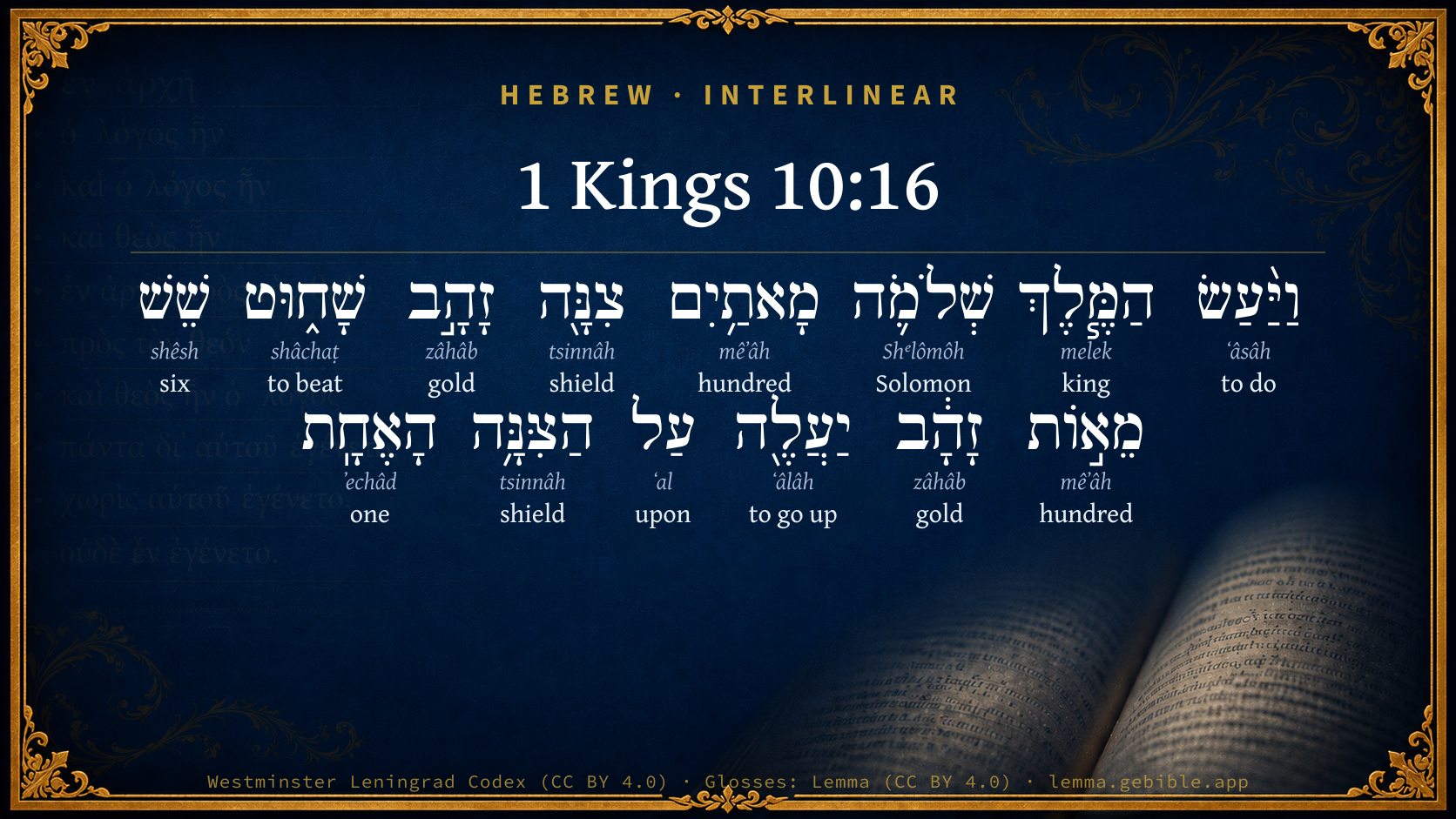
  1. וַיַּ֨עַשׂ ʻâsâh H6213 “and · to do” Conjunction + Verb, Qal, Sequential Imperfect, 3rd Person, Masculine, Singular
  2. הַמֶּ֧לֶךְ melek H4428 “the · king” Particle, Definite Article + Noun, Common, Masculine, Singular, Absolute
  3. שְׁלֹמֹ֛ה Shᵉlômôh H8010 “Solomon” Noun, Proper
  4. מָאתַ֥יִם mêʼâh H3967 “hundred” Adjective, Cardinal number, Both, Dual, Absolute
  5. צִנָּ֖ה tsinnâh H6793 “shield” Noun, Common, Feminine, Singular, Absolute
  6. זָהָ֣ב zâhâb H2091 “gold” Noun, Common, Masculine, Singular, Absolute
  7. שֵׁשׁ shêsh H8337 “six” Adjective, Cardinal number, Feminine, Singular, Absolute
  8. מֵא֣וֹת mêʼâh H3967 “hundred” Adjective, Cardinal number, Both, Plural, Absolute
  9. זָהָ֔ב zâhâb H2091 “gold” Noun, Common, Masculine, Singular, Absolute
  10. יַעֲלֶ֖ה ʻâlâh H5927 “to go up” Verb, Hiphil, Imperfect, 3rd Person, Masculine, Singular
  11. עַל ʻal H5921 “upon” Preposition
  12. הַצִּנָּ֥ה tsinnâh H6793 “the · shield” Particle, Definite Article + Noun, Common, Feminine, Singular, Absolute
  13. הָאֶחָֽת ʼechâd H259 “the · one” Particle, Definite Article + Adjective, Cardinal number, Feminine, Singular, Absolute

About this verse

These counts appear in no published source. They are computed here, from the morphology-tagged text and Lemma’s own curated glosses. What Lemma adds →

14
words
11
distinct lemmas
Historical
section

Notable vocabulary

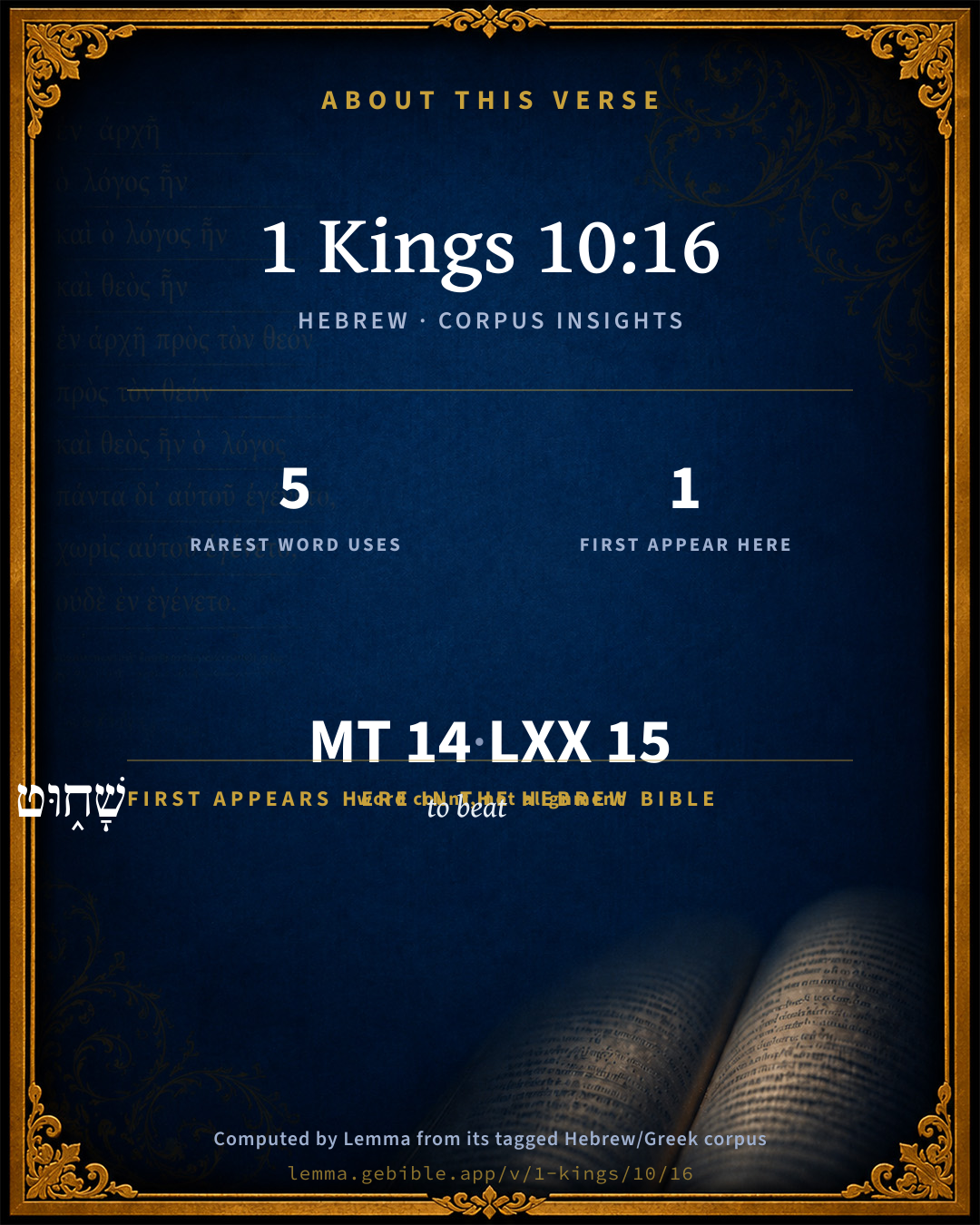
The rarest word here is שָׁח֑וּט to beat H7820 — appearing just 5 times in the whole Hebrew Bible.

First appearance in Scripture

This word makes its first canonical appearance in the Hebrew Bible here:

  • שָׁח֑וּט to beat H7820

Shared distinctive vocabulary

שָׁח֑וּט to beat H7820 occurs in 4 verses of the Hebrew Bible. Also found in:

Grammatical profile

  • 3 verbs
  • 6 nouns
  • 4 adjectives
  • 1 preposition

Verb forms

  • וַיַּ֨עַשׂ Qal · Sequential Imperfect
  • שָׁח֑וּט Qal · Participle Passive
  • יַעֲלֶ֖ה Hiphil · Imperfect

Repetition

Words recur within this verse — often emphatic in Hebrew:

  • מָאתַ֥יִם hundred H3967 ×2
  • צִנָּ֖ה shield H6793 ×2
  • זָהָ֣ב gold H2091 ×2

Hebrew & Septuagint length

In English translation the verse runs 18 words from the Hebrew and 18 from the Septuagint (LXX English) — the same length.

A rough comparison of the two English renderings, which tokenize alike — not a word-level alignment.

Word counts can differ between the Hebrew and the Greek without any difference in meaning — e.g. the Hebrew direct-object marker אֵת has no separate Greek word, and Greek often adds the article ὁ.

In the original languages it is 14 Hebrew tokens and 15 Greek tokens — but the two are counted differently (Hebrew bundles its prefixes and suffixes into one token; the Greek is in lemma form), so that isn’t a like-for-like length.

Cross-references

3

Topical passages linked to 1 Kings 10:16 in the Treasury of Scripture Knowledge — connected by theme and wording, ordered by reader-vote popularity; previews shown in the World English Bible.

  • 1 Kings 14:26–28 and he took away the treasures of the house of Yahweh, and the treasures of the king's house; he even took away all: and he took away all the shields of gold which Solomon had made.
  • 2 Chronicles 12:9–10 So Shishak king of Egypt came up against Jerusalem, and took away the treasures of the house of Yahweh, and the treasures of the king's house: he took all away: he took away also the shields of gold which Solomon had made.
  • 2 Chronicles 9:15–16 King Solomon made two hundred bucklers of beaten gold; six hundred [shekels] of beaten gold went to one buckler.

Cross-references courtesy of OpenBible.info (CC BY 4.0).

Hebrew and Greek witnesses Masoretic Hebrew ↔ Greek Septuagint

The same verse in the two great witnesses to the Old Testament, shown verse-for-verse.

These are two independent witnesses, not word-aligned to each other, and the Septuagint is shown in lemma (dictionary) form.

Hebrew 1 Kings 10:16 Masoretic · Westminster Leningrad Codex

וַיַּ֨עַשׂ הַמֶּ֧לֶךְ שְׁלֹמֹ֛ה מָאתַ֥יִם צִנָּ֖ה זָהָ֣ב שָׁח֑וּט שֵׁשׁ מֵא֣וֹת זָהָ֔ב יַעֲלֶ֖ה עַל הַצִּנָּ֥ה הָאֶחָֽת

King Solomon made two hundred bucklers of beaten gold; six hundred [shekels] of gold went to one buckler.

World English Bible · Public Domain

Greek LXX 1 Kings 10:16 Septuagint · lemma form

καί ποιέω σαλωμών τριακόσιοι δόρυ χρυσοῦς ἐλατός τριακόσιοι χρυσοῦς ἐπιεἰμί ἐπί ὁ δόρυ ὁ εἷς

And Solomon made three hundred spears of beaten gold: three hundred shekels of gold were upon one spear.

LXX2012 (modern English Septuagint) · Public Domain

On this verse, The Cambridge Bible for Schools and Colleges discusses the Septuagint’s reading. Read the note in Commentary ↓

Hebrew: Westminster Leningrad Codex (CC BY 4.0). Greek: Septuagint (public domain); English from LXX2012 (modern English Septuagint) (Public Domain). How the Septuagint differs from the Hebrew →

Targum (Aramaic paraphrase)

1

The Targum is the ancient Jewish Aramaic paraphrase of the Hebrew Scriptures — an interpretive translation, not the Hebrew text itself. Onkelos (literal) and Pseudo-Jonathan (expansive) render the Torah, and Jonathan the Prophets. Coverage is partial: where no permissively-licensed English translation exists for a verse, only the Aramaic is shown. This is verse-level text, not a word-by-word alignment to the Hebrew.

  1. Targum Jonathan Prophets (Joshua–Malachi)
    וַעֲבַד מַלְכָּא שְׁלֹמֹה מָאתָן תְּרֵיסִין דַהֲבָא טָבָא שִׁית מְאָה דַהֲבָא מַסִיק עַל תְּרֵיסָא חֲדָא:

    (no public-domain English translation for this verse)

    Targum Jonathan — Aramaic: “Mikraot Gedolot” (public domain). English: “Sefaria Community Translation” (CC0 1.0 (public-domain dedication)); “London "Chaldee Paraphrase," 1871” (public domain). Text via Sefaria.

Commentary

Notes on 1 Kings 10:16 from classic Christian and Jewish commentators (each source and its license shown beneath its notes). The classic Christian expositions comment on the surrounding passage and are grouped to its opening verse, so a note may address several verses; the Jewish commentaries on the Tanakh (Rashi and others) are per-verse, so they appear only where the commentator wrote on this verse.

Lemma curates 59 commentaries, every one of them public domain or Creative Commons licensed, each selected and text-cleaned for this edition rather than reprinted as found. About our sources →

Trapp's Complete Commentary

John Trapp

1Ki 10:16 And king Solomon made two hundred targets [of] beaten gold: six hundred [shekels] of gold went to one target.

Ver. 16. Two hundred targets of beaten gold.] Which were carried before him by his guard, as 1Ki 14:27-28, being more for pomp than service; and therefore so soon became a prey to the enemy through God’s just indignation.

John Trapp, A Commentary or Exposition upon All the Books of the Old and New Testament (1647–1656) — public domain. Text from a community e-Sword module.

Joseph Benson's Commentary

1Ki 10:16-17. Solomon made two hundred targets of beaten gold — For pomp and magnificence, and to be carried before him by his guard when he went abroad. The Roman magistrates had rods and axes carried before them, in token of their power to correct the bad; but Solomon shields and targets, to show he took more pleasure in his power to defend and protect the good. Three hundred shields — Smaller than targets. The king put them in the house of the forest of Lebanon — Where, it is likely, he kept his most precious treasures.

Joseph Benson's Commentary on the Old and New Testaments (1811–1818) — public domain. Text from a community e-Sword module.

Tyndale Open Study Notes

Tyndale Open Resources

10:16-17 Although such shields were typically designed to accommodate infantry (large shields) or archers (smaller shields), these shields probably had ceremonial uses.

Tyndale Open Study Notes — © Tyndale Open Resources, licensed CC BY-SA 4.0. Text via the HelloAO Bible API.

Jamieson, Fausset & Brown

Robert Jamieson, A. R. Fausset & David Brown

two hundred targets, six hundred shekels--These defensive arms were anciently made of wood and covered with leather; those were covered with fine gold. 600 shekels were used in the gilding of each target--300 for each shield. They were intended for the state armory of the palace (see Kg1 14:26).

Jamieson, Fausset & Brown — Commentary Critical and Explanatory on the Whole Bible (1871) — public domain (CC PDM 1.0). Text via the HelloAO Bible API.

Adam Clarke's Commentary

Verse 16. Solomon made two hundred targets of beaten gold] I have already conjectured that the צנה tsinnah might resemble the Highland targe or target, with a dagger projecting from the UMBO or centre.

Adam Clarke's Commentary on the Bible (1810–1826) — public domain. Text from a community e-Sword/MySword module.

Ellicott's Commentary for English Readers

(16, 17) The shields overlaid with gold—the larger called “targets,” and the lesser called “shields”—were evidently used for ornamenting the king’s palace, and (as we may gather from the notice in 2Ch_12:11, of the brazen shields which superseded them) taken down and borne before the king on solemn occasions, as “when he went to the house of the Lord.” We have notices of shields of gold among the Syrians of Zobah (2Sa_8:7; 1Ch_18:7), and of shields hung on the walls of Tyre (Eze_27:10-11). The use of such ornaments argues a plethora of gold, too great to be absorbed either in currency or in personal and architectural decorations.

A Bible Commentary for English Readers, edited by Charles John Ellicott (1878–1897) — public domain. Text from a community e-Sword module.

The Cambridge Bible for Schools and Colleges

gen. ed. J. J. S. Perowne

16. two hundred targets of beaten gold] The ‘targets’ here spoken of appear, from the gold consumed in them, to have been much larger than the ‘shields’ mentioned in the next verse. Both the names imply ‘protection,’ ‘covering,’ but give us no clue to their form. The LXX. makes these ‘targets’ three hundred in number, and gives three hundred shekels of gold to each.

six hundred shekels of gold] It was not unusual in Hebrew where it was well known what word ought to be supplied to omit the word ‘shekels’ as is done here. So Gen_24:22; Exo_30:23. No Englishman misunderstands such an expression as ‘three hundred a year.’

The Cambridge Bible for Schools and Colleges (gen. ed. J. J. S. Perowne; Cambridge University Press, 1878–1918) — public domain. Text from a community e-Sword module.

John Gill's Exposition

And King Solomon made two hundred targets of beaten gold,.... Which were a larger sort of shields, which covered the whole body; and these were made of gold beaten with the hammer, or drawn into plates, being melted like wax; so the Poeni or Carthaginians made shields of gold (m):

six hundred shekels of gold went to one target; which is to be understood not of the weight, but of the price or value of them, which amounted to four hundred and fifty pounds of our money; so Brerewood (n).

(m) Plin. Nat. Hist. l. 35. 3. (n) Ut supra. (De Ponder. & Pret. c. 5.)

John Gill's Exposition of the Whole Bible (1746–1763) — public domain (CC PDM 1.0). Text via the HelloAO Bible API.

Albert Barnes' Notes on the Bible

The “targets” seem to have been long shields protecting the whole body, while the “shields” of the next verse were bucklers of a smaller size, probably round, and much lighter. They may be compared with the Assyrian long shield, and the ordinary Assyrian round shield. As the amount of gold used in each of the larger shields was only 600 shekels - worth from 650 to 700 of our money - and that used in the smaller ones was only half as much it is evident that the metal did not form the substance of the shields, but was laid as a coating or plating over them.

Albert Barnes' Notes on the Bible (1834–1885) — public domain. Text from a community e-Sword/MySword module.

Haydock's Catholic Bible Commentary

Shields. Hebrew tsinnu is rather indeterminate, denoting something sharp or pointed; "a dart," &c. (Calmet) --- Paralipomenon spears. Some of the shields were made with a point, projecting from the middle, (Haydock) with which the enemy might be wounded. (Menochius) --- These arms were used when the king went to the temple, and were reposited in the arsenal, at his return, chap. xiv. 28.

George Leo Haydock (1774–1849), Haydock's Catholic Family Bible and Commentary, 1859 edition — public domain. Excludes Psalms (Douay-Rheims chapter numbering differs from Protestant) and Deuterocanonical books (Catholic canon only).

Matthew Poole's English Annotations

For pomp and magnificence, and (as may be thought from the use of the brazen shields, 1Ki 14:27,28) to be carried before him by his guard when he went abroad.

Matthew Poole's English Annotations on the Holy Bible (1683–1685) — public domain. Text from a community e-Sword/MySword module.

Whedon's Commentary on the Bible

Daniel D. Whedon

16. Targets — Large oblong shields, to cover or defend the whole body.

Six hundred shekels — About eighteen pounds.

Daniel D. Whedon (gen. ed.), Commentary on the Old and New Testaments (1874–1909) — public domain. Text from a community e-Sword module.

The Pulpit Commentary

And king Solomon made two hundred targets hNxi from a root which signifies protect, a large oblong shield, which covered the entire person, (Psa_5:12) qureov, scutum. See 1Sa_17:7, 1Sa_17:41. The LXX here reads dorata, i.e., spears of beaten gold The authorities are divided as to the meaning of fWjv; here translated beaten. This rendering is supported by Bahr and Keil (after Kimchi), but Gesenius understands mixed gold. Rawlinson infers from the weight that the shields were only plated (shields were commonly made of wood, covered with leather). But whether they were solid or not does not decide the question whether the gold was pure or alloyed. "Shields of gold" are mentioned: (2Sa_8:7 RAPC 1Ma 6:39) six hundred shekels Heb. omits shekels, as elsewhere, Gen_24:22 Gen_37:28; Jud_1:8:26, etc. There were apparently two kinds of shekel, the Mosaic and the royal. (for the latter see 2Sa_14:26) The former was twice as much as the latter, but there is no agreement amongst commentators as to the weight or value of either. Nor can we be certain which is indicated here. Thenius decides for the former, and estimates the weight of the gold on each target to be 17 ½ lbs., and the value to be 6000 thalers ( or, according to Keil, 5000 thalers ( Keil, however, inclines to the belief that the royal shekel is meant, in which case the weight would be 9 lbs., and the value about Bahr, however, estimates the gold at no more than (523 thalers) of gold went to one target.

The Pulpit Commentary (1880–1919), ed. H.D.M. Spence-Jones & Joseph S. Exell — public domain. Text from a community e-Sword module.

John Wesley's Explanatory Notes

Targets - For pomp and magnificence, and to be carried before him, by his guard, when he went abroad. The Roman magistrates had rods and axes carried before them, in token of their power to correct the bad: but Solomon shields and targets, to shew he took more pleasure in his power to defend and protect the good.

John Wesley, Explanatory Notes Upon the Whole Bible (1754–1765) — public domain. Text via the GEBible commentary corpus.

Keil & Delitzsch

C. F. Keil & F. Delitzsch

Solomon had 500 ornamental shields made, 200 larger ones (צנּים, scuta, targets), and 300 smaller (מגנּים, clypei). These shields, like all the shields of the ancients, were made of wood or basket-work, and covered with gold plate instead of leather (see my bibl. Archol. ii. pp. 296ff.). שׁחוּט זהב does not mean aurum jugulatum, i.e., gold mixed with metal of a different kind, but, as Kimchi has shown, aurum diductum, beaten gold, from שׁחט, to stretch; since Solomon would certainly use pure gold for these ornamental shields. "Six hundred shekels of gold he spread upon one target," that is to say, he used for gilding one target. Six hundred shekels would weigh about 17 1/2 lbs., so that the value of the gold upon a target would be more than 5000 thalers (750), supposing that the Mosaic shekel is meant. But this is rendered doubtful by the fact that the gold upon the small shields is estimated at three minae. If, for example, the three minae are equal to three hundred shekels, according to Ch2 9:16, as is generally assumed, a hundred shekels are reckoned as one mina; and as the mina only contained fifty Mosaic shekels, according to Eze 45:12, the reference must be to shekels after the king's weight (Sa2 14:26), which were only half the sacred shekels (see my bibl. Archol. ii. p. 135). Consequently the gold plate upon one target was not quite 9 lbs., and that upon a shield not quite 4 1/2 lbs. These shields were intended for the body-guard to carry on state occasions (Kg1 14:27-28; Ch2 12:10), and were kept in the house of the forest of Lebanon (Kg1 7:2).

Keil & Delitzsch — Biblical Commentary on the Old Testament (1861–1891) — public domain (CC PDM 1.0). Text via the HelloAO Bible API. (Old Testament only.)

unfoldingWord translationNotes

Door43 World Missions Community

King Solomon made

It might be best to translate so that the reader understands that other people helped Solomon do this. AT: "King Solomon's men made" (See: Synecdoche)

two hundred large shields

"200 large shields" (See: Numbers)

Six hundred shekels of gold

A shekel is a unit of weight equal to about 11 grams. AT: "About 6.6 kilograms of gold" or "Six and one half kilograms of gold" (See: Biblical Weight)

Six hundred shekels

Because the word "shekels" does not appear here in the Hebrew text, some modern versions assume instead the unit of bekah, which was equivalent to only a half shekel. Any version making this assumption would signal a metric equivalent of about three kilograms.

He also made

It might be best to translate so that the reader understands that other people helped Solomon do this. AT: "The king's men also made" (See: Synecdoche)

three hundred shields

"300 shields" (See: Numbers)

Three minas of gold

A mina is a unit of weight equal to about 550 grams. AT: "About 1.7 kilograms of gold" or "One and three-quarters kilograms of gold" (See: Biblical Weight)

the Palace of the Forest of Lebanon

"the house called the House of the Lebanon Forest." See how you translated this in 1 Kings 7:2.

translationWords

shield

palace

Lebanon

unfoldingWord translationNotes — © Distant Shores Media and the Door43 World Missions Community, licensed CC BY-SA 4.0. Source: git.door43.org/Door43/en_tn.

Rashi

Rabbi Shlomo Yitzchaki (Rashi)

Full shields. [A body shield that] encircles the person on three sides. This is the meaning of the verse in the Book of Tehillim, “as a body shield, with good, will You shall surround him.”

Six hundred. Six manim, for [a piece of] gold is a dinar.

Rashi on the Tanakh — English translations: “The Judaica Press complete Tanach with Rashi, translated by A. J. Rosenberg” (CC BY 4.0); “Pentateuch with Rashi's commentary by M. Rosenbaum and A.M. Silbermann, 1929-1934” (public domain); “The Metsudah Tanach series, Lakewood, N.J” (CC BY 4.0); and “The Book of Joshua, Metsudah Publications, 1997” (CC BY 4.0). Text via Sefaria.

Lesson kit

Teaching starters — assembled from the data on this page, not authored interpretation. Every prompt links to the verse data it draws on. Edit before teaching.

1 Kings, in the Historical, opens this verse with 14 words (11 distinct Hebrew lemmas). Its most distinctive word is shâchaṭ (“to beat”). A historical commentator’s framing appears above. Read the whole chapter for the surrounding context.

Discussion questions

  1. What does “to beat” (shâchaṭ) contribute to the verse as a whole?
  2. This is the first place “to beat” appears in Scripture (first appears here). What does its debut here establish?
  3. How does 1 Kings 10:17, which shares the word «to beat», read alongside this verse?
  4. What does the repetition of “hundred” (2× in this one verse) do in this verse?
  5. The translations on this page render this verse differently — a whole-verse word diff, not a word-by-word alignment. What might account for the different wordings?
  6. «וַיַּ֨עַשׂ» is a Qal Sequential Imperfect verb. How does that grammatical form shape the action described?
  7. Compare how Trapp's Complete Commentary and Joseph Benson's Commentary read this verse. Where do they agree or differ?

Things to notice

Reading settings

Reading text

Shown beneath each verse's original-language words.

Old Testament
Old Testament edition

Read the OT as the Masoretic Hebrew (MT) or the Greek Septuagint (LXX).

English shown for the Greek Septuagint (in the Hebrew ↔ Greek comparison).

Comparing translations? Open the Compare panel on any verse page to stack up to four side by side.