Isaiah 40:19

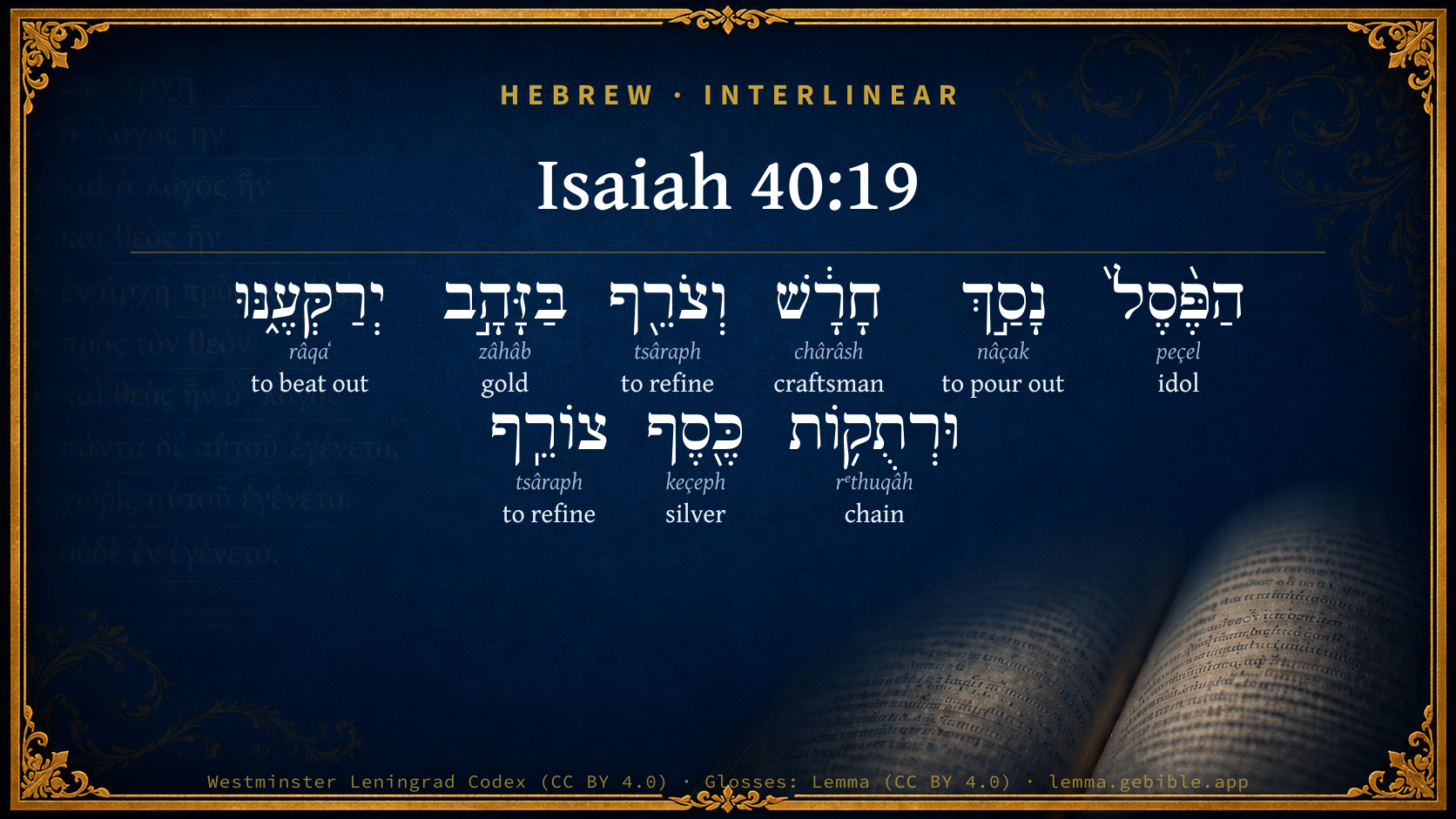
Hebrew (Westminster Leningrad Codex) Isaiah 40:19 appears in the Hebrew Old Testament. The text above is from the Westminster Leningrad Codex. Each word links to its Strong’s number, a concise gloss, and parsing drawn from the Open Scriptures Hebrew Bible morphology. Click any word for its full Brown-Driver-Briggs (BDB) entry.
Download image
Cite this verse

Isaiah 40:19 (World English Bible). Public Domain. Lemma interlinear Bible study tool, https://lemma.gebible.app/v/isaiah/40/19.

Show BibTeX & RIS
BibTeX
RIS
English Translation
The image, a workman has cast [it], and the goldsmith overlays it with gold, and casts [for it] silver chains.
World English Bible · Public Domain
Highlights
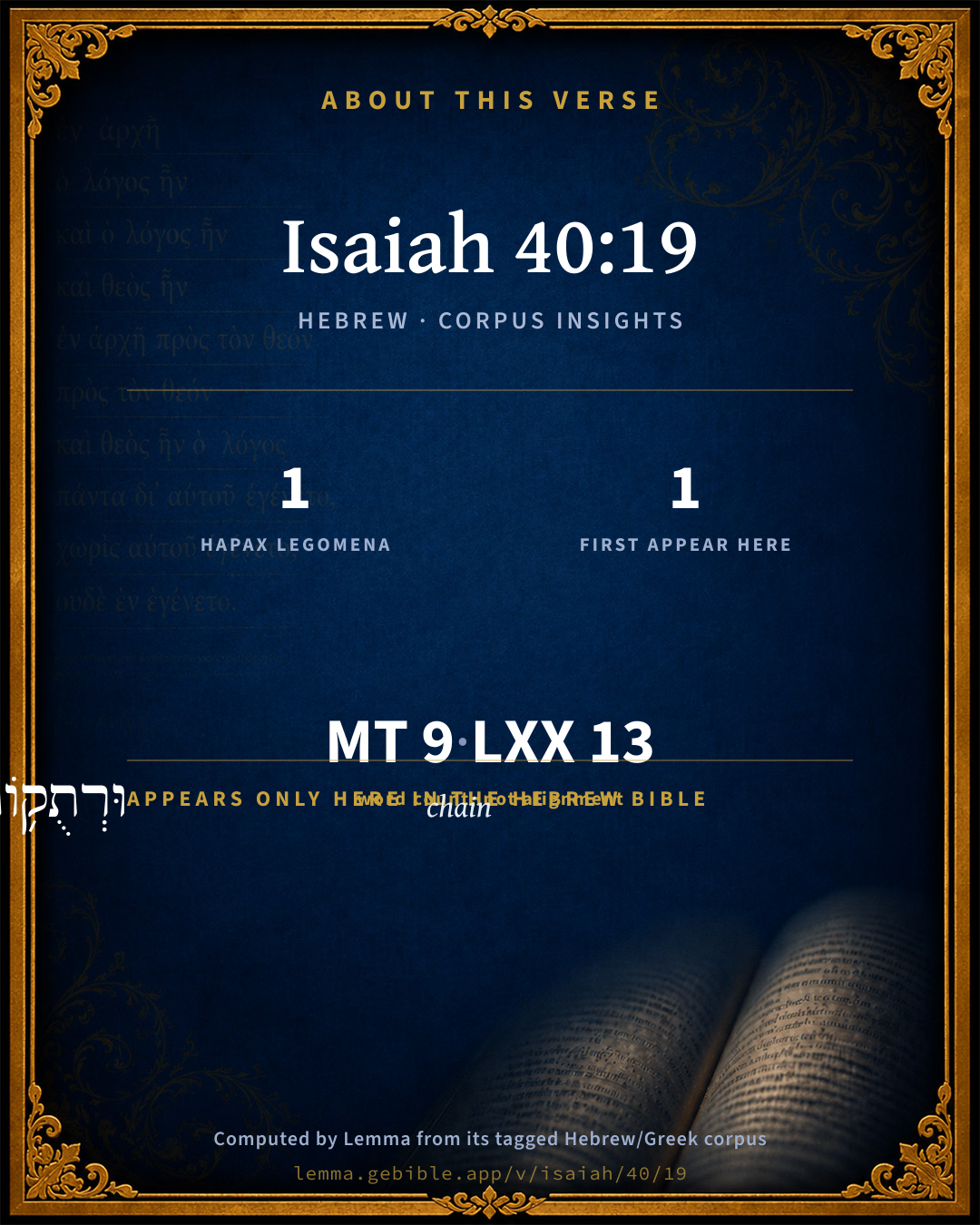
  • 1 hapax legomenon — only here in the Hebrew Bible
  • 1 first appearance in the Hebrew Bible
Full analysis ↓
Download a study sheet

One document with this verse’s original text, its word-by-word gloss line, the meaning frame, cross-references with their text, attributed commentary, and full source and license credits — printable, and it pastes into notes with its structure intact.

This verse Autodidact and up

Study sheet (.html) Plain text (.txt)

A passage Seminary Student

Up to 50 verses in one chapter. A passage sheet keeps up to 6 commentary sources and 12 cross-references per verse, in the order this page ranks them, and says so on the sheet whenever that leaves anything out. Ask for a single verse and you get the Autodidact verse sheet above.

Everything on this page stays free to read, with no account — the sheet is a download of what is already on screen, not access to it.

Want to remove ads? Support Godless Engineer
Compare translations 3

The same verse in 3 English versions, stacked beneath the original-language interlinear above. Click any original word for its lexicon entry.

Each is an independent rendering of the whole verse — the interlinear is not word-aligned to these translations.

Highlighted words mark where these versions differ — a whole-verse word diff, not a word-by-word alignment.

  • World English Bible Public Domain
    The image, a workman has cast [it], and the goldsmith overlays it with gold, and casts [for it] silver chains.
  • King James Version Public Domain
    The workman melteth a graven image, and the goldsmith spreadeth it over with gold, and casteth silver chains.
  • unfoldingWord Literal Text CC BY-SA 4.0
    An idol? A craftsman casts, and a metalworker overlays it with gold, and he is forging chains of silver.

unfoldingWord Literal Text — © unfoldingWord, licensed CC BY-SA 4.0. Word-aligned USFM3 via Door43 (git.door43.org/unfoldingWord/en_ult).

Versions to compare (up to 4)

3 of 4 selected

Show all 18 translations

Every available English version of this verse, each an independent rendering of the whole verse.

  • World English Bible Public Domain
    The image, a workman has cast [it], and the goldsmith overlays it with gold, and casts [for it] silver chains.
  • Berean Standard Bible Public Domain
    To an idol that a craftsman casts and a metalworker overlays with gold and fits with silver chains?
  • Majority Standard Bible Public Domain
    To an idol that a craftsman casts and a metalworker overlays with gold and fits with silver chains?
  • King James Version Public Domain
    The workman melteth a graven image, and the goldsmith spreadeth it over with gold, and casteth silver chains.
  • American Standard Version (1901) Public Domain
    The image, a workman hath cast `it', and the goldsmith overlayeth it with gold, and casteth `for it' silver chains.
  • Revised Version (1885) Public Domain
    The graven image, a workman melted it, and the goldsmith spreadeth it over with gold, and casteth for it silver chains.
  • Geneva Bible (1599) Public Domain
    The workeman melteth an image, or the goldsmith beateth it out in golde, or the goldesmith maketh siluer plates.
  • Douay-Rheims (1899) Public Domain
    Hath the workman cast a graven statue? or hath the goldsmith formed it with gold, or the silversmith with plates of silver?
  • Young's Literal Translation Public Domain
    The graven image poured out hath a artizan, And a refiner with gold spreadeth it over, And chains of silver he is refining.
  • Literal Standard Version CC BY-SA 4.0
    An artisan has poured out the carved image, || And a refiner spreads it over with gold, || And he is refining chains of silver.
  • Unlocked Literal Bible CC BY-SA 4.0
    An idol! A craftsman casts it: The goldsmith overlays it with gold and forges silver chains for it.
  • unfoldingWord Literal Text CC BY-SA 4.0
    An idol? A craftsman casts, and a metalworker overlays it with gold, and he is forging chains of silver.
  • Darby Bible Public Domain
    The workman casteth a graven image, and the goldsmith spreadeth it over with gold, and casteth silver chains [for it].
  • World Messianic Bible Public Domain
    A workman has cast an image, and the goldsmith overlays it with gold, and casts silver chains for it.
  • Webster's Bible Public Domain
    The workman melteth a graven image, and the goldsmith spreadeth it over with gold, and casteth silver chains.
  • Free Bible Version CC BY-SA 4.0
    Is he a metal idol that a craftsman casts in a mold, and then a goldsmith overlays it with gold and makes silver chains for it?
  • Bible in Basic English Public Domain
    The workman makes an image, and the gold-worker puts gold plates over it, and makes silver bands for it.
  • JPS Tanakh (1917) Public Domain
    The image perchance, which the craftsman hath melted, and the goldsmith spread over with gold, the silversmith casting silver chains?

Literal Standard Version (2020), Covenant Press — licensed CC BY-SA 4.0. Text via the HelloAO Bible API (eBible.org). Unlocked Literal Bible (unfoldingWord) — licensed CC BY-SA 4.0. Text via the HelloAO Bible API (eBible.org). unfoldingWord Literal Text — © unfoldingWord, licensed CC BY-SA 4.0. Word-aligned USFM3 via Door43 (git.door43.org/unfoldingWord/en_ult). Free Bible Version, Dr. Jonathan Gallagher — licensed CC BY-SA 4.0. Text via the HelloAO Bible API (eBible.org).

Word by word

More ways to search: Search by grammar → Find every occurrence → Compare this word →

Practice this passage: Drill this verse → Learn its vocabulary →

וּרְתֻק֥וֹת
rᵉthuqâh
H7577
“and · chains of”
Conjunction + Noun, Common, Feminine, Plural, Construct
Part of Speech
Conjunction + Noun
Type
Common
Gender
Feminine
Number
Plural
State
Construct
Full BDB Definition

Origin: pass part of H7576

TWOT: 2227a

chain
  1. הַפֶּ֨סֶל֙ peçel H6459 “the · idol” Particle, Definite Article + Noun, Common, Masculine, Singular, Absolute
  2. נָסַ֣ךְ nâçak H5258 “to pour out” Verb, Qal, Perfect, 3rd Person, Masculine, Singular
  3. חָרָ֔שׁ chârâsh H2796 “craftsman” Noun, Common, Masculine, Singular, Absolute
  4. וְצֹרֵ֖ף tsâraph H6884 “and · refining” Conjunction + Verb, Qal, Participle Active, Masculine, Singular, Absolute
  5. בַּזָּהָ֣ב zâhâb H2091 “in/at the · gold” Preposition, Determined + Noun, Common, Masculine, Singular, Absolute
  6. יְרַקְּעֶ֑נּוּ râqaʻ H7554 “to beat out · him” Verb, Piel, Imperfect, 3rd Person, Masculine, Singular + Suffix, Personal, 3rd Person, Masculine, Singular
  7. כֶּ֖סֶף keçeph H3701 “silver” Noun, Common, Masculine, Singular, Absolute
  8. צוֹרֵֽף tsâraph H6884 “refining” Verb, Qal, Participle Active, Masculine, Singular, Absolute

About this verse

These counts appear in no published source. They are computed here, from the morphology-tagged text and Lemma’s own curated glosses. What Lemma adds →

9
words
8
distinct lemmas
Prophets
section

Notable vocabulary

1 hapax legomenon — a word that appears only here in the entire Hebrew Bible:

  • וּרְתֻק֥וֹת chain H7577

First appearance in Scripture

This word makes its first canonical appearance in the Hebrew Bible here:

  • וּרְתֻק֥וֹת chain H7577

Shared distinctive vocabulary

יְרַקְּעֶ֑נּוּ to beat out H7554 occurs in 11 verses of the Hebrew Bible. Also found in:

Grammatical profile

  • 4 verbs
  • 5 nouns

Verb forms

  • נָסַ֣ךְ Qal · Perfect
  • וְצֹרֵ֖ף Qal · Participle Active
  • יְרַקְּעֶ֑נּוּ Piel · Imperfect
  • צוֹרֵֽף Qal · Participle Active

Repetition

A word recurs within this verse — often emphatic in Hebrew:

  • וְצֹרֵ֖ף to refine H6884 ×2

Hebrew & Septuagint length

In English translation the verse runs 20 words from the Hebrew and 21 from the Septuagint (LXX English) — closely comparable.

A rough comparison of the two English renderings, which tokenize alike — not a word-level alignment.

Word counts can differ between the Hebrew and the Greek without any difference in meaning — e.g. the Hebrew direct-object marker אֵת has no separate Greek word, and Greek often adds the article ὁ.

In the original languages it is 9 Hebrew tokens and 13 Greek tokens — but the two are counted differently (Hebrew bundles its prefixes and suffixes into one token; the Greek is in lemma form), so that isn’t a like-for-like length.

Cross-references

14

Topical passages linked to Isaiah 40:19 in the Treasury of Scripture Knowledge — connected by theme and wording, ordered by reader-vote popularity; previews shown in the World English Bible.

  • Jeremiah 10:9 There is silver beaten into plates, which is brought from Tarshish, and gold from Uphaz, the work of the artificer and of the hands of the goldsmith; blue and purple for their clothing; they are all the work of skillful men.
  • Exodus 32:2–4 Aaron said to them, "Take off the golden rings, which are in the ears of your wives, of your sons, and of your daughters, and bring them to me."
  • Judges 17:4 When he restored the money to his mother, his mother took two hundred [pieces] of silver, and gave them to the founder, who made of it an engraved image and a molten image: and it was in the house of Micah.
  • Psalms 115:4–8 Their idols are silver and gold, The work of men's hands.
  • Isaiah 46:6–7 Some pour out gold from the bag, and weigh silver in the balance. They hire a goldsmith, and he makes it a god. They fall down--yes, they worship.
  • Habakkuk 2:18–19 "What value does the engraved image have, that its maker has engraved it; the molten image, even the teacher of lies, that he who fashions its form trusts in it, to make mute idols?
  • Psalms 135:15 The idols of the nations are silver and gold, The work of men's hands.
  • Psalms 135:18 Those who make them will be like them; Yes, everyone who trusts in them.
  • Isaiah 2:20 In that day, men shall cast away their idols of silver, And their idols of gold, Which have been made for themselves to worship, To the moles and to the bats;
  • Isaiah 37:18–19 Of a truth, Yahweh, the kings of Assyria have laid waste all the countries, and their land,
  • Isaiah 44:10–12 Who has fashioned a god, or molten an image that is profitable for nothing?
  • Jeremiah 10:3–5 For the customs of the peoples are vanity; for one cuts a tree out of the forest, the work of the hands of the workman with the axe.
  • Hosea 8:6 For this is even from Israel! The workman made it, and it is no God; Indeed, the calf of Samaria shall be broken in pieces.
  • Isaiah 41:6–7 They help everyone his neighbor; and [every one] says to his brother, Be of good courage.

Cross-references courtesy of OpenBible.info (CC BY 4.0).

Hebrew and Greek witnesses Masoretic Hebrew ↔ Greek Septuagint

The same verse in the two great witnesses to the Old Testament, shown verse-for-verse.

These are two independent witnesses, not word-aligned to each other, and the Septuagint is shown in lemma (dictionary) form.

Hebrew Isaiah 40:19 Masoretic · Westminster Leningrad Codex

הַפֶּ֨סֶל֙ נָסַ֣ךְ חָרָ֔שׁ וְצֹרֵ֖ף בַּזָּהָ֣ב יְרַקְּעֶ֑נּוּ וּרְתֻק֥וֹת כֶּ֖סֶף צוֹרֵֽף

The image, a workman has cast [it], and the goldsmith overlays it with gold, and casts [for it] silver chains.

World English Bible · Public Domain

Greek LXX Isaiah 40:19 Septuagint · lemma form

μή εἰκών ποιέω τέκτων ἤ χρυσοχόος χωνεύω χρυσίον περιχρυσόω αὐτός ὁμοίωμα κατασκευάζω αὐτός

Has not the artificer made an image, or the goldsmith having melted gold, gilt it over, and made it a similitude?

LXX2012 (modern English Septuagint) · Public Domain

On this verse, The Cambridge Bible for Schools and Colleges discusses the Septuagint’s reading. Read the note in Commentary ↓

Hebrew: Westminster Leningrad Codex (CC BY 4.0). Greek: Septuagint (public domain); English from LXX2012 (modern English Septuagint) (Public Domain). How the Septuagint differs from the Hebrew →

Targum (Aramaic paraphrase)

1

The Targum is the ancient Jewish Aramaic paraphrase of the Hebrew Scriptures — an interpretive translation, not the Hebrew text itself. Onkelos (literal) and Pseudo-Jonathan (expansive) render the Torah, and Jonathan the Prophets. Coverage is partial: where no permissively-licensed English translation exists for a verse, only the Aramaic is shown. This is verse-level text, not a word-by-word alignment to the Hebrew.

  1. Targum Jonathan Prophets (Joshua–Malachi)
    הָא צִלְמָא נַגְרָא עֲבֵיד וְקֵינָאָה בִּדְהַב מְחַפֵּי לֵיהּ וְשַׁלְשְׁלַן דִכְסַף קֵינָאָה מְאָחֵיד לֵיהּ:

    Behold, the artificer maketh an image, and the goldsmith overlayeth it with gold, and with silver chains the silversmith fasteneth it.

    Targum Jonathan — Aramaic: “Mikraot Gedolot” (public domain). English: “Sefaria Community Translation” (CC0 1.0 (public-domain dedication)); “London "Chaldee Paraphrase," 1871” (public domain). Text via Sefaria.

Commentary

Notes on Isaiah 40:19 from classic Christian and Jewish commentators (each source and its license shown beneath its notes). The classic Christian expositions comment on the surrounding passage and are grouped to its opening verse, so a note may address several verses; the Jewish commentaries on the Tanakh (Rashi and others) are per-verse, so they appear only where the commentator wrote on this verse.

Lemma curates 59 commentaries, every one of them public domain or Creative Commons licensed, each selected and text-cleaned for this edition rather than reprinted as found. About our sources →

Trapp's Complete Commentary

John Trapp

Isa 40:19 The workman melteth a graven image, and the goldsmith spreadeth it over with gold, and casteth silver chains.

Ver. 19. The workman melteth a graven image.] That may be afterward graved and gilded over.

And casteth silver chains.] To fasten it to the place; or, he raileth it in. Et nisi homini Deus placuerit, Deus non erit, saith Tertullian. Numa, second king of Romans, saw this great vanity, and therefore forbade images of the gods in temples. {a} So do the Turks at this day to the shame of Papists’ idolomania.

{a} Plutarch. de Isid. et Osir.

John Trapp, A Commentary or Exposition upon All the Books of the Old and New Testament (1647–1656) — public domain. Text from a community e-Sword module.

Joseph Benson's Commentary

Isa 40:19-20. The workman melteth a graven image — He melteth some base metal into a mould which giveth it the form of an image, which afterward is graven or carved to make it the more exact and pleasing likeness of some creature. Thus the image owes all its excellence to the earth for the matter of it, and to the art of man for the fashion of it. The goldsmith spreadeth it over with gold — Beaten out into leaves or plates; and casteth silver chains — For ornaments; or rather, for use, to fasten it to a wall or pillar, lest it should fall down and be broken in pieces. Which is spoken by way of derision of such ridiculous deities as needed such supports. He that hath no oblation — That can hardly procure money to buy the meanest sacrifice; chooseth a tree, &c. — He is so mad upon his idols, that he will find money to procure the choicest materials, and the best artist to make his idol; to prepare a graven image, &c. — Which, after all this cost, cannot stir one step out of its place to give him any help.

Joseph Benson's Commentary on the Old and New Testaments (1811–1818) — public domain. Text from a community e-Sword module.

Jamieson, Fausset & Brown

Robert Jamieson, A. R. Fausset & David Brown

graven--rather, an image in general; for it is incongruous to say "melteth" (that is, casts out of metal) a graven image (that is, one of carved wood); so Jer 10:14, "molten image."

spreadeth it over--(See on Isa 30:22).

chains--an ornament lavishly worn by rich Orientals (Isa 3:18-19), and so transferred to their idols. Egyptian relics show that idols were suspended in houses by chains.

Jamieson, Fausset & Brown — Commentary Critical and Explanatory on the Whole Bible (1871) — public domain (CC PDM 1.0). Text via the HelloAO Bible API.

Adam Clarke's Commentary

Verse 19. And casteth silver chains - "And forgeth for it chains of silver."] For צורף tsoreph, the participle, twenty-seven MSS., five ancient, and three editions, read צרף tsaraph, pret. third person.

Adam Clarke's Commentary on the Bible (1810–1826) — public domain. Text from a community e-Sword/MySword module.

Ellicott's Commentary for English Readers

(19) The workman melteth . . .—The reign of Ahaz, not to speak of that of Manasseh, must have supplied the prophet with his picture of the idol factory not less fully than if he had lived in Babylon or Nineveh.

Spreadeth it over with gold.—The image of lead was covered over, as in the well-known story of Phidias’s “Zeus,” with plates of gold. The “silver chains” fastened it to the wall.

A Bible Commentary for English Readers, edited by Charles John Ellicott (1878–1897) — public domain. Text from a community e-Sword module.

The Cambridge Bible for Schools and Colleges

gen. ed. J. J. S. Perowne

19. melteth a graven image] R.V. The graven image, a workman melted it. The word péṣel means strictly a “graven image,” but is used several times as here of an image in general.

overlayeth it with gold] The idol consists of a core of brass which is cast by the “workman,” and then handed over to the goldsmith to be covered with a plating of gold (see ch. Isa_30:22).

and casteth silver chains] A perplexing clause, which the LXX. omits. The word rendered “casteth” is the same as that for “goldsmith” (strictly “assayer”), the participle being translated by a finite verb. But such a construction is incorrect: and besides the verb is never used except in the sense of “test” or “purify.” It is only when the partic. has become a noun that it assumes the general sense of worker in metal. Hence Dillmann proposes to render “and with silver chains a smelter (sc. covers it).” But this is exceedingly harsh. The word for “chains” is also of doubtful meaning, and altogether the clause must be pronounced hopelessly obscure.

The Cambridge Bible for Schools and Colleges (gen. ed. J. J. S. Perowne; Cambridge University Press, 1878–1918) — public domain. Text from a community e-Sword module.

John Gill's Exposition

The workman melteth a graven image,.... Or, "the founder"; he melts some sort of metal, as iron, brass, copper, or lead, which he casts into a mould for an image, and afterwards graves, or gets it graved:

and the goldsmith spreadeth it over with gold; or, "the finer"; he stretches out plates of gold, and covers it with them, so that it looks as if it was made of solid gold, and deceives the eyes of men; such stupidity and vanity are there in mortals to believe that there can be deity in such a piece of workmanship!

and casteth silver chains to put about the graven image, either for ornament, or rather to fasten it to some wall or pillar, that it may stand upright, and may not be taken down and stole away, or blown down with the wind, or fall of itself and be broken; thus ridiculing the weakness of these idols, and the folly of the makers and worshippers of them. The Targum is,

"the silversmith joins silver chains to it.''

John Gill's Exposition of the Whole Bible (1746–1763) — public domain (CC PDM 1.0). Text via the HelloAO Bible API.

Albert Barnes' Notes on the Bible

The workman - The Hebrew word denotes an artificer of any kind, and is applied to one who engraved on wood or stone Exo 28:2; to a workman in iron, brass, stone, wood Exo 35:35; Deu 27:15; or an artisan, or artificer in general. It here refers manifestly to a man who worked in the metals of which idols were commonly made. Those idols were sometimes made of wood, sometimes of clay, but more frequently, as they are at present in India, of metal. It became, undoubtedly, a regular trade or business thus to make idol-gods.

Melteth - Casts or founds.

A graven image - (פסל pesel). This word commonly denotes an image carved or graven from wood Exo 20:4; Jdg 17:3; Isa 44:15, Isa 44:17; but it is also frequently applied to a molten image, or one that is cast from metals Jer 10:14; Jer 51:17. It is used in this sense here; as there is an incongruity in the idea of casting, or melting a graven image.

And the goldsmith spreadeth it over with gold - Idols were frequently overlaid with gold or silver. Those which were in the temples of the gods were probably commonly made in this way, and probably those also which were made for private use, as far as it could be afforded. The word here rendered ‘goldsmith,’ however, does not of necessity man a worker in gold, but a smith in general, or a worker in any kind of metals.

And casteth silver chains - For the idol. These were not to fasten it, but for the purpose of ornament. The general principle seems to have been to decorate their idols with that which was regarded as the highest ornament among the people; and as chains were used in abundance as a part of their personal ornaments among the Orientals (see the notes at Isa 3:23), so they made use of the same kind of ornaments for their idols. The idols of the Hindoos now are lavishly decorated in this manner.

Albert Barnes' Notes on the Bible (1834–1885) — public domain. Text from a community e-Sword/MySword module.

Haydock's Catholic Bible Commentary

Silver. Is God like these idols? (Haydock) --- Who knows not that the workman is better than they are? (Wisdom xiii. 11.) (Calmet)

George Leo Haydock (1774–1849), Haydock's Catholic Family Bible and Commentary, 1859 edition — public domain. Excludes Psalms (Douay-Rheims chapter numbering differs from Protestant) and Deuterocanonical books (Catholic canon only).

Matthew Poole's English Annotations

The workman melteth a graven image; he melteth some base metal into a mould, which giveth it the form of an image, which afterwards is graven or carved to make it more exact and amiable. Thus the image oweth all its excellency to the earth for the matter of it, and to the art of man for the form or fashion of it.

Spreadeth it over with gold, beaten out into leaves or plates.

Casteth silver chains; either for ornaments; or rather for use, to fasten it to a wall or pillar, lest it should fall down, and be broken in pieces; which is spoken in way of scorn and derision of such ridiculous deities as needed such supports.

Matthew Poole's English Annotations on the Holy Bible (1683–1685) — public domain. Text from a community e-Sword/MySword module.

The Pulpit Commentary

The workman melteth a graven image; rather, the workman casteth an image. (comp. Isa_41:7 Isa_44:9-17 Isa_46:6, Isa_46:7) Israel"s tendency to idolatry has been touched on in the earlier prophecies once or; (Isa_2:8, 20 31:7) but in the later chapters idolatry is assailed with a frequency, a pungency, and a vigour that are new, and that imply a change, either in the prophet"s circumstances or in his standpoint. Perhaps it is enough to suppose that, placing himself ideally among the captives, Isaiah sees that the Babylonian idolatry will be, or at any rate may be, a snare to them, and provides an antidote against the subtle poison. The special antidote which he employs is ridicule, and the first ground of his ridicule is the genesis or formation of an image. It is made by man himself, out of known material substances. Either a figure is cast in some inferior metal, and then coated with gold and finished with the graving tool, or a mere block of wood is taken and cut into shape. Can it be supposed that such things are "likenesses" of God, or that he is comparable to them? Casteth silver chains; as ornaments to be worn by the images, which were often dressed (see Thucyd., 2:13 RAPC Bar 6:9-12).

Vers. 19-26. Idolatry ridiculous.

A strong tone of irony and ridicule runs through the description; and nothing could better illustrate by contrast that sublime faith which has just been presented to our view.

I THE IMAGE CONTRASTED WITH JEHOVAH. All our thought is composed of images, but what a descent from that image in the mind and solely there on which we have been dwelling, to yonder thing of metal, which the craftsman casts, and the goldsmith overlays with gold, and for which he forges chains of silver! Let art be honoured; let artists strive their best to give distinctness to thoughts that must otherwise wander in the vague. But if the concrete thing be thrust into the place of that spiritual reality it can but faintly suggest, it becomes an object of scorn instead of admiration. Have the great traditions of our fathers ended in this? What has that thing of your poor manufacture to do with the great scheme of things?

II THE ETERNAL REVELATION. The prophet is astonished that men are blind and deaf to that eternal truth which has been announced from the beginning of the creation the speech poured out from day to day, the declarations of every starry night. The works of God are the shadows of himself. "The whole system of the world is but a standing copy and representation of the Divine goodness, writing little images of itself upon every the least portion of this great body." "The night itself cannot conceal the glories of the heaven; but the moon and stars, those lesser lights, then show forth their lesser beauties. While the labourer ties down for his rest, the astronomer sits up and watches for his pleasure." When men were talking atheism around Napoleon on the passage to Africa, the great man exclaimed, pointing to the starry sky, "It is all very well for you to talk, gentlemen; but who made all that?" Again the prophet rises to that conception of the sublimity of Jehovah and the insignificance of man"s power in contrast with him, which may be called contrast in Hebrew thought. A series of "admiring exclamations" follows. Jehovah sits above the circle that over-arches the earth; (Job_22:14 Pro_8:27) and men seem as insignificant insects in comparison. (cf. Num_13:33) His vast hand has spread out the heavens like a curtain of fine cloth; they resemble a habitable tent also an idea frequent in Hebrew poetry. (Isa_42:5 Isa_44:24 Isa_45:12 Isa_51:13Jo Isa_9:8 Zec_12:1) Thus the dimensions of nature suggest the majesty and infinitude of God. So the revolutions of the nations suggest the sovereignty and spiritual might of God. Men of weight are by him brought to nothing, and the judges of the earth become as worthless chaos. A magnificent city, with the tombs of departed and the palaces of living kings, is an imposing monument of human passion and human intelligence. Nineveh and Babylon "seemed planted for eternity, firmly rooted in the soil; but to the prophets, regarding them from the point of view of the future, they seemed as though they had never been." Prefound faith in the Eternal fills the mind with contempt for the gloria mundi, which seems to be withering in the very hour it most proudly flourishes. The prophet falls back upon the thought of the holy and incomparable One, who marshals the starry hosts, who is Lord of the physical universe and of the world of man"s spirits. We need to rest our thought upon the infinite power of God. Weak ourselves, we need to lean upon that which is strong and enduring. And here we are liable to many illusions the illusion of the permanence of physical systems, the illusion of the permanence of human customs and institutions. God can cause the heavens to be shrivelled like a scroll, can efface the cities of the nation as if they were so many rubbish-heaps from the face of the earth. He and the soul alone abide. J.

The Pulpit Commentary (1880–1919), ed. H.D.M. Spence-Jones & Joseph S. Exell — public domain. Text from a community e-Sword module.

John Wesley's Explanatory Notes

Melteth - He melts metal into a mould, which afterwards is graven or carved to make it more exact.

John Wesley, Explanatory Notes Upon the Whole Bible (1754–1765) — public domain. Text via the GEBible commentary corpus.

Keil & Delitzsch

C. F. Keil & F. Delitzsch

Least of all can an idol bear comparison with Him. "The idol, when the smith has cast it, the melter plates it with gold, and melteth silver chains for it." The object (happesel, the idol), which is here placed first as the theme in the accusative (lit. the image hewn out), denotes in this instance an idol generally. חרשׁ is as comprehensive as faber. בּזּהב רקּע signifies here to cover over with a זהב רקּע (laminâ auri), the verb being used in a denominative sense, and not in its primary meaning. As we must assume, according to Isa 40:20, that the prophet intends to carry us into the midst of the process of manufacturing the idol, the paratactic expression is to be pointed as above, viz., "after the (a) smith has cast it (compare Arab. nasik, a piece of cast metal), the (a) melter (goldsmith) covers it with gold plate;" and tsōrēph, which is palindromically repeated, according to Isaiah's custom, is not the third pers. poel (on the poel of strong stems, see at Job 9:15 and Psa 109:10), but a participle, equivalent to הוּא צורף (as in Isa 29:8, which see; and also, according to the accents, Isa 33:5), "and he melteth chains of silver," viz., to fasten the image.

Keil & Delitzsch — Biblical Commentary on the Old Testament (1861–1891) — public domain (CC PDM 1.0). Text via the HelloAO Bible API. (Old Testament only.)

J. A. Alexander on Isaiah

Joseph Addison Alexander

“The image a carver has wrought, and a glider with gold shall overlay it, and chains of silver (he is) casting.” The ambiguous construction of the first clause is the same in the original, where we may either supply a relative, or make it a distinct proposition. In favor of the first, which is a frequent ellipsis both in Hebrew and English, is the fact, that the verse then contains a direct answer to the question in the one before it. ‘What have you to set over against such a God? The image which an ordinary workman manufactures.’ It enables us also to account for the position of the image at the beginning of the sentence, and for its having the definite article; while the following nouns have none, both which forms of expression seem to be significant, ‘the image which a workman (i.e., any workman) can produce’. The consecution of the tenses seems to show, that the writer takes his stand between the commencement and the end of the process, and describes it as actually going on. The carver has already wrought the image, and the gilder is about to overlay it. The word gilder, although not an exact translation, has been used above, as more appropriate in this connection than the common version goldsmith. The silver chains may be considered either simply ornamental, or as intended to suspend the image and prevent its falling.

Joseph Addison Alexander, The Prophecies of Isaiah (1846–1847; New York: Scribner, 1870–1878) — public domain. Text from a community e-Sword module.

Rashi

Rabbi Shlomo Yitzchaki (Rashi)

melted Heb. נָסַךְ, an expression of melting (מַסֵּכָה).

the craftsman has melted The ironsmith has cast it from iron or from copper, and then the goldsmith plates it with plates of gold and covers it from above.

and chains Heb. וּרְתֻקוֹת, and chains.

Rashi on the Tanakh — English translations: “The Judaica Press complete Tanach with Rashi, translated by A. J. Rosenberg” (CC BY 4.0); “Pentateuch with Rashi's commentary by M. Rosenbaum and A.M. Silbermann, 1929-1934” (public domain); “The Metsudah Tanach series, Lakewood, N.J” (CC BY 4.0); and “The Book of Joshua, Metsudah Publications, 1997” (CC BY 4.0). Text via Sefaria.

Ibn Ezra

Rabbi Abraham ibn Ezra

הפסלּ The image, which is cut of stone or wood.

נסך Melteth. Comp. ענל מסכה a molten calf (Ex, 32:4).

ירקענו Beateth it. Comp. וירקעו and they did beat (Ex. 39:3), רקיע expanse (Gen. 1:6).

רתקות A kind of chain. Comp. הרתוק the chains (Ez. 7:23)

Ibn Ezra on the Tanakh — English translations: “Sefaria Community Translation” (CC0 1.0 (public-domain dedication)); “Yalkut, Sifsei Chachomim Chumash, Metsudah Publications, 2009” (CC BY 4.0); and “Commentary of Ibn Ezra on Isaiah - trans. by M. Friedlander, 1873” (public domain). Text via Sefaria.

Lesson kit

Teaching starters — assembled from the data on this page, not authored interpretation. Every prompt links to the verse data it draws on. Edit before teaching.

Isaiah, in the Prophets, opens this verse with 9 words (8 distinct Hebrew lemmas). Its most distinctive word is rᵉthuqâh (“chain”). A historical commentator’s framing appears above. Read the whole chapter for the surrounding context.

Discussion questions

  1. What does “chain” (rᵉthuqâh) contribute to the verse as a whole?
  2. 1 word here appears nowhere else in the Hebrew Bible. Why might the author reach for such rare wording?
  3. This is the first place “chain” appears in Scripture (first appears here). What does its debut here establish?
  4. How does Exodus 39:3, which shares the word «to beat out», read alongside this verse?
  5. What does the repetition of “to refine” (2× in this one verse) do in this verse?
  6. The translations on this page render this verse differently — a whole-verse word diff, not a word-by-word alignment. What might account for the different wordings?
  7. «נָסַ֣ךְ» is a Qal Perfect verb. How does that grammatical form shape the action described?
  8. Compare how Trapp's Complete Commentary and Joseph Benson's Commentary read this verse. Where do they agree or differ?

Things to notice

  • 1 word in this verse appears nowhere else in the Hebrew Bible.
  • 1 word makes its first canonical appearance in Scripture here.
  • This verse counts 9 Hebrew ↔ 13 Greek words.
  • These translations choose different wording for 16 words in this verse.
  • “to refine” occurs 2× in this single verse.

Reading settings

Reading text

Shown beneath each verse's original-language words.

Old Testament
Old Testament edition

Read the OT as the Masoretic Hebrew (MT) or the Greek Septuagint (LXX).

English shown for the Greek Septuagint (in the Hebrew ↔ Greek comparison).

Comparing translations? Open the Compare panel on any verse page to stack up to four side by side.