
2 Kings 23:35

Hebrew (Westminster Leningrad Codex) 2 Kings 23:35 appears in the Hebrew Old Testament. The text above is from the Westminster Leningrad Codex. Each word links to its Strong’s number, a concise gloss, and parsing drawn from the Open Scriptures Hebrew Bible morphology. Click any word for its full Brown-Driver-Briggs (BDB) entry.
Download image
Cite this verse

2 Kings 23:35 (World English Bible). Public Domain. Lemma interlinear Bible study tool, https://lemma.gebible.app/v/2-kings/23/35.

Show BibTeX & RIS
BibTeX
RIS
English Translation
Jehoiakim gave the silver and the gold to Pharaoh; but he taxed the land to give the money according to the commandment of Pharaoh: he exacted the silver and the gold of the people of the land, of everyone according to his taxation, to give it to Pharaoh Necoh.
World English Bible · Public Domain
Download a study sheet

One document with this verse’s original text, its word-by-word gloss line, the meaning frame, cross-references with their text, attributed commentary, and full source and license credits — printable, and it pastes into notes with its structure intact.

This verse Autodidact and up

Study sheet (.html) Plain text (.txt)

A passage Seminary Student

Up to 50 verses in one chapter. A passage sheet keeps up to 6 commentary sources and 12 cross-references per verse, in the order this page ranks them, and says so on the sheet whenever that leaves anything out. Ask for a single verse and you get the Autodidact verse sheet above.

Everything on this page stays free to read, with no account — the sheet is a download of what is already on screen, not access to it.

Want to remove ads? Support Godless Engineer
Compare translations 3

The same verse in 3 English versions, stacked beneath the original-language interlinear above. Click any original word for its lexicon entry.

Each is an independent rendering of the whole verse — the interlinear is not word-aligned to these translations.

Highlighted words mark where these versions differ — a whole-verse word diff, not a word-by-word alignment.

  • World English Bible Public Domain
    Jehoiakim gave the silver and the gold to Pharaoh; but he taxed the land to give the money according to the commandment of Pharaoh: he exacted the silver and the gold of the people of the land, of everyone according to his taxation, to give it to Pharaoh Necoh.
  • King James Version Public Domain
    And Jehoiakim gave the silver and the gold to Pharaoh; but he taxed the land to give the money according to the commandment of Pharaoh: he exacted the silver and the gold of the people of the land, of every one according to his taxation, to give it unto Pharaohnechoh.
  • unfoldingWord Literal Text CC BY-SA 4.0
    And Jehoiakim gave the silver and the gold to Pharaoh, but he assessed the land to give the silver according to the mouth of Pharoah. a man according to his assessment, he exacted the silver and the gold the people of the land to give to Pharoah Neco.

unfoldingWord Literal Text — © unfoldingWord, licensed CC BY-SA 4.0. Word-aligned USFM3 via Door43 (git.door43.org/unfoldingWord/en_ult).

Versions to compare (up to 4)

3 of 4 selected

Show all 18 translations

Every available English version of this verse, each an independent rendering of the whole verse.

  • World English Bible Public Domain
    Jehoiakim gave the silver and the gold to Pharaoh; but he taxed the land to give the money according to the commandment of Pharaoh: he exacted the silver and the gold of the people of the land, of everyone according to his taxation, to give it to Pharaoh Necoh.
  • Berean Standard Bible Public Domain
    So Jehoiakim paid the silver and gold to Pharaoh Neco, but to meet Pharaoh’s demand he taxed the land and exacted the silver and the gold from the people, each according to his wealth.
  • Majority Standard Bible Public Domain
    So Jehoiakim paid the silver and gold to Pharaoh Neco, but to meet Pharaoh’s demand he taxed the land and exacted the silver and the gold from the people, each according to his wealth.
  • King James Version Public Domain
    And Jehoiakim gave the silver and the gold to Pharaoh; but he taxed the land to give the money according to the commandment of Pharaoh: he exacted the silver and the gold of the people of the land, of every one according to his taxation, to give it unto Pharaohnechoh.
  • American Standard Version (1901) Public Domain
    And Jehoiakim gave the silver and the gold to Pharaoh; but he taxed the land to give the money according to the commandment of Pharaoh: he exacted the silver and the gold of the people of the land, of every one according to his taxation, to give it unto Pharaoh-necoh.
  • Revised Version (1885) Public Domain
    And Jehoiakim gave the silver and the gold to Pharaoh; but he taxed the land to give the money according to the commandment of Pharaoh: he exacted the silver and the gold of the people of the land, of everyone according to his taxation, to give it unto Pharaoh-necoh.
  • Geneva Bible (1599) Public Domain
    And Iehoiakim gaue the siluer and the golde to Pharaoh, and taxed the land to giue the money, according to the commadement of Pharaoh: he leuyed of euery man of the people of the lande, according to his value, siluer and golde to giue vnto Pharaoh Nechoh.
  • Douay-Rheims (1899) Public Domain
    And Joakim gave the silver and the gold to Pharao, after he had taxed the land for every man, to contribute according to the commandment of Pharao: and he exacted both the silver and the gold of the people of the land, of every man according to his ability: to give to Pharao Nechao.
  • Young's Literal Translation Public Domain
    And the silver and the gold hath Jehoiakim given to Pharaoh; only he valued the land to give the silver by the command of Pharaoh; from each, according to his valuation, he exacted the silver and the gold, from the people of the land, to give to Pharaoh-Nechoh.
  • Literal Standard Version CC BY-SA 4.0
    And Jehoiakim has given the silver and the gold to Pharaoh; only he valued the land to give the silver by the command of Pharaoh; from each, according to his valuation, he exacted the silver and the gold, from the people of the land, to give to Pharaoh Necho.
  • Unlocked Literal Bible CC BY-SA 4.0
    Jehoiakim paid the silver and gold to Pharaoh. In order to meet the demand of Pharaoh, Jehoikim taxed the land and he forced each man among the people of the land to pay him the silver and gold according to their assessments.
  • unfoldingWord Literal Text CC BY-SA 4.0
    And Jehoiakim gave the silver and the gold to Pharaoh, but he assessed the land to give the silver according to the mouth of Pharoah. a man according to his assessment, he exacted the silver and the gold the people of the land to give to Pharoah Neco.
  • Darby Bible Public Domain
    And Jehoiakim gave the silver and the gold to Pharaoh; but he laid a proportional tax on the land to give the money according to the command of Pharaoh: he exacted the silver and the gold of the people of the land, of every one according to his estimation, to give it to Pharaoh-Nechoh.
  • World Messianic Bible Public Domain
    Jehoiakim gave the silver and the gold to Pharaoh; but he taxed the land to give the money according to the commandment of Pharaoh. He exacted the silver and the gold of the people of the land, from everyone according to his assessment, to give it to Pharaoh Necoh.
  • Webster's Bible Public Domain
    And Jehoiakim gave the silver and the gold to Pharaoh; but he taxed the land to give the money according to the commandment of Pharaoh: he exacted the silver and the gold from the people of the land, from every one according to his taxation, to give it to Pharaoh-nechoh.
  • Free Bible Version CC BY-SA 4.0
    Jehoiakim paid the silver and gold to Pharaoh Neco, but in order to meet Pharaoh's demand he taxed the land and required payment of the silver and the gold from the people, each in proportion to their wealth.
  • Bible in Basic English Public Domain
    And Jehoiakim gave the silver and gold to Pharaoh, taxing the land by his orders to get the money; the people of the land had to give silver and gold, everyone as he was taxed, to make the payment to Pharaoh-necoh.
  • JPS Tanakh (1917) Public Domain
    And Jehoiakim gave the silver and the gold to Pharaoh; but he taxed the land to give the money according to the commandment of Pharaoh; he exacted the silver and the gold of the people of the land, of every one according to his taxation, to give it unto Pharaoh-necoh.

Literal Standard Version (2020), Covenant Press — licensed CC BY-SA 4.0. Text via the HelloAO Bible API (eBible.org). Unlocked Literal Bible (unfoldingWord) — licensed CC BY-SA 4.0. Text via the HelloAO Bible API (eBible.org). unfoldingWord Literal Text — © unfoldingWord, licensed CC BY-SA 4.0. Word-aligned USFM3 via Door43 (git.door43.org/unfoldingWord/en_ult). Free Bible Version, Dr. Jonathan Gallagher — licensed CC BY-SA 4.0. Text via the HelloAO Bible API (eBible.org).

Word by word

More ways to search: Search by grammar → Find every occurrence → Compare this word →

Practice this passage: Drill this verse → Learn its vocabulary →

לְפַרְעֹ֥ה
Parʻôh Nᵉkôh
H6549
“to/for · Pharaoh-necho”
Preposition + Noun, Proper
Part of Speech
Preposition + Noun
Type
Proper
Full BDB Definition

Origin: of Egyptian derivation

TWOT: None

Pharaoh-necho = "great house-he is smitten" - the Pharaoh of Egypt who fought king Josiah of Judah at Megiddo and killed him
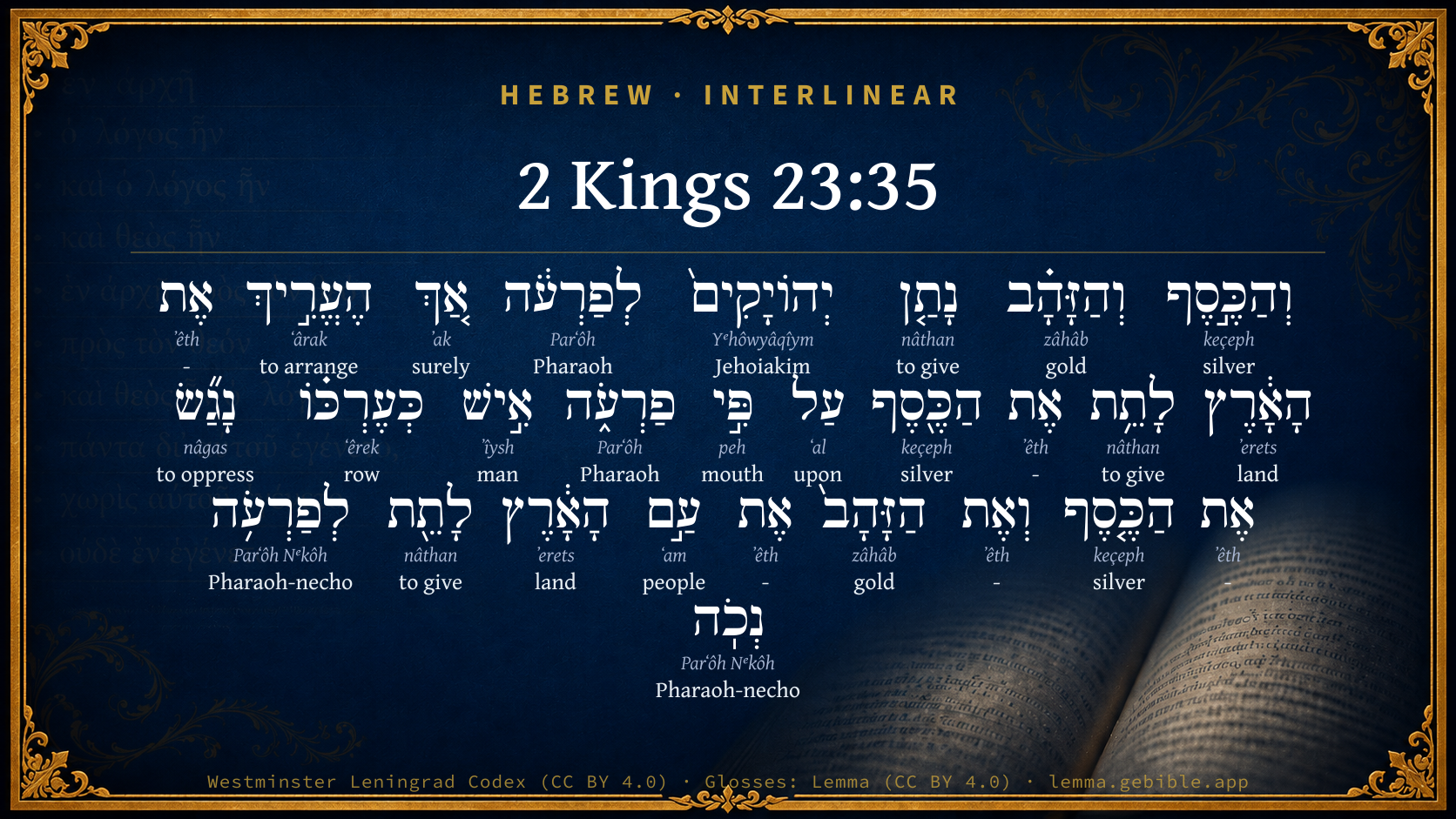
  1. וְהַכֶּ֣סֶף keçeph H3701 “and · the · silver” Conjunction + Particle, Definite Article + Noun, Common, Masculine, Singular, Absolute
  2. וְהַזָּהָ֗ב zâhâb H2091 “and · the · gold” Conjunction + Particle, Definite Article + Noun, Common, Masculine, Singular, Absolute
  3. נָתַ֤ן nâthan H5414 “to give” Verb, Qal, Perfect, 3rd Person, Masculine, Singular
  4. יְהוֹיָקִים֙ Yᵉhôwyâqîym H3079 “Jehoiakim” Noun, Proper
  5. לְפַרְעֹ֔ה Parʻôh H6547 “to/for · Pharaoh” Preposition + Noun, Proper
  6. אַ֚ךְ ʼak H389 “surely” Particle, Accusative
  7. הֶעֱרִ֣יךְ ʻârak H6186 “to arrange” Verb, Hiphil, Perfect, 3rd Person, Masculine, Singular
  8. אֶת ʼêth H853 “-” Particle, Direct Object
  9. הָאָ֔רֶץ ʼerets H776 “the · land” Particle, Definite Article + Noun, Common, Both, Singular, Absolute
  10. לָתֵ֥ת nâthan H5414 “to give” Preposition + Verb, Qal, Infinitive Construct
  11. אֶת ʼêth H853 “-” Particle, Direct Object
  12. הַכֶּ֖סֶף keçeph H3701 “the · silver” Particle, Definite Article + Noun, Common, Masculine, Singular, Absolute
  13. עַל ʻal H5921 “upon” Preposition
  14. פִּ֣י peh H6310 “mouth of” Noun, Common, Masculine, Singular, Construct
  15. פַרְעֹ֑ה Parʻôh H6547 “Pharaoh” Noun, Proper
  16. אִ֣ישׁ ʼîysh H376 “man” Noun, Common, Masculine, Singular, Absolute
  17. כְּעֶרְכּ֗וֹ ʻêrek H6187 “like/as · row · his” Preposition + Noun, Common, Masculine, Singular, Construct + Suffix, Personal, 3rd Person, Masculine, Singular
  18. נָגַ֞שׂ nâgas H5065 “to oppress” Verb, Qal, Perfect, 3rd Person, Masculine, Singular
  19. אֶת ʼêth H853 “-” Particle, Direct Object
  20. הַכֶּ֤סֶף keçeph H3701 “the · silver” Particle, Definite Article + Noun, Common, Masculine, Singular, Absolute
  21. וְאֶת ʼêth H853 “and · -” Conjunction + Particle, Direct Object
  22. הַזָּהָב֙ zâhâb H2091 “the · gold” Particle, Definite Article + Noun, Common, Masculine, Singular, Absolute
  23. אֶת ʼêth H853 “-” Particle, Direct Object
  24. עַ֣ם ʻam H5971 “people of” Noun, Common, Masculine, Singular, Construct
  25. הָאָ֔רֶץ ʼerets H776 “the · land” Particle, Definite Article + Noun, Common, Both, Singular, Absolute
  26. לָתֵ֖ת nâthan H5414 “to give” Preposition + Verb, Qal, Infinitive Construct
  27. נְכֹֽה Parʻôh Nᵉkôh H6549 “Pharaoh-necho” Noun, Proper

About this verse

These counts appear in no published source. They are computed here, from the morphology-tagged text and Lemma’s own curated glosses. What Lemma adds →

28
words
16
distinct lemmas
Historical
section

Notable vocabulary

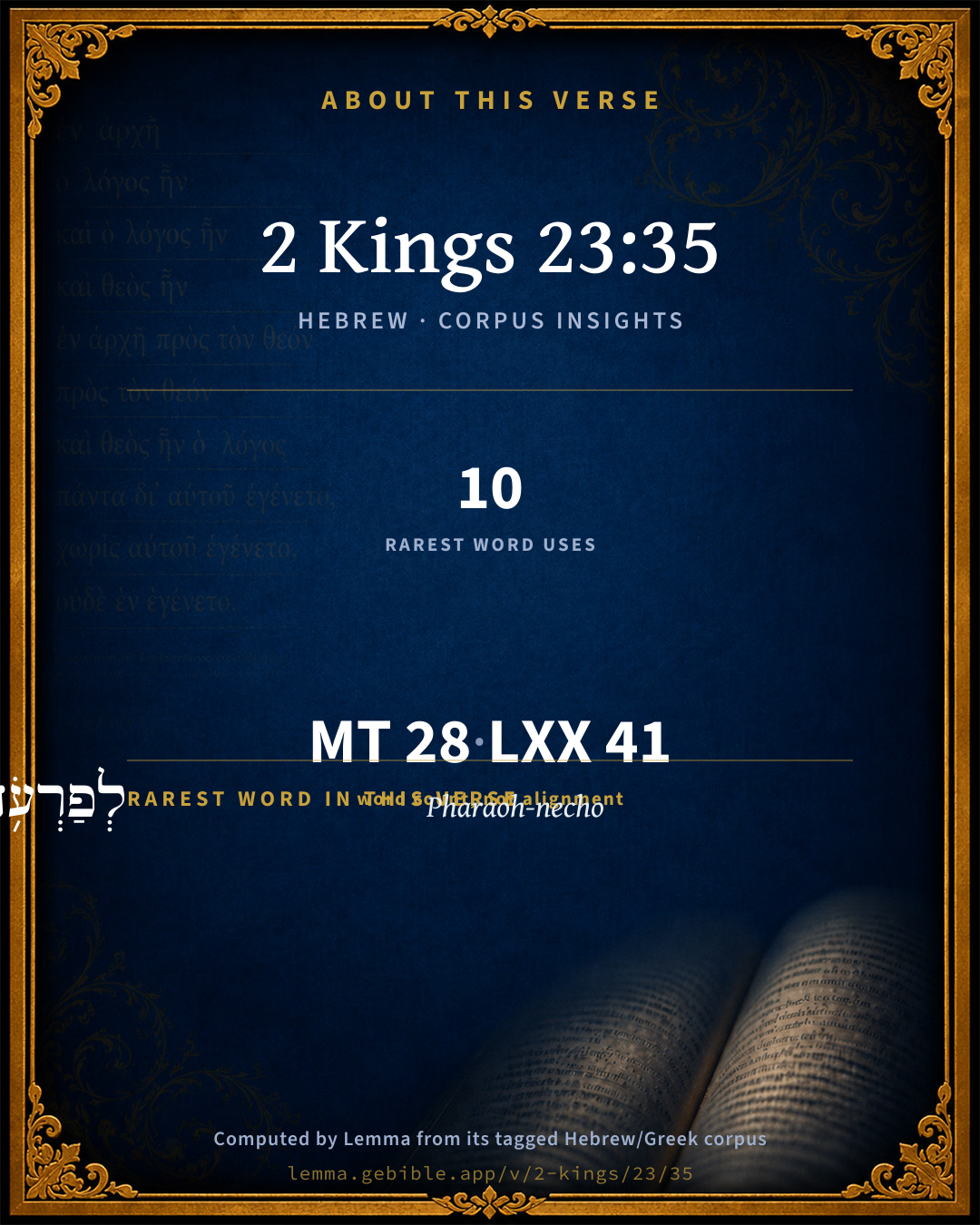
The rarest word here is לְפַרְעֹ֥ה Pharaoh-necho H6549 — appearing just 10 times in the whole Hebrew Bible.

Shared distinctive vocabulary

לְפַרְעֹ֥ה Pharaoh-necho H6549 occurs in 5 verses of the Hebrew Bible. Also found in:

Grammatical profile

  • 5 verbs
  • 16 nouns
  • 1 preposition
  • 6 particles

Verb forms

  • נָתַ֤ן Qal · Perfect
  • הֶעֱרִ֣יךְ Hiphil · Perfect
  • לָתֵ֥ת Qal · Infinitive Construct
  • נָגַ֞שׂ Qal · Perfect
  • לָתֵ֖ת Qal · Infinitive Construct

Repetition

Words recur within this verse — often emphatic in Hebrew:

  • וְהַכֶּ֣סֶף silver H3701 ×3
  • נָתַ֤ן to give H5414 ×3
  • וְהַזָּהָ֗ב gold H2091 ×2
  • לְפַרְעֹ֔ה Pharaoh H6547 ×2
  • הָאָ֔רֶץ land H776 ×2
  • לְפַרְעֹ֥ה Pharaoh-necho H6549 ×2

Hebrew & Septuagint length

In English translation the verse runs 49 words from the Hebrew and 49 from the Septuagint (LXX English) — the same length.

A rough comparison of the two English renderings, which tokenize alike — not a word-level alignment.

Word counts can differ between the Hebrew and the Greek without any difference in meaning — e.g. the Hebrew direct-object marker אֵת has no separate Greek word, and Greek often adds the article ὁ.

In the original languages it is 28 Hebrew tokens and 41 Greek tokens — but the two are counted differently (Hebrew bundles its prefixes and suffixes into one token; the Greek is in lemma form), so that isn’t a like-for-like length.

Cross-references

2

Topical passages linked to 2 Kings 23:35 in the Treasury of Scripture Knowledge — connected by theme and wording, ordered by reader-vote popularity; previews shown in the World English Bible.

  • 2 Kings 23:33 Pharaoh Necoh put him in bonds at Riblah in the land of Hamath, that he might not reign in Jerusalem; and put the land to a tribute of one hundred talents of silver, and a talent of gold.
  • 2 Kings 15:19–20 There came against the land Pul the king of Assyria; and Menahem gave Pul one thousand talents of silver, that his hand might be with him to confirm the kingdom in his hand.

Cross-references courtesy of OpenBible.info (CC BY 4.0).

Hebrew and Greek witnesses Masoretic Hebrew ↔ Greek Septuagint

The same verse in the two great witnesses to the Old Testament, shown verse-for-verse.

These are two independent witnesses, not word-aligned to each other, and the Septuagint is shown in lemma (dictionary) form.

Hebrew 2 Kings 23:35 Masoretic · Westminster Leningrad Codex

וְהַכֶּ֣סֶף וְהַזָּהָ֗ב נָתַ֤ן יְהוֹיָקִים֙ לְפַרְעֹ֔ה אַ֚ךְ הֶעֱרִ֣יךְ אֶת הָאָ֔רֶץ לָתֵ֥ת אֶת הַכֶּ֖סֶף עַל פִּ֣י פַרְעֹ֑ה אִ֣ישׁ כְּעֶרְכּ֗וֹ נָגַ֞שׂ אֶת הַכֶּ֤סֶף וְאֶת הַזָּהָב֙ אֶת עַ֣ם הָאָ֔רֶץ לָתֵ֖ת לְפַרְעֹ֥ה נְכֹֽה

Jehoiakim gave the silver and the gold to Pharaoh; but he taxed the land to give the money according to the commandment of Pharaoh: he exacted the silver and the gold of the people of the land, of everyone according to his taxation, to give it to Pharaoh Necoh.

World English Bible · Public Domain

Greek LXX 2 Kings 23:35 Septuagint · lemma form

καί ὁ ἀργύριον καί ὁ χρυσίον δίδωμι ιωακιμ ὁ φαραώ πλήν τιμογραφέω ὁ γῆ ὁ δίδωμι ὁ ἀργύριον ἐπί στόμα φαραώ ἀνήρ κατά ὁ συντίμησις αὐτός δίδωμι ὁ ἀργύριον καί ὁ χρυσίον μετά ὁ λαός ὁ γῆ δίδωμι ὁ φαραώ νεχαω

And Joakim gave the silver and the gold to Pharao; but he assessed the land to give the money at the command of Pharao: they gave the silver and the gold each man according to his assessment together with the people of the land to give to Pharao Nechao.

LXX2012 (modern English Septuagint) · Public Domain

Hebrew: Westminster Leningrad Codex (CC BY 4.0). Greek: Septuagint (public domain); English from LXX2012 (modern English Septuagint) (Public Domain). How the Septuagint differs from the Hebrew →

Targum (Aramaic paraphrase)

1

The Targum is the ancient Jewish Aramaic paraphrase of the Hebrew Scriptures — an interpretive translation, not the Hebrew text itself. Onkelos (literal) and Pseudo-Jonathan (expansive) render the Torah, and Jonathan the Prophets. Coverage is partial: where no permissively-licensed English translation exists for a verse, only the Aramaic is shown. This is verse-level text, not a word-by-word alignment to the Hebrew.

  1. Targum Jonathan Prophets (Joshua–Malachi)
    וְכַסְפָא וְדַהֲבָא יְהַב יְהוֹיָקִים לְפַרְעֹה בְּרַם רְמָא מַגְבִּיתָא עַל עַמָא דְאַרְעָא לְמִתַּן יַת כַּסְפָּא עַל מֵימְרָא דְפַרְעֹה גְבַר כַּד חֲזֵי טַקִיס יַת כַּסְפָּא וְיַת דַהֲבָא מִן עַמָא דְאַרְעָא לְמִתַּן לְפַרְעֹה חֲגִירָא:

    (no public-domain English translation for this verse)

    Targum Jonathan — Aramaic: “Mikraot Gedolot” (public domain). English: “Sefaria Community Translation” (CC0 1.0 (public-domain dedication)); “London "Chaldee Paraphrase," 1871” (public domain). Text via Sefaria.

Commentary

Notes on 2 Kings 23:35 from classic Christian and Jewish commentators (each source and its license shown beneath its notes). The classic Christian expositions comment on the surrounding passage and are grouped to its opening verse, so a note may address several verses; the Jewish commentaries on the Tanakh (Rashi and others) are per-verse, so they appear only where the commentator wrote on this verse.

Lemma curates 59 commentaries, every one of them public domain or Creative Commons licensed, each selected and text-cleaned for this edition rather than reprinted as found. About our sources →

Ellicott's Commentary for English Readers

THE REIGN OF JEHOIAKIM (2Ki_23:35 to 2Ki_24:7).

(35) And Jehoiakim gave.—And the silver and the gold did Jehoiakim give . . . He had to pay for his elevation. The raising of the fine of 2Ki_23:33 is described in this verse.

But he taxed . . .—The king kept his pledge to Pharaoh, but not out of his own means. He exacted the money from “the people of the land,” i.e., the people of all classes, levying a fixed contribution even upon the poorest of his subjects. As in 2Ki_11:14; 2Ki_14:21; 2Ki_21:24, Thenius insists that “the people of the land” are the national militia, and he renders: “he exacted the silver and the gold, along with (i.e., by the help of) the people of the land.” But this is, to say the least, very questionable. (See Note on 2Ki_11:14.)

(36) He reigned eleven years.—Not eleven full years. (Comp. Jer_25:1 with 2Ki_24:12; and Jeremiah 3 with 2Ki_25:8.)

His mother’s name was Zebudah.—So the Hebrew margin and Targum. Hebrew text, Syriac, Vulg., Arabic, Zebidah. Zebadiah may have been the real name. The mother of Jehoahaz was Hamutal (2Ki_23:31). Thus Josiah had at least two wives, and probably more. (Comp. 2Ki_24:15.) He could not have been over fourteen when he begot Jehoiakim.

Rumah.—Perhaps Arumah, near Shechem (Jdg_9:41), as Josephus has Abumah. This is interesting as a slight indication that Josiah’s power extended over the territory of the former kingdom of Samaria.

(37) He did that which was evil . . .—Jeremiah represents him as luxurious, covetous, and violent (Jer_22:13 seq.). He murdered Urijah a prophet (Jer_26:20 seq.). Ewald thinks that he introduced Egyptian animal-worship (Eze_8:7 seq.), which is rendered highly probable by his relation of dependence on Necho. (Comp. the introduction of Assyrian star-worship under Ahaz.)

A Bible Commentary for English Readers, edited by Charles John Ellicott (1878–1897) — public domain. Text from a community e-Sword module.

Trapp's Complete Commentary

John Trapp

2Ki 23:35 And Jehoiakim gave the silver and the gold to Pharaoh; but he taxed the land to give the money according to the commandment of Pharaoh: he exacted the silver and the gold of the people of the land, of every one according to his taxation, to give [it] unto Pharaohnechoh.

Ver. 35. He exacted.] Though he received, likely, from his subjects no less sums of curses than of coin.

John Trapp, A Commentary or Exposition upon All the Books of the Old and New Testament (1647–1656) — public domain. Text from a community e-Sword module.

Adam Clarke's Commentary

Verse 35. Jehoiakim gave the silver and the gold] Nechoh had placed him there as viceroy, simply to raise and collect his taxes.

Every one according to his taxation] That is, each was assessed in proportion to his property: that was the principle avowed: but there is reason to fear that this bad king was not governed by it.

Adam Clarke's Commentary on the Bible (1810–1826) — public domain. Text from a community e-Sword/MySword module.

The Cambridge Bible for Schools and Colleges

gen. ed. J. J. S. Perowne

35. he exacted the silver and the gold of the people of the land] The king did not undertake to pay, as had been done aforetime (cf. 2Ki_16:8; 2Ki_18:15) this tax out of any treasures in the house of the Lord, or of the king’s house. In those troublous days there was likely to be but little in store, so a tax was laid on the whole people.

2Ki_23:36 to 2Ki_24:7. Jehoiakim king of Judah. Nebuchadnezzar makes him tributary. His many adversaries. Jehoiachin, his son, succeeds him (2Ch_36:5-8)

The Cambridge Bible for Schools and Colleges (gen. ed. J. J. S. Perowne; Cambridge University Press, 1878–1918) — public domain. Text from a community e-Sword module.

John Gill's Exposition

And he did that which was evil in the sight of the Lord, according to all that his fathers had done. Amon and Manasseh; see Kg2 23:32.

Next: 2 Kings Chapter 24

John Gill's Exposition of the Whole Bible (1746–1763) — public domain (CC PDM 1.0). Text via the HelloAO Bible API.

Whedon's Commentary on the Bible

Daniel D. Whedon

35. Jehoiakim gave the silver — The payment of this tribute is mentioned before the writer takes up directly the history of Jehoiakim’s reign, probably because the commandment of Pharaoh required him to pay the tribute as the condition of his being elevated to the throne.

Daniel D. Whedon (gen. ed.), Commentary on the Old and New Testaments (1874–1909) — public domain. Text from a community e-Sword module.

The Pulpit Commentary

And Jehoiakim gave the silver and the gold to Pharaoh. Jehoiakim, i.e. , paid the tribute, which Nechoh had fixed (ver. 33), regularly. He did not, however, pay it out of the state treasury, which was exhausted. But he taxed the land to give the money according to the commandment of Pharaoh: he exacted the silver and the gold of the people of the land, of every one according to his taxation, to give it unto Pharaoh-Nechoh; rather, he had the land valued , (comp. Lev_27:8) and "exacted the silver and the gold of the people of the land, of every one according to his valuation."

The Pulpit Commentary (1880–1919), ed. H.D.M. Spence-Jones & Joseph S. Exell — public domain. Text from a community e-Sword module.

Rashi

Rabbi Shlomo Yitzchaki (Rashi)

Each one according to his assessment. According to his wealth.

Rashi on the Tanakh — English translations: “The Judaica Press complete Tanach with Rashi, translated by A. J. Rosenberg” (CC BY 4.0); “Pentateuch with Rashi's commentary by M. Rosenbaum and A.M. Silbermann, 1929-1934” (public domain); “The Metsudah Tanach series, Lakewood, N.J” (CC BY 4.0); and “The Book of Joshua, Metsudah Publications, 1997” (CC BY 4.0). Text via Sefaria.

Lesson kit

Teaching starters — assembled from the data on this page, not authored interpretation. Every prompt links to the verse data it draws on. Edit before teaching.

2 Kings, in the Historical, opens this verse with 28 words (16 distinct Hebrew lemmas). Its most distinctive word is Parʻôh Nᵉkôh (“Pharaoh-necho”). A historical commentator’s framing appears above. Read the whole chapter for the surrounding context.

Discussion questions

  1. What does “Pharaoh-necho” (Parʻôh Nᵉkôh) contribute to the verse as a whole?
  2. How does 2 Kings 23:29, which shares the word «Pharaoh-necho», read alongside this verse?
  3. What does the repetition of “silver” (3× in this one verse) do in this verse?
  4. These translations render this verse differently. What is at stake in choosing one wording over another?
  5. «נָתַ֤ן» is a Qal Perfect verb. How does that grammatical form shape the action described?
  6. Compare how Ellicott's Commentary for English Readers and Trapp's Complete Commentary read this verse. Where do they agree or differ?

Things to notice

Reading settings

Reading text

Shown beneath each verse's original-language words.

Old Testament
Old Testament edition

Read the OT as the Masoretic Hebrew (MT) or the Greek Septuagint (LXX).

English shown for the Greek Septuagint (in the Hebrew ↔ Greek comparison).

Comparing translations? Open the Compare panel on any verse page to stack up to four side by side.