1 Kings 9:28

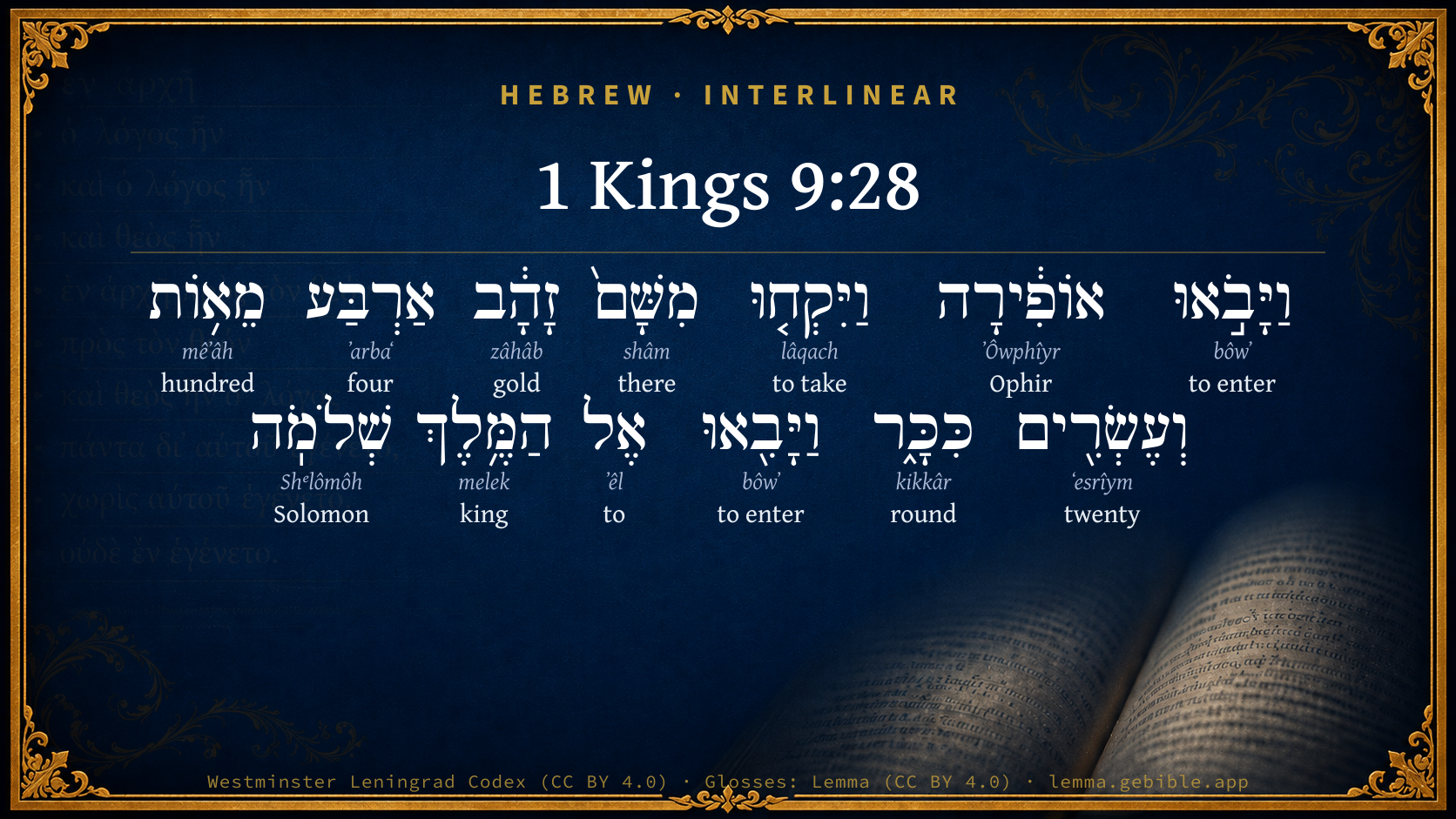
Hebrew (Westminster Leningrad Codex) 1 Kings 9:28 appears in the Hebrew Old Testament. The text above is from the Westminster Leningrad Codex. Each word links to its Strong’s number, a concise gloss, and parsing drawn from the Open Scriptures Hebrew Bible morphology. Click any word for its full Brown-Driver-Briggs (BDB) entry.
Download image
Cite this verse

1 Kings 9:28 (World English Bible). Public Domain. Lemma interlinear Bible study tool, https://lemma.gebible.app/v/1-kings/9/28.

Show BibTeX & RIS
BibTeX
RIS
English Translation
They came to Ophir, and fetched from there gold, four hundred and twenty talents, and brought it to king Solomon.
World English Bible · Public Domain
Download a study sheet

One document with this verse’s original text, its word-by-word gloss line, the meaning frame, cross-references with their text, attributed commentary, and full source and license credits — printable, and it pastes into notes with its structure intact.

This verse Autodidact and up

Study sheet (.html) Plain text (.txt)

A passage Seminary Student

Up to 50 verses in one chapter. A passage sheet keeps up to 6 commentary sources and 12 cross-references per verse, in the order this page ranks them, and says so on the sheet whenever that leaves anything out. Ask for a single verse and you get the Autodidact verse sheet above.

Everything on this page stays free to read, with no account — the sheet is a download of what is already on screen, not access to it.

Want to remove ads? Support Godless Engineer
Compare translations 3

The same verse in 3 English versions, stacked beneath the original-language interlinear above. Click any original word for its lexicon entry.

Each is an independent rendering of the whole verse — the interlinear is not word-aligned to these translations.

Highlighted words mark where these versions differ — a whole-verse word diff, not a word-by-word alignment.

  • World English Bible Public Domain
    They came to Ophir, and fetched from there gold, four hundred and twenty talents, and brought it to king Solomon.
  • King James Version Public Domain
    And they came to Ophir, and fetched from thence gold, four hundred and twenty talents, and brought it to king Solomon.
  • unfoldingWord Literal Text CC BY-SA 4.0
    And they came to Ophir, and they took gold from there, 420 kikkars. And they brought it to King Solomon.

unfoldingWord Literal Text — © unfoldingWord, licensed CC BY-SA 4.0. Word-aligned USFM3 via Door43 (git.door43.org/unfoldingWord/en_ult).

Versions to compare (up to 4)

3 of 4 selected

Show all 18 translations

Every available English version of this verse, each an independent rendering of the whole verse.

  • World English Bible Public Domain
    They came to Ophir, and fetched from there gold, four hundred and twenty talents, and brought it to king Solomon.
  • Berean Standard Bible Public Domain
    They sailed to Ophir and imported gold from there—420 talents—and delivered it to Solomon.
  • Majority Standard Bible Public Domain
    They sailed to Ophir and imported gold from there—420 talents—and delivered it to Solomon.
  • King James Version Public Domain
    And they came to Ophir, and fetched from thence gold, four hundred and twenty talents, and brought it to king Solomon.
  • American Standard Version (1901) Public Domain
    And they came to Ophir, and fetched from thence gold, four hundred and twenty talents, and brought it to king Solomon.
  • Revised Version (1885) Public Domain
    And they came to Ophir, and fetched from thence gold, four hundred and twenty talents, and brought it to king Solomon.
  • Geneva Bible (1599) Public Domain
    And they came to Ophir and sette from thence foure hundreth and twentie talents of gold, and brought it to King Salomon.
  • Douay-Rheims (1899) Public Domain
    And they came to Ophir, and they brought from thence to king Solomon four hundred and twenty talents of gold.
  • Young's Literal Translation Public Domain
    and they come in to Ophir and take thence gold, four hundred and twenty talents, and bring `it' in unto king Solomon.
  • Literal Standard Version CC BY-SA 4.0
    and they come to Ophir, and take four hundred and twenty talents of gold from there, and bring [it] to King Solomon.
  • Unlocked Literal Bible CC BY-SA 4.0
    They went to Ophir with servants of Solomon. From there they brought back 420 talents of gold for King Solomon.
  • unfoldingWord Literal Text CC BY-SA 4.0
    And they came to Ophir, and they took gold from there, 420 kikkars. And they brought it to King Solomon.
  • Darby Bible Public Domain
    and they went to Ophir, and fetched thence gold, four hundred and twenty talents, and brought it to king Solomon.
  • World Messianic Bible Public Domain
    They came to Ophir, and fetched from there gold, four hundred and twenty talents, and brought it to King Solomon.
  • Webster's Bible Public Domain
    And they came to Ophir, and imported from thence gold, four hundred and twenty talents, and brought it to king Solomon.
  • Free Bible Version CC BY-SA 4.0
    They sailed to Ophir and brought back 420 talents of gold from there and delivered it to Solomon.
  • Bible in Basic English Public Domain
    And they came to Ophir, where they got four hundred and twenty talents of gold, and took it back to King Solomon.
  • JPS Tanakh (1917) Public Domain
    And they came to Ophir, and fetched from thence gold, four hundred and twenty talents, and brought it to king Solomon.

Literal Standard Version (2020), Covenant Press — licensed CC BY-SA 4.0. Text via the HelloAO Bible API (eBible.org). Unlocked Literal Bible (unfoldingWord) — licensed CC BY-SA 4.0. Text via the HelloAO Bible API (eBible.org). unfoldingWord Literal Text — © unfoldingWord, licensed CC BY-SA 4.0. Word-aligned USFM3 via Door43 (git.door43.org/unfoldingWord/en_ult). Free Bible Version, Dr. Jonathan Gallagher — licensed CC BY-SA 4.0. Text via the HelloAO Bible API (eBible.org).

Word by word

More ways to search: Search by grammar → Find every occurrence → Compare this word →

Practice this passage: Drill this verse → Learn its vocabulary →

אוֹפִ֔ירָה
ʼÔwphîyr
H211
“Ophir · toward”
Noun, Proper + Suffix, Demonstrative
Part of Speech
Noun
Type
Proper
Full BDB Definition

Origin: of uncertain derivation

TWOT: 50

Ophir = "reducing to ashes" - eleventh son of Joktan - a land or city in southern Arabia in Solomon's trade route where gold evidently was traded for goods - characteristic of fine gold - fine gold
  1. וַיָּבֹ֣אוּ bôwʼ H935 “and · to enter” Conjunction + Verb, Qal, Sequential Imperfect, 3rd Person, Masculine, Plural
  2. וַיִּקְח֤וּ lâqach H3947 “and · to take” Conjunction + Verb, Qal, Sequential Imperfect, 3rd Person, Masculine, Plural
  3. מִשָּׁם֙ shâm H8033 “from · there” Preposition + Adverb
  4. זָהָ֔ב zâhâb H2091 “gold” Noun, Common, Masculine, Singular, Absolute
  5. אַרְבַּע ʼarbaʻ H702 “four” Adjective, Cardinal number, Feminine, Singular, Absolute
  6. מֵא֥וֹת mêʼâh H3967 “hundred” Adjective, Cardinal number, Both, Plural, Absolute
  7. וְעֶשְׂרִ֖ים ʻesrîym H6242 “and · twenty” Conjunction + Adjective, Cardinal number, Both, Plural, Absolute
  8. כִּכָּ֑ר kikkâr H3603 “round” Noun, Common, Both, Singular, Absolute
  9. וַיָּבִ֖אוּ bôwʼ H935 “and · to enter” Conjunction + Verb, Hiphil, Sequential Imperfect, 3rd Person, Masculine, Plural
  10. אֶל ʼêl H413 “to” Preposition
  11. הַמֶּ֥לֶךְ melek H4428 “the · king” Particle, Definite Article + Noun, Common, Masculine, Singular, Absolute
  12. שְׁלֹמֹֽה Shᵉlômôh H8010 “Solomon” Noun, Proper

About this verse

These counts appear in no published source. They are computed here, from the morphology-tagged text and Lemma’s own curated glosses. What Lemma adds →

13
words
12
distinct lemmas
Historical
section

Notable vocabulary

The rarest word here is אוֹפִ֔ירָה Ophir H211 — appearing just 13 times in the whole Hebrew Bible.

Shared distinctive vocabulary

אוֹפִ֔ירָה Ophir H211 occurs in 12 verses of the Hebrew Bible. Also found in:

Grammatical profile

  • 3 verbs
  • 5 nouns
  • 3 adjectives
  • 1 preposition
  • 1 adverb

Verb forms

  • וַיָּבֹ֣אוּ Qal · Sequential Imperfect
  • וַיִּקְח֤וּ Qal · Sequential Imperfect
  • וַיָּבִ֖אוּ Hiphil · Sequential Imperfect

Repetition

A word recurs within this verse — often emphatic in Hebrew:

  • וַיָּבֹ֣אוּ to enter H935 ×2

Hebrew & Septuagint length

In English translation the verse runs 20 words from the Hebrew and 21 from the Septuagint (LXX English) — closely comparable.

A rough comparison of the two English renderings, which tokenize alike — not a word-level alignment.

Word counts can differ between the Hebrew and the Greek without any difference in meaning — e.g. the Hebrew direct-object marker אֵת has no separate Greek word, and Greek often adds the article ὁ.

Cross-references

9

Topical passages linked to 1 Kings 9:28 in the Treasury of Scripture Knowledge — connected by theme and wording, ordered by reader-vote popularity; previews shown in the World English Bible.

  • 1 Chronicles 29:4 even three thousand talents of gold, of the gold of Ophir, and seven thousand talents of refined silver, with which to overlay the walls of the houses;
  • 2 Chronicles 8:18 Huram sent him by the hands of his servants ships, and servants who had knowledge of the sea; and they came with the servants of Solomon to Ophir, and fetched from there four hundred fifty talents of gold, and brought them to king Solomon.
  • 1 Kings 10:11 The navy also of Hiram, that brought gold from Ophir, brought in from Ophir great plenty of almug trees and precious stones.
  • Job 22:24 Lay your treasure in the dust, The gold of Ophir among the stones of the brooks.
  • Job 28:16 It can't be valued with the gold of Ophir, With the precious onyx, or the sapphire.
  • Psalms 45:9 Kings' daughters are among your honorable women. At your right hand the queen stands in gold of Ophir.
  • Isaiah 13:12 I will make a man more rare than fine gold, even a man than the pure gold of Ophir.
  • Genesis 10:29 Ophir, Havilah, and Jobab. All these were the sons of Joktan.
  • 2 Chronicles 9:10 The servants also of Huram, and the servants of Solomon, who brought gold from Ophir, brought algum trees and precious stones.

Cross-references courtesy of OpenBible.info (CC BY 4.0).

Hebrew and Greek witnesses Masoretic Hebrew ↔ Greek Septuagint

The same verse in the two great witnesses to the Old Testament, shown verse-for-verse.

These are two independent witnesses, not word-aligned to each other, and the Septuagint is shown in lemma (dictionary) form.

Hebrew 1 Kings 9:28 Masoretic · Westminster Leningrad Codex

וַיָּבֹ֣אוּ אוֹפִ֔ירָה וַיִּקְח֤וּ מִשָּׁם֙ זָהָ֔ב אַרְבַּע מֵא֥וֹת וְעֶשְׂרִ֖ים כִּכָּ֑ר וַיָּבִ֖אוּ אֶל הַמֶּ֥לֶךְ שְׁלֹמֹֽה

They came to Ophir, and fetched from there gold, four hundred and twenty talents, and brought it to king Solomon.

World English Bible · Public Domain

Greek LXX 1 Kings 9:28 Septuagint · lemma form
And they came to Sophira, and took thence one hundred and twenty talents of gold, and brought them to king Solomon.

LXX2012 (modern English Septuagint) · Public Domain

On this verse, Ellicott's Commentary for English Readers discusses the Septuagint’s reading. Read the note in Commentary ↓

Hebrew: Westminster Leningrad Codex (CC BY 4.0). Greek: Septuagint (public domain); English from LXX2012 (modern English Septuagint) (Public Domain). How the Septuagint differs from the Hebrew →

Targum (Aramaic paraphrase)

1

The Targum is the ancient Jewish Aramaic paraphrase of the Hebrew Scriptures — an interpretive translation, not the Hebrew text itself. Onkelos (literal) and Pseudo-Jonathan (expansive) render the Torah, and Jonathan the Prophets. Coverage is partial: where no permissively-licensed English translation exists for a verse, only the Aramaic is shown. This is verse-level text, not a word-by-word alignment to the Hebrew.

  1. Targum Jonathan Prophets (Joshua–Malachi)
    וַאֲתוֹ לְאוֹפִיר וּנְסִיבוּ מִתַּמָן דַהֲבָא אַרְבַּע מְאָה וְעַשְׂרִין כִּכָּרִין וְאַיְתִיאוּ לְוַת מַלְכָּא שְׁלֹמֹה:

    (no public-domain English translation for this verse)

    Targum Jonathan — Aramaic: “Mikraot Gedolot” (public domain). English: “Sefaria Community Translation” (CC0 1.0 (public-domain dedication)); “London "Chaldee Paraphrase," 1871” (public domain). Text via Sefaria.

Commentary

Notes on 1 Kings 9:28 from classic Christian and Jewish commentators (each source and its license shown beneath its notes). The classic Christian expositions comment on the surrounding passage and are grouped to its opening verse, so a note may address several verses; the Jewish commentaries on the Tanakh (Rashi and others) are per-verse, so they appear only where the commentator wrote on this verse.

Lemma curates 59 commentaries, every one of them public domain or Creative Commons licensed, each selected and text-cleaned for this edition rather than reprinted as found. About our sources →

Trapp's Complete Commentary

John Trapp

1Ki 9:28 And they came to Ophir, and fetched from thence gold, four hundred and twenty talents, and brought [it] to king Solomon.

Ver. 28. And they came to Ophir,] i.e., To golden Chersonesus, saith Josephus; to Peru, or Hispaniola, say others, who hold that the newly found world, as we call America, was known to Solomon and the ancients; like as the Chinese say that they had the art of printing among them many hundreds of years before we had. The gold of this land is called gold of Parvaim, {2Ch 3:6} that is, of the two Perus, say they; the greater and the lesser.

Four hundred and twenty talents.] At one time: as at another, four hundred and fifty, {2Ch 8:18} for every three years they made a voyage thither, {1Ki 10:22} it being distant from Jerusalem four thousand eight hundred miles, as some have computed it.

John Trapp, A Commentary or Exposition upon All the Books of the Old and New Testament (1647–1656) — public domain. Text from a community e-Sword module.

Joseph Benson's Commentary

1Ki 9:28. They came to Ophir — A place famous for gold, which was found there in great plenty, and peculiarly fine. It is highly probable that this place was in India, but in what part of it is not easy to determine. Bochart thinks it was Taprobana, now called Ceylon, and shows that the account which the ancients give of the former, answers to that which the moderns give of the latter. It is certain that this island affords gold, ivory, and precious stones. The authors of the Universal History after confuting at large those opinions which seemed to them less probable, observe as follows: “Ophir appears most likely to have been in some of those remote, rich countries of India beyond the Ganges, and perhaps as far as China or Japan; which last still abounds with the finest gold, and several other commodities in which Solomon’s fleet dealt, as silver, precious stones, ebony, and other valuable sorts of wood, to say nothing of spices, peacocks, parrots, apes, and other such creatures; and by its distance best answers to the length of the voyage.” Gold, four hundred and twenty talents — It is said (2Ch 8:18) that they brought four hundred and fifty; but we may well suppose that thirty talents might be partly spent in the charges of the voyage to and fro, and partly allowed to Hiram and his men; so that only four hundred and twenty came clear into the king’s treasury. This, however, was a prodigious sum, being calculated to be above three millions two hundred thousand pounds sterling. How they obtained this vast quantity of gold, whether by exchanging various merchandises for it, or by finding out mines, or procuring it from the natives, does not appear.

Joseph Benson's Commentary on the Old and New Testaments (1811–1818) — public domain. Text from a community e-Sword module.

Geneva Bible (1599)

Geneva Bible translators

In 2 Chron. 8:18, is made mention of thirty more, which seem to have been employed for their charges.

Geneva Bible (1599) marginal notes — public domain. Text via Bolls.life.

Jamieson, Fausset & Brown

Robert Jamieson, A. R. Fausset & David Brown

Ophir--a general name, like the East or West Indies with us, for all the southern regions lying on the African, Arabian, or Indian seas, in so far as at that time known [HEEREN].

gold, four hundred and twenty talents--(See on Ch2 8:18). At 125 pounds Troy, or 1500 ounces to the talent, and about £4 to the ounce, this would make £2,604,000.

Next: 1 Kings Chapter 10

Jamieson, Fausset & Brown — Commentary Critical and Explanatory on the Whole Bible (1871) — public domain (CC PDM 1.0). Text via the HelloAO Bible API.

Adam Clarke's Commentary

Verse 28. And they came to Ophir] No man knows certainly, to this day, where this Ophir was situated. There were two places of this name; one somewhere in India, beyond the Ganges, and another in Arabia, near the country of the Sabaeans, mentioned by Job, Job 22:24: Then shalt thou lay up gold as dust; and the gold of Ophir as the stones of the brooks. And Job 28:16: It cannot be valued with the gold of Ophir, with the precious onyx, or the sapphire. Calmet places this country at the sources of the Euphrates and Tigris.

But there are several reasons to prove that this was not the Ophir of the Bible, which it seems was so situated as to require a voyage of three years long to go out, load, and return. Mr. Bruce has discussed this subject at great length; see his Travels, vol. ii., chap. iv., p. 354, c. He endeavours to prove

1. That Ezion-geber is situated on the Elanitic branch of the Arabian Gulf or Red Sea.

2. That Tharshish is Moka, near to Melinda, in the Indian Ocean, in about three degrees south latitude.

3. That Ophir lies somewhere in the land of Sofala, or in the vicinity of the Zimbeze river, opposite the island of Madagascar, where there have been gold and silver mines in great abundance from the remotest antiquity. And he proves,

4. That no vessel could perform this voyage in less than THREE years, because of the monsoons that more time need not be employed, and that this is the precise time mentioned in 1Kg 10:22.

5. That this is the country of the queen of Sheba, or Sabia, or Azeba, who on her visit to Solomon, brought him one hundred and twenty talents of gold, and of spices and precious stones great store, 1Kg 10:10. And that gold, ivory, silver, c., are the natural productions of this country.

To illustrate and prove his positions he has given a map on a large scale, "showing the track of Solomon's fleet in their three years' voyage from the Elanitic Gulf to Ophir and Tharshish" to which, and his description, I must refer the reader.

Adam Clarke's Commentary on the Bible (1810–1826) — public domain. Text from a community e-Sword/MySword module.

Ellicott's Commentary for English Readers

(28) Ophir.—All that can be certainly gathered from the mention of Ophir in the Old Testament is, first; that it was situated to the east of Palestine and approached by the Red Sea (as is clear from this passage, from 1Ki_22:48, and from 2Ch_8:18; 2Ch_9:10), and next, that so famous was the gold imported from it, that the “gold of Ophir” became proverbial (Job_22:24; Job_28:16; Psa_45:10; Isa_13:12; 1 Chronicles 4). All else is matter of speculation and tradition. Setting aside merely fanciful conjectures, substantial reasons have been given for fixing it geographically in Africa, Arabia, and India; and of these three positions, evidence strongly preponderates for the second or third. Tradition is in favour of India; the LXX. renders the name as Soufir, or Sofir, which is the Coptic word for “India; the Arabic versions actually render it “India;” and Josephus (Ant. viii. 6, 4) srates unhesitatingly that Ophir was in his day called “The Golden Chersonesus,” which is the Malay peninsula. On the other hand, it is urged that “Ophir,” in the ethnological list of Gen_10:29, is placed among the sons of Joktan, clearly indicating an Arabian position; and that the mention of Ophir (here and in 1Ki_10:11), stands in close connection with the visit of the Queen of Sheba and the gold brought from Arabia. But neither of these considerations is conclusive. Looking to the products described as brought from Ophir, the “gold and precious stones” would suit either. but India better than Arabia (although, indeed, so far as gold is concerned, Western Africa would have better claim than either); while the “almug,” or “algum” wood is certainly the “sandal wood” found almost exclusively on the Malabar coast, and the very word “algum” appears to be a corruption of its Sanscrit name valguka. If the other imports mentioned in 1Ki_10:22 were also from Ophir, this latter argument would be greatly strengthened. (See Note there.) But putting this aside as doubtful, the preponderance of evidence still appears to be in favour of India. The Tyrians, it may be added, are known to have had trading settlements on the Persian Gulf, and to have rivalled in the trade of the East the Egyptians, to whom it would more naturally have belonged. Various places have been named conjecturally as identical with Ophir: as in Arabia, Zaphar or Saphar, Doffir, and Zafari; in Africa, Sofala; and in India, Abhira, at the mouth of the Indus, and a Soupara mentioned by ancient Greek geographers, not far from Goa.

A Bible Commentary for English Readers, edited by Charles John Ellicott (1878–1897) — public domain. Text from a community e-Sword module.

The Cambridge Bible for Schools and Colleges

gen. ed. J. J. S. Perowne

28. they came to Ophir] There is not sufficient evidence to decide where Ophir was. The most probable conjectures have been Africa, India and Arabia. But on account of the productions named in connexion with the place in chap. 1Ki_10:11 Africa has been almost universally given up. And in the decision between India and Arabia, the latter seems the more likely, partly because it is nearer to reach from Ezion-geber, which is a consideration not without weight in questions connected with early navigation, and partly because the first mention of Ophir (Gen_10:29) makes it refer to the descendants of Joktan, whose home was in Arabia. There is no necessity to conclude that the commodities brought from Ophir, gold, almug-trees and precious stones, were products of the land. Almug-wood has been supposed to be the same with sandal-wood, but the evidence on this point seems very inconclusive, and if it were proved, it might well be that the wood, produced in India, was brought to some mart on the Arabian coast for sale. The ports of Yemen and the Persian Gulf were great entrepots of commerce from the earliest times. With precious stones also this could easily be done, and with gold too. But the gold of Sheba (i.e. Arabia) is noted as famous in Psa_72:15; Isa_60:6. There appears therefore to be more in favour of some place on the coast of Arabia than for any other suggested site of Ophir. Josephus however says it was in India (Ant. viii. 6. 4), and that a more modern name is Χρυσῆ γῆ.

four hundred and twenty talents] The sum seems enormous, £2,250,000. What could a country like Palestine furnish in exchange? Perhaps the sum represents the total of many expeditions. The parallel passage in 2 Chron. (1Ki_8:18) says ‘four hundred and fifty talents,’ Josephus ‘about four hundred.’ The LXX. (Vat.) gives ‘one hundred and twenty talents.’ The expedition appears to have been all for Solomon’s benefit, as we hear nothing of any share of the adventure given to the Tyrian king.

The Cambridge Bible for Schools and Colleges (gen. ed. J. J. S. Perowne; Cambridge University Press, 1878–1918) — public domain. Text from a community e-Sword module.

Albert Barnes' Notes on the Bible

On Ophir, see the marginal reference note. Among the various opinions three predominate; all moderns, except a very few, being in favor of Arabia, India, or Eastern Africa. Arabia’s claims are supported by the greatest number.

Albert Barnes' Notes on the Bible (1834–1885) — public domain. Text from a community e-Sword/MySword module.

Haydock's Catholic Bible Commentary

Ophir, in the East Indies; (Menochius) an island called Taprobana, or Sumatra; (Salien) or a country near the heads of the Euphrates and Tigris. (Calmet, Dissert.) --- The variety of opinions is astonishing. Huet fixes upon Sophola, on the eastern coast of Africa; and supposes that the fleet of Hiram might proceed down a canal, which seems to have been formerly opened for a communication between the Mediterranean and the Red Sea. (Strabo i. 17., and ii.) (Du Hamel) --- The various commodities might be procured either in Africa, or, on the voyage, in other countries. (Haydock) --- Twenty. Paralipomenon reads fifty. The letter c (20) and n (50) may easily have been mistaken. (Huet) --- The thirty talents might be the value of other parts of the cargo, or might be spent in repairs and wages. (Calmet) --- The sum here mentioned might be also refined gold. (Menochius)

George Leo Haydock (1774–1849), Haydock's Catholic Family Bible and Commentary, 1859 edition — public domain. Excludes Psalms (Douay-Rheims chapter numbering differs from Protestant) and Deuterocanonical books (Catholic canon only).

Matthew Poole's English Annotations

Ophir; a place famous for the plenty and fineness of the gold there; of which see Gen 2:11,12; Job 22:24; 28:16; Psa 45:9; Isa 13:12. It is manifest and agreed that it was a part of the East Indies, which though very remote from us, yet was far nearer to the Red Sea, from whence they might easily sail to it in these ancient times, because they needed not to go far from the coast to come to it, because they might (according to the manner of these first ages) sail all along near the coast, though the voyage was thereby more tedious, which was the reason why three years were spent in it. And here, and here only, were to bc had all the commodities which Solomon fetched from Ophir, 1Ki 10:22.

Four hundred and twenty talents: in all there came to the king four hundred and fifty talents, whereof it seems thirty talents were allowed by Solomon to Hiram and his men for the voyage, and so there were only four hundred and twenty that came clearly into the king’s treasury.

Matthew Poole's English Annotations on the Holy Bible (1683–1685) — public domain. Text from a community e-Sword/MySword module.

Whedon's Commentary on the Bible

Daniel D. Whedon

28. Ophir — Endless have been the conjectures as to the locality of Ophir; but there are no sufficient data to bring the question to a positive decision. India, Africa, and Arabia have each been urged with much plausibility. But the assumption made by many critics, that this navy fitted out by Solomon from Ezion-geber to bring gold from Ophir is identical with the “navy of Tarshish,” (1Ki_10:22,) that returned only once in three years, and that Jehoshaphat’s “ships of Tarshish,” built and broken at Ezion-geber, which were designed to go to Ophir for gold, (1Ki_22:48,) and also to go to Tarshish, (2Ch_20:36-37,) necessarily involve the conclusion that Ophir and Tarshish were contiguous, or on the same route, is at best only a supposition. To us it seems most probable that Ophir was a region somewhere in Arabia. For, 1.) It must have been easily accessible from Ezion-geber. 2.) Several ancient authorities affirm that gold was formerly abundant in Arabia. 3.) The region probably took its name from Ophir, the son of Joktan, (Gen_10:29,) and it is quite generally agreed that the Joktanites peopled Southern Arabia. Sheba, the region in Southern Arabia ruled by the celebrated queen who visited Solomon, (1Ki_10:1,) probably received its name from Sheba, another son of Joktan, who is mentioned Gen_10:28, in immediate connexion with Ophir, and probably settled in a district adjoining him. So a navy that carried on a regular traffic with Ophir would be likely to spread the fame of Solomon to the neighbouring province, and at this time the queen of Sheba might have ruled the districts both of Sheba and Ophir.

Four hundred and twenty — In 2Ch_8:18 the reading is four hundred and fifty, which is probably the error of some early transcriber, who mistook כ, twenty, for נ, fifty.

Daniel D. Whedon (gen. ed.), Commentary on the Old and New Testaments (1874–1909) — public domain. Text from a community e-Sword module.

The Pulpit Commentary

And they came to Ophir It is perhaps impossible to identify this place with any degree of precision. The opinions of scholars may, however, be practically reduced to two, The first would place Ophir in India; the second in southern Arabia. In favour of India is

(1) the three years" voyage; (but see on 1Ki_10:22)

(2) most of the other treasures brought back by the fleet, exclusive of gold, are Indian products. But against it is urged the important fact that no gold is now found there, south of Cashmere, whilst south Arabia was famed for its abundant gold (Psa_72:15; Eze_27:22) On the other hand, it is alleged that in ancient times India was rich in gold (Ewald, 3. p. 264), and that there are no traces of gold mines in Arabia. The question is discussed at considerable length and with great learning by Mr. Twisleton (Dict. Bib. art. "Ophir"). He shows that it is reasonably certain

(1) that the Ophir of Gen_10:29 is the name of some city, region, or tribe in Arabia, and

(2) that the Ophir of Genesis is the Ophir of the Book of Kings. And Gesenius, Bahr, Keil, al. agree with him in locating Ophir in the latter country. Ewald, however, sees in Ophir "the most distant coasts of India," and it is probable that the Hebrews used the word somewhat loosely, as they did the corresponding word Tarshish, and as we do the words East and West Indies. They were not geographers, and Ophir may have been merely an emporium where the products of different countries were collected, or a nomen generale for "all the countries lying on the African, Arabian, or Indian seas, so far as at that time known" (Heeren). See on, 1Ki_10:5 and fetched from thence gold, four hundred and twenty talents The chronicler says 450. The discrepancy is easily accounted for, 20 being expressed by k; 50 by n. Wordsworth suggests that "perhaps thirty were assigned to Hiram for his help" and brought it to king Solomon .

The Pulpit Commentary (1880–1919), ed. H.D.M. Spence-Jones & Joseph S. Exell — public domain. Text from a community e-Sword module.

John Wesley's Explanatory Notes

Ophir - A place famous for the plenty and fineness of the gold there. It is agreed, that it was a part of the East-Indies, probably Ceylon, which though very remote from us, yet was far nearer the Red-sea, from whence they might easily sail to it in those ancient times, because they might (according to the manner of those first ages) sail all along near the coast, though the voyage was thereby more tedious, which was the reason why three years were spent in it. And here, and here only were to be had all the commodities which Solomon fetched from Ophir, chap. x, 22. Fetched - In all there came to the king four hundred and fifty talents, whereof it seems thirty talents were allowed to Hiram and his men, and so there were only four hundred and twenty that came clear into the king's treasury.

John Wesley, Explanatory Notes Upon the Whole Bible (1754–1765) — public domain. Text via the GEBible commentary corpus.

Lesson kit

Teaching starters — assembled from the data on this page, not authored interpretation. Every prompt links to the verse data it draws on. Edit before teaching.

1 Kings, in the Historical, opens this verse with 13 words (12 distinct Hebrew lemmas). Its most distinctive word is ʼÔwphîyr (“Ophir”). A historical commentator’s framing appears above. Read the whole chapter for the surrounding context.

Discussion questions

  1. What does “Ophir” (ʼÔwphîyr) contribute to the verse as a whole?
  2. Genesis 10:29 shares the word «Ophir» with this verse. How do the two illuminate each other?
  3. “to enter” occurs 2× in this one verse. What is the effect of the repetition?
  4. These translations render this verse differently; the difference is in the English rendering, not the original. What questions does that raise?
  5. The verb «וַיָּבֹ֣אוּ» is Qal Sequential Imperfect. How does its form color the action?
  6. Reading how Trapp's Complete Commentary and Joseph Benson's Commentary read this verse, where do the two commentators agree and where do they part?

Things to notice

Reading settings

Reading text

Shown beneath each verse's original-language words.

Old Testament
Old Testament edition

Read the OT as the Masoretic Hebrew (MT) or the Greek Septuagint (LXX).

English shown for the Greek Septuagint (in the Hebrew ↔ Greek comparison).

Comparing translations? Open the Compare panel on any verse page to stack up to four side by side.