
2 Chronicles 3:6

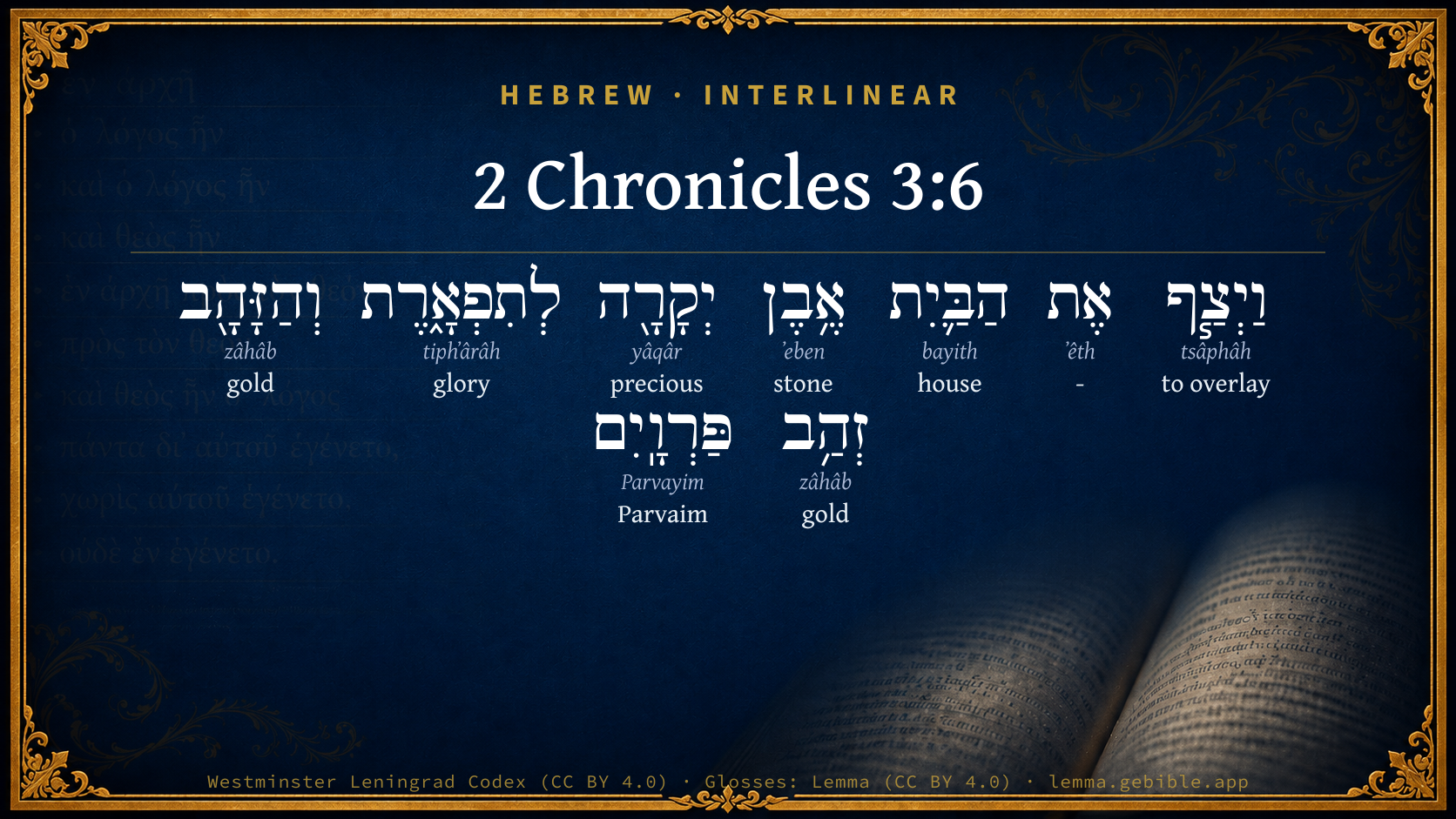
Hebrew (Westminster Leningrad Codex) 2 Chronicles 3:6 appears in the Hebrew Old Testament. The text above is from the Westminster Leningrad Codex. Each word links to its Strong’s number, a concise gloss, and parsing drawn from the Open Scriptures Hebrew Bible morphology. Click any word for its full Brown-Driver-Briggs (BDB) entry.
Download image
Cite this verse

2 Chronicles 3:6 (World English Bible). Public Domain. Lemma interlinear Bible study tool, https://lemma.gebible.app/v/2-chronicles/3/6.

Show BibTeX & RIS
BibTeX
RIS
English Translation
He garnished the house with precious stones for beauty: and the gold was gold of Parvaim.
World English Bible · Public Domain
Highlights
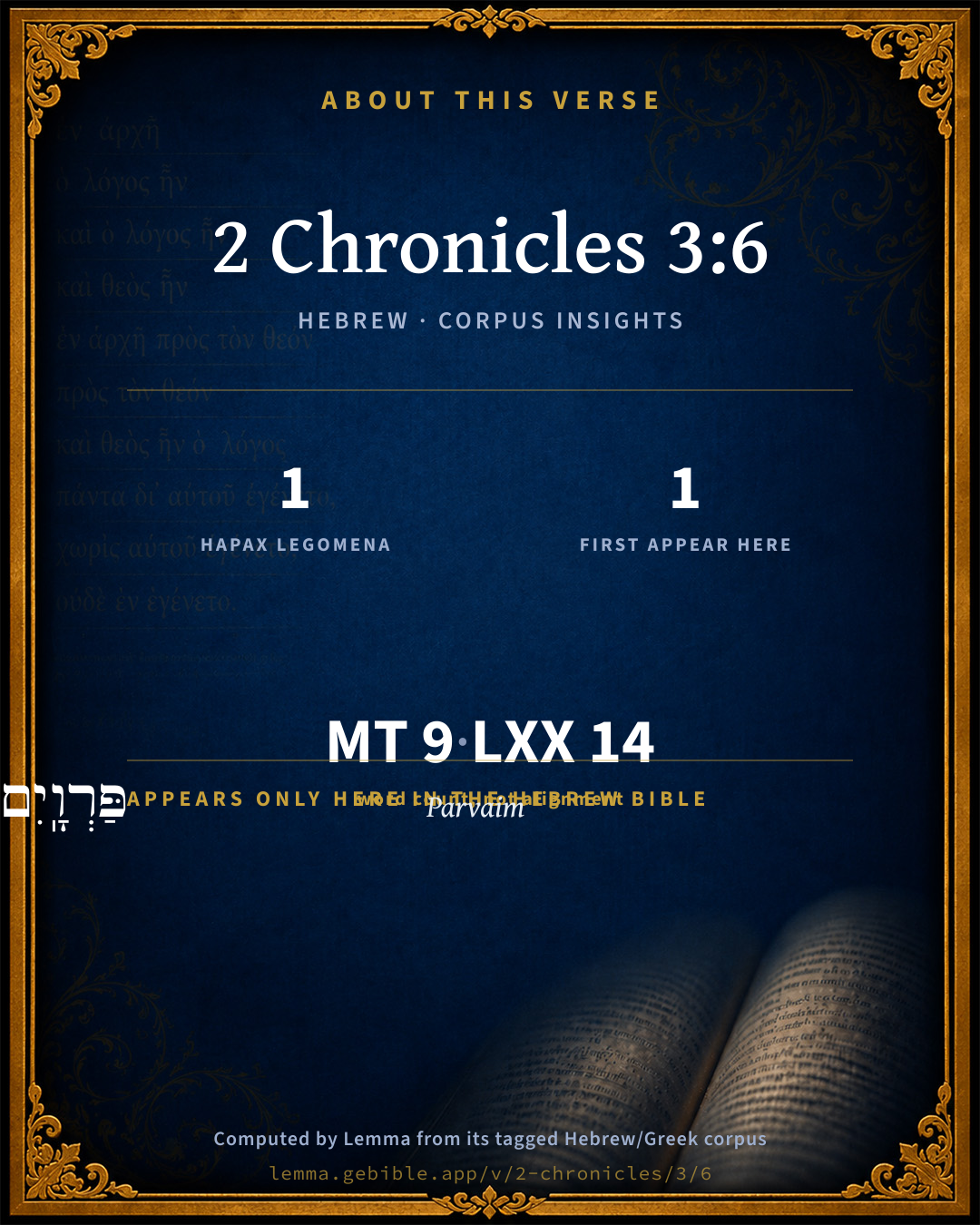
  • 1 hapax legomenon — only here in the Hebrew Bible
  • 1 first appearance in the Hebrew Bible
Full analysis ↓
Download a study sheet

One document with this verse’s original text, its word-by-word gloss line, the meaning frame, cross-references with their text, attributed commentary, and full source and license credits — printable, and it pastes into notes with its structure intact.

This verse Autodidact and up

Study sheet (.html) Plain text (.txt)

A passage Seminary Student

Up to 50 verses in one chapter. A passage sheet keeps up to 6 commentary sources and 12 cross-references per verse, in the order this page ranks them, and says so on the sheet whenever that leaves anything out. Ask for a single verse and you get the Autodidact verse sheet above.

Everything on this page stays free to read, with no account — the sheet is a download of what is already on screen, not access to it.

Want to remove ads? Support Godless Engineer
Compare translations 3

The same verse in 3 English versions, stacked beneath the original-language interlinear above. Click any original word for its lexicon entry.

Each is an independent rendering of the whole verse — the interlinear is not word-aligned to these translations.

Highlighted words mark where these versions differ — a whole-verse word diff, not a word-by-word alignment.

  • World English Bible Public Domain
    He garnished the house with precious stones for beauty: and the gold was gold of Parvaim.
  • King James Version Public Domain
    And he garnished the house with precious stones for beauty: and the gold was gold of Parvaim.
  • unfoldingWord Literal Text CC BY-SA 4.0
    And he overlaid the house with precious stones for beauty; and the gold was gold of Parvaim.

unfoldingWord Literal Text — © unfoldingWord, licensed CC BY-SA 4.0. Word-aligned USFM3 via Door43 (git.door43.org/unfoldingWord/en_ult).

Versions to compare (up to 4)

3 of 4 selected

Show all 18 translations

Every available English version of this verse, each an independent rendering of the whole verse.

  • World English Bible Public Domain
    He garnished the house with precious stones for beauty: and the gold was gold of Parvaim.
  • Berean Standard Bible Public Domain
    He adorned the temple with precious stones for beauty, and its gold was from Parvaim.
  • Majority Standard Bible Public Domain
    He adorned the temple with precious stones for beauty, and its gold was from Parvaim.
  • King James Version Public Domain
    And he garnished the house with precious stones for beauty: and the gold was gold of Parvaim.
  • American Standard Version (1901) Public Domain
    And he garnished the house with precious stones for beauty: and the gold was gold of Parvaim.
  • Revised Version (1885) Public Domain
    And he garnished the house with precious stones for beauty: and the gold was gold of Parvaim.
  • Geneva Bible (1599) Public Domain
    And hee ouerlayde the house with precious stone for beautie: and the golde was gold of Paruaim.
  • Douay-Rheims (1899) Public Domain
    He paved also the floor of the temple with most precious marble, of great beauty.
  • Young's Literal Translation Public Domain
    and he overlayeth the house with precious stone for beauty, and the gold `is' gold of Parvaim,
  • Literal Standard Version CC BY-SA 4.0
    and he overlays the house with precious stone for beauty, and the gold [is] gold of Parvaim,
  • Unlocked Literal Bible CC BY-SA 4.0
    He decorated the house with precious stones; the gold was gold from Parvaim.
  • unfoldingWord Literal Text CC BY-SA 4.0
    And he overlaid the house with precious stones for beauty; and the gold was gold of Parvaim.
  • Darby Bible Public Domain
    And he overlaid the house with precious stones for beauty; and the gold was gold of Parvaim.
  • World Messianic Bible Public Domain
    He decorated the house with precious stones for beauty. The gold was gold from Parvaim.
  • Webster's Bible Public Domain
    And he garnished the house with precious stones for beauty: and the gold was gold of Parvaim.
  • Free Bible Version CC BY-SA 4.0
    He decorated the Temple with beautiful gems, and with gold he imported from Parvaim.
  • Bible in Basic English Public Domain
    And the house was made beautiful with stones of great value, and the gold was gold of Parvaim.
  • JPS Tanakh (1917) Public Domain
    And he garnished the house with precious stones for beauty; and the gold was gold of Parvaim.

Literal Standard Version (2020), Covenant Press — licensed CC BY-SA 4.0. Text via the HelloAO Bible API (eBible.org). Unlocked Literal Bible (unfoldingWord) — licensed CC BY-SA 4.0. Text via the HelloAO Bible API (eBible.org). unfoldingWord Literal Text — © unfoldingWord, licensed CC BY-SA 4.0. Word-aligned USFM3 via Door43 (git.door43.org/unfoldingWord/en_ult). Free Bible Version, Dr. Jonathan Gallagher — licensed CC BY-SA 4.0. Text via the HelloAO Bible API (eBible.org).

Word by word

More ways to search: Search by grammar → Find every occurrence → Compare this word →

Practice this passage: Drill this verse → Learn its vocabulary →

About this verse

These counts appear in no published source. They are computed here, from the morphology-tagged text and Lemma’s own curated glosses. What Lemma adds →

9
words
8
distinct lemmas
Historical
section

Notable vocabulary

1 hapax legomenon — a word that appears only here in the entire Hebrew Bible:

  • פַּרְוָֽיִם Parvaim H6516

First appearance in Scripture

This word makes its first canonical appearance in the Hebrew Bible here:

  • פַּרְוָֽיִם Parvaim H6516

Shared distinctive vocabulary

יְקָרָ֖ה precious H3368 occurs in 36 verses of the Hebrew Bible. Also found in:

Grammatical profile

  • 1 verb
  • 6 nouns
  • 1 adjective
  • 1 particle

Verb forms

  • וַיְצַ֧ף Piel · Sequential Imperfect

Repetition

A word recurs within this verse — often emphatic in Hebrew:

  • וְהַזָּהָ֖ב gold H2091 ×2

Hebrew & Septuagint length

In English translation the verse runs 16 words from the Hebrew and 21 from the Septuagint (LXX English) — closely comparable.

A rough comparison of the two English renderings, which tokenize alike — not a word-level alignment.

Word counts can differ between the Hebrew and the Greek without any difference in meaning — e.g. the Hebrew direct-object marker אֵת has no separate Greek word, and Greek often adds the article ὁ.

In the original languages it is 9 Hebrew tokens and 14 Greek tokens — but the two are counted differently (Hebrew bundles its prefixes and suffixes into one token; the Greek is in lemma form), so that isn’t a like-for-like length.

Cross-references

4

Topical passages linked to 2 Chronicles 3:6 in the Treasury of Scripture Knowledge — connected by theme and wording, ordered by reader-vote popularity; previews shown in the World English Bible.

  • 1 Chronicles 29:2 Now I have prepared with all my might for the house of my God the gold for the [things of] gold, and the silver for the [things of] silver, and the brass for the [things of] brass, the iron for the [things of] iron, and wood for the [things of] wood; onyx stones, and [stones] to be set, stones for inlaid work, and of various colors, and all manner of precious stones, and marble stones in abundance.
  • 1 Chronicles 29:8 They with whom [precious] stones were found gave them to the treasure of the house of Yahweh, under the hand of Jehiel the Gershonite.
  • Isaiah 54:11–12 you afflicted, tossed with tempest, and not comforted, behold, I will set your stones in beautiful colors, and lay your foundations with sapphires.
  • Revelation 21:18–21 The construction of its wall was jasper. The city was pure gold, like pure glass.

Cross-references courtesy of OpenBible.info (CC BY 4.0).

Hebrew and Greek witnesses Masoretic Hebrew ↔ Greek Septuagint

The same verse in the two great witnesses to the Old Testament, shown verse-for-verse.

These are two independent witnesses, not word-aligned to each other, and the Septuagint is shown in lemma (dictionary) form.

Hebrew 2 Chronicles 3:6 Masoretic · Westminster Leningrad Codex

וַיְצַ֧ף אֶת הַבַּ֛יִת אֶ֥בֶן יְקָרָ֖ה לְתִפְאָ֑רֶת וְהַזָּהָ֖ב זְהַ֥ב פַּרְוָֽיִם

He garnished the house with precious stones for beauty: and the gold was gold of Parvaim.

World English Bible · Public Domain

Greek LXX 2 Chronicles 3:6 Septuagint · lemma form

καί κοσμέω ὁ οἶκος λίθος τίμιος εἰς δόξα καί χρυσίον χρυσίον ὁ ἐκ φαρουαιμ

And he garnished the house with precious stones for beauty; and he gilded it with gold of the gold from Pharuim.

LXX2012 (modern English Septuagint) · Public Domain

Hebrew: Westminster Leningrad Codex (CC BY 4.0). Greek: Septuagint (public domain); English from LXX2012 (modern English Septuagint) (Public Domain). How the Septuagint differs from the Hebrew →

Commentary

Notes on 2 Chronicles 3:6 from classic Christian and Jewish commentators (each source and its license shown beneath its notes). The classic Christian expositions comment on the surrounding passage and are grouped to its opening verse, so a note may address several verses; the Jewish commentaries on the Tanakh (Rashi and others) are per-verse, so they appear only where the commentator wrote on this verse.

Lemma curates 59 commentaries, every one of them public domain or Creative Commons licensed, each selected and text-cleaned for this edition rather than reprinted as found. About our sources →

Trapp's Complete Commentary

John Trapp

2Ch 3:6 And he garnished the house with precious stones for beauty: and the gold [was] gold of Parvaim.

Ver. 6. And he garnished the house with precious stones.] Every one of which had some egregious virtue: so, much more hath effectual faith, laborious love, reverent fear, patient hope, right repentance, assured confidence, &c., and - that which holdeth all these together lovely lowly mindedness. See 1Pe 5:5. {See Trapp on "1Pe 5:5"}

And the gold was gold of Parvaim.] That is, Of Havilah, {Gen 2:11} where the best gold is, saith Junius, and where, Pliny saith, {a} there is a town called, corruptly, Parbacia. Others take it for Ophir, now called Peru, the greater and the lesser; whence the word here used is of the dual number. It hath affinity with Epher, dust, and Peer, comeliness: the finest gold is but yellow earth.

{a} Lib. vi. cap. 28.

John Trapp, A Commentary or Exposition upon All the Books of the Old and New Testament (1647–1656) — public domain. Text from a community e-Sword module.

The Biblical Illustrator

Joseph S. Exell

2Ch_3:6

And he garnished the house with precious stones for beauty.

Cost and beauty in Christian worship

The author of the history of the Jewish Church uses these words concerning the temple of Solomon: As in the Grecian tragedies we see always in the background the gate of Mycenae, so in the story of the people of Israel we have always in view the temple of Solomon. There is hardly any Jewish reign that is not in some way connected with its construction or its changes. In front of the great Church of the Escuriel in Spain--in the eyes of Spaniards itself a likeness of the temple--overlooking the court called by them the Court of the Kings are six colossal statues of the kings of Judah who bore the chief part in the temple of Jerusalem--David, the proposer; Solomon, the founder; Jehoshaphat, Hezekiah, Josiah, Manasseh, the successive purifiers and restorers. The idea there so impressively graven in stone runs through all the subsequent history of the chosen people. Why was this temple built and what was the motive, especially of its enormous costliness and its unrivalled beauty? Solomon did not build and garnish the house with precious stones and with gold of the gold of Parvaim because he was ambitious as a king and a conqueror to outshine his neighbours or to immortalise himself, but because he was bidden to do so. The temple was not an exhibition of wealth or cleverness, or superiority on the part of man, its builder; it was mans education in cost and sacrifice and unsparing labour on the part of God, its designer. There is just one principle that runs through all the teaching of the two Testaments concerning what men do for their Maker, and that is that God does not want, and cannot otherwise than lightly esteem, that which costs us nothing, and that the value of any service or sacrifice which we render for His sake is that, whatever may be its intrinsic meanness or meagreness, it is as from us our very best. This will let us see the insufficiency of the average explanations that are given of the motives that prompt to the enriching and beautifying of our sanctuaries to-day, such as--

1. Such things are necessitated by the inevitable rivalries of the day. It would be said that this is a time, especially in England and on the continent of Europe, of restorations. And what one Church has done, another cannot afford to be behind in doing also. The spirit of the age is the spirit of competition, and competition which is the life of trade is the life of religion too. If this is a very pitiful motive to be alleged for any such work, it is not an altogether surprising one. That competitive temper has so much to do with explaining our personal and social expenditures that it is not unnatural to seek in it the clue to expenditures that are sacred. Think for a moment how much money is spent for dress, for the furnishing and decoration of houses. Now, then, what is it that is sad about all this? its cost? No, but what is too often and too plainly its motive. If our banquets were always the symbols of our eagerness to please, of our desire to give of our best to those whom we love and honour, then their cost and splendour would only so much the more ennoble them. But it is because, too often, our dress, our houses, our entertainments, our equipages, are only so many means by which we strive to outshine and eclipse our neighbour that such expenditure becomes so largely not only the wasteful, but the truly contemptible thing that it is. And yet it is no wonder that so long as we allow such motives to influence us in things secular, we should infer or impute them concerning things that are sacred.

2. When changes are made in our social customs, in our habits of expenditure, and even in our modes of worship, we are often told that they are necessitated because we must keep up with the times, and those who are wedded by very sacred associations to things ancient, are often wounded in their tenderest feelings by being told that they must give up the old in order not to be behind the age. Well, the spirit of the nineteenth century, whatever else may be said of it, is not an infallible spirit, and in many respects it would be better if some of us were behind the age rather than so eagerly and unthinkingly in accord with it. But however this may be, the spirit of the age can never be the guide for the principles of worship or the law of sacrifice. Such cost and beauty is helpful to the instinct of worship and devotion. This motive is a perfectly valid and intelligible one. But the one sufficient motive for cost, and beauty, and even lavish outlay in the building and adornment of the house of God, is the consecrating to Him the best and costliest that human hands can bring. This is the very essence of the Cross of Christ. The power of the Cross over men lies in this, that it is the gift to men, by God, of His very best--His well-beloved Son. (Bp. H. C. Potter.)

.

The Biblical Illustrator, edited by Joseph S. Exell (c. 1880s–1900s) — public domain. Text from a community e-Sword module.

Joseph Benson's Commentary

2Ch 3:6-7. He garnished the house with precious stones for beauty — A great many precious stones were dedicated to God 1Ch 29:2; 1Ch 29:8, and these were set here and there where they would show to the best advantage. And the gold was gold of Parvaim — That is, of Taprobana, or Ceylon, as Bochart hath satisfactorily proved. See note on 1Ki 9:28. With this gold, which was deemed the best, Solomon overlaid even the beams, the posts, the walls, and the doors, graving also cherubim on the walls — The finest houses now pretend to no better garnishing than good paint on the doors, posts, and walls: but the ornaments of the temple were more substantially rich. For it was to be a type of the New Jerusalem, which has therefore no temple in it, because it is all temple, and the walls, gates, and foundations of it are said to be precious stones and pearls.

Joseph Benson's Commentary on the Old and New Testaments (1811–1818) — public domain. Text from a community e-Sword module.

Tyndale Open Study Notes

Tyndale Open Resources

3:6 The gold from the land of Parvaim was the highest quality. The actual location of this place was unknown by the time of the earliest translators and might not have been known to the Chronicler either.

Tyndale Open Study Notes — © Tyndale Open Resources, licensed CC BY-SA 4.0. Text via the HelloAO Bible API.

Geneva Bible (1599)

Geneva Bible translators

Some think it is that place which is called Peru.

Geneva Bible (1599) marginal notes — public domain. Text via Bolls.life.

Jamieson, Fausset & Brown

Robert Jamieson, A. R. Fausset & David Brown

he garnished the house with precious stones for beauty--better, he paved the house with precious and beautiful marble [KITTO]. It may be, after all, that these were stones with veins of different colors for decorating the walls. This was an ancient and thoroughly Oriental kind of embellishment. There was an under pavement of marble, which was covered with planks of fir. The whole interior was lined with boards, richly decorated with carved work, clusters of foliage and flowers, among which the pomegranate and lotus (or water-lily) were conspicuous; and overlaid, excepting the floor, with gold, either by gilding or in plates (1Ki. 6:1-38).

Jamieson, Fausset & Brown — Commentary Critical and Explanatory on the Whole Bible (1871) — public domain (CC PDM 1.0). Text via the HelloAO Bible API.

Adam Clarke's Commentary

Verse 6. Gold of Parvaim.] We know not what this place was; some think it is the same as Sepharvaim, a place in Armenia or Media, conquered by the king of Assyria, 2Kg 17:24, c. Others, that it is Taprobane, now the island of Ceylon, which Bochart derives from taph, signifying the border, and Parvan, i.e., the coast of Parvan. The rabbins say that it was gold of a blood-red colour, and had its name from פרים parim, heifers, being like to bullocks' blood.

The Vulgate translates the passage thus: Stravit quoque pavimentum templi pretiosissimo marmore, decore multo porro aurum erat probatissimum; "And he made the pavement of the temple of the most precious marble; and moreover the gold was of the best quality," &c.

Adam Clarke's Commentary on the Bible (1810–1826) — public domain. Text from a community e-Sword/MySword module.

Ellicott's Commentary for English Readers

(6) Garnished.—Overlaid (2Ch_3:4) the chamber.

Precious stones.—See 1Ch_29:2; and 1Ki_10:11, which relates that Hiram’s fleet brought “precious stones” from Ophir for Solomon. But no mention of this kind of decoration is made in 1 Kings 6. The Vulgate explains the phrase as meaning a floor of costly marble.

Gold of Parvaim.—Perhaps Farwâ, an auriferous region in S. Arabia. Others connect the word with the Sanskrit pûrva, “eastern,” and seek Parvaim, like Ophir, in India. The name does not recur in the Old Testament.

A Bible Commentary for English Readers, edited by Charles John Ellicott (1878–1897) — public domain. Text from a community e-Sword module.

The Cambridge Bible for Schools and Colleges

gen. ed. J. J. S. Perowne

6. precious stones] Not mentioned in the parallel account, but according to 1Ki_5:17 costly stones (the same expression in Hebrew) were used for the foundations of the house. Probably here also costly rather than precious stones are meant.

Parvaim] Apparently the name of a place, but nothing certain is known about it.

The Cambridge Bible for Schools and Colleges (gen. ed. J. J. S. Perowne; Cambridge University Press, 1878–1918) — public domain. Text from a community e-Sword module.

Albert Barnes' Notes on the Bible

Precious stones for beauty - Not marbles but gems (compare 1Ch 29:2). The phrase translated “for beauty” means “for its beautification,” “to beautify it.”

Parvaim is probably the name of a place, but what is quite uncertain.

Albert Barnes' Notes on the Bible (1834–1885) — public domain. Text from a community e-Sword/MySword module.

Matthew Poole's English Annotations

See Poole "1Ki 9:26", &c.

Matthew Poole's English Annotations on the Holy Bible (1683–1685) — public domain. Text from a community e-Sword/MySword module.

The Pulpit Commentary

He garnished. The verb employed is (e) of ver. 4, supra. (Rev_21:19) Precious stones. The exact manner in which these were applied or fixed is not stated. What the precious stones were, however, need not be doubtful 1Ch_29:2; the obvious references for which passage, Isa_54:11, 12 and Rev_21:18-21, cannot be forgotten. See also (Eze_27:16; Son_5:14; Lam_4:7) For beauty; i.e. to add beauty to the house. Parvaim. What this word designates, or, if a place, where the place was, is not known. Gesenius ("Lexicon," sub vet. ) would derive it from a Sanskrit word, purva, meaning "oriental." Hitzig suggests another Sanskrit word, paru, meaning "hill," and indicating the "twin hills" of Arabia (Prof., 6:7. as the derivation. And Knobel suggests that it is a form of Sepharvaim, the Syriac and Jonathan Targum version of Sephar. (Gen_10:30) The word does not occur in any other Bible passage (see Dr. Smith"s "Bible Dictionary," vol. it. p. 711).

The Pulpit Commentary (1880–1919), ed. H.D.M. Spence-Jones & Joseph S. Exell — public domain. Text from a community e-Sword module.

unfoldingWord translationNotes

Door43 World Missions Community

He decorated ... He also overlaid ... he carved

The readers should understand that Solomon probably commanded other people to do the actual work. AT: "Solomon's workers decorated ... They also overlaid ... they carved" (See: Metonymy)

precious stones

Stones that were beautiful, highly valued, and used for decorations.

Parvaim

This is probably the name of a region. (See: How to Translate Names)

beams

A beam is a long heavy piece of wood used to support a building.

translationWords

threshold

cherub

unfoldingWord translationNotes — © Distant Shores Media and the Door43 World Missions Community, licensed CC BY-SA 4.0. Source: git.door43.org/Door43/en_tn.

Rashi

Rabbi Shlomo Yitzchaki (Rashi)

And he overlaid the House with precious stone He set and inlaid precious stones in gold in the walls of the House for glory and for beauty.

and the gold that he refers to: “and he overlaid it with fine gold,” was of the gold of Parvaim. Parvaim is the name of a place, and our Sages explained that it resembles the blood of bulls in its high quality and its redness.

Rashi on the Tanakh — English translations: “The Judaica Press complete Tanach with Rashi, translated by A. J. Rosenberg” (CC BY 4.0); “Pentateuch with Rashi's commentary by M. Rosenbaum and A.M. Silbermann, 1929-1934” (public domain); “The Metsudah Tanach series, Lakewood, N.J” (CC BY 4.0); and “The Book of Joshua, Metsudah Publications, 1997” (CC BY 4.0). Text via Sefaria.

Lesson kit

Teaching starters — assembled from the data on this page, not authored interpretation. Every prompt links to the verse data it draws on. Edit before teaching.

2 Chronicles, in the Historical, opens this verse with 9 words (8 distinct Hebrew lemmas). Its most distinctive word is Parvayim (“Parvaim”). A historical commentator’s framing appears above. Read the whole chapter for the surrounding context.

Discussion questions

  1. What does “Parvaim” (Parvayim) contribute to the verse as a whole?
  2. 1 word here appears nowhere else in the Hebrew Bible. Why might the author reach for such rare wording?
  3. This is the first place “Parvaim” appears in Scripture (first appears here). What does its debut here establish?
  4. How does 1 Samuel 3:1, which shares the word «precious», read alongside this verse?
  5. What does the repetition of “gold” (2× in this one verse) do in this verse?
  6. These translations render this verse differently; the difference is in the English rendering, not the original. What questions does that raise?
  7. «וַיְצַ֧ף» is a Piel Sequential Imperfect verb. How does that grammatical form shape the action described?
  8. Compare how Trapp's Complete Commentary and The Biblical Illustrator read this verse. Where do they agree or differ?

Things to notice

  • 1 word in this verse appears nowhere else in the Hebrew Bible.
  • 1 word makes its first canonical appearance in Scripture here.
  • This verse counts 9 Hebrew ↔ 14 Greek words.
  • These translations choose different wording for 2 words in this verse.
  • “gold” occurs 2× in this single verse.

Reading settings

Reading text

Shown beneath each verse's original-language words.

Old Testament
Old Testament edition

Read the OT as the Masoretic Hebrew (MT) or the Greek Septuagint (LXX).

English shown for the Greek Septuagint (in the Hebrew ↔ Greek comparison).

Comparing translations? Open the Compare panel on any verse page to stack up to four side by side.