
Proverbs 2:14

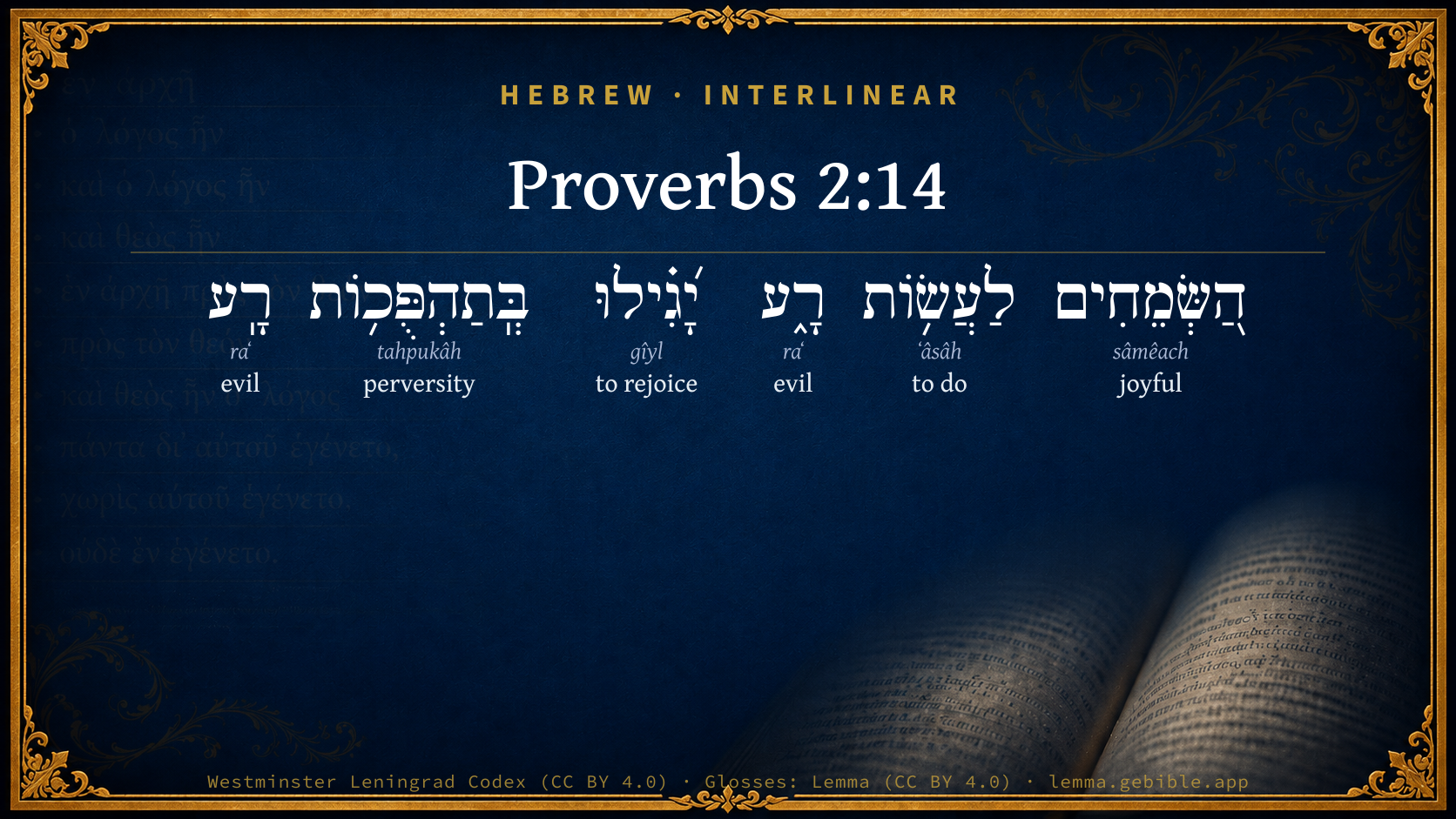
Hebrew (Westminster Leningrad Codex) Proverbs 2:14 appears in the Hebrew Old Testament. The text above is from the Westminster Leningrad Codex. Each word links to its Strong’s number, a concise gloss, and parsing drawn from the Open Scriptures Hebrew Bible morphology. Click any word for its full Brown-Driver-Briggs (BDB) entry.
Download image
Cite this verse

Proverbs 2:14 (World English Bible). Public Domain. Lemma interlinear Bible study tool, https://lemma.gebible.app/v/proverbs/2/14.

Show BibTeX & RIS
BibTeX
RIS
English Translation
Who rejoice to do evil, And delight in the perverseness of evil;
World English Bible · Public Domain
Download a study sheet

One document with this verse’s original text, its word-by-word gloss line, the meaning frame, cross-references with their text, attributed commentary, and full source and license credits — printable, and it pastes into notes with its structure intact.

This verse Autodidact and up

Study sheet (.html) Plain text (.txt)

A passage Seminary Student

Up to 50 verses in one chapter. A passage sheet keeps up to 6 commentary sources and 12 cross-references per verse, in the order this page ranks them, and says so on the sheet whenever that leaves anything out. Ask for a single verse and you get the Autodidact verse sheet above.

Everything on this page stays free to read, with no account — the sheet is a download of what is already on screen, not access to it.

Want to remove ads? Support Godless Engineer
Compare translations 3

The same verse in 3 English versions, stacked beneath the original-language interlinear above. Click any original word for its lexicon entry.

Each is an independent rendering of the whole verse — the interlinear is not word-aligned to these translations.

Highlighted words mark where these versions differ — a whole-verse word diff, not a word-by-word alignment.

  • World English Bible Public Domain
    Who rejoice to do evil, And delight in the perverseness of evil;
  • King James Version Public Domain
    Who rejoice to do evil, and delight in the frowardness of the wicked;
  • unfoldingWord Literal Text CC BY-SA 4.0
    the ones who are glad to do evil, they rejoice in perverse things of evil,

unfoldingWord Literal Text — © unfoldingWord, licensed CC BY-SA 4.0. Word-aligned USFM3 via Door43 (git.door43.org/unfoldingWord/en_ult).

Versions to compare (up to 4)

3 of 4 selected

Show all 18 translations

Every available English version of this verse, each an independent rendering of the whole verse.

  • World English Bible Public Domain
    Who rejoice to do evil, And delight in the perverseness of evil;
  • Berean Standard Bible Public Domain
    from those who enjoy doing evil and rejoice in the twistedness of evil,
  • Majority Standard Bible Public Domain
    from those who enjoy doing evil and rejoice in the twistedness of evil,
  • King James Version Public Domain
    Who rejoice to do evil, and delight in the frowardness of the wicked;
  • American Standard Version (1901) Public Domain
    Who rejoice to do evil, And delight in the perverseness of evil;
  • Revised Version (1885) Public Domain
    Who rejoice to do evil, and delight in the frowardness of evil;
  • Geneva Bible (1599) Public Domain
    Which reioyce in doing euill, and delite in the frowardnesse of the wicked,
  • Douay-Rheims (1899) Public Domain
    Who are glad when they have done evil, and rejoice in most wicked things:
  • Young's Literal Translation Public Domain
    Who are rejoicing to do evil, They delight in frowardness of the wicked,
  • Literal Standard Version CC BY-SA 4.0
    Who are rejoicing to do evil, || They delight in [the] contrariness of the wicked,
  • Unlocked Literal Bible CC BY-SA 4.0
    They rejoice when they do evil and delight in the perversities of evil.
  • unfoldingWord Literal Text CC BY-SA 4.0
    the ones who are glad to do evil, they rejoice in perverse things of evil,
  • Darby Bible Public Domain
    who rejoice to do evil, [and] delight in the frowardness of evil;
  • World Messianic Bible Public Domain
    who rejoice to do evil, and delight in the perverseness of evil,
  • Webster's Bible Public Domain
    Who rejoice to do evil, and delight in the frowardness of the wicked;
  • Free Bible Version CC BY-SA 4.0
    They happily do wrong; they love how twisted evil is.
  • Bible in Basic English Public Domain
    Who take pleasure in wrongdoing, and have joy in the evil designs of the sinner;
  • JPS Tanakh (1917) Public Domain
    Who rejoice to do evil, and delight in the frowardness of evil;

Literal Standard Version (2020), Covenant Press — licensed CC BY-SA 4.0. Text via the HelloAO Bible API (eBible.org). Unlocked Literal Bible (unfoldingWord) — licensed CC BY-SA 4.0. Text via the HelloAO Bible API (eBible.org). unfoldingWord Literal Text — © unfoldingWord, licensed CC BY-SA 4.0. Word-aligned USFM3 via Door43 (git.door43.org/unfoldingWord/en_ult). Free Bible Version, Dr. Jonathan Gallagher — licensed CC BY-SA 4.0. Text via the HelloAO Bible API (eBible.org).

Word by word

More ways to search: Search by grammar → Find every occurrence → Compare this word →

Practice this passage: Drill this verse → Learn its vocabulary →

About this verse

These counts appear in no published source. They are computed here, from the morphology-tagged text and Lemma’s own curated glosses. What Lemma adds →

6
words
5
distinct lemmas
Wisdom
section

Notable vocabulary

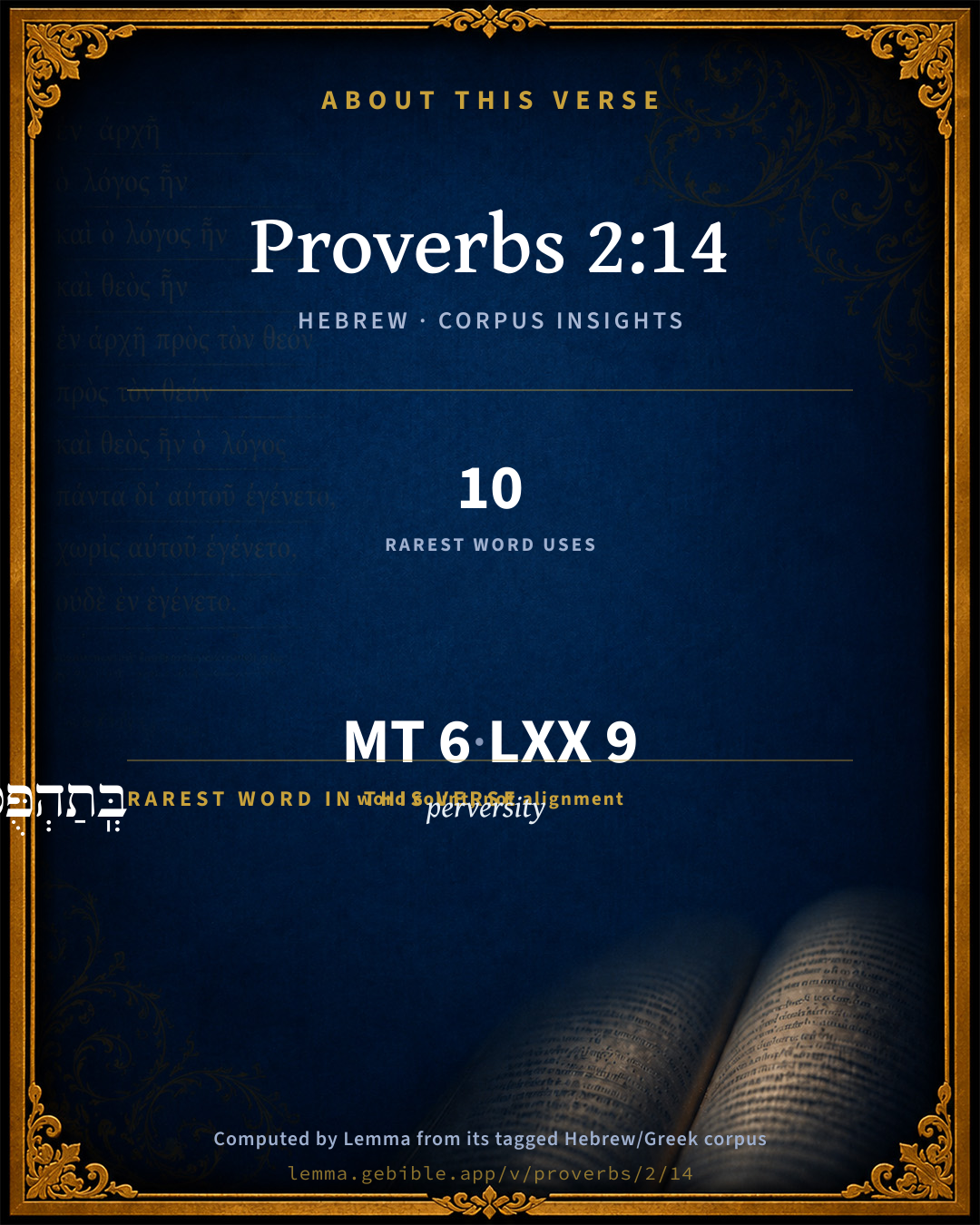
The rarest word here is בְּֽתַהְפֻּכ֥וֹת perversity H8419 — appearing just 10 times in the whole Hebrew Bible.

Shared distinctive vocabulary

בְּֽתַהְפֻּכ֥וֹת perversity H8419 occurs in 10 verses of the Hebrew Bible. Also found in:

Grammatical profile

  • 2 verbs
  • 1 noun
  • 3 adjectives

Verb forms

  • לַעֲשׂ֥וֹת Qal · Infinitive Construct
  • יָ֝גִ֗ילוּ Qal · Imperfect

Repetition

A word recurs within this verse — often emphatic in Hebrew:

  • רָ֑ע evil H7451 ×2

Hebrew & Septuagint length

In English translation the verse runs 12 words from the Hebrew and 9 from the Septuagint (LXX English) — closely comparable.

A rough comparison of the two English renderings, which tokenize alike — not a word-level alignment.

Word counts can differ between the Hebrew and the Greek without any difference in meaning — e.g. the Hebrew direct-object marker אֵת has no separate Greek word, and Greek often adds the article ὁ.

In the original languages it is 6 Hebrew tokens and 9 Greek tokens — but the two are counted differently (Hebrew bundles its prefixes and suffixes into one token; the Greek is in lemma form), so that isn’t a like-for-like length.

Cross-references

8

Topical passages linked to Proverbs 2:14 in the Treasury of Scripture Knowledge — connected by theme and wording, ordered by reader-vote popularity; previews shown in the World English Bible.

  • Proverbs 10:23 It is a fool's pleasure to do wickedness, But wisdom is a man of understanding's pleasure.
  • Romans 1:32 who, knowing the ordinance of God, that those who practice such things are worthy of death, not only do the same, but also approve of those who practice them.
  • Jeremiah 11:15 What has my beloved to do in my house, seeing she has worked lewdness [with] many, and the holy flesh is passed from you? when you do evil, then you rejoice.
  • Luke 22:4–5 He went away, and talked with the chief priests and captains about how he might deliver him to them.
  • 1 Corinthians 13:6 doesn't rejoice in unrighteousness, but rejoices with the truth;
  • Hosea 7:3 They make the king glad with their wickedness, And the princes with their lies.
  • Zephaniah 3:11 In that day you will not be disappointed for all your doings, in which you have transgressed against me; for then I will take away out of the midst of you your proudly exulting ones, and you will no more be haughty in my holy mountain.
  • Habakkuk 1:15 He takes up all of them with the hook. He catches them in his net, and gathers them in his dragnet. Therefore he rejoices and is glad.

Cross-references courtesy of OpenBible.info (CC BY 4.0).

Hebrew and Greek witnesses Masoretic Hebrew ↔ Greek Septuagint

The same verse in the two great witnesses to the Old Testament, shown verse-for-verse.

These are two independent witnesses, not word-aligned to each other, and the Septuagint is shown in lemma (dictionary) form.

Hebrew Proverbs 2:14 Masoretic · Westminster Leningrad Codex

הַ֭שְּׂמֵחִים לַעֲשׂ֥וֹת רָ֑ע יָ֝גִ֗ילוּ בְּֽתַהְפֻּכ֥וֹת רָֽע

Who rejoice to do evil, And delight in the perverseness of evil;

World English Bible · Public Domain

Greek LXX Proverbs 2:14 Septuagint · lemma form

ὁ εὐφραίνω ἐπί κακός καί χαίρω ἐπί διαστροφή κακός

who rejoice in evils, and delight in wicked perverseness;

LXX2012 (modern English Septuagint) · Public Domain

On this verse, The Pulpit Commentary discusses the Septuagint’s reading. Read the note in Commentary ↓

Hebrew: Westminster Leningrad Codex (CC BY 4.0). Greek: Septuagint (public domain); English from LXX2012 (modern English Septuagint) (Public Domain). How the Septuagint differs from the Hebrew →

Commentary

Notes on Proverbs 2:14 from classic Christian and Jewish commentators (each source and its license shown beneath its notes). The classic Christian expositions comment on the surrounding passage and are grouped to its opening verse, so a note may address several verses; the Jewish commentaries on the Tanakh (Rashi and others) are per-verse, so they appear only where the commentator wrote on this verse.

Lemma curates 59 commentaries, every one of them public domain or Creative Commons licensed, each selected and text-cleaned for this edition rather than reprinted as found. About our sources →

Trapp's Complete Commentary

John Trapp

Pro 2:14 Who rejoice to do evil, [and] delight in the frowardness of the wicked;

Ver. 14. Who rejoice to do evil.] It is their meat, drink, sport; {Pro 4:27; Pro 10:23} they cannot be merry unless the devil be their play fellow. This is reckoned as an aggravation of Jerusalem’s sin: "When thou doest evil, then thou rejoicest." {Jer 11:15} But better is the sorrow of him that suffereth evil than the jollity of him that doth evil, saith Augustine. {a}

{a} Melior est tristitia iniqua patientis quam laetitia iniqua facientis.

John Trapp, A Commentary or Exposition upon All the Books of the Old and New Testament (1647–1656) — public domain. Text from a community e-Sword module.

Geneva Bible (1599)

Geneva Bible translators

When they see any given to evil as they are.

Geneva Bible (1599) marginal notes — public domain. Text via Bolls.life.

Jamieson, Fausset & Brown

Robert Jamieson, A. R. Fausset & David Brown

and that with pleasure, in ignorance of good and pursuit of evil.

frowardness--Not only their own perversity, but that of others is their delight. They love most the worst things.

Jamieson, Fausset & Brown — Commentary Critical and Explanatory on the Whole Bible (1871) — public domain (CC PDM 1.0). Text via the HelloAO Bible API.

Ellicott's Commentary for English Readers

(14) Delight in the frowardness of the wicked.—This positive taking pleasure in evil is mentioned by St. Paul (Rom_1:32) as the last stage of degradation.

A Bible Commentary for English Readers, edited by Charles John Ellicott (1878–1897) — public domain. Text from a community e-Sword module.

The Cambridge Bible for Schools and Colleges

gen. ed. J. J. S. Perowne

14. of the wicked] Or, of evil, R.V. text, as in Pro_2:12.

The Cambridge Bible for Schools and Colleges (gen. ed. J. J. S. Perowne; Cambridge University Press, 1878–1918) — public domain. Text from a community e-Sword module.

John Gill's Exposition

Who rejoice to do evil,.... At the doing of it, or when they have done it; they are glad of an opportunity of doing mischief, and glory when they have done it; it is a sport and pastime to them, Pro 10:2; they take pleasure in the act of sin, and have no remorse of conscience afterwards; they speak of it in an exulting manner, and boast of it, and glory in their shame;

and delight in the frowardness of the wicked: of the wicked man, as Aben Ezra and Gersom supply it; in the perversities and contradictions of every wicked man; they not only take pleasure in their own sins, but in the sins of others, and in them that commit them; which is an aggravation of their wickedness, Rom 1:32; they delight to hear a man speak froward and perverse things; things against God, and Christ, and religion, against all good men, and everything that is good; against the Gospel, the doctrines and ordinances of it; and they delight to see him do things perverse and contrary to the will of God. The Vulgate Latin version renders it, "they exult in the worst things".

John Gill's Exposition of the Whole Bible (1746–1763) — public domain (CC PDM 1.0). Text via the HelloAO Bible API.

Haydock's Catholic Bible Commentary

Evil. These signs prove whom we ought to shun. St. Augustine depicts his own conduct before his conversion in the darkest colours. (Calmet)

George Leo Haydock (1774–1849), Haydock's Catholic Family Bible and Commentary, 1859 edition — public domain. Excludes Psalms (Douay-Rheims chapter numbering differs from Protestant) and Deuterocanonical books (Catholic canon only).

Matthew Poole's English Annotations

Who rejoice to do evil; seeking and embracing occasions of sin with diligence and greediness, and pleasing themselves both in the practice and remembrance of sin; whereas upright men abhor and watch against all occasions of sin beforehand, and mourn bitterly for it afterwards.

Delight in the frowardness of the wicked; not only in their own sins, but in the sins of other wicked men, which shows a greater malignity of mind and love to sin. See Rom 1:32.

Matthew Poole's English Annotations on the Holy Bible (1683–1685) — public domain. Text from a community e-Sword/MySword module.

The Pulpit Commentary

Who rejoice to do evil. Another element is here brought forward, and the description increases in intensity. The wicked not only rejoice to do evil themselves, but they exult when they hear of evil in others. (cf. Rom_1:32) Such may be the interpretation, though the latter part, of the verse is capable of a different and more general rendering as signifying exultation in evil generally, whether it appears in themselves or others. The expression rendered in the Authorized Version, in the frowardness of the wicked, is in the original (r twOkpujtB, b"thah"pucoth ra), in the perverseness of evil, or in evil perverseness, where the combination of the two nouns serves to give force to the main idea, which is that of perverseness. This rendering is adopted in the LXX, epi diastrofh kakh , "in evil distortion;" in the Vulgate, in pessimis rebus; in the Targum, Syriac, and Arabic, in conversatione mala, "in a bad course of conduct;" and in the Targum, in malitiae perversione, "in the perversion of wickedness." It is not perverseness in its simple and common form that these men exult in. but in its worst and most vicious form. (for a similar construction, see Pro_6:24 Pro_15:26; and Pro_28:5) How widely different is the conduct of charity, which "rejoiceth not in iniquity"! (1Co_13:6)

Rejoicing to do evil.

We often insist upon the fact that goodness is the secret of true happiness, and invite men to rejoice in the service of God; but we are here reminded of an opposite kind of joy which some find in the course of wickedness.

I THIS IS A POSSIBLE EXPERIENCE. It is so unnatural that one who knew nothing of the world might well declare it to be impossible. But experience proves its existence, and the explanation of it is not far to seek.

1. Naturally desirable ends lend a sense of pleasure to the evil means by which they are sought. The miser loves his money on its own account through previous associations with the ideas of what it might purchase. So the criminal may come to delight in his crimes because the profit he gets out of them has cast a glamour over the ugly deeds themselves.

2. Some pleasures are sinful. Then the whole course, end as well as means, is wicked; yet, as it concerns self-indulgence, a wicked glee accompanies it.

3. There is a sense of freedom in sin. There is more room to range at large over the broad way than in the narrow path of righteousness. The sinner has burst the shackles of law, and he revels in the licence of self-will.

4. Sin gives an opportunity for the exercise of power. Much evil is done simply for the sake of effect, in order that the doer of it may find himself producing results. But it is easier to do harm than to do good. Therefore a man turns to evil for the larger realization of his power. So wicked children delight in picking flies to pieces.

II THIS IS A SIGN OF ADVANCED WICKEDNESS.

1. At first it is painful to sin. The poor, weak soul gives way to temptation, but the very act of sinning is accompanied with a sense of uneasiness and humiliation.

2. A further stage is reached when sin is committed with indifference. This is indeed a state of moral degradation, for conscience is now practically dead, and the sinner is as willing to have his pleasure by lawless means as in an innocent manner.

3. The lowest depth is reached when there is a positive pleasure in doing wrong. Evil is then chosen on its own account, and not as the disagreeable or the indifferent means for reaching some ulterior end. When two courses are open, the bad one is deliberately selected as the more pleasant on its own account. A malignant joy lights up the countenance of the abandoned sinner at the mere prospect of some new villainy. This is Satanic wickedness. The abandoned sinner can now exclaim with Milton"s Satan"Evil, be thou my good!

III THIS IS A DELUSIVE JOY.

1. It is shallow. Though it may be excited into a diabolical ecstasy, it has no heart-satisfying qualities. Beneath it there is profound unrest, The peace which accompanies the joy of holiness, and which is the sweetest ingredient in the cup of the good man, is quite wanting here. There are shooting pangs, dark misgivings, and dread sinkings of heart in the midst of this monstrous delight.

2. It will not endure. The pleasures of sin do but endure for a season. The sweet morsels soon turn to dust and ashes. After the wild crete there follows deep depression or dread despair, or at best a sense of listless weariness. The appetite is soon exhausted. New and more piquant forms of wickedness must be invented to stimulate the jaded palate. At length the awful consequences must come, and anguish of soul follow the delights of sin when God"s judgment takes effect.

The Pulpit Commentary (1880–1919), ed. H.D.M. Spence-Jones & Joseph S. Exell — public domain. Text from a community e-Sword module.

unfoldingWord translationNotes

Door43 World Missions Community

They rejoice

"They" refers to the same people as in Proverbs 2:12.

delight in the perversities of evil

This means basically the same thing as the first part of the sentence. AT: "delight in doing what they know is evil" (See: Parallelism)

They follow crooked paths

People who lie to others are spoken of as if they walk on crooked or twisted paths. AT: "They deceive other people" (See: Metaphor)

using deception they hide their tracks

People lying so that others will not find out what they did is spoken of as if they covered the tracks on a path so that no one could follow them. AT: "they lie so that no one will know what they have done" (See: Metaphor)

translationWords

joy

evil

deceive

unfoldingWord translationNotes — © Distant Shores Media and the Door43 World Missions Community, licensed CC BY-SA 4.0. Source: git.door43.org/Door43/en_tn.

Lesson kit

Teaching starters — assembled from the data on this page, not authored interpretation. Every prompt links to the verse data it draws on. Edit before teaching.

Proverbs, in the Wisdom, opens this verse with 6 words (5 distinct Hebrew lemmas). Its most distinctive word is tahpukâh (“perversity”). A historical commentator’s framing appears above. Read the whole chapter for the surrounding context.

Discussion questions

  1. How does “perversity” (tahpukâh) shape what this verse is saying?
  2. Deuteronomy 32:20 shares the word «perversity» with this verse. How do the two illuminate each other?
  3. “evil” occurs 2× in this one verse. What is the effect of the repetition?
  4. These translations render this verse differently; the difference is in the English rendering, not the original. What questions does that raise?
  5. The verb «לַעֲשׂ֥וֹת» is Qal Infinitive Construct. How does its form color the action?
  6. Reading how Trapp's Complete Commentary and Geneva Bible (1599) read this verse, where do the two commentators agree and where do they part?

Things to notice

Reading settings

Reading text

Shown beneath each verse's original-language words.

Old Testament
Old Testament edition

Read the OT as the Masoretic Hebrew (MT) or the Greek Septuagint (LXX).

English shown for the Greek Septuagint (in the Hebrew ↔ Greek comparison).

Comparing translations? Open the Compare panel on any verse page to stack up to four side by side.