Philippians 2:18

Greek (Tischendorf 8th ed.) Philippians 2:18 appears in the Greek New Testament. The text above is from the Tischendorf 8th edition. Each word links to its Strong’s number and a concise gloss. Click any word for its full Thayer’s Greek Lexicon entry.

Download image
Cite this verse

Philippians 2:18 (World English Bible). Public Domain. Lemma interlinear Bible study tool, https://lemma.gebible.app/v/philippians/2/18.

Show BibTeX & RIS
BibTeX
RIS
English Translation
In the same way, you also rejoice, and rejoice with me.
World English Bible · Public Domain
Download a study sheet

One document with this verse’s original text, its word-by-word gloss line, the meaning frame, cross-references with their text, attributed commentary, and full source and license credits — printable, and it pastes into notes with its structure intact.

This verse Autodidact and up

Study sheet (.html) Plain text (.txt)

A passage Seminary Student

Up to 50 verses in one chapter. A passage sheet keeps up to 6 commentary sources and 12 cross-references per verse, in the order this page ranks them, and says so on the sheet whenever that leaves anything out. Ask for a single verse and you get the Autodidact verse sheet above.

Everything on this page stays free to read, with no account — the sheet is a download of what is already on screen, not access to it.

Want to remove ads? Support Godless Engineer
Compare translations 3

The same verse in 3 English versions, stacked beneath the original-language interlinear above. Click any original word for its lexicon entry.

Each is an independent rendering of the whole verse — the interlinear is not word-aligned to these translations.

Highlighted words mark where these versions differ — a whole-verse word diff, not a word-by-word alignment.

  • World English Bible Public Domain
    In the same way, you also rejoice, and rejoice with me.
  • King James Version Public Domain
    For the same cause also do ye joy, and rejoice with me.
  • unfoldingWord Literal Text CC BY-SA 4.0
    Now in the same manner, you also rejoice and rejoice with me.

unfoldingWord Literal Text — © unfoldingWord, licensed CC BY-SA 4.0. Word-aligned USFM3 via Door43 (git.door43.org/unfoldingWord/en_ult).

Versions to compare (up to 4)

3 of 4 selected

Show all 19 translations

Every available English version of this verse, each an independent rendering of the whole verse.

  • World English Bible Public Domain
    In the same way, you also rejoice, and rejoice with me.
  • Berean Standard Bible Public Domain
    So you too should be glad and rejoice with me.
  • Majority Standard Bible Public Domain
    So you too should be glad and rejoice with me.
  • King James Version Public Domain
    For the same cause also do ye joy, and rejoice with me.
  • American Standard Version (1901) Public Domain
    and in the same manner do ye also joy, and rejoice with me.
  • Revised Version (1885) Public Domain
    and in the same manner do ye also joy, and rejoice with me.
  • Geneva Bible (1599) Public Domain
    For the same cause also be ye glad, and reioyce with me.
  • Douay-Rheims (1899) Public Domain
    And for the selfsame thing do you also rejoice, and congratulate with me.
  • Young's Literal Translation Public Domain
    because of this do ye also rejoice and joy with me.
  • Literal Standard Version CC BY-SA 4.0
    because of this you also rejoice and are glad with me.
  • Unlocked Literal Bible CC BY-SA 4.0
    In the same manner you also should be glad and rejoice with me.
  • unfoldingWord Literal Text CC BY-SA 4.0
    Now in the same manner, you also rejoice and rejoice with me.
  • Darby Bible Public Domain
    In like manner do *ye* also rejoice, and rejoice with me.
  • World Messianic Bible Public Domain
    In the same way, you also should be glad and rejoice with me.
  • Webster's Bible Public Domain
    For the same cause also do ye joy, and rejoice with me.
  • Free Bible Version CC BY-SA 4.0
    just as you have such joy and are glad with me.
  • Bible in Basic English Public Domain
    And in the same way do you be glad and have a part in my joy.
  • Text-Critical English NT CC BY 4.0
    In the same way you also should be glad and rejoice with me.
  • Tyndale New Testament (1534) Public Domain
    For the same cause also reioyce ye and reioyce ye with me.

Literal Standard Version (2020), Covenant Press — licensed CC BY-SA 4.0. Text via the HelloAO Bible API (eBible.org). Unlocked Literal Bible (unfoldingWord) — licensed CC BY-SA 4.0. Text via the HelloAO Bible API (eBible.org). unfoldingWord Literal Text — © unfoldingWord, licensed CC BY-SA 4.0. Word-aligned USFM3 via Door43 (git.door43.org/unfoldingWord/en_ult). Free Bible Version, Dr. Jonathan Gallagher — licensed CC BY-SA 4.0. Text via the HelloAO Bible API (eBible.org).

Word by word

More ways to search: Search by grammar → Find every occurrence → Compare this word →

Practice this passage: Drill this verse → Learn its vocabulary →

About this verse

These counts appear in no published source. They are computed here, from the morphology-tagged text and Lemma’s own curated glosses. What Lemma adds →

9
words
8
distinct lemmas
Pauline Epistles
section

Notable vocabulary

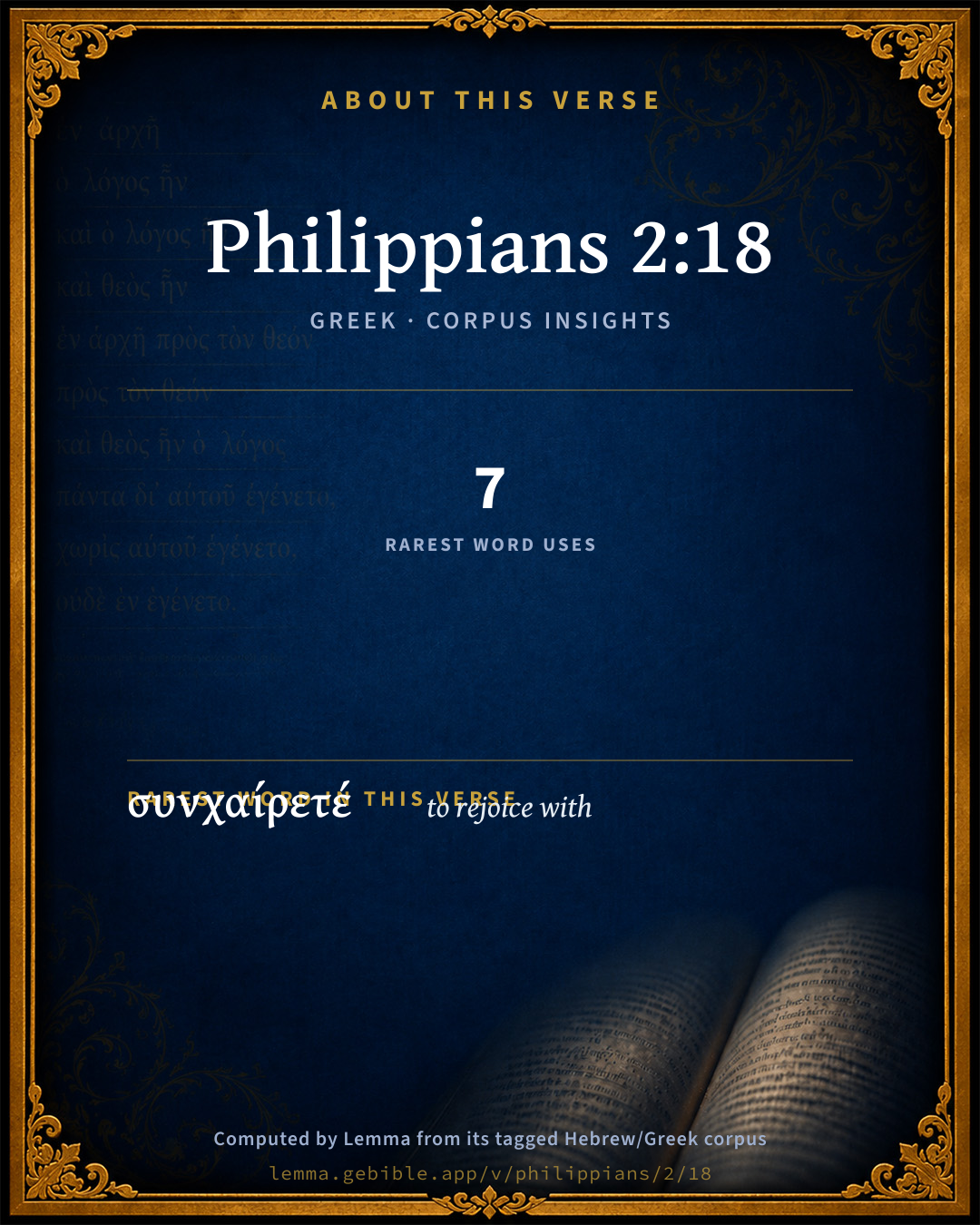
The rarest word here is συνχαίρετέ to rejoice with G4796 — appearing just 7 times in the whole Greek New Testament.

Shared distinctive vocabulary

συνχαίρετέ to rejoice with G4796 occurs in 7 verses of the Greek New Testament. Also found in:

Repetition

A word recurs within this verse:

Cross-references

4

Topical passages linked to Philippians 2:18 in the Treasury of Scripture Knowledge — connected by theme and wording, ordered by reader-vote popularity; previews shown in the World English Bible.

  • James 1:2–4 Count it all joy, my brothers, when you fall into various temptations,
  • Philippians 4:4 Rejoice in the Lord always! Again I will say, Rejoice!
  • Philippians 3:1 Finally, my brothers, rejoice in the Lord. To write the same things to you, to me indeed is not tiresome, but for you it is safe.
  • Ephesians 3:13 Therefore I ask that you may not lose heart at my troubles for you, which are your glory.

Cross-references courtesy of OpenBible.info (CC BY 4.0).

Commentary

Notes on Philippians 2:18 from classic Christian and Jewish commentators (each source and its license shown beneath its notes). The classic Christian expositions comment on the surrounding passage and are grouped to its opening verse, so a note may address several verses; the Jewish commentaries on the Tanakh (Rashi and others) are per-verse, so they appear only where the commentator wrote on this verse.

Lemma curates 59 commentaries, every one of them public domain or Creative Commons licensed, each selected and text-cleaned for this edition rather than reprinted as found. About our sources →

Bengel's Gnomon

Johann Albrecht Bengel

Php 2:18. Συγχαίρετε μοι) rejoice with me, congratulate me, on being poured out as a libation.

Bengel's Gnomon of the New Testament — English translation (T&T Clark, Edinburgh, 1860) — public domain. Text from a community e-Sword module.

Meyer's Critical & Exegetical Commentary

Heinrich August Wilhelm Meyer

Php_2:18. And upon the same (upon my possibly occurring σπένδεσθαι ἐπὶ τ. θυσ. κ.τ.λ., Php_2:17) rejoice ye also (because it takes place for the sake of your faith), and congratulate me thereon (on such a sacred destination). The verbs are imperatives. Postulat enim Paulus parem συμπάθειαν a Philipp., Beza. The ground of the χαίρετε may not be arbitrarily introduced (Hofmann: whatever untowardness may occur), but must by logical necessity be the same which, in Php_2:17, suggested the συγχαίρω ὑμῖν; and that of the συγχαίρετέ μοι must be the same as caused Paul to say χαίρω in Php_2:17.[135] The expositors, who do not take ΣΥΓΧΑΊΡΕΙΝ as gratulari, are here placed in the awkward position of making the apostle summon his readers to a joy which, according to Php_2:17, they would already possess. By this impossibility Weiss, in spite of the τὸ αὐτό, allows himself to be driven into taking the joy in Php_2:18, not as in Php_2:17, but (comp. also Hofmann) quite generally, of a joyful frame of mind.

τὸ αὐτό] in the same (on the accusative, comp. Mat_2:10) rejoice ye also; see also on Php_1:25. Hence it is not to be taken as equivalent to ὡσαύτως (Beza, Storr, Flatt, Heinrichs, Rheinwald, Rilliet, de Wette, Wiesinger, Weiss, Hofmann) (comp. on Php_1:6), in order thereby to avoid identifying it with the joy mentioned in Php_2:17. As to ΧΑΊΡΕΙΝ with the accusative in classical authors, see generally Lobeck, ad Aj. 131; Kühner, II. 1, p. 255 f.

[135] The difficulty which van Hengel (comp. Hofmann) urges, that the readers vix aut ne vix quidem induci potuerunt de hujus viri morte violenta gaudentes vel gavisuri, entirely mistakes the lofty standpoint of the apostle, who looks death in the face with a holy joy (comp. the frequent corresponding sentiments in the epistles of Ignatius), and also attributes to his readers a corresponding mode of looking at the possibility of his death.

Meyer — Critical and Exegetical Commentary on the New Testament — English translation by Peter Christie, edited by Frederick Crombie (T&T Clark, 1880) — public domain. Text from a community e-Sword module.

Expositor's Greek Testament

ed. W. Robertson Nicoll

Phi 2:18 . τὸ δʼ αὐτό . Adverbial use = ὡσαύτως . Cf. Mat 27:44 . συγχαίρ . This is, of course, a different joy from that which he shares with them. It is their joy in his obtaining the martyr’s crown.

The Expositor's Greek Testament, edited by W. Robertson Nicoll (1897–1910) — public domain. Text from a community e-Sword module.

Jamieson, Fausset & Brown

Robert Jamieson, A. R. Fausset & David Brown

"Do ye also rejoice" at this honor to you, "and congratulate me" on my blessed "gain" (Phi 1:21).

Jamieson, Fausset & Brown — Commentary Critical and Explanatory on the Whole Bible (1871) — public domain (CC PDM 1.0). Text via the HelloAO Bible API.

Adam Clarke's Commentary

Verse 18. For the same cause also do ye joy] Should I be thus offered, as I shall rejoice in it, do ye also rejoice that I am counted worthy of this high honour.

Adam Clarke's Commentary on the Bible (1810–1826) — public domain. Text from a community e-Sword/MySword module.

John Calvin's Commentaries

18 Rejoice ye. By the alacrity which he thus discovers, he encourages the Philippians, and enkindles in them a desire to meet death with firmness, inasmuch as believers suffer no harm from it. For he has formerly taught them that death would be gain to himself, (Philippians 1:21;) here, on the other hand, he is chiefly concerned that his death may not disconcert the Philippians. He, accordingly, declares that it is no ground of sorrow; nay, that they have occasion of joy, inasmuch as they will find it to be productive of advantage. For, although it was in itself a serious loss to be deprived of such a teacher, it was no slight compensation that the gospel was confirmed by his blood. In the mean time, he lets them know that to himself personally death would be matter of joy. The rendering of Erasmus, taking it in the present tense, Ye rejoice, is altogether unsuitable.

John Calvin's Commentaries (1540-1563) — public domain. Text from the Calvin Translation Society English edition (1840s-50s) via the Christian Classics Ethereal Library (ccel.org). Calvin's coverage is partial (roughly two-thirds of the Bible); uncommented books and verses are honest gaps, never fabricated. The 19th-century editor's footnotes and remarks are omitted so the notes are faithfully Calvin's own voice.

Ellicott's Commentary for English Readers

(18) Do ye joy . . .—The Epistle lays great stress on joy, not only as a privilege, but as a duty, following from Christian faith and proving its reality. Joy is in itself natural in the first thoughts of childhood and youth; it is apt to be chequered or even destroyed by the second thoughts of fuller experience of life, as darkened by suffering, sin, and death; but in the third and deepest thoughts of the Christian, recognising these darker elements of life, but knowing that they were not in the beginning, and shall not be in the end, joy comes back, solemnised but deepened into thankfulness. A Christianity which has no power to rejoice, either in flashes of joy amidst tribulation, or, better still, in the calm steady light of cheerfulness, may be true, but is imperfect. It has not yet entered into the promise given by our Lord Himself of the “joy which no man taketh from us” (Joh_16:22).

A Bible Commentary for English Readers, edited by Charles John Ellicott (1878–1897) — public domain. Text from a community e-Sword module.

The Cambridge Bible for Schools and Colleges

gen. ed. J. J. S. Perowne

18. For the same cause] Better, with R.V., In the same manner. The same phrase occurs Mat_27:44.

do ye joy &c.] A loving imperative. He bids them be glad, and share their joy with him as he with them. It is an emphatic reiteration of what he has implied in the words just above, that his death would be their joy, as being, if the Lord so willed, their spiritual blessing.

The Cambridge Bible for Schools and Colleges (gen. ed. J. J. S. Perowne; Cambridge University Press, 1878–1918) — public domain. Text from a community e-Sword module.

John Gill's Exposition

For the same cause also do ye joy and rejoice with me. He would not have them be sorrowful, should they hear of his death for the sake of the Gospel, and of his blood being poured out in such a cause, since it was as a libation on their faith, and for the confirmation of it, and would be gain to Christ, and his interest, and to the apostle also: and therefore they should be so far from indulging grief and sorrow on that account, that they should rather joy and rejoice with him, who was ready to be offered up, or poured out; since he had run out his race, and that not in vain, but to so good a purpose, and especially among them.

For the same cause also do ye joy and rejoice with me. He would not have them be sorrowful, should they hear of his death for the sake of the Gospel, and of his blood being poured out in such a cause, since it was as a libation on their faith, and for the confirmation of it, and would be gain to Christ, and his interest, and to the apostle also: and therefore they should be so far from indulging grief and sorrow on that account, that they should rather joy and rejoice with him, who was ready to be offered up, or poured out; since he had run out his race, and that not in vain, but to so good a purpose, and especially among them.

Philippians 2:19

phi 2:19

phi 2:19

phi 2:19But I trust in the Lord Jesus,.... Or "hope"; not in himself, his wisdom, will, resolutions, and purposes; nor in an arm of flesh, in any human aid and power; nor in princes, nor in Nero, the Roman emperor, as expecting a release from bonds by him, when he could the more easily part with Timothy; but in the Lord Jesus, in the Lord whom every tongue shall confess to be so; and in that Jesus, in whose name every knee shall bow; who is King of kings, and Lord of lords, and the only Saviour and Deliverer of his people; who has the hearts of all men in his hands, and all power in heaven and in earth: he hoped and trusted, that through the goodness and power of Christ, opening a way for him, he should be able

to send Timotheus shortly unto you; one that had known the Scriptures from his youth, and was very early converted to the Christian faith, was an eminent preacher of the Gospel, and well known to the Philippians. The apostle hoped to send him to them "shortly", in a very little time; this he said in order to encourage them, and thereby suggesting, that he thought his own deliverance was at hand: this hope did not arise from a sure and certain persuasion of the thing, but from love to these saints; he had a very great affection for them; he knew that a Gospel minister, and particularly Timothy, would be of great comfort and service to them; wherefore, from that love which hopes all things, he hoped he should, in a short time, be able to serve them in love that way: the end he proposed in it is next expressed,

that I also may be of good comfort when I know your state; not their worldly estate, their secular affairs, and whether they prospered in their trades and business, and increased in riches; nor their corporeal estate, or state of health, and whether they prospered in their bodies, not but that the knowledge of each of these would be welcome to the apostle; nor everyone's personal spiritual estate, what was the particular case and state of each member; for though it is the business of a pastor of a church to look diligently to the state of his flock, and learn the case of every particular member, the apostle could not be thought to come at such an exact knowledge of things, who had the care of all the churches upon him; but their ecclesiastical state, their church state in general; how the Gospel stood with them, and they in that; whether they held it fast, and strove for it, and what ground the false teachers got among them; how the ordinances of the Gospel were regarded and attended on by them; with what life and light, and liberty and zeal, their ministers preached the word; and what success they had to the conversion of sinners, and comfort of saints; and how they behaved towards them, in honouring, obeying, and submitting to them, and esteeming them highly for their works' sake; what an increase of gifts, grace, and numbers there was among them; and what harmony, love, peace, and concord subsisted between them; and what afflictions and persecutions they endured for the sake of Christ; and with what patience, faith, and cheerfulness they bore them. By the return of Timothy he hoped to have knowledge of these things, that so he might "also be of good comfort"; as they would be by the coming of Timothy to them, by his preaching among them, and relating to them the case and circumstances of the apostle, how cheerful he was under his afflictions, and of what use they were to the cause of Christ. The comfort and pleasure of Gospel ministers lie in the good of the churches of Christ; it puts them in good heart and soul, as the word here used signifies, when they hear of their steadfastness in the faith of Christ, of their love to one another, and all the saints, and of their patience under sufferings.

John Gill's Exposition of the Whole Bible (1746–1763) — public domain (CC PDM 1.0). Text via the HelloAO Bible API.

Trapp's Complete Commentary

John Trapp

18 For the same cause also do ye joy, and rejoice with me.

Ver. 18. For the same cause also, &c.] The hearers’ affections and endeavours should exactly answer to the affections and endeavours of the preacher, as the elders of Ephesus did, Act 20:31; Act 20:37; and as those religious Romans did, Rom 6:17, and these Philippians, 2Co 8:5.

John Trapp, A Commentary or Exposition upon All the Books of the Old and New Testament (1647–1656) — public domain. Text from a community e-Sword module.

Albert Barnes' Notes on the Bible

For the same cause - Because we are united, and what affects one of us should affect both.

Do ye joy, and rejoice with me - That is, “do not grieve at my death. Be not overwhelmed with sorrow, but let your hearts be filled with congratulation. It will be a privilege and a pleasure thus to die.” This is a noble sentiment, and one that could have been uttered only by a heroic and generous mind - by a man who will not dread death, and who felt that it was honorable thus to die Doddridge has illustrated the sentiment by an appropriate reference to a fact stated by Plutarch. A brave Athenian returned from the battle of Marathon, bleeding with wounds and exhausted, and rushed into the presence of the magistrates, and uttered only these two words - χαιρετε chairete, χαιρομεν chairomen - “rejoice, we rejoice,” and immediately expired. So Paul felt that there was occasion for him, and for all whom he loved, to rejoice, if he was permitted to die in the cause of others, and in such a manner that his death would benefit the world.

Albert Barnes' Notes on the Bible (1834–1885) — public domain. Text from a community e-Sword/MySword module.

Matthew Poole's English Annotations

For the same cause also do ye joy; he expects the like affection and sympathy in every one of them, that upon the account of his sufferings they would the more readily, cheerfully, and courageously believe in and suffer for Christ: considering the difference between death threatened by man, for our sticking close to God, Mat 10:28, and denounced for slipping aside from God, in whole or in part, 2Th 1:5.

And rejoice with me; and that would be a congratulation of him, who should account their being established in the faith with mutual love and unity, a fulfilling of his faith, as before, Phi 2:2.

Matthew Poole's English Annotations on the Holy Bible (1683–1685) — public domain. Text from a community e-Sword/MySword module.

Whedon's Commentary on the Bible

Daniel D. Whedon

18. Do ye joy—Such a death he anticipates with holy joy, and he would have them look at it for him with a like spirit, even counting it an honour that his blood accompanies the offering of their faith.

Daniel D. Whedon (gen. ed.), Commentary on the Old and New Testaments (1874–1909) — public domain. Text from a community e-Sword module.

The Pulpit Commentary

For the same cause also do ye joy, and rejoice with me; or, as R.V, in the m anner. Their joy is to be like his, to mingle with his joy. The second clause may be rendered, as in Ver. 17, "and congratulate me."

The Pulpit Commentary (1880–1919), ed. H.D.M. Spence-Jones & Joseph S. Exell — public domain. Text from a community e-Sword module.

John Wesley's Explanatory Notes

Congratulate me - When I am offered up.

John Wesley, Explanatory Notes Upon the Whole Bible (1754–1765) — public domain. Text via the GEBible commentary corpus.

The People's New Testament

B. W. Johnson

18. Rejoice with me. Like me, rejoice in the prospect of death, if thereby Christ may be glorified.

B. W. Johnson's The People's New Testament with Notes (1889–1891) — public domain. Electronic text from the Christian Classics Ethereal Library (CCEL) ThML edition.

Cambridge Greek Testament for Schools and Colleges

18. τὸ δὲ αὐτὸ. “In the same manner” (R.V.). So Mat 27:44, τὸ δʼ αὐτὸ καὶ οἱ λῃσταὶ … ὠνείδιζον αὐτόν. “The accusative [τὸ αὐτό] defines rather the character than the object of the action” (Lightfoot).

χαίρετε καὶ συνχαίρετέ μοι. Gaudete et congratulamini mihi, Vulg. The Greek leaves us free to explain it as either imperative (as Vulg.) or indicative. If the latter is chosen, it is little else than the imperative in disguise; he assumes their joy and congratulation in order to enjoin it. Lightfoot quotes from Plutarch (Mor. p. 347 c) the χαίρετε καὶ χαίρομεν of the messenger from Marathon; the χαίρετε there is probably indicative.

He bids them share his martyr-joy, as partners of the martyr-spirit.

Cambridge Greek Testament for Schools and Colleges (Cambridge University Press, 1896; 21 vols, various authors incl. Carr, Maclear, Plummer, Farrar, Lumby, Moule, M. R. James, Simcox) — public domain. Text from a community e-Sword module.

Alford’s Greek Testament

Henry Alford

18.] These verses are closely connected with the preceding; not, as De W., al., with ch. 1:26, which is most unnatural, and never would occur to any reader. The connexion is this: in ver. 16 he had tacitly assumed (εἰς ἡμ. χ.) that he should live to witness their blameless conduct even till the day of Christ. Now, he puts the other alternative—that the dangers which surrounded him would result in his death:—and in that case equally he rejoiced, &c.

εἰ καί implies more probability than καὶ εἰ: in the former the case is presupposed, in the latter merely hypothesized. Klotz in Devar. p. 519 f., gives two examples from Xen.’s Anabasis: (1) ὁδοποιήσειέ γʼ ἂν αὐτοῖς, καὶ εἰ σὺν τεθρίπποις βούλοιντο ἀπιέναι (iii. 2. 24), a supposition evidently thought improbable: (2) ἐγώ, ὦ Κλέανδρε, εἰ καὶ οἴει με ἀδικοῦντά τι ἄγεσθαι (vi. 4. 27), where as evidently the speaker believes that Cleander does entertain the thought. The difference is explained by the common rules of emphasis. In εἰ καί, the stress is on εἰ, which is simply ‘posito,’ and the ‘even’ belongs to that which is assumed: in καὶ εἰ, the stress is on καί, even, and the strangeness belongs not to the thing simply assumed, but to the making of the assumption. In the present case then, the Apostle seems rather to believe the supposition which he makes.

σπένδομαι] not future, but present; If I am even being poured out, because the danger was besetting him now, and waxing onward to its accomplishment. He uses the word literally, with reference to the shedding of his blood. “He represents his whole apostolic work for the faith of the Philippians, as a sacrifice: if he is put to death in the course of it, he will be, by the shedding of his blood, poured out as a libation upon this sacrifice, as among the Jews (Num 28:7; Num 15:4 ff. Jos. Antt. iii. 9. 4. Winer, Realw., s. v. Trankopfer) and heathens, in their sacrifices, libations of wine were usual, which were poured over the offerings (Hom. Il. λ. 775, σπένδων αἴθοπα οἶνον ἐπʼ αἰθομένοις ἱεροῖσιν: cf. also Herod., ii. 39).” Meyer.

Wetst., al., would render it ‘affundor’ (κατασπένδομαι), and understand it of the pouring of wine over a live victim destined for sacrifice—but wrongly.

The θυσία is the sacrifice: i.e. the deed of sacrifice, not the victim, the thing sacrificed. λειτουργία, priest’s ministration, without another article, signifying therefore the same course of action as that indicated by θυσία, viz. his apostolic labours: see below.

τῆς πίστεως ὑμ., gen. objective; your faith is the sacrifice, which I, as a priest, offer to God. The image is precisely as in Rom 15:16, where he is the priest, offering up the Gentiles to God. And the case which he puts is, that he, the priest, should have his own blood poured out at, upon (i.e. in accession to: not locally “upon:” for it was not so among the Jews, see Ellic. here), his sacrificing and presentation to God of their faith.

χαίρω] not to be joined with ἐπί, as Chrys., but absolute, I rejoice for myself (οὐχ ὡς ἀποθανούμενος λυποῦμαι ἀλλὰ χαίρω, ὅτι σπονδὴ γίνομαι, Thl.) and congratulate you (so the Vulg. rightly, and all.: not, ‘rejoice with you,’ as most Commentators (even Ellic.). Meyer well observes that the following verse is decisive against this: for if they rejoiced already, what need of καὶ ὑμεῖς χαίρετε?—congratulate you, viz. on the fact that I have been thus poured out for your faith, which would be an honour and a boast for you. De W.’s objection, after Van Hengel, that to congratulate would be συγχαίρομαι is futile: cf. Æschin. p. 34, τὴν Ἑστίαν ἐπώμοσε τὴν βουλαίαν συγχαίρειν τῇ πόλει ὅτι τοιούτους ἄνδρας ἐπὶ τὴν πρεσβείαν ἐξέπεμψεν:—Demosth. p. 194,—Ῥοδίοις … συγχαίρω τῶν γεγενημένων):

18.] and (‘but’ would be too strong: the contrast is only in the reciprocity) on the same account (accusative of reference, governed by χαίρ.) do ye (imperative, not indicative, as Erasm., al.) rejoice (answer to συγχαίρω above,—for this your honour) and congratulate me (answer to χαίρω above,—on this my joy).

Henry Alford, The Greek Testament (1849–1861) — public domain. Text from a community e-Sword module.

International Critical Commentary

18. τὸ δὲ αὐτὸ καὶ ὑμεῖς χαίρετε καὶ συνχαίρετέ μοι: ‘for the same reason do ye also joy and rejoice with me.’

τὸ δὲ αὐτὸ: ‘for the same reason’; to wit, the advancement of the work of your salvation. For the grammatical construction, see Win. xxxii. 4 a; and comp. Rom 6:10. The verbs χαίρ. and συνχαίρ. acquire a quasi-transitive force.

Rill., Weiss, Lightf., Weizs., R.V., render ‘in the same manner.’

χαίρετε καὶ συνχαίρετέ μοι: Comp. the striking figure of the Romans forming a chorus and singing a sacrificial hymn round the martyr Ignatius. (Ign. Rom. ii.; see also Trall. i.)

He hopes soon to send Timothy to them.

International Critical Commentary — older volumes (1896–1929), various authors — public domain. Text from a community e-Sword module.

Lesson kit

Teaching starters — assembled from the data on this page, not authored interpretation. Every prompt links to the verse data it draws on. Edit before teaching.

Philippians, in the Pauline Epistles, opens this verse with 9 words (8 distinct Greek lemmas). Its most distinctive word is synchaírō (“to rejoice with”). A historical commentator’s framing appears above. Read the whole chapter for the surrounding context.

Discussion questions

  1. How does “to rejoice with” (synchaírō) shape what this verse is saying?
  2. Luke 1:58 shares the word «to rejoice with» with this verse. How do the two illuminate each other?
  3. “and” occurs 2× in this one verse. What is the effect of the repetition?
  4. These translations render this verse differently; the difference is in the English rendering, not the original. What questions does that raise?
  5. Reading how Bengel's Gnomon and Meyer's Critical & Exegetical Commentary read this verse, where do the two commentators agree and where do they part?

Things to notice

  • These translations choose different wording for 7 words in this verse.
  • “and” occurs 2× in this single verse.
  • 8 distinct Greek lemmas span 9 words in this verse.

Reading settings

Reading text

Shown beneath each verse's original-language words.

Old Testament
Old Testament edition

Read the OT as the Masoretic Hebrew (MT) or the Greek Septuagint (LXX).

English shown for the Greek Septuagint (in the Hebrew ↔ Greek comparison).

Comparing translations? Open the Compare panel on any verse page to stack up to four side by side.