2 Corinthians 7:16

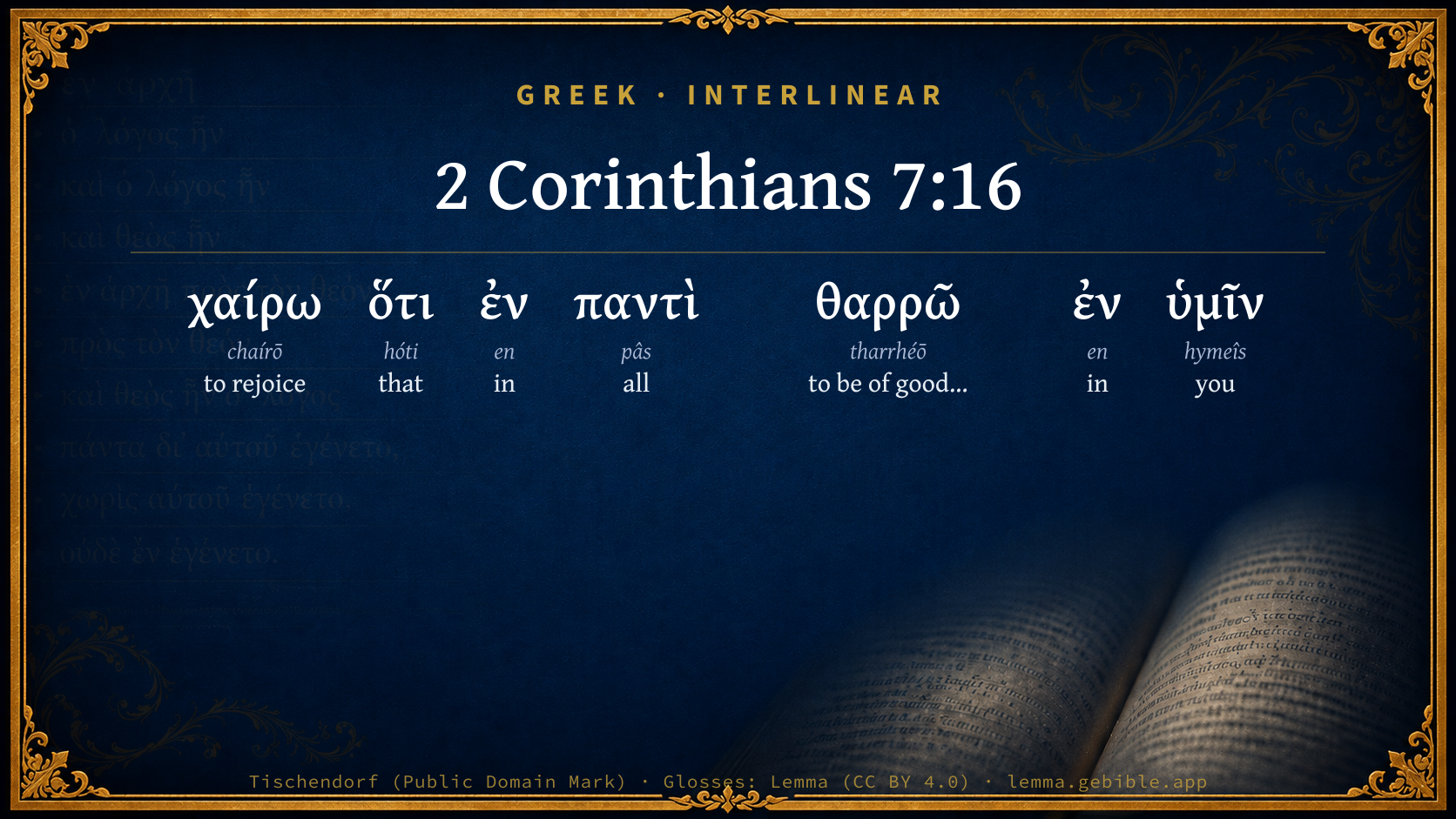
Greek (Tischendorf 8th ed.) 2 Corinthians 7:16 appears in the Greek New Testament. The text above is from the Tischendorf 8th edition. Each word links to its Strong’s number and a concise gloss. Click any word for its full Thayer’s Greek Lexicon entry.
Download image
Cite this verse

2 Corinthians 7:16 (World English Bible). Public Domain. Lemma interlinear Bible study tool, https://lemma.gebible.app/v/2-corinthians/7/16.

Show BibTeX & RIS
BibTeX
RIS
English Translation
I rejoice that in everything I am of good courage concerning you.
World English Bible · Public Domain
Download a study sheet

One document with this verse’s original text, its word-by-word gloss line, the meaning frame, cross-references with their text, attributed commentary, and full source and license credits — printable, and it pastes into notes with its structure intact.

This verse Autodidact and up

Study sheet (.html) Plain text (.txt)

A passage Seminary Student

Up to 50 verses in one chapter. A passage sheet keeps up to 6 commentary sources and 12 cross-references per verse, in the order this page ranks them, and says so on the sheet whenever that leaves anything out. Ask for a single verse and you get the Autodidact verse sheet above.

Everything on this page stays free to read, with no account — the sheet is a download of what is already on screen, not access to it.

Want to remove ads? Support Godless Engineer
Compare translations 3

The same verse in 3 English versions, stacked beneath the original-language interlinear above. Click any original word for its lexicon entry.

Each is an independent rendering of the whole verse — the interlinear is not word-aligned to these translations.

Highlighted words mark where these versions differ — a whole-verse word diff, not a word-by-word alignment.

  • World English Bible Public Domain
    I rejoice that in everything I am of good courage concerning you.
  • King James Version Public Domain
    I rejoice therefore that I have confidence in you in all things.
  • unfoldingWord Literal Text CC BY-SA 4.0
    I rejoice that in everything I am confident in you.

unfoldingWord Literal Text — © unfoldingWord, licensed CC BY-SA 4.0. Word-aligned USFM3 via Door43 (git.door43.org/unfoldingWord/en_ult).

Versions to compare (up to 4)

3 of 4 selected

Show all 19 translations

Every available English version of this verse, each an independent rendering of the whole verse.

  • World English Bible Public Domain
    I rejoice that in everything I am of good courage concerning you.
  • Berean Standard Bible Public Domain
    I rejoice that I can have complete confidence in you.
  • Majority Standard Bible Public Domain
    I rejoice that I can have complete confidence in you.
  • King James Version Public Domain
    I rejoice therefore that I have confidence in you in all things.
  • American Standard Version (1901) Public Domain
    I rejoice that in everything I am of good courage concerning you.
  • Revised Version (1885) Public Domain
    I rejoice that in everything I am of good courage concerning you.
  • Geneva Bible (1599) Public Domain
    I reioyce therefore that I may put my confidence in you in all things.
  • Douay-Rheims (1899) Public Domain
    I rejoice that in all things I have confidence in you.
  • Young's Literal Translation Public Domain
    I rejoice, therefore, that in everything I have courage in you.
  • Literal Standard Version CC BY-SA 4.0
    I rejoice, therefore, that in everything I have courage in you.
  • Unlocked Literal Bible CC BY-SA 4.0
    I rejoice because I have complete confidence in you.
  • unfoldingWord Literal Text CC BY-SA 4.0
    I rejoice that in everything I am confident in you.
  • Darby Bible Public Domain
    I rejoice that in everything I am confident as to you.
  • World Messianic Bible Public Domain
    I rejoice that in everything I am confident concerning you.
  • Webster's Bible Public Domain
    I rejoice therefore that I have confidence in you in all things.
  • Free Bible Version CC BY-SA 4.0
    I am so happy that I can be completely confident of you.
  • Bible in Basic English Public Domain
    It gives me great joy to see you answering to my good opinion of you in every way.
  • Text-Critical English NT CC BY 4.0
    I rejoice, because I have complete confidence in you.
  • Tyndale New Testament (1534) Public Domain
    I reioyce that I maye be bolde over you in all thynges.

Literal Standard Version (2020), Covenant Press — licensed CC BY-SA 4.0. Text via the HelloAO Bible API (eBible.org). Unlocked Literal Bible (unfoldingWord) — licensed CC BY-SA 4.0. Text via the HelloAO Bible API (eBible.org). unfoldingWord Literal Text — © unfoldingWord, licensed CC BY-SA 4.0. Word-aligned USFM3 via Door43 (git.door43.org/unfoldingWord/en_ult). Free Bible Version, Dr. Jonathan Gallagher — licensed CC BY-SA 4.0. Text via the HelloAO Bible API (eBible.org).

Word by word

More ways to search: Search by grammar → Find every occurrence → Compare this word →

Practice this passage: Drill this verse → Learn its vocabulary →

About this verse

These counts appear in no published source. They are computed here, from the morphology-tagged text and Lemma’s own curated glosses. What Lemma adds →

7
words
6
distinct lemmas
Pauline Epistles
section

Notable vocabulary

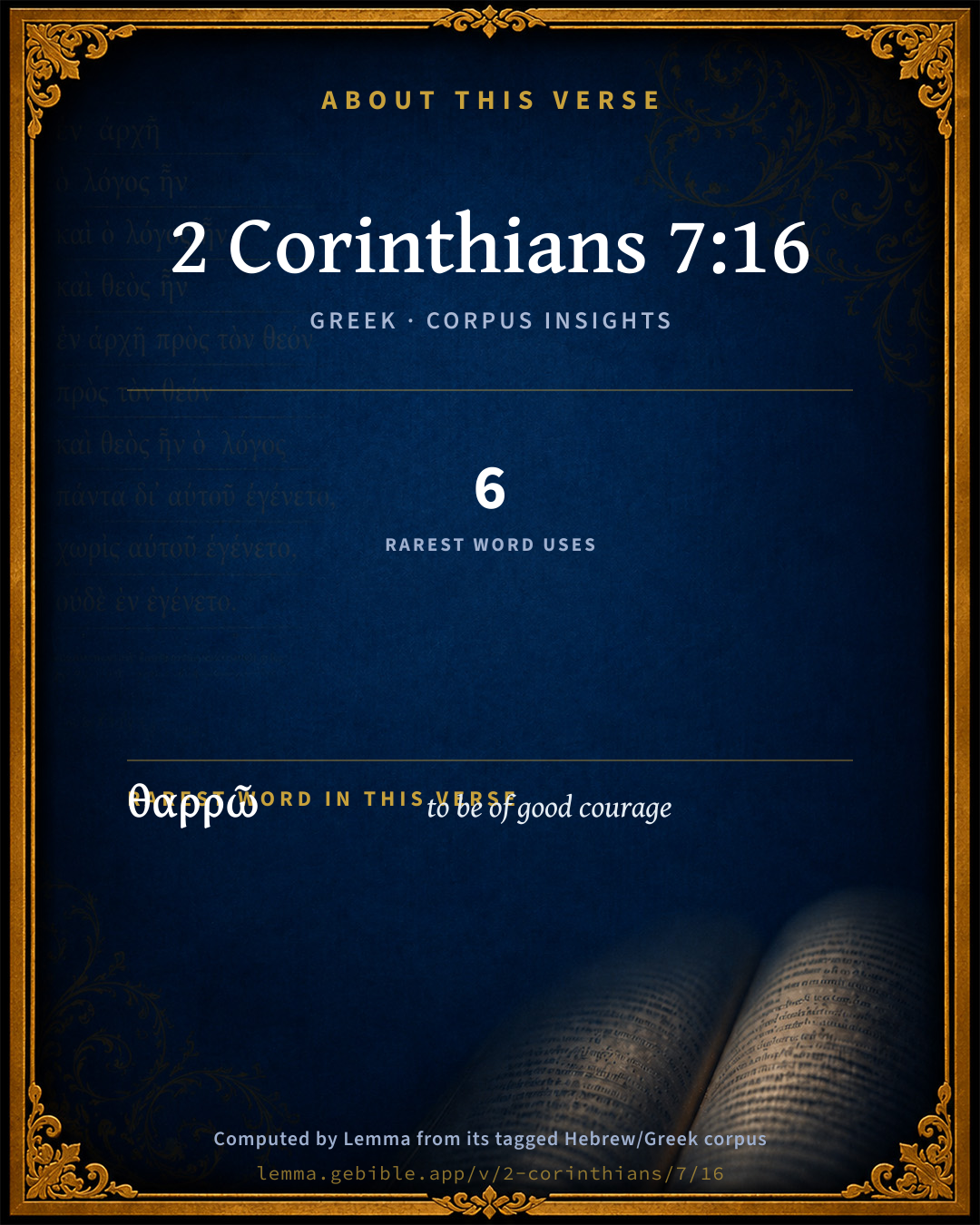
The rarest word here is θαρρῶ to be of good courage G2292 — appearing just 6 times in the whole Greek New Testament.

Shared distinctive vocabulary

θαρρῶ to be of good courage G2292 occurs in 6 verses of the Greek New Testament. Also found in:

Repetition

A word recurs within this verse:

Cross-references

4

Topical passages linked to 2 Corinthians 7:16 in the Treasury of Scripture Knowledge — connected by theme and wording, ordered by reader-vote popularity; previews shown in the World English Bible.

  • 2 Corinthians 2:3 And I wrote this very thing to you, so that, when I came, I wouldn't have sorrow from them of whom I ought to rejoice; having confidence in you all, that my joy would be shared by all of you.
  • Philemon 1:8 Therefore, though I have all boldness in Christ to command you that which is appropriate,
  • Philemon 1:21 Having confidence in your obedience, I write to you, knowing that you will do even beyond what I say.
  • 2 Thessalonians 3:4 We have confidence in the Lord concerning you, that you both do and will do the things we command.

Cross-references courtesy of OpenBible.info (CC BY 4.0).

Commentary

Notes on 2 Corinthians 7:16 from classic Christian and Jewish commentators (each source and its license shown beneath its notes). The classic Christian expositions comment on the surrounding passage and are grouped to its opening verse, so a note may address several verses; the Jewish commentaries on the Tanakh (Rashi and others) are per-verse, so they appear only where the commentator wrote on this verse.

Lemma curates 59 commentaries, every one of them public domain or Creative Commons licensed, each selected and text-cleaned for this edition rather than reprinted as found. About our sources →

Bengel's Gnomon

Johann Albrecht Bengel

2Co 7:16. Ἐν παντὶ, in every thing) This is applicable in the antecedent and consequent [in the context which precedes and that which follows]. He says, if I reprove you, you take it well; if I promise for you, you perform what is promised. So he prepares a way for himself with a view to what follows in 2Co 8:1 and 2Co 10:1, where the very word θαῤῥῶ, I have confidence, is resumed.—ἐν ὑμῖν, in you) on your account.

Bengel's Gnomon of the New Testament — English translation (T&T Clark, Edinburgh, 1860) — public domain. Text from a community e-Sword module.

Meyer's Critical & Exegetical Commentary

Heinrich August Wilhelm Meyer

2Co_7:16. Concluding result of the whole section, introduced vividly (without οὖν, comp. 2Co_7:12): I am glad that in every respect I have confidence on you.

ἐν ὑμῖν] not as to you, which would have been expressed prepositionally by περί, ὑπέρ, ἐπί, πρός, ἕνεκα (εἰς, 2Co_10:1, is in an adverse sense), but Paul knows his consolation as closely resting on the readers; that is the causal nexus, in which his joyous frame of mind depends on them. Comp. Winer, p. 218 [E. T. 291 f.]; Soph. Aj. 1294: ἐν ἐμοὶ θρασύς,1071: ἐν θανοῦσιν ὑβριστὴς γένῃ, Eurip. Or. 754: ἐν γυναιξὶν ἄλκιμος, Sir_38:23; Mat_3:17.

Meyer — Critical and Exegetical Commentary on the New Testament — English translation by Peter Christie, edited by Frederick Crombie (T&T Clark, 1880) — public domain. Text from a community e-Sword module.

Expositor's Greek Testament

ed. W. Robertson Nicoll

2Co 7:16 . χαίρω ὅτι κ . τ . λ .: I rejoice that in everything I am of good courage (not as A.V. “I have confidence,” which would be πέποιθα ) concerning you .

11. The Collection for the Judæan Christians (2Co 8:1 to 2Co 9:15 ). We have now come to the second main topic of the Epistle, viz. , the collection to be made at Corinth, as in all the Christian communities which the Apostle had founded, on behalf of the poor Christians at Judæa (chaps. 8 and 9). We first hear of this great undertaking at 1Co 16:1 , but it is plain from that passage as well as from 2Co 8:10 ; 2Co 9:2 , that it had been organised some time before 1 Cor. was written. (See Introd. , p. 6.) The poverty of the Christians at Jerusalem, however caused, was evidently acute; and when St. Paul first parted from the Twelve on his mission to the Gentiles, one of the stipulations made with him was that he should “remember the poor” (Gal 2:10 ). This stipulation he faithfully observed, and it was to convey the money thus entrusted to him to its proper recipients that he paid his last visit to Jerusalem (Act 24:17 ). See further the excellent discussion in Stanley’s note on 1Co 16:1 .

The Expositor's Greek Testament, edited by W. Robertson Nicoll (1897–1910) — public domain. Text from a community e-Sword module.

Cambridge Greek Testament for Schools and Colleges

16. χαίρω (אBCDFGKLP) rather than χαίρω οὖν (some cursives, Arm.).

16. Χαίρω ὅτι ἕν παντὶ θαρρῶ ἐν ὑμῖν. The οὗν is a weak interpolation. I rejoice that in everything (2Co 7:11) I am of good courage concerning you. In 2Co 5:6; 2Co 5:8 ‘be confident’ is the better rendering of θαρρῶ: but here and 2Co 10:1-2 ‘be of good courage’ is more suitable. And it is important that the rendering here and in 2Co 10:1-2 should be alike, for, if 10–13 be part of the second lost letter, this passage may be connected with 2Co 10:1-2. In the painful letter he had to think of being of good courage in withstanding them. Here he is of good courage about their loyalty. See on 2Co 1:23, 2Co 2:3; 2Co 2:9, 2Co 4:2, 2Co 5:13, 2Co 7:2 for other cases in which passages in 1–9 seem to refer to passages in 10–13. But, whether there be any connexion between this verse and 2Co 10:1-2 or not, how could the Apostle write this, and then in the same letter write 2Co 12:20-21?

This ends the first main portion of the Epistle (2Co 1:12 to 2Co 7:16). The next two chapters form the second main portion.

Cambridge Greek Testament for Schools and Colleges (Cambridge University Press, 1896; 21 vols, various authors incl. Carr, Maclear, Plummer, Farrar, Lumby, Moule, M. R. James, Simcox) — public domain. Text from a community e-Sword module.

International Critical Commentary

16. χαίρω ὅτι ἐν πάντι θαρρῶ ἐν ὑμῖν. A joyous conclusion to the whole section (6:11-7:16), added impressively without any connecting particle. The οὖν, ‘therefore’ (AV) is one of those freq. insertions made by scribes and translators (here Goth. Arm.) for the sake of smoothness, and such smoothness generally involves weakness. It does not much matter how we take ὅτι, whether ‘I rejoice that, ’ or ‘I rejoice because.’ The translation of θαρρῶ is more important; ‘I am of good courage’ (RV), as in 10:1, 2, rather than ‘I have confidence’ (AV). If 10-13. is part of the painful letter which preceded 1-9., this verse may refer to 10:1, 2. There he is of good courage in standing out against some of them; here he is of good courage about the present obedience of all of them, and (as he hopes) about their readiness to help in raising money for the poor at Jerusalem. This verse prepares the way for the request which he is about to urge in 8. and 9. Their past good works and present loyalty give him courage in pressing this matter upon them. See on 1:23, 2:3, 9, 4:2, 5:13, 7:2 for other instances in which these first nine chapters seem to refer to passages in the last four. Whatever may be the truth about this or any other possible reference, the Apostle’s mood and judgment must have changed extraordinarily, if, after dictating these verses (13-16), he dictated 12:20, 21 as part of the same letter.

ἐν ὑμῖν. ‘Concerning you’; cf. ἀποροῦμαι ἐν ὑμῖν, ‘I am perplexed about you’ (Gal 4:20); lit. ‘in your case.’ Others explain that the root of the courage or the perplexity is in them, and translate ‘through you.’ The difference is not very great.

The reconciliation between the Apostle and the Corinthians is now complete; and with this verse the first main division of the Epistle (1:12-7:16) ends. Sicut sapiens medicus jam paene sanata vulnera lenissimis medicamentis curabat, ut prioris increpationis usura sanaretur (Herveius).

Before leaving this chapter we must notice once more its exuberant and passionate tone. The Apostle “lets himself go,” and can hardly find language in which to express his appreciation of the present attitude of the Corinthians towards himself and Titus, and his consequent joy over them and over the joy which they have produced in Titus. Words expressive of comfort, rejoicing, glorying, boldness, and courage occur with surprising frequency, as if he could not repeat them too often. We have παρακαλέω four times, παράκλησις thrice, χαίρω four times, χαρά twice, καύχησις twice, καυχάομαι and παρρησία and θαρρῶ once each. With regard to the good conduct of the Corinthians we have ζῆλος twice, σπουδή twice, μετάνοια twice, φόβος twice, together with ὑπακοή and other terms of approbation. And all this is within the compass of fifteen, or rather of thirteen verses. It is all the more necessary to notice this because of the very marked change of tone which is at once evident directly we leave this part of the Epistle and begin to study the next two chapters. The change of subject causes a sudden cessation of this overflowing enthusiasm and generosity of language. So far from letting himself go, the Apostle manifestly feels that he is treading on delicate ground, and that he must be cautious about what he says and the language in which he says it. The Epistle is full of rapid changes of feeling, perhaps caused in some cases by breaks in the times of dictating. Here it is the new subject that causes the change.

* The proposal has been anticipated by Augustine (De Doc. Chris. iii.2), who points it out as possible, but does not adopt it.

* Several of the Latin commentators, misled by Capite nos, take this as meaning mente capite, intelligite, ‘Consider what I say.’ Others interpret, ‘Consider me, take me as an example.’ The Greek cannot mean this. Theophylact is right; δέξασθε ἡμᾶς πλατέως καί μή στενοχορώμεθα ἐν ὑμῖν. Bengel expands ήμᾶς thus; vestri amantes, vestra causa laetante.

אԠא (Fourth century). Codex Sinaiticus; now at Petrograd, the only uncial MS. containing the whole N.T.

B B (Fourth century). Codex Vaticanus.

C C (Fifth century). Codex Ephraemi, a Palimpsest; now at Paris, very defective. Of 2 Corinthians all from 10:8 onwards is wanting.

P P (Ninth century). Codex Porfirianus Chiovensis, formerly possessed by Bishop Porfiri of Kiev, and now at Petrograd.

D D (Sixth century). Codex Claromontanus; now at Paris. A Graeco-Latin MS. The Latin (d) is akin to the Old Latin. Many subsequent hands (sixth to ninth centuries) have corrected the MS.

E E (Ninth century). At Petrograd. A copy of D, and unimportant

F F (Late ninth century). Codex Augiensis (from Reichenau); now at Trinity College, Cambridge.

G G (Late ninth century). Codex Boernerianus; at Dresden. Interlined with the Latin (in minluscules). The Greek text is almost the same as that of F, but the Latin (g) shows Old Latin elements.

K K (Ninth century). Codex Mosquensis; now at Moscow.

L L (Ninth century). Codex Angelicus; now in the Angelica Library at Rome.

* information respecting the commentator is to be found in the volume on the First Epistle, pp. lxvi f.

* Cf. Τόε στήσεται ὲν παρρησιᾳ ὀ δίκαιος (Wisd. 5:1): λάβετα σκῦλα καὶ μετὰ παρρησίας (1 Macc. 4:18): also Heb 3:6, Heb 4:16, Heb 10:35

* “We must remember that we have not the letter in its entirety. Are not the passages which he most repented those have disappeared?” (Rendall, The Epp. of St. Paul to the Corinthians, p. 69).

d d The Latin companion of D

e d The Latin companion of E

f d The Latin companion of F

g d The Latin companion of G

* It is remarkable that μετανοια occurs only four times in the Pauline Epistles, twice in these two verses and once in Rom 2:4 and 2Ti 2:25, while μετανοέω occurs only in 2Co 12:21. This does not imply “the almost complete ommission of the twin Rabbinic ideas of repentance and forgiveness” (C. G. Montefiore, Judaism and St. Paul, p. 75). These words are rare, but the thought of forgiveness, such as he himself had won, is often present as reconciliation to God.

† Superest ne rursus prauinciae, quad damnasse dicitur, placeat, aeatque pxnitmtiam poenitentias suae (Plin. Ep. vii. 10).

* See the Essay and the Sermon on these words by F. Paget, The Spirit of Discipline, pp. 1 f. and 51 f.

37 37. (Evan. 69, Acts 69, Rev_14. Fifteenth century). The well-known Leicester codex; belongs to the Ferrar group.

† A steady reformation is a more decisive test of the value of mourning than depth of grief" (F. W. Robertson).

17 17. (Evan. 33, Act_13. Ninth century). Now at paris. “The queen of the cursives” and the best for the Pauline Epistles; more than any other it preserves Pre-Syrian readings and agrees with B D L.

* Bousset says with reason; so gibt diese Wendung nur dann einen er traglichen Sinn, wenn man annimt, dass Paulus selbst der Betroffence sti.

* But it is possible that περισσοτέρως is simply ‘very abundantly’ and implies no comparison with any other occasion.

* “In the same spirit with which a young man of character would work who was starting in business on capital advanced by a friend” (Denney).

International Critical Commentary — older volumes (1896–1929), various authors — public domain. Text from a community e-Sword module.

Jamieson, Fausset & Brown

Robert Jamieson, A. R. Fausset & David Brown

therefore--omitted in the oldest manuscripts. The conclusion is more emphatical without it.

that I have confidence in you in all things--rather, as Greek, "that in everything I am of good courage concerning (literally, 'in the case of') you," as contrasted with my former doubts concerning you.

Next: 2 Corinthians Chapter 8

Jamieson, Fausset & Brown — Commentary Critical and Explanatory on the Whole Bible (1871) — public domain (CC PDM 1.0). Text via the HelloAO Bible API.

Adam Clarke's Commentary

Verse 16. I have confidence in you, in all things.] It appears that the apostle was now fully persuaded, from the accounts given by Titus, that every scandal had been put away from this Church; that the faction which had long distracted and divided them was nearly broken; that all was on the eve of being restored to its primitive purity and excellence; and that their character was now so firmly fixed, that there was no reason to apprehend that they should be again tossed to and fro with every wind of doctrine.

1. THUS a happy termination was put to an affair that seemed likely to ruin the Christian Church, not only at Corinth, but through all Greece; for, if this bad man, who had been chief in opposing the apostle's authority, bringing in licentious doctrines, and denying the resurrection of the dead, had ultimately succeeded at Corinth, his doctrine and influence might soon have extended over Greece and Asia Minor, and the great work of God which had been wrought in those parts would have been totally destroyed. This one consideration is sufficient to account for the apostle's great anxiety and distress on account of the divisions and heresies at Corinth. He knew it was a most pernicious leaven; and, unless destroyed, must destroy the work of God. The loss of the affections of the Church at Corinth, however much it might affect the tender, fatherly heart of the apostle, cannot account for the awful apprehensions, poignant distress, and deep anguish, which he, in different parts of these epistles, so feelingly describes; and which he describes as having been invariably his portion from the time that he heard of their perversion, till he was assured of their restoration by the account brought by Titus.

2. A scandal or heresy in the Church of God is ruinous at all times, but particularly so when the cause is in its infancy; and therefore the messengers of God cannot be too careful to lay the foundation well in doctrine, to establish the strictest discipline, and to be very cautious whom they admit and accredit as members of the Church of Christ. It is certain that the door should be opened wide to admit penitent sinners; but the watchman should ever stand by, to see that no improper person enter in. Christian prudence should ever be connected with Christian zeal. It is a great work to bring sinners to Christ; it is a greater work to preserve them in the faith; and it requires much grace and much wisdom to keep the Church of Christ pure, not only by not permitting the unholy to enter, but by casting out those who apostatize or work iniquity. Slackness in discipline generally precedes corruption of doctrine; the former generating the latter.

Adam Clarke's Commentary on the Bible (1810–1826) — public domain. Text from a community e-Sword/MySword module.

Ellicott's Commentary for English Readers

(16) I rejoice therefore that I have confidence in you in all things.—Most of the better MSS. omit “therefore,” which may have been inserted for the sake of connecting the verse. “I have confidence in you,” though, in one sense, a literal translation of the Greek, fails to give its exact meaning. He does not mean, “I trust you,” but “I am of good cheer, I take courage in you, being what you are.” With this expression of thankfulness he leaves the painful subject of which he had been compelled to speak, and passes, probably after a pause of greater or less length, to another.

A Bible Commentary for English Readers, edited by Charles John Ellicott (1878–1897) — public domain. Text from a community e-Sword module.

The Cambridge Bible for Schools and Colleges

gen. ed. J. J. S. Perowne

16. I rejoice therefore] Our translation follows the Geneva version here. There is no ‘therefore’ in the best MSS. and versions. It is found neither in Wiclif, Tyndale, nor Cranmer. And the somewhat abrupt conclusion is in harmony with St Paul’s style. Cf. 1Co_5:13, where a similar attempt has been made by some copyist to soften down the abruptness.

that I have confidence in you] Tyndale and Cranmer translate that I may be bolde over you. Our version here again follows the Geneva Bible. Wiclif renders trist. But the word is not that usually rendered ‘have confidence’ in the N. T. The Apostle’s meaning is rather, that in every thing I am of good courage in consequence of your conduct. From this chapter, says Robertson, we learn “the value of explanations. Had St Paul left the matter unsettled, or only half settled, there never could have been a hearty understanding between him and the Corinthians. Whenever there is a misunderstanding between man and man, the true remedy is a direct and open request for explanation.” Cf. Mat_18:15-17.

The Cambridge Bible for Schools and Colleges (gen. ed. J. J. S. Perowne; Cambridge University Press, 1878–1918) — public domain. Text from a community e-Sword module.

John Gill's Exposition

I rejoice therefore that I have confidence in you in all things. That I can speak freely and boldly to you, reprove, admonish, and advise you, since you take it all in good part, as I design it; that I can confidently speak in your favour, boast of your love and obedience, which is found upon trial and by experience to be truth; and that I can promise myself every good thing from you, that is proper to ask of you, and lies in your power to perform; which he says partly to commend them for their past conduct, and partly to pave the way for what he had to say to them, concerning making a collection for the poor saints.

Next: 2 Corinthians Chapter 8

John Gill's Exposition of the Whole Bible (1746–1763) — public domain (CC PDM 1.0). Text via the HelloAO Bible API.

Trapp's Complete Commentary

John Trapp

16 I rejoice therefore that I have confidence in you in all things.

Ver. 16. I rejoice therefore] Thus by praising them, he further winneth upon them, whom before he had more sharply handled. Sour and sweet make the best sauce.

John Trapp, A Commentary or Exposition upon All the Books of the Old and New Testament (1647–1656) — public domain. Text from a community e-Sword module.

Albert Barnes' Notes on the Bible

I rejoice, therefore, that I have confidence ... - I have had the most ample proof that you are disposed to obey God, and to put away everything that is offensive to him. The address of this part of the Epistle, says Doddridge, is wonderful. It is designed, evidently, not merely to commend them for what they had done, and to show them the deep attachment which he had for them, but in a special manner to prepare them for what he he was about to say in the following chapter, respecting the collection which he had so much at heart for the poor saints at Jerusalem. What he here says was admirably adapted to introduce that subject. They had thus far showed the deepest regard for him. They had complied with all his directions. All that he had said of them had proved to be true. And as he had boasted of them to Titus 2Co 7:14, and expressed his entire confidence that they would comply with his requisitions, so he had also boasted of them to the churches of Macedonia and expressed the utmost confidence that they would be liberal in their benefactions, 2Co 9:2. All that Paul here says in their favor, therefore, was eminently adapted to excite them to liberality, and prepare them to comply with his wishes in regard to that contribution.

Remarks

1. Christians are bound by every solemn and sacred consideration to endeavor to purify themselves, 2Co 7:1. They who have the promises of eternal life, and the assurance that God will be to them a father, and evidence that they are his sons and daughters, should not indulge in the filthiness of the flesh and spirit.

2. Every true Christian will aim at perfection, 2Co 7:1. He will desire to be perfect; he will strive for it; he will make it a subject of unceasing and constant prayer. No man can be a Christian to whom it would not be a pleasure to be at once as perfect as God. And if any man is conscious that the idea of being made at once perfectly holy would be unpleasant or painful, he may set it down as certain evidence that he is a stranger to religion.

3. No man can be a Christian who voluntarily indulges in sin, or in what he knows to be wrong, 2Co 7:1. A man who does that cannot be aiming at perfection. A man who does that shows that he has no real desire to be perfect.

4. How blessed will be heaven, 2Co 7:1. There we shall be perfect. And the crowning glory of heaven is not that we shall be happy, but that we shall be holy. Whatever there is in the heart that is good shall there be perfectly developed; whatever there is that is evil shall be removed, and the whole soul will be like God. The Christian desires heaven because he will be there perfect. He desires no other heaven. He could be induced to accept no other if it were offered to him. He blesses God day by day that there is such a heaven, and that there is no other: that there is one world which sin does not enter, and where evil shall be unknown.

5. What a change will take place at death, 2Co 7:1. The Christian will be there made perfect. How this change will be there produced we do not know. Whether it will be by some extraordinary influence of the Spirit of God on the heart, or by the mere removal from the body, and from a sinful world to a world of glory, we know not. The fact seems to be clear, that at death the Christian will be made at once as holy as God is holy, and that he will ever continue to be in the future world.

6. What a desirable thing it is to die, 2Co 7:1. Here, should we attain to the age of the patriarchs, like them we should continue to be imperfect. Death only will secure our perfection; and death, therefore, is a desirable event. The perfection of our being could not be attained but for death; and every Christian should rejoice that he is to die. It is better to be in heaven than on earth; better to be with God than to be away from him; better to be made perfect than to be contending here with internal corruption, and to struggle with our sins. “I would not live always,” was the language of holy Job; “I desire to depart and to be with Christ,” was the language of holy Paul.

7. It is often painful to be compelled to use the language of reproof, 2Co 7:8. Paul deeply regretted the necessity of doing it in the case of the Corinthians, and expressed the deepest anxiety in regard to it. No man, no minister, parent, or friend can use it but with deep regret that it is necessary. But the painfulness of it should not prevent our doing it. It should be done tenderly but faithfully. If done with the deep feeling, with the tender affection of Paul, it will be done right; and when so done, it will produce the desired effect, and do good. No man should use the language of reproof with a hard heart, or with severity of feeling. If he is, like Paul, ready to weep when he does it, it will do good. If he does it because he delights in it, it will do evil.

8. It is a subject of rejoicing where a people exercise repentance, 2Co 7:8. A minister has pleasure not in the pain which his reproofs cause; not in the deep anxiety and distress of the sinner, and not in the pain which Christians feel under his reproofs, but he has joy in the happy results or the fruits which follow from it. It is only from the belief that those tears will produce abundant joy that he has pleasure in causing them, or in witnessing them.

9. The way to bring people to repentance is to present to them the simple and unvarnished truth, 2Co 7:8-9. Paul stated simple and plain truths to the Corinthians. He did not abuse them; he did not censure them in general terms; he stated things just as they were, and specified the things on account of which there was occasion for repentance. So if ministers wish to excite repentance in others, they must specify the sins over which others should weep; if we wish, as individuals, to feel regret for our sins, and to have true repentance toward God, we must dwell on those particular sins which we have committed, and should endeavor so to reflect on them that they may make an appropriate impression on the heart. No man will truly repent by general reflections on his sin; no one who does not endeavor so to dwell on his sins as that they shall make the proper impression which each one is suited to produce on the soul. Repentance is that state of mind which a view of the truth in regard to our own depravity is suited to produce.

10. There is a great difference between godly sorrow and the sorrow of the world, 2Co 7:10. All people feel sorrow. All people, at some period of their lives, grieve over their past conduct. Some in their sorrow are pained because they have offended God, and go to God, and find pardon and peace in him. That sorrow is unto salvation. But the mass do not look to God. They turn away from him even in their disappointments, and in their sorrows, and in the bitter consciousness of sin. They seek to alleviate their sorrows in worldly company, in pleasure, in the intoxicating bowl; and such sorrow works death. It produces additional distress, and deeper gloom here, and eternal woe hereafter.

11. We may learn what constitutes true repentance, 2Co 7:11. There should be. and there will be, deep feeling. There will be “carefulness,” deep anxiety to be freed from the sin; there will be a desire to remove it; “indignation” against it; “fear” of offending God; “earnest desire” that all that has been wrong should be corrected; “zeal” that the reformation should be entire; and a wish that the appropriate “revenge,” or expression of displeasure, should be excited against it. The true penitent hates nothing so cordially as he does his sin. He hates nothing but sin. And his warfare with that is decided, uncompromising, inexorable, and eternal.

12. It is an evidence of mercy and goodness in God that the sorrow which is felt about sin may be made to terminate in our good, and to promote our salvation, 2Co 7:10-11. If sorrow for sin had been suffered to take its own course, and had proceeded unchecked, it would in all cases have produced death. If it had not been for the merciful interposition of Christianity, by which even sorrow might be turned to joy, this world would have been everywhere a world of sadness and of death. Man would have suffered. Sin always produces, sooner or later, woe. Christianity has done nothing to make people wretched, but it has done everything to bind up broken hearts. It has revealed a way by which sorrow may be turned into joy, and the bitterness of grief may be followed by the sweet calm and sunshine of peace.

13. The great purpose of Christian discipline is to benefit the whole church, 2Co 7:12. It is not merely on account of the offender, nor is it merely that the injured may receive a just recompense. it is primarily that the church may be pure, and that the cause of religion may not be dishonored. When the work of discipline is entered on from any private and personal motives, it is usually attended with bad feeling, and usually results in evil. When it is entered on with a desire to honor God, and to promote the purity of the church, when the whole aim is to deliver the church from opprobrium and scandal, and to have just such a church as Jesus Christ desires, then it will be prosecuted with good temper, and with right feeling, and then it will lead to happy results. Let no man institute a process of discipline on an offending brother from private, personal, and revengeful feelings. Let him first examine his own heart, and let him be sure that his aim is solely the glory of Christ, before he attempts to draw down the censure of the church on an offending brother. How many cases of church discipline would be arrested if this simple rule were observed! And while the case before us shows that it is important in the highest degree that discipline should be exercised on an offending member of the church; while no consideration should prevent us from exercising that discipline; and while every man should feel desirous that the offending brother should be reproved or punished, yet this case also shows that it should be done with the utmost tenderness, the most strict regard to justice, and the deepest anxiety that the general interests of religion should not suffer by the manifestation of an improper spirit, or by improper motives in inflicting punishment on an offending brother.

Albert Barnes' Notes on the Bible (1834–1885) — public domain. Text from a community e-Sword/MySword module.

Haydock's Catholic Bible Commentary

After these proofs of your charity, and the uprightness of your heart, I can reprehend and correct you, exhort and praise you, without fear of my reprehensions separating you from me, without apprehension that my recommendations will prove false, or my confidence vain; I now reckon you as persons entirely devoted to me, and whose affection towards me will never cease. (Calmet) See Grotius, Estius, &c. &c. --- I therefore rejoice, as we read in the Greek, after this trial, that you will refuse me nothing I ask of you: and this my confidence I shall shew, by asking you to contribute to the wants of the distressed brethren in Jerusalem, who have suffered so much for their religion.

George Leo Haydock (1774–1849), Haydock's Catholic Family Bible and Commentary, 1859 edition — public domain. Excludes Psalms (Douay-Rheims chapter numbering differs from Protestant) and Deuterocanonical books (Catholic canon only).

Matthew Poole's English Annotations

That I can write and speak to you with confidence that you will hearken to my admonitions and exhortations, and that I can confidently boast and glory concerning you.

Matthew Poole's English Annotations on the Holy Bible (1683–1685) — public domain. Text from a community e-Sword/MySword module.

Whedon's Commentary on the Bible

Daniel D. Whedon

16. Confidence—In this word is the final seal of settlement of all misgivings between St. Paul and his Corinthians. The agonies of suspense and distrust are all over, and their hearts are one. He will meet them again as their assured apostle. And he will now exhibit his confidence in their fidelity by moving them to open their pockets, and give a generous lead in furnishing funds for the poor saints at Jerusalem.

Daniel D. Whedon (gen. ed.), Commentary on the Old and New Testaments (1874–1909) — public domain. Text from a community e-Sword module.

The Pulpit Commentary

I rejoice therefore. The "therefore" concludes the whole paragraph, but is omitted in many manuscripts. I have confidence in you; literally, I am bold in you; i.e. I feel courage about you. The phrase in 2Th_3:4 expresses a calmer and less hazardous trust.

Apostolic confidence;

or the fulness of the restoration man may make to follow on his forgiveness of his fellow men. "I rejoice, therefore, that I have confidence in you in all things." F.W. Robertson says, "We learn from this the value of explanations. Had St. Paul left the matter unsettled, or only half settled, there never could have been a hearty understanding between him and the Corinthians. Whenever there is a misunderstanding between man and man, the true remedy is a direct and open request for explanation." This sentence closes the apostle"s reference to a very painful subject; he wishes it now to be put quite away, out of thought, and so he assures the Corinthians that no relic of suspicion or fear is left in his mind; he restores them fully to his affection and esteem; he has "confidence in them in all things." Now, in this complete restoration of the Corinthians to favour we see that man may be the shadow of God, and his forgiveness and full reconciliation may help his fellow men to realize the fulness of the restoration which God gives to the penitent. He puts our sins behind his back. He casts them into the depths of the sea. He separates them from us as far as the east is from the west. He remembers them no more against us forever. He blots out our transgressions as a cloud, and our iniquities as a thick cloud. The figure of our God is the father in the parable of the prodigal son, who brings the penitent and forgiven son into the old place at the family table, dresses him in the son"s robes, and gives him such a welcome as will show the sad past to be all forgiven and forgotten. It should be a serious thought to us that men may take their ideas of God"s dealing with them from the manner of our dealing with them. If they find that we cannot forgive and forget, and wholly restore confidence, it will be very hard for them to believe that God can. Three points of man"s dealing with man, especially of the Christian man"s dealing with his fellow Christian, may be taken as representing God"s dealings with us. In these we may be ourselves examples of God.

I MAN WITHDRAWING CONFIDENCE BECAUSE OF CHERISHED SIN. God never passes by sin, and we must not. Every Church member should be quickly sensitive to the inconsistencies and sins of his fellow members. If the sin is kept and cherished there ought to be withdrawal of confidence, for whenever his people cherish sin there is a cloud passes before God and hides his face from them.

II MAN ENDEAVOURING TO INFLUENCE FOR THE PUTTING AWAY OF SIN. Falling into transgression ought to set our brothers upon our Christian love and effort. Erring brothers must not be left to go in their evil ways. Illustrate from St. Paul"s efforts to bring the incestuous man to repentance. Too often Churches are more eager to exercise discipline than to attempt recovery, and labour to secure repentance. "Ye that are spiritual restore such a one in the spirit of meekness.

III MAN RESTORING TO CONFIDENCE WHEN THE SIN IS PUT AWAY. This we have illustrated in the hearty words of the apostle. Speaking of Newman"s sentence, "A true penitent never forgives himself," F.W. Robertson says, "A false estimate of the gospel of Christ and of theheart of man! A proud remorse does not forgive itself the forfeiture of its own dignity; but it is the very beauty of the penitence which is according to God that at last the sinner, realizing God"s forgiveness, does learn to forgive himself." And help to this "self-forgiving" we can render if we show to the sincere penitent the heartiness of our forgiveness and restoration. R.T.

The Pulpit Commentary (1880–1919), ed. H.D.M. Spence-Jones & Joseph S. Exell — public domain. Text from a community e-Sword module.

McGarvey & Pendleton's Commentaries

J. W. McGarvey

I rejoice that in everything I am of good courage concerning you . [The affections which the Corinthians had awakened in the heart of Titus, who had come among them and had been received as Paul's messenger, greatly established the confidence of the apostle in that church, as he here tells them. Having thus led up to a well-grounded expression of confidence, Paul makes it a basis on which to rest the second division of his epistle--a division in which he appeals to them to fulfill their promises with regard to the collection for the poor at Jerusalem.]

J. W. McGarvey (with Philip Y. Pendleton), Commentaries on the New Testament (The Fourfold Gospel, 1914; Acts; and the epistles) — public domain. Text from a community e-Sword/MySword module.

The People's New Testament

B. W. Johnson

16. I rejoice therefore that I have confidence in you. Rather, that I am greatly encouraged concerning you.

B. W. Johnson's The People's New Testament with Notes (1889–1891) — public domain. Electronic text from the Christian Classics Ethereal Library (CCEL) ThML edition.

Alford’s Greek Testament

Henry Alford

16.] I rejoice (more expressive than with a connecting particle) that in every thing I am (re)- assured by you; ‘am of good courage, in contrast to my former dejection, owing to your good conduct.’ The ordinary rendering, ‘I can have confidence in you,’ is wrong in not giving the indic. θαῤῥῶ, and still more, in making θαῤῥεῖν ἐν mean ‘to have confidence in,’ which is unexampled. Meyer, who remarks this, does not notice, that the strongest reason against it is not mere want of usage, but the psychological meaning of θαῤῥεῖν, which is not like πεποιθέναι, descriptive of a relative, but of an absolute state of mind,—to be of good courage: and this admits only of qualification as to the ground of that good courage; thus we have θαῤῥεῖν ὑπέρ περί, ἐπί, in the sense of ‘rejoicing at,’ ‘feeling confident concerning:’ but θαῤῥεῖν ἐν for ‘to trust in,’ as πεποιθέναι ἐν, would, I think, be inadmissible. Meyer quotes ἐν σοὶ πᾶσʼ ἔγωγε σώζομαι, Soph. Aj. 519, where, as here, ἐν gives the ground of the verb as in the person spoken of.

Henry Alford, The Greek Testament (1849–1861) — public domain. Text from a community e-Sword module.

Vincent's Word Studies in the New Testament

Marvin R. Vincent

I have confidence in you [θαρρω εν υμιν] . Wrong. Rev., correctly, I am of good courage. In you expresses the ground of his encouragement as lying in them.

Marvin R. Vincent, Word Studies in the New Testament (1887–1900) — public domain. Text from a community e-Sword/MySword module.

Lesson kit

Teaching starters — assembled from the data on this page, not authored interpretation. Every prompt links to the verse data it draws on. Edit before teaching.

2 Corinthians, in the Pauline Epistles, opens this verse with 7 words (6 distinct Greek lemmas). Its most distinctive word is tharrhéō (“to be of good courage”). A historical commentator’s framing appears above. Read the whole chapter for the surrounding context.

Discussion questions

  1. The word tharrhéō carries the sense “to be of good courage.” How does it shape the verse?
  2. 2 Corinthians 5:6 shares the word «to be of good courage» with this verse. How do the two illuminate each other?
  3. “in” occurs 2× in this one verse. What is the effect of the repetition?
  4. The translations on this page render this verse differently — a whole-verse word diff, not a word-by-word alignment. What might account for the different wordings?
  5. Reading how Bengel's Gnomon and Meyer's Critical & Exegetical Commentary read this verse, where do the two commentators agree and where do they part?

Things to notice

Reading settings

Reading text

Shown beneath each verse's original-language words.

Old Testament
Old Testament edition

Read the OT as the Masoretic Hebrew (MT) or the Greek Septuagint (LXX).

English shown for the Greek Septuagint (in the Hebrew ↔ Greek comparison).

Comparing translations? Open the Compare panel on any verse page to stack up to four side by side.