
Philippians 2:17

Greek (Tischendorf 8th ed.) Philippians 2:17 appears in the Greek New Testament. The text above is from the Tischendorf 8th edition. Each word links to its Strong’s number and a concise gloss. Click any word for its full Thayer’s Greek Lexicon entry.
Download image
Cite this verse

Philippians 2:17 (World English Bible). Public Domain. Lemma interlinear Bible study tool, https://lemma.gebible.app/v/philippians/2/17.

Show BibTeX & RIS
BibTeX
RIS
English Translation
Yes, and if I am poured out on the sacrifice and service of your faith, I rejoice, and rejoice with you all.
World English Bible · Public Domain
Highlights
  • 1 first appearance in the Greek New Testament
Full analysis ↓
Download a study sheet

One document with this verse’s original text, its word-by-word gloss line, the meaning frame, cross-references with their text, attributed commentary, and full source and license credits — printable, and it pastes into notes with its structure intact.

This verse Autodidact and up

Study sheet (.html) Plain text (.txt)

A passage Seminary Student

Up to 50 verses in one chapter. A passage sheet keeps up to 6 commentary sources and 12 cross-references per verse, in the order this page ranks them, and says so on the sheet whenever that leaves anything out. Ask for a single verse and you get the Autodidact verse sheet above.

Everything on this page stays free to read, with no account — the sheet is a download of what is already on screen, not access to it.

Want to remove ads? Support Godless Engineer
Compare translations 3

The same verse in 3 English versions, stacked beneath the original-language interlinear above. Click any original word for its lexicon entry.

Each is an independent rendering of the whole verse — the interlinear is not word-aligned to these translations.

Highlighted words mark where these versions differ — a whole-verse word diff, not a word-by-word alignment.

  • World English Bible Public Domain
    Yes, and if I am poured out on the sacrifice and service of your faith, I rejoice, and rejoice with you all.
  • King James Version Public Domain
    Yea, and if I be offered upon the sacrifice and service of your faith, I joy, and rejoice with you all.
  • unfoldingWord Literal Text CC BY-SA 4.0
    But even if I am being poured out as an offering on the sacrifice and service of your faith, I rejoice and rejoice with you all.

unfoldingWord Literal Text — © unfoldingWord, licensed CC BY-SA 4.0. Word-aligned USFM3 via Door43 (git.door43.org/unfoldingWord/en_ult).

Versions to compare (up to 4)

3 of 4 selected

Show all 19 translations

Every available English version of this verse, each an independent rendering of the whole verse.

  • World English Bible Public Domain
    Yes, and if I am poured out on the sacrifice and service of your faith, I rejoice, and rejoice with you all.
  • Berean Standard Bible Public Domain
    But even if I am being poured out like a drink offering on the sacrifice and service of your faith, I am glad and rejoice with all of you.
  • Majority Standard Bible Public Domain
    But even if I am being poured out like a drink offering on the sacrifice and service of your faith, I am glad and rejoice with all of you.
  • King James Version Public Domain
    Yea, and if I be offered upon the sacrifice and service of your faith, I joy, and rejoice with you all.
  • American Standard Version (1901) Public Domain
    Yea, and if I am offered upon the sacrifice and service of your faith, I joy, and rejoice with you all:
  • Revised Version (1885) Public Domain
    Yea, and if I am offered upon the sacrifice and service of your faith, I joy, and rejoice with you all:
  • Geneva Bible (1599) Public Domain
    Yea, and though I bee offered vp vpon the sacrifice, and seruice of your faith, I am glad, and reioyce with you all.
  • Douay-Rheims (1899) Public Domain
    Yea, and if I be made a victim upon the sacrifice and service of your faith, I rejoice, and congratulate with you all.
  • Young's Literal Translation Public Domain
    but if also I am poured forth upon the sacrifice and service of your faith, I rejoice and joy with you all,
  • Literal Standard Version CC BY-SA 4.0
    but if I also am poured forth on the sacrifice and service of your faith, I rejoice and am glad with you all,
  • Unlocked Literal Bible CC BY-SA 4.0
    But even if I am being poured out as an offering on the sacrifice and service of your faith, I am glad and rejoice with you all.
  • unfoldingWord Literal Text CC BY-SA 4.0
    But even if I am being poured out as an offering on the sacrifice and service of your faith, I rejoice and rejoice with you all.
  • Darby Bible Public Domain
    But if also I am poured out as a libation on the sacrifice and ministration of your faith, I rejoice, and rejoice in common with you all.
  • World Messianic Bible Public Domain
    Yes, and if I am poured out on the sacrifice and service of your faith, I am glad and rejoice with you all.
  • Webster's Bible Public Domain
    And if I am even offered upon the sacrifice and service of your faith, I joy, and rejoice with you all.
  • Free Bible Version CC BY-SA 4.0
    So even if I pour out my life as a sacrifice and offering so you may trust in God, I'm happy for it, and I'm glad together with all of you,
  • Bible in Basic English Public Domain
    And even if I am offered like a drink offering, giving myself for the cause and work of your faith, I am glad and have joy with you all:
  • Text-Critical English NT CC BY 4.0
    But even if I am being poured out as a drink offering upon the sacrifice and service of your faith, I am glad and rejoice with you all.
  • Tyndale New Testament (1534) Public Domain
    nether have labored in vayne. Yee and though I be offered vp vpon the offerynge and sacrifice of youre fayth: I reioyce and reioyce with you all.

Literal Standard Version (2020), Covenant Press — licensed CC BY-SA 4.0. Text via the HelloAO Bible API (eBible.org). Unlocked Literal Bible (unfoldingWord) — licensed CC BY-SA 4.0. Text via the HelloAO Bible API (eBible.org). unfoldingWord Literal Text — © unfoldingWord, licensed CC BY-SA 4.0. Word-aligned USFM3 via Door43 (git.door43.org/unfoldingWord/en_ult). Free Bible Version, Dr. Jonathan Gallagher — licensed CC BY-SA 4.0. Text via the HelloAO Bible API (eBible.org).

Word by word

More ways to search: Search by grammar → Find every occurrence → Compare this word →

Practice this passage: Drill this verse → Learn its vocabulary →

σπένδομαι
spéndō
G4689
“to pour out”
Verb, Present, Passive, Indicative, 1st person, Singular
Part of Speech
Verb
Tense
Present
Voice
Passive
Mood
Indicative
Person
1st person
Number
Singular
Full Thayer's Definition

Origin: apparently a primary verb

TDNT: 7:528,*

1. to pour out as a drink offering, make a libation 2. in the NT to be offered as a libation 3. fig. used of one whose blood is poured out in a violent death for the cause of God
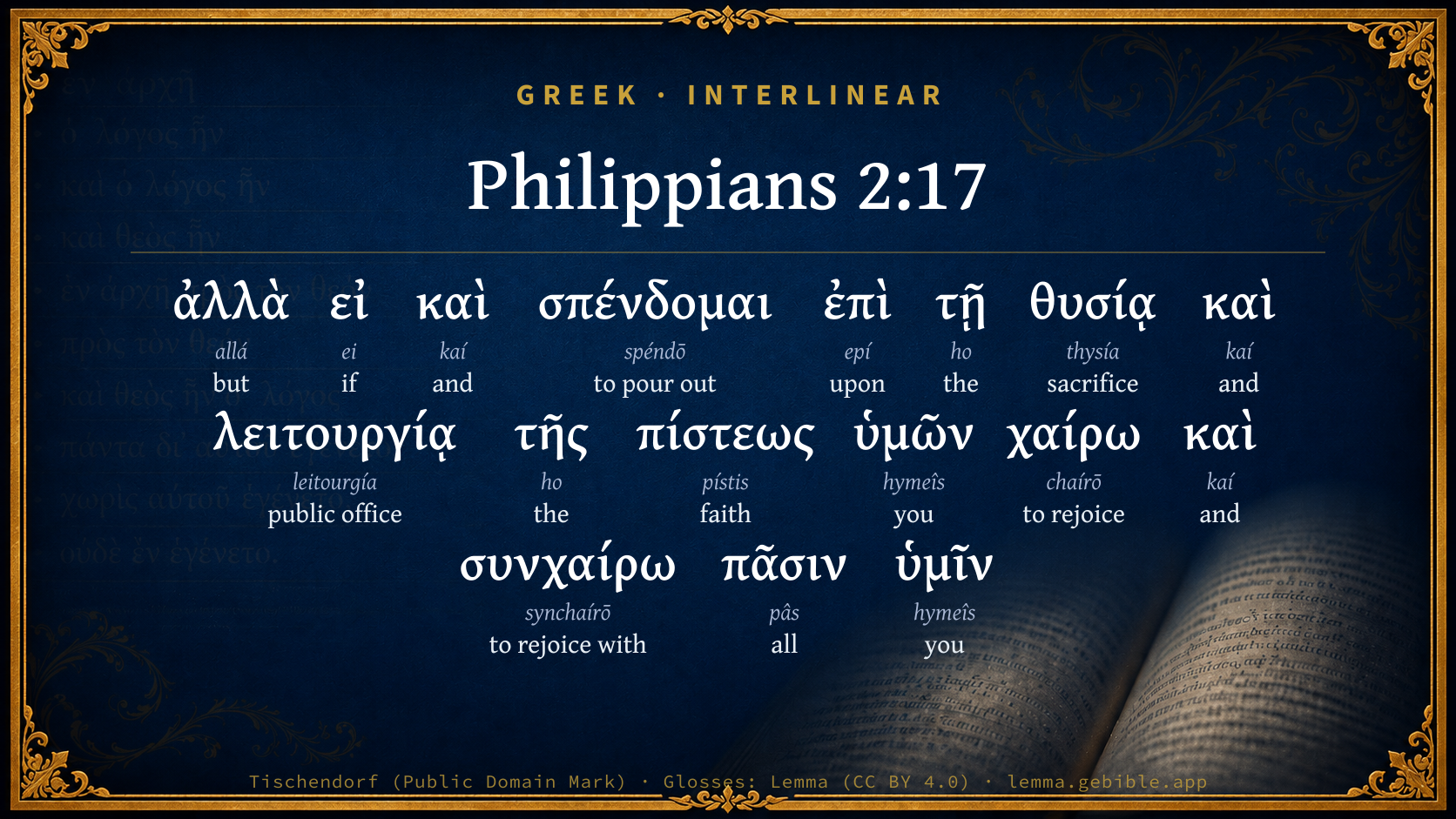
  1. ἀλλὰ allá G235 “but” Conjunction
  2. εἰ ei G1487 “if” Conditional
  3. καὶ kaí G2532 “and” Conjunction
  4. ἐπὶ epí G1909 “upon” Preposition
  5. τῇ ho G3588 “the” Article, Dative, Singular, Feminine
  6. θυσίᾳ thysía G2378 “sacrifice” Noun, Dative, Singular, Feminine
  7. καὶ kaí G2532 “and” Conjunction
  8. λειτουργίᾳ leitourgía G3009 “public office” Noun, Dative, Singular, Feminine
  9. τῆς ho G3588 “the” Article, Genitive, Singular, Feminine
  10. πίστεως pístis G4102 “faith” Noun, Genitive, Singular, Feminine
  11. ὑμῶν hymeîs G5210 “you” Personal pronoun, 2nd person, Genitive, Plural
  12. χαίρω chaírō G5463 “to rejoice” Verb, Present, Active, Indicative, 1st person, Singular
  13. καὶ kaí G2532 “and” Conjunction
  14. συνχαίρω synchaírō G4796 “to rejoice with” Verb, Present, Active, Indicative, 1st person, Singular
  15. πᾶσιν pâs G3956 “all” Adjective, Dative, Plural, Masculine
  16. ὑμῖν hymeîs G5210 “you” Personal pronoun, 2nd person, Dative, Plural

About this verse

These counts appear in no published source. They are computed here, from the morphology-tagged text and Lemma’s own curated glosses. What Lemma adds →

17
words
13
distinct lemmas
Pauline Epistles
section

Notable vocabulary

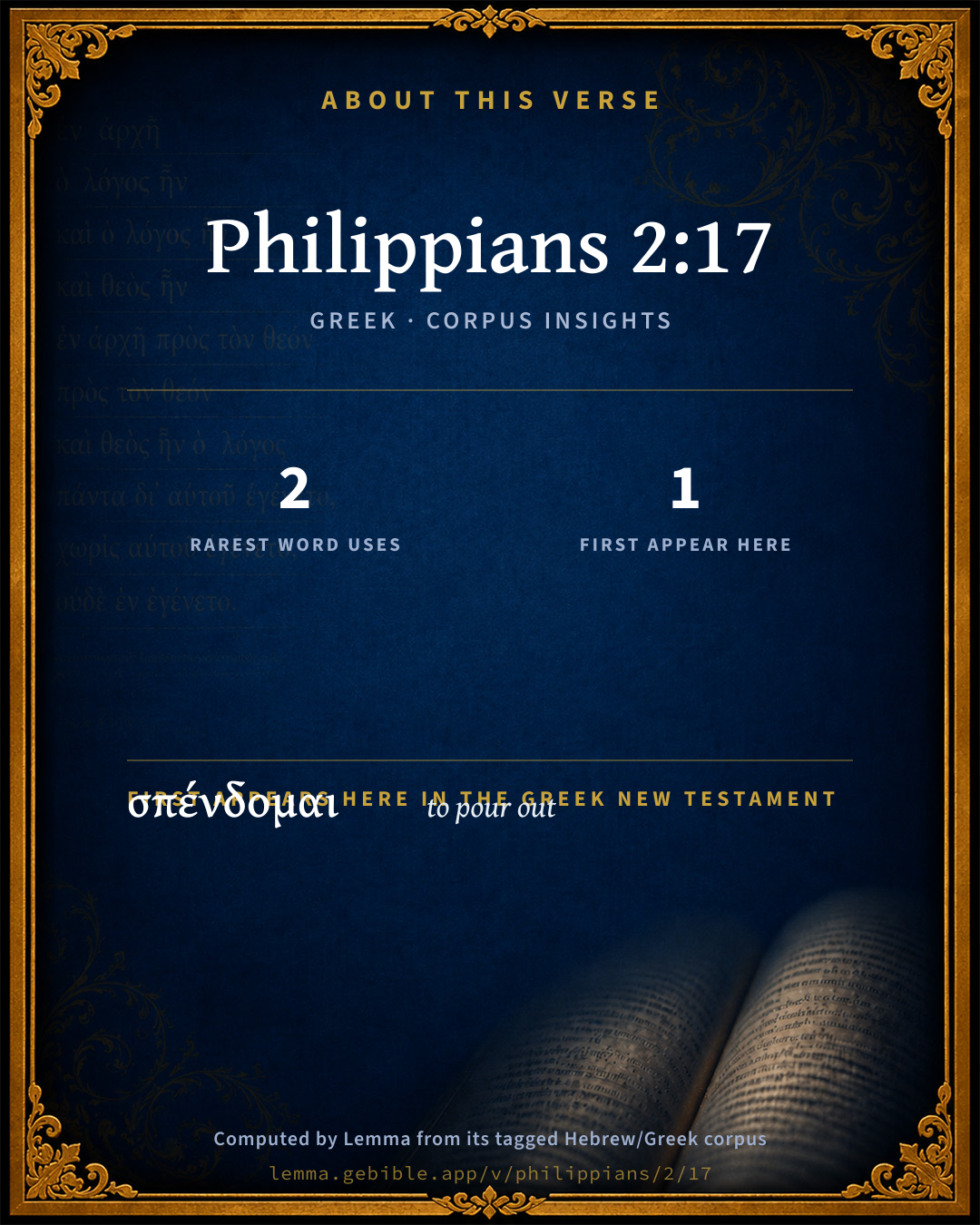
The rarest word here is σπένδομαι to pour out G4689 — appearing just 2 times in the whole Greek New Testament.

First appearance in Scripture

This word makes its first canonical appearance in the Greek New Testament here:

  • σπένδομαι to pour out G4689

Shared distinctive vocabulary

σπένδομαι to pour out G4689 occurs in 2 verses of the Greek New Testament. Also found in:
Repetition

Words recur within this verse:

Cross-references

16

Topical passages linked to Philippians 2:17 in the Treasury of Scripture Knowledge — connected by theme and wording, ordered by reader-vote popularity; previews shown in the World English Bible.

  • 2 Timothy 4:6 For I am already being offered, and the time of my departure has come.
  • Romans 15:16 that I should be a servant of Christ Jesus to the Gentiles, ministering as a priest the Gospel of God, that the offering up of the Gentiles might be made acceptable, sanctified by the Holy Spirit.
  • Hebrews 13:15–16 Through him, then, let us offer up a sacrifice of praise to God continually, that is, the fruit of lips which make confession to his name.
  • 2 Corinthians 12:15 I will most gladly spend and be spent for your souls. If I love you more abundantly, am I loved the less?
  • Romans 12:1 Therefore I urge you, brothers, by the mercies of God, to present your bodies a living sacrifice, holy, acceptable to God, which is your spiritual service.
  • 2 Corinthians 7:4 Great is my boldness of speech toward you. Great is my boasting on your behalf. I am filled with comfort. I overflow with joy in all our affliction.
  • Philippians 1:20 according to my earnest expectation and hope, that I will in no way be disappointed, but with all boldness, as always, now also Christ will be magnified in my body, whether by life, or by death.
  • Colossians 1:24 Now I rejoice in my sufferings for your sake, and fill up on my part that which is lacking of the afflictions of Christ in my flesh for his body's sake, which is the assembly;
  • 1 John 3:16 By this we know love, because he laid down his life for us. And we ought to lay down our lives for the brothers.
  • Acts 20:24 But these things don't count; nor do I hold my life dear to myself, so that I may finish my race with joy, and the ministry which I received from the Lord Jesus, to fully testify to the Gospel of the grace of God.
  • Philippians 4:18 But I have all things, and abound. I am filled, having received from Epaphroditus the things that came from you, a sweet-smelling fragrance, an acceptable and well-pleasing sacrifice to God.
  • 1 Thessalonians 2:8 Even so, affectionately longing for you, we were well pleased to impart to you, not the Gospel of God only, but also our own souls, because you had become very dear to us.
  • 1 Peter 2:5 You also, as living stones, are built up as a spiritual house, to be a holy priesthood, to offer up spiritual sacrifices, acceptable to God through Jesus Christ.
  • Acts 21:13 Then Paul answered, "What are you doing, weeping and breaking my heart? For I am ready not only to be bound, but also to die at Jerusalem for the name of the Lord Jesus."
  • Philippians 2:30 because for the work of Christ he came near to death, risking his life to supply that which was lacking in your service toward me.
  • 1 Thessalonians 3:7–9 for this cause, brothers, we were comforted over you in all our distress and affliction through your faith.

Cross-references courtesy of OpenBible.info (CC BY 4.0).

Commentary

Notes on Philippians 2:17 from classic Christian and Jewish commentators (each source and its license shown beneath its notes). The classic Christian expositions comment on the surrounding passage and are grouped to its opening verse, so a note may address several verses; the Jewish commentaries on the Tanakh (Rashi and others) are per-verse, so they appear only where the commentator wrote on this verse.

Lemma curates 59 commentaries, every one of them public domain or Creative Commons licensed, each selected and text-cleaned for this edition rather than reprinted as found. About our sources →

The Biblical Illustrator

Joseph S. Exell

Php_2:17-18

If I be offered upon the sacrifice and service of your faith--Observe

I.

The sacrifice of faith. Christ is the only true sacrifice, faith offers it--every one must offer it for himself.

II. The libation. The blood of the martyrs--joyfully offered--in defence of the truth, and for the confirmation of our faith. (J. Lyth, D. D.)

The law of the Christian life

The sacrifices of the Jews were not all sombre ceremonials. A solemn oppression rested on the people on the great day of Atonement; and it was not until the High Priest returned from the Most Holy Place, and proclaimed by His presence that the ceremonial was ended, that the people were able to breathe in gladness again. But there was one special festival which was of a joyous character--the whole burnt offering, or splendour offering, which was an expression of gratitude to God for His goodness. This was the service in which beasts in multitude smoked upon the altar, and wine was poured out in libation. It was to this that the apostle here refers. He delighted to think of humanity as presented in offering to the most Holy One--all presenting to God their faith and sacrifice, and to have part in such service was his highest joy. Life itself might be freely poured out upon it in libation. Christian history furnishes us with the reality of these two types. When the Saviour hung on Calvary, the sin-offering, there was no room for any but solemn accessories. There was darkness, etc.; but when He returned the whole spirit of piety was altered and enlarged. Sadness gave way to joy; death, suffering, endurance, became charged with joyous inspiration; so that the very word sacrifice took on a new significance.

I. In Christian service there must be sacrifice.

1. This is the law of Christian life. If any man will come after me, etc.

2. It is the impulse of Christian affection. Enough for the disciple to be as his Lord.

3. It is the revelation of a higher righteousness. It is better to suffer, etc., because Christ also suffered the just, etc.

4. It is the assurance of triumph and the way to spiritual influence. If we suffer with Him we shall also reign with Him.

(1) The spirit of sacrifice is the possession of all Christians.

(2) But there are those whose suffering is more conspicuous than that of others. Men foremost in office. The Shepherd giveth His life for the sheep. These draw most opposition. The qualities which make them worthy of confidence mark them out. Duty demands that they should be faithful in times of danger; and in times of peace they find room to offer themselves. A long life spent in Christs cause is as truly poured out as that which is cut short by the axe.

(3) There are others who, by a necessity of their being, cannot serve without sacrificing themselves. There is feeling in all their labour, and feeling wears out more than toil.

II. Faith knows how to vindicate and approve the law of sacrifice.

1. The cause of humanity is justly held to vindicate all the sacrifices that individual men can make to it. That story of Marcus Curtius, who threw himself into the gulf opened in the forum at Rome, is one of the noblest legends of history. Now and then we are thrilled by records of shipwreck, how that officers stand on the quarter-deck and go down with the ship. To what purpose is this waste? The cause of humanity demands it, and he would be a dastard who would count his own life dearer than that of the tiniest child. The gifted must not alone enjoy their gifts, but lay them out in the service of the undistinguished.

2. The Christian cause is the cause of man. Philanthropy has drawn its inspiration from the life of Christ. What was the sacrifice of which the apostle speaks, and which missionaries offer? To free the heathen from their licentiousness, to throw a new glory on the lot of the slave, to light the pathway of the dying, to raise woman from her degradation, etc., etc. Whatever be the talk about humanity, the opportunity for serving it must be sought in the fellowship of Christ.

3. The service of Christian faith contemplates not only humanity but also God.

III. The sacrifice of faith is a common sacrifice. Paul aims to draw the Philippians into the fellowship of his own sacrificial ecstasy, and assumes that they are already in sympathy with him. He speaks of himself as the libation only, and of them us the sacrifice. He calls it the sacrifice and liturgy of their faith.

1. It is to their service that he is devoted; how, then, could they do other than join with him in the sacrificial spirit which possesses him. They cannot blame the enthusiasm which carried him into danger at Rome when they remembered the vision of the man of Macedonia.

2. It was their cause because it was the cause of Christ, and they were Christians. The same law and sacrifice was binding on them and on him; they would be as ready as he to be offered if the same call should come. Here are two thoughts which should reconcile us to sacrifice, particularly when witnessed in others.

(1) We are debtors for all we have to others. The woman experiencing the pangs of motherhood and the anxiety of a family is paying her debt to humanity, for she, too, once costed beneath a mothers heart. The man toiling for his fellows is the son of a toil-worn generation.

(2) It is in us to offer ourselves when called upon. There is no tale of manful endurance or womanly self-devotion that does not thrill us. Why? Because of sympathy. It is only the expression of a common passion. There are differences of gifts, but it is the same spirit. The sacrifice of the missionary warrants and inspires our sacrifice. (A. Mackennal, D. D.)

The spirit of the martyrs

I. Faith. They died in faith for the faith.

II. Love--to Christ and His cause--to the brethren.

III. Joy, in the prospect of glory, of the benefit derived by the Church.

IV. Triumph over persecution and death. (J. Lyth, D. D.)

The Christian service

I. The sacrifice. The Jewish sacrifices were propitiatory and eucharistic. Our Lord by the offering of Himself once for all has fulfilled the former, but Christians are to offer the sacrifice of praise to God continually, to present their bodies living sacrifices, and with such God is well pleased.

1. All sacrifices involve something given up. Thus we say a man sacrificed half his fortune; a father sacrificed his time for his son.

2. Faith is here represented as a sacrifice, because out of it all other sacrifices spring--love, zeal, liberality. Is our faith such? Do we in it surrender anything really valued? Does it cost us a struggle? If not, may we not suspect that it is a mere assent to doctrine.

3. Real faith is sacrifice, inasmuch as it is a renunciation of pride.

(1) The pride of reason. Reason loves to elaborate for itself, but the gospel claims to be believed. Its absolute authority, its simplicity, its mysteries, are all hateful to intellectual arrogance.

(2) The pride of self-righteousness. There is a great proneness to dream that eternal life may be earned. With this the spirit of the gospel will not suit; for the reality and universality of sinfulness, and our utter inability to satisfy the claims of the Divine law, and the absolute gratuitousness of salvation are its very essence.

(3) The pride of self-will (verse 5, etc.).

II. The priestly service connected with the sacrifice.

1. The New Testament recognizes but one priest in the strict sense of the word, but by a figurative application of the name, Christians are priests as by the unction of the Holy One. Set apart from the world for the service of God, a holy priesthood to offer spiritual sacrifices. Such a spiritual sacrifice was the Philippians faith.

2. In speaking of this faith St. Paul introduces a variation of the ordinary figure, to bring out the relation between him and them. His labours had been blessed to their conversion and advancement, and thus had been a kind of priestly service. Through the spiritual energy given them from heaven, they brought faith and love as a free-will offering to God; and the apostles part in the work, his teachings, and prayers, corresponded with the priestly act of laying the offering on the altar (Rom_15:15-16).

3. See, then, the comprehensive work of the Christian priest. He is called on to present his whole life by personal holiness, and also to bring other men to God and help them onward. This work belongs to all Christians.

4. The apostle thought it not unlikely that he should close his relations with his converts by a violent death. This would be his being offered (lit., poured forth)

the libation or drink offering by which his priestly service connected with their sacrifice of faith should be completed. The apostles joy in this prospect is very sublime, and is a magnificent proof of the sustaining power of the Christian faith. The sources of Christian joy in prospect of martyrdom are two-fold.

(1) The confident hope of glory.

(2) The knowledge that glory will accrue to God.

5. In this the joy was mutual. (R. Johnstone, LL. B.)

The joy of the Church in her martyrs and confessors

I. In their faithful testimony and noble triumph.

II. In the confirmation of the faith and its consequent diffusion.

III. In the encouragement afforded by their example. (J. Lyth, D. D.)

Priest and sacrifice

In the first place, he compares himself to a priest, and sets before us the conversion of the Philippians to the faith of the gospel, brought about by his preaching, and their piety as its consequence, under the image of a sacrifice. He speaks in the same way in Rom_15:16. In this mystical sacrifice the apostle was the high priest; the gospel was, as it were, the knife with which he spiritually immolated his victims. The Philippians converted to Jesus Christ were his victims; for as also the ancient priests consecrated to God the victims that they offered, so also the apostle, and all the faithful preachers of the gospel, lead and offer to the Lord those to whom they preach the word with effect. Besides, as the priests of old put their victims to death, so now do the ministers of the gospel in some manner immolate men who receive their preaching, making them die to the world and the flesh, drawing out of their hearts vain affections and lusts, in which their life consisted. And as for the ancient victims, they remained purely and simply dead, without receiving from the hand of the priest any kind of life instead of that of which he had deprived them. But it is not so with the men whom the ministers of the Lord immolate with the sword of His gospel. For instead of this miserable, earthly, and carnal life which they take from them, they clothe them with another that is holy and Divine, changing them by this mystical sacrifice from children of Adam into children of God, from old and perishing creatures into new and heavenly men. Besides this difference, there is still another. For whereas those poor animals, destitute as they were of reason and intellect, suffered death simply, without any act on their part; now the victims of Jesus Christ are only immolated when they knowingly and willingly receive the stroke of the gospel. Thus you see that the apostle here expressly mentions the faith of the Philippians, as it was through that they had been offered to God. From whence again a third difference arises between these two kinds of victims. For whereas the ancient victims remained entirely deprived of their being, without obtaining any new one; men now offered to God by the gospel, besides being made by it new creatures, become also themselves priests, to offer themselves henceforth to God, by a true faith, presenting their bodies to him in sacrifice (Rom_12:1; 1Pe_2:5). And this is the reason that the Scripture honours with the name of sacrifices all those actions of their spiritual life which they practise in faith, as their alms giving, their repentance, their patience, their hymns, their prayers, and such like. St. Paul comprehends here all those spiritual oblations under the name of sacrifice and service of faith of the Philippians. (J. Daille.)

The joy of martyrdom

The Greeks of old delighted to tell how Phidippides--fleetest of foot among his countrymen--having borne himself gallantly in the great fight at Marathon, darted from the field immediately after victory was secure, ran to Athens, related his tidings to the fathers of the city, closing with the words, Rejoice ye, as we rejoice, and then, utterly exhausted by wounds and toil, fell down dead before them. The entire sinking of the thought or care of self in joy over the safety and glory of his native land was very beautiful. Yet the noblest feelings which arise out of any of the relations of man to what is earthly and visible, make but a feeble approach to the grandeur of spirit of him who joys to think of dying a cruel death, that the unseen God, the God whom he knows by faith only, may thereby be glorified. Paul believed that out of the eater would come forth meat; and out of the strong, sweetness,--that from the place of his martyrdom there would exhale a rich fragrance of Christ, which would bring spiritual joy to many souls;--and therefore he would gladly endure all things for the elects sake, that they also might obtain the salvation which is in Christ Jesus, with eternal glory. (R. Johnstone, LL. B.)

The kindled torch

Perhaps one of the closest parallels with the apostles spirit and word is that of the venerable Latimer, as at the stake in front of Balliol College at Oxford he encouraged his younger companion in tribulation, Ridley: Be of good cheer, brother! We shall this day kindle such a torch in England as by the blessing of God shall never be extinguished. (J. Hutchinson, D. D.)

William Tyndale, the grandest figure, perhaps, take him all in all, of the English Reformation--a man of Pauline strength of character and singleness of devotion to the work which God had given him to do--suffered martyrdom in circumstances of such seclusion that we know scarcely anything more than the mere fact. But no information of his demeanour in the dungeon of Vilvorde could possibly either tell us more of his character, or speak more weightily for Christ to any one who has ears to hear, than these words, written years before, in his preface to The Parable of the Wicked Mammon,--Some man will ask, peradventure, why I take the labour to make this work, inasmuch as they will burn it, seeing they burned the gospel. I answer, In burning the New Testament they did none other thing than that I looked for; no more shall they do if they burn me also, if it be Gods will it shall so be. Nevertheless, in translating the New Testament I did my duty, and so do I now, and will do as much more as God hath ordained me to do. (R. Johnstone, LL. B.)

Luigi Pascali, pastor of the Waldenses in Calabria, being condemned to death after the horrors of a long captivity, and but a little while before his death by fire, was visited by his brother. The spectacle he presented in consequence of his sufferings caused his brother to fall powerless when he attempted to embrace him. But as the visitor has himself told us, the martyr exclaimed, My brother, if you are a Christian, why do you allow yourself to be thus cast down? Do you not know that not a single hair can fall from our heads without the will of God? Trust in Jesus and take courage. The sufferings of this present time are not worthy to be compared with the glory that shall be revealed in us. These are the feelings of my heart, wrote the martyr; My faith becomes stronger as the hour approaches, when I am to be offered as a sweet-smelling sacrifice unto Christ. Yes, my joy is so lively that I can fancy I see my fetters broken, and I would be ready to brave a thousand deaths, were that necessary for the cause of truth. To his betrothed wife, Camilla Guarina, whom he was to see no more, he wrote, My love to you increases with my love to God. The more I have suffered the more progress I have made in the Christian religion, and the more also have I loved you. Console yourself in Jesus Christ. May your life be a copy of His. (M. Bonnet.)

The Biblical Illustrator, edited by Joseph S. Exell (c. 1880s–1900s) — public domain. Text from a community e-Sword module.

Joseph Benson's Commentary

Php 2:17-18. Yea, and if I be offered up — Or, poured out, as σπενδομαι properly signifies; upon the sacrifice and service of your faith — Greek, θυσια και λειτουργια; the former word properly signifies a sacrifice, and the latter the performance of any public service, especially that pertaining to the worship of God. The apostle alludes to the Jewish sacrifices, which were prepared for the altar on which they were to be offered, by the Levites and priests, and on which, or on the meat-offerings that accompanied them, were poured oil and wine, which was the σπονδη, or libation, Exo 29:40-41. Thus the apostle, representing himself as a priest, and the Philippian believers, and other converted heathen, as sacrifices prepared and offered for God’s acceptance through his ministry, speaks of his blood as a libation, which, costly as it was, he was willing to pour out on these sacrifices, if this might tend, in any degree, to confirm the faith of these Gentiles, establish them in the truth, and thereby render the oblation of them more acceptable to God. I joy and rejoice with you all — Or, I rejoice and congratulate you all; that is, if while I am thus, λειτουργων, ministering as a priest, or employed in preparing and offering this living sacrifice, my blood should be the libation poured out upon it, I should rejoice even thus to die in your service, and for the confirmation of your faith. The apostle’s manner of speaking well agrees with that kind of martyrdom by which he was afterward offered up to God. For the same cause do ye joy and rejoice with me — As I rejoice at the prospect of my sufferings for your good, so do you rejoice, or congratulate me also, on account of them; for, while suffering the last extremities in a cause like this, I am happy, and ought to be regarded as an object of congratulation rather than of condolence. Instead, however, of for the same cause, το δε αυτο may be rendered, after the same manner; and then the sense will be, Rejoice you as I do, when ye suffer for the gospel, and partake with me in the joy arising from fidelity to Christ.

Joseph Benson's Commentary on the Old and New Testaments (1811–1818) — public domain. Text from a community e-Sword module.

Whedon's Commentary on the Bible

Daniel D. Whedon

c. Paul’s joy in their fidelity, Php_2:17-18.

17. If I be offered—Better, if I am even being poured out. The apostle hoped to live and witness their progress, but remembering the danger in which he stood, and the possibly near termination of his career, he rejoices even in that supposition. He seems to himself to be as a priest ministering at the altar, presenting the faith of the Philippians as a pure sacrifice to God, and, as he is in the act, he is suddenly slain, and his blood pours forth upon the sacrifice. So his death by martyrdom would be an offering poured forth upon their faith.

Daniel D. Whedon (gen. ed.), Commentary on the Old and New Testaments (1874–1909) — public domain. Text from a community e-Sword module.

Tyndale Open Study Notes

Tyndale Open Resources

2:17-18 I will rejoice even if I lose my life, pouring it out like a liquid offering to God: Both Jews and pagans often poured out a libation of wine either on a sacrifice or at the base of the altar in honor of the deity. Paul’s entire life was an offering to God (cp. Rom 12:1; 15:16). • Faithful service is a cause for rejoicing, because nothing done for God is in vain (see 1 Cor 15:58).

Tyndale Open Study Notes — © Tyndale Open Resources, licensed CC BY-SA 4.0. Text via the HelloAO Bible API.

Bengel's Gnomon

Johann Albrecht Bengel

Php 2:17. Ἀλλʼ εἰ καὶ, but if even) Look back at Php 1:22, note.—εἰ καὶ σπένδομαι ἐπὶ τῇ θυσίᾳ καὶ λειτουργίᾳ, Engl. Vers. if I am even offered upon the sacrifice and service; Bengel gives, if I am poured out on the victim and sacrifice) The Philippians, as well as the other nations converted to the faith, were the oblation; Paul was the minister [not here primarily, the offering, or oblation, as Engl. Vers. implies], Rom 15:16; and as at the holocausts, a libation of wine was usually made, and it was poured out at the base of the altar, so Paul rejoices that his blood should be poured out. The future accomplishment of the sacrifice was matter of joy to both. Here is the superior excellence of martyrdom. The phrase is in consonance with the punishment of the sword, which awaited Paul.—θυσίᾳ, the victim, the sacrifice) To this refer, I rejoice with you, rejoice ye.—λειτουργίᾳ, service) To this refer, I rejoice, and rejoice ye with me.

Bengel's Gnomon of the New Testament — English translation (T&T Clark, Edinburgh, 1860) — public domain. Text from a community e-Sword module.

Meyer's Critical & Exegetical Commentary

Heinrich August Wilhelm Meyer

Php_2:17. The connection of ideas is this: What Paul had said in Php_2:16 : εἰς καύχημα κ.τ.λ., presupposed, in the first place, that he himself would live to see the further development described in Php_2:15 : ἵνα γένησθε ἄμεμπτοι. Now, however, he puts the opposite case, so as to elevate his readers to the right point of view for this also, and says: But even if I should be put to death in my vocation dedicated to your faith, etc. Van Hengel finds in these words the contrast to the hope of living to see the Parousia. But this hope is not expressed in what precedes, since the result εἰς καύχημα κ.τ.λ. was conditioned, not by the apostles living to see the Parousia, but only by his living to see the described perfection of his readers; inasmuch as, even when arisen at the Parousia, he might glory in what he had lived to see in the Philippians. Many others are satisfied with making these words express merely a climax (in relation to ἐκοπίασα) (see especially Heinrichs and Matthies); but this is erroneous, because ἐκοπίασα in the preceding verse is neither the main idea, nor specially indicative of tribulation. Arbitrary and entirely unnecessary is, further, the assumption of an opponents objection (at vero imminent tristissima!) to which Paul replies; or the explanation of ἀλλά by the intervening thought: non, ie nai pas travaillé en vain, mais au contraire, etc., Rilliet; comp. also Erasmus, Paraphr. In a similar but direct way Hofmann gains for ἀλλά the explanation, but on the contrary, by connecting it antithetically with the preceding negative clauses ὅτι οὐκ εἰς κενόν κ.τ.λ., which, with the right explanation of the following words, is impossible. According to de Wette (comp. also Storr and Flatt), Php_2:17 connects itself with Php_1:26, so that ἀλλά forms a contrast to Php_2:25, and all that intervenes is a digression. But how could any reader guess at this? The suggestion is the more groundless, on account of the χαίρω in Php_2:17 corresponding so naturally and appositely with the καύχημα in Php_2:16.

εἰ καὶ κ.τ.λ.] if I even (which I will by no means call in question) should be poured out, etc. On the concessive sense of εἰ καί (1Co_4:7; 2Co_4:3; 2Co_4:16; 2Co_5:16; 2Co_7:8, al.), see Herm. ad Viger. p. 832; Klotz, ad Devar. p. 519. The case supposed is thus rendered more probable than by the reading of E G, καὶ εἰ (even assuming that I). Stallbaum, ad Plat. Ap. S. p. 32 A; Gorg. p. 509 A; Schmalf. Syntax d. Verb. sec. 99 f. The protasis beginning with ἀλλʼ εἰ καί extends to τ. πίστ. ὑμῶν. As in Php_2:12, so also here Hofmann makes the violent assumption that the apodosis already begins at ἐπὶ τ. θυσίᾳ κ.τ.λ. with σπένδομαι again to be supplied, whilst at the same time there is imputed to this ἐπὶ τ. θυσίᾳ κ.τ.λ., in order to give an appropriate turn to the assumed antithesis for ἀλλά, a tenor of thought which the words do not bear; see below.

σπένδομαι] I become offered as a, libation, poured out as a drink-offering (2Ti_4:6, frequently in all classical writers; see also Schleusner, Thes. V. p. 79; Suicer, Thes. II. p. 993). The sense stripped of figure is: if even my blood is shed, if even I should be put to death.[132] Paul represents his apostolic exertions for the faith of the Philippians as an offering (comp. Rom_15:16); if he is therein put to death, he is, by means of the shedding of his blood in this sacrifice, made a libation, just as among the Jews (Num_28:7; Num_15:4 ff.; Joseph. Antt. iii. 9. 4; see generally, Ewald, Alterth. p. 46 f.; Saalschütz, M. R. p. 314 f.) in the sacrifices, together with meat-offerings, libations of wine were made, which were poured upon the ground from sacred vessels (σπονδεῖα) at the altar. As to the Hellenic sacrificial libations, see Hermann, Gottesd. Alterth. § 25, 15 f. On the figurative representation of the shedding of blood as a σπονδή, comp. Anthol. ix. 184. 6: ξίφος αἷμα τυράννων ἔσπεισεν, Ignatius, Romans 2; σπονδισθῆναι Θεῷ ὡς ἔτι θυσιαστήριον ἑτοιμὸν ἐστί.

The present tense is used, because Paul has strongly in view his present danger (Php_1:20 ff.); Kühner, II, 1, p. 119 f. Rilliet (comp. Wetstein) takes the passive erroneously: I am besprinkled (which also does not correspond with the present tense), making Paul say, que la libation préparatoire du sacrifice a coulé sur sa tête. Confusion with κατασπένδεσθαι, Plut. Alex. 50, de def. orac. 46; Strabo, iv. p. 197; Eur. Or. 1239; Antip. Sid. 73 (Anthol. 7:27).

ἐπὶ τ. θυσ. κ. λειτ. τ. π. ὑμ.] at the sacrifice and priestly service of your faith, that is, whilst I present your faith as a sacrifice and perform priestly service in respect to it; the sense of this, stripped of the figure, is: whilst I, by furtherance of your faith in Christ, serve God, as by the offering and priestly ministration of a sacrifice. τῆς πίστ. is the object which is conceived as sacrificed and undergoing priestly ministration; ΘΥΣΊᾼ and ΛΕΙΤΟΥΡΓΊᾼ have one article in common, and are thereby joined so as to form one conception. But ΛΕΙΤΟΥΡΓΊᾼ (priestly function, comp. Luk_1:23; Heb_8:6; Heb_9:21, and frequently in the LXX.; see Schleusner, Thes.; comp. also Diod. Sic. i. 21, and, for the figurative use of the word, Rom_15:16; Rom_15:27) is added by the apostle as a more precise definition, because the mere θυσίᾳ would leave it uncertain whether he was to be considered as a priest, whereas Paul desires expressly to describe himself as such. θυσίᾳ, as always in the N. T., is sacrifice, so that the idea is: at the sacrifice and priestly service of your faith; hence there is no necessity for taking it as sacrificing, or the act of sacrifice (Herod. iv. 60, viii. 99; Herodian, viii. 3. 5, i. 36. 12, al.). The ἐπί, however, is simply to be taken as at, as in Php_1:3 and frequently; not as to, in addition to (Beza, Raphel, Matthies, de Wette, Weiss, and many others; comp. also Hofmann), or with the Vulgate as supra (Heinrichs, Hoelemann, van Hengel), in the sense of the (heathen) mode[133] of the libation, an interpretation which should have been precluded by the addition of the abstract κ. λειτουργ. Finally, although Pauls official activity concerned the faith of all his churches, he says ὑμῶν with the same right of individualizing reference as in δἰ ὑμᾶς at Php_1:24 and many other passages. The passage is peculiarly misunderstood by Hofmann, who holds that ἐπί has the sense in association with; that τῆς πίστεως ὑμ. is the genitive of apposition to θυσίᾳ and λειτουργ.; that the sacrificing and ministering subject is not the apostle, but the Philippian church, which, when it became believing, had presented its own sacrifice to God, and has been constantly honouring Him with its own work of service. Accordingly Paul says that, even though his labours should end in a violent death, yet the shedding of his blood would not be an isolated drink-offering, but would associate itself with their sacrifice. But this would only make him say, with artificial mysteriousness, something which is perfectly self-evident (namely: after that ye became believers, and whilst ye are believers). Moreover, ἐπί would thus be made to express two very different relations, namely, with τῇ θυσίᾳ after, after that, and with the λειτουργίᾳ at, during. And how could a reader discover from the mere ἐπί κ.τ.λ. the alleged antithetical reference of an isolated drink-offering, especially as no antithesis of the persons is even indicated by ὑμῶν being placed first (immediately after ἐπί)? The entire explanation is a forced artificial expedient in consequence of the mistaken assumption that an apodosis begins after σπένδομαι, and a new section sets in with χαίρω.[134]

ΧΑΊΡΩ] Apodosis down to ὙΜῖΝ: I rejoice, not at the θυσία κ. λειτουργία τῆς πίστ. ὑμ (Chrysostom, who connects ἘΠῚ Τ. ΘΥΣ. Κ.Τ.Λ. with ΧΑΊΡΩ; comp. Oecumenius; so also Rilliet), for it is mere arbitrariness to separate the sacrificial expressions ΣΠΈΝΔΟΜΑΙ and ἘΠῚ Τ. ΘΥΣΊᾼ Κ.Τ.Λ. and attach them to different parts of the sentence, and because ΧΑΊΡΩ, as the point of the apodosis, would have been placed before ἐπὶ τ. θυσ. κ.τ.λ.; but at the σπένδεσθαι: I rejoice to be employed for so sacred a destination. Theophylact appropriately remarks: οὐχ ὡς ὁ ἀποθανούμενος λυποῦμαι, ἀλλὰ καὶ χαίρω … ὅτι σπονδὴ γίνομαι, and Theodoret: ΤΑῦΤΑ ΔῈ ΛΈΓΕΙ ΨΥΧΑΓΩΓῶΝ ΑὐΤΟῪς Κ. ΔΙΔΆΣΚΩΝ ΤΟῦ ΜΑΡΤΥΡΊΟΥ ΤῸ ΜΈΓΕΘΟς. Comp. Grotius, Heinrichs. The ground of the apostles joy, assumed by many (including Flatt, Hoelemann, Matthies, de Wette): because my death will tend to the advantage of the gospel (Php_1:20), and also the interpretation of Weiss: that joy at the progress of the Philippians towards perfection is intended, are both quite gratuitously imported into the passage. The explanation of it as referring generally to inward joyfulness of faith (Wiesinger) or divine serenity (Ewald), does not correspond with the protasis, according to which it must be joyfulness in the prospect of death. Even if I am compelled to die in this sacrificial service, I rejoice therein, and that, indeed, now for the case supposed; hence not future.

καὶ συγχ. πᾶσιν ὑμῖν] is wrongly explained by most commentators: and I rejoice with you all (so Chrysostom, Theophylact, Luther, Calvin, Heinrichs, Matthies, van Hengel, Rilliet, de Wette, Wiesinger, Ewald, Schneckenburger, Weiss, Hofmann, and many others); along with which explanation Chrysostom, Theophylact, and various of the older expositors, bring forward another ground for this joint joy than for the χαίρω (Chrysostom: ΧΑΊΡΩ ΜῈΝ, ὍΤΙ ΣΠΟΝΔΉ ΓΊΝΟΜΑΙ· ΣΥΓΧΑΊΡΩ ΔῈ, ὍΤΙ ΘΥΣΊΑΝ ΠΡΟΣΕΝΕΓΚΏΝ; comp. Schneckenburger). Decisive against this interpretation is the ΧΑΊΡΕΤΕ which follows in Php_2:18,a summons which would be absurd, if ΣΝΓΧ. ὙΜ. meant: I rejoice with you. The Vulgate already rightly renders: congratulor (comp. Jerome, Beza, Castalio, Grotius, Storr, Flatt, Rheinwald, Hoelemann, Bisping, Ellicott, Lightfoot), I congratulate you, all, namely, on the fact that I am poured out in the service of your faith. Such a martyrdom, namely, for the sake of their faith, how it must have elevated and honoured the readers, their whole church; for such a martyr death concerned them all! Comp. on Eph_3:13; it redounds to their glory, if the apostle sheds his blood on account of their Christian standing established by him. It is in this light that Paul wishes his σπένδεσθαι, should it occur, to be regarded by his readers, and therefore gracefully and ingeniously represents it (though Hofmann holds this to be impossible) as something on which he must congratulate them all. Pauline linguistic usage is not to be urged in objection to this view (Weiss), as Paul employs συγχαίρω elsewhere only in the passages 1Co_12:26; 1Co_13:6, and these are balanced by Php_2:17-18 here. Van Hengel and de Wette have erroneously objected that it would have been ΣΥΓΧΑΊΡΟΜΑΙ (3Ma_1:8). The active as well as the middle may convey either meaning, to rejoice along with, or gratulari (Polyb. xxix. 29:7. 4, xxx. 10. 1; Plut. Mor. p. 231 B; 3Ma_1:8). See Valckenaer, Schol. I. p. 54.

[132] This (since the time of Chrysostom) unanimous interpretation of the figurative expression has been abandoned by Otto, Pastoralbr. p. 214 f., who explains it as referring, not to the shedding of blood, but to the severance of the apostles life in his vocation from intercourse with the world by his imprisonment. An abortive suggestion, the forced result of incorrect assumptions.

[133] On this mode of libation rests the expression ἐπισπένδειν, to pour a libation over something (Herod. ii. 39, iv. 60. 62, vii. 167; Aesch. Ag. 1395; Plut. Romans 4).

[134] In which χαίρω κ. σνγχαίρω πᾶσιν ὑμῖν are supposed to serve merely as an introduction for the exhortation which follows; thus Paul would be made to say, that even for that supposed case of the σπένδεσθαι he is in a joyful mood, and he rejoices with any person in the church whose heart is joyful (all this is supposed to be implied in πᾶσιν ὑμῖν!).

Meyer — Critical and Exegetical Commentary on the New Testament — English translation by Peter Christie, edited by Frederick Crombie (T&T Clark, 1880) — public domain. Text from a community e-Sword module.

Expositor's Greek Testament

ed. W. Robertson Nicoll

Phi 2:17-18 . MUTUAL REJOICING IN CHRISTIAN SERVICE.

Phi 2:17 . “Nay, although I should even be offered (lit. ‘poured out as a libation’) upon the sacrifice and sacred service,” etc. εἰ καί leaves abundant room for the possibility, as distinct from καὶ εἰ , which barely allows the supposition. See esp [2] . Hermann on Viger , no. 307. The metaphor of this verse has given rise to much discussion. It is admitted that σπένδ . = to be poured out as a drink offering. Cf. 2Ti 4:6 , ἐγὼ γὰρ ἤδη σπένδομαι . But what is the meaning of ἐπί ? Is it “upon,” “over,” or “in addition to,” “concurrently with”? Ell [3] . and others, holding that the Apostle refers to Jewish sacrificial usages in which, it is said, the drink-offering was poured, not over the sacrifice but round the altar, decide for the latter sense. Paul’s life would be a sacrifice additional to that of their faith. But, in writing to the Philippians, it is far more likely that he should illustrate from heathen ritual in which the libation took so prominent a place. In that case we have an apt parallel in Hom., Il. , xi., 775, σπένδων αἴθοπα οἶνον ἐπʼ αἰθομένοις ἱεροῖσι , where ἐπί can scarcely mean anything but “upon”. After all, the decision between the two does not affect the sense. The offering of Paul in either case, instead of being a cause of sadness and despair, is really the climax of their sacrifice, the libation which crowns it. Zahn ( op. cit. , p. 296 297), followed by Hpt [4] . , joins ἐπί with χαίρω in the sense of “I rejoice on account of the sacrifice,” etc. This is certainly attractive, but seems too bold in view of the order of the words. τῇ θυσίᾳ κ . λειτ . τ . πίστ . Here, again, unnecessary difficulties have been raised over the question whether Paul or the Philippians are to be regarded as offering the sacrifice. There is no evidence that the Apostle wishes to strain the metaphor to the breaking point. He has been urging them to preserve their Christian faith pure and unfaltering. That will be a joy to him in the day of Christ. But now another thought crosses his mind. What if in his Christian labours he should fall a victim? The idea gives a sacrificial cast to his thinking, and he regards their faith ( i.e. , virtually, their Christian profession and life), on the one hand, as a θυσία , an offering presented to God ( cf. Rom 12:1 ), and, on the other, as a λειτουργία , a sacred service, the presenting of that offering. (For the ritual use of λειτ . in Egyptian Papyri see Dsm [5] . , BS [6] . , pp. 137 138). “Even although I should fall a victim to my labours in the cause of Christ, I rejoice because your faith is an accomplished fact. I rejoice on my own account ( χαίρω ) because I have been the instrument of your salvation. I also share in the joy ( συγχαίρω ) which you experience in the new life you have received.” This paraphrase, perhaps, expresses the real force of the words in their close connexion with the context. We can see no ground for translating συγχαίρω (with Lft [7] . and others) as “congratulate,” a translation which surely misses the point of the language. Cf. 1Co 12:26 .

[2] especially.

[3] Ellicott.

[4] Haupt.

[5] Deissmann ( BS. = Bibelstudien, NBS. = Neue Bibelstudien ).

[6] Bibelstudien

[7] Lightfoot.

The Expositor's Greek Testament, edited by W. Robertson Nicoll (1897–1910) — public domain. Text from a community e-Sword module.

Geneva Bible (1599)

Geneva Bible translators

As if he said, I brought you Philippians to Christ, my desire is that you present yourselves a lively sacrifice to him, and then shall it not grieve me to be offered up as a drink offering, to accomplish this your spiritual offering.

Geneva Bible (1599) marginal notes — public domain. Text via Bolls.life.

Jamieson, Fausset & Brown

Robert Jamieson, A. R. Fausset & David Brown

Yea, and if--rather as Greek, "Yea, if even"; implying that he regarded the contingency as not unlikely: He had assumed the possibility of his being found alive at Christ's coming (for in every age Christ designed Christians to stand in preparedness for His coming as at hand): he here puts a supposition which he regards as more likely, namely, his own death before Christ's coming.

I be offered--rather as Greek, "I am poured out." "I am made a libation." Present, not future, as the danger is threatening him now. As in sacrifices libations of wine were "poured upon" the offerings, so he represents his Philippian converts, offered through faith (or else their faith itself), as the sacrifice, and his blood as the libation "poured upon" it (compare Rom 15:16; Ti2 4:6).

service--Greek, "priest's ministration"; carrying out the image of a sacrifice.

I joy--for myself (Phi 1:21, Phi 1:23). His expectation of release from prison is much fainter, than in the Epistles to Ephesians, Colossians, and Philemon, written somewhat earlier from Rome. The appointment of Tigellinus to be Prætorian Prefect was probably the cause of this change. See Introduction.

rejoice with you all--ALFORD translates, "I congratulate you all," namely on the honor occurring to you by my blood being poured out on the sacrifice of your faith. If they rejoiced already (as English Version represents), what need of his urging them, "Do ye also joy."

Jamieson, Fausset & Brown — Commentary Critical and Explanatory on the Whole Bible (1871) — public domain (CC PDM 1.0). Text via the HelloAO Bible API.

Adam Clarke's Commentary

Verse 17. Yea, and if I be offered upon the sacrifice and service] The metaphor appears to be still carried on. As it was customary for the weather-beaten mariner, when he had gained his port, to offer a sacrifice, θυσια, to God, of some particular animal which he had vowed while in his state of danger, and this was considered to be a religious service, λειτουργια. the apostle, pursuing the idea, states himself to be willing to become the libation, (for so much the word σπενδομαι imports,) that was to be poured upon the sacrifice. Parkhurst observes that the apostle compares the faith of the Philippians to the sacrificial victim, and his own blood shed in martyrdom to the libation, i.e. the wine poured out on occasion of the sacrifice. Raphelius observes that Arrian uses the phrase σπενδειν επι τη θυσια for pouring out the libation after the sacrifice. The apostle had guided them safely into port; their faith in the atoning death of Christ was their sacrifice; and he was willing that his blood in martyrdom should be poured out as a libation on that sacrificial offering.

Adam Clarke's Commentary on the Bible (1810–1826) — public domain. Text from a community e-Sword/MySword module.

John Calvin's Commentaries

17 If I should be offered. The Greek word is σπένδομαι, and accordingly there appears to be an allusion to those animals, by the slaughter of which agreements and treaties were confirmed among the ancients. For the Greeks specially employ the term σπονδὰς to denote the victims by which treaties are confirmed. In this way, he calls his death the confirmation of their faith, which it certainly would be. That, however, the whole passage may be more clearly understood, he says that he offered sacrifice to God, when he consecrated them by the gospel. There is a similar expression in Romans 15:16; for in that passage he represents himself as a priest, who offers up the Gentiles to God by the gospel. Now, as the gospel is a spiritual sword for slaying victims, so faith is, as it were, the oblation; for there is no faith without mortification, by means of which we are consecrated to God.

He makes use of the terms, καὶ λειτουργίαν — sacrifice and service, the former of which refers to the Philippians, who had been offered up to God; and the latter to Paul, for it is the very act of sacrificing. The term, it is true, is equivalent to administration, and thus it includes functions and offices of every kind; but here it relates properly to the service of God — corresponding to the phrase made use of by the Latins — operari sacris — (to be employed in sacred rites ) Now Paul says that he will rejoice, if he shall be offered up upon a sacrifice of this nature — that it may be the more ratified and confirmed. This is to teach the gospel from the heart — when we are prepared to confirm with our own blood what we teach.

From this, however, a useful lesson is to be gathered as to the nature of faith — that it is not a vain thing, but of such a nature as to consecrate man to God. The ministers of the gospel have, also, here a singular consolation in being called priests of God, to present victims to him; for with what ardor ought that man to apply himself to the pursuit of preaching, who knows that this is an acceptable sacrifice to God! The wretched Papists, having no knowledge of this kind of sacrifice, contrive another, which is utter sacrilege.

I rejoice with you, says he — so that if it should happen that he died, they would know that this took place for their profit, and would receive advantage from his death.

John Calvin's Commentaries (1540-1563) — public domain. Text from the Calvin Translation Society English edition (1840s-50s) via the Christian Classics Ethereal Library (ccel.org). Calvin's coverage is partial (roughly two-thirds of the Bible); uncommented books and verses are honest gaps, never fabricated. The 19th-century editor's footnotes and remarks are omitted so the notes are faithfully Calvin's own voice.

Ellicott's Commentary for English Readers

(17) If I be offered upon the sacrifice and service of your faith.—The striking metaphor of the original is here imperfectly represented. It is, If I am being poured out—if my life-blood is poured out—over the sacrifice and religious ministration of your faith. The same word is used in 2Ti_4:6, where our version has, “I am now ready to be offered.” The allusion is to the practice of pouring out libations or drink-offerings (usually of wine) over sacrifices, both Jewish and heathen. Such libation was held to be a subsidiary or preparatory element of the sacrifice. In that light St. Paul regards his own possible martyrdom, not so much as having a purpose and value in itself, but rather as conducing to the self-sacrifice of the Philippians by faith—a sacrifice apparently contemplated as likely to be offered in life rather than by death.

The sacrifice and service of your faith.—The word here rendered “service,” with its kindred words, properly means any service rendered by an individual for the community; and it retains something of this meaning in 2Co_9:12, where it is applied to the collection and transmission of alms to Jerusalem (comp. Rom_15:27; and see below, Php_2:25; Php_2:30), and in Rom_13:6 and Heb_1:7, where “the powers that be” and the angels are respectively called “ministers of God.” But the great preponderance of New Testament usage appropriates it to priestly service (see Luk_1:23; Rom_15:16; Heb_8:2; Heb_8:6; Heb_9:21; Heb_10:11), which is obviously its sense here. The simplest interpretation of the whole passage would be to consider the Philippians merely as priests, and to suppose “sacrifice” to describe the chief function, and “ministration” the general function, of their priesthood. But the word “sacrifice,” though it might etymologically mean the act of sacrifice, has universally in the New Testament the sense, not of the act, but of the thing sacrificed. Accordingly, here it would seem that, following afar off the example of the great high priest, the Christian is described as at once sacrifice and priest, “offering” (see Rom_12:1) “his own body as a living sacrifice, holy, acceptable to God,” and with it the “sacrifice of praise” and the “sacrifice of doing good and communicating” (Heb_13:15-16, and below, Php_4:18). This union of sacrifice and ministration, being the work “of faith,” is in St. Paul’s view the thing really precious; his own death the mere preparation for it, in which he rejoices “to spend and be spent” for them.

I joy, and rejoice with you all.—That is, I joy, and that in sympathy with you. First, “I joy” absolutely, in the feeling that “to depart and be with Christ,” following Him in His own way of suffering, is far better. Next, “I joy in sympathy with you,” in the sense of community of sacrifice, and brotherhood in suffering, for the sake of the one Lord. The emphasis laid on the latter clause harmonises with the old proverb, that sorrow is halved, and joy doubled, when it is shared with others.

A Bible Commentary for English Readers, edited by Charles John Ellicott (1878–1897) — public domain. Text from a community e-Sword module.

The Cambridge Bible for Schools and Colleges

gen. ed. J. J. S. Perowne

17. Yea, and if &c.] He takes up the last word, characteristically. “Laboured for you, did I say? Nay, if I have to say also died, poured out my heart’s blood, it is only joy to me.”

be offered upon] Lit. and better, am being shed as a libation upon. The imagery is sacrificial. He views the Philippians as an altar-sacrifice, a burnt-offering, in their character of consecrated believers; and upon that sacrifice the drink-offering, the libation, the outpoured wine, is Paul’s life-blood, Paul as their missionary martyr. On the libations of the Mosaic ritual, cp. Num_15:3-10, where the drink-offering appears as a conspicuous detail in the rite of the burnt-offering. Bp Lightfoot thinks that a reference to the pagan ritual of libation is more likely, in an Epistle to a Church of Gentile converts. But surely St Paul familiarized all his converts with O.T. symbolism; and his own mind was of course deeply impregnated with it.——The same word, but without any detail of imagery, appears again 2Ti_4:6, on the then actual eve of St Paul’s death by the sword.—“The present tense [‘am being shed’] places the hypothesis vividly before the eyes: but it does not … refer to present dangers … comp. e.g. Mat_12:26” (Lightfoot).—Ignatius (To the Romans, c. 2) speaks of being “libated to God”; probably an allusion to this phrase.

the sacrifice and service of your faith] As we have just explained, their faith in Jesus Christ, resulting in their living self-sacrifice to God (Rom_12:1), constituted them as it were victims at a spiritual altar, and their lives a sacerdotal ritual or “service.” Cp. for an instructive parallel Rom_15:16, with note in this Series.—These are the only two passages in his whole writings where the Apostle applies the language of sacerdotalism to the work of the Christian ministry. (See Appendix C.) It is remarkable that in each place the language is obviously that of figure and, so to speak, poetry. In the Ep. to the Romans, “the Gentiles” are “the oblation,” and “the glad-tidings” is the matter on which his “priest-work” is exercised. In this passage the Philippians are both “sacrifice” and “altar-ministers,” while Paul is the “libation.”

I joy, and rejoice with you all] Again the warm and significant words, “you all.”—His willing death for Christ, viewed as a last contribution to their spiritual good, a last aid in their life of believing self-consecration, would be a personal joy to him, and an occasion of united joy with them or (as Lightfoot explains the phrase here) congratulation of them. The Apostle assumes that they would rejoice, with the deep joy of men who shared the martyr spirit. Cp. Eph_3:13 for a somewhat similar thought.

Polycarp’s Epistle (see our Introduction, ch. 5) almost begins with a phrase which is a reminiscence of this sentence and Php_4:10.

The Cambridge Bible for Schools and Colleges (gen. ed. J. J. S. Perowne; Cambridge University Press, 1878–1918) — public domain. Text from a community e-Sword module.

John Gill's Exposition

Yea, and if I be offered,.... Or "poured out", as the drink offerings of wine or oil were; meaning the effusion of his blood, which he compares to a libation, or drink offering, which was poured upon the sacrifice; and the laying down of his life for the sake of Christ, and his Gospel: which he knew not how soon might be, though he was in some hopes of a deliverance for the present, and therefore speaks of it in an hypothetical way: yet he expected it sooner or later; and that whenever it was, it would be as the libation upon the offering,

Upon the sacrifice and service of your faith; he had been the means of bringing them to the faith of Christ, in which they were an offering acceptable to God, being sanctified by the Holy Ghost; see Rom 15:16; and should he suffer and shed his blood in the cause of Christ, it would be as a libation on them, as a sacrifice; it would be for the sake of preaching the doctrine of faith, by which they were brought to believe on Christ; and it would be for the further confirmation of their faith, and as a drink offering acceptable unto God; upon all which accounts it would be matter of joy to him,

I joy and rejoice with you all; meaning at his sufferings and death, and the advantages thereof to Christ, to his churches, and to himself.

John Gill's Exposition of the Whole Bible (1746–1763) — public domain (CC PDM 1.0). Text via the HelloAO Bible API.

Trapp's Complete Commentary

John Trapp

17 Yea, and if I be offered upon the sacrifice and service of your faith, I joy, and rejoice with you all.

Ver. 17. Yea, and if I be offered] Or, be poured out as a drink offering upon the sacrifice, &c., to seal up my doctrine, whereby I have brought you to the obedience of faith. Bishop Ridley in a letter to Bishop Brooks of Gloucester, writeth thus: "As for the doctrine which I have taught, my conscience assureth me that it was sound and according to God’s word, to his glory be it spoken; the which doctrine, the Lord being my help, I will maintain, so long as my tongue shall wag, and breath is within my body, and in confirmation thereof seal the same with my blood."

John Trapp, A Commentary or Exposition upon All the Books of the Old and New Testament (1647–1656) — public domain. Text from a community e-Sword module.

Albert Barnes' Notes on the Bible

Yea, and if I be offered - Margin, “poured forth.” The mention of his labors in their behalf, in the previous verse, seems to have suggested to him the sufferings which he was likely yet to endure on their account. He had labored for their salvation. He had exposed himself to peril that they and others might have the gospel. On their account he had suffered much; he had been made a prisoner at Rome; and there was a possibility, if not a probability, that his life might be a forfeit for his labors in their behalf. Yet he says that, even if this should happen, he would not regret it, but it would be a source of joy. The word which is used here - σπένδομαι spendomai - properly means, to pour out, to make a libation; and is commonly used, in the classic writers, in connection with sacrifices. It refers to a drink-offering, where one who was about to offer a sacrifice, or to present a drink-offering to the gods, before he tasted of it himself, poured out apart of it on the altar. Passow. It is used also to denote the fact that, when an animal was about to be slain in sacrifice, wine was poured on it as a solemn act of devoting it to God; compare Num 15:5; Num 28:7, Num 28:14. In like manner, Paul may have regarded himself as a victim prepared for the sacrifice. In the New Testament it is found only in this place, and in 2Ti 4:6, where it is rendered, “I am ready to be offered;” compare the notes at that place. It does not here mean that Paul really expected to be a sacrifice, or to make an expiation for sin by his death; but that he might be called to pour out his blood, or to offer up his life as if he were a sacrifice, or an offering to God. We have a similar use of language, when we say that a man sacrifices himself for his friends or his country.

Upon the sacrifice - ἐπὶ τῆ θυσίᾳ epi tē thusia. The word rendered here as “sacrifice,” means:

(1)The act of sacrificing;

(2)The victim that is offered; and,

(3)Any oblation or offering.

Robinson’s Lexicon. Here it must be used in the latter sense, and is connected with “faith” - “the sacrifice of your faith.” The reference is probably to the faith, i. e., the religion of the Philippians, regarded as a sacrifice or an offering to God; the worship which they rendered to Him. The idea of Paul is, that if, in order to render that offering what it should be - to make it as complete and acceptable to God as possible - it were necessary for him to die, pouring out his blood, and strength, and life, as wine was poured out to prepare a sacrifice for the altar and make it complete, he would not refuse to do it, but would rejoice in the opportunity. He seems to have regarded them as engaged in making an offering of faith, and as endeavoring to make the offering complete and acceptable; and says that if his death were necessary to make their piety of the highest and most acceptable kind, he was ready to die.

And service - λειτουργία leitourgia - a word taken from an act of worship, or public service, and especially the ministry of those engaged in offering sacrifices; Luk 1:23; Heb 8:6. Here it means, the ministering or service which the Philippians rendered to God; the worship which they offered, the essential element of which was faith. Paul was willing to endure anything, even to suffer death in their cause, if it would tend to make their “service” more pure, spiritual, and acceptable to God. The meaning of the whole is:

(1) That the sufferings and dangers which he now experienced were in their cause, and on their behalf; and,

(2) That he was willing to lay down his life, if their piety would be promoted, and their worship be rendered more pure and acceptable to God.

I joy - That is, I am not afraid of death; and if my dying can be the means of promoting your piety, it will be a source of rejoicing; compare the notes at Phi 1:23.

And rejoice with you all - My joy will be increased in anything that promotes yours. The fruits of my death will reach and benefit you, and it will be a source of mutual congratulation.

Albert Barnes' Notes on the Bible (1834–1885) — public domain. Text from a community e-Sword/MySword module.

Haydock's Catholic Bible Commentary

and if I be made a victim upon the sacrifice [5] and service of your faith, I rejoice, &c. The sense of these obscure words seems to be: that I shall rejoice, and you also may rejoice and congratulate with me, if after having first offered up you faith and obedience to the gospel, as an acceptable sacrifice to God, I myself (or my blood, by martyrdom) be also added, and poured out as a second sacrifice upon the other. It is be understood with an allusion to those sacrifices of the old law called libations, consisting of liquid things, as wine, oil, blood, which were poured out, or at least sprinkled, upon other victims and things sacrificed: so that he compares the shedding of his blood to these libations, and their submission to the faith of Christ to the sacrifice before offered to God. (Witham)

===============================

[BIBLIOGRAPHY]

Sed etsi immolor super sacrificium, et obsequium fidei vestræ, Greek: alla ei kai spendoma: epi to thusia, kai leitourgia tes pisteos umon: spendesthai, est libari, eo modo quo sanguis effunditur super sacrificia.

====================

George Leo Haydock (1774–1849), Haydock's Catholic Family Bible and Commentary, 1859 edition — public domain. Excludes Psalms (Douay-Rheims chapter numbering differs from Protestant) and Deuterocanonical books (Catholic canon only).

Matthew Poole's English Annotations

Yea, and if I be offered: that he might further confirm and encourage them in their duty, he doth not here conclude the certainty of his death, at his first imprisonment, having expressed before some confidence of his surviving it, Phi 1:19,25; but, in imitation of Christ, the good Shepherd, Joh 10:11, to demonstrate his constant affection to them, (as he doth to others, 2Co 12:15; 1Th 2:8), he argues upon supposition of his own death, which might afterwards happen, 2Ti 4:6; using an elegant allegory, borrowed from legal offerings, Lev 2:6; Num 15:5,7; Num 23:4; Jdg 11:13; to show that he could cheerfully lay down his life for their salvation; not for reconciling them to God, for that was done before by Christ’s own offering up himself, Heb 7:27, a sacrifice of a sweet smell unto God, Eph 5:2; but whereby they might be confirmed in the faith sealed with his blood, for bearing witness to Christ, precious to God, Psa 116:15. The Greek word he hath here, is borrowed from the usage in sacrificing, of pouring wine or oil upon the victim, Exo 30:9; 2Ki 16:13; Jer 19:13, when that which was poured forth was called the drink-offering, to the confirming of covenants.

Upon the sacrifice; by sacrifice, he means either specially their alms, prepared by them, and presented by Epaphroditus, for supporting him in his sufferings, and in the person of the apostle offered up unto God, Phi 4:18; 2Co 9:12; or, more generally, the Philippians’ conversion, because sanctified by a principle of faith, and so made a sacrifice. For he doth more than once write of believers being offered, and resigned to God, under the notion of a sacrifice, Rom 12:1; 15:16; and so doth another, 1Pe 2:5.

And service of your faith; to bring them unto which by his ministration, was a very pleasing service to him, who by pouring out his blood in this martyrdom, would confirm the doctrine of the gospel, or new covenant, and fix it more strongly in the hearts of them and others of God’s chosen people.

I joy; whereupon he expresseth his joy and delight in that, which, upon this supposition, would in the issue be so much to their honour and advantage, when it should seem good to the Lord. They would reckon it no small honour, to have him, the apostle that planted the gospel amongst them, satisfied in their vouching of the truth, which therefore could not but be profitable to the establishing of them in it, who had cordially embraced it.

And rejoice with you all; whereupon he doth heartily congratulate with each of them, the meanest as well as the greatest of them, who would be so privileged.

Matthew Poole's English Annotations on the Holy Bible (1683–1685) — public domain. Text from a community e-Sword/MySword module.

The Pulpit Commentary

Yea, and if I be offered upon the sacrifice and service of your faith. He again compares the advantages of life and death, as in Php_1:20-25. In the last verse he was speaking of the possibility of looking back from the day of Christ upon a life of prolonged labor. Here he supposes the other alternative. The form of the sentence, the particles used (leitourgia), and the indicative verb, all imply that the apostle looked forward to a martyr"s death as the probable end of his life of warfare: Yea. he if I am even offered, as seems likely, and as I expect. Offered; the word means "poured out" as a libation or drink offering. St. Paul regards his blood shed in martyrdom as a libation poured forth in willing sacrifice. See 2Ti_4:6, Egw gandomai , "I am already being poured forth: the libation is commencing, the time of my departure is at hand." Compare also the similar words of Ignatius, "Rom." 2, and the words of the dying Seneca (Tacitus, "Annals," 15:64). Some think that the apostle, writing, as he does, to converted heathen, draws his metaphor from heathen sacrifices: in those sacrifices the libation was a much more important element than the drink offering in the Mosaic rites; and it was poured upon the sacrifice, whereas the drink offering seems to have been poured around the altar, not upon it. On the other hand, the preposition epi is constantly used of the Jewish drink offering, and does not necessarily mean upon, but only "in addition to," or "at;" the drink offering being an accompaniment to the sacrifice. Service (leitourgia). This important word denotes in classical Greek

(1) certain costly public offices at Athens, discharged by the richer citizens in rotation;

(2) any service or function In the Greek Scriptures it is used of priestly ministrations. (Heb_8:6 Heb_9:21; comp. also Rom_15:16) In ecclesiastical Greek it stands for the order of the Holy Communion, the ancient liturgies; it is sometimes used loosely for any set form of public prayer. The analogy of Rom_12:1, Where St. Paul exhorts Christians to present their bodies a living sacrifice, suggests that here the Philippians are regarded as priests, (comp. 1Pe_3:5) offering the sacrifice of their faith, their hearts, themselves, in the ministrations of the spiritual priesthood; St. Paul"s blood being represented as the accompanying drink offering. Others, comparing Rom_15:16, where also sacrificial words are used, regard St. Paul himself as the ministering priest, and understand the metaphor of a priest slain at the altar, his blood being shed while he is offering the sacrifice of their faith. I joy, and rejoice with you all. Meyer, Bengel, and others prefer "congratulate" as the rendering of sugcairw "I rejoice with you.

Vers. 17, 18. The apostle"s readings to sacrifice his life for the Philippians.

"Yea, and if I be offered upon the sacrifice and service of your faith, I joy, and rejoice with you all. For the same cause also do ye joy, and rejoice with me.

I MARK THE APOSTLE"S DEEP AFFECTION FOR THE PHILIPPIANS AND HIS INTENSE INTEREST IN THEIR SPIRITUAL WELL-BEING. He considered not his life too dear a sacrifice to be made on their behalf.

II MARK THE IMPORTANCE OF THE TRUTH WHICH COULD DEMAND SUCH A SACRIFICE.

III THE PROSPECT OF MARTYRDOM IN SUCH A CAUSE OUGHT TO BE SUBJECT OF JOY ALIKE TO THE SUFFERER AND TO HIS DISCIPLES. T.C.

Vers. 17, 18. Christly love.

"Yea, and if I be offered upon the sacrifice and service of your faith, I joy, and rejoice with you all. For the same cause also do ye joy, and rejoice with me." There are different kinds of love. Christly love is love in the highest form, the love which is the inspiration of all human activities, approved of God, and spiritually useful to man. Two remarks are here suggested concerning this love.

I IT IS SELF-CONSECRATING. It was so:

1. In the conduct of the Philippian Christians. Paul speaks of their religion as the "sacrifice" and "service" of their "faith." The life of a genuine Christian is the life of a true priest; he is at once the offering and the offerer. It is a self-dedication to God. In this priesthood of personal Christianity two things are to be observed.

(1) Every man is his own sacrifice. The sacrifice of anything short of his own self will not do. The wealth of the world would not be a substitute for this. He must lay himself on the altar. It is not until he has done this that anything else that he can do has aught of virtue in it. What does this offering of self imply?

(a) Not the loss of personality. Man does not lose himself by consecrating his existence to the Eternal. He will never be absorbed in the Infinite; a man once, a man for ever.

(b) Not the loss of Free agency. In the consecration man does not become the mere limb or machine of Omnipotence. In truth he only secures his highest liberty by yielding up himself to God. What does it mean, then? It includes two things yielding to his love as the inspiration of his being, and adopting his will as the rule of his activities.

(2) Every man is his own minister. He must offer the sacrifice himself; no one can do it for him. Could my being be offered to the Almighty by another, it would be a crime in the offerer and no virtue to me. I must do it fully, devoutly, manfully.

2. In the life of the apostle. "Yea, and if I be offered or, "poured forth upon the sacrifice." The allusion is to the practice of pouring ont libations or drink offerings over sacrifices both Jewish and heathen. Paul regards his own possible martyrdom in the sense of a libation. He felt that his possible death was to serve that practical Christianity which the Philippians were exemplifying in their "sacrifice" and "service." He had consecrated his existence to the furtherance of the gospel.

II IT IS JOY-INSPIRING. "I joy, and rejoice with you all. For the same cause also do ye joy, and rejoice with me." This self-consecrating love to the cause of Divine benevolence, the cause of Christ and humanity, is "joy." Such disinterested love is happiness, nothing else, is heaven and nothing else. Just as the individual man loses himself, his ego, in the love of God and the interests of his universe, all personal anxieties and sorrows sink into the depths of oblivion, the soul gets filled with all the fullness of God. Genuine religion is joy; it is not the means to heaven, it is heaven itself. Such is Christly love, and such alone is true religion. Selfish love, sectarian love, and theological love are not constituents, but antipathies, to this love. D.T.

Vers. 17, 18. The law of sacrifice.

St. Paul takes his metaphor from the methods of sacrificial worship in common use among heathen nations. He sees "the soul of good in things evil," and even in the notions of corrupt human imaginations a distorted reflection of truth. He compares the faith and devotion of the Philippian Christians to a sacrifice presented on the altar, and he is ready to pour out his own life"s blood as the libation which shall complete this offering and render it acceptable.

I THE TRUE CHRISTIAN SACRIFICE. The offering of ourselves, our powers, and possessions. How can these be offered? Only through our Lord Jesus Christ, who offered himself for us, because we had nothing worthy of God"s acceptance. His sacrifice becomes ours, inasmuch as we are in him. By his being in us he now enables us to offer ourselves.

II THE TRUE CHRISTIAN PRIESTHOOD. To offer ourselves for one another is the true privilege of priesthood. Christ is the one Priest, for he alone is worthy to offer anything acceptable to God. In as far as we are partakers of his spirit we share in his priesthood and are permitted to offer ourselves for each other. VW.H.

The Pulpit Commentary (1880–1919), ed. H.D.M. Spence-Jones & Joseph S. Exell — public domain. Text from a community e-Sword module.

John Wesley's Explanatory Notes

Here he begins to treat of the latter clause of chap. i, 22. Yea, and if I be offered - Literally, If I be poured out. Upon the sacrifice of your faith - The Philippians, as the other converted heathens, were a sacrifice to God through St. Paul's ministry, Rom. xv, 16. And as in sacrificing, wine was poured at the foot of the altar, so he was willing that his blood should be poured out. The expression well agrees with that kind of martyrdom by which he was afterwards offered up to God.

John Wesley, Explanatory Notes Upon the Whole Bible (1754–1765) — public domain. Text via the GEBible commentary corpus.

Burkitt's Expository Notes on the New Testament

William Burkitt

Behold here now St. Paul, the undershepherd, imitates Christ, that great and good Shepherd, in his readiness to lay down his life for the sheep; not for their reconciliation, but for their confirmation: If, says he, it shall please God that I be, by martyrdom, offered upon the sacrifice and service of your faith; that is, to establish you in the faith which I have taught you, and to confirm and seal the truth of it with my blood, I will rejoice therein for your sakes; and I desire you to rejoice with me, and to bless God for me in so doing.

Note here, The emphasis and elegancy of the apostle’s words, If I be offered up: a manifest allusion to the Jewish sacrifices, in which there was wine poured out as a libation upon the sacrifice, and then offered up to God. Thus, says he, if my blood, like wine, be poured forth, whilst I am employed by the preaching of the gospel to render you Gentiles an acceptable sacrifice, and a sweet-smelling savour unto God, I should rejoice even thus to die in your service, and for the confirmation of your faith.

Hence learn, That life itself is not, and will not be thought too dear, or accounted by the ministers of Christ too much, to lay down in the service of their people’s souls, and for the confirmation of their faith: If I be offered upon the sacrifice and service of your faith, I joy and rejoice.

Learn, 2. That the ministers of Christ should not preach any thing to their people, but what they dare seal and confirm the truth of, with their very blood, if God calls them thereunto. St. Paul had before preached the doctrine of the gospel to the Philippians, and now he stood ready to seal it with his blood.

William Burkitt's Expository Notes on the New Testament (1700–1703) — public domain. Text from a community e-Sword module.

Godbey's Commentary on the New Testament

William B. Godbey

ARGUMENT 7

MARTYRDOM

17. “But if truly I am offered for a sacrifice and the ministry of your faith, I rejoice, and rejoice along with you all;

18. “But you also rejoice, and rejoice along with me in this same thing.” O what a contrast this triumph with the howling, shivering, cowardly religion of the present day! I have already notified my wife to wear no crape when I die. Mourning for the sainted dead belongs to a former dispensation, three thousand years behind the age, and is utterly out of harmony with the victories and triumphs of New Testament sanctification. Here while Nero’s sword is hanging over Paul’s neck, and he knows not what minute it will drop and amputate his head (for a part of the punishment of the martyrs was to give them no notification of their impending doom), in this precarious attitude Paul here notifies the Philippian saints to get ready to shout, and to shout along with him; for he is going to have a hallelujah time when they cut his head off, and he wants all of the saints to be ready to help him shout. Good Lord, deliver us from a lugubrious religion, that makes us weep and mourn when there is a chance to go to heaven!

19-24. In this paragraph Paul notifies them of his determination to send Timothy to them so soon as he learns more about the decision of the imperial court with reference to himself. He also here speaks of a lamentable apostasy there in Rome. No wonder the disciples were discouraged and intimidated when they saw their great leader completely in the hands of their enemies, and the clouds of persecution accumulating and the darkness intensifying. Amid these prevailing defections he highly commends Timothy, his favorite son in the gospel, assuring them that he will send him to them when he ascertains more satisfactorily the trend of things appertaining to himself. “I trust in the Lord that I myself will quickly come to you.” This I rightly believe he did after his trial and acquittal, as he was charged with nothing criminal in Roman law, but simply disharmony with the apostate theocracy.

25-29. Before he got ready to send Timothy, who doubtless carried the good news of his acquittal along with this letter, Paul sent to them Epaphroditus, to comfort them till the convalescence of Timothy.

30. “Because for the work of Christ he was nigh unto death, gambling his life, that he may supply your lack of ministry to me.” In this Paul indulges a tacit hint to the Philippian saints that should have been helping him push the battle at Rome and elsewhere with all their might. He also in this letter very highly commends them for their faithful attention to his temporal needs, which he can no longer supply, as he faintly wishes his hands were disencumbered of the prisoner’s chain. Hence, this delinquency was doubtless in the ministry of the Word and the salvation work. Here we have a beautiful statement illustrating Epaphroditus’ perfect consecration to God’s work, in the fact that he staked all he had—physical, mental, and spiritual—for God, using the gambler’s word, paraboleusamenos, when he stakes all he possesses in a game of dice. How many of us are like Epaphroditus, just keeping all we possess on the table staked up for God!

1. “Finally, brethren, rejoice in the Lord. To write the same things unto you to me is not irksome, but to you it is safe.” Paul felt it his duty to write to them the very same truth which he had repeated over and over in his preaching while with them. This is an important argument for the sanctification of the preachers, which alone can make them utterly dead to popular opinion. Carnality is always foolishly gaping after something new, regardless of truth, sense, or salvation. A Methodist preacher, arriving on his circuit, preached on repentance, came around again and preached on repentance, and so continued preaching on repentance, till the people, awfully bored, asked him for a new subject; to whom he responded, “All right! I will give you a new sermon whenever you repent.” In the olden time they cried out to the prophets, “Why do you not give us something new? we are worn out with your old subjects; ‘line upon line, and precept upon precept.’” When a presiding elder, I always dreaded to see certain popular, high-soaring, metropolitan pastors light on a city station; for I knew they would stay the full quadrennium, and freeze the Church into an iceberg; with etiquettical negative policy, they would antagonize nothing, preach to please the people, and let them slip through their fingers into hell. The unsanctified preacher, incompetent to preach the great truths of experimental salvation over and over, with his eye on the judgment-bar, where God will require the people at his hands, when he goes to his appointment, soon preaches all of his gospel sermons. Then he must go off on wild-goose chases hunting something new, which has no gospel. in it, and lets the people starve to death in a pile on his hands.

William B. Godbey, Commentary on the New Testament (1896–1900) — public domain. Text from a community e-Sword module.

The People's New Testament

B. W. Johnson

17. Yea, and if I be offered upon the sacrifice, etc. He is willing to die as a sacrifice for Christ, martyred because he has preached the gospel to the Gentiles, if it will be an encouragement to their faith. He will even rejoice in death if it will help the cause of Christ. The imagery used was familiar to those who had so often seen victims sacrificed as offerings in the heathen temples.

B. W. Johnson's The People's New Testament with Notes (1889–1891) — public domain. Electronic text from the Christian Classics Ethereal Library (CCEL) ThML edition.

unfoldingWord translationNotes

Door43 World Missions Community

But even if I am being poured out as an offering on the sacrifice and service of your faith, I am glad and rejoice with you all

Paul speaks of his death as if he were a drink offering which is poured upon the animal sacrifice to honor God. What Paul means is that he would gladly die for the Philippians if that would make them more pleasing to God. AT: "But, even if the Romans kill me and it is as if my blood pours out as an offering, I will be glad and rejoice with you all if my death will make your faith and obedience more pleasing to God" (See: Metaphor)

translationWords

sacrifice

faith

joy

unfoldingWord translationNotes — © Distant Shores Media and the Door43 World Missions Community, licensed CC BY-SA 4.0. Source: git.door43.org/Door43/en_tn.

Cambridge Greek Testament for Schools and Colleges

17. Ἀλλὰ εἰ καὶ. He takes up the thought suggested by ἐκοπίασα, as if to say, “Toil it is indeed; but it is glad, ungrudging toil; if it involves my shedding my blood for you, it will be only joy to me.” “Meanwhile” may thus represent ἀλλὰ.

σπένδομαι. “I am being outpoured”; “libated,” in my life-blood. “The present tense places the hypothesis vividly before the eyes; but it does not … refer to present dangers … comp. e.g. Mat 12:26” [εἰ ὁ Σατανᾶς τὸν Σ. ἐκβάλλει] (Lightfoot). But it is at least possible that, in suspense as he was about the issue of his trial, he is here thinking of martyrdom as perhaps at the door.

For the phrase cp. 2Ti 4:6, ἐγὼ γὰρ ἤδη σπένδομαι. Lightfoot compares Ignat. ad Rom. c. 2, a close parallel here, μὴ παράσχησθέ (μοι) τοῦ σπονδισθῆναι θεῷ, ὡς ἔτι θυσιαστήριον ἕτοιμόν ἐστιν.

The Vulg. here has immolor, and the lexicographer Hesychius (cent. 4) explains σπένδομαι here by θυσιάζομαι. But the imagery is certainly more precise than this allows.

ἐπὶ τῇ θυσίᾳ. “On,” as a libation is shed on the altar. He views the Philippians, in their character of consecrated believers (cp. Rom 12:1), as a holocaust to God; and upon that sacrifice the drink-offering, the outpoured wine, is his own life-blood, his martyrdom for the Gospel which he has preached to them. Cp. Num 15:5 for the Mosaic libation, οἶνον εἰς σπονδὴν … ποιήσετε ἐπὶ τῆς ὁλοκαυτώσεως. Lightfoot thinks that a reference to pagan libations is more likely in a letter to a Gentile mission; but surely St Paul familiarized all his converts with O.T. symbolism; and his own mind was of course full of it.

τῇ θυσίᾳ καὶ λειτουργίᾳ τῆς πίστεως ὑμῶν. “The sacrifice and ritual” were “of” their faith because vitally connected with it. In faith they were self-surrendered to their Saviour; so they were themselves “a living sacrifice,” and their lives were a sacerdotal ordinance. Cp. Rom 15:16 (with note in the Cambridge Bible for Schools) for an instructive parallel. There the ἔθνη are the προσφορά, and the εὐαγγέλιον· is the matter on which the ἰερουργία is exercised. Here the Philippians are both sacrifice and priests, while Paul is their libation.

These are the only two passages where the Apostle connects the language of sacerdotalism with the distinctive work of the Christian ministry; and both passages have the tone of figure and, so to speak, poetry.

χαίρω. With the deep joy of love in self-sacrifice.

συνχαίρω πᾶσιν ὑμῖν. Again the warm and significant “you all.”

Συνχαίρειν can mean “to congratulate”; so Plutarch, Mor. 231 B (quoted by Lightfoot), συνχαίρω τῇ πόλει, in a context which leaves no doubt of the meaning. This meaning is in point here. Dying for them, his last thought would be congratulation on their faith and obedience.

The Epistle of Polycarp to the Philippians, at the beginning, has συνεχάρην ὑμῖν μεγάλως ἐν Κυρίῳ, words which may be an echo of these.

Cambridge Greek Testament for Schools and Colleges (Cambridge University Press, 1896; 21 vols, various authors incl. Carr, Maclear, Plummer, Farrar, Lumby, Moule, M. R. James, Simcox) — public domain. Text from a community e-Sword module.

International Critical Commentary

17. ἀλλὰ εἰ καὶ: ‘but if even.’ The feebly supported reading καὶ εἰ, which does not appear elsewhere in Paul, would introduce an improbable supposition. Καὶ refers to the whole clause σπένδ. … πίστ., putting the case as possible (Win. liii.).

σπένδομαι ἐπὶ τῇ θυσίᾳ καὶ λειτουργίᾳ τῆς πίστεως ὑμῶν: ‘I am poured out (as a libation) in addition to the sacrifice and service of your faith.’

Ἐπὶ may mean ‘at,’ ‘upon,’ or ‘in addition to.’ Better the last (Ellic., De W., Weiss, Kl., Lips.). ‘At’ (Mey.) would give an active meaning to θυσία. ‘Upon’ is precluded by λειτουργία.

θυσίᾳ: Not the act of sacrificing, but the thing sacrificed. So always in N.T. (See Luk 13:1; Act 7:41; Rom 12:1; 1Co 10:18; Eph 5:2.)

λειτουργίᾳ: ‘ministry’ or ‘service.’ (See Luk 1:23; 2Co 9:12; Heb 8:6, Heb 9:21.) From an old adjective λεῖτος or λέϊτος, found only in this compound, ‘belonging to the people,’ and ἔργον, ‘work.’ Hence, originally, ‘service of the state in a public office.’ In LXX the verb λειτουργεῖν, of the performance of priestly functions (Neh 10:36); λειτουργεῖν and λειτουργὸς, of service rendered to men (1 K. 1:4, 19:21; 2 K. 4:43, 6:15). In N.T., of sacerdotal ministry (Act 13:2; Heb 10:11; Luk 1:23; Heb 9:21; Rom 13:6, 15:16; Heb 8:2). Also of human, non-official ministry (Rom 15:27; 2Co 9:12; Php 2:25, Php 2:30). In the general sense of ‘servants of God’ (λειτουργοὺς αὐτοῦ), Heb 1:7. Here metaphorically in the priestly sense. Θυς. and λειτ. have the article in common, and form one conception (not a hendiadys), a sacrifice ministered.

τῆς πίστεως ὑμῶν: The objective genitive common to θυς. and λειτ.; a sacrifice which consists of your faith; a ministry which offers faith as a sacrifice.

According to Paul’s metaphor, therefore, the Philippians as priests offer their faith to God in the midst of an ungodly generation who had already shed Paul’s blood at Philippi, had imprisoned him at Rome, and would probably put him to death. If they should do this, Paul’s blood would be the libation which would be added to the Philippians’ offering.

This explanation, in which Lightf. stands almost alone among modern expositors, is preferable because it accords better with the course of thought from vs. 12, in which the Philippians are the agents, and distinctly corresponds with Rom 12:2, where the Romans are exhorted to present their bodies as a sacrifice (θυσίαν), which is further described as λατρεία, ‘a service rendered to God.’ See note on λατρεύοντες (3:3). In 4:8, the gift of the Philippians is described as a sacrifice to God. The other and favorite interpretation makes Paul the priest, the Philippians’ faith the sacrifice, and Paul’s apostolic activity the ministry offering the sacrifice. Then the blood of the priest is poured out upon the sacrifice which he is offering. This explanation is urged principally upon the ground of Rom 15:16, Rom 15:17, where Paul represents himself as λειτουργὸς, ministering the gospel in sacrifice, and presenting the Gentiles as an offering to God. But in that passage Paul is specially exhibiting his apostolic office as a priestly service of offering ordained by Christ, who was himself made a minister that the Gentiles might glorify God for his mercy (vs. 8). That is the only instance of the figure, and in view of the great variety of Paul’s metaphors cannot be regarded as decisive.

The fact that Paul is writing from Rome and to a Gentile church seems to indicate that the metaphor is cast in the mould of heathen rather than of Jewish sacrificial usage. Comp. 2Co 2:14, where the picture of a Roman triumph is suggested, with the clouds of incense rising from the altars.

χαίρω καὶ συνχαίρω πᾶσιν ὑμῖν: ‘I joy and rejoice with you all.’ Comp. μενῶ καὶ παραμενῶ (1:25). The natural connection is with εἰ καὶ σπένδομαι as the subject of congratulation, not in itself, but as a means of promoting their salvation—that cause of boasting which he desires to have in them. Thus his joy will be fulfilled in them (vs. 2).

συνχαίρω: ‘I rejoice with.’ This is the natural and appropriate meaning in every N.T. passage in which the word occurs. The rendering ‘congratulate’ (Lightf., Mey.) is admissible in Luk 1:58, Luk 1:15:6, Luk 1:9, but the other is equally good. ‘Congratulate’ does not suit vs. 18.

‘Rejoice with’ is the rendering of the Gk. Fathers, Luth., Calv., De W., Wies., Weiss, Weizs., Lips., von Sod. Mey.’s objection, repeated by Lightf., that the apostle would thus summon his readers to a joy which, according to vs. 17, they already possessed, requires no notice beyond a reminder of the informal and familiar style of the epistle.

Paul therefore says: Even if I should be poured out as a libation in addition to the sacrifice of faith which you are offering to God, I rejoice, and rejoice with you, because such a result will promote your salvation, and that will be a cause of joy to us both alike. (Comp. Eph 3:13.)

International Critical Commentary — older volumes (1896–1929), various authors — public domain. Text from a community e-Sword module.

Vincent's Word Studies in the New Testament

Marvin R. Vincent

I am offered [σπενδομαι] . Lit., I am poured out as a libation. The figure is that of a sacrifice, in which the Philippians are the priests, offering their faith to God, and Paul 's life is the libation poured out at this offering. Compare 2Co 12:15; 2Ti 4:6. Ignatius :

"Brethren, I am lavishly poured out in love for you" (Philadelphia, 5.). Upon the sacrifice, etc. [επι] . The image is probably drawn from heathen rather than from Jewish sacrifices, since Paul was writing to converted heathen. According to Josephus, the Jewish libation was poured round and not upon the altar; but the preposition ejpi used here, was also used to describe it. At all events, ejpi may be rendered at, which would suit either. Sacrifice and service [θυσια και λειτουργια] . Sacrifice, as uniformly in the New Testament, the thing sacrificed. Service, see on ministration, Luk 1:23, and ministered, Act 13:2. In the Old Testament, used habitually of the ministry of priests and Levites; also of Samuel's service to God; 1Sa 2:18; 1Sa 3:1. Of service to men, 1Ki 1:4, 15. In the apostolic writings this and its kindred words are used of services to both God and man. See Rom 13:6; Rom 14:16; Luk 1:23; Rom 14:27; 2Co 9:12; Phi 2:25.

Of your faith. Offered by you as a sacrifice to God.

Rejoice with [συγχαιρω] . There seems to be no sufficient reason for rendering congratulate.

Marvin R. Vincent, Word Studies in the New Testament (1887–1900) — public domain. Text from a community e-Sword/MySword module.

Lesson kit

Teaching starters — assembled from the data on this page, not authored interpretation. Every prompt links to the verse data it draws on. Edit before teaching.

Philippians, in the Pauline Epistles, opens this verse with 17 words (13 distinct Greek lemmas). Its most distinctive word is spéndō (“to pour out”). A historical commentator’s framing appears above. Read the whole chapter for the surrounding context.

Discussion questions

  1. How does “to pour out” (spéndō) shape what this verse is saying?
  2. This is the first place “to pour out” appears in Scripture (first appears here). What does its debut here establish?
  3. How does 2 Timothy 4:6, which shares the word «to pour out», read alongside this verse?
  4. What does the repetition of “and” (3× in this one verse) do in this verse?
  5. The translations on this page render this verse differently — a whole-verse word diff, not a word-by-word alignment. What might account for the different wordings?
  6. Compare how The Biblical Illustrator and Joseph Benson's Commentary read this verse. Where do they agree or differ?

Things to notice

  • 1 word makes its first canonical appearance in Scripture here.
  • These translations choose different wording for 11 words in this verse.
  • “and” occurs 3× in this single verse.
  • 13 distinct Greek lemmas span 17 words in this verse.

Reading settings

Reading text

Shown beneath each verse's original-language words.

Old Testament
Old Testament edition

Read the OT as the Masoretic Hebrew (MT) or the Greek Septuagint (LXX).

English shown for the Greek Septuagint (in the Hebrew ↔ Greek comparison).

Comparing translations? Open the Compare panel on any verse page to stack up to four side by side.