1 Peter 4:13

Greek (Tischendorf 8th ed.) 1 Peter 4:13 appears in the Greek New Testament. The text above is from the Tischendorf 8th edition. Each word links to its Strong’s number and a concise gloss. Click any word for its full Thayer’s Greek Lexicon entry.
Download image
Cite this verse

1 Peter 4:13 (World English Bible). Public Domain. Lemma interlinear Bible study tool, https://lemma.gebible.app/v/1-peter/4/13.

Show BibTeX & RIS
BibTeX
RIS
English Translation
But because you are partakers of Christ's sufferings, rejoice; that at the revelation of his glory also you may rejoice with exceeding joy.
World English Bible · Public Domain
Download a study sheet

One document with this verse’s original text, its word-by-word gloss line, the meaning frame, cross-references with their text, attributed commentary, and full source and license credits — printable, and it pastes into notes with its structure intact.

This verse Autodidact and up

Study sheet (.html) Plain text (.txt)

A passage Seminary Student

Up to 50 verses in one chapter. A passage sheet keeps up to 6 commentary sources and 12 cross-references per verse, in the order this page ranks them, and says so on the sheet whenever that leaves anything out. Ask for a single verse and you get the Autodidact verse sheet above.

Everything on this page stays free to read, with no account — the sheet is a download of what is already on screen, not access to it.

Want to remove ads? Support Godless Engineer
Compare translations 3

The same verse in 3 English versions, stacked beneath the original-language interlinear above. Click any original word for its lexicon entry.

Each is an independent rendering of the whole verse — the interlinear is not word-aligned to these translations.

Highlighted words mark where these versions differ — a whole-verse word diff, not a word-by-word alignment.

  • World English Bible Public Domain
    But because you are partakers of Christ's sufferings, rejoice; that at the revelation of his glory also you may rejoice with exceeding joy.
  • King James Version Public Domain
    But rejoice, inasmuch as ye are partakers of Christ's sufferings; that, when his glory shall be revealed, ye may be glad also with exceeding joy.
  • unfoldingWord Literal Text CC BY-SA 4.0
    but, however much you are sharing in the sufferings of Christ, rejoice, so that also, at the revelation of his glory, you may rejoice, being glad.

unfoldingWord Literal Text — © unfoldingWord, licensed CC BY-SA 4.0. Word-aligned USFM3 via Door43 (git.door43.org/unfoldingWord/en_ult).

Versions to compare (up to 4)

3 of 4 selected

Show all 19 translations

Every available English version of this verse, each an independent rendering of the whole verse.

  • World English Bible Public Domain
    But because you are partakers of Christ's sufferings, rejoice; that at the revelation of his glory also you may rejoice with exceeding joy.
  • Berean Standard Bible Public Domain
    But rejoice that you share in the sufferings of Christ, so that you may be overjoyed at the revelation of His glory.
  • Majority Standard Bible Public Domain
    But rejoice that you share in the sufferings of Christ, so that you may be overjoyed at the revelation of His glory.
  • King James Version Public Domain
    But rejoice, inasmuch as ye are partakers of Christ's sufferings; that, when his glory shall be revealed, ye may be glad also with exceeding joy.
  • American Standard Version (1901) Public Domain
    but insomuch as ye are partakers of Christ's sufferings, rejoice; that at the revelation of his glory also ye may rejoice with exceeding joy.
  • Revised Version (1885) Public Domain
    but insomuch as ye are partakers of Christ’s sufferings, rejoice; that at the revelation of his glory also ye may rejoice with exceeding joy.
  • Geneva Bible (1599) Public Domain
    But reioyce, in asmuch as ye are partakers of Christs suffrings, that when his glory shall appeare, ye may be glad and reioyce.
  • Douay-Rheims (1899) Public Domain
    But if you partake of the sufferings of Christ, rejoice that when his glory shall be revealed, you may also be glad with exceeding joy.
  • Young's Literal Translation Public Domain
    but, according as ye have fellowship with the sufferings of the Christ, rejoice ye, that also in the revelation of his glory ye may rejoice -- exulting;
  • Literal Standard Version CC BY-SA 4.0
    but according as you have fellowship with the sufferings of the Christ, rejoice, that you may also rejoice in the revelation of His glory—exulting;
  • Unlocked Literal Bible CC BY-SA 4.0
    Instead, however much you experience the sufferings of Christ, rejoice, so that you may also rejoice and be glad at the revealing of his glory.
  • unfoldingWord Literal Text CC BY-SA 4.0
    but, however much you are sharing in the sufferings of Christ, rejoice, so that also, at the revelation of his glory, you may rejoice, being glad.
  • Darby Bible Public Domain
    but as ye have share in the sufferings of Christ, rejoice, that in the revelation of his glory also ye may rejoice with exultation.
  • World Messianic Bible Public Domain
    But because you are partakers of Messiah’s sufferings, rejoice, that at the revelation of his glory you also may rejoice with exceeding joy.
  • Webster's Bible Public Domain
    But rejoice, seeing ye are partakers of Christ's sufferings; that, when his glory shall be revealed, ye may be glad also with exceeding joy.
  • Free Bible Version CC BY-SA 4.0
    Be happy to the extent that you share in Christ's suffering, because when he appears in his glory, you will be incredibly happy!
  • Bible in Basic English Public Domain
    But be glad that you are given a part in the pains of Christ; so that at the revelation of his glory you may have great joy.
  • Text-Critical English NT CC BY 4.0
    But insofar as you share in the sufferings of Christ, rejoice, so that you may also rejoice and be glad when his glory is revealed.
  • Tyndale New Testament (1534) Public Domain
    but reioyce in as moche as ye are partetakers of Christes passions that when his glory appereth ye maye be mery and glad.

Literal Standard Version (2020), Covenant Press — licensed CC BY-SA 4.0. Text via the HelloAO Bible API (eBible.org). Unlocked Literal Bible (unfoldingWord) — licensed CC BY-SA 4.0. Text via the HelloAO Bible API (eBible.org). unfoldingWord Literal Text — © unfoldingWord, licensed CC BY-SA 4.0. Word-aligned USFM3 via Door43 (git.door43.org/unfoldingWord/en_ult). Free Bible Version, Dr. Jonathan Gallagher — licensed CC BY-SA 4.0. Text via the HelloAO Bible API (eBible.org).

Word by word

More ways to search: Search by grammar → Find every occurrence → Compare this word →

Practice this passage: Drill this verse → Learn its vocabulary →

καθὸ
kathó
G2526
“according to what”
Adverb
Part of Speech
Adverb
Full Thayer's Definition

Origin: from G2596 and G3739

TDNT: None

1. according to what a. as b. according as, in so far as, so far forth as
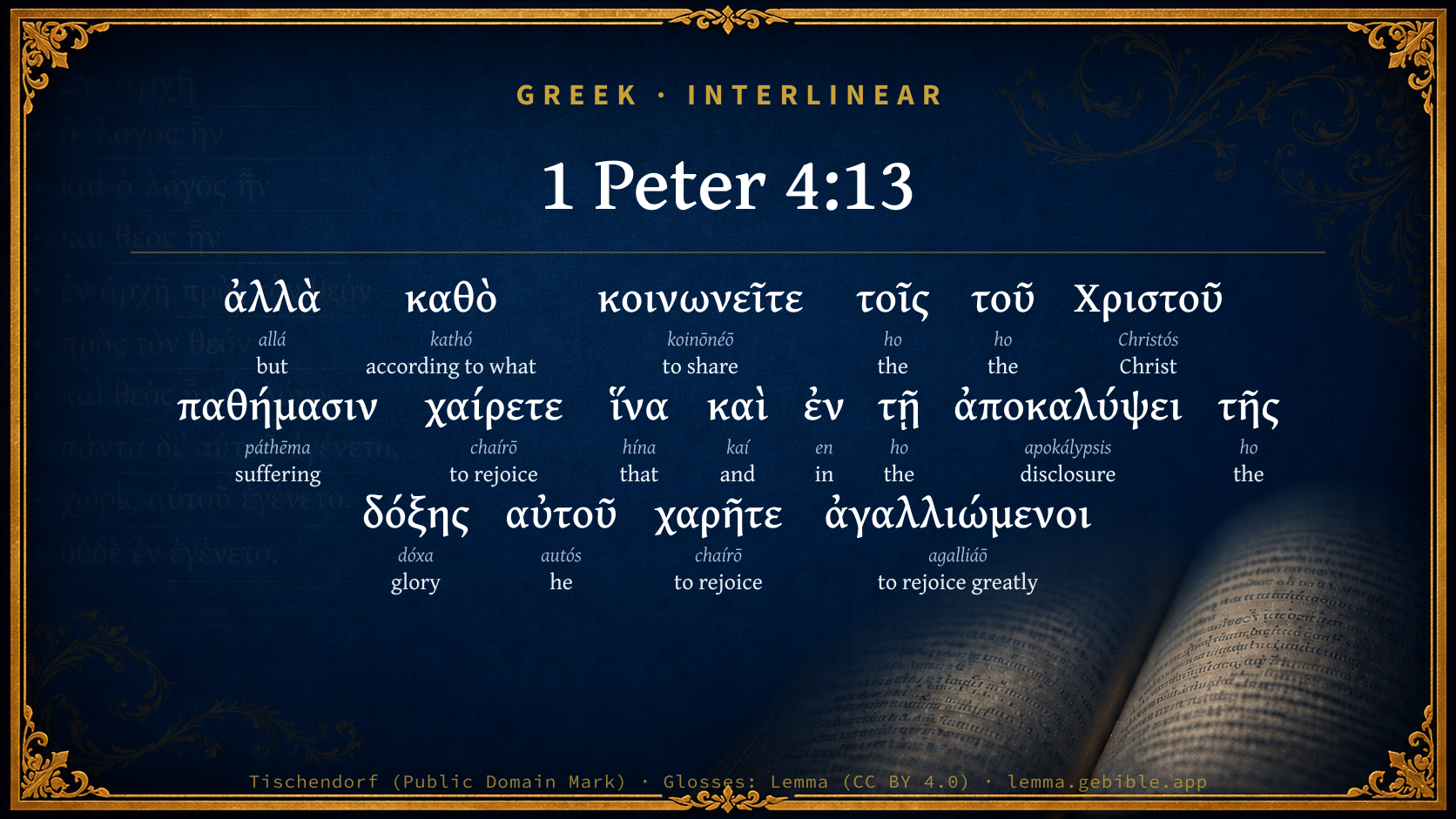
  1. ἀλλὰ allá G235 “but” Conjunction
  2. κοινωνεῖτε koinōnéō G2841 “to share” Verb, Present, Active, Indicative, 2nd person, Plural
  3. τοῖς ho G3588 “the” Article, Dative, Plural, Neuter
  4. τοῦ ho G3588 “the” Article, Genitive, Singular, Masculine
  5. Χριστοῦ Christós G5547 “Christ” Noun, Genitive, Singular, Masculine
  6. παθήμασιν páthēma G3804 “suffering” Noun, Dative, Plural, Neuter
  7. χαίρετε chaírō G5463 “to rejoice” Verb, Present, Active, Imperative, 2nd person, Plural
  8. ἵνα hína G2443 “that” Conjunction
  9. καὶ kaí G2532 “and” Conjunction
  10. ἐν en G1722 “in” Preposition
  11. τῇ ho G3588 “the” Article, Dative, Singular, Feminine
  12. ἀποκαλύψει apokálypsis G602 “disclosure” Noun, Dative, Singular, Feminine
  13. τῆς ho G3588 “the” Article, Genitive, Singular, Feminine
  14. δόξης dóxa G1391 “glory” Noun, Genitive, Singular, Feminine
  15. αὐτοῦ autós G846 “he” Personal pronoun, Genitive, Singular, Masculine
  16. χαρῆτε chaírō G5463 “to rejoice” Verb, Aorist, Passive deponent, Subjunctive, 2nd person, Plural
  17. ἀγαλλιώμενοι agalliáō G21 “to rejoice greatly” Verb, Present, Middle or Passive deponent, Participle, Nominative, Plural, Masculine

About this verse

These counts appear in no published source. They are computed here, from the morphology-tagged text and Lemma’s own curated glosses. What Lemma adds →

18
words
14
distinct lemmas
General Epistles
section

Notable vocabulary

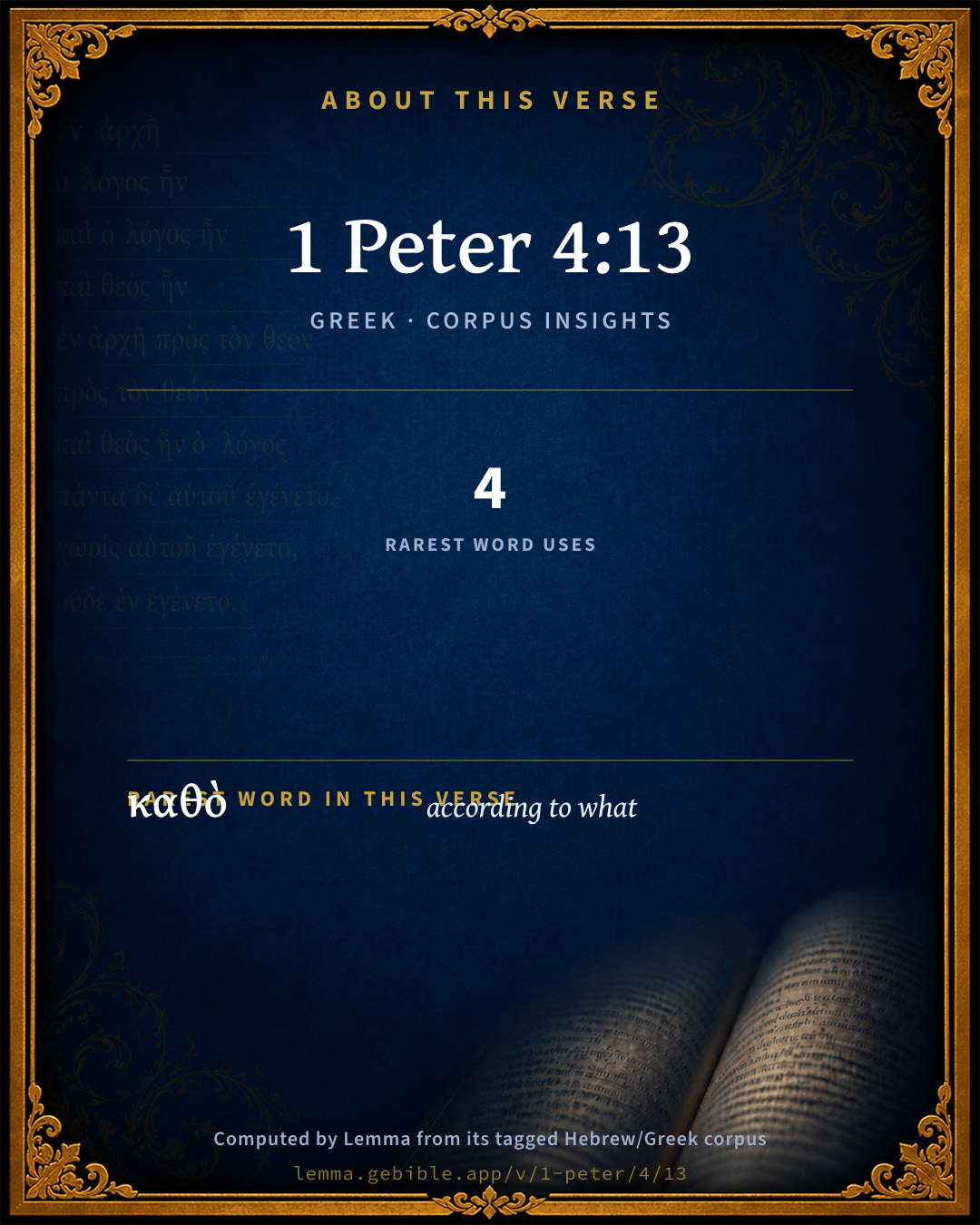
The rarest word here is καθὸ according to what G2526 — appearing just 4 times in the whole Greek New Testament.

Shared distinctive vocabulary

καθὸ according to what G2526 occurs in 3 verses of the Greek New Testament. Also found in:

Repetition

Words recur within this verse:

  • χαίρετε to rejoice G5463 ×2
  • τοῖς the G3588 ×4

Cross-references

31

Topical passages linked to 1 Peter 4:13 in the Treasury of Scripture Knowledge — connected by theme and wording, ordered by reader-vote popularity; previews shown in the World English Bible.

  • Romans 8:17 and if children, then heirs; heirs of God, and joint-heirs with Christ; if indeed we suffer with him, that we may also be glorified with him.
  • James 1:2–3 Count it all joy, my brothers, when you fall into various temptations,
  • Romans 5:3 Not only this, but we also rejoice in our sufferings, knowing that suffering works perseverance;
  • Philippians 3:10 that I may know him, and the power of his resurrection, and the fellowship of his sufferings, becoming conformed to his death;
  • 2 Corinthians 1:7 Our hope for you is steadfast, knowing that, since you are partakers of the sufferings, so also are you of the comfort.
  • 2 Corinthians 4:10 always carrying in the body the putting to death of the Lord Jesus, that the life of Jesus may also be revealed in our body.
  • 1 Peter 5:10 But may the God of all grace, who called you to his eternal glory by Christ Jesus, after you have suffered a little while, perfect, establish, strengthen, and settle you.
  • 1 Peter 1:5–8 who by the power of God are guarded through faith for a salvation ready to be revealed in the last time.
  • 2 Corinthians 12:9–10 He has said to me, "My grace is sufficient for you, for my power is made perfect in weakness." Most gladly therefore I will rather glory in my weaknesses, that the power of Christ may rest on me.
  • Luke 6:22–23 Blessed are you when men shall hate you, and when they shall exclude and mock you, and throw out your name as evil, for the Son of Man's sake.
  • Acts 5:41 They therefore departed from the presence of the council, rejoicing that they were counted worthy to suffer dishonor for Jesus' name.
  • 2 Corinthians 4:17 For our light affliction, which is for the moment, works for us more and more exceedingly an eternal weight of glory;
  • 2 Timothy 2:12 If we endure, We will also reign with him. If we deny him, He also will deny us.
  • Isaiah 35:10 and the ransomed of Yahweh shall return, and come with singing to Zion; and everlasting joy shall be on their heads: they shall obtain gladness and joy, and sorrow and sighing shall flee away.
  • Matthew 5:12 Rejoice, and be exceedingly glad, for great is your reward in heaven. For that is how they persecuted the prophets who were before you.
  • Matthew 16:27 For the Son of Man will come in the glory of his Father with his angels, and then he will render to everyone according to his deeds.
  • Colossians 1:24 Now I rejoice in my sufferings for your sake, and fill up on my part that which is lacking of the afflictions of Christ in my flesh for his body's sake, which is the assembly;
  • 1 Peter 5:1 I exhort the elders among you, as a fellow elder, and a witness of the sufferings of Christ, and who will also share in the glory that will be revealed.
  • Revelation 1:9 I John, your brother and partner with you in oppression, Kingdom, and perseverance in Christ Jesus, was on the isle that is called Patmos because of God's Word and the testimony of Jesus Christ.
  • Isaiah 25:9 It shall be said in that day, Behold, this is our God; we have waited for him, and he will save us: this is Yahweh; we have waited for him, we will be glad and rejoice in his salvation.
  • Isaiah 51:11 The ransomed of Yahweh shall return, and come with singing to Zion; and everlasting joy shall be on their heads: they shall obtain gladness and joy; [and] sorrow and sighing shall flee away.
  • Matthew 25:21 "His lord said to him, 'Well done, good and faithful servant. You have been faithful over a few things, I will set you over many things. Enter into the joy of your lord.'
  • Matthew 25:23 "His lord said to him, 'Well done, good and faithful servant. You have been faithful over a few things, I will set you over many things. Enter into the joy of your lord.'
  • Matthew 25:31 "But when the Son of Man comes in his glory, and all the holy angels with him, then he will sit on the throne of his glory.
  • Matthew 25:34 Then the King will tell those on his right hand, 'Come, blessed of my Father, inherit the Kingdom prepared for you from the foundation of the world;
  • Acts 16:25 But about midnight Paul and Silas were praying and singing hymns to God, and the prisoners were listening to them.
  • 1 Peter 1:13 Therefore, prepare your minds for action, be sober and set your hope fully on the grace that will be brought to you at the revelation of Jesus Christ--
  • Mark 8:38 For whoever will be ashamed of me and of my words in this adulterous and sinful generation, the Son of Man also will be ashamed of him, when he comes in the glory of his Father with the holy angels."
  • Luke 17:30 It will be the same way in the day that the Son of Man is revealed.
  • 2 Thessalonians 1:7–10 and to give relief to you that are afflicted with us, when the Lord Jesus is revealed from heaven with his mighty angels in flaming fire,
  • Revelation 1:7 Behold, he is coming with the clouds, and every eye will see him, including those who pierced him. All the tribes of the earth will mourn over him. Even so, Amen.

Cross-references courtesy of OpenBible.info (CC BY 4.0).

Commentary

Notes on 1 Peter 4:13 from classic Christian and Jewish commentators (each source and its license shown beneath its notes). The classic Christian expositions comment on the surrounding passage and are grouped to its opening verse, so a note may address several verses; the Jewish commentaries on the Tanakh (Rashi and others) are per-verse, so they appear only where the commentator wrote on this verse.

Lemma curates 59 commentaries, every one of them public domain or Creative Commons licensed, each selected and text-cleaned for this edition rather than reprinted as found. About our sources →

Tyndale Open Study Notes

Tyndale Open Resources

4:13 Christians are called to suffer with Christ in order to be glorified with him (see also Rom 8:17).

Tyndale Open Study Notes — © Tyndale Open Resources, licensed CC BY-SA 4.0. Text via the HelloAO Bible API.

Bengel's Gnomon

Johann Albrecht Bengel

1Pe 4:13. Καθὸ, even as) Glory answers to the measure of sufferings, but much more abundantly.—κοινωνεῖτε, ye are partakers) willingly.—παθήμασι, in the sufferings) 1Pe 4:1.—χαίρετε, ἵνα, rejoice, that) That, here, is more than if he had said ὅνα, because. By joy and desire we attain to joy and gladness. Comp. ἵνα, that, Joh 8:56. The reward of joyful patience is had regard to here.—ἀγαλλιώμενοι, with exulting joy) then free from all suffering.

Bengel's Gnomon of the New Testament — English translation (T&T Clark, Edinburgh, 1860) — public domain. Text from a community e-Sword module.

Meyer's Critical & Exegetical Commentary

Heinrich August Wilhelm Meyer

1Pe_4:13. ἀλλὰ … χαίρετε] Antithesis to ξενίζεσθε; non tantum mirari vetat Petrus, sed gaudere etiam jubet (Calvin); the measure of the joy is indicated by καθὸ κοινωνεῖτε τοῖς τοῦ Χριστοῦ παθήμασι.

καθό, not equivalent to, that, nor to, quando (Pott), but to, quatenus, in quantum; cf. Rom_8:26, 2Co_8:12.

τὰ τοῦ Χριστοῦ παθήματα is inexactly interpreted by Vorst. as: afflictiones Christi membris destinatae, nempe quas pii propter justitiam et evangelium Christi sustinent; they rather mean the sufferings which Christ Himself has endured. Of these the believers are partakers (κοινωνοῦσιν αὐτοῖς), for the world shows the same enmity to them as to Christ, since it is He who is hated in them; cf. my commentary to Col_1:24, and Meyer to 2Co_1:5; 2Co_1:7 (so, too, Wiesinger, Weiss, p. 293 f., Schott). Steiger[253] is wrong in thinking of the inward suffering endured by the Christian, whilst, by the power of Christs death, he dies unto sin.

The object to be supplied in thought to ΧΑΊΡΕΤΕ is the ΠΎΡΩΣΙς previously mentioned by the apostle.

ἽΝΑ ΚΑΊ] states the design of ΧΑΊΡΕΙΝ: the Christians are to rejoice now, in order that they may also (καί lays stress on the future in relation to the present) rejoice ἘΝ Τῇ ἈΠΟΚΑΛΎΨΕΙ, etc.; for this future joy is conditioned by that of the present, as the future partaking of the ΔΌΞΑ of Christ by the present sharing of His ΠΑΘΉΜΑΣΙ.[254] Schott unreasonably opposes as grammatical pedantry the application of ἽΝΑ to the preceding ΧΑΊΡΕΤΕ, for he remarks, it is the sufferings themselves which hold out to us the future joy. But he omits to consider that the ΚΟΙΝΩΝΕῖΝ ΤΟῖς Τ. ΧΡ. ΠΑΘ. holds out future happiness to him only who finds his joy in it. Schott incorrectly appeals in support of his construction to Joh_11:15.

It is not correct to explain, with Gerhard, etc., ἽΝΑ, ἘΚΒΑΤΙΚῶς.

ἘΝ Τῇ ἈΠΟΚΑΛΎΨΕΙ Κ.Τ.Λ.] not because of, but at (Luther: at the time of) the revelation; cf. chap. 1Pe_1:17. The expression: ἈΠΟΚΆΛ. Τῆς ΔΌΞΗς ΧΡΙΣΤΟῦ (with which compare Mat_25:31), is to be found only here. By it the apostle indicates that he who is now a partaker of the sufferings of Christ, and rejoices in them (Col_3:4), will one day be partaker of His glory, and in it rejoice everlastingly. ἈΓΑΛΛΙΏΜΕΝΟΙ is added to ΧΑΡῆΤΕ by way of giving additional force to the idea (chap. 1Pe_1:8; Mat_5:12): quia prius illud (gaudium) cum dolore et tristitia mixtum est, secundum cum exsultatione conjungit (Calvin).

[253] The κοινωνεῖν τ. παθ. consists in the inward fellowship of the sufferings of Christ, in the participation in that strength which arises from the justifying confidence in their value, and which causes us even to die unto sin.

[254] Weiss (p. 291 ff.), while denying that Peter has the Pauline idea of community of life with Christ, supplements, as an intermediate thought that participation in the sufferings of Christ is the necessary mark of the true disciples. But this is to give a much too superficial conception of the relation, and could Peter haye thought it possible to be a disciple without community of life?

Meyer — Critical and Exegetical Commentary on the New Testament — English translation by Peter Christie, edited by Frederick Crombie (T&T Clark, 1880) — public domain. Text from a community e-Sword module.

Expositor's Greek Testament

ed. W. Robertson Nicoll

1Pe 4:13 . καθό , so for as , i.e. , so far as your suffering is undeserved and for Christ’s name. κοινωνεῖτε … παθήμασιν , ye share the sufferings of the Messiah . The dative after κ . usually denotes the partner; here the thing shared as in Rom 15:27 ; 1Ti 5:22 ; 2Jn 1:11 ; and in LXX; Sap. 6:23; 3Ma 4:11 . This idea is expressed even more strongly by St. Paul ἀνταναπληρῶ τὰ ὑστερήματα τῶν θλίψεων τοῦ Χριστοῦ (Col 1:24 ). It is derived from such sayings as the disciple is as his Master (Mat 10:24 f.) the sons of Zebedee must drink his cup, be baptised with his baptism (Mar 10:38 f.). To suffer in Christ’s name is to suffer as representing Christ and so to share His sufferings. ἵνα κ . τ . λ ., from Mat 5:12 , χαίρετε καὶ ἀγαλλιᾶσθε . But St. Peter postpones the exultation. St. James (1Pe 5:10 ) follows Jesus in appealing to the pattern of the prophets. ἀποκαλύψει , the final revelation represents an original wordplay גלה on the quoted ἀγαλλιώμενοι = גיל .

The Expositor's Greek Testament, edited by W. Robertson Nicoll (1897–1910) — public domain. Text from a community e-Sword module.

Geneva Bible (1599)

Geneva Bible translators

Another reason: Because the afflictions of the godly and the wicked differ very much, and chiefly in three points. First, because the godly communicate with Christ in their afflictions, and therefore shall in their time be partakers also of his glory.

Geneva Bible (1599) marginal notes — public domain. Text via Bolls.life.

Jamieson, Fausset & Brown

Robert Jamieson, A. R. Fausset & David Brown

inasmuch as--The oldest manuscripts read, "in proportion as"; "in as far as" ye by suffering are partakers of Christ's sufferings, that is, by faith enter into realizing fellowship with them; willingly for His sake suffering as He suffered.

with exceeding joy--Greek, "exulting joy"; now ye rejoice amidst sufferings; then ye shall EXULT, for ever free from sufferings (Pe1 1:6, Pe1 1:8). If we will not bear suffering for Christ now, we must bear eternal sufferings hereafter.

Jamieson, Fausset & Brown — Commentary Critical and Explanatory on the Whole Bible (1871) — public domain (CC PDM 1.0). Text via the HelloAO Bible API.

John Calvin's Commentaries

Hence, then, is the whole consolation of the godly, that they are associates with Christ, that hereafter they may be partakers of his glory; for we are always to bear in mind this transition from the cross to the resurrection. But as this world is like a labyrinth, in which no end of evils appears, Peter refers to the future revelation of Christ’s glory, as though he had said, that the day of its revelation is not to be overlooked, but ought to be expected. But he mentions a twofold joy, one which we now enjoy in hope, and the other the full fruition of which the coming of Christ shall bring to us; for the first is mingled with grief and sorrow, the second is connected with exultation. For it is not suitable in the midst of afflictions to think of joy, which can free us from all trouble; but the consolations of God moderate evils, so that we can rejoice at the same time.

John Calvin's Commentaries (1540-1563) — public domain. Text from the Calvin Translation Society English edition (1840s-50s) via the Christian Classics Ethereal Library (ccel.org). Calvin's coverage is partial (roughly two-thirds of the Bible); uncommented books and verses are honest gaps, never fabricated. The 19th-century editor's footnotes and remarks are omitted so the notes are faithfully Calvin's own voice.

Ellicott's Commentary for English Readers

(13) But rejoice.—The opposite of being bewildered at it, for “rejoicing” in it implies a recognition of its character and purpose. The word rendered “inasmuch as” (which occurs also in 2Co_8:12) seems to mean, “in proportion as:” “the more nearly you are made to share Christ’s sufferings the more you should rejoice.” In the Acts of St. Probus (a Cappadocian), when, after many other tortures, the judge ordered them to heat some nails and run them through his hands, the martyr exclaims, “Glory to Thee, Lord Jesus Christ, who hast even deigned to let my hands be pierced for Thy name’s sake!”

Christ’s sufferings.—Rather, the sufferings of the Christ. (Comp. Note on 1Pe_1:11.)

That—i.e., “in order that.” This is to be attached to “think it not strange, but rejoice”—“in order that at the revelation of His glory also (as now, in the sharing of His sufferings) ye may rejoice (the word is the same), exulting.” Such a recognition of the meaning of suffering, such a rejoicing in suffering now, is a sure means to rejoicing in glory also hereafter.

A Bible Commentary for English Readers, edited by Charles John Ellicott (1878–1897) — public domain. Text from a community e-Sword module.

The Cambridge Bible for Schools and Colleges

gen. ed. J. J. S. Perowne

13. but rejoice] The words of the beatitude of Mat_5:12 come back upon the Apostle’s mind, and are reproduced as from his own personal experience. When he had first heard them, he may well have counted them a strange thing. Now he has tried and proved their truth.

inasmuch as ye are partakers of Christ’s sufferings] The Greek conjunction expresses more than the ground of the joy. Men are to rejoice in proportion as they are sharers in the sufferings of Christ. On the thought of this intercommunion in suffering between Christ and His people, see note on chap. 1Pe_1:11. Here “the sufferings of Christ” are those which He endured while on earth, those also which He endures now as the Head of His body, the Church, in His infinite sympathy with each individual member. Each faithful sufferer, accordingly, in proportion to the measure of his sufferings, becomes ipso facto a sharer in those of Christ. He fills up, in St Paul’s bold language, “what was lacking in the sufferings of Christ” (Col_1:24).

that, when his glory shall be revealed] The thought is again closely parallel to that of chap. 1Pe_1:11. Literally the words run, in the revelation of His glory. As thought of by the Apostles, the “revelation of Christ” is identical with His coming to judge the quick and dead (Luk_17:30). The precise phrase “the revelation of His glory” is not found elsewhere, but it has an analogue in “the throne of His glory” in Mat_25:31.

The Cambridge Bible for Schools and Colleges (gen. ed. J. J. S. Perowne; Cambridge University Press, 1878–1918) — public domain. Text from a community e-Sword module.

John Gill's Exposition

But rejoice, inasmuch as ye are partakers of Christ's sufferings,.... Not of his personal sufferings; though they were partakers of the benefits and blessings which come through them, and result from them, such as justification, peace, and pardon, and which are matter and ground of rejoicing; but of the sufferings of his body, the church, which is mystically himself; and are called his, because of the union between him and his people, and the sympathy he bears to them, and because they are endured for the sake of him and his Gospel, and conform the saints, and make them like unto him; and therefore suffering saints should rejoice in this, that their sufferings are accounted by Christ as his own, who in all their afflictions is afflicted; and that they are honoured to suffer for his name's sake, and are hereby made like unto him:

that when his glory shall be revealed; the glory of his divine nature, as the only begotten Son of God, in which he will come and appear at the last day; and which, though incommunicable, will be more manifest to all men, and especially to the saints, who will know more of him, as the brightness of his Father's glory, and the express image of his person; and when the glory of his office, as Mediator, will be more conspicuous, and shall be beheld by all that the Father has given to him; and also the glory of his human nature, which is now crowned with glory and honour at the right hand of God; and likewise the glory which he has in his hands for his people, even eternal glory and happiness: this is now, in a great measure, unseen, but it will then be revealed, both to the saints and in them; they will appear with Christ in glory, and have a glory both upon their souls and bodies. As they suffer with him, and for his sake, they will be glorified with him, when he shall come in his own glory, and in his Father's glory, and in the glory of his holy angels: the consideration of which, as it must greatly encourage to suffer for his sake, so must be matter of great joy; as follows:

ye may be glad also with exceeding joy; a joy unspeakable, and full of glory, being made partakers of the glory of Christ, either in beholding, or in possessing it.

John Gill's Exposition of the Whole Bible (1746–1763) — public domain (CC PDM 1.0). Text via the HelloAO Bible API.

Trapp's Complete Commentary

John Trapp

13 But rejoice, inasmuch as ye are partakers of Christ’s sufferings; that, when his glory shall be revealed, ye may be glad also with exceeding joy.

Ver. 13. But rejoice] As the apostles did, Act 5:41. {See Trapp on "Act 5:41"}

inasmuch as ye are partakers of Christ’s sufferings] So they are called: 1. Because they are for his sake. 2. Because he suffereth with us; though not with a sense of pain, yet with a sense of pity; for in all our afflictions he is afflicted. 3. We fill up that which is behind of the sufferings of Christ, &c., Col 1:24. {See Trapp on "Col 1:24"}

With exceeding joy] Gr. αγαλλιωμενοι, dancing a galliard, leaping levaltos, lifting up your heads, because your redemption draweth nigh. Vincentius, laughing at his tormentors, said that death and tortures were to Christians iocularia et ludicra, matters of sport and pastime; and walking upon hot burning coals, he boasted that he walked upon roses. Other martyrs said that they felt no more pain in the fire than if they lay upon a bed of down. Constantine embraced Paphnutius, and kissed his lost eye; so will Christ deal at the last day by his suffering servants.

John Trapp, A Commentary or Exposition upon All the Books of the Old and New Testament (1647–1656) — public domain. Text from a community e-Sword module.

Albert Barnes' Notes on the Bible

But rejoice, inasmuch as ye are partakers of Christ’s sufferings - That is, sufferings of the same kind that he endured, and inflicted for the same reasons. Compare Col 1:24; Jam 1:2; See the notes at Mat 5:12. The meaning here is, that they were to regard it as a matter of rejoicing that they were identified with Christ, even in suffering. See this sentiment illustrated at length in the notes at Phi 3:10.

That, when his glory shall be revealed - At the day of judgment. See the notes at Mat 26:30.

Ye may be glad also with exceeding joy - Being admitted to the rewards which he will then confer on his people. Compare 1Th 2:19. Every good man will have joy when, immediately at death, he is received into the presence of his Saviour; but his joy will be complete only when, in the presence of assembled worlds, he shall hear the sentence which shall confirm him in happiness forever.

Albert Barnes' Notes on the Bible (1834–1885) — public domain. Text from a community e-Sword/MySword module.

Matthew Poole's English Annotations

But rejoice; be so far from being offended at your sufferings, as rather to reckon that there is great matter of rejoicing in them; their being trials makes them tolerable, but your being in them partakers of Christ’s sufferings makes them comfortable.

Inasmuch as ye are partakers of Christ’s sufferings; i.e. ye suffer:

1. As Christ did, for the confession of the truth, and so ye are such kind of sufferers as Christ was.

2. As members of Christ, ye suffer those evils which are laid out for those that belong to Christ, 1Th 3:3.

3. Ye are hereby conformed to Christ your Head.

4. Ye partake of the influence of what Christ suffered, for the sanctification of your sufferings: see Phi 3:10.

That, when his glory shall be revealed; viz. at his second coming, 1Pe 1:7; Col 3:4; 2Th 1:7.

Ye may be glad also with exceeding joy; a joy without any the least mixture of pain or grief. The rejoicing of the saints here is mixed with pain and heaviness, but shall be pure hereafter; they rejoice in hope now, but in enjoyment then.

Matthew Poole's English Annotations on the Holy Bible (1683–1685) — public domain. Text from a community e-Sword/MySword module.

Whedon's Commentary on the Bible

Daniel D. Whedon

13. Rejoice—Habitually.

Partakers of—In actual bodily sufferings for Christ’s sake, thus identifying them with him. Then, at the time of the revelation of his glory, (1Pe_1:7; 1Pe_1:13,) in the day of judgment, they will “also reign with him.” 2Ti_2:12.

Be glad—Better, rejoice.

The first rejoice is in sorrow and pain: this is with triumphant exultation.

Daniel D. Whedon (gen. ed.), Commentary on the Old and New Testaments (1874–1909) — public domain. Text from a community e-Sword module.

The Pulpit Commentary

But rejoice, inasmuch as ye are partakers of Christ"s sufferings. St. Peter speaks in stronger language; he repeats the Lord"s words in), Mat_5:12. Christians should learn to rejoice in persecution; they must rejoice in so far as, in proportion as (kaqo) they are partakers of Christ"s sufferings (see 2Co_9:10; Php_3:10; Heb_13:13) Suffering meekly borne draws the Christian nearer to Christ, lifts him, as on a cross, nearer to the crucified Lord; but this it does only when he looks to Jesus in his suffering, when the eye of faith is fixed upon the cross of Christ. Then faith unites the sufferings of the disciple with the sufferings of his Lord; he is made a partaker of Christ"s sufferings; and so far as suffering has that blessed result, in such measure he must rejoice in his sufferings. That, when his glory shall be revealed, ye may be glad also with exceeding joy; literally, that in the revelation of Ms glory also ye may rejoice exulting. The word for "exulting," ajgalliwmenoi, corresponds with that used in 1Pe_1:6 and inrete Mat_5:12 (cai kai ajgalliasqe). Joy in suffering now is the earnest of the great joy of the redeemed at the revelation of that glory which they now see through a glass darkly.

The Pulpit Commentary (1880–1919), ed. H.D.M. Spence-Jones & Joseph S. Exell — public domain. Text from a community e-Sword module.

John Wesley's Explanatory Notes

But as ye partake of the sufferings of Christ - chap. 1, while ye suffer for his sake, rejoice in hope of more abundant glory. For the measure of glory answers the measure of suffering; and much more abundantly.

John Wesley, Explanatory Notes Upon the Whole Bible (1754–1765) — public domain. Text via the GEBible commentary corpus.

The People's New Testament

B. W. Johnson

13. Rejoice. Because thus you are made partakers of Christ's sufferings. See notes on Rom. 8:17, and 2 Cor. 1:7. At the revelation of his glory. All who suffer with him will be glorified.

B. W. Johnson's The People's New Testament with Notes (1889–1891) — public domain. Electronic text from the Christian Classics Ethereal Library (CCEL) ThML edition.

Cambridge Greek Testament for Schools and Colleges

13. καθὸ κοινωνεῖτε = in proportion as you have personal fellowship in the sufferings of the Christ. Christians are regarded not merely as suffering with (συμπάσχοντες) Christ, (Rom 8:17), but as members of His body they have a personal share in His sufferings, cf. Php 3:10; Col 1:24; 2Co 1:5. Suffering was the necessary prelude to glory in the case of Christ their Head, therefore His members can rejoice in present sufferings as being the prelude to glory in which they too will share when it is revealed. For rejoicing in suffering cf. Mat 5:12; Luk 6:23; Act 5:41; 2Co 6:10; Php 2:17; Col 1:24, etc.

χαίρετε ἵνα might possibly be explained as in Joh 8:56 “Your father Abraham ἠγαλλιάσατο ἵνα = rejoiced in the effort to see my day.” Abraham’s joy was that of anticipation and not that of present realization. So the joy of Christians in suffering is prompted by their anticipation of their exultation in the glory which is to follow. But it is simpler to regard joy in suffering as a preparation for the final joy. (See J. H. Moulton, Gram. pp. 205 ff.)

χαρῆτε ἀγαλλιώμενοι. ἀγαλλιᾶσθαι denotes exultant joy. Here such exultation is only regarded as possible when suffering culminates in glory, the joy during the process of suffering being of a more chastened character. But in 1Pe 1:6; 1Pe 1:8 ἀγαλλιᾶσθαι is used of the Christian’s present joy despite his griefs. The two words are combined in Mat 5:12; Rev 19:7.

Cambridge Greek Testament for Schools and Colleges (Cambridge University Press, 1896; 21 vols, various authors incl. Carr, Maclear, Plummer, Farrar, Lumby, Moule, M. R. James, Simcox) — public domain. Text from a community e-Sword module.

Alford’s Greek Testament

Henry Alford

13.] See above.

13.] but in as far as (καθό, not “in that,” “inasmuch as,” E. V., nor quando, Pott: see reff.) ye are partakers with the sufferings of Christ (i. e. have a share, in your own persons, of those sufferings which He personally bare: cf. 2Co 4:10; Php 3:10; Heb 13:13 &c. It is not the sufferings of Christ mystical in His Body the church (cf. Col 1:24) which are meant: in these the readers might bear their part, but could hardly be said κοινωνεῖν), rejoice, that (ἵνα simply of the scope of that joy, as the preparation for what follows) ye may also at (in, i. e. “in the day or time of:” not to be taken with χαρῆτε, as indicating that at which or because of which the joy takes place) the revelation of His glory rejoice (aor.: χαίρετε before, of the habit of life; now χαρῆτε, of the single event of that day) exulting (“quia prius illud cum dolore et tristitia mixtum est, secundum cum exultatione conjungit.” Calv.).

Henry Alford, The Greek Testament (1849–1861) — public domain. Text from a community e-Sword module.

Vincent's Word Studies in the New Testament

Marvin R. Vincent

Inasmuch as ye are partakers. Compare Rom 8:17.

Be glad with exceeding joy [χαρητε αγαλλιωμενοι] . Lit., ye may rejoice exulting. See on ch. 1Pe 1:6.

Marvin R. Vincent, Word Studies in the New Testament (1887–1900) — public domain. Text from a community e-Sword/MySword module.

Lesson kit

Teaching starters — assembled from the data on this page, not authored interpretation. Every prompt links to the verse data it draws on. Edit before teaching.

1 Peter, in the General Epistles, opens this verse with 18 words (14 distinct Greek lemmas). Its most distinctive word is kathó (“according to what”). A historical commentator’s framing appears above. Read the whole chapter for the surrounding context.

Discussion questions

  1. The word kathó carries the sense “according to what.” How does it shape the verse?
  2. How does Romans 8:26, which shares the word «according to what», read alongside this verse?
  3. What does the repetition of “to rejoice” (2× in this one verse) do in this verse?
  4. The translations on this page render this verse differently — a whole-verse word diff, not a word-by-word alignment. What might account for the different wordings?
  5. Compare how Tyndale Open Study Notes and Bengel's Gnomon read this verse. Where do they agree or differ?

Things to notice

  • These translations choose different wording for 17 words in this verse.
  • “to rejoice” occurs 2× in this single verse.
  • 14 distinct Greek lemmas span 18 words in this verse.

Reading settings

Reading text

Shown beneath each verse's original-language words.

Old Testament
Old Testament edition

Read the OT as the Masoretic Hebrew (MT) or the Greek Septuagint (LXX).

English shown for the Greek Septuagint (in the Hebrew ↔ Greek comparison).

Comparing translations? Open the Compare panel on any verse page to stack up to four side by side.