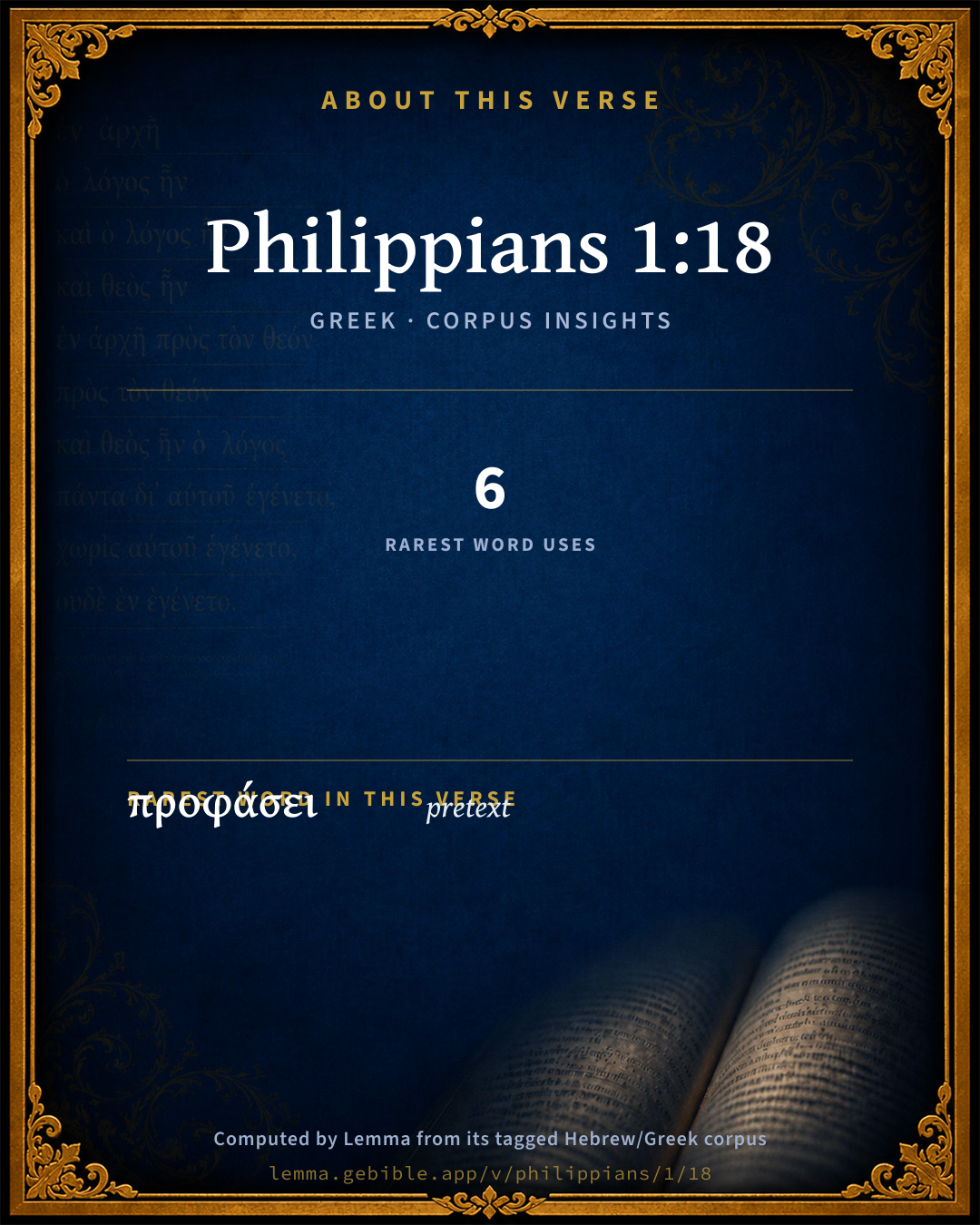
Philippians 1:18

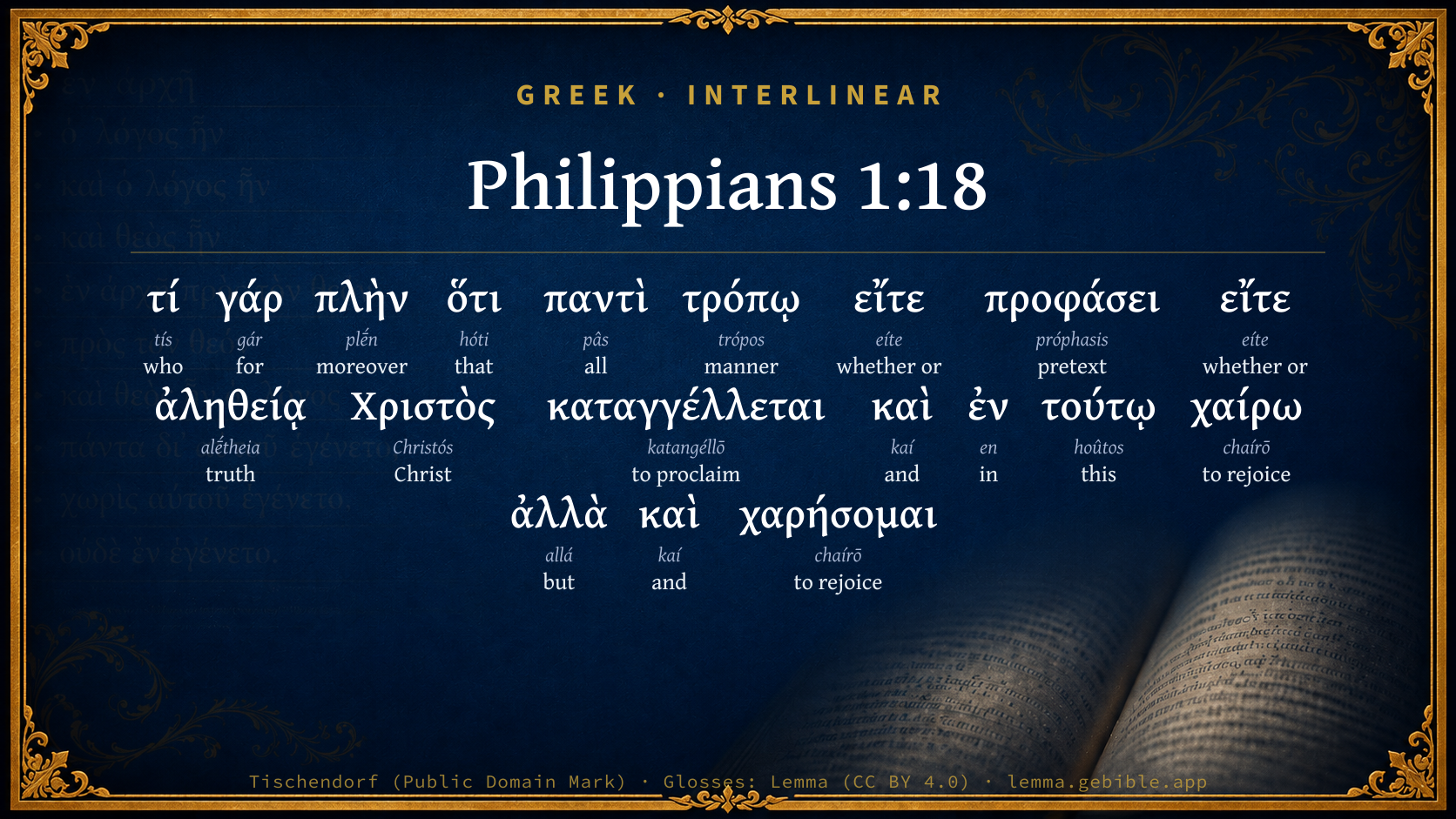
Greek (Tischendorf 8th ed.) Philippians 1:18 appears in the Greek New Testament. The text above is from the Tischendorf 8th edition. Each word links to its Strong’s number and a concise gloss. Click any word for its full Thayer’s Greek Lexicon entry.
Download image
Cite this verse

Philippians 1:18 (World English Bible). Public Domain. Lemma interlinear Bible study tool, https://lemma.gebible.app/v/philippians/1/18.

Show BibTeX & RIS
BibTeX
RIS
English Translation
What does it matter? Only that in every way, whether in pretense or in truth, Christ is proclaimed. I rejoice in this, yes, and will rejoice.
World English Bible · Public Domain
Download a study sheet

One document with this verse’s original text, its word-by-word gloss line, the meaning frame, cross-references with their text, attributed commentary, and full source and license credits — printable, and it pastes into notes with its structure intact.

This verse Autodidact and up

Study sheet (.html) Plain text (.txt)

A passage Seminary Student

Up to 50 verses in one chapter. A passage sheet keeps up to 6 commentary sources and 12 cross-references per verse, in the order this page ranks them, and says so on the sheet whenever that leaves anything out. Ask for a single verse and you get the Autodidact verse sheet above.

Everything on this page stays free to read, with no account — the sheet is a download of what is already on screen, not access to it.

Want to remove ads? Support Godless Engineer
Compare translations 3

The same verse in 3 English versions, stacked beneath the original-language interlinear above. Click any original word for its lexicon entry.

Each is an independent rendering of the whole verse — the interlinear is not word-aligned to these translations.

Highlighted words mark where these versions differ — a whole-verse word diff, not a word-by-word alignment.

  • World English Bible Public Domain
    What does it matter? Only that in every way, whether in pretense or in truth, Christ is proclaimed. I rejoice in this, yes, and will rejoice.
  • King James Version Public Domain
    What then? notwithstanding, every way, whether in pretence, or in truth, Christ is preached; and I therein do rejoice, yea, and will rejoice.
  • unfoldingWord Literal Text CC BY-SA 4.0
    What then? Only that in every way—whether in pretext or in truth—Christ is proclaimed, and in this I rejoice. Yes, and I will rejoice,

unfoldingWord Literal Text — © unfoldingWord, licensed CC BY-SA 4.0. Word-aligned USFM3 via Door43 (git.door43.org/unfoldingWord/en_ult).

Versions to compare (up to 4)

3 of 4 selected

Show all 19 translations

Every available English version of this verse, each an independent rendering of the whole verse.

  • World English Bible Public Domain
    What does it matter? Only that in every way, whether in pretense or in truth, Christ is proclaimed. I rejoice in this, yes, and will rejoice.
  • Berean Standard Bible Public Domain
    What then is the issue? Just this: that in every way, whether by false motives or true, Christ is preached. And in this I rejoice. Yes, and I will continue to rejoice,
  • Majority Standard Bible Public Domain
    What then is the issue? Just this: that in every way, whether by false motives or true, Christ is preached. And in this I rejoice. Yes, and I will continue to rejoice,
  • King James Version Public Domain
    What then? notwithstanding, every way, whether in pretence, or in truth, Christ is preached; and I therein do rejoice, yea, and will rejoice.
  • American Standard Version (1901) Public Domain
    What then? only that in every way, whether in pretence or in truth, Christ is proclaimed; and therein I rejoice, yea, and will rejoice.
  • Revised Version (1885) Public Domain
    What then? only that in every way, whether in pretence or in truth, Christ is proclaimed; and therein I rejoice, yea, and will rejoice.
  • Geneva Bible (1599) Public Domain
    What then? yet Christ is preached all maner wayes, whether it be vnder a pretence, or syncerely: and I therein ioye: yea and will ioye.
  • Douay-Rheims (1899) Public Domain
    But what then? So that by all means, whether by occasion, or by truth, Christ be preached: in this also I rejoice, yea, and will rejoice.
  • Young's Literal Translation Public Domain
    what then? in every way, whether in pretence or in truth, Christ is proclaimed -- and in this I rejoice, yea, and shall rejoice.
  • Literal Standard Version CC BY-SA 4.0
    what then? In every way, whether in pretense or in truth, Christ is proclaimed—and I rejoice in this, indeed, and will rejoice.
  • Unlocked Literal Bible CC BY-SA 4.0
    What then? Only that in every way—whether from false motives or from true—Christ is proclaimed, and in this I rejoice. Yes, and I will rejoice,
  • unfoldingWord Literal Text CC BY-SA 4.0
    What then? Only that in every way—whether in pretext or in truth—Christ is proclaimed, and in this I rejoice. Yes, and I will rejoice,
  • Darby Bible Public Domain
    What is it then? at any rate, in every way, whether in pretext or in truth, Christ is announced; and in this I rejoice, yea, also I will rejoice;
  • World Messianic Bible Public Domain
    What does it matter? Only that in every way, whether in pretense or in truth, Messiah is proclaimed. I rejoice in this, yes, and will rejoice.
  • Webster's Bible Public Domain
    What then? notwithstanding, every way, whether in pretense or in truth, Christ is preached; and I therein do rejoice, yes, and will rejoice.
  • Free Bible Version CC BY-SA 4.0
    But so what? All I care about is that Christ is presented every which way, whether just pretending or whether from true convictions. That's what makes me happy—and I will go on being happy!
  • Bible in Basic English Public Domain
    What then? only that in every way, falsely or truly, the preaching of Christ goes on; and in this I am glad, and will be glad.
  • Text-Critical English NT CC BY 4.0
    But what does it matter? Only that in every way, whether in pretense or in truth, Christ is proclaimed, and in that I rejoice. Yes, and I will continue to rejoice.
  • Tyndale New Testament (1534) Public Domain
    What then? So that Christ be preached all maner wayes whether it be by occasion or of true meaninge I therin ioye: ye and will ioye.

Literal Standard Version (2020), Covenant Press — licensed CC BY-SA 4.0. Text via the HelloAO Bible API (eBible.org). Unlocked Literal Bible (unfoldingWord) — licensed CC BY-SA 4.0. Text via the HelloAO Bible API (eBible.org). unfoldingWord Literal Text — © unfoldingWord, licensed CC BY-SA 4.0. Word-aligned USFM3 via Door43 (git.door43.org/unfoldingWord/en_ult). Free Bible Version, Dr. Jonathan Gallagher — licensed CC BY-SA 4.0. Text via the HelloAO Bible API (eBible.org).

Word by word

More ways to search: Search by grammar → Find every occurrence → Compare this word →

Practice this passage: Drill this verse → Learn its vocabulary →

προφάσει
próphasis
G4392
“pretext”
Noun, Dative, Singular, Feminine
Part of Speech
Noun
Case
Dative
Number
Singular
Gender
Feminine
Full Thayer's Definition

Origin: from a compound of G4253 and G5316

TDNT: None

1. a pretext (alleged reason, pretended cause) 2. show a. under colour as though they would do something b. in pretence, ostensibly
  1. τί tís G5101 “who” Interrogative pronoun, Nominative, Singular, Neuter
  2. γάρ gár G1063 “for” Conjunction
  3. πλὴν plḗn G4133 “moreover” Adverb
  4. ὅτι hóti G3754 “that” Conjunction
  5. παντὶ pâs G3956 “all” Adjective, Dative, Singular, Masculine
  6. τρόπῳ trópos G5158 “manner” Noun, Dative, Singular, Masculine
  7. εἴτε eíte G1535 “whether or” Conjunction
  8. εἴτε eíte G1535 “whether or” Conjunction
  9. ἀληθείᾳ alḗtheia G225 “truth” Noun, Dative, Singular, Feminine
  10. Χριστὸς Christós G5547 “Christ” Noun, Nominative, Singular, Masculine
  11. καταγγέλλεται katangéllō G2605 “to proclaim” Verb, Present, Passive, Indicative, 3rd person, Singular
  12. καὶ kaí G2532 “and” Conjunction
  13. ἐν en G1722 “in” Preposition
  14. τούτῳ hoûtos G3778 “this” Demonstrative pronoun, Dative, Singular, Neuter
  15. χαίρω chaírō G5463 “to rejoice” Verb, Present, Active, Indicative, 1st person, Singular
  16. ἀλλὰ allá G235 “but” Conjunction
  17. καὶ kaí G2532 “and” Conjunction
  18. χαρήσομαι chaírō G5463 “to rejoice” Verb, Future, Passive deponent, Indicative, 1st person, Singular

About this verse

These counts appear in no published source. They are computed here, from the morphology-tagged text and Lemma’s own curated glosses. What Lemma adds →

19
words
16
distinct lemmas
Pauline Epistles
section

Notable vocabulary

The rarest word here is προφάσει pretext G4392 — appearing just 6 times in the whole Greek New Testament.

Shared distinctive vocabulary

προφάσει pretext G4392 occurs in 6 verses of the Greek New Testament. Also found in:

Repetition

Words recur within this verse:

  • εἴτε whether or G1535 ×2
  • χαίρω to rejoice G5463 ×2
  • καὶ and G2532 ×2

Cross-references

8

Topical passages linked to Philippians 1:18 in the Treasury of Scripture Knowledge — connected by theme and wording, ordered by reader-vote popularity; previews shown in the World English Bible.

  • Luke 9:50 Jesus said to him, "Don't forbid him, for he who is not against us is for us."
  • Mark 9:38–40 John said to him, "Teacher, we saw someone who doesn't follow us casting out demons in your name; and we forbade him, because he doesn't follow us."
  • 1 Corinthians 15:11 Whether then it is I or they, so we preach, and so you believed.
  • Philippians 1:14–17 and that most of the brothers in the Lord, being confident through my bonds, are more abundantly bold to speak the word of God without fear.
  • Matthew 23:13 "Woe to you, scribes and Pharisees, hypocrites! For you devour widows' houses, and as a pretense you make long prayers. Therefore you will receive greater condemnation.
  • 1 Corinthians 14:15 What is it then? I will pray with the spirit, and I will pray with the understanding also. I will sing with the spirit, and I will sing with the understanding also.
  • Mark 12:40 those who devour widows' houses, and for a pretense make long prayers. These will receive greater condemnation."
  • 2 John 1:9–11 Whoever transgresses and doesn't remain in the teaching of Christ, doesn't have God. He who remains in the teaching, the same has both the Father and the Son.

Cross-references courtesy of OpenBible.info (CC BY 4.0).

Commentary

Notes on Philippians 1:18 from classic Christian and Jewish commentators (each source and its license shown beneath its notes). The classic Christian expositions comment on the surrounding passage and are grouped to its opening verse, so a note may address several verses; the Jewish commentaries on the Tanakh (Rashi and others) are per-verse, so they appear only where the commentator wrote on this verse.

Lemma curates 59 commentaries, every one of them public domain or Creative Commons licensed, each selected and text-cleaned for this edition rather than reprinted as found. About our sources →

Joseph Benson's Commentary

Php 1:18-20. What then? — What shall we think of these attempts, proceeding from such different principles? Shall they grieve us? No, in no wise. For, every way, whether in pretence — Under colour of propagating the gospel; or in truth — With a real design so to do; Christ is preached — And the great doctrine of salvation by him has a wider spread; and I therein do rejoice, yea, and I will rejoice — That is, I shall have cause so to do in regard of the good issue it will have. The love which the apostle bore to Christ, had extinguished in his mind resentment, pride, self-love, and all other evil passions; insomuch that his greatest joy resulted from the advancement of the gospel, even though it was promoted by his enemies. We must observe, however, that though truth is here opposed to pretence, it doth not follow that preaching Christ in pretence means preaching false doctrine concerning him. For the apostle could not rejoice that Christ was preached in that manner. Truth and pretence here relate not so much to the matters preached, as to the views of the preachers. The Judaizers preached the truth concerning Christ, at least in part, when they affirmed him to be the Jewish Messiah. But they did this not purely and sincerely to bring the Jews to believe on him, but also and especially to inculcate at the same time the Jewish ceremonies, and thereby to extend the authority of their ritual law; and by these means ultimately to grieve the apostle, and render his persecutors more bitter against him. But others both preached Christ as the Jewish Messiah, and also inculcated all the great doctrines of his gospel, truly and sincerely intending to bring both Jews and Gentiles to believe aright in him, and to embrace his gospel in its purity. But from whatever motive Christ was preached, according to his true character, it was matter of joy to the apostle. For I know that this — Preaching of Christ, whether from a pure motive or otherwise, or this trouble which I meet with from some of these teachers; shall turn to my salvation — Namely, to the promotion of it, or shall procure me a higher degree of glory; through your prayer — Continuing to be addressed to God for me; and the supply of the Spirit of Christ — More largely communicated to me in answer to it, and enabling me to make a good use of these trials. According to my earnest expectation — According to what I have all along earnestly hoped for; that in nothing I shall be ashamed — Whatever injurious reflections may be cast on my conduct; but that with all boldness — Bearing testimony to every truth of the gospel; as always — Since my call to the apostleship; so now Christ shall be magnified — Shall be honoured, and the interest of his kingdom promoted; in my body, however it be disposed of, whether by preserving its life, or allowing it to be put to death — For the confirmation of the gospel. How that might be, he did not yet know. For the apostles did not know all that should befall them, but were left in uncertainty with respect to many things, that they might have cause for the exercise of faith and patience.

Joseph Benson's Commentary on the Old and New Testaments (1811–1818) — public domain. Text from a community e-Sword module.

Bengel's Gnomon

Johann Albrecht Bengel

Php 1:18. Τί γὰρ, what then?) What does it matter? That is, I am helped [the cause I have at heart is furthered] either way, Php 1:12.—πλήν, yet) nevertheless.—προφάσει, in pretext) Such men, says he, make the name of Christ a pretext: they really design to excite against me ill-will.—ἀληθείᾳ, in truth) from the heart, seriously.

Bengel's Gnomon of the New Testament — English translation (T&T Clark, Edinburgh, 1860) — public domain. Text from a community e-Sword module.

Meyer's Critical & Exegetical Commentary

Heinrich August Wilhelm Meyer

Php_1:18. On τί γάρ, scil. ἐστι, comp. on Rom_3:3, where, however, γάρ is not, as here, conclusive (see on 1Co_11:22[67]); comp. also Klotz, ad Devar. p. 245. It is rendered necessary by the πλήν that the mark of interrogation should not be placed (as it usually is) after τί γάρ, but the question goes on to καταγγέλλεται (comp. Hofmann); and it is to be observed that through πλήν the τί γάρ receives the sense of τί γὰρ ἄλλο (see Heindorf, ad Plat. Soph. p. 232 C). Hence: what else takes place therefore (in such a state of the case) except that, etc., i.e. what else than that by every sort of preaching, whether it is done in pretence or in truth, Christ is proclaimed? and therein, that it is always Christ whom they preach, I rejoice, etc. How magnanimous is this liberality of judgment as to the existing circumstances in their reference to Christ! By προφάσει and ἀληθείᾳ is indicated the characteristic difference in the two kinds of preachers, Php_1:15-17, and thus παντὶ τρόπῳ receives the more precise definition of its respective parts. As regards the first class, the preaching of Christ was not a matter of sincerity and truthwherein they, in accordance with their sentiments, were really concerned about Christ, and He was the real αἰτία of their working (see on the contrast between αἰτία and πρόφασις, Polyb. iii. 6. 6 ff.)but a matter of pretence, under the cloak of which they entertained in their hearts envy, strife, and cabal, as the real objects of their endeavours. For instances of the antithesis between πρόφασις and ἀλήθεια or τἀληθές, see Raphel, Polyb.; Loesner and Wetstein. To take πρόφασις as opportunity, occasion (Herod. i. 29, 30, iv. 145, vi. 94; Dem. xx. 26; Antiph. v. 21; Herodian, i. 8. 16, v. 2. 14),as, following the Vulgate, Luther, Estius, Grotius (nam occasione illi Judaei, dum nocere Paulo student, multos pertrahebant ad evang.), and others understand it,is opposed to the context in Php_1:15-17, in which the want of honest disposition is set forth as the characteristic mark of these persons. On πλήν in the sense of ἤ, comp. Kühner, II. 2, p. 842.

ἐν τούτῳ] the neuter: therein, in accordance with the conception of that in which the feeling has its basis. Comp. Col_1:24; Plat. Rep. x. p. 603 C; Soph. Tr. 1118; Kühner, II. 1, p. 403. In the Χριστὸς καταγγέλλεται lies the apostles joy.

ἀλλὰ καὶ χαρήσομαι] surpassing the simple χαίρω by a plus, and therefore added in a corrective antithetical form (imo etiam); comp. on 1Co_3:2; 2Co_11:1. To begin a new sentence with ἀλλά (Lachmann, Tischendorf), and to sever χαρήσομαι from its connection with ἐν τούτῳ (Hofmann, who makes the apostle only assert generally that he will continue to rejoice also in the future), interrupts, without sufficient reason, the flow of the animated discourse, and is also opposed by the proper reference of οἶδα γάρ in Php_1:19. This applies also in opposition to Hinsch, p. 64 f.

[67] According to Weiss, γάρ is intended to establish the οἰόμενοι κ.τ.λ., so far as the latter is only an empty imagination. But this is an unnecessary seeking after a very obscure reference. The τι γάρ draws, as it were, the result from vv. 1517. Hence also we cannot, with Huther, adopt as the sense: it then so, as they think?

REMARK.

Of course this rejoicing does not refer to the impure intention of the preachers, but to the objective result. See, already, Augustine, c. Faust. xxii. 48; c. Ep. Parm. ii. 11. Nor does παντὶ τρόπῳ apply to the doctrinal purport of the preaching (Gal_1:8), but to its ethical nature and method, to disposition and purpose. See Chrysostom and those who follow him. Nevertheless the apostles judgment may excite surprise by its mildness (comp. Php_3:2), since these opponents must have taught what in substance was anti-Pauline. But we must consider, first, the tone of lofty resignation in general which prevails in this passage, and which might be fitted to raise him more than elsewhere above antagonisms; secondly, that in this case the danger did not affect, as it did in Asia and Greece, in Galatia and Corinth, his personal sphere of apostolical ministry; thirdly, that Rome was the very place in which the preaching of Christ might appear to him in itself of such preponderating importance as to induce him in the meantime, while his own ministry was impeded and in fact threatened with an imminent end, to allowin generous tolerance, the lofty philosophical spirit of which Chrysostom has admiredof even un-Pauline admixtures of doctrine, in reliance on the discriminating power of the truth; lastly, that a comparison of Php_3:2 permits the assumption, as regards the teachers referred to in the present passage, of a less important grade of anti-Pauline doctrine,[68] and especially of a tenor of teaching which did not fundamentally overthrow that of Paul. Comp. also on Php_3:2. All the less, therefore, can the stamp of mildness and forbearance which our passage bears be used, as Baur and Hitzig[69] employ it, as a weapon of attack against the genuineness of the epistle. Comp. the appropriate remarks of Hilgenfeld in his Zeitschr. 1871, p. 314 ff.; in opposition to Hinsch, see on Php_1:15. Calvin, moreover, well says: Quamquam autem gaudebat Paulus evangelii incrementis, nunquam tamen, si fuisset in ejus manu, tales ordinasset ministros.

[68] Comp. Lechler, apost. Zeitalt. p. 388.

[69] Who thinks that he recognises here an indistinct shadow of Tacitus, Agric. 41: Optimus quisque amore et fide, pessimi malignitate et livore.

Meyer — Critical and Exegetical Commentary on the New Testament — English translation by Peter Christie, edited by Frederick Crombie (T&T Clark, 1880) — public domain. Text from a community e-Sword module.

Expositor's Greek Testament

ed. W. Robertson Nicoll

Phi 1:18-20 . HIS JOY IN THE PREACHING OF CHRIST AND EXPECTATION OF SUCCESS IN HIS CAUSE.

Phi 1:18 . There seems little doubt that we should read πλὴν ὅτι , as there would be a tendency to omit either word to simplify the sense. Ws [39] holds that πλήν was inserted because copyists did not notice that ὅτι is causal, introducing a protasis. But it is difficult to imagine this misunderstanding if ὅτι stood alone. τί γάρ probably goes closely with οἰόμενοι preceding. “Supposing they purpose, etc., what then? Only that … Christ is preached.” τί γάρ has its usual classical sense. For πλ . ὅτι in this usage, cf. Act 20:22-23 , τὰ … συναντήσοντα ἐμοὶ μὴ εἰδώς , πλὴν ὅτι τὸ πνεῦμα … διαμαρτύρεται . προφάσει ε . ἀληθ . A common antithesis. The one party preached the Gospel, ostensibly for Christ’s sake, really to gain their own ends. The best punctuation of the next clause is that of W.H., who place a colon after χαίρω and a comma after χαρης . ἐν τούτῳ . Must not τ . mean “the fact that, in spite of my imprisonment, Christ is preached”? It seems far-fetched to refer it to his imprisonment. χαίρω . Assuming that Paul’s opponents here were Judaisers, Comm [40] have been driven to desperate shifts to explain his joy in their preaching. This verse was quoted in the early Church in favour of heretics, so that Chr [41] , Th. Mps [42] and Thdrt [43] have to protest against the abuse of it (see Swete, Th. Mps [44] , i., p. 209). When reasonably interpreted it presents no serious difficulties. ἀλλὰ κ . χαρής . Closely connected with the following verse, but not necessarily introducing a new subject (as Hfm [45] ). It has almost the same force as if οὐ μόνον had preceded. The κοινή form for χαιρήσω , like ζήσομαι for ζήσω in N.T. Cf. CIA. , ii., 593, b , 18 (2 cent. B.C.). Found in LXX, where χαροῦμαι also occurs (W-Sch [46] , p. 108, n. 8). This is a progressive future. Cf. Rom 6:2 (see Burton, MT [47] , p. 32). Perhaps we can detect, as some have suggested, a note of loneliness and resignation in this verse ( cf. chap. Phi 2:21 ).

[39] Weiss.

[40]omm. Commentators.

[41] Chrysostom.

[42] Mps. Theodore of Mopsuestia.

[43]hdrt. Theodoret.

[44] Mps. Theodore of Mopsuestia.

[45] Hofmann.

[46]-Sch. Schmiedel’s Ed. of Winer.

[47] Moods and Tenses (Burton, Goodwin).

The Expositor's Greek Testament, edited by W. Robertson Nicoll (1897–1910) — public domain. Text from a community e-Sword module.

Geneva Bible (1599)

Geneva Bible translators

He showeth by setting forth his own example, that the end of our affliction is true joy: and that through the virtue of the Spirit of Christ, which he giveth to them that ask it.

Under a goodly color and show: for they made Christ a cloak for their ambition and envy.

Geneva Bible (1599) marginal notes — public domain. Text via Bolls.life.

Jamieson, Fausset & Brown

Robert Jamieson, A. R. Fausset & David Brown

What follows from this? Does this trouble me as they thought it would? "Notwithstanding" their unkind thought to me, and self-seeking intention, the cause I have at heart is furthered "every way" of preaching, "whether in pretense (with a by motive, Phi 1:16) or in truth (out of true 'love' to Christ, Phi 1:17), Christ is proclaimed; and therein I do rejoice, yea, and I will rejoice." From this it would seem that these self-seeking teachers in the main "proclaimed Christ," not "another Gospel," such as the Judaizers in Galatia taught (Gal 1:6-8); though probably having some of the Jewish leaven (see on Phi 1:15-16), their chief error was their self-seeking envious motive, not so much error of doctrine; had there been vital error, Paul would not have rejoiced. The proclamation of CHRIST," however done, roused attention, and so was sure to be of service. Paul could thus rejoice at the good result of their bad intentions (Psa 76:10; Isa 10:5, Isa 10:7).

Jamieson, Fausset & Brown — Commentary Critical and Explanatory on the Whole Bible (1871) — public domain (CC PDM 1.0). Text via the HelloAO Bible API.

Adam Clarke's Commentary

Verse 18. What then?] It is a matter of little importance to me how Christ is preached, provided he be preached. I rejoice that any thing is known of him; and am truly glad that the Gospel is even made partially known, for this will lead to farther inquiries, and in the end be of service to the truth.

Adam Clarke's Commentary on the Bible (1810–1826) — public domain. Text from a community e-Sword/MySword module.

John Calvin's Commentaries

18 But in every way. As the wicked disposition of those of whom he has spoken might detract from the acceptableness of the doctrine, he says that this ought to be reckoned of great importance, that they nevertheless promoted the cause of the gospel, whatever their disposition might be. For God sometimes accomplishes an admirable work by means of wicked and depraved instruments. Accordingly, he says that he rejoices in a happy result of this nature; because this one thing contented him — if he saw the kingdom of Christ increasing — just as we, on hearing that that impure dog Carolus was scattering the seeds of pure doctrine at Avignon and elsewhere, we gave thanks to God because he had made use of that most profligate and worthless villain for his glory: and at this day we rejoice that the progress of the gospel is advanced by many who, nevertheless, had another design in view. But though Paul rejoiced in the advancement of the gospel, yet, had the matter been in his hand, he would never have ordained such persons as ministers. We ought, therefore, to rejoice if God accomplishes anything that is good by means of wicked persons; but they ought not on that account to be either placed by us in the ministry, or looked upon as Christ’s lawful ministers.

John Calvin's Commentaries (1540-1563) — public domain. Text from the Calvin Translation Society English edition (1840s-50s) via the Christian Classics Ethereal Library (ccel.org). Calvin's coverage is partial (roughly two-thirds of the Bible); uncommented books and verses are honest gaps, never fabricated. The 19th-century editor's footnotes and remarks are omitted so the notes are faithfully Calvin's own voice.

Ellicott's Commentary for English Readers

(18) The contrast of this verse with such passages as 2Co_12:4—where the Judaisers at Corinth are said to preach “another Jesus and a different gospel;” with Gal_1:6—where their gospel is declared to be “a different gospel,” and not merely a variety of the same (see Note there); and even with the emphatic warning as to Philippi, in Php_3:2-16, is singularly instructive. St. Paul, in the words “in pretence” and “in truth,” is speaking of the motives of the preachers, not of the substance of their preaching. For the latter he cares much; for the former nothing. When (as at Corinth) the rejection of his personal authority was bound up with rejection of his apostolic doctrine, he rebukes it vehemently; when (as here) there was no such connection, it is to him a very small thing. But we may also gather from this that, whatever might be the case at Philippi, at Rome St. Paul’s Epistle had done its work, and the battle of principle was won; even at Colossæ it had wholly changed its character (see Col_2:16-23), and its old phases had passed away. The differences between the parties at Rome were no longer fundamental, although, as so often is the case, the bitterness of division might remain. “Every way Christ was preached,” and accepted as justifying through faith. This being so, St. Paul could rejoice. Even an imperfect Christianity, with something of narrowness, and perhaps of superstitious formalism, cleaving to it, was as different from the gross heathenism which it superseded, as light from darkness.

Yea, and will rejoice.—Properly, I shall rejoice to the end. The words lead on to the next verse, which gives the reason of this persistent rejoicing.

A Bible Commentary for English Readers, edited by Charles John Ellicott (1878–1897) — public domain. Text from a community e-Sword module.

The Cambridge Bible for Schools and Colleges

gen. ed. J. J. S. Perowne

18. What then?] “What matters it? Qu’importe?” The right order of the two previous verses gives full force to such a question.

notwithstanding] Better, only. With beautiful significance he modifies the thought that it matters not. There is one respect in which it matters; it promotes the diffusion of the Gospel.

R.V. reads, only that; an elliptical phrase, for “only I must confess that,” or the like. The documentary evidence for the word “that” is strong, but not decisive.

pretence] The Judaists would “pretend,” perhaps even to themselves, that their energy came of pure zeal for God.

preached] Better, proclaimed. See second note on Php_1:16.—In modern English the Greek (present) tense is best represented by is being proclaimed.

I therein] Better, therein I, &c. There is no emphasis on “I” in the Greek.

will rejoice] Better, perhaps, with Alford, Ellicott, and Lightfoot (but not so R.V.), shall rejoice; an expectation, rather than a resolve. He is assured that the future will only bring fresh reasons for rejoicing.

No long comment is needed on the noble spiritual lesson of this verse. The interests of his Lord are his own, and in that fact, realized by the grace of God, he finds, amidst circumstances extremely vexatious in themselves, more than equanimity—positive happiness. Self has yielded the inner throne to Christ, and the result is a Divine harmony between circumstances and self, as both are seen equally subject to Him and contributing to His ends.

The Cambridge Bible for Schools and Colleges (gen. ed. J. J. S. Perowne; Cambridge University Press, 1878–1918) — public domain. Text from a community e-Sword module.

John Gill's Exposition

What then? notwithstanding every way,.... What follows from hence? what is to be concluded from all this? what is to be thought or said in this case? this, that notwithstanding these brethren acted on those different principles, and with those different views:

whether in pretence: of love to Christ, zeal for the Gospel, and concern for the good of souls; though their real views were their own applause, and detriment to the apostle's character; or "by occasion", as the Syriac version renders the word, and as many interpreters think is the sense of it; occasionally preaching Christ, and making a handle of this to gain some other points, and get, advantages to themselves as some:

or in truth; as the hearty friends of Christ and the apostle did; they not only preached Christ who is the truth, and the truth as it is in Jesus, and every truth of the Gospel; and especially that fundamental one, salvation alone by a crucified Christ, and that without any adulteration or concealing any part of it; but with great purity of mind, with integrity of heart, and in the uprightness of their souls; as of sincerity, and in the sight of God; without selfish and sinister ends, and any ambitious views and evil designs: whether it was now in the one or the other way, upon the one or the other principles and views, the apostle stood thus affected; and these were his sentiments, reflections, and resolutions, that inasmuch as

Christ is preached; in the glory of his person, in the fulness of his grace, in the suitableness of his offices and great salvation, in the excellency of his righteousness, and the virtue of his blood, and the efficacy of his sacrifice,

and therein I do rejoice, yea, and will rejoice; not that it was an indifferent thing with him, whether Christ was sincerely or hypocritically preached; or that he could take any pleasure in the manner of preaching, and in the principles and views of one sort of these preachers; for nothing was more disagreeable to him than envy and ambition, strife and contention, hypocrisy and insincerity; but he rejoiced in the subject matter of their ministry, which was Christ Jesus the Lord, whom he dearly loved, and whose interest, if served by any means, or any sort of persons, was a pleasure to him; and also in the effects and consequences of their ministry, the establishing of the saints, the conversion of sinners, the spread of the Gospel, and the enlargement of the interest of Christ: all which may be answered through the preaching of Christ, by evil designing men; for Christ and his Gospel are the same by whomsoever preached, and God may make use of his own truths to answer his ends and purposes, whoever are the dispensers of them, and though they themselves may be cast away, as Judas and others.

John Gill's Exposition of the Whole Bible (1746–1763) — public domain (CC PDM 1.0). Text via the HelloAO Bible API.

Trapp's Complete Commentary

John Trapp

18 What then? notwithstanding, every way, whether in pretence, or in truth, Christ is preached; and I therein do rejoice, yea, and will rejoice.

Ver. 18. Christ is preached, &c.] Prorsus Satan est Lutherus, sed Christus vivit, et regnat, Amen, saith Luther in an epistle of his to Spalatinus; Luther is called a devil; but be it so, so long as Christ is magnified, I am well paid. All private respects should be drowned in the glory of God. But he is a base spirited man that is totus in se, entirely in himself, like the snail, still within doors, and at home. I would to God (saith Mr Dod) I were the worst minister in England; not wishing himself worse than he was, but other men better. Yea, Pedaretus, a heathen, a Lacedaemonian, when he was not chosen into the number of the three hundred counsellors of state, I thank thee, O God (said he), that thou hast given to this city so many men that are better than I am, and fitter to bear office.

John Trapp, A Commentary or Exposition upon All the Books of the Old and New Testament (1647–1656) — public domain. Text from a community e-Sword module.

Albert Barnes' Notes on the Bible

What then? - What follows from this? What effect does it have on my mind? Does the fact that some preach from a spirit of envy and contention give me pain?

Notwithstanding every way - No matter in what way it is done. We are not to suppose, however, that Paul was indifferent as to the way in which the gospel was preached, or the spirit with which it was done; but the meaning is, that it was a matter of rejoicing that it was done at all, whatever the motives might be.

Whether in pretence or in truth - Whether as a mere pretext to cover up some other design, or from pure motives. Their pretence was that they preached the gospel because they believed it true and loved it; their real object was to build up a party, and to diminish the influence and authority of Paul.

Christ is preached - They made known the name of the Saviour, and announced that the Messiah had come. They could not go forth under any pretence as preachers, without making known some truth about the Redeemer. So now, it is hardly possible that any persons should attempt to preach, without stating some truth that would not otherwise be known. The name of a Saviour will be announced, and that will be something. Some views of his life and work will be presented, which, though they may be far enough from full views, are yet better than none. Though there may be much error in what is said, yet there will be also some truth. It would be better to have preachers that were better instructed, or that were more prudent, or that had purer motives, or that held a more perfect system, yet it is much in our world to have the name of the Redeemer announced in any way, and even to be told, in the most stammering manner, and from whatever motives, that man has a Saviour. The announcement of that fact in any way may save a soul; but ignorance of it could save none.

And I therein do rejoice - This is an instance of great magnanimity on the part of Paul, and nothing, perhaps, could better show his supreme love for the Saviour. Paul preached to increase his afflictions, and the tendency of that preaching was, probably, as it was designed to be, to unsettle confidence in him, and to lessen his influence. Yet this did not move him. The more important matter was secured, and Christ was made known; and if this were secured, he was willing that his own name should be cast into the shade. This may furnish valuable lessons to preachers of the gospel now:

(1) When we are laid aside from preaching by sickness, we should rejoice that others are in health, and are able to make the Saviour known, though we are forgotten.

(2) When we are unpopular and unsuccessful, we should rejoice that others are more popular and successful - for Christ is preached.

(3) When we have rivals, who have better plans than we for doing good, and whose labors are crowned with success, we should not be envious or jealous - for Christ is preached.

(4) When ministers of other denominations preach what we regard as error, and their preaching becomes popular, and is attended with success, we can find occasion to rejoice - for they preach Christ.

In the error we should not, we cannot rejoice; but in the fact that the great truth is held up that Christ died for people, we can always find abundant occasion for joy. Mingled as it may be with error, it may be nevertheless the means of saving souls, and though we should rejoice more if the truth were preached without any admixture of error, yet still the very fact that Christ is made known lays the foundation for gratitude and rejoicing. If all Christians and Christian ministers had the feelings which Paul expresses here, there would be much less envy and uncharitableness than there is now in the churches. May we not hope that the time will yet come when all who preach the gospel will have such supreme regard for the name and work of the Saviour, that they will find sincere joy in the success of a rival denomination, or a rival preacher, or in rival plans for doing good? Then, indeed, contentions would cease, and the hearts of Christians, “like kindred drops,” would mingle into one.

Albert Barnes' Notes on the Bible (1834–1885) — public domain. Text from a community e-Sword/MySword module.

Matthew Poole's English Annotations

What then? notwithstanding, every way, whether in pretence, or in, truth, Christ is preached: q.d. It doth not follow, that these different intentions of the preachers should hinder the spreading of the gospel, and therefore it should not abate either your confidence or mine in the cause of Christ, since, by the overruling providence of God, that is carried on, both by the one and the other; not only by those who in truth preach the word faithfully, Jer 23:28; Mat 22:16, from a principle of love, (as before), to the same good intent with myself; but also by those who, though they act (as in Phi 1:15) out of envy and ill will to me, for base ends under a fair show, 1Th 2:5, yet they occasionally and accidentally, not by any direct causality, do promote the interest of Christ.

And I therein do rejoice; and upon this account, that there is so good an effect, as the making known of Christ for the salvation of sinners, I have matter of present joy.

Yea, and will rejoice; yea, and hereupon for the future, though some should continue to do that in itself which might aggravate his affliction, yet it should not take his joy from him eventually; however directly and of itself it tend to it, yet indirectly and by accident, God disposing, it should issue well for the furtherance of the gospel.

Matthew Poole's English Annotations on the Holy Bible (1683–1685) — public domain. Text from a community e-Sword/MySword module.

Whedon's Commentary on the Bible

Daniel D. Whedon

18. What then?—Nothing, so far as the personal feeling of the apostle is concerned; yet much, in that in every way of preaching, whatever be its motive or spirit, whether it be in pretence, covering its real purpose, or in truth, Christ is preached. His great soul rises above the petty opposition to himself, in the knowledge that the name of his Master is more widely proclaimed. In this he rejoices, and, with his eye on the future, adds, yea, and will rejoice.

Daniel D. Whedon (gen. ed.), Commentary on the Old and New Testaments (1874–1909) — public domain. Text from a community e-Sword module.

The Pulpit Commentary

What then? notwithstanding, every way, whether in pretense, or in truth, Christ is preached; rather, only that, as R.V. (Act_20:23) What is the result of all this preaching? Only that Christ is announced, that the story of Christ is told. The motives of the preachers may not be good, but the result is good; the gospel facts are made more widely known, not only by those who preach in sincerity, but even by means of those who strive to promote their own party ends under the pretense of preaching Christ. And I therein do rejoice, yea, and will rejoice. St. Paul rejoices in the good which God brings out of evil; though that good is produced by the outward agency of his own adversaries. Yea, and I shall rejoice. He will not allow himself to be vexed by the bitterness of his opponents, he will not imitate their party spirit; his joy will continue, for he knows that, in spite of present hindrances, the result is assured.

Christ preached in sectarian jealousy.

It is scarcely possible to conceive of a more magnificent breadth of charity, a more heroic self-abnegation, or a more ardent devotion to Christ than St. Paul here manifests. His preaching at Rome appears to have excited opposition in the Judaizing section of the Church there. In jealousy of the influence gained by the great apostle, this party was roused to more earnest missionary enterprise on their own account. Their motive was miserably narrow and ungenerous. But they little understood the spirit of the man whom they thought to annoy. The last thing that mean and selfish men can comprehend is the larger heart of a better nature. St. Paul completely triumphed over this miserable attempt at raising up afflictions for him in his bonds. Instead of being irritated at the injury done to himself, he utterly forgot that injury in his joy that a flesh impetus was given to the preaching of Christ. What a noble example for all Christians!

I THE PREACHING OF CHRIST IS THE MOST IMPORTANT WORK OF the CHURCH. There were truths dear to the heart of St. Paul which the Judaizing party denied, and it was part of the life-work of the apostle to vindicate these truths. But he clearly saw that they were subsidiary to the great, common Christian gospel. Therefore he would rather see the gospel preached by men who were at the same time resisting those truths, than that the secondary truths should triumph but missionary work be less zealously promoted. We are all in danger of losing theological perspective. We are inclined to magnify our own special views to the neglect of the truth that is common to all Christendom. To make Christ known not to preach this or that doctrine about Christ, but to reveal Christ himself in his beautiful life, death, and resurrection this is to preach the gospel, and all else is of minor importance.

II CHRIST MAY BE PREACHED IN A GREAT VARIETY OF WAYS. The more illiberal Christians set forth the gospel in a very different way from St. Paul"s method. Yet he had insight to see that the essential truth was proclaimed by them.

1. Because men do not pronounce our "shibboleth," let us not refuse to recognize that they preach our Christ, the one Christ.

2. Moreover, note that, as a rule, the grounds on which Christians agree are far more important than those on which they differ.

3. Observe also that, though the spirit and motive of the preacher are important, the truth of the gospel is of more importance; so that, though this be proclaimed with an unworthy motive (as here in very spite to St. Paul), yet, being proclaimed, it may reach the hearts of men and do its own work.

III DIVISIONS AMONG CHRISTIANS MAY LEAD TO THE MORE ZEALOUS PREACHING OF CHRIST. We naturally deplore these divisions. They are very injurious to Christian charity. They generate sectarian bitterness of spirit and narrowness of thought. They lead to much waste of effort in controversy and to a scandal in the eyes of the world. On the other hand, they undoubtedly excite greater zeal in propagating the gospel. The sects provoke one another to good works. The motive may not be the highest; still, the result is that the gospel is preached more energetically and with more variety, so as to reach different classes of mind. And often the emulation is not unworthy. Each party is honestly desirous not to be found wanting, and is stimulated by the example of the rest. Competition, which greatly encourages efficiency in study and in business, is not without its influence in religion. Competitive Christianity may be, indeed, a low form of religion, but it is much better than lifeless Christianity.

IV THE TRUE SERVANT OF CHRIST WILL VALUE THE PREACHING OF CHRIST MORE THAN THE EXTENSION OF HIS OWN VIEWS AND INFLUENCE. It is exceedingly difficult really to rejoice at efforts which weaken our own particular cause while they promote the great cause of Christ. But this is because we think more of ourselves than of Christ. Greater devotion to Christ will issue in larger charity to rivals and enemies. When we can say, "To me to live is Christ," we shall be able to experience the grand feeling of St. Paul in rising above the provocation of jealous opposition to himself with the joy of witnessing a more earnest preaching of Christ. W.F.A.

The Pulpit Commentary (1880–1919), ed. H.D.M. Spence-Jones & Joseph S. Exell — public domain. Text from a community e-Sword module.

John Wesley's Explanatory Notes

In pretense - Under colour of propagating the gospel. In truth - With a real design so to do.

John Wesley, Explanatory Notes Upon the Whole Bible (1754–1765) — public domain. Text via the GEBible commentary corpus.

Kretzmann's Popular Commentary

Paul E. Kretzmann

The apostle satisfied if only Christ is magnified:

v. 18. What then? Notwithstanding, every way, whether in pretense or in truth, Christ is preached; and I therefore do rejoice, yea, and will rejoice.

v. 19. For I know that this shall turn to my salvation, through your prayer, and the supply of the Spirit of Jesus Christ,

v. 20. according to my earnest expectation and my hope, that in nothing I shall be ashamed, but that with all boldness, as always, so now also, Christ shall be magnified in my body, whether it be by life or by death.

v. 21. For to me to live is Christ and to die is gain.

Without discussing the right to preach or the absence of such a right on the part of these men that are preaching with false and sinful motives, Paul’s charity even finds reason for rejoicing in the situation: What matters it? Only that in every way, whether by simulation or in truth, Christ is preached, and in this I rejoice. Paul here has only one matter in view, namely, the possible effect which this unauthorized preaching may have on the spread of the Gospel, on the work of the Kingdom. What is the situation? he asks. How shall we judge the entire matter? And he is ready to overlook everything else, if only, in the final analysis, the full honor be given to Christ. The false and selfish preachers may be working under false pretenses, they may not be really concerned about the Gospel, they may not be sincere. The others, by contrast, the men that love the apostle and are working for him and the Gospel in all sincerity, they have only the glory of Christ in view. But no matter at this time! Paul cries out. In either case the Gospel of Christ is the winner, even through the preaching of the hypocrites of whom he speaks. And therefore Paul rejoices: it is a cause of gratification, of satisfaction, to him. The same is true today, but only so long as the preachers that are serving on account of some insincere motive really preach the pure Gospel. A false preacher can never really do anything for the glory of Christ.

But Paul is thinking not only of the present, but also of the future: Moreover, I shall rejoice; for I know that this shall result for me unto salvation through your prayer and the ministration of the Spirit of Jesus Christ. No matter what the final result will be in his own case, Paul will rejoice, he will persist in driving away all gloomy thoughts. As his imprisonment so far has served the Gospel, so it will continue to have a good, a blessed progress and result. This result will be made possible through the prayers of the Philippians. Their earnest prayer will be mighty before God to overcome the evil of their enemies. He relies upon that prayer and its power; he knows that the earnest prayer of the believers has great might and power before God. And the ministration of the Spirit of God and of Christ will be the other factor which will be of assistance to him. The Spirit, who lives in the apostle, given him by Christ, gives him strength and willingness both to endure the present tribulation and to continue the work of the Gospel with unabated vigor. He knew that the Spirit Himself would come to the aid of his infirmity and that he could do all things through Christ, who strengthened him.

The apostle is sure, moreover, that his confidence is not misplaced: According to my constant expectation and hope that in nothing I be put to shame, but in all confidence, as always, also now, Christ be magnified in my body, whether through life or through death: For to me to live is Christ, and to die, gain. The apostle has his own work in mind. His expectation with regard to that is a solicitous, an earnest, a constant one. It is a case of intense watching and longing on his part. It is a definite hope which he is entertaining. He expects and hopes most firmly not to be put to shame in anything. Just as his shame before men had been changed to a correct estimation of his work, so he hoped that in his entire ministry there would be no real, no justified cause for any feeling of shame. In all confidence, in all openness, in all freedom of preaching, Christ was to be magnified, His name was to be praised and extolled, this being the one true and final reason for the preaching of the Gospel. This has always been the fervent hope and expectation, literally, the waiting with outstretched hand, which Paul entertained. In his body the apostle expects Christ to be magnified. By the work which Paul performed and which entailed a good deal of hard physical labor, and by the suffering which he underwent, Christ was to be extolled highly. And it made no difference to the apostle whether this happened by his life or by his death. If he lives, he can do and also suffer more for Christ, whom he has embraced in the faith and whom he loves by reason of that faith. And if he dies, it will be in the faith of Christ, for the sake of Him who loved him and who is worth far greater sacrifices. Exultantly his cry rings out: For to me to live is Christ, and to die, gain. Being in Christ, is a new creature; his life is bound up with Christ, most intimately connected with Him. Christ is to him the source and secret of life, for him life is summed up in Christ. He has put on Christ in Baptism, and he grows more and more in the knowledge and likeness of Christ day by day. And to die is gain, the best and truest gain: the fulfillment of all hopes and expectations comes in the so-called death of the Christian. He enters upon the heritage which is his in Christ Jesus. Would that all Christians learned to believe and to say these words in simple confidence, and lived their lives in accordance with their import!

Paul E. Kretzmann, Popular Commentary of the Bible (1921–1924) — public domain. Text from a community e-Sword module.

The People's New Testament

B. W. Johnson

18. What then? So anxious is he to have Christ preached, that, whatever may be the motives of men, whether their zeal is only a pretence or in truth, still if only Christ is preached, he will rejoice. This is not a sanction of a false gospel (see Gal. 1:8), nor of the men themselves, but rejoicing, if by any means the knowledge of Christ is spread. How different this glorious unselfishness, and greatness of spirit, from the narrowness of those who higgle over “plans” and forbid “those who walk not with them!”

B. W. Johnson's The People's New Testament with Notes (1889–1891) — public domain. Electronic text from the Christian Classics Ethereal Library (CCEL) ThML edition.

unfoldingWord translationNotes

Door43 World Missions Community

What then?

Paul uses this question to tell how he feels about the situation he wrote about in Philippians 15-17. Possible meanings are 1) this is an idiom that means "It does not matter." or 2) the words "shall I think about this" are understood as part of the question. AT: "What then shall I think about this?" or "This is what I think about it" (See: Rhetorical Question and Ellipsis)

Only that in every way—whether from false motives or from true—Christ is proclaimed

"As long as people preach about Christ, it does not matter if they do it for good reasons or for bad reasons"

in this I rejoice

"I am happy because people are preaching about Jesus"

I will rejoice

"I will celebrate" or "I will be glad"

this will result in my deliverance

"because people proclaim Christ, God will deliver me"

in my deliverance

"Deliverance" here is an abstract noun that refers to one person bringing another person to a safe place. You may have to specify that it is God whom Paul expects to deliver him. AT: "in my being brought to a safe place" or "in God bringing me to a safe place" (See: Abstract Nouns)

through your prayers and the help of the Spirit of Jesus Christ

"because you are praying and the Spirit of Jesus Christ is helping me"

Spirit of Jesus Christ

"Holy Spirit"

translationWords

true

joy

pray

Holy Spirit

unfoldingWord translationNotes — © Distant Shores Media and the Door43 World Missions Community, licensed CC BY-SA 4.0. Source: git.door43.org/Door43/en_tn.

Cambridge Greek Testament for Schools and Colleges

18. τί γάρ; “Well, what of that?” Τί γάρ; is common in classical Greek in quick steps of more or less argumentative statement. Lightfoot cites Xen. Mem. II. vi. §§ 2, 3, where τί γάρ; (varied by τί δέ; τί οὖν;) repeatedly thus takes up the thread in dialogue.

πλὴν ὅτι. “Only that.” A beautiful modification of the thought, that all this “does not matter.” It does “matter,” in one happy respect; it helps to diffuse the Gospel.—On the reading, see critical note.

προφάσει. With those who preached ἐξ ἐριθείας, the “pretext” (perhaps even to themselves) would be zeal for truth; the truer reason was prejudice against a person.

ἀλλὰ καὶ χαρήσομαι. “Aye, and I shall rejoice.” “Shall” seems better here than “will,” an expectation rather than a resolve (so Ellicott, Alford, Lightfoot, but not R.V.), because he at once goes on to anticipate a bright future.

No long comment is needed on the noble spiritual lesson of this passage. His Lord’s interests are his own, and in that fact, amidst extremely vexatious circumstances, he finds by grace more than resignation, more than equanimity; there is positive and assured happiness. Self has yielded the inner throne to Christ, and the result is a Divine harmony between circumstances and the man, as both are seen equally subject to, and usable by, Him.

Cambridge Greek Testament for Schools and Colleges (Cambridge University Press, 1896; 21 vols, various authors incl. Carr, Maclear, Plummer, Farrar, Lumby, Moule, M. R. James, Simcox) — public domain. Text from a community e-Sword module.

Alford’s Greek Testament

Henry Alford

18.] What then (i.e. ‘what is my feeling thereupon?’ see Ellic.’s note)? Nevertheless (i.e. notwithstanding this opposition to myself: see reff.: St. Paul uses πλήν in this sense only. Reading ὅτι after the πλήν, the expression is elliptical, as in ref. Acts. What then? ‘(nothing,) except that’) in every way (of preaching;—from whatever motive undertaken and however carried out), in pretext (with a by-motive, as in ver. 17), or in verity (‘truth and sincerity of spirit:’ the datives are those of the manner and form,—see Winer, § 31. 7. On προφάσει and ἀληθείᾳ, cf. Æschin. cont. Timarch. p. 6, προφάσει μὲν τῆς τέχνης μαθητής, τῇ δὲ ἀληθείᾳ πωλεῖν αὑτὸν προῃρημένος, and other examples in Wetst.) Christ is proclaimed (then these adversaries of the Apostle can hardly have been those against whom he speaks so decisively in Galatians, and indeed in our ch. 3:2. These men preached Christ, and thus forwarded pro tanto the work of the Gospel, however mixed their motives may have been, or however imperfect their work): and in this (ἐν ἀρεταῖς γέγαθε, Pind. Nem. iii. 56: οὐ γὰρ ἂν γνοίης ἐν οἷς | χαίρειν προθυμῇ κἀν ὅτοις ἀλγεῖς μάτην, Soph. Trach. 1118) I rejoice, yea and (on ἀλλὰ καί, see Ellic. It does not seem to me necessary, with him, to place a colon at χαίρω) I shall (hereafter) rejoice:

Henry Alford, The Greek Testament (1849–1861) — public domain. Text from a community e-Sword module.

International Critical Commentary

18-26. What then comes of this insincere preaching and of this malice towards me? Only this, that whether Christ is preached in pretext or in truth, he is preached, and in that I rejoice. Yes, and I will continue to rejoice; for I know that this train of afflictions will turn out for my salvation in answer to your prayer and through that which the Spirit of Christ shall supply to me. And thus will be fulfilled my earnest expectation and my hope that I shall be put to shame in nothing; but that, as with all boldness I shall continue to preach and to suffer for Christ’s sake, Christ will be magnified in this afflicted body of mine, whether I live or die. For as to life, life to me is Christ. As to death, it is gain. Now, if to continue to live means fruitful labor, I have nothing to say as to my own preference. I am strongly appealed to from both sides. If I should consult only my own desire, I should wish to go and be with Christ, for that is by far the better thing. But, on the other hand, I am assured that, for your sake, it is more necessary that I should continue to live; and therefore I know that I shall remain with you, that I may promote your advancement and your joy in your faith; so that, in Christ Jesus, your joy in me may abound through my being present with you again.

18. τί γάρ: To be followed by the interrogation-point. Interjectional, and called out by what immediately precedes. (Comp. Rom 3:3.) They think to raise up affliction for me in my chains. What then? Suppose this is so. (Comp. Eng. ‘for why.’) For γάρ in interrogations suggested by what precedes, see Mat 27:23; Rom 4:3, Rom 4:11:34; 1Co 2:16, 1Co 11:22. (See Win. liii., lxiv.)

πλὴν ὅτι: ‘only that.’

TR omits οτι, as DKL. B reads οτι without πλην.

What does it signify? Only that, in any event, Christ is preached. He leaves the annoying side of the case to take care of itself, and passes on to the encouraging aspect. For πλὴν, comp. 3:16, 4:14; 1Co 11:11; Eph 5:33. Πλὴν with ὅτι only Act 20:23. (See Blass, Gramm. § 77, 13.)

παντὶ τρόπῳ: ‘in every way’ of preaching the gospel.

εἴτε προφάσει εἴτε ἀληθείᾳ: Expanding and defining παντὶ τρόπῳ.

προφάσει: Using the name of Christ as a cover or mask for personal and selfish ends. For the word, comp. 1Th 2:5. Used absolutely, Mar 12:40; Luk 20:47.

Χριστὸς καταγγέλλεται: Christianity thrives even through insincere preaching. The enemies of the truth proclaim it by their opposition. The words imply Paul’s confidence in the power of the mere proclamation of Christ as a fact.

Mey. thinks that the interrogation-point should be placed after καταγγ. instead of τί γάρ. In that case the rendering would be: ‘What else takes place save that Christ is preached?’ But though τί γάρ as an independent question occurs only twice, Paul often uses τί οὖν in that way. There is no instance in his letters of πλὴν ὅτι=τί ἀλλὸ ὅτι. He uses πλὴν elsewhere in the sense given above. The construction of καὶ ἐν τούτῳ χαίρω is simpler and more natural if united with πλὴν … καταγγέλλεται than if taken as an answer to a question, τί … καταγγ.; (See Dw.)

ἐν τούτῳ: In the fact that Christ is preached, though with different motives.

χαίρω: Joy is a frequent theme in this letter. Beng. says: “The sum of the epistle is, ‘I rejoice, do ye rejoice.’” (See 1:25, 2:2, 17, 18, 28, 29, 3:1, 4:1, 4, 10.)

ἀλλὰ καὶ χαιρήσομαι: Punctuate with a period or colon after χαίρω, thus connecting οἶδα γὰρ with ἀλλὰ καὶ χαιρήσομαι (so WH., Tisch.), ‘I rejoice. Nay but I will also continue to rejoice, since I know,’ etc. His thought passes from the present to the future joy, which is assured by their prayer and by the supply of the Spirit of Christ.

International Critical Commentary — older volumes (1896–1929), various authors — public domain. Text from a community e-Sword module.

Vincent's Word Studies in the New Testament

Marvin R. Vincent

What then? Such being the case, how does it affect me?

Notwithstanding [πλην] . Read plhn oti except that. Rev., only that. What is my feeling in view of these things? Only that I rejoice that Christ is preached.

In pretense. With a spirit of envy and faction, possibly with a counterfeited zeal for truth.

Marvin R. Vincent, Word Studies in the New Testament (1887–1900) — public domain. Text from a community e-Sword/MySword module.

Lesson kit

Teaching starters — assembled from the data on this page, not authored interpretation. Every prompt links to the verse data it draws on. Edit before teaching.

Philippians, in the Pauline Epistles, opens this verse with 19 words (16 distinct Greek lemmas). Its most distinctive word is próphasis (“pretext”). A historical commentator’s framing appears above. Read the whole chapter for the surrounding context.

Discussion questions

  1. The word próphasis carries the sense “pretext.” How does it shape the verse?
  2. How does Mark 12:40, which shares the word «pretext», read alongside this verse?
  3. What does the repetition of “whether or” (2× in this one verse) do in this verse?
  4. These translations render this verse differently; the difference is in the English rendering, not the original. What questions does that raise?
  5. Compare how Joseph Benson's Commentary and Bengel's Gnomon read this verse. Where do they agree or differ?

Things to notice

  • These translations choose different wording for 19 words in this verse.
  • “whether or” occurs 2× in this single verse.
  • 16 distinct Greek lemmas span 19 words in this verse.

Reading settings

Reading text

Shown beneath each verse's original-language words.

Old Testament
Old Testament edition

Read the OT as the Masoretic Hebrew (MT) or the Greek Septuagint (LXX).

English shown for the Greek Septuagint (in the Hebrew ↔ Greek comparison).

Comparing translations? Open the Compare panel on any verse page to stack up to four side by side.