
Acts 15:31

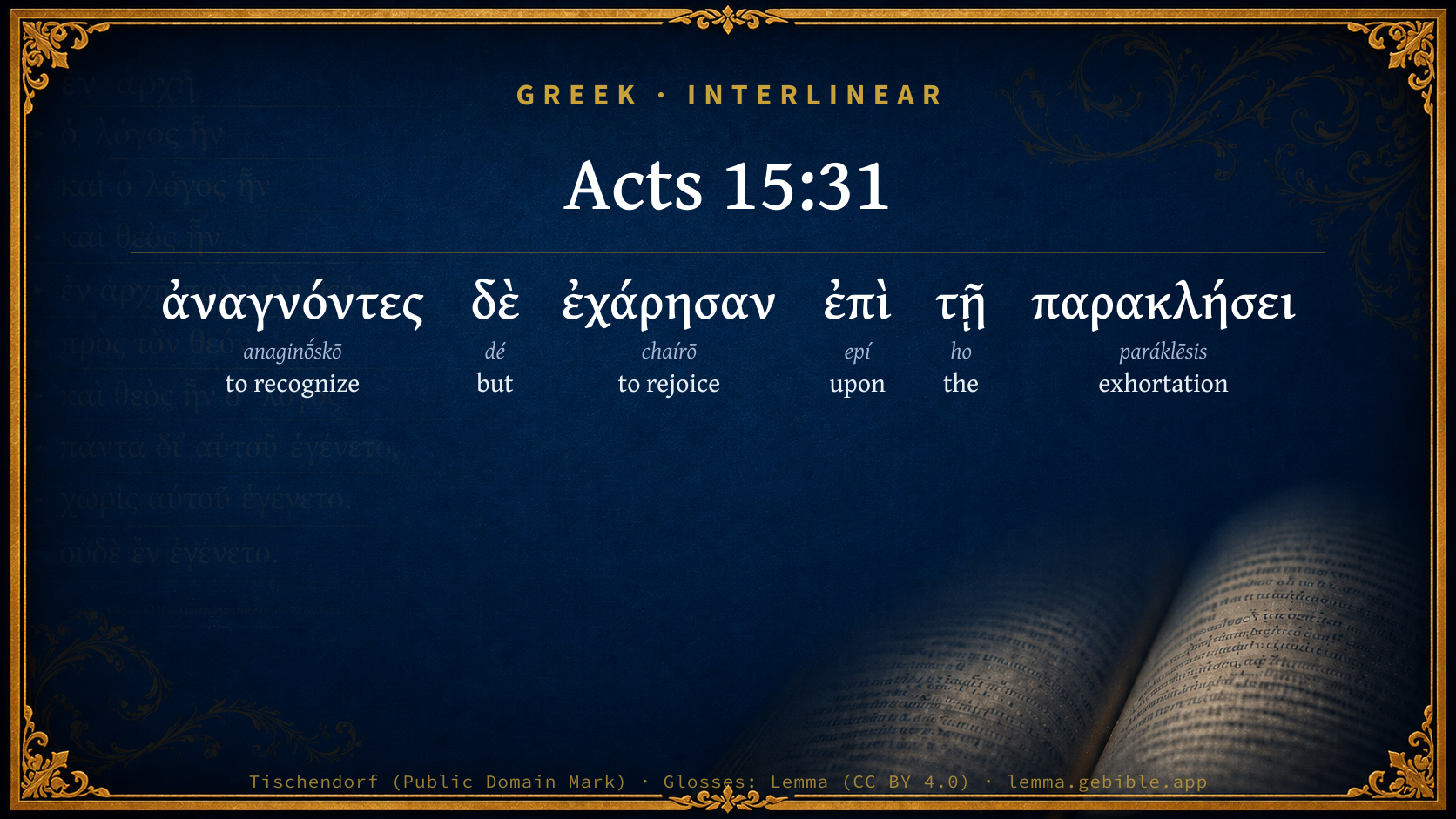
Greek (Tischendorf 8th ed.) Acts 15:31 appears in the Greek New Testament. The text above is from the Tischendorf 8th edition. Each word links to its Strong’s number and a concise gloss. Click any word for its full Thayer’s Greek Lexicon entry.
Download image
Cite this verse

Acts 15:31 (World English Bible). Public Domain. Lemma interlinear Bible study tool, https://lemma.gebible.app/v/acts/15/31.

Show BibTeX & RIS
BibTeX
RIS
English Translation
When they had read it, they rejoiced over the encouragement.
World English Bible · Public Domain
Download a study sheet

One document with this verse’s original text, its word-by-word gloss line, the meaning frame, cross-references with their text, attributed commentary, and full source and license credits — printable, and it pastes into notes with its structure intact.

This verse Autodidact and up

Study sheet (.html) Plain text (.txt)

A passage Seminary Student

Up to 50 verses in one chapter. A passage sheet keeps up to 6 commentary sources and 12 cross-references per verse, in the order this page ranks them, and says so on the sheet whenever that leaves anything out. Ask for a single verse and you get the Autodidact verse sheet above.

Everything on this page stays free to read, with no account — the sheet is a download of what is already on screen, not access to it.

Want to remove ads? Support Godless Engineer
Compare translations 3

The same verse in 3 English versions, stacked beneath the original-language interlinear above. Click any original word for its lexicon entry.

Each is an independent rendering of the whole verse — the interlinear is not word-aligned to these translations.

Highlighted words mark where these versions differ — a whole-verse word diff, not a word-by-word alignment.

  • World English Bible Public Domain
    When they had read it, they rejoiced over the encouragement.
  • King James Version Public Domain
    Which when they had read, they rejoiced for the consolation.
  • unfoldingWord Literal Text CC BY-SA 4.0
    And having read it, they rejoiced at the encouragement.

unfoldingWord Literal Text — © unfoldingWord, licensed CC BY-SA 4.0. Word-aligned USFM3 via Door43 (git.door43.org/unfoldingWord/en_ult).

Versions to compare (up to 4)

3 of 4 selected

Show all 19 translations

Every available English version of this verse, each an independent rendering of the whole verse.

  • World English Bible Public Domain
    When they had read it, they rejoiced over the encouragement.
  • Berean Standard Bible Public Domain
    When the people read it, they rejoiced at its encouraging message.
  • Majority Standard Bible Public Domain
    When the people read it, they rejoiced at its encouraging message.
  • King James Version Public Domain
    Which when they had read, they rejoiced for the consolation.
  • American Standard Version (1901) Public Domain
    And when they had read it, they rejoiced for the consolation.
  • Revised Version (1885) Public Domain
    And when they had read it, they rejoiced for the consolation.
  • Geneva Bible (1599) Public Domain
    And when they had read it, they reioyced for the consolation.
  • Douay-Rheims (1899) Public Domain
    Which when they had read, they rejoiced for the consolation.
  • Young's Literal Translation Public Domain
    and they having read, did rejoice for the consolation;
  • Literal Standard Version CC BY-SA 4.0
    and having read [it] they rejoiced for the consolation;
  • Unlocked Literal Bible CC BY-SA 4.0
    When they had read it, they rejoiced because of the encouragement.
  • unfoldingWord Literal Text CC BY-SA 4.0
    And having read it, they rejoiced at the encouragement.
  • Darby Bible Public Domain
    And having read it, they rejoiced at the consolation.
  • World Messianic Bible Public Domain
    When they had read it, they rejoiced over the encouragement.
  • Webster's Bible Public Domain
    Which when they had read, they rejoiced for the consolation.
  • Free Bible Version CC BY-SA 4.0
    After they had read it, the people were so happy for the encouraging message.
  • Bible in Basic English Public Domain
    And after reading it, they were glad of its comfort.
  • Text-Critical English NT CC BY 4.0
    When the people read it, they rejoiced over its encouragement.
  • Tyndale New Testament (1534) Public Domain
    When they had redde it they reioysed of that consolacion.

Literal Standard Version (2020), Covenant Press — licensed CC BY-SA 4.0. Text via the HelloAO Bible API (eBible.org). Unlocked Literal Bible (unfoldingWord) — licensed CC BY-SA 4.0. Text via the HelloAO Bible API (eBible.org). unfoldingWord Literal Text — © unfoldingWord, licensed CC BY-SA 4.0. Word-aligned USFM3 via Door43 (git.door43.org/unfoldingWord/en_ult). Free Bible Version, Dr. Jonathan Gallagher — licensed CC BY-SA 4.0. Text via the HelloAO Bible API (eBible.org).

Word by word

More ways to search: Search by grammar → Find every occurrence → Compare this word →

Practice this passage: Drill this verse → Learn its vocabulary →

παρακλήσει
paráklēsis
G3874
“exhortation”
Noun, Dative, Singular, Feminine
Part of Speech
Noun
Case
Dative
Number
Singular
Gender
Feminine
Full Thayer's Definition

Origin: from G3870

TDNT: 17:53,8

1. a calling near, summons, (esp. for help) 2. importation, supplication, entreaty 3. exhortation, admonition, encouragement 4. consolation, comfort, solace; that which affords comfort or refreshment a. thus of the Messianic salvation (so the Rabbis call the Messiah the consoler, the comforter) 5. persuasive discourse, stirring address a. instructive, admonitory, conciliatory, powerful hortatory discourse
  1. ἀναγνόντες anaginṓskō G314 “to recognize” Verb, Aorist, Active, Participle, Nominative, Plural, Masculine
  2. δὲ dé G1161 “but” Conjunction
  3. ἐχάρησαν chaírō G5463 “to rejoice” Verb, Aorist, Passive deponent, Indicative, 3rd person, Plural
  4. ἐπὶ epí G1909 “upon” Preposition
  5. τῇ ho G3588 “the” Article, Dative, Singular, Feminine

About this verse

These counts appear in no published source. They are computed here, from the morphology-tagged text and Lemma’s own curated glosses. What Lemma adds →

6
words
6
distinct lemmas
Acts
section

Shared distinctive vocabulary

παρακλήσει exhortation G3874 occurs in 28 verses of the Greek New Testament. Also found in:
Cross-references

6

Topical passages linked to Acts 15:31 in the Treasury of Scripture Knowledge — connected by theme and wording, ordered by reader-vote popularity; previews shown in the World English Bible.

  • Galatians 2:4–5 This was because of the false brothers secretly brought in, who stole in to spy out our liberty which we have in Christ Jesus, that they might bring us into bondage;
  • Galatians 5:1 Stand firm therefore in the liberty by which Christ has made us free, and don't be entangled again with a yoke of bondage.
  • Philippians 3:3 For we are the circumcision, who worship God in the Spirit, and rejoice in Christ Jesus, and have no confidence in the flesh;
  • Acts 15:1 Some men came down from Judea and taught the brothers, "Unless you are circumcised after the custom of Moses, you can't be saved."
  • Acts 15:10 Now therefore why do you tempt God, that you should put a yoke on the neck of the disciples which neither our fathers nor we were able to bear?
  • Acts 16:5 So the assemblies were strengthened in the faith, and increased in number daily.

Cross-references courtesy of OpenBible.info (CC BY 4.0).

Commentary

Notes on Acts 15:31 from classic Christian and Jewish commentators (each source and its license shown beneath its notes). The classic Christian expositions comment on the surrounding passage and are grouped to its opening verse, so a note may address several verses; the Jewish commentaries on the Tanakh (Rashi and others) are per-verse, so they appear only where the commentator wrote on this verse.

Lemma curates 59 commentaries, every one of them public domain or Creative Commons licensed, each selected and text-cleaned for this edition rather than reprinted as found. About our sources →

Jamieson, Fausset & Brown

Robert Jamieson, A. R. Fausset & David Brown

they rejoiced for the consolation--As the same word is in Act 15:31 properly rendered "exhorted," the meaning probably is "rejoiced for the exhortation" (Margin), or advice; so wise in itself and so contrary to the imposition attempted to be practiced upon them by the Judaizers.

Jamieson, Fausset & Brown — Commentary Critical and Explanatory on the Whole Bible (1871) — public domain (CC PDM 1.0). Text via the HelloAO Bible API.

Bengel's Gnomon

Johann Albrecht Bengel

Act 15:31. Ἀναγνόντες, when they had read) in public.—παρακλήσει, at the consolation) To this refer παρεκάλεσαν, consoled (Engl. Vers., exhorted), Act 15:32.

Bengel's Gnomon of the New Testament — English translation (T&T Clark, Edinburgh, 1860) — public domain. Text from a community e-Sword module.

Meyer's Critical & Exegetical Commentary

Heinrich August Wilhelm Meyer

Act_15:31-32. Ἐπὶ τῇ παρακλήσει] for the consolation, which the contents of the letter granted to them. They now saw Christian liberty protected and secured, where the abrupt demand of the Jewish-Christians had formerly excited so much anxiety. The meaning cohortatio, arousing address (Beza, Castalio, and others), is less suitable to the contents of the letter and to the threatening situation in which they had been placed.

καὶ αὐτοί] is to be explained in keeping with Act_15:27; and so to be connected, not, as is usually done, with προφ. ὄντες (as they also, as well as Paul and Barnabas, were prophets), but with διὰ λόγου π. παρεκάλ. κ.τ.λ. Judas and Silas also personally (as the letter by writing) comforted and strengthened the brethren by much discourse, which they could the more do, since they were prophets (see on Act_11:27). The παρεκάλεσαν must be interpreted like παρακλήσει, and so not cohortabantur (as usually). Comp. Vulgate; and see Act_15:27, τὰ αὐτά.

Meyer — Critical and Exegetical Commentary on the New Testament — English translation by Peter Christie, edited by Frederick Crombie (T&T Clark, 1880) — public domain. Text from a community e-Sword module.

Expositor's Greek Testament

ed. W. Robertson Nicoll

Act 15:31 . παρακλήσει : A. and R.V. “consolation” (“exhortation” margin, R.V.). The former rendering seems suitable here, because the letter causes rejoicing, not as an exhortation, but as a message of relief and concord. Ramsay and Hort render “encouragement”. Barnabas was a fitting bearer of such a message, cf. Act 4:36 .

The Expositor's Greek Testament, edited by W. Robertson Nicoll (1897–1910) — public domain. Text from a community e-Sword module.

Adam Clarke's Commentary

Verse 31. They rejoiced for the consolation.] It was not a matter of small moment to have a question on which such stress was laid decided by an apostolic council, over which the Spirit of God presided.

Adam Clarke's Commentary on the Bible (1810–1826) — public domain. Text from a community e-Sword/MySword module.

John Calvin's Commentaries

31. They rejoiced over the consolation. Seeing that the epistle is so short, and containeth nothing but a bare narration, what consolation could they have by it? But we must note, that there was no small matter of consolation therein, because, when they knew the consent of the apostles, they were all pacified, and also whereas before there was variance among them, they are now reconciled one to another. Seeing there went a false report about, that all the apostles were against Paul and Barnabas, this same had shaken some who were too light of belief, many did stand in doubt; the wicked abused this occasion to speak evil; others some were pricked forward with love of novelty and with curiosity, and one was set against another. But now, after that they see that the judgment of the first Church doth agree with the doctrine of Paul and Barnabas, they obtain that for which the children of God ought most to wish, that being established in the right faith, and being of one mind among themselves, they may with quiet minds have peace one with another.

John Calvin's Commentaries (1540-1563) — public domain. Text from the Calvin Translation Society English edition (1840s-50s) via the Christian Classics Ethereal Library (ccel.org). Calvin's coverage is partial (roughly two-thirds of the Bible); uncommented books and verses are honest gaps, never fabricated. The 19th-century editor's footnotes and remarks are omitted so the notes are faithfully Calvin's own voice.

Ellicott's Commentary for English Readers

(31) They rejoiced for the consolation.—We ought not to forget that the letter was probably read out by one who was himself emphatically “the son of consolation” (Act_4:36) in all the manifold aspects of that word, and who now proved himself worthy of the name.

A Bible Commentary for English Readers, edited by Charles John Ellicott (1878–1897) — public domain. Text from a community e-Sword module.

The Cambridge Bible for Schools and Colleges

gen. ed. J. J. S. Perowne

31. rejoiced for the consolation] Barnabas “the son of consolation” (Act_4:36) was a fit member of such an embassy. The consolation would be felt both by Jews and Gentiles, by the former because they knew how much was to be asked of their Gentile fellow-worshippers, by the latter because they were declared free from the yoke of Jewish observances. The noun very often signifies exhortation, but that sense is neither so apt here, nor is it borne out by the character of the letter, which sets forth a ground of peace and comfort, but is not hortatory.

The Cambridge Bible for Schools and Colleges (gen. ed. J. J. S. Perowne; Cambridge University Press, 1878–1918) — public domain. Text from a community e-Sword module.

John Gill's Exposition

Which when they had read,.... That is, when the brethren of the church at Antioch had read the letter delivered to them; for not Paul and Barnabas, or Judas and Silas, who were sent with it, read it, but the brethren to whom it was sent, as was proper.

They rejoiced for the consolation, or "exhortation", as the word may be rendered, which was given them in the letter, to abstain from the above things, without being burdened with any other; and they rejoiced that there was such an agreement among the apostles, elders, and brethren at Jerusalem; and that their sentiments, and those of Paul and Barnabas, and other faithful ministers and saints at Antioch, were alike, and were opposed to the judaizing preachers and professors; and above all, they rejoiced that they were freed from the burdensome yoke of the law, and that the controversy which had been raised among them, was likely to be ended, and to issue so well.

John Gill's Exposition of the Whole Bible (1746–1763) — public domain (CC PDM 1.0). Text via the HelloAO Bible API.

Trapp's Complete Commentary

John Trapp

31 Which when they had read, they rejoiced for the consolation.

Ver. 31. They rejoiced for the consolation] How should we rejoice in Christ our Saviour, who bare our sins, &c., and freed us from the burden and brunt of both crime and curse!

John Trapp, A Commentary or Exposition upon All the Books of the Old and New Testament (1647–1656) — public domain. Text from a community e-Sword module.

Albert Barnes' Notes on the Bible

They rejoiced for the consolation - They acquiesced in the decision of the apostles and elders, and rejoiced that they were not to be subjected to the burdensome rites and ceremonies of the Jewish religion. This closes the account of the first Christian council. It was conducted throughout on Christian principles; in a mild, kind, conciliatory spirit, and is a model for all similar assemblages. It came together, not to promote, but to silence disputation; not to persecute the people of God, but to promote their peace; not to be a scene of harsh and angry recrimination, but to be an example of all that was mild, and tender, and kind. Those who composed it came together, not to carry a point, not to overreach their adversaries, not to be party people, but to mingle their sober counsels, to inquire what was right, and to express, in a Christian manner, what was proper to be done. Great and important principles were to be established in regard to the Christian church, and they engaged in their work evidently with a deep sense of their responsibility, and with a just view of their dependence on the aid of the Holy Spirit. How happy Would it have been if this spirit had been possessed by all professedly Christian councils; if all had really sought the peace and harmony of the churches; if none had ever been convened to kindle the fires of persecution, or to rend and destroy the church of God!

This council has been usually appealed to as the authority for councils in the church as a permanent arrangement, and especially as an authority for courts of appeal and control. But it establishes neither, and should be brought as authority for neither. For:

(1) It was not a court of appeal in any intelligible sense. It was an assembly convened for a special purpose; designed to settle an inquiry which arose in a particular part of the church, and which required the collected wisdom of the apostles and elders.

(2) It had none of the marks or appendages of a court. The term “court,” or judicature, is nowhere applied to it, nor to any assembly of Christian people in the New Testament. Nor should these terms be used now in the churches. courts of judicature imply a degree of authority which cannot be proved from the New Testament to have been conceded to any ecclesiastical body of people.

(3) There is not the slightest intimation that anything like permanency was to be attached to this council, or that it would be periodically or regularly repeated. It proves, indeed, that, when cases of difficulty occur - when Christians are perplexed and embarrassed, or when contentions arise - it is proper to refer to Christian people for advice and direction. Such was the case here, and such a course is obviously proper. If it should be maintained that it is well that Christian ministers and laymen should assemble periodically, at stated intervals, on the supposition that such cases may arise, this is conceded; but the example of the apostles and elders should not be pleaded as making such assemblies of divine right and authority, or as being essential to the existence of a church of God. Such an arrangement has been deemed to be so desirable by Christians, that it has been adopted by Episcopalians in their regular annual and triennial Conventions; by Methodists in their conferences; by Presbyterians in their General Assembly; by Friends in their Yearly Meetings; by Baptists and congregationalists in their Associations, etc.; but the example of the council summoned on a special emergency at Jerusalem should not be pleaded as giving divine authority to these periodical assemblages. They are wise and prudent arrangements, contributing to the peace of the church, and the example of the council at Jerusalem can be adduced as furnishing as reach divine authority for one as for another; that is, it does not make all or either of them of divine authority, or obligatory on the church of God.

(4) It should be added that a degree of authority (compare Act 16:4) would, of course, be attached to the decision of the apostles and elders at that time which cannot be to any body of ministers and laymen now. Besides, it should never be forgotten - what, alas! it seems to have been the pleasure and the interest of ecclesiastics to forget that neither the apostles nor elders asserted any jurisdiction over the churches of Antioch, Syria, and Cilicia; that they did not claim a right to have these cases referred to them; that they did not attempt to “lord it” over their faith or their consciences. The case was a single, specific, definite question referred to them, and they decided it as such. They asserted no abstract right of such jurisdiction; they sought not to intermeddle With the case; they enjoined no future reference of such cases to them, to their successors, or to any ecclesiastical tribunal. They evidently regarded the churches as blessed with the most ample freedom, and contemplated no arrangement of a permanent character asserting a right to legislate on articles of faith, or to make laws for the direction of the Lord’s freemen.

Albert Barnes' Notes on the Bible (1834–1885) — public domain. Text from a community e-Sword/MySword module.

Haydock's Catholic Bible Commentary

We may here briefly remark, that the controversy was finally adjusted by the decree of the Council. 2ndly, That all, not only the Gentiles, but the abettors and masters of the former dissension, experienced great consolation in the promulgation of the decision, receiving it as the resolve not of mere mortal men, but of the Holy Ghost. It hath seemed good to the Holy Ghost and to us.

George Leo Haydock (1774–1849), Haydock's Catholic Family Bible and Commentary, 1859 edition — public domain. Excludes Psalms (Douay-Rheims chapter numbering differs from Protestant) and Deuterocanonical books (Catholic canon only).

Matthew Poole's English Annotations

It could not but much rejoice the Gentile believers, that they were exempted from circumcision, and the ceremonial law. And it gladdened the believing Jews also, that the controversy was determined, and concord established amongst them. But much more might they all rejoice to understand the grace of the gospel; and that we are not justified by the deeds of the law, but by faith in Christ, Rom 5:1.

Consolation; this word also signifies exhortation, and it was matter of joy to be put upon such excellent duties as our most holy religion recommends, and to be deterred from such erroneous evils as it forbids. All that God requires of us being only to eschew evil, and do good, Isa 1:16,17; 1Pe 3:11.

Matthew Poole's English Annotations on the Holy Bible (1683–1685) — public domain. Text from a community e-Sword/MySword module.

The Pulpit Commentary

And when they had read it for which when they had read, A.V.

The Pulpit Commentary (1880–1919), ed. H.D.M. Spence-Jones & Joseph S. Exell — public domain. Text from a community e-Sword module.

McGarvey & Pendleton's Commentaries

J. W. McGarvey

See notes on verse 30

J. W. McGarvey (with Philip Y. Pendleton), Commentaries on the New Testament (The Fourfold Gospel, 1914; Acts; and the epistles) — public domain. Text from a community e-Sword/MySword module.

Cambridge Greek Testament for Schools and Colleges

31. ἐχάρησαν ἐπὶ τῇ παρακλήσει, rejoiced for the consolation. Barnabas (υἱὸς παρακλήσεως, Act 4:36) was a fit member of such an embassy. The consolation would be felt both by Jews and Gentiles, by the former because they now knew how much was to be asked of their Gentile fellow-worshippers, by the latter because they were declared free from the yoke of Jewish observances. The noun very often signifies exhortation, but that sense is neither so apt here, nor is it borne out by the character of the letter, which sets forth a ground of peace and comfort, but is not hortatory.

Cambridge Greek Testament for Schools and Colleges (Cambridge University Press, 1896; 21 vols, various authors incl. Carr, Maclear, Plummer, Farrar, Lumby, Moule, M. R. James, Simcox) — public domain. Text from a community e-Sword module.

Alford’s Greek Testament

Henry Alford

31. παρακλήσει] It does not appear, because παρεκάλεσαν follows in the sense of ‘exhorted,’ that this word need mean ‘exhortation.’ There was (De W.) very little exhortation in the letter: and it is much more natural to render it consolation here: it was the matter of their joy, which surely could not be said of the orders to abstain given in the letter. It has been observed by Mr. Pusey that syr. renders παρεκάλεσαν 5:32, by comforted.

Henry Alford, The Greek Testament (1849–1861) — public domain. Text from a community e-Sword module.

Vincent's Word Studies in the New Testament

Marvin R. Vincent

Consolation. See on Act 9:31.

Marvin R. Vincent, Word Studies in the New Testament (1887–1900) — public domain. Text from a community e-Sword/MySword module.

Lesson kit

Teaching starters — assembled from the data on this page, not authored interpretation. Every prompt links to the verse data it draws on. Edit before teaching.

Acts, in the Acts, opens this verse with 6 words (6 distinct Greek lemmas). Its most distinctive word is paráklēsis (“exhortation”). A historical commentator’s framing appears above. Read the whole chapter for the surrounding context.

Discussion questions

  1. What does “exhortation” (paráklēsis) contribute to the verse as a whole?
  2. How does Luke 2:25, which shares the word «exhortation», read alongside this verse?
  3. The translations on this page render this verse differently — a whole-verse word diff, not a word-by-word alignment. What might account for the different wordings?
  4. Compare how Jamieson, Fausset & Brown and Bengel's Gnomon read this verse. Where do they agree or differ?

Things to notice

Reading settings

Reading text

Shown beneath each verse's original-language words.

Old Testament
Old Testament edition

Read the OT as the Masoretic Hebrew (MT) or the Greek Septuagint (LXX).

English shown for the Greek Septuagint (in the Hebrew ↔ Greek comparison).

Comparing translations? Open the Compare panel on any verse page to stack up to four side by side.