
2 John 1:10

Greek (Tischendorf 8th ed.) 2 John 1:10 appears in the Greek New Testament. The text above is from the Tischendorf 8th edition. Each word links to its Strong’s number and a concise gloss. Click any word for its full Thayer’s Greek Lexicon entry.
Download image
Cite this verse

2 John 1:10 (World English Bible). Public Domain. Lemma interlinear Bible study tool, https://lemma.gebible.app/v/2-john/1/10.

Show BibTeX & RIS
BibTeX
RIS
English Translation
If anyone comes to you, and doesn't bring this teaching, don't receive him into your house, and don't welcome him,
World English Bible · Public Domain
Download a study sheet

One document with this verse’s original text, its word-by-word gloss line, the meaning frame, cross-references with their text, attributed commentary, and full source and license credits — printable, and it pastes into notes with its structure intact.

This verse Autodidact and up

Study sheet (.html) Plain text (.txt)

A passage Seminary Student

Up to 50 verses in one chapter. A passage sheet keeps up to 6 commentary sources and 12 cross-references per verse, in the order this page ranks them, and says so on the sheet whenever that leaves anything out. Ask for a single verse and you get the Autodidact verse sheet above.

Everything on this page stays free to read, with no account — the sheet is a download of what is already on screen, not access to it.

Want to remove ads? Support Godless Engineer
Compare translations 3

The same verse in 3 English versions, stacked beneath the original-language interlinear above. Click any original word for its lexicon entry.

Each is an independent rendering of the whole verse — the interlinear is not word-aligned to these translations.

Highlighted words mark where these versions differ — a whole-verse word diff, not a word-by-word alignment.

  • World English Bible Public Domain
    If anyone comes to you, and doesn't bring this teaching, don't receive him into your house, and don't welcome him,
  • King James Version Public Domain
    If there come any unto you, and bring not this doctrine, receive him not into your house, neither bid him God speed:
  • unfoldingWord Literal Text CC BY-SA 4.0
    If anyone comes to you and does not bring this teaching, do not receive him into your house and do not say to him, “Greetings.”

unfoldingWord Literal Text — © unfoldingWord, licensed CC BY-SA 4.0. Word-aligned USFM3 via Door43 (git.door43.org/unfoldingWord/en_ult).

Versions to compare (up to 4)

3 of 4 selected

Show all 19 translations

Every available English version of this verse, each an independent rendering of the whole verse.

  • World English Bible Public Domain
    If anyone comes to you, and doesn't bring this teaching, don't receive him into your house, and don't welcome him,
  • Berean Standard Bible Public Domain
    If anyone comes to you but does not bring this teaching, do not receive him into your home or even greet him.
  • Majority Standard Bible Public Domain
    If anyone comes to you but does not bring this teaching, do not receive him into your home or even greet him.
  • King James Version Public Domain
    If there come any unto you, and bring not this doctrine, receive him not into your house, neither bid him God speed:
  • American Standard Version (1901) Public Domain
    If any one cometh unto you, and bringeth not this teaching, receive him not into `your' house, and give him no greeting:
  • Revised Version (1885) Public Domain
    If any one cometh unto you, and bringeth not this teaching, receive him not into your house, and give him no greeting:
  • Geneva Bible (1599) Public Domain
    If there come any vnto you, and bring not this doctrine, receiue him not to house, neither bid him, God speede:
  • Douay-Rheims (1899) Public Domain
    If any man come to you, and bring not this doctrine, receive him not into the house nor say to him, God speed you.
  • Young's Literal Translation Public Domain
    if any one doth come unto you, and this teaching doth not bear, receive him not into the house, and say not to him, `Hail!'
  • Literal Standard Version CC BY-SA 4.0
    if anyone comes to you, and does not bear this teaching, do not receive him into the house, and do not say to him, “Greetings!”
  • Unlocked Literal Bible CC BY-SA 4.0
    If anyone comes to you and does not bring this teaching, do not receive him into your house and do not greet him.
  • unfoldingWord Literal Text CC BY-SA 4.0
    If anyone comes to you and does not bring this teaching, do not receive him into your house and do not say to him, “Greetings.”
  • Darby Bible Public Domain
    If any one come to you and bring not this doctrine, do not receive him into [the] house, and greet him not;
  • World Messianic Bible Public Domain
    If anyone comes to you and doesn’t bring this teaching, don’t receive him into your house, and don’t welcome him,
  • Webster's Bible Public Domain
    If any one cometh to you, and bringeth not this doctrine, receive him not into your house, neither wish him happiness:
  • Free Bible Version CC BY-SA 4.0
    If people come to you and don't show evidence of Christ's teaching, don't take them in, don't welcome them—
  • Bible in Basic English Public Domain
    If anyone comes to you not having this teaching, do not take him into your house or give him words of love:
  • Text-Critical English NT CC BY 4.0
    If anyone comes to you and does not bring this teaching, do not receive him into your house, and do not greet him;
  • Tyndale New Testament (1534) Public Domain
    Yf ther come eny vnto you and bringe not this learninge him receave not to housse: nether bid him God spede.

Literal Standard Version (2020), Covenant Press — licensed CC BY-SA 4.0. Text via the HelloAO Bible API (eBible.org). Unlocked Literal Bible (unfoldingWord) — licensed CC BY-SA 4.0. Text via the HelloAO Bible API (eBible.org). unfoldingWord Literal Text — © unfoldingWord, licensed CC BY-SA 4.0. Word-aligned USFM3 via Door43 (git.door43.org/unfoldingWord/en_ult). Free Bible Version, Dr. Jonathan Gallagher — licensed CC BY-SA 4.0. Text via the HelloAO Bible API (eBible.org).

Word by word

More ways to search: Search by grammar → Find every occurrence → Compare this word →

Practice this passage: Drill this verse → Learn its vocabulary →

διδαχὴν
didachḗ
G1322
“teaching”
Noun, Accusative, Singular, Feminine
Part of Speech
Noun
Case
Accusative
Number
Singular
Gender
Feminine
Full Thayer's Definition

Origin: from G1321

TDNT: 04:43,2

1. teaching a. that which is taught b. doctrine, teaching, concerning something 2. the act of teaching, instruction a. in religious assemblies of the Christians, to speak in the way of teaching, in distinction from other modes of speaking in public
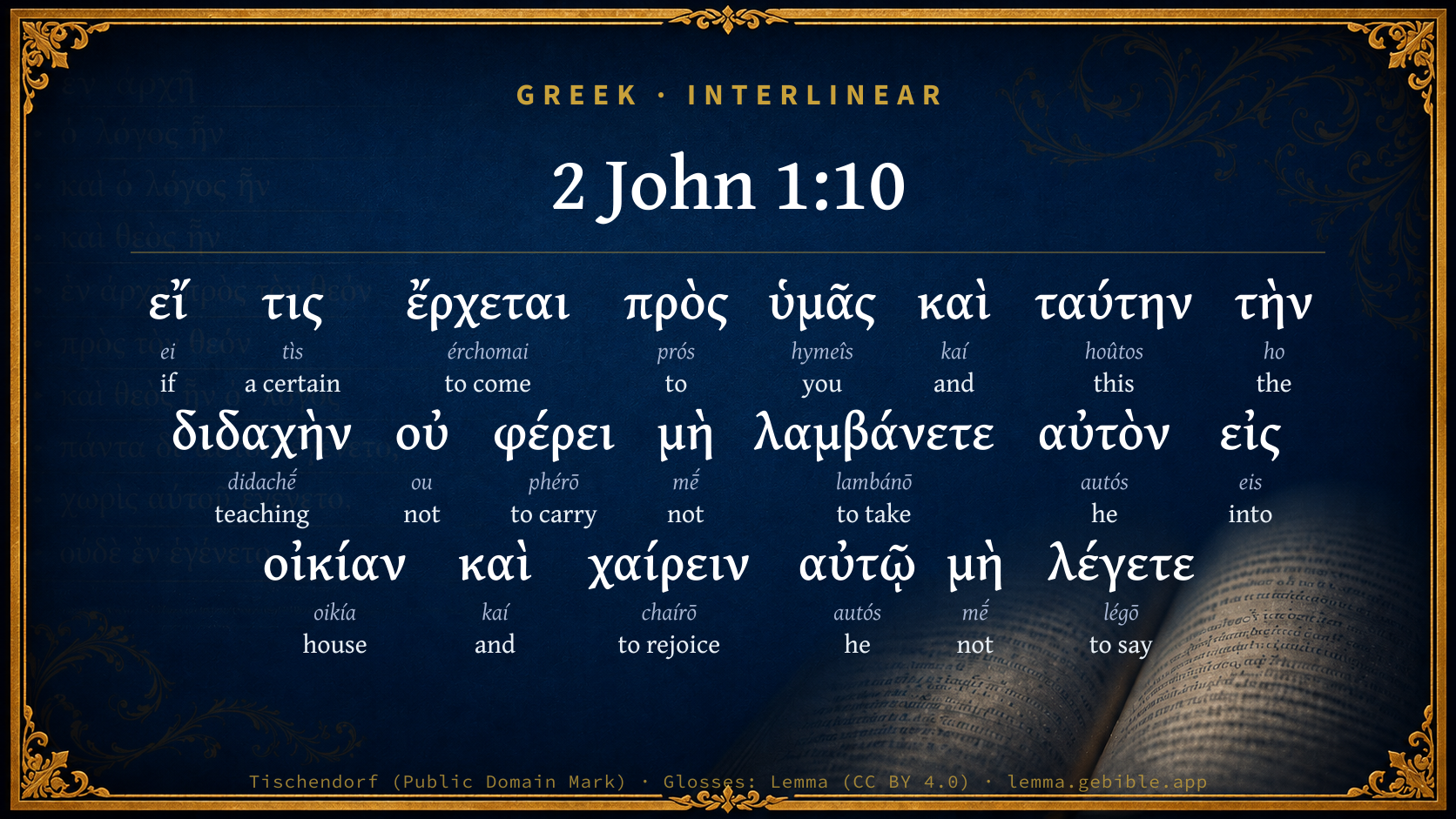
  1. εἴ ei G1487 “if” Conditional
  2. τις tìs G5100 “a certain” Indefinite pronoun, Nominative, Singular, Masculine
  3. ἔρχεται érchomai G2064 “to come” Verb, Present, Middle or Passive deponent, Indicative, 3rd person, Singular
  4. πρὸς prós G4314 “to” Preposition
  5. ὑμᾶς hymeîs G5210 “you” Personal pronoun, 2nd person, Accusative, Plural
  6. καὶ kaí G2532 “and” Conjunction
  7. ταύτην hoûtos G3778 “this” Demonstrative pronoun, Accusative, Singular, Feminine
  8. τὴν ho G3588 “the” Article, Accusative, Singular, Feminine
  9. οὐ ou G3756 “not” Particle, Negative
  10. φέρει phérō G5342 “to carry” Verb, Present, Active, Indicative, 3rd person, Singular
  11. μὴ mḗ G3361 “not” Particle, Negative
  12. λαμβάνετε lambánō G2983 “to take” Verb, Present, Active, Imperative, 2nd person, Plural
  13. αὐτὸν autós G846 “he” Personal pronoun, Accusative, Singular, Masculine
  14. εἰς eis G1519 “into” Preposition
  15. οἰκίαν oikía G3614 “house” Noun, Accusative, Singular, Feminine
  16. καὶ kaí G2532 “and” Conjunction
  17. χαίρειν chaírō G5463 “to rejoice” Verb, Present, Active, Infinitive
  18. αὐτῷ autós G846 “he” Personal pronoun, Dative, Singular, Masculine
  19. μὴ mḗ G3361 “not” Particle, Negative
  20. λέγετε légō G3004 “to say” Verb, Present, Active, Imperative, 2nd person, Plural

About this verse

These counts appear in no published source. They are computed here, from the morphology-tagged text and Lemma’s own curated glosses. What Lemma adds →

21
words
18
distinct lemmas
General Epistles
section

Shared distinctive vocabulary

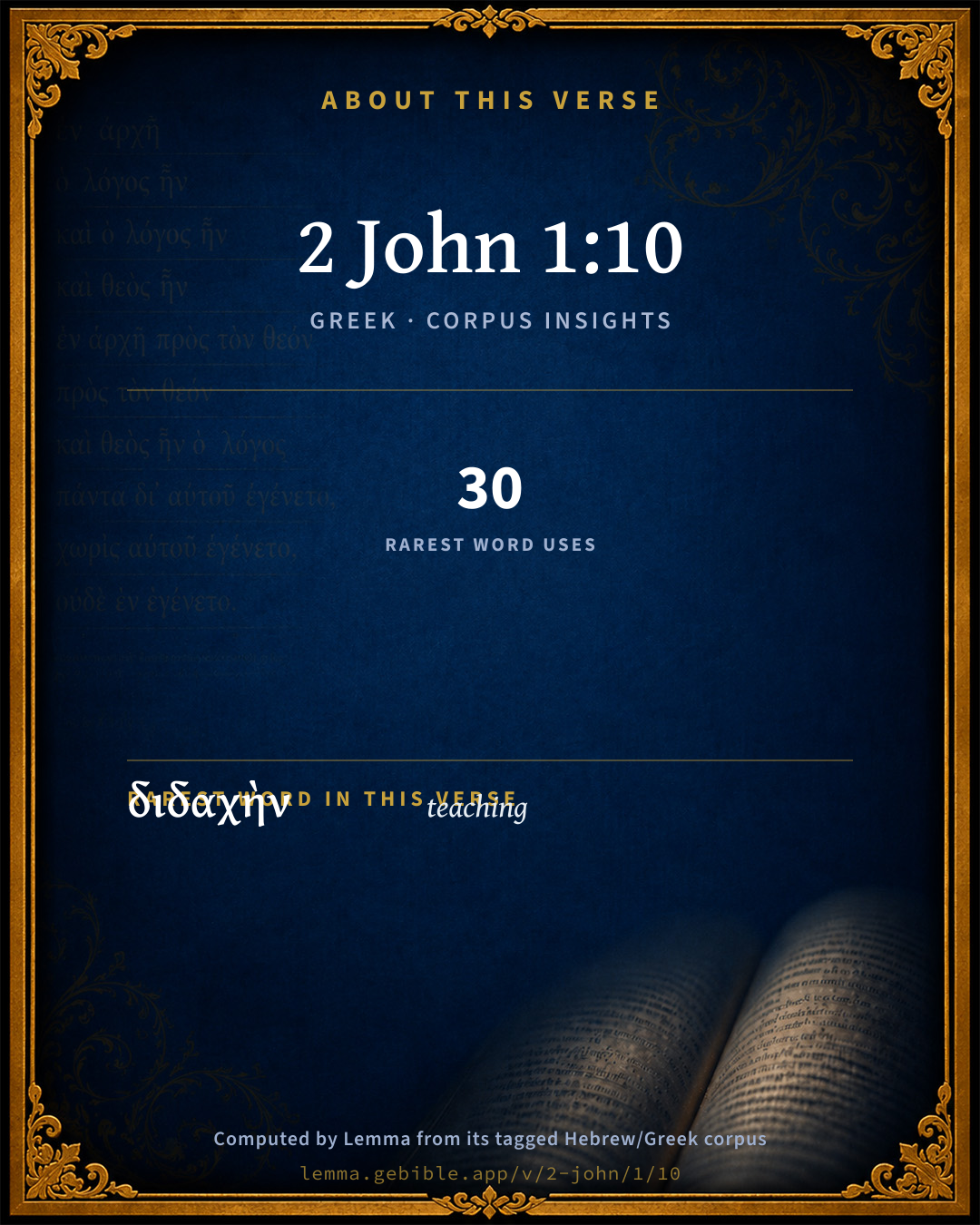
διδαχὴν teaching G1322 occurs in 29 verses of the Greek New Testament. Also found in:
Repetition

Words recur within this verse:

Cross-references

10

Topical passages linked to 2 John 1:10 in the Treasury of Scripture Knowledge — connected by theme and wording, ordered by reader-vote popularity; previews shown in the World English Bible.

  • Titus 3:10 Avoid a factious man after a first and second warning;
  • Romans 16:17–18 Now I beg you, brothers, look out for those who are causing the divisions and occasions of stumbling, contrary to the doctrine which you learned, and turn away from them.
  • 2 Thessalonians 3:6 Now we command you, brothers, in the name of our Lord Jesus Christ, that you withdraw yourselves from every brother who walks in rebellion, and not after the tradition which they received from us.
  • 2 Thessalonians 3:14 If any man doesn't obey our word in this letter, note that man, that you have no company with him, to the end that he may be ashamed.
  • 2 Timothy 3:5–6 holding a form of godliness, but having denied the power thereof. Turn away from these, also.
  • 1 Corinthians 5:11 But as it is, I wrote to you not to associate with anyone who is called a brother who is a sexual sinner, or covetous, or an idolater, or a slanderer, or a drunkard, or an extortioner. Don't even eat with such a person.
  • 2 John 1:11 for he who welcomes him participates in his evil works.
  • 1 Corinthians 16:22 If any man doesn't love the Lord Jesus Christ, let him be accursed. Come, Lord!
  • Galatians 1:8–9 But even though we, or an angel from heaven, should preach to you any gospel other than that which we preached to you, let him be cursed.
  • Psalms 129:8 Neither do those who go by say, "The blessing of Yahweh be on you. We bless you in the name of Yahweh."

Cross-references courtesy of OpenBible.info (CC BY 4.0).

Commentary

Notes on 2 John 1:10 from classic Christian and Jewish commentators (each source and its license shown beneath its notes). The classic Christian expositions comment on the surrounding passage and are grouped to its opening verse, so a note may address several verses; the Jewish commentaries on the Tanakh (Rashi and others) are per-verse, so they appear only where the commentator wrote on this verse.

Lemma curates 59 commentaries, every one of them public domain or Creative Commons licensed, each selected and text-cleaned for this edition rather than reprinted as found. About our sources →

The Cambridge Bible for Schools and Colleges

gen. ed. J. J. S. Perowne

10, 11. Warnings against False Charity

10. If there come any unto you] Better, as R. V., if any one Cometh unto you: it is εἰ with the indicative, not ἐάν with the subjunctive. It is implied that such people do come; it is no mere hypothesis: comp. 1Jn_5:9; Joh_7:4; Joh_7:23; Joh_8:39; Joh_8:46; Joh_18:8. ‘Cometh’ probably means more than a mere visit: it implies coming on a mission as a teacher; comp. 3Jn_1:10; Joh_1:7; Joh_1:30-31; Joh_3:2; Joh_4:25; Joh_5:43; Joh_7:27, &c.; 1Co_2:1; 1Co_4:18-19; 1Co_4:21; 1Co_11:34, &c.

and bring not this doctrine] Better, and bringeth not this doctrine, The negative (οὐ not μή should be emphasized in reading: it “does not coalesce with the verb, as some maintain, but sharply marks off from the class of faithful Christians all who are not faithful” (Speaker’s Commentary on 1Co_16:22). The phrase ‘to bring doctrine’ occurs nowhere else in N. T., but it is on the analogy of ‘to bring a message, to bring word’ (Hom. Il. XV. 15, 175 &c.): comp. ‘What accusation bring ye’? (Joh_18:29).

receive him not into your house] ‘Refuse him the hospitality which as a matter of course you would shew to a faithful Christian’. Charity has its limits: it must not be shewn to one man in such a way as to do grievous harm to others; still less must it be shewn in such a way as to do more harm than good to the recipient of it. If these deceivers were treated as if they were true Christians, (1) their opportunities of doing harm would be greatly increased, (2) they might never be brought to see their own errors. “S. John is at once earnestly dogmatic and earnestly philanthropic; for the Incarnation has taught him both the preciousness of man and the preciousness of truth” (Liddon). The famous story respecting S. John and Cerinthus in the public baths is confirmed in its main outlines by this injunction to the elect lady, which it explains and illustrates. See the Introduction, p. 24.

The greatest care will be necessary before we can venture to act upon the injunction here given to the elect lady. We must ask, Are the cases really parallel? Am I quite sure that the man in question is an unbeliever and a teacher of infidelity? Will my shewing him hospitality aid him in teaching infidelity? Am I and mine in any danger of being infected by his errors? Is he more likely to be impressed by severity or gentleness? Is severity likely to create sympathy in others, first for him, and then for his teaching? In not a few cases the differences between Christianity in the first century and Christianity in the nineteenth would at once destroy the analogy between these antichristian Gnostics visiting Kyria and an Agnostic visiting one of ourselves. Let us never forget the way in which the Lord treated Pharisees, publicans and sinners.

neither bid him God speed] ‘Give him no greeting’ is perhaps too narrow, whether as translation or interpretation. And do not bid him, God speed will perhaps be a better rendering; and the injunction will cover any act which might seem to give sanction to the false doctrine or shew sympathy with it. The word for ‘God speed’ (χαίρειν) is used in a similar sense Act_15:23; Act_23:26; Jas_1:1 : comp. Joh_19:3, &c.

The Cambridge Bible for Schools and Colleges (gen. ed. J. J. S. Perowne; Cambridge University Press, 1878–1918) — public domain. Text from a community e-Sword module.

The Biblical Illustrator

Joseph S. Exell

2Jn_1:10-11

Receive him not into your house, neither bid him God speed.

Loyalty to Christ

The man who comes to undermine mens faith in Christ is on an evil errand. His work is an evil work. Let no false motives of courtesy or toleration lead you to give any assistance or encouragement to such. Let not your tolerance to men have for its other side indifference to Christ. A tremendous responsibility rests upon us to-day. Christ is the sole remaining hope of the world. For the sake of our own souls, and all the souls around us, and for all that are coming to be born into this world, let us be faithful. Polycarp, said Dr. Duncan, would have stood a bad chance in an examination by John Owen; but he was a famous man to burn. He was offered his life if he would just say, Caesar is Lord, and fling a few grains of incense on the altar. No; life at that price was too dear. He could not afford to live at such a cost. Would he swear, then? Revile Christ by a word? No. Eighty and six years, said the old man, have I served Him, and He hath done me no wrong. How, then, can I speak evil of my King? And then they put him in the fire. He was but a simple, commonplace, pious old man. But he burned well. He has left no system of theology. That was his theology--to burn for Christ, to be faithful unto death. God give us to be equally faithful under different and less arduous circumstances, that at the last we too may receive the crown of life. (J. M. Gibbon.)

No toleration

1. Intercourse with anti-christian teachers is very injurious to the faith of young Christians. The faith of young Christians is itself young and tender. Any fellow may knock about the babe in the cradle, but he would not lift up his hand against its father. What is very painful in the conduct of the infidels, agnostics, and secularists of the day, is the effort they make to get young men together to their meetings.

2. It also incurs a grave responsibility. For he that giveth him greeting partaketh in his evil works. That is, he is reckoned by others to be in partnership with him. To countenance evil is as bad as to commit it, and to be where evil is done is to countenance it. Let religious teachers often show to the young the perils and responsibilities of mixing up in unchristian and immoral society. (T. Davies, M. A.)

The contagion of evil to be avoided

When a man is known to suffer from a sadly contagious disease none of his friends will come near the house. There is little need to warn them off: they are all too alarmed to come near. Why is it men are not as much afraid of the contagion of vice? How dare they run risks for themselves and children by allowing evil companions to frequent their house? Sin is as infectious and far more deadly than the smallpox or fever. (C. H. Spurgeon.)

He that biddeth him God speed is partaker of his evil deeds.

Our share in other mens sins

There are few more remarkable sayings in Holy Writ than that of our blessed Redeemer, He that receiveth a prophet in the name of a prophet shall receive a prophets reward. But the principle which pervades this saying of Christ is not limited in its operations; and, if one application of it be encouraging, another may be alarming. May it not be possible to identify yourself with an evil man as well as with a good, so that, though you may not yourself actually commit the evil mans deeds, yet you shall be reckoned with as though you had done the deeds? That the principle admits of this application is but too clearly proved by our text. These words of St. John are, indeed, precisely parallel to what our Saviour says in regard of a prophet. To bid the heretic God speed would be to give the weight of your authority to his heresy. In mercantile phrase, as has been well said, it would be to endorse his false doctrines; and the day of reckoning shall come. But this opens before us a great and solemn subject of discourse One is disposed at first to hope that it may be merely through some metaphysical subtlety that human beings are represented as so interwoven with each other, that the same actions may be charged on a variety of agents: but metaphysical subtlety there is absolutely none; the apostle speaks of our partaking in other mens evil deeds with the same plainness which he would use if speaking of our obeying any one of the Ten Commandments. Oh, this wonderfully enlarges the power or opportunity of destroying our souls; this amazingly magnifies the dread business of the judgment. I could tremble at being told, Every man shall bear his own burden--at hearing, So, then, every one of us shall give account of himself to God; but I do not apprehend all the awfulness of appearing at the tribunal of the Most High till I ponder this assertion of St. John, He that biddeth him God speed is partaker of his evil deeds. Now, examine more definitely the modes in which we may have share in other mens sins. We will select two modes: the first is that of giving evil counsel, or diffusing wrong principles; the second is that of setting a bad example. To illustrate the first mode, we will take an extreme case, but which cannot be examined without our discovering a principle which may equally be applied in various lesser instances. The case is that of an author, who, having committed to writing licentious or sceptical thoughts, applies the vast power of the Press to the gaining for them currency through the world. You will hardly require of us to show you that this author participates in the sins of ether men. Wheresoever his book is, there may he be, undermining the foundations of morality and religion, poisoning the springs of life, and instigating others to be as sceptical or as debauched as himself. Repentance, for the most part, is utterly unavailing; the author may become altogether a reformed man, being changed from the infidel into the sincere believer, and from the immoral into the righteous; but he may have no power whatsoever of recalling his writings: they have gone forth as upon wings to the farthest ends of the earth. What a perpetuity of evil-doing has thus been acquired by many of the dead! And though you may think that this, however clear an illustration of the partaking in the sins of other men, furnishes but little of practical lesson to yourselves, I would remind you that the author only does that in a higher degree that is done by any one in a lower, who gives bad advice or sanctions wrong principles. The act of printing does but enlarge, so to speak, the sphere of the authors individuality, and cause him to act on a broader surface; but evidently if, in place of printing, he confines himself to speaking, delivering to the comparatively few who are brought within sound of his voice the same sentiments that we suppose scattered by the Press over half a community, why, he will partake of the sins of those few, even as under the other supposition he would of the sins of the whole host of his fellow-men. And if you still further reduce the position of the author, so that in place of blasphemous sentiments you put mere worldly words into his mouth, and without making him a pattern of immorality simply ascribe to him indifference as to religion, it is clear you do not touch the argument upon which participation in other mens sins is established, though you may diminish the likelihood of his making other men to sin, or the enormity of the crimes to which he may be accessory. Do you never let slip an opportunity of reproving vice, of recommending virtue? Do you never, when you have given an opinion on points of difference between men of the world and disciples of Christ--do you never lean to the side of the world, because not honest enough to despise the risk of giving offence? There is not one of you whose actions do not operate on the actions of others--operate, we mean, in the way of example. He would be insignificant who could only destroy his own soul; but you are all, alas! of importance enough to help also to destroy the souls of others; and henceforward we would have you remember that whensoever you act you act for a multitude; eyes are upon you, many or few, according to the position that you occupy; some are either watching to take pattern or waiting for your halting. Be vicious, and viciousness may go down as an heirloom in half a hundred families; be inconsistent, and enmity to the gospel may be propagated over a parish; give occasions of offence, and many may fall; those who are entering in the narrow way may be discouraged, and those who have already entered may be made to stumble. Well, then, if such be the fact--if, through our necessary connection with numbers of our fellow-men, a connection resulting from the circumstances of our nature--if, through the giving evil counsel, which it seems almost impossible to avoid, and through the setting evil example, which must be done in some sense by all but the perfect--if in these ways we become partakers in other mens sins--better fly the world at once; better retire to the desert, where, altogether separated from our kind, we should at least have no guilt to add to our own! Vain thought! Suppose, then, that we flee from active life and bury these powers in solitude, we shall still be chargeable with all the evil which might have been counteracted, had we stood to our posts and made use of our talents. We might have stayed the torrent of vice and ungodliness; we might have turned some sinners from the error of their ways. What, then, have we obtained by flight? Have I striven up to the measure of the ability conferred on me by God to promote the diffusion of sound principles, and to subdue the aboundings of iniquity? You ask, in a sort of terror, for some specific by which to guard against this partaking in the sins of other men. I have but one answer to give. The only way not to partake in other mens sins is not to sin yourselves. The great use which we make of this subject of discourse is the furnishing another motive to you to the walking circumspectly and the living righteously. (H. Melvill, B. D.)

The Biblical Illustrator, edited by Joseph S. Exell (c. 1880s–1900s) — public domain. Text from a community e-Sword module.

Joseph Benson's Commentary

2Jn 1:10-11. If there come any unto you — Either as a teacher or a brother; and bring not this doctrine — Of Christ, namely, that Jesus Christ, the Son of God, did come in the flesh to save mankind; or advance any thing contrary to it, or any other branch of Christ’s doctrine; receive him not into your house — Either as a teacher or a brother; neither bid him God speed — Give him no encouragement therein; for he that biddeth him God speed — That gives him any encouragement; is partaker of — Is necessary to; his evil deeds — We may infer, from what the apostle here says, 1st, That when those who professed to be the disciples of Christ came to any place where they were not known to the brethren who resided there, nor were recommended to them by some with whom they were acquainted, they made themselves known to them as the real disciples of Christ, by declaring their faith. This shows the propriety of the apostle’s advice to this pious matron and her children. 2d, That as the Christians in those days exercised hospitality to their stranger brethren, who were employed in spreading the gospel; so the Christian sister to whom the apostle wrote this letter, being probably rich, and of a benevolent disposition, thought herself under an obligation to supply the wants of those strangers who went about preaching. Wherefore, to prevent her from being deceived by impostors, the apostle here directs her to require such teachers to give an account of the doctrines which they taught; and if she found that they did not hold the true Christian doctrine, he advised her not to receive them into her house, nor to give them any countenance. And this advice of the apostle was certainly perfectly proper, because they who entertained, or otherwise showed respect to, false teachers, enabled them the more effectually to spread their erroneous doctrine, to the seduction and ruin of those whom they deceived.

Joseph Benson's Commentary on the Old and New Testaments (1811–1818) — public domain. Text from a community e-Sword module.

Tyndale Open Study Notes

Tyndale Open Resources

1:10-11 Believers should not invite that person, who does not teach the truth about Christ, into their homes. The early churches met in homes (see Acts 2:46; 5:42; 8:3; 12:5, 12; Col 4:15; Phlm 1:2), so this could refer to inviting false teachers to a meeting of the church. It could also refer to giving any form of hospitality to false teachers, which would help their mission. The only way to deal with them was to not accept them into the fellowship.

Tyndale Open Study Notes — © Tyndale Open Resources, licensed CC BY-SA 4.0. Text via the HelloAO Bible API.

Bengel's Gnomon

Johann Albrecht Bengel

2Jn 1:10. Ἔρχεται, comes) as a teacher or brother.—ταύτην) this, of Christ.—οὐ φέρει, does not bring) by a true profession.—καὶ) and moreover.—χαίρειν, salutation) Let him be to you as a heathen, to whom however a salutation is more safely addressed: 1Co 5:10. He is speaking of a familiar greeting, and that of brethren and Christians. Salutations appear to have been more unusual of old among strangers and foreigners.

Bengel's Gnomon of the New Testament — English translation (T&T Clark, Edinburgh, 1860) — public domain. Text from a community e-Sword module.

Meyer's Critical & Exegetical Commentary

Heinrich August Wilhelm Meyer

2Jn_1:10. Warning against fellowship with false teachers. εἴ τις ἔρχεται πρὸς ὑμᾶς] The more particular definition of the τις is contained in the following: καὶ … φέρει. The particle εἰ is used here because the case is put as if actual (Winer). The author assumes the ἔρχεσθαι as really occurring, and in reference to it gives the command: μὴ λαμβάνετε; if he had regarded the coming as a thing which might only possibly occur, he would have put ἐάν; hence it is unsuitable to say that εἴ τις is un-Johannean (Ebrard), for it cannot be un-Johannean to assume a case as a reality (Braune).

καὶ ταύτην τὴν διδαχὴν οὐ φέρει] τ. τ. διδ., namely, the διδ. τοῦ Χριστοῦ. The phrase φέρειν τ. διδ. only here in the N. T.; comp. the classical: μῦθον, ἀγγελίην φέρειν τινί.

On οὐ after εἰ, see Al. Buttm. p. 299. Grotius rightly says: non de iis qui alieni semper fuerunt ab ecclesia (1Co_5:10), sed de iis qui volunt fratres haberi ct doctrinam evertunt. It is only with this interpretation that the prohibition of the apostle can be correctly understood.

μὴ λαμβάνετε αὐτὸν εἰς οἰκίαν] is to be understood of the hospitable reception into our house, which is to be accorded to the brethren as such; the apostle therefore forbids the brotherly reception of such as bring not the doctrine of Christ, but another doctrine opposed to it, and are, accordingly, assiduous in asserting the latter. The limitation of the prohibition to the relationship of φιλοξενία (Rom_12:13; Heb_13:2) finds no support in the words of the apostle. Now such a κρίσις was so much the more necessary the more the false teachers sought to abuse the Christian hospitality, in order to gain for themselves access to the Churches; comp. 2Ti_3:6.

καὶ χαίρειν αὐτῷ μὴ λέγετε] It is arbitrary to limit this prohibition, with Clemens Alex., to the salutatio, quae fiebat, postquam surgebatur ab oratione solemni velut gaudii et pacis indicium; as well as to interpret it in that degree of generality which a Lapide gives it when he says: vetat hic Joh. omne colloquium, omne consortium, omne commercium cum haereticis; just as little is it to be interpreted, with Vitringa (de Synag. vet. p. 759), of the excommunication proper. This prohibition is in closest connection with the preceding, and similarly refers to εἴ τις ἔρχεται πρὸς ὑμᾶς κ.τ.λ.; it is meant to strengthen the former; not merely the hospitable reception into the house, but also the friendly greeting of the false teacher, if he comes as a Christian brother, is not to take place[13] (comp. Hofmann, Schriftbew. II. 2, p. 339). The word χαίρειν, as a formula of salutation, appears frequently both in the classics and also in the N. T., especially in Epistles; see Wahl on this word.

[13] Ebrard contradicts himself when, in opposition to the interpretation given here, he first maintains that χαίρειν λέγειν here is the quite general idea of the greeting of conventional politeness, and afterwards interprets: He who greets such a false teacher, i.e. keeps up personal acquaintance and conventional intercourse with him.

Meyer — Critical and Exegetical Commentary on the New Testament — English translation by Peter Christie, edited by Frederick Crombie (T&T Clark, 1880) — public domain. Text from a community e-Sword module.

Expositor's Greek Testament

ed. W. Robertson Nicoll

2Jn 1:10-11 . Treatment of Heretical Teachers. “If any one cometh unto you and bringeth not this teaching, receive him not into your house, and bid him not farewell. For he that biddeth him farewell hath fellowship with his works, his evil works.”

2Jn 1:10 . φέρει , not “endureth” ( cf. Rom 9:22 ; Heb 12:20 ), but “bringeth” as a precious boon ( cf. Rev 21:24 ; Rev 21:26 ). εἰς οἰκίαν ( cf. Mar 2:1 ; Mar 3:19 ), zu Hause; cf. “to church,” “to town,” “to market,” “to bed”. See Moulton’s Winer , pp. 148 ff. χαῖρε , like ave, salve , was used of both the salutation at meeting and the farewell at parting. The former is its prevailing use in N.T., but here, as in 2Co 13:11 , the latter. “Zum Abschied, wenn der Abgewiesene weiter ziehen muss” (Holtzmann).

The Expositor's Greek Testament, edited by W. Robertson Nicoll (1897–1910) — public domain. Text from a community e-Sword module.

Cambridge Greek Testament for Schools and Colleges

10, 11. WARNINGS AGAINST FALSE CHARITY

10. εἴ τις ἔρχεται. As R.V., If anyone cometh. ‘If there come any unto you’ would require ἐάν with the subjunctive. It is implied that such people do come; it is no mere hypothesis: comp. 1Jn 5:9; Joh 7:4; Joh 7:23; Joh 8:39; Joh 8:46; Joh 18:8. Ἔρχεται probably means more than a mere visit: it implies coming on a mission as a teacher; comp. 3Jn 1:10; Joh 1:7; Joh 1:30-31; Joh 3:2; Joh 4:25; Joh 5:43; Joh 7:27, &c.; 1Co 2:1; 1Co 4:18-19; 1Co 4:21; 1Co 11:34, &c.

καὶ τ. τ. διδαχἠν οὐ φέρει. And bringeth not this doctrine. The negative (οὐ not μή) should be emphasized in reading: it “does not coalesce with the verb, as some maintain, but sharply marks off from the class of faithful Christians all who are not faithful” (Speaker’s Commentary on 1Co 16:22). The phrase διδαχὴν φέρειν occurs nowhere else in N.T., but it is on the analogy of μῦθον or ἀγγελίην φέρειν (Hom. Il. x. 288; xv. 175, 202, &c.). Comp. Τίνα κατηγορίαν φέρετε κ.τ.λ.; (Joh 18:29).

μὴ λαμβάνετε … μὴ λέγετε. Present imperative forbidding a continuance of what is customary. ‘Refuse him the hospitality which as a matter of course you would shew to a faithful Christian’. The severity of the injunction is almost without a parallel in N. T. Charity has its limits: it must not be shewn to one man in such a way as to do grievous harm to others; still less must it be shewn in such a way as to do more harm than good to the recipient of it. If these deceivers were treated as if they were true Christians, (1) their opportunities of doing harm would be greatly increased, (2) they might never be brought to see their own errors. “S. John is at once earnestly dogmatic and earnestly philanthropic; for the Incarnation has taught him both the preciousness of man and the preciousness of truth” (Liddon). The famous story respecting S. John and Cerinthus in the public baths is confirmed in its main outlines by this injunction to the elect lady, which it explains and illustrates. Both are instances of “that intense hatred of evil, without which love of good can hardly be said to exist” (Stanley). See the Introduction, p. xxxii.

The greatest care will be necessary before we can venture to act upon the injunction here given to the elect lady. We must ask, Are the cases really parallel? Am I quite sure that the man in question is an unbeliever and a teacher of infidelity? Will my shewing him hospitality aid him in teaching infidelity? Am I and mine in any danger of being infected by his errors? Is he more likely to be impressed by severity or gentleness? Is severity likely to create sympathy in others, first for him, and then for his teaching? In not a few cases the differences between Christianity in the first century and Christianity in the nineteenth would at once destroy the analogy between antichristian Gnostics visiting this lady and an Agnostic visiting one of ourselves. Let us never forget the way in which the Lord treated Pharisees, publicans, and sinners.

καὶ χαίρειν αὐτῷ μὴ λέγετε. ‘And give him no greeting’ is perhaps too narrow, whether as translation or interpretation. And do not bid him God speed will perhaps be a better rendering; and the injunction will cover any act which might seem to give sanction to the false doctrine or shew sympathy with it. Χαίρειν is used in a similar sense Act 15:23; Act 23:26; Jas 1:1: comp. Joh 19:3, &c.

Cambridge Greek Testament for Schools and Colleges (Cambridge University Press, 1896; 21 vols, various authors incl. Carr, Maclear, Plummer, Farrar, Lumby, Moule, M. R. James, Simcox) — public domain. Text from a community e-Sword module.

International Critical Commentary

10. εἴ τις ἔρχεται κ.τ.λ.] Cf. Didache xi. I, 2, ὃς ἂν οὖν ἐλθὼν διδάξῃ ὑμᾶς ταῦτα πάντα τὰ προειρημένα δέξασθε αὐτόν· ἐὰν δὲ αὐτὸς ὁ διδάσκων στραφεὶς διδάσκῃ ἄλλην διδαχὴν εἰς τὸ καταλῦσαι, μὴ αὐτοῦ ἀκούσητε. There is nothing in the Epistle itself to indicate that this verse “at last discloses the special purpose of the whole Epistle.” Its purpose is clearly to encourage those to whom it is addressed to continue in the active exercise of the faith and love which they had learned from Christ and His Apostles, even to the point of refusing hospitality to those who claimed to come in Christ’s name, but who, in the writer’s opinion, were destroying the work of Christ by their teaching.

The form of the conditional sentence used presents the case as more than a mere possibility, rather as something not unlikely to happen.

ἔρχεται πρὸς ὑμᾶς] The usage of ἔρχεσθαι in the Johannine Epistles is confined to the “coming” of Christ, or Antichrist, or of the brethren visiting another Church (3Jn 1:3), or of the Elder paying a formal visit (3Jn 1:10, ἐὰν ἔλθω). It is dangerous to read a special sense into common words. But clearly the accompanying condition, καὶ ταύτην τὴν διδαχὴν οὐ φέρει, limits the reference to those who claim to come as Christians, and to have a “teaching” to communicate to the members of the Church. The context excludes the idea that the writer is thinking of “casual visits of strangers.” Those to whom he would refuse recognition claim to be received as brethren by fellow-Christians. In his view their conduct has made that impossible.

μὴ λαμβάνετε εἰς οἰκίαν] For the use of the verb, cf. Joh 1:12, ὅσοι δὲ ἔλαβον αὐτόν: 6:21, λαβεῖν αὐτὸν εἰς τὸ πλοῖον: 13:20, ὁ λαμβάνων ἄν τινα πέμψω ἐμὲ λαμβάνει.χαίρειν … μὴ λέγετε] Elsewhere in the N.T. χαίρειν is only used in the greeting at the beginning of Epistles (Act 15:23, Act 15:23:26; Jas 1:1). These passages throw no light on the question whether the welcome at meeting or the farewell greeting is meant. There is really nothing in the usage of the word or in the context to decide the question. We may perhaps compare Luk 10:5, εἰς ἣν δʼ ἂν εἰσέλθητε οἰκίαν πρῶτον λέγετε· Εἴρηνη τῷ οἴκῳ τούτῳ. In the LXX the use of χαίρειν in this sense is confined to the letters contained in the Books of the Maccabees.

ει τις ερχεται] οτι εισερχεται Ic 506 (60) | ταυτην] post διδαχην 31 | αυτω] pr. ενIc 114 (335).

International Critical Commentary — older volumes (1896–1929), various authors — public domain. Text from a community e-Sword module.

Geneva Bible (1599)

Geneva Bible translators

We ought to have nothing to do with them that defend perverse doctrine.

Geneva Bible (1599) marginal notes — public domain. Text via Bolls.life.

Matthew Henry's Commentary

Here, I. Upon due warning given concerning seducers, the apostle gives direction concerning the treatment of such. They are not to be entertained as the ministers of Christ. The Lord Christ will distinguish them from such, and so would he have his disciples. The direction is negative. 1. "Support them not: If there come any unto you, and bring not this doctrine (concerning Christ as the Son of God, the Messiah and anointed of God for our redemption and salvation), receive him not into your house." Possibly this lady was like Gaius, of whom we read in the next epistle, a generous housekeeper, and hospitable entertainer of travelling ministers and Christians. These deceivers might possibly expect the same reception with others, or with the best who came there (as the blind are often bold enough), but the apostle allows it not: "Do not welcome them into your family." Doubtless such may be relieved in their pressing necessities, but not encouraged for ill service. Deniers of the faith are destroyers of souls; and it is supposed that even ladies themselves should have good understanding in the affairs of religion. 2. "Bless not their enterprises: Neither bid him God speed. Attend not their service with your prayers and good wishes." Bad work should not be consecrated or recommended to the divine benediction. God will be no patron of falsehood, seduction, and sin. We ought to bid God speed to evangelical ministration; but the propagation of fatal error, if we cannot prevent, we must not dare to countenance. Then,

II. Here is the reason of such direction, forbidding the support and patronage of the deceiver: For he that biddeth him God speed is partaker of his evil deeds. Favour and affection partake of the sin. We may be sharers in the iniquities of others. How judicious and how cautious should the Christian be! There are many ways of sharing the guilt of other people's transgressions; it may be done by culpable silence, indolence, unconcernedness, private contribution, public countenance and assistance, inward approbation, open apology and defence. The Lord pardon our guilt of other persons' sins!

Matthew Henry's Commentary on the Whole Bible (1708–1710) — public domain (CC PDM 1.0). Text via the HelloAO Bible API.

Jamieson, Fausset & Brown

Robert Jamieson, A. R. Fausset & David Brown

If there come any--as a teacher or brother. The Greek is indicative, not subjunctive; implying that such persons do actually come, and are sure to come; when any comes, as there will. True love is combined with hearty renunciation and separation from all that is false, whether persons or doctrines.

receive him not . . . neither bid him God speed--This is not said of those who were always aliens from the Church, but of those who wish to be esteemed brethren, and subvert the true doctrine [GROTIUS]. The greeting salutation forbidden in the case of such a one is that usual among Christian brethren in those days, not a mere formality, but a token of Christian brotherhood.

Jamieson, Fausset & Brown — Commentary Critical and Explanatory on the Whole Bible (1871) — public domain (CC PDM 1.0). Text via the HelloAO Bible API.

Adam Clarke's Commentary

Verse 10. If there come any unto you] Under the character of an apostle or evangelist, to preach in your house; and bring not this doctrine, that Jesus is come in the flesh, and has died for the redemption of the world.

Receive him not unto your house] Give him no entertainment as an evangelical teacher. Let him not preach under your roof.

Neither bid him God speed.] Και χαιρειν αυτῳ μη λεγερε· And do not say, Health to him-do not salute him with Peace be to thee! The usual salutation among friends and those of the same religion in the east is, [Arabic] Salam aleekum, "Peace be to you;" which those of the same religion will use among themselves, but never to strangers, except in very rare cases. This is the case to the present day; and, from what John says here, it was a very ancient custom. We have often seen that peace among the Hebrews comprehended every spiritual and temporal blessing. The words mean, according to the eastern use of them, "Have no religious connection with him, nor act towards him so as to induce others to believe you acknowledge him as a brother."

Adam Clarke's Commentary on the Bible (1810–1826) — public domain. Text from a community e-Sword/MySword module.

John Gill's Exposition

If there come any unto you,.... Under the character of a preacher;

and bring not this doctrine; or does not preach the doctrine of Christ, as before explained, but despises it, and preaches a contrary one:

receive him not into your house; neither into the house of God, suffer him not to preach there; nor into your own house, give him no entertainment there: false teachers always tried to creep into houses, where they served their own turn every way, both by feeding their bellies, and spreading their pernicious doctrines; and therefore such should: be avoided, both publicly and privately; their ministry should not be attended on in the church, or house of God; and they should not be entertained in private houses, and much less caressed:

neither bid him God speed; or give him the usual civil form of salutation, as a good day to you, all hail, all health and prosperity attend you, the Lord be with you, and the like. The word used by the Jews was which signifies "happiness"; so it is said (i), what do they salute with? "God speed"; which was forbidden to say to one that was ploughing in the seventh year. The meaning is, that with such no familiar conversation should be had, lest any encouragement should be given them; or it should induce a suspicion in the minds of other saints, that they are in the same sentiments; or it should tend to make others think favourably of them, and be a snare and a stumblingblock to weak Christians.

(i) T. Hieros. Sheviith, fol. 35. 2. Vid. Taanith. fol. 64. 2.

John Gill's Exposition of the Whole Bible (1746–1763) — public domain (CC PDM 1.0). Text via the HelloAO Bible API.

Trapp's Complete Commentary

John Trapp

10 If there come any unto you, and bring not this doctrine, receive him not into your house, neither bid him God speed:

Ver. 10. And bring not this doctrine] If he hold not the foundation, but be found heterodox and heretical.

Receive him not, &c.] Illam domum in qua fuerit inventus haereticus diruendam decernimus, Down with that house that harbours a heretic, said the Council of Tholouse in their constitution against the Albigenses, whom they mistook for heretics.

Neither bid him God speed] Show not love where you owe nothing but hatred. "I hate every false way," saith David. And I shall look upon Auxentius as upon a devil, as long as he is an Arian, said Hilarius. St John sprang out of the bath wherein Cerinthus the heretic was washing, and said, Let us be gone, lest the house fall on our heads.

John Trapp, A Commentary or Exposition upon All the Books of the Old and New Testament (1647–1656) — public domain. Text from a community e-Sword module.

Albert Barnes' Notes on the Bible

If there come any unto you - Any professed teacher of religion. There can be no doubt that she to whom this Epistle was written was accustomed to entertain such teachers.

And bring not this doctrine - This doctrine which Christ taught, or the true doctrine respecting him and his religion.

Receive him not into your house - This cannot mean that no acts of kindness, in any circumstances, were to be shown to such persons; but that there was to be nothing done which could be fairly construed as encouraging or countenancing them as “religious teachers.” The true rule would seem to be, in regard to such persons, that, so far as we have contact with them as neighbors, or strangers, we are to be honest, true, kind, and just, but we are to do nothing that will countenance them as religious teachers, We are not to aid their instruction, Pro 19:27; we are not to receive them into our houses, or to entertain them as religious teachers; we are not to commend them to others, or to give them any reason to use our names or influence in propagating error. It would not be difficult to practice this rule, and yet to show to others all the kindness, and all the attention in circumstances of need, which religion demands. A person who is truly consistent is never suspected of countenancing error, even when he is distinguished for liberality, and is ready, like the good Samaritan, to pour in oil and wine in the wounds of any waylaid traveler. The command not to “receive such an one into the house,” in such circumstances as those referred to by John, would be probably understood literally, as he doubtless designed that it should be. To do that, to meet such persons with a friendly greeting, would be construed as countenancing their doctrine, and as commending them to others; and hence it was forbidden that they should be entertained as such. This treatment would not be demanded where no such interpretation could be put on receiving a friend or relative who held different and even erroneous views, or in showing kindness to a stranger who differed from us, but it would apply to the receiving and entertaining “a professed teacher of religion, as such;” and the rule is as applicable now as it was then.

Neither bid him God speed - Καὶ χαίρειν αὐτῷ μὴ λέγετε Kai chairein autō mē legete - “and do not say to him, hail, or joy.” Do not wish him joy; do not hail, or salute him. The word used expresses the common form of salutation, as when we wish one health, success, prosperity, Mat 26:49; Act 15:23; Act 23:26; Jam 1:1. It would be understood as expressing a wish for success in the enterprise in which they were embarked; and, though we should love all people, and desire their welfare, and sincerely seek their happiness, yet we can properly wish no one success in career of sin and error.

Albert Barnes' Notes on the Bible (1834–1885) — public domain. Text from a community e-Sword/MySword module.

Haydock's Catholic Bible Commentary

No say to him, Hail; or peace be to you, God speed you, all hail; or use any form of saluting him, as you would a friend, much less receive or entertain him in your house: this admonition is in general to forewarn persons of the dangers which may arise from a familiarity with heretics, and such as teach evil doctrine. But by this is not forbidden civility, kindness, and a sincere charity for all men, by which we ought to wish and pray for the eternal salvation of every one. I translate Ave by peace be to you, because this was the usual salutation among the Jews, and in those times, as we see Luke xxiv. and John xx.

====================

George Leo Haydock (1774–1849), Haydock's Catholic Family Bible and Commentary, 1859 edition — public domain. Excludes Psalms (Douay-Rheims chapter numbering differs from Protestant) and Deuterocanonical books (Catholic canon only).

Matthew Poole's English Annotations

Such as bring any contrary doctrine, (as Gal 1:8), ought not to be harboured or countenanced by any encouraging salutation, lest we involve ourselves in the participation of their guilt, 1Ti 5:22.

Matthew Poole's English Annotations on the Holy Bible (1683–1685) — public domain. Text from a community e-Sword/MySword module.

Whedon's Commentary on the Bible

Daniel D. Whedon

10. If—Caution against any apparent endorsement of the travelling emissaries of idealism.

Any—Teacher of the phantasm.

Receive him not—Do not entertain and maintain him as a preacher of antichristianity. It must be remembered that these antinomians were as corrupt in morals as they were false in faith.

House—The home of the Christian lady. It might be the hospitable home of charity to the poor and of liberality to the itinerant preacher of the gospel, but not the dependence of the opposer and deceiver.

God speed—A cheering wish for his success.

Daniel D. Whedon (gen. ed.), Commentary on the Old and New Testaments (1874–1909) — public domain. Text from a community e-Sword module.

The Pulpit Commentary

If any one cometh unto you. As in 1Jn_5:9, the Greek construction (indicative with eij, not conjunctive with eja) shows that the case is stated as a fact, and not as a mere supposition. "If people of this kind come and it is well known that they do do not receive them or give them a welcome." It is of the utmost importance to remember that St. John is here giving a rule for a special case, not laying down a general principle. His words give no sanction to the view that no hospitality is to be shown to heretics, still less to the monstrous mediaeval doctrine that no faith need be kept with them. The apostle is giving directions to a particular Christian household during a particular crisis in the history of the Christian faith. It by no means follows that he would have given the same directions to every household during that crisis, or to any household under totally different circumstances. We may well believe that he would not have followed them himself, but would have endeavoured "to convince the gainsayers." His charity towards them would not have been misunderstood, and his faith would not have been in danger of being subverted. It was otherwise with her and her children, as experience had proved. And before we take this verse as a rule for our own guidance, we must consider the difference, which may well constitute an essential difference, between a time in which those who confessed Jesus Christ coming in the flesh were a despised and persecuted handful, and one in which some courage is required to avow that one denies him.

Vers. 10, 11.

How to treat heretics.

there come any unto you, and bring not this doctrine," etc. Our subject divides itself into two branches.

I THE EXHORTATION OF THE APOSTLE. "If any one cometh unto you, and bringeth not this teaching, receive him not into your house, and give him no greeting." Notice:

1. What the exhortation implies.

(1) That the elect lady was accustomed to entertain Christian ministers. (cf. 3Jn_1:5, 3Jn_1:6) We have a beautiful illustration of similar hospitality in 2Ki_4:8-13. From that time to this very many godly persons have obtained for themselves a good report by entertaining faithful ministers of religion. In so doing they have often been richly blessed; and a gracious reward is promised unto them. (Mat_10:40-42)

(2) That there were ministers of false teaching abroad who were likely to call upon this lady. "If any one cometh unto you, and bringeth not this teaching;" i.e., " the teaching of Christ" (verse 9). Alford Points out that the use of " the indicative after eij shows that the case supposed actually existed; that such persons were sure to come to" her. The teachers of error were at work, etc.

2. What the exhortation enjoins. "If any one cometh unto you, and bringeth not this teaching, receive him not into your house, and give him no greeting." We have already considered (in dealing with verse 8) what is a Christian"s first duty in relation to false doctrines and their propagators. What is his subsequent duty? To refute such doctrines? To denounce such teachers? To oppose them? Or, to persecute them? The New Testament nowhere sanctions persecution in any form. And opposition should be left to the few who have the ability to conduct it successfully. The wise course for the great majority of those who hold the truth is, first, to look to themselves (verse 8), and next, to withhold all help and encouragement from the false teachers. St. John enjoins:

(1) That we do not aid the teachers of false doctrine by our hospitality. "Receive him not into your house." The apostle is not giving directions concerning the case of an ordinary traveler seeking hospitality; but of an active agent in the propagation of error, and error as to a fact of vital importance. "Let not your house be made a base of operations against Christ.

(2) That we do not aid the teachers of false doctrine by wishing them success. "Give him no greeting." Do not bid him "God-speed." Do not countenance him and his errors in any way or in any degree. "God will be no Patron of falsehood, seduction, and sin." And in this respect his people should imitate him. In our age, in some quarters, there is a great demand for liberality in the treatment of men who differ from us on religious questions. And so far as matters of opinion and of the interpretation of the Scriptures are concerned, the demand is a just one. But it is altogether different when it is a question of the acceptation or rejection of facts, or a fact, as in the case before us. The question was Had Jesus Christ come in the flesh, or not? (verse 7). In such a case the course marked out by St. John in this letter (verses 8, 10, 11) is the only one for a Christian. How severely he characterizes the heretics (verse 7)! How sternly St. Paul writes of teachers of error! (Gal_1:7-9) They knew that a true faith is the necessary root of Christian fruitfulness and beauty. True faith is essential to spiritual life, holy love, and hearty obedience.

II THE REASON BY WHICH THE EXHORTATION IS ENFORCED. "For he that giveth him greeting partaketh in his evil works." To countenance a teacher of error, to wish him "God-speed," is to approve his evil works and to share his guilt. Says Matthew Henry, "We may be sharers in the iniquities of others. How judicious and how cautious should the Christian be! There are many ways of sharing the guilt of other people"s transgressions; it may be done by culpable silence, indolence, unconcernedness, private contribution, public countenance and assistance, inward approbation, open apology and defense." Let us take heed that we be not "partakers of other men"s sins.

In matters of opinion let us cultivate the widest liberality; in matters of fact, uncompromising firmness. "In things essential, unity; in things doubtful, liberty; in all things, charity. W.J.

The Pulpit Commentary (1880–1919), ed. H.D.M. Spence-Jones & Joseph S. Exell — public domain. Text from a community e-Sword module.

John Wesley's Explanatory Notes

If any came to you - Either as a teacher or a brother. And bring not this doctrine - That is, advance anything contrary to it. Receive him not into your house - As either a teacher or a brother- Neither bid him God speed - Give him no encouragement therein.

John Wesley, Explanatory Notes Upon the Whole Bible (1754–1765) — public domain. Text via the GEBible commentary corpus.

Burkitt's Expository Notes on the New Testament

William Burkitt

In these words our apostle directs them how to carry themselves towards those wicked apostates and heretical seducers, that deny the gospel, or any essential part of Christianity; by no means to give any countenance or encouragement to them, or to hold any familiarity or communion with them, nor to entertain them, nor so much as courteously to salute them, but, by showing them disrespect, manifest a dislike and disapproving of their errors. This form of interdict, Bid him not God speed, seems to be an imitation of the Jewish practice towards excommunicated persons, who were not only excluded from all commerce, but also from all kind of common civilities, and ordinary salutation.

Learn hence, That even civil courtesy, and common respect, is not, ought not, to be paid to those that seduce others, or attempt to seduce us, from the Christian faith.

William Burkitt's Expository Notes on the New Testament (1700–1703) — public domain. Text from a community e-Sword module.

The People's New Testament

B. W. Johnson

10. If there come … and bring not this doctrine. That of Christ. If he be a deceiver, an opposer of Christ, one who denies that “Jesus Christ came in the flesh.” Receive him not into your house. Do not recognize him as a brother and extend to him a brotherly welcome. He is not to be fellowshipped. Neither bid him God speed. Give him no encouragement in his work of destruction. To give him greetings is to wish for his success.

B. W. Johnson's The People's New Testament with Notes (1889–1891) — public domain. Electronic text from the Christian Classics Ethereal Library (CCEL) ThML edition.

Vincent's Word Studies in the New Testament

Marvin R. Vincent

If there come any [ει τις ερχεται] . Better, Rev., if anyone cometh. The indicative mood assumes the fact : if anyone comes, as there are those that come. Cometh is used in an official sense as of a teacher. See on 1Jo 3:5.

Bring [φερει] . For the use of the verb see Joh 18:29; Act 25:18; 2Pe 2:11; 2Pe 1:17, 18; 1Pe 1:13.

Neither bid him God speed [και χαιρειν αυτω μη λεγετε] . Lit., and say not unto him "greeting!" Cairein rejoice, hail, was the customary form of salutation. It was also used in bidding farewell; but in the New Testament always of greeting (Act 14:23; Act 23:26; Jas 1:1). 70 "Now whoever cometh and teacheth you all these things, before spoken, receive him; but if the teacher himself turn aside and teach another teaching, so as to overthrow this, do not hear him" (" Teaching of the Twelve Apostles, " ch. 11. See on Mt 10:10).

Marvin R. Vincent, Word Studies in the New Testament (1887–1900) — public domain. Text from a community e-Sword/MySword module.

Westcott on Hebrews & the Epistles of John

Brooke Foss Westcott

10, ef ris ἔρχεται...) Tf any one cometh... The form of expression is not found elsewhere in the Epistles or Gospel of St John. It assumes the case, and does not simply regard it as possible (ἐάν ris). By ‘cometh’ is to be understood an official ‘coming.’ St John is not dealing with the casual visit of a stranger but with that of a teacher who claims authority.

The picture of the itinerating ‘ prophet’ in the Διδαχή is a vivid illustration of the scene present to St John’s mind (δὲ 11 f.).

πρὸς ὑμᾶς] ‘the lady and her children’ δῦ. 1, 12.

ravr. τ. ὃ. οὐ φ.] and beareth not as his message, thie doctrine of Christ which declares the Father and the Son, the decisive revelation of the Gospel. For φέρειν compare John xviii. 29; Acts xxv. 18; 2 Pet. ii. 11. See also 2 Pet. i. 17, 18, 21; 1 Pet. i. 13. The negative is not affected by ei, because it goes closely with the

μὴ λαμβ.... nolite recipere...nec ave et dizeritis V., receive him not...and give him no greeting.... These words

are to be interpreted with the limitation suggested by the character of the ‘coming’: ‘Do not receive such a teacher as one who can justly claim the privilege of Christian hospitality as a brother; and do not even welcome him with a greeting of sympathy.’ In the N. T. χαίρειν is always used of the greeting of first address (Acts xv. 23; xxiii. 26; James i. 1); otherwise the context would perhaps suggest that the thought here is of the greeting of farewell: ‘Do not entertain such a one: do not send him on his way with good wishes.’ Clement adds: arbitror autem quia et orare cum talibus non oportet, quoniam in oratione quze fit in domo postquam ab orando surgitur salutatio gaudii est et pacis indicium (Fragm. Hypotyp. p. 1011 P.), Whatever may be thought of the application the picture of family devotion is of singular interest.

Brooke Foss Westcott (1825–1901), The Epistle to the Hebrews (1889) and The Epistles of St John (1883) — public domain (pre-1929). Text recovered from Internet Archive / Google Books OCR scans. Westcott’s Gospel of John commentary is not included (its OCR lost the chapter running-heads required for reliable verse-keying). Some Greek quoted in the Hebrews volume is imperfectly rendered by the OCR.

Lesson kit

Teaching starters — assembled from the data on this page, not authored interpretation. Every prompt links to the verse data it draws on. Edit before teaching.

2 John, in the General Epistles, opens this verse with 21 words (18 distinct Greek lemmas). Its most distinctive word is didachḗ (“teaching”). A historical commentator’s framing appears above. Read the whole chapter for the surrounding context.

Discussion questions

  1. How does “teaching” (didachḗ) shape what this verse is saying?
  2. How does Matthew 7:28, which shares the word «teaching», read alongside this verse?
  3. What does the repetition of “and” (2× in this one verse) do in this verse?
  4. These translations render this verse differently. What is at stake in choosing one wording over another?
  5. Compare how The Cambridge Bible for Schools and Colleges and The Biblical Illustrator read this verse. Where do they agree or differ?

Things to notice

Reading settings

Reading text

Shown beneath each verse's original-language words.

Old Testament
Old Testament edition

Read the OT as the Masoretic Hebrew (MT) or the Greek Septuagint (LXX).

English shown for the Greek Septuagint (in the Hebrew ↔ Greek comparison).

Comparing translations? Open the Compare panel on any verse page to stack up to four side by side.