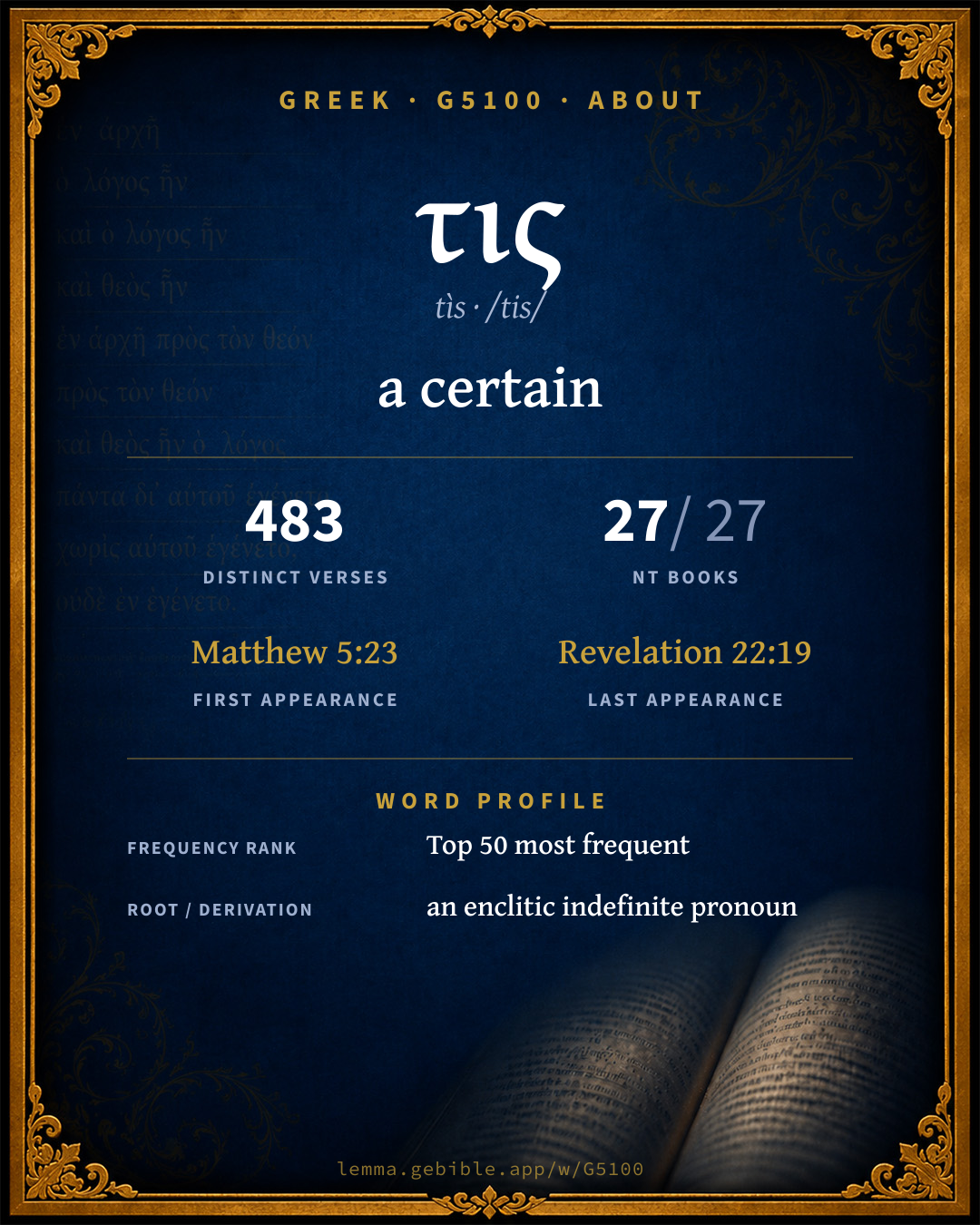
τίς
a certain
‘a certain’ is one of 2 main senses fuller range ↓
Full lexicon entry — Thayer's Greek Lexicon
From Thayer's Greek Lexicon
Where this word appears
See every Nominative-case word in the Greek New Testament →
Grammar key — what these labels mean
Part of speech
- Indefinite pronoun
- Refers to someone or something unspecified (“someone,” “anything”).
Case
- Nominative
- The case of the subject (and the predicate nominative).
- Accusative
- The case of the direct object and of extent.
- Genitive
- The case of source, possession, or “of” — answers “whose / from what.”
- Dative
- The case of the indirect object, means, or location — “to / for / with / in.”
Gender
- Masculine
- Grammatically masculine.
- Neuter
- Grammatically neuter.
- Feminine
- Grammatically feminine.
Number
- Singular
- One.
- Plural
- More than one.
49 verses where G5100 appears in the Nominative case in the Book of Luke. Filtered view — show all forms. Click any verse to open its interlinear word-by-word view. Verse text shown in the World English Bible for context — . Each verse’s Greek form is shown with its reference; the English is not keyword-highlighted, since the data carries no word-level English alignment. Use “Compare translations” on any verse to read it across multiple English versions. This concordance covers the Greek New Testament; Septuagint (Greek Old Testament) occurrences of this word are not indexed here.
Luke
- Luke 1:5 τις indef.pron nom sg masc There was in the days of Herod, the king of Judea, a certain priest named Zacharias, of the priestly division of Abijah. He had a wife of the daughters of Aaron, and her name was Elizabeth.
- Luke 6:2 τινὲς indef.pron nom pl masc But some of the Pharisees said to them, "Why do you do that which is not lawful to do on the Sabbath day?"
- Luke 7:36 τις indef.pron nom sg masc One of the Pharisees invited him to eat with him. He entered into the Pharisee's house, and sat at the table.
- Luke 8:2 τινες indef.pron nom pl fem and certain women who had been healed of evil spirits and infirmities: Mary who was called Magdalene, from whom seven demons had gone out;
- Luke 8:27 τις indef.pron nom sg masc When Jesus stepped ashore, a certain man out of the city who had demons for a long time met him. He wore no clothes, and didn't live in a house, but in the tombs.
- Luke 8:46 τις indef.pron nom sg fem But Jesus said, "Someone did touch me, for I perceived that power has gone out of me."
- Luke 8:49 τις indef.pron nom sg masc While he still spoke, one from the ruler of the synagogue's house came, saying to him, "Your daughter is dead. Don't trouble the Teacher."
- Luke 9:8 τινων τις indef.pron gen pl masc indef.pron nom sg masc and by some that Elijah had appeared, and by others that one of the old prophets had risen again.
- Luke 9:19 τις indef.pron nom sg masc They answered, "'John the Baptizer,' but others say, 'Elijah,' and others, that one of the old prophets is risen again."
- Luke 9:23 τις indef.pron nom sg masc He said to all, "If anyone desires to come after me, let him deny himself, take up his cross, and follow me.
- Luke 9:27 τινες indef.pron nom pl masc But I tell you the truth: There are some of those who stand here, who will in no way taste of death, until they see the Kingdom of God."
- Luke 9:57 τις indef.pron nom sg masc As they went on the way, a certain man said to him, "I want to follow you wherever you go, Lord."
- Luke 10:25 τις indef.pron nom sg masc Behold, a certain lawyer stood up and tested him, saying, "Teacher, what shall I do to inherit eternal life?"
- Luke 10:30 τις indef.pron nom sg masc Jesus answered, "A certain man was going down from Jerusalem to Jericho, and he fell among robbers, who both stripped him and beat him, and departed, leaving him half dead.
- Luke 10:31 τις indef.pron nom sg masc By chance a certain priest was going down that way. When he saw him, he passed by on the other side.
- Luke 10:33 τις indef.pron nom sg masc But a certain Samaritan, as he traveled, came where he was. When he saw him, he was moved with compassion,
- Luke 10:38 τινά τις indef.pron acc sg fem indef.pron nom sg fem It happened as they went on their way, he entered into a certain village, and a certain woman named Martha received him into her house.
- Luke 11:1 τινὶ τις indef.pron dat sg masc indef.pron nom sg masc It happened, that when he finished praying in a certain place, one of his disciples said to him, "Lord, teach us to pray, just as John also taught his disciples."
- Luke 11:15 τινὲς indef.pron nom pl masc But some of them said, "He casts out demons by Beelzebul, the prince of the demons."
- Luke 11:27 τις indef.pron nom sg fem It came to pass, as he said these things, a certain woman out of the multitude lifted up her voice, and said to him, "Blessed is the womb that bore you, and the breasts which nursed you!"
- Luke 11:45 τις indef.pron nom sg masc One of the lawyers answered him, "Teacher, in saying this you insult us also."
- Luke 12:13 τις indef.pron nom sg masc One of the multitude said to him, "Teacher, tell my brother to divide the inheritance with me."
- Luke 13:1 τινες indef.pron nom pl masc Now there were some present at the same time who told him about the Galileans, whose blood Pilate had mixed with their sacrifices.
- Luke 13:6 τις indef.pron nom sg masc He spoke this parable. "A certain man had a fig tree planted in his vineyard, and he came seeking fruit on it, and found none.
- Luke 13:23 τις indef.pron nom sg masc One said to him, "Lord, are they few who are saved?" He said to them,
- Luke 13:31 τινες indef.pron nom pl masc On that same day, some Pharisees came, saying to him, "Get out of here, and go away, for Herod wants to kill you."
- Luke 14:2 τις indef.pron nom sg masc Behold, a certain man who had dropsy was in front of him.
- Luke 14:15 τις indef.pron nom sg masc When one of those who sat at the table with him heard these things, he said to him, "Blessed is he who will feast in the Kingdom of God!"
- Luke 14:16 τις indef.pron nom sg masc But he said to him, "A certain man made a great supper, and he invited many people.
- Luke 14:26 τις indef.pron nom sg masc "If anyone comes to me, and doesn't hate his own father, mother, wife, children, brothers, and sisters, yes, and his own life also, he can't be my disciple.
- Luke 15:11 τις indef.pron nom sg masc He said, "A certain man had two sons.
- Luke 16:1 τις indef.pron nom sg masc He also said to his disciples, "There was a certain rich man who had a manager. An accusation was made to him that this man was wasting his possessions.
- Luke 16:19 τις indef.pron nom sg masc "Now there was a certain rich man, and he was clothed in purple and fine linen, living in luxury every day.
- Luke 16:20 τις indef.pron nom sg masc A certain beggar, named Lazarus, was laid at his gate, full of sores,
- Luke 16:30 τις indef.pron nom sg masc "He said, 'No, father Abraham, but if one goes to them from the dead, they will repent.'
- Luke 16:31 τις indef.pron nom sg masc "He said to him, 'If they don't listen to Moses and the prophets, neither will they be persuaded if one rises from the dead.'"
- Luke 18:2 τις τινι indef.pron nom sg masc indef.pron dat sg fem saying, "There was a judge in a certain city who didn't fear God, and didn't respect man.
- Luke 18:18 τις indef.pron nom sg masc A certain ruler asked him, saying, "Good Teacher, what shall I do to inherit eternal life?"
- Luke 18:35 τις indef.pron nom sg masc It happened, as he came near Jericho, a certain blind man sat by the road, begging.
- Luke 19:12 τις indef.pron nom sg masc He said therefore, "A certain nobleman went into a far country to receive for himself a kingdom, and to return.
- Luke 19:31 τις indef.pron nom sg masc If anyone asks you, 'Why are you untying it?' say to him: 'The Lord needs it.'"
- Luke 19:39 τινες indef.pron nom pl masc Some of the Pharisees from the multitude said to him, "Teacher, rebuke your disciples!"
- Luke 20:27 τινες indef.pron nom pl masc Some of the Sadducees came to him, those who deny that there is a resurrection.
- Luke 20:39 τινες indef.pron nom pl masc Some of the scribes answered, "Teacher, you speak well."
- Luke 22:50 τις indef.pron nom sg masc A certain one of them struck the servant of the high priest, and cut off his right ear.
- Luke 22:56 τις indef.pron nom sg fem A certain servant girl saw him as he sat in the light, and looking intently at him, said, "This man also was with him."
- Luke 22:59 τις indef.pron nom sg masc After about one hour passed, another confidently affirmed, saying, "Truly this man also was with him, for he is a Galilean!"
- Luke 24:22 τινες indef.pron nom pl fem Also, certain women of our company amazed us, having arrived early at the tomb;
- Luke 24:24 τινες indef.pron nom pl masc Some of us went to the tomb, and found it just like the women had said, but they didn't see him."
About this entry
At a glance — auto-summarized from this page’s data, not written by a person. Every figure links to its source below. This summary describes the numbers; it doesn’t interpret them.
τις (tìs) is a Greek word most often rendered “a certain.” Translators differ — “certain” in the King James Version, then “anyone” (unfoldingWord Literal Text), as the renderings breakdown shows. It turns up in 483 verses across 27 books, a common footprint. It first appears in Matthew 5:23. Its lexical range runs to 2 senses. The sections below give every sense, occurrence, and version rendering.
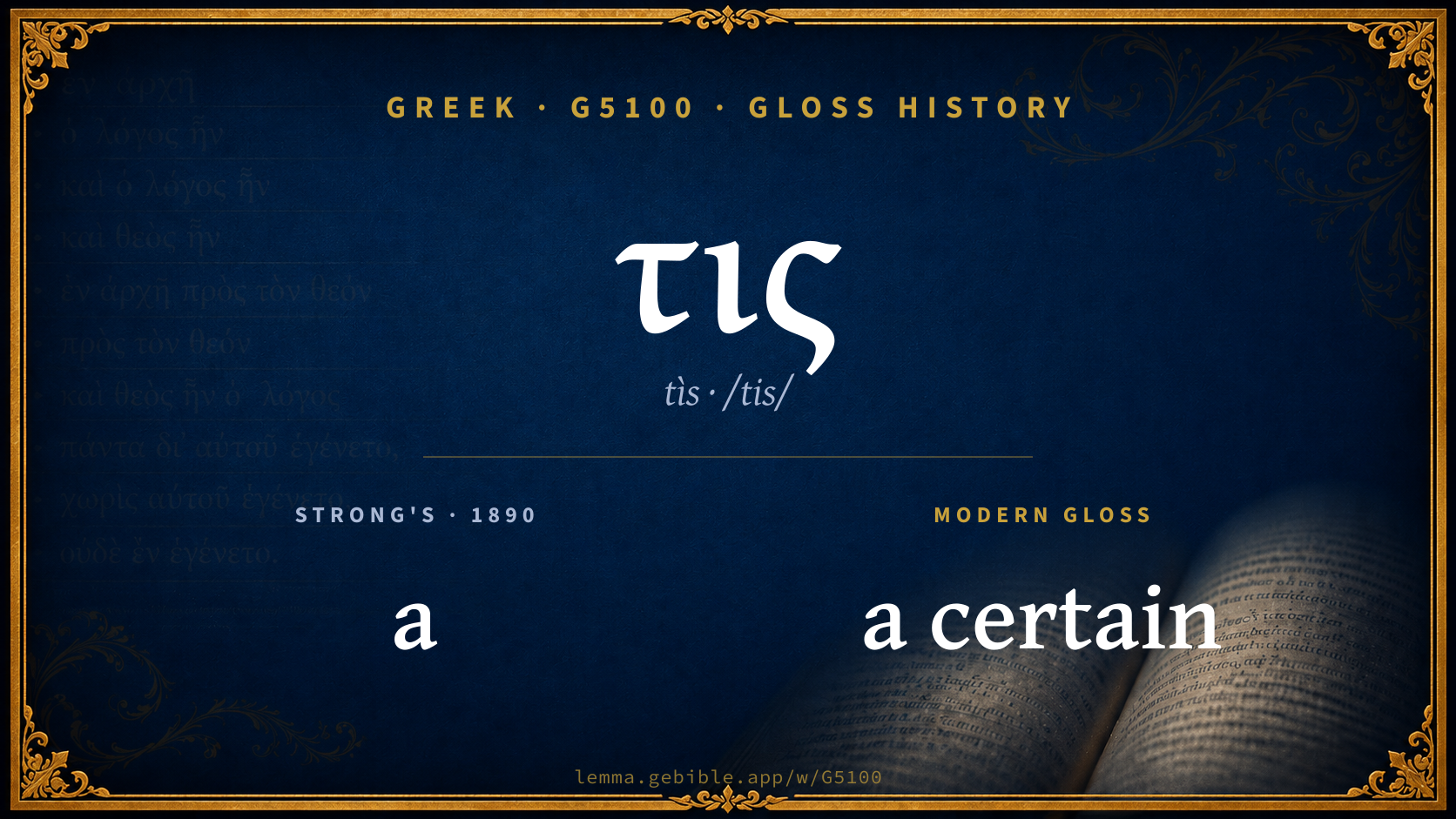
Gloss history
Strong's 1890 vs modern scholarship
About this word
Strong's G5100 catalogs a Greek word from the Greek New Testament.
These counts are not copied from any lexicon or concordance. They are computed here, from the morphology-tagged Greek New Testament. What Lemma adds →
- 483
- distinct verses
- The word appears in 483 distinct verses.
- 27 / 27
- NT books
- The word appears in 27 of 27 New Testament books.
- #38
- by frequency
- Top 50 most frequent Greek words (rank 38 of 5,347 Greek words by occurrence).
View all 483 occurrences in the concordance →
Most concentrated in
- Acts 109 verses 23%
- Luke 75 verses 16%
- 1 Corinthians 53 verses 11%
By section of the New Testament
By traditional corpus
Conventional, traditional groupings — biblical authorship is debated, so this is a traditional corpus grouping, not an authorship claim. Some books belong to more than one corpus (Luke is in both the Gospels and the Lukan corpus, and so on), so these shares overlap and need not total 100%. Each figure is a share of the word’s 483 distinct verses.
- Lukan (Luke–Acts) 184 verses · 38%
- Gospels 177 verses · 37%
- Pauline corpus 138 verses · 29%
- Johannine 68 verses · 14%
- General (Catholic) Epistles 29 verses · 6%
- Hebrews 20 verses · 4%
- Revelation 10 verses · 2%
How translations render this word
Counts come from each version’s own published word-to-Strong’s tagging or interlinear alignment — an approximate guide to how each version renders this word, not a word-level alignment the data otherwise carries. Because each total is that version’s own tagged count, the per-version totals vary from one another and need not match the appearance or distinct-verse counts above. These counts may also differ from a printed concordance because Lemma counts each distinctly tagged rendering and does not collapse phrase taggings into a single head-word total. This is a fixed set of word-tagged versions (KJV, ASV, BSB, ULT) and does not change with the reading translation you choose elsewhere. Each version’s license is shown beside its name below (and on Sources).
- King James Version: Certain 107×, Some 70×, Any man 46×
- American Standard Version: Certain 101×, Some 71×, Any man 60×
- Berean Standard Bible: Some 97×, Anyone 84×, A 67×
- unfoldingWord Literal Text: Anyone 105×, Some 96×, Certain 89×
King James Version Public Domain
Renders G5100 across 423 tagged occurrences — most commonly:
Plus other, less common renderings. Plus 29 renderings that appear only once — usually multi-word phrases or single function words the recovered tagging swept in, not distinct renderings. Not rendered by a distinct English word in 27 further occurrences.
American Standard Version Public Domain
Renders G5100 across 503 tagged occurrences — most commonly:
Plus other, less common renderings. Plus 44 renderings that appear only once — usually multi-word phrases or single function words the recovered tagging swept in, not distinct renderings. Not rendered by a distinct English word in 1 further occurrence.
Berean Standard Bible Public Domain
Renders G5100 across 449 tagged occurrences — most commonly:
Plus other, less common renderings. Plus 31 renderings that appear only once — usually multi-word phrases or single function words the recovered tagging swept in, not distinct renderings. Not rendered by a distinct English word in 64 further occurrences.
unfoldingWord Literal Text CC BY-SA 4.0
Renders G5100 across 549 tagged occurrences — most commonly:
Plus other, less common renderings. Plus 29 renderings that appear only once — usually multi-word phrases or single function words the recovered tagging swept in, not distinct renderings.
Senses in Thayer's
The 2 senses Thayer's distinguishes for this word, in lexicon order (not ranked by frequency or importance). The full entry — with sub-senses — is in the Lexicon Entry tab.
- a certain, a certain one
- some, some time, a while
Word origin
Origin: an enclitic indefinite pronoun
An enclitic indefinite pronoun; some or any person or object : - a (kind of) any (man thing thing at all) certain (thing) divers he (every) man one (X thing) ought + partly some (man -body -thing -what) (+ that no-) thing what (-soever) X wherewith whom [-soever] whose ([-soever]).
— Strong’s Exhaustive Concordance (1890), public domain.
Forms in the corpus
The 23 distinct written forms G5100 takes in the Greek New Testament, most frequent first — each parse links to that case’s occurrences in the concordance.
Same root — word family
Other Thayer's entries built from the same root as G5100, grouped by Strong’s listed origin. These share a root / origin per the lexicon — not necessarily a shared meaning. Each links to that word’s own entry.
Derived from this word
Compare all same-root words → They share a root, not necessarily a meaning.
Septuagint usage
The same Greek word τις appears 1,375 times in the Greek Old Testament (Septuagint), across 1,146 verses in 38 books.
- 1,375
- LXX occurrences
- Tagged occurrences of this Greek word in the Septuagint.
- 1,146
- verses
- Distinct Septuagint verses containing this word.
- 38 / 39
- OT books
- The word appears in 38 of the 39 Old Testament books.
Sample Septuagint occurrences
- Genesis 2:19 τίς
- Exodus 1:18 τίς
- Leviticus 4:2 τις
- Numbers 5:7 τίς
- Deuteronomy 1:31 τις
- Joshua 2:20 τις
- Judges 1:1 τίς
- Ruth 1:11 τίς
- 1 Samuel 1:8 τίς
- 2 Samuel 1:4 τίς
- 1 Kings 1:6 τίς
- 2 Kings 1:5 τίς
Septuagint occurrences (same lexeme)
Every verse where the same Strong’s number (G5100) appears in the Greek Septuagint — showing the first 50 of 1,146. Verse text shown in the World English Bible for context; the Greek form is the matched word — the English is not keyword-highlighted.
- Genesis 2:19 τίς Out of the ground Yahweh God formed every animal of the field, and every bird of the sky, and brought them to the man to see what he would call them. Whatever the man called every living creature, that was its name.
- Genesis 3:1 τίς Now the serpent was more subtle than any animal of the field which Yahweh God had made. He said to the woman, "Yes, has God said, 'You shall not eat of any tree of the garden?'"
- Genesis 3:11 τίς God said, "Who told you that you were naked? Have you eaten from the tree that I commanded you not to eat from?"
- Genesis 3:13 τίς Yahweh God said to the woman, "What is this you have done?" The woman said, "The serpent deceived me, and I ate."
- Genesis 4:6 τίς Yahweh said to Cain, "Why are you angry? Why has the expression of your face fallen?
- Genesis 4:10 τίς Yahweh said, "What have you done? The voice of your brother's blood cries to me from the ground.
- Genesis 6:5 τις Yahweh saw that the wickedness of man was great in the earth, and that every imagination of the thoughts of his heart was only evil continually.
- Genesis 12:18 τίς Pharaoh called Abram, and said, "What is this that you have done to me? Why didn't you tell me that she was your wife?
- Genesis 12:19 τίς Why did you say, 'She is my sister,' so that I took her to be my wife? Now therefore, see your wife, take her, and go your way."
- Genesis 13:16 τις I will make your offspring as the dust of the earth, so that if a man can number the dust of the earth, then your seed may also be numbered.
- Genesis 14:13 τις One who had escaped came and told Abram, the Hebrew. Now he lived by the oaks of Mamre, the Amorite, brother of Eshcol, and brother of Aner; and these were allies of Abram.
- Genesis 15:2 τίς Abram said, "Lord Yahweh, what will you give me, seeing I go childless, and he who will inherit my estate is Eliezer of Damascus?"
- Genesis 15:8 τίς He said, "Lord Yahweh, how will I know that I will inherit it?"
- Genesis 18:13 τίς Yahweh said to Abraham, "Why did Sarah laugh, saying, 'Will I really bear a child, yet I am old?'
- Genesis 18:30 τις He said, "Oh don't let the Lord be angry, and I will speak. What if there are thirty found there?" He said, "I will not do it, if I find thirty there."
- Genesis 18:32 τις He said, "Oh don't let the Lord be angry, and I will speak yet but this once. What if ten are found there?" He said, "I will not destroy it for the ten's sake."
- Genesis 19:12 τίς The men said to Lot, "Do you have anybody else here? Sons-in-law, your sons, your daughters, and whoever you have in the city, bring them out of the place:
- Genesis 20:9 τίςτις Then Abimelech called Abraham, and said to him, "What have you done to us? How have I sinned against you, that you have brought on me and on my kingdom a great sin? You have done deeds to me that ought not to be done!"
- Genesis 20:10 τίς Abimelech said to Abraham, "What did you see, that you have done this thing?"
- Genesis 21:7 τίς She said, "Who would have said to Abraham, that Sarah would nurse children? For I have borne him a son in his old age."
- Genesis 21:17 τίς God heard the voice of the boy. The angel of God called to Hagar out of the sky, and said to her, "What ails you, Hagar? Don't be afraid. For God has heard the voice of the boy where he is.
- Genesis 21:26 τίς Abimelech said, "I don't know who has done this thing. Neither did you tell me, neither did I hear of it, until today."
- Genesis 21:29 τίς Abimelech said to Abraham, "What do these seven ewe lambs which you have set by themselves mean?"
- Genesis 22:7 τίς Isaac spoke to Abraham his father, and said, "My father?" He said, "Here I am, my son." He said, "Here is the fire and the wood, but where is the lamb for a burnt offering?"
- Genesis 23:15 τίς "My lord, listen to me. What is a piece of land worth four hundred shekels of silver between me and you? Therefore bury your dead."
- Genesis 24:23 τίς and said, "Whose daughter are you? Please tell me. Is there room in your father's house for us to lodge in?"
- Genesis 24:31 τίς He said, "Come in, you blessed of Yahweh. Why do you stand outside? For I have prepared the house, and room for the camels."
- Genesis 24:47 τίς I asked her, and said, 'Whose daughter are you?' She said, 'The daughter of Bethuel, Nahor's son, whom Milcah bare to him.' I put the ring on her nose, and the bracelets on her hands.
- Genesis 24:65 τίς She said to the servant, "Who is the man who is walking in the field to meet us?" The servant said, "It is my master." She took her veil, and covered herself.
- Genesis 25:22 τίς The children struggled together within her. She said, "If it be so, why do I live?" She went to inquire of Yahweh.
- Genesis 25:32 τίς Esau said, "Behold, I am about to die. What good is the birthright to me?"
- Genesis 26:9 τίς Abimelech called Isaac, and said, "Behold, surely she is your wife. Why did you say, 'She is my sister?'" Isaac said to him, "Because I said, 'Lest I die because of her.'"
- Genesis 26:10 τίςτις Abimelech said, "What is this you have done to us? One of the people might easily have lain with your wife, and you would have brought guilt on us!"
- Genesis 26:27 τίς Isaac said to them, "Why have you come to me, since you hate me, and have sent me away from you?"
- Genesis 27:18 τίς He came to his father, and said, "My father?" He said, "Here I am. Who are you, my son?"
- Genesis 27:20 τίς Isaac said to his son, "How is it that you have found it so quickly, my son?" He said, "Because Yahweh your God gave me success."
- Genesis 27:32 τίς Isaac his father said to him, "Who are you?" He said, "I am your son, your firstborn, Esau."
- Genesis 27:33 τίς Isaac trembled violently, and said, "Who, then, is he who has taken venison, and brought it me, and I have eaten of all before you came, and have blessed him? Yes, he will be blessed."
- Genesis 27:37 τίς Isaac answered Esau, "Behold, I have made him your lord, and all his brothers have I given to him for servants. With grain and new wine have I sustained him. What then will I do for you, my son?"
- Genesis 27:44 τις Stay with him a few days, until your brother's fury turns away;
- Genesis 27:46 τίς Rebekah said to Isaac, "I am weary of my life because of the daughters of Heth. If Jacob takes a wife of the daughters of Heth, such as these, of the daughters of the land, what good will my life do me?"
- Genesis 29:15 τίς Laban said to Jacob, "Because you are my brother, should you therefore serve me for nothing? Tell me, what will your wages be?"
- Genesis 29:25 τίς It happened in the morning that, behold, it was Leah. He said to Laban, "What is this you have done to me? Didn't I serve with you for Rachel? Why then have you deceived me?"
- Genesis 30:31 τίς He said, "What shall I give you?" Jacob said, "You shall not give me anything. If you will do this thing for me, I will again feed your flock and keep it.
- Genesis 31:11 τίς The angel of God said to me in the dream, 'Jacob,' and I said, 'Here I am.'
- Genesis 31:26 τίς Laban said to Jacob, "What have you done, that you have deceived me, and carried away my daughters like captives of the sword?
- Genesis 31:30 τίς Now, you want to be gone, because you sore longed after your father's house, but why have you stolen my gods?"
- Genesis 31:32 τίς With whoever you find your gods, he shall not live. Before our relatives, discern what is yours with me, and take it." For Jacob didn't know that Rachel had stolen them.
- Genesis 31:36 τίς Jacob was angry, and argued with Laban. Jacob answered Laban, "What is my trespass? What is my sin, that you have hotly pursued after me?
- Genesis 31:37 τίς Now that you have felt around in all my stuff, what have you found of all your household stuff? Set it here before my relatives and your relatives, that they may judge between us two.
These are occurrences of the same Greek lexeme (G5100) in the Septuagint — not a translation of any one Hebrew word. The store carries no word-level Hebrew↔Greek alignment, so no Hebrew original is asserted here. Counts come from the recovered LXX Strong's tagging — high-frequency vocabulary is well covered, while rare or late forms may be untagged — so they reflect tagged occurrences and may slightly undercount.