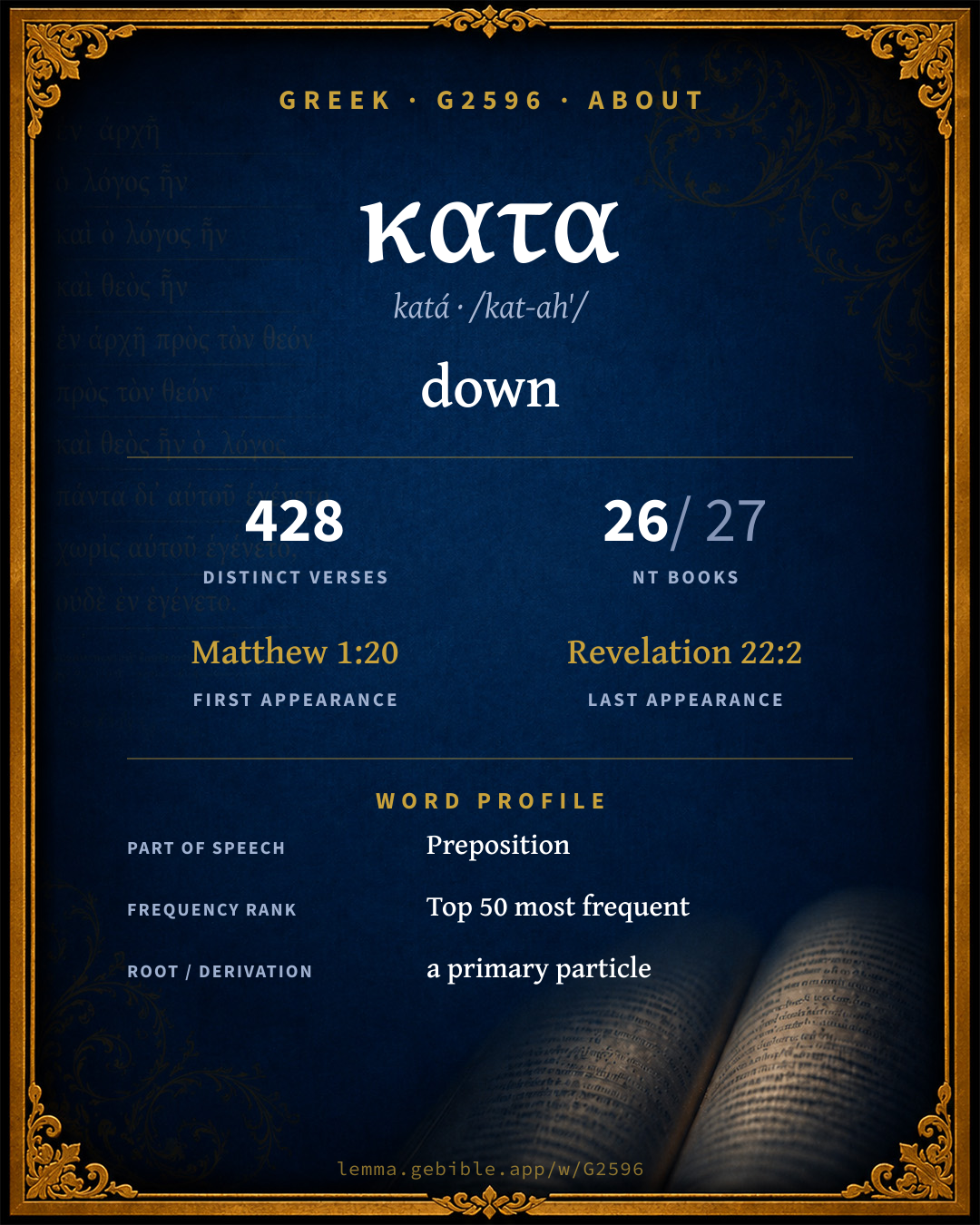
κατά
down
‘down’ is one of 2 main senses fuller range ↓
Full lexicon entry — Thayer's Greek Lexicon
From Thayer's Greek Lexicon
Where this word appears
Grammar key — what these labels mean
Part of speech
- Preposition
- A relational word governing a noun in a particular case.
Every verse where G2596 appears in the Book of 2 Corinthians — 25 distinct verses. Click any verse to open its interlinear word-by-word view. Verse text shown in the World English Bible for context — . Each verse’s Greek form is shown with its reference; the English is not keyword-highlighted, since the data carries no word-level English alignment. Use “Compare translations” on any verse to read it across multiple English versions. This concordance covers the Greek New Testament; Septuagint (Greek Old Testament) occurrences of this word are not indexed here.
2 Corinthians
- 2 Corinthians 1:8 καθ’ prep For we don't desire to have you uninformed, brothers, concerning our affliction which happened to us in Asia, that we were weighed down exceedingly, beyond our power, so much that we despaired even of life.
- 2 Corinthians 1:17 κατὰ prep When I therefore was thus determined, did I show fickleness? Or the things that I purpose, do I purpose according to the flesh, that with me there should be the "Yes, yes" and the "No, no?"
- 2 Corinthians 4:13 κατὰ prep But having the same spirit of faith, according to that which is written, "I believed, and therefore I spoke." We also believe, and therefore also we speak;
- 2 Corinthians 4:17 καθ’ prep For our light affliction, which is for the moment, works for us more and more exceedingly an eternal weight of glory;
- 2 Corinthians 5:16 κατὰ κατὰ prep prep Therefore we know no one after the flesh from now on. Even though we have known Christ after the flesh, yet now we know him so no more.
- 2 Corinthians 7:9 κατὰ prep I now rejoice, not that you were made sorry, but that you were made sorry to repentance. For you were made sorry in a godly way, that you might suffer loss by us in nothing.
- 2 Corinthians 7:10 κατὰ prep For godly sorrow works repentance to salvation, which brings no regret. But the sorrow of the world works death.
- 2 Corinthians 7:11 κατὰ prep For behold, this same thing, that you were made sorry in a godly way, what earnest care it worked in you. Yes, what defense, indignation, fear, longing, zeal, and vengeance! In everything you demonstrated yourselves to be pure in the matter.
- 2 Corinthians 8:2 κατὰ prep how that in much proof of affliction the abundance of their joy and their deep poverty abounded to the riches of their liberality.
- 2 Corinthians 8:3 κατὰ prep For according to their power, I testify, yes and beyond their power, they gave of their own accord,
- 2 Corinthians 8:8 κατ’ prep I speak not by way of commandment, but as proving through the earnestness of others the sincerity also of your love.
- 2 Corinthians 10:1 κατὰ prep Now I Paul, myself, entreat you by the humility and gentleness of Christ; I who in your presence am lowly among you, but being absent am of good courage toward you.
- 2 Corinthians 10:2 κατὰ prep Yes, I beg you that I may not, when present, show courage with the confidence with which I intend to be bold against some, who consider us to be walking according to the flesh.
- 2 Corinthians 10:3 κατὰ prep For though we walk in the flesh, we don't wage war according to the flesh;
- 2 Corinthians 10:5 κατὰ prep throwing down imaginations and every high thing that is exalted against the knowledge of God, and bringing every thought into captivity to the obedience of Christ;
- 2 Corinthians 10:7 κατὰ prep Do you look at things only as they appear in front of your face? If anyone trusts in himself that he is Christ's, let him consider this again with himself, that, even as he is Christ's, so also we are Christ's.
- 2 Corinthians 10:13 κατὰ prep But we will not boast beyond proper limits, but within the boundaries with which God appointed to us, which reach even to you.
- 2 Corinthians 10:15 κατὰ prep not boasting beyond proper limits in other men's labors, but having hope that as your faith grows, we will be abundantly enlarged by you in our sphere of influence,
- 2 Corinthians 11:15 κατὰ prep It is no great thing therefore if his ministers also masquerade as servants of righteousness, whose end will be according to their works.
- 2 Corinthians 11:17 κατὰ prep That which I speak, I don't speak according to the Lord, but as in foolishness, in this confidence of boasting.
- 2 Corinthians 11:18 κατὰ prep Seeing that many boast after the flesh, I will also boast.
- 2 Corinthians 11:21 κατὰ prep I speak by way of disparagement, as though we had been weak. Yet however any is bold (I speak in foolishness), I am bold also.
- 2 Corinthians 11:28 καθ’ prep Besides those things that are outside, there is that which presses on me daily, anxiety for all the assemblies.
- 2 Corinthians 13:8 κατὰ prep For we can do nothing against the truth, but for the truth.
- 2 Corinthians 13:10 κατὰ prep For this cause I write these things while absent, that I may not deal sharply when present, according to the authority which the Lord gave me for building up, and not for tearing down.
About this entry
At a glance — auto-summarized from this page’s data, not written by a person. Every figure links to its source below. This summary describes the numbers; it doesn’t interpret them.
κατα — transliterated katá — is a Greek preposition carrying the sense “down.” The King James Version usually renders it “according,” while modern versions prefer “according to” (Berean Standard Bible) — see the renderings breakdown. With 428 verses in 26 books, it is a common word in the Greek New Testament. Debuting at Matthew 1:20, it then recurs through the corpus. Thayer's distinguishes 2 senses for it. See the sense tree, 428-verse concordance, and the renderings breakdown below.
Gloss history
Strong's 1890 vs modern scholarship

About this word
Strong's G2596 catalogs a Greek word from the Greek New Testament.
These counts are not copied from any lexicon or concordance. They are computed here, from the morphology-tagged Greek New Testament. What Lemma adds →
- 428
- distinct verses
- The word appears in 428 distinct verses.
- 26 / 27
- NT books
- The word appears in 26 of 27 New Testament books.
- #42
- by frequency
- Top 50 most frequent Greek words (rank 42 of 5,347 Greek words by occurrence).
View all 428 occurrences in the concordance →
By section of the New Testament
By traditional corpus
Conventional, traditional groupings — biblical authorship is debated, so this is a traditional corpus grouping, not an authorship claim. Some books belong to more than one corpus (Luke is in both the Gospels and the Lukan corpus, and so on), so these shares overlap and need not total 100%. Each figure is a share of the word’s 428 distinct verses.
- Pauline corpus 170 verses · 40%
- Lukan (Luke–Acts) 127 verses · 30%
- Gospels 106 verses · 25%
- Hebrews 36 verses · 8%
- General (Catholic) Epistles 23 verses · 5%
- Johannine 20 verses · 5%
- Revelation 9 verses · 2%
How translations render this word
Counts come from each version’s own published word-to-Strong’s tagging or interlinear alignment — an approximate guide to how each version renders this word, not a word-level alignment the data otherwise carries. Because each total is that version’s own tagged count, the per-version totals vary from one another and need not match the appearance or distinct-verse counts above. These counts may also differ from a printed concordance because Lemma counts each distinctly tagged rendering and does not collapse phrase taggings into a single head-word total. This is a fixed set of word-tagged versions (KJV, ASV, BSB, ULT) and does not change with the reading translation you choose elsewhere. Each version’s license is shown beside its name below (and on Sources).
- King James Version: According 59×, After 57×, Against 52×
- American Standard Version: According to 92×, Against 52×, After 49×
- Berean Standard Bible: According to 65×, Against 45×, In 41×
- unfoldingWord Literal Text: According to 212×, Against 57×, By 35×
King James Version Public Domain
Renders G2596 across 459 tagged occurrences — most commonly:
Plus other, less common renderings. Plus 59 renderings that appear only once — usually multi-word phrases or single function words the recovered tagging swept in, not distinct renderings. Not rendered by a distinct English word in 23 further occurrences.
American Standard Version Public Domain
Renders G2596 across 430 tagged occurrences — most commonly:
Plus other, less common renderings. Plus 76 renderings that appear only once — usually multi-word phrases or single function words the recovered tagging swept in, not distinct renderings.
Berean Standard Bible Public Domain
Renders G2596 across 382 tagged occurrences — most commonly:
Plus other, less common renderings. Plus 56 renderings that appear only once — usually multi-word phrases or single function words the recovered tagging swept in, not distinct renderings. Not rendered by a distinct English word in 39 further occurrences.
unfoldingWord Literal Text CC BY-SA 4.0
Renders G2596 across 477 tagged occurrences — most commonly:
Plus other, less common renderings. Plus 35 renderings that appear only once — usually multi-word phrases or single function words the recovered tagging swept in, not distinct renderings.
Senses in Thayer's
The 2 senses Thayer's distinguishes for this word, in lexicon order (not ranked by frequency or importance). The full entry — with sub-senses — is in the Lexicon Entry tab.
- down from, through out
- according to, toward, along
Word origin
Origin: a primary particle
A primary particle; (preposition) down (in place or time) in varied relations (according to the case [genitive dative or accusative] with which it is joined)i : - about according as (to) after against (when they were) X alone among and X apart (even like) as (concerning pertaining to touching) X aside at before beyond by to the charge of [charita-] bly concerning + covered [dai-] ly down every (+ far more) exceeding X more excellent for from... to godly in (-asmuch divers every -to respect of)... by after the manner of + by any means beyond (out of) measure X mightily more X natural of (up-) on (X part) out (of every) over against (+ your) X own + particularly so through (-oughout -oughout every) thus (un-) to (-gether -ward) X uttermost where (-by) with. In composition it retains many of these applications and frequently denotes opposition distribution or intensity .
— Strong’s Exhaustive Concordance (1890), public domain.
Forms in the corpus
The 6 distinct written forms G2596 takes in the Greek New Testament, most frequent first — each parse links to that case’s occurrences in the concordance.
| Form | Parsing | Example | Uses |
|---|---|---|---|
| κατὰ katà | Preposition | Matthew 2:16 | 320 |
| κατ’ kat | Preposition | Matthew 1:20 | 83 |
| καθ’ kath | Preposition | Matthew 5:11 | 61 |
| Κατὰ Katà | Preposition | Matthew 9:29 | 5 |
| Κατ’ Kat | Preposition | Acts 12:1 | 1 |
| κατά katá | Preposition | Mark 11:25 | 1 |
Same root — word family
Other Thayer's entries built from the same root as G2596, grouped by Strong’s listed origin. These share a root / origin per the lexicon — not necessarily a shared meaning. Each links to that word’s own entry.
Derived from this word
- καθα kathá G2505 according as
- καθαιρεω kathairéō G2507 to tear down
- καθαπτω katháptō G2510 to fasten down
- καθεδρα kathédra G2515 seat
- καθεζομαι kathézomai G2516 to sit down
- καθεξης kathexēs G2517 in order
- καθευδω katheúdō G2518 to fall asleep
- καθηγητης kathēgētḗs G2519 guide
- καθηκω kathḗkō G2520 to come down
- καθημαι káthēmai G2521 to sit down
- καθημερινος kathēmerinós G2522 daily
- καθιημι kathíēmi G2524 to send down
- καθιστημι kathístēmi G2525 to place
- καθο kathó G2526 according to what
- καθολου kathólou G2527 wholly
- καθοπλιζω kathoplízō G2528 to arm
- καθοραω kathoráō G2529 to see clearly
- καθοτι kathóti G2530 according to what
- καθως kathṓs G2531 according as
- καμμυω kammýō G2576 to close eyes
- καταβαινω katabaínō G2597 to descend
- καταβαλλω katabállō G2598 to cast down
- καταβαρεω katabaréō G2599 to weigh down
- καταβιβαζω katabibázō G2601 to bring down
+104 more words derive from G2596 (not shown).
Compare all same-root words → Showing 4 of 129 — not the complete family. They share a root, not necessarily a meaning.
Septuagint usage
The same Greek word κατα appears 1,606 times in the Greek Old Testament (Septuagint), across 1,281 verses in 34 books.
- 1,606
- LXX occurrences
- Tagged occurrences of this Greek word in the Septuagint.
- 1,281
- verses
- Distinct Septuagint verses containing this word.
- 34 / 39
- OT books
- The word appears in 34 of the 39 Old Testament books.
Sample Septuagint occurrences
- Genesis 1:11 κατά
- Exodus 1:14 κατά
- Leviticus 1:6 κατά
- Numbers 1:2 κατά
- Deuteronomy 1:3 κατά
- Joshua 1:11 κατά
- Judges 1:15 κατά
- Ruth 3:6 κατά
- 1 Samuel 1:6 κατά
- 2 Samuel 1:16 κατά
- 1 Kings 1:23 κατά
- 2 Kings 1:17 κατά
Septuagint occurrences (same lexeme)
Every verse where the same Strong’s number (G2596) appears in the Greek Septuagint — showing the first 50 of 1,281. Verse text shown in the World English Bible for context; the Greek form is the matched word — the English is not keyword-highlighted.
- Genesis 1:11 κατά God said, "Let the earth put forth grass, herbs yielding seed, and fruit trees bearing fruit after their kind, with its seed in it, on the earth," and it was so.
- Genesis 1:12 κατά The earth brought forth grass, herbs yielding seed after their kind, and trees bearing fruit, with its seed in it, after their kind: and God saw that it was good.
- Genesis 1:20 κατά God said, "Let the waters swarm with swarms of living creatures, and let birds fly above the earth in the open expanse of sky."
- Genesis 1:21 κατά God created the large sea creatures, and every living creature that moves, with which the waters swarmed, after their kind, and every winged bird after its kind. God saw that it was good.
- Genesis 1:24 κατά God said, "Let the earth bring forth living creatures after their kind, cattle, creeping things, and animals of the earth after their kind," and it was so.
- Genesis 1:25 κατά God made the animals of the earth after their kind, and the cattle after their kind, and everything that creeps on the ground after its kind. God saw that it was good.
- Genesis 1:26 κατά God said, "Let us make man in our image, after our likeness: and let them have dominion over the fish of the sea, and over the birds of the sky, and over the cattle, and over all the earth, and over every creeping thing that creeps on the earth."
- Genesis 1:27 κατά God created man in his own image. In God's image he created him; male and female he created them.
- Genesis 2:8 κατά Yahweh God planted a garden eastward, in Eden, and there he put the man whom he had formed.
- Genesis 2:18 κατά Yahweh God said, "It is not good that the man should be alone; I will make him a helper suitable for him."
- Genesis 5:1 κατά This is the book of the generations of Adam. In the day that God created man, he made him in God's likeness.
- Genesis 5:3 κατά Adam lived one hundred thirty years, and became the father of a son in his own likeness, after his image, and named him Seth.
- Genesis 6:20 κατά Of the birds after their kind, of the cattle after their kind, of every creeping thing of the ground after its kind, two of every sort shall come to you, to keep them alive.
- Genesis 7:14 κατά they, and every animal after its kind, all the cattle after their kind, every creeping thing that creeps on the earth after its kind, and every bird after its kind, every bird of every sort.
- Genesis 8:19 κατά Every animal, every creeping thing, and every bird, whatever moves on the earth, after their families, went forth out of the ark.
- Genesis 10:5 κατά Of these were the isles of the nations divided in their lands, everyone after his language, after their families, in their nations.
- Genesis 10:20 κατά These are the sons of Ham, after their families, after their languages, in their lands, in their nations.
- Genesis 10:31 κατά These are the sons of Shem, after their families, after their languages, in their lands, after their nations.
- Genesis 10:32 κατά These are the families of the sons of Noah, after their generations, in their nations. Of these were the nations divided in the earth after the flood.
- Genesis 12:8 κατά He left from there to the mountain on the east of Bethel, and pitched his tent, having Bethel on the west, and Ai on the east. There he built an altar to Yahweh, and called on the name of Yahweh.
- Genesis 15:8 κατά He said, "Lord Yahweh, how will I know that I will inherit it?"
- Genesis 16:12 κατά He will be like a wild donkey among men. His hand will be against every man, and every man's hand against him. He will live opposite all of his brothers."
- Genesis 18:10 κατά He said, "I will certainly return to you when the season comes round. Behold, Sarah your wife will have a son." Sarah heard in the tent door, which was behind him.
- Genesis 18:21 κατά I will go down now, and see whether they have done altogether according to the cry of it, which is come to me. If not, I will know."
- Genesis 20:6 κατά God said to him in the dream, "Yes, I know that in the integrity of your heart you have done this, and I also withheld you from sinning against me. Therefore I didn't allow you to touch her.
- Genesis 21:14 κατά Abraham rose up early in the morning, and took bread and a bottle of water, and gave it to Hagar, putting it on her shoulder, and gave her the child, and sent her away. She departed, and wandered in the wilderness of Beersheba.
- Genesis 21:23 κατά Now therefore swear to me here by God that you will not deal falsely with me, nor with my son, nor with my son's son. But according to the kindness that I have done to you, you shall do to me, and to the land in which you have lived as a foreigner."
- Genesis 22:16 κατά and said, "I have sworn by myself, says Yahweh, because you have done this thing, and have not withheld your son, your only son,
- Genesis 23:17 κατά So the field of Ephron, which was in Machpelah, which was before Mamre, the field, the cave which was therein, and all the trees that were in the field, that were in all the border of it round about, were made sure
- Genesis 24:1 κατά Abraham was old, and well stricken in age. Yahweh had blessed Abraham in all things.
- Genesis 24:28 κατά The young lady ran, and told her mother's house about these words.
- Genesis 24:62 κατά Isaac came from the way of Beer Lahai Roi. For he lived in the land of the South.
- Genesis 25:13 κατά These are the names of the sons of Ishmael, by their names, according to the order of their birth: the firstborn of Ishmael, Nebaioth, then Kedar, Adbeel, Mibsam,
- Genesis 25:16 κατά These are the sons of Ishmael, and these are their names, by their villages, and by their encampments: twelve princes, according to their nations.
- Genesis 25:18 κατά They lived from Havilah to Shur that is before Egypt, as you go toward Assyria. He lived opposite all his relatives.
- Genesis 26:18 κατά Isaac dug again the wells of water, which they had dug in the days of Abraham his father. For the Philistines had stopped them after the death of Abraham. He called their names after the names by which his father had called them.
- Genesis 29:12 κατά Jacob told Rachel that he was her father's brother, and that he was Rebekah's son. She ran and told her father.
- Genesis 30:34 κατά Laban said, "Behold, I desire it to be according to your word."
- Genesis 30:40 κατά Jacob separated the lambs, and set the faces of the flocks toward the streaked and all the black in the flock of Laban: and he put his own droves apart, and didn't put them into Laban's flock.
- Genesis 30:41 κατά It happened, whenever the stronger of the flock conceived, that Jacob laid the rods before the eyes of the flock in the gutters, that they might conceive among the rods;
- Genesis 31:11 κατά The angel of God said to me in the dream, 'Jacob,' and I said, 'Here I am.'
- Genesis 31:24 κατά God came to Laban, the Syrian, in a dream of the night, and said to him, "Take heed to yourself that you don't speak to Jacob either good or bad."
- Genesis 31:35 κατά She said to her father, "Don't let my lord be angry that I can't rise up before you; for the manner of women is on me." He searched, but didn't find the teraphim.
- Genesis 31:53 κατά The God of Abraham, and the God of Nahor, the God of their father, judge between us." Then Jacob swore by the fear of his father, Isaac.
- Genesis 32:17 κατά He commanded the foremost, saying, "When Esau, my brother, meets you, and asks you, saying, 'Whose are you? Where are you going? Whose are these before you?'
- Genesis 32:20 κατά You shall say, 'Not only that, but behold, your servant, Jacob, is behind us.'" For, he said, "I will appease him with the present that goes before me, and afterward I will see his face. Perhaps he will accept me."
- Genesis 32:22 κατά He rose up that night, and took his two wives, and his two handmaids, and his eleven sons, and passed over the ford of the Jabbok.
- Genesis 33:14 κατά Please let my lord pass over before his servant: and I will lead on gently, according to the pace of the cattle that are before me and according to the pace of the children, until I come to my lord to Seir."
- Genesis 33:18 κατά Jacob came in peace to the city of Shechem, which is in the land of Canaan, when he came from Paddan Aram; and encamped before the city.
- Genesis 34:3 κατά His soul joined to Dinah, the daughter of Jacob, and he loved the young lady, and spoke kindly to the young lady.
These are occurrences of the same Greek lexeme (G2596) in the Septuagint — not a translation of any one Hebrew word. The store carries no word-level Hebrew↔Greek alignment, so no Hebrew original is asserted here. Counts come from the recovered LXX Strong's tagging — high-frequency vocabulary is well covered, while rare or late forms may be untagged — so they reflect tagged occurrences and may slightly undercount.