
2 Corinthians 4:17

Greek (Tischendorf 8th ed.) 2 Corinthians 4:17 appears in the Greek New Testament. The text above is from the Tischendorf 8th edition. Each word links to its Strong’s number and a concise gloss. Click any word for its full Thayer’s Greek Lexicon entry.
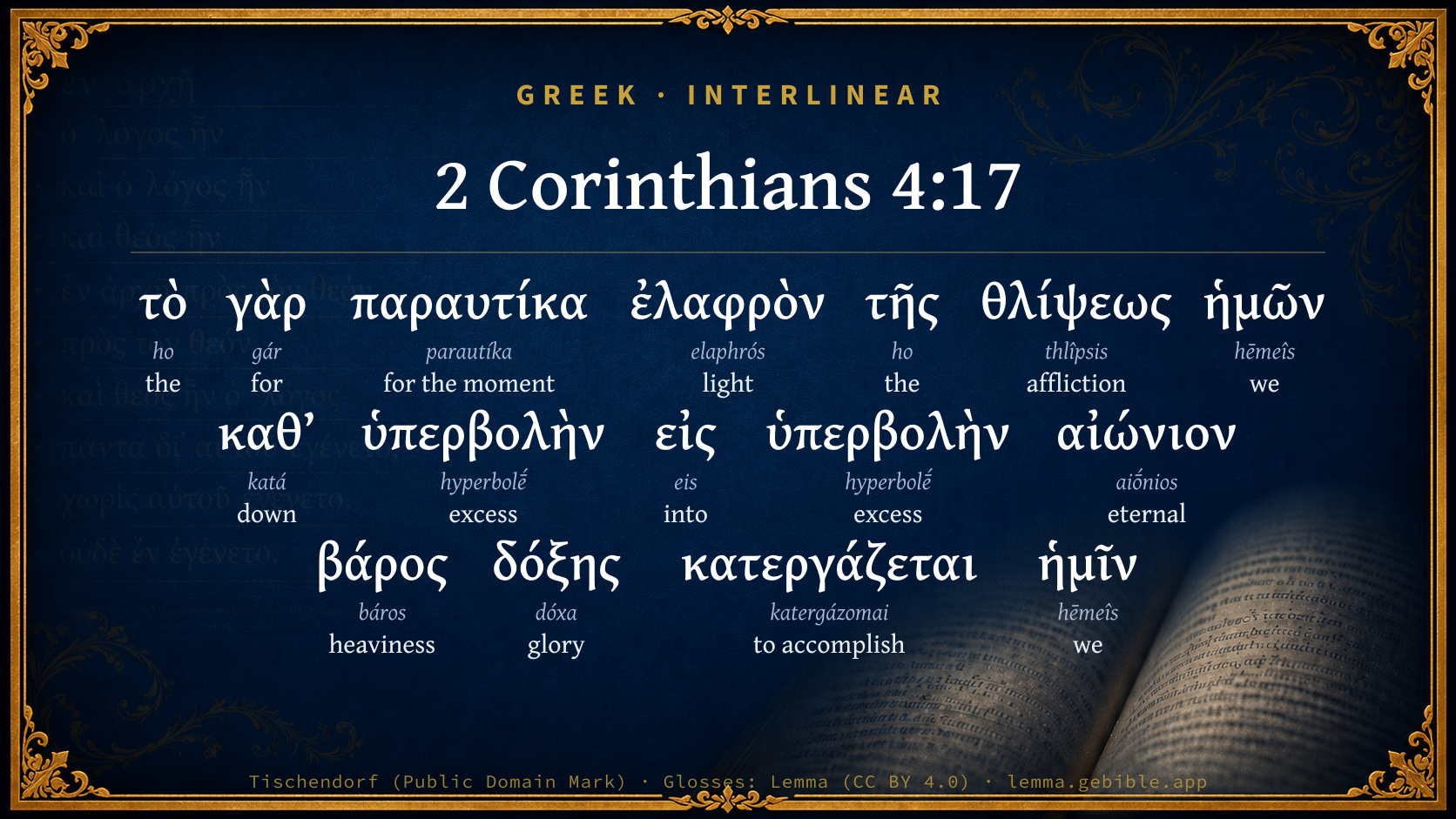
Download image
Cite this verse

2 Corinthians 4:17 (World English Bible). Public Domain. Lemma interlinear Bible study tool, https://lemma.gebible.app/v/2-corinthians/4/17.

Show BibTeX & RIS
BibTeX
RIS
English Translation
For our light affliction, which is for the moment, works for us more and more exceedingly an eternal weight of glory;
World English Bible · Public Domain
Highlights
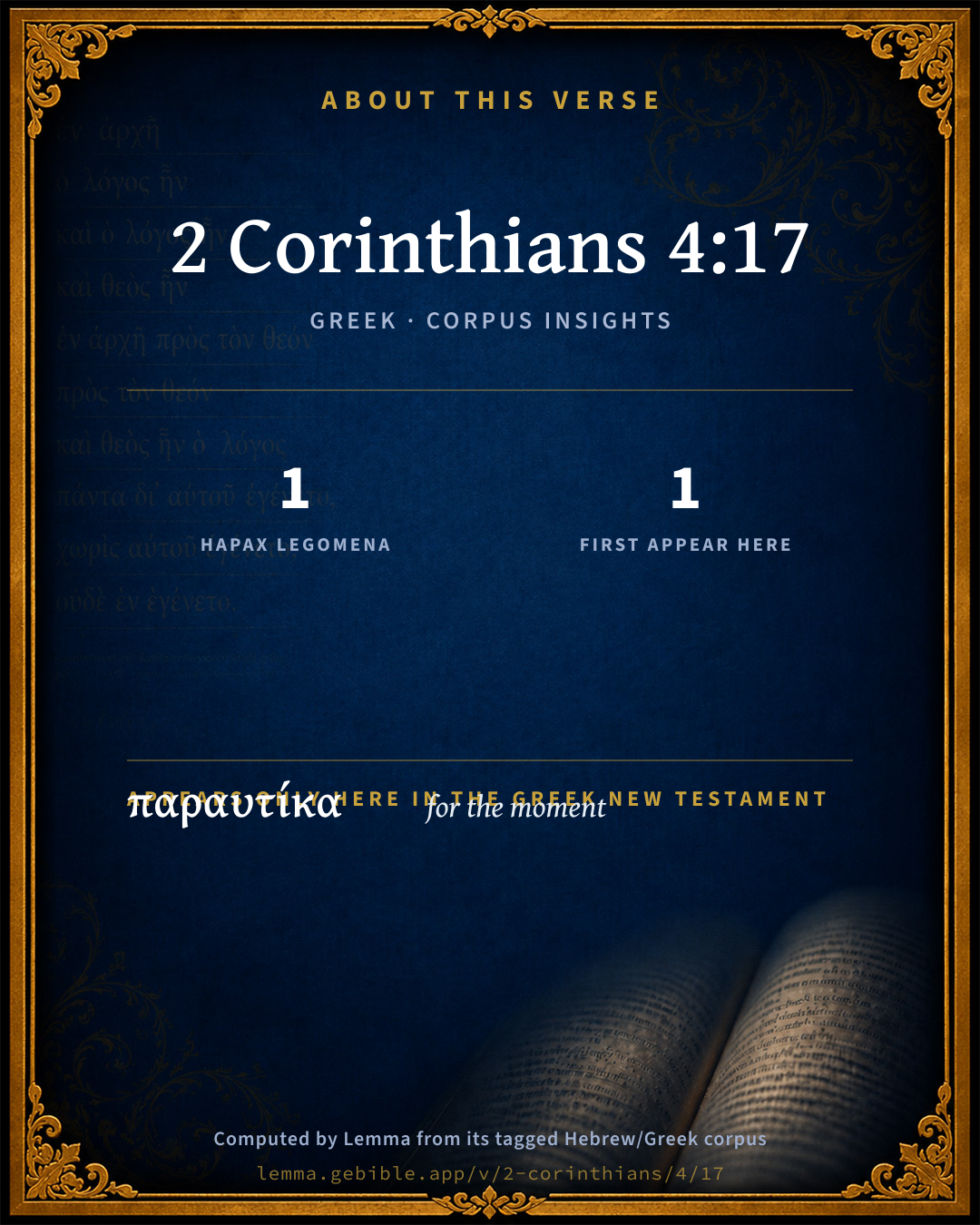
  • 1 hapax legomenon — only here in the Greek New Testament
  • 1 first appearance in the Greek New Testament
Full analysis ↓
Download a study sheet

One document with this verse’s original text, its word-by-word gloss line, the meaning frame, cross-references with their text, attributed commentary, and full source and license credits — printable, and it pastes into notes with its structure intact.

This verse Autodidact and up

Study sheet (.html) Plain text (.txt)

A passage Seminary Student

Up to 50 verses in one chapter. A passage sheet keeps up to 6 commentary sources and 12 cross-references per verse, in the order this page ranks them, and says so on the sheet whenever that leaves anything out. Ask for a single verse and you get the Autodidact verse sheet above.

Everything on this page stays free to read, with no account — the sheet is a download of what is already on screen, not access to it.

Want to remove ads? Support Godless Engineer
Compare translations 3

The same verse in 3 English versions, stacked beneath the original-language interlinear above. Click any original word for its lexicon entry.

Each is an independent rendering of the whole verse — the interlinear is not word-aligned to these translations.

Highlighted words mark where these versions differ — a whole-verse word diff, not a word-by-word alignment.

  • World English Bible Public Domain
    For our light affliction, which is for the moment, works for us more and more exceedingly an eternal weight of glory;
  • King James Version Public Domain
    For our light affliction, which is but for a moment, worketh for us a far more exceeding and eternal weight of glory;
  • unfoldingWord Literal Text CC BY-SA 4.0
    For our momentary, light affliction is producing in us an eternal weight of glory far beyond all comparison.

unfoldingWord Literal Text — © unfoldingWord, licensed CC BY-SA 4.0. Word-aligned USFM3 via Door43 (git.door43.org/unfoldingWord/en_ult).

Versions to compare (up to 4)

3 of 4 selected

Show all 19 translations

Every available English version of this verse, each an independent rendering of the whole verse.

  • World English Bible Public Domain
    For our light affliction, which is for the moment, works for us more and more exceedingly an eternal weight of glory;
  • Berean Standard Bible Public Domain
    For our light and momentary affliction is producing for us an eternal weight of glory that is far beyond comparison.
  • Majority Standard Bible Public Domain
    For our light and momentary affliction is producing for us an eternal weight of glory that is far beyond comparison.
  • King James Version Public Domain
    For our light affliction, which is but for a moment, worketh for us a far more exceeding and eternal weight of glory;
  • American Standard Version (1901) Public Domain
    For our light affliction, which is for the moment, worketh for us more and more exceedingly an eternal weight of glory;
  • Revised Version (1885) Public Domain
    For our light affliction, which is for the moment, worketh for us more and more exceedingly an eternal weight of glory;
  • Geneva Bible (1599) Public Domain
    For our light affliction which is but for a moment, causeth vnto vs a farre most excellent and an eternall waight of glorie:
  • Douay-Rheims (1899) Public Domain
    For that which is at present momentary and light of our tribulation, worketh for us above measure exceedingly an eternal weight of glory.
  • Young's Literal Translation Public Domain
    for the momentary light matter of our tribulation, more and more exceedingly an age-during weight of glory doth work out for us --
  • Literal Standard Version CC BY-SA 4.0
    for the momentary light matter of our tribulation works out for us more and more an exceedingly continuous weight of glory—
  • Unlocked Literal Bible CC BY-SA 4.0
    For this momentary, light affliction is preparing us for an eternal weight of glory that exceeds all measurement.
  • unfoldingWord Literal Text CC BY-SA 4.0
    For our momentary, light affliction is producing in us an eternal weight of glory far beyond all comparison.
  • Darby Bible Public Domain
    For our momentary [and] light affliction works for us in surpassing measure an eternal weight of glory;
  • World Messianic Bible Public Domain
    For our light affliction, which is for the moment, works for us more and more exceedingly an eternal weight of glory,
  • Webster's Bible Public Domain
    For our light affliction, which is but for a moment, worketh out for us a far more exceeding and eternal weight of glory;
  • Free Bible Version CC BY-SA 4.0
    These trivial troubles we have only last for a little while, but they produce for us an ever-increasing degree of glory.
  • Bible in Basic English Public Domain
    For our present trouble, which is only for a short time, is working out for us a much greater weight of glory;
  • Text-Critical English NT CC BY 4.0
    For our light and momentary affliction is bringing about for us an eternal weight of glory far beyond all measure,
  • Tyndale New Testament (1534) Public Domain
    For oure excedinge tribulacion which is momentany and light prepareth an excedinge and an eternall wayght of glorye vnto vs

Literal Standard Version (2020), Covenant Press — licensed CC BY-SA 4.0. Text via the HelloAO Bible API (eBible.org). Unlocked Literal Bible (unfoldingWord) — licensed CC BY-SA 4.0. Text via the HelloAO Bible API (eBible.org). unfoldingWord Literal Text — © unfoldingWord, licensed CC BY-SA 4.0. Word-aligned USFM3 via Door43 (git.door43.org/unfoldingWord/en_ult). Free Bible Version, Dr. Jonathan Gallagher — licensed CC BY-SA 4.0. Text via the HelloAO Bible API (eBible.org).

Word by word

More ways to search: Search by grammar → Find every occurrence → Compare this word →

Practice this passage: Drill this verse → Learn its vocabulary →

παραυτίκα
parautíka
G3910
“for the moment”
Adverb
Part of Speech
Adverb
Full Thayer's Definition

Origin: from G3844 and a derivative of G846

TDNT: None

1. for the moment
  1. τὸ ho G3588 “the” Article, Nominative, Singular, Neuter
  2. γὰρ gár G1063 “for” Conjunction
  3. ἐλαφρὸν elaphrós G1645 “light” Adjective, Nominative, Singular, Neuter
  4. τῆς ho G3588 “the” Article, Genitive, Singular, Feminine
  5. θλίψεως thlîpsis G2347 “affliction” Noun, Genitive, Singular, Feminine
  6. ἡμῶν hēmeîs G2249 “we” Personal pronoun, 1st person, Genitive, Plural
  7. καθ’ katá G2596 “down” Preposition
  8. ὑπερβολὴν hyperbolḗ G5236 “excess” Noun, Accusative, Singular, Feminine
  9. εἰς eis G1519 “into” Preposition
  10. ὑπερβολὴν hyperbolḗ G5236 “excess” Noun, Accusative, Singular, Feminine
  11. αἰώνιον aiṓnios G166 “eternal” Adjective, Accusative, Singular, Neuter
  12. βάρος báros G922 “heaviness” Noun, Accusative, Singular, Neuter
  13. δόξης dóxa G1391 “glory” Noun, Genitive, Singular, Feminine
  14. κατεργάζεται katergázomai G2716 “to accomplish” Verb, Present, Middle or Passive deponent, Indicative, 3rd person, Singular
  15. ἡμῖν hēmeîs G2249 “we” Personal pronoun, 1st person, Dative, Plural

About this verse

These counts appear in no published source. They are computed here, from the morphology-tagged text and Lemma’s own curated glosses. What Lemma adds →

16
words
13
distinct lemmas
Pauline Epistles
section

Notable vocabulary

1 hapax legomenon — a word that appears only here in the entire Greek New Testament:

  • παραυτίκα for the moment G3910

First appearance in Scripture

This word makes its first canonical appearance in the Greek New Testament here:

  • παραυτίκα for the moment G3910

Shared distinctive vocabulary

ἐλαφρὸν light G1645 occurs in 2 verses of the Greek New Testament. Also found in:
Repetition

Words recur within this verse:

  • ὑπερβολὴν excess G5236 ×2
  • τὸ the G3588 ×2
  • ἡμῶν we G2249 ×2

Cross-references

30

Topical passages linked to 2 Corinthians 4:17 in the Treasury of Scripture Knowledge — connected by theme and wording, ordered by reader-vote popularity; previews shown in the World English Bible.

  • Romans 8:18 For I consider that the sufferings of this present time are not worthy to be compared with the glory which will be revealed toward us.
  • 1 Peter 5:10 But may the God of all grace, who called you to his eternal glory by Christ Jesus, after you have suffered a little while, perfect, establish, strengthen, and settle you.
  • Romans 5:3–5 Not only this, but we also rejoice in our sufferings, knowing that suffering works perseverance;
  • James 1:12 Blessed is the man who endures temptation, for when he has been approved, he will receive the crown of life, which the Lord promised to those who love him.
  • Hebrews 12:10–11 For they indeed, for a few days, punished us as seemed good to them; but he for our profit, that we may be partakers of his holiness.
  • James 1:3–4 knowing that the testing of your faith produces endurance.
  • 2 Corinthians 3:18 But we all, with unveiled face beholding as in a mirror the glory of the Lord, are transformed into the same image from glory to glory, even as from the Lord, the Spirit.
  • 1 Peter 1:6–8 Wherein you greatly rejoice, though now for a little while, if need be, you have been put to grief in various trials,
  • Romans 8:37 No, in all these things, we are more than conquerors through him who loved us.
  • 2 Corinthians 11:23–28 Are they servants of Christ? (I speak as one beside himself) I am more so; in labors more abundantly, in prisons more abundantly, in stripes above measure, in deaths often.
  • 1 Peter 4:7 But the end of all things is near. Therefore be of sound mind, self-controlled, and sober in prayer.
  • 1 Corinthians 2:9 But as it is written, "Things which an eye didn't see, and an ear didn't hear, Which didn't enter into the heart of man, These God has prepared for those who love him."
  • Psalms 73:24 You will guide me with your counsel, And afterward receive me to glory.
  • Romans 2:7 to those who by patience in well-doing seek for glory and honor and incorruptibility, eternal life;
  • Romans 8:34 Who is he who condemns? It is Christ who died, yes rather, who was raised from the dead, who is at the right hand of God, who also makes intercession for us.
  • Philippians 1:19 For I know that this will turn out to my salvation, through your supplication and the supply of the Spirit of Jesus Christ,
  • Psalms 30:5 For his anger is but for a moment; His favor is for a lifetime. Weeping may stay for the night, But joy comes in the morning.
  • Psalms 119:67 Before I was afflicted, I went astray; But now I observe your word.
  • Psalms 119:71 It is good for me that I have been afflicted, That I may learn your statutes.
  • Isaiah 54:8 In overflowing wrath I hid my face from you for a moment; but with everlasting loving kindness will I have mercy on you, says Yahweh your Redeemer.
  • Genesis 15:1 After these things the word of Yahweh came to Abram in a vision, saying, "Don't be afraid, Abram. I am your shield, your exceedingly great reward."
  • Psalms 31:19 Oh how great is your goodness, Which you have laid up for those who fear you, Which you have worked for those who take refuge in you, Before the sons of men!
  • Isaiah 64:4 For from of old men have not heard, nor perceived by the ear, neither has the eye seen a God besides you, who works for him who waits for him.
  • Matthew 5:12 Rejoice, and be exceedingly glad, for great is your reward in heaven. For that is how they persecuted the prophets who were before you.
  • Acts 20:23 except that the Holy Spirit testifies in every city, saying that bonds and afflictions wait for me.
  • Jude 1:24 Now to him who is able to keep them from stumbling, and to present you faultless before the presence of his glory in great joy,
  • 2 Thessalonians 1:4 so that we ourselves boast about you in the assemblies of God for your patience and faith in all your persecutions and in the afflictions which you endure.
  • 2 Thessalonians 1:6 Since it is a righteous thing with God to repay affliction to those who afflict you,
  • 1 John 3:2 Beloved, now we are children of God, and it is not yet revealed what we will be. But we know that, when he is revealed, we will be like him; for we will see him just as he is.
  • Luke 6:23 Rejoice in that day, and leap for joy, for behold, your reward is great in heaven, for their fathers did the same thing to the prophets.

Cross-references courtesy of OpenBible.info (CC BY 4.0).

Commentary

Notes on 2 Corinthians 4:17 from classic Christian and Jewish commentators (each source and its license shown beneath its notes). The classic Christian expositions comment on the surrounding passage and are grouped to its opening verse, so a note may address several verses; the Jewish commentaries on the Tanakh (Rashi and others) are per-verse, so they appear only where the commentator wrote on this verse.

Lemma curates 59 commentaries, every one of them public domain or Creative Commons licensed, each selected and text-cleaned for this edition rather than reprinted as found. About our sources →

The Biblical Illustrator

Joseph S. Exell

2Co_4:17-18

For our light affliction.

., worketh for us a … weight of glory.

Light affliction and eternal glory

I. A few preliminary observations upon affliction.

1. There are afflictions which are common to humanity. Disease and death (Gen_3:17-19).

2. There are afflictions which are of a self-procured character. We can no more sin with impunity against physical laws than we can against moral laws.

3. There are afflictions which are of Divine appointment.

4. Afflictions are not meritorious. They cannot make atonement for sin, nor regenerate our nature.

5. Afflictions in themselves, abstractly considered, are heavy, but light when compared with those of others.

II. Let us ponder our afflictions. They are light--

1. When compared with the demerit of our sins.

2. When compared with those of our forefathers. The saints have had to suffer hunger, thirst, nakedness, fire, faggot, sword, imprisonment, and death (Heb_11:1-40.).

3. When compared with those of Christ.

4. When compared with the weight of glory referred to in the text.

5. Being but for a moment when compared with the eternity of glory.

6. When compared with the exceeding greatness and infinite excellence of the glory.

III. Consider the beneficial and gracious tendency of our afflictions. All trials, whether personal, relative, or national, may be regarded in the light of a gracious discipline. The tendency of affliction in the saint is--

1. The development and maturity of moral purity. There is much about him which needs correction and refinement. Afflictions operate as fire upon metal (Heb_12:5; Heb_12:11; Jam_1:2-4; Jam_1:12).

2. The development and exhibition of principle and character. It is possible for a man not to know his own real character and strength of principle, till cast upon his own resources. What a living embodiment of magnanimity, self-denial, goodness, and moral sublimity in the lives and deaths of many of the people of God!

3. To test the truthfulness of our Christianity and exhibit its character before the world.

4. The exercise and perfection of our faith. Faith is a principle which is strengthened by exercise. In trials faith finds ample scope for action (Heb_11:1-40.).

IV. The future glory of the saint is--

I. Substantial. The word weight gives us the idea of ponderousness. The Greek word doxa and the Hebrew word kabhodh mean an opinion, doctrine; and then praise, dignity, splendour, and perfection. The words are applied to the visible manifestations of the Divine Being. Heaven is spoken of as a most glorious locality. It is compared to a house eternal in the heavens, a mansion, an inheritance incorruptible, a great city, and a prepared kingdom. There will be perfect correspondence betwixt the resurrection body of the saint and heaven as an abode (1Co_15:39-58; Php_3:20-21; 1Jn_3:2). Glory embraces also the perfection of the soul. We shall be perfect in body and in mind. Enjoyments and employments will be all complete.

2. Ever-enduring. The perpetuity of bliss is bliss.

3. Ever-increasing. Progress is as essential to mans nature as gravitation to the universe, and light and heat to the sun. (C. Briggs.)

The work of affliction

1. The text contains, a repetition of ὑπερβολη, which is generally used when a person in any excited manner oversteps the truth. What the apostle means, therefore, is that no proportion whatever can be instituted between present affliction and future glory.

2. Now, there is much in Gods dealings with our race which seems hopelessly intricate, and we satisfy ourselves by referring to the disclosures of another world when, evolving order from confusion, God shall vindicate His proceedings on the broad stage of the judgment. But while in the main this course may be correct, we must take heed that we do not refuse to be wise up to what is revealed. It would be a great clue for us, in the labyrinth of Providence, if we were to regard all that takes place in the body as preparatory to the dispensation of another state: e.g., we ought to be able to show that all which a righteous man suffers goes to heighten and multiply his future enjoyments; so that each sorrow shall not only be counterbalanced, but shall be distinctly preliminary to some portion of happiness. The apostle speaks of the affliction as working out for us glory. There is a vast deal more asserted than the mere succeeding of glory to affliction; there is the connection of cause and effect; the present and the future are so linked, that the two may be surveyed as parts of the same dispensation.

I. In what sense can it be true that affliction worketh for us glory?

1. It cannot be that suffering in this present life is to be accounted a make-weight for punishment in the next. We have heard persons express a hope that they should endure all their pains on this side the grave, as though pain had a power of making compensation for sin. No doubt pain is the consequence and punishment of sin; but it is evident that the future and not the present is the time at which Gods threatenings are especially to take effect. And if present suffering do not pass instead of future, much less can it procure for us favour and enjoyment. The splendours of eternity are too rare and costly to be procured out of the anguish of the sinful.

2. But if affliction do not procure for us glory through any inherent merit, it must have a working power; it must be because of the discipline which affliction exerts. Whatever was required for the pardon of our sins, was wrought out for us by our Surety. Nothing more is needed in order to our being freely forgiven and graciously received. But while all this has been done for us, there is something which remains to be done in us. This is what Scripture calls the being made meet for the inheritance of the saints in light. It were comparatively but little worth that we should be admitted into Gods presence, if there were no change rendering us capable of enjoying what is celestial and pure. To effect this work is the orifice of affliction. When you have admitted the need of refining, you must expect that the furnace of affliction will be placed in the pathway of the Christian.

3. Our text goes further. Not merely is affliction preparatory to glory, but that glory is to be increased by affliction. One Christian is evidently much more tried than another. The meekest and most devoted are often most so. Therefore we conclude that affliction produces different degrees of fitness, and that with these different degrees of fitness are proportioned different degrees of blessedness in the scale of future rewards. Upon this supposition, but on no other, that as one star differeth from another star in glory, so does one saint in heaven differ from another--can full force be ascribed to the language of our text.

II. The notices of the invisible world which we may extract from the passage.

1. That there shall be different degrees in the happiness of the saints in heaven. The dispositions and faculties of our fellow-men are almost infinitely various. If this variety did not exist a dull monotony would be introduced. Yes, religious men are cast in great varieties of mould. The lines of distinction are strongly marked between Peter and James and Paul. So one apostle was fitted for engaging in enterprises which would not have suited another. And so with all. There are no two Christians who are quite alike as Christians. One is remarkable for his humility, another for his love, a third for his faith, and a fourth for his zeal. And God places each Christian just where there is scope for his particular gifts. If there were no difference amongst Christians, the Church would lose its beauty and power. Is it, then, to be for a moment imagined that heaven alone should not consist of this wonderful diversity? Shall death produce over the whole face of humankind that uniformity against which God has now marvellously provided? This does not interfere in the remotest degree with the perfection of the happiness of every justified saint. That being is perfectly happy who has just as much happiness as he is capable of enjoying. And besides these arguments from analogy, you find in Scripture abundant reason for the opinion, that in hell the quantity of misery is not the same to all, and that in heaven the quantity of happiness is not the same to all. By being enormous in guilt, we may increase the capacity for pain; and by being eminent in piety, we may increase the capacity for pleasure. We should conclude indeed rashly if we should set down a believer more than ordinarily tried as designed for one of the highest places in heaven: for we cannot tell what training we may require for the lowest place in heaven. But putting together the simple propositions, that there are degrees of happiness above, and that affliction is one of the chief modes by which God prepares man for happiness, it follows that the sufferings we endure may have an effect in fitting us for a loftier throne, a richer crown, a nobler heritage; and thus may the apostles words most literally come true.

2. There is much material for thought in the hint that affliction at the most is light, and at the longest but for a moment. Now we can hardly expect that such verdicts will be assented to while we are on earth. The soul must be in glory before they can be pronounced with a deep feeling of their truth.

3. Observe, in order to the obtaining a better glimpse of things within the veil, that the aim of the creature has always been independence, and one great object of Gods dealings with our race has been to prove the nothingness of the creature, by placing him in a variety of estates, in none of which he is able to sustain himself. And we may well believe that the lesson thus painfully and woefully taught shall be continually in the view of the glorified multitude. Shall they not be conscious that Christ not only brought them to glory, but that Christ also supports them in glory? We find an intimation of this in a weight of glory. The Greek word is always used of something massive and hard to be borne; and it seems implied that the glory itself will be so ponderous, that the saints need help in sustaining it. In other words, they will be no more able to do without Christ in wearing their crown, than they could do without Christ in winning their crown. (H. Melvill, B. D.)

How we ought to view our afflictions

Consider--

I. The manner in which the apostle teaches Christians to view their afflictions.

1. We are apt to magnify our troubles rather than to diminish them. In the human mind there is a strong aversion to trouble of any kind. It is indeed true that affliction, in itself, is not agreeable. Now no affliction for the present seemeth to be joyous, but grievous. But here the apostle makes it out to be a very insignificant thing. You think it heavy--a burden greater than you can bear, but the apostle says that it is light. And, besides, you think the time of your affliction long, however short it may be, and anxiously desire its removal; but the apostle wishes you to view it even as momentary. But Paul is here speaking comparatively. His eye was full of an exceeding weight of glory which language could not express; in comparison to that his affliction was levity itself, and by faith he saw the eternity of that glory, and then it seemed contracted into a point that was invisible.

2. You cannot feel sympathy with the apostle, in this exalted view of affliction, if you remain on the low ground of this world, where you are involved in darkness. You must aspire to attain the height of the subject. You must endeavour, in some measure, to comprehend the glory to be revealed.

II. The influence of affliction in preparing Christians for future glory. Worketh for us. Affliction is part of the discipline of the covenant of grace; and it worketh the peaceable fruit of righteousness in all who are properly exercised under it.

1. Afflictions work in Christians a meetness or suitableness for glory. Naturally they are unprepared, and corruption is strong within them. But afflictions weaken the power of corruption. The mind of the Christian may be unduly set upon worldly objects. These are removed, and then the Christian seeks his enjoyment in God, and raises his mind to heaven.

2. In proportion to the extent of the affliction of Christians will be their future glory. All that you can do or suffer for Christ, in itself, is without merit, but yet it will be rewarded.

III. What this glory is. Who can describe the greatness of things eternal? We can only judge from what we see; and it must be confessed that in the visible universe there is much that impresses us with the greatness and the power of God. But we must beware of losing ourselves in generalities. We are not destitute of definite ideas on which to fix our minds.

1. This is an exceeding weight of glory; it will, in its very nature, be substantial, weighty, solid. Now this forms a striking contrast to the objects of the world, even the weightiest and most important of them. But men consider wealth weighty. It is, however, all a mistake, for riches make to themselves wings. All the riches of this world are, in comparison, less than nothing and vanity.

2. This is such a weight of glory that Christians could not sustain it if they were not prepared and strengthened by Omnipotence to do it. Even in the world men are not always able to sustain their circumstances. Some sink under the load of affliction, prosperity. Now to bear up under this weight of glory it is necessary that the soul of the Christian should be absolutely perfect, completely delivered from sin; and at the last day, when there will be a vast accession to the glory, a body fashioned like unto Christs will be necessary: thus the soul and body of the Christian will not only be adapted to each other, but they will also be adapted to the glory which is to be bestowed upon them. At the present time you could not bear this glory.

3. And what will it be? It will be all the fulness of the Deity--all the glory of God in Christ.

(1) You will be blessed with all knowledge; all mysteries, in nature, providence, and grace, will shine out clearly in your view.

(2) Immense dignity will be conferred upon us; in the presence of the greatest spirits you will be honoured by God Himself, and will be exalted to sit on the throne of Christ.

(3) Your happiness will be complete; you will experience the fulness of joy.

(4) Add to all, it will be eternal, unlike the glories of the world, which are evanescent. Now, with this prospect, will not Christians welcome all their affliction? (T. Swan.)

Affliction and its issues

In the words there is an elegant antithesis of our future estate to our present. In our future glory there is--

1. Solidity and excellency. Glory is called a weight, because the same word, chabod, which signifieth a weight, signifieth also glory, and weight addeth to the value of gold and precious things. All words are too weak to express heavens happiness, and therefore he heapeth expression upon expression.

2. Eternity. This is opposed to the momentariness of our affliction. Both properties suit with Gods infiniteness and eternity. In the other world God will give like Himself. See how the apostle doth--

I. Lessen the afflictions of our present condition, that we may not faint under them.

1. The evil expressed, our affliction. God will have all tried, and the most eminent most tried (Rev_7:14). Christ Himself was made low before He was exalted. And the members follow the head by a conformity of suffering (Act_14:22).

2. The evil lessened. The highest comfort which philosophy could afford was, that if afflictions were great, they were short; if long, light; meaning thereby, that if their afflictions were grievous, they would shorten their lives; if of long continuance, by bearing they learned the better to bear. But here both light and short, too, in respect of our glorious reward, which being infinite, maketh them light, and being eternal, makes them short.

(1) Our affliction is light, not in itself but--

(a) Comparatively, in respect of the excellency and infiniteness of the heavenly glory (Rom_8:18). The trouble is nothing to the recompense, nor the cross to the crown.

(b) Copulatively. Though affliction be not light in itself, yet by the strong support and comfort of the Spirit, God maketh it light and easy to us.

To a strong back a burden is light which crusheth the weak and faint; a man well clad may without great annoyance bear the cold of winter, which pincheth the naked (2Co_1:5; Rom_8:37). Now there is a more liberal allowance of these comforts and supports to Gods suffering servants than to those who live at ease (1Pe_4:14).

(2) It is short as well as light. If they should last for our whole lives, they are but momentary compared with eternity.

(3) To make this more evident, let us consider how the afflictions of Gods people are long and short.

(a) Concerning their length. They seem long to those that reckon by time and not by eternity. The longest time to eternity is nothing (Psa_90:4). They seem long because of the impatiency of the flesh. We love our own ease, and therefore affliction soon groweth irksome. An hour seemeth a day, and a day a week. Winter nights seem long in the passing.

(b) For their shortness; they seem short, partly because they are not so long as they might be in regard of the enemies rage (Zec_1:15).

Satan and wicked men know no bounds. Partly they are not so long as we deserve. The evil of one sin cannot be expiated in a thousand years; but God in the midst of judgment remembereth mercy (Hab_3:2). Partly they are not so long as they might be in regard of second causes and probabilities (Hab_3:2). Partly because faith will not count it long; for to the eye of faith things future and afar off are as present (Heb_11:1). Partly because love will not count it long (Gen_29:20). If we had any love to Christ, we would be willing to suffer a little while for His sake. But chiefly in regard of our eternal reward and blessedness; so it is a light affliction, that is but for a moment, like a rainy day to an everlasting sunshine.

II. Greater heavenly things. They are set forth by unwonted forms of speech, but such as you may observe an exact opposition of our happiness to our misery.

1. Affliction and glory. In our calamities we are depressed and put to shame, but whatever honour we lose in this mortal life shall be abundantly recompensed in heaven.

(1) Are you pained with sickness and weariness of the flesh? In heaven we shall have everlasting ease (Heb_4:9).

(2) Are you cast out by man? There you are received by the Lord (1Th_4:17).

(3) Have you lost the love of all men for your faithfulness? You shall everlastingly enjoy the love of God (Rom_8:39).

(4) Are you reproached, calumniated in the world? Then your faith shall be found to praise, glory, and honour (1Pe_1:7).

(5) Are you cast into prison? You will shortly be in our Fathers house (Joh_14:2)

(6) Are you reduced to sordid poverty? There you read of the riches of the glory of the inheritance of the saints in light (Eph_2:18).

(7) Have you lost children for Christ? They shall not come to you, but you shall-go to them.

(8) Must you die, and the guest be turned out of the old house? You do but leave a shed to live in a palace (2Co_5:1). If you are forced out by the violence of man, the sword is but the key to open heavens doors for you.

2. A far more exceeding weight of glory and light affliction. Things excellent we count weighty; small, light (1Jn_3:2).

3. This glory is eternal, in opposition to our momentary affliction. If we desire to prolong this life, which is obnoxious to divers calamities, how much more should that life affect us which shall be fully happy and never have end?

III. Show how the one is the fruit of the other. (T. Manton, D. D.)

Sanctified affliction, its tendency and result

Consider--

I. The manner in which affliction is to be estimated by the Christian believer. It signifies something that beats down, presses sore, and is in itself grievous and tormenting. The forms of human trial are like the lineaments of the human countenance, boundlessly diversified.

II. The beneficial tendency of affliction. The present state of man is not his ultimate condition, nor is this world his final home. While on earth his state is not only one of probation, but also of discipline and--

1. It is designed to correct and reclaim. There is in the heart of man a natural proneness to wander from God. In vain, perhaps, have been the attempts of other agencies to win the thoughtless wanderer. It is in mercy, therefore, rather than in anger, that he is smitten with affliction, that he may return to God.

2. The grace of God beats the spears of affliction into pruning-hooks, to them that are in Christ.

3. In affliction there is something which exerts a subduing influence upon the mind. It prostrates pride, subdues self, disenchants creation of its bright and fleeting colours. It is often the means of bringing the will of the Christian into a more entire subjection to the will of God.

4. It has a tendency to purify, refine, and elevate the Christian character. The trial of faith is said to be more precious than that of gold.

III. The glory for which the Christian believer is prepared by sanctified affliction.

1. The final issue of sanctified affliction will be a higher position, greater felicity, more glory in the heavenly state. The Christian would have had glory without it, but he will have more by reason of it.

2. This glory will be eternal in its duration. The highest enjoyments this world can afford are short-lived. Life itself is short. The fashion of this world passeth away. But the glory of heaven will endure for ever.

3. This glory is further spoken of under the idea of weight.

Conclusion: The design of God, in afflictions, being to prepare us for a far more exceeding and eternal weight of glory, let us devoutly strive to improve them.

1. By deep humility and self-abasement. When the soul is truly humbled before God, His Spirit lifts it up, and lets in upon the feelings the genial light and warmth of the Sun of righteousness.

2. By a renewed consecration of ourselves to God. (J. Lambert.)

The world of glory

I. The celestial state will impart exalted and perfect felicity to those who shall enjoy it. It will be a state of--

1. Unsullied and absolute holiness. Mourning, as now you do, over your waywardness and sinfulness, how must you exult in the prospect of being made meet to be partakers of the inheritance of the saints in light!

2. Vast intellectual illumination (1Co_13:9-12). As to the objects of celestial knowledge, we may believe them to be the Divine character and perfections; the reasons of providential government, the counsels of grace; the breadths, and lengths, and depths, and heights of the love of Christ which passeth knowledge, etc. As holiness is our moral glory, attainment of such knowledge, will be our intellectual glory, both being associated with happiness which is incomparable and supreme. The tree of knowledge, there will hide no serpent in its foliage, and instil no poison with its fruit. It shall be the tree of life, as well as the tree of knowledge, and there shall not be a leaf that adorns it, or a cluster that enriches it, that will not be found redolent with rapture, and that can decay or die. Ye who love and long for knowledge, endeavour to find your sphere in heaven; and while now, at the best, you can but collect the fragments and the crumbs, be it your high ambition to pant always for the full banquet of intelligence in immortality.

3. Delightful communion. A vast proportion of the enjoyments of the present life arises from intercourse; the more refined that intercourse, the more delightful it is; and the delights of intercourse will be found perfected amidst the purity and the expanded illumination of the skies. If man be permitted to enjoy fellowship with God, while still he bears the remains of his sinfulness, much more will he possess that fellowship when all his impurities shall be removed, and when he shall exist perfectly in the image of his God. Intercourse with God is the very life of heaven; and were that intercourse to be withdrawn, the light would wane, and the glory would be shrouded, and the music would be hushed, and the bliss would die, and the reward would be transformed into wretchedness.

4. Active and devoted employment. The rest of heaven is not synonymous with indolence; it is rest merely from corporeal languor, pain and disease, mental sorrow and foreboding. But this rest is not incompatible with employment. As Luther said, God requires servants in heaven as well as on earth. Worship, in presenting the expressions of adoration and of praise; study, in the contemplation of the grand themes of knowledge; and active employment, in promoting the high behests, which probably will be multiplied upon us by the vastness of our capacities and by the deathlessness of our existence.

5. Permanent and imperishable duration. Heaven bears over its golden portals the inscription, There shall be no more death. You read of heaven as a substance; it is a better and enduring substance. As a kingdom, it is an everlasting kingdom. As an inheritance, it is an inheritance incorruptible, and undefiled, and that fadeth not away. There is nought in that world of glory, which is not for ever and for ever.

II. The contemplation of the celestial state ought to produce powerful influences and effects, while we are existing in the present life.

1. We ought to embrace the one appointed method, by which alone the enjoyment of the heavenly state is to be secured. Do any of you ask what is the way to heaven? By the Cross of the Lord Jesus Christ.

2. Believe on the Lord Jesus Christ, if you would be saved. Bear with fortitude, in the prospect of that celestial state, the various difficulties and sorrows of the present life. In the context you see how the fortitude of the apostle and of his companions was secured by the prospect of the future.

3. There ought also to be a constant anticipation of the period when the celestial state shall be entered by ourselves. Conclusion: Let me remind you there is no middle state, no compromise between a destiny of splendour and a destiny of darkness and despair. (J. Parsons.)

The Biblical Illustrator, edited by Joseph S. Exell (c. 1880s–1900s) — public domain. Text from a community e-Sword module.

Bengel's Gnomon

Johann Albrecht Bengel

2Co 4:17. Παραυτίκα, [but for a moment]) just now: a brief present season is denoted, 1Pe 1:6 [ὄλιγον ἄρτι, a brief season now.] The antitheses are, just now, and eternal; light, and weight: affliction, and glory; which is in excessive measure, and in an exceeding degree.—καθʼ ὑπερβολὴν, in excessive measure) Even that affliction, which is καθʼ ὑπερβολὴν, in excessive measure, when compared with other less afflictions, 2Co 1:8, is yet light compared with the glory εἰς ὑπερβολὴν, in an exceeding degree. A noble Oxymoron.—κατεργάζεται) works, procures, accomplishes.

Bengel's Gnomon of the New Testament — English translation (T&T Clark, Edinburgh, 1860) — public domain. Text from a community e-Sword module.

Meyer's Critical & Exegetical Commentary

Heinrich August Wilhelm Meyer

2Co_4:17. Ground for the furtherance of this ὁ ἔσωθεν ἀνακαινοῦται ἡμέρᾳ κ. ἡμ. from the glorious eternal result of temporal sufferin.

τὸ γὰρ παραυτίκα κ.τ.λ.] for the present lightness of our affliction, i.e. our momentary affliction weighing light, not heavy to be borne, τὸ νῦν ἐλαφρ. τῆς θλίψ. and τὸ παρὸν ἐγαφρ. τῆς θλίψ. would each give a different meaning; see Hermann, ad Viger. p. 783. For examples of the very frequent adjectival use of παραυτίκα, see Wetstein, Heindorf, ad Plat. Protag. § 106 p. 620; Stallbaum, ad Plat. Rep. p. 558 A; from Xenophon in Raphel. Bengel aptly remarks: notatur praesens breve. The near Parousia is conceived as terminus ad quern; comp. 1Pe_1:6.

τὸ ἐγαφρὸν τῆς θλίψ.] like τὸ δεινὸν τοῦ πολέμου, the horrors of war (Plato, Menex. p. 243 B), χαλεπὸν τοῦ βίου (Rep. p. 328 E). Regarding the substantival use of the neuter adjective, whereby the idea of the adjective is brought into prominence as the chief idea, see Matthiae, p. 994; Kühner, II. p. 122.

καθʼ ὑπερβολὴν εἰς ὑπερβολήν] is definition of manner and degree to κατεργάζεται; it works in an abundant way even to abundance an eternal weight (growth) of glory. In thisand how exuberant is the deeply emotional form of expression itself!lies the measureless force, and the measureless success of the κατεργάζεται. If, with Rückert, we sought to find in this an adverbial definition to αἰώνιον βάρος (Rom_7:13), it could only refer to αἰώνιον, and the notion of αἰώνιος would make this appear as unsuitable. Rückert is further wrong in thinking that the expression does not seem to admit of a precise verbal explanation. But on καθʼ ὑπερβ. see 2Co_1:8; Rom_7:13; 1Co_12:31; Gal_1:13; 4Ma_3:18; Bernhardy, p. 241; and on εἰς ὑπερβ. comp. passages like 2Co_10:15; Luk_13:11; Eur. Hipp. 939; Lucian, D. M. 27. 9; Gymnas. 28; Tox. 12; on both expressions Valckenaer, ad Eur. Hipp. l.c.

αἰώνιον ingeniously corresponds to the previous παραυτίκα, and βάρος to the ἐλαφρόν (comp. Plato, Timaeus, p. 63 C). There is contained, however, in βάρος[201] the quantitative greatness of the δόξα; comp. βάρος πολούτου, Plut. Alex. 48; Eur. Iph. 419; Soph. Ajax. 130, and Lobeck thereon. It is similar to the German phrase eine schwere Menge.

κατεργάζεται ἡμῖν] brings about for us. The δόξα is conceived as requital for the θλίψις (Mat_5:12; Luk_16:25; Rom_8:17; 2Ti_2:12-13), and in so far as its effect, the production of which is developed in the present suffering. It is not merely a spiritual and moral δόξα that is meant (Rückert, who irrelevantly appeals to Rom_3:23), but the whole glory, the aggregate glorious condition in the Messiahs kingdom, Rom_8:17-18 ff.; Mat_13:43.

μὴ σκοπούντ. ἡμ. κ.τ.λ.] since we do not direct our aim to that which is seen, i.e. since we have not in view, as the goal of our striving (Php_2:4), the visible goods, enjoyments, etc., which belong to the pre-Messianic period (τὰ ἐπίγεια, Php_3:19); comp. Rom_8:25. Billroth wrongly understands the resurrection-bodies to be meant, which must have been derived from what precedes, and may not be inferred from 2Co_5:1. The participle is taken as conditioning by Calvin, Rückert, Ewald, Hofmann: it being presupposed that we, etc.; comp. Chrysostom: ἂν τῶν ὁρωμένων ἀπαγάγωμεν ἑαυτούς. The μή would accord with this interpretation, but does not require it; see Buttmann, neut. Gr. p. 301 f. [E. T. 351]. The former sense, specifying the reason, is not only more appropriate in general to the ideal apostolic way of regarding the Christian life (Rom_5:3-5; Rom_8:1; Rom_8:9; Rom_8:25; 2Co_4:18), but it is also recommended by the fact that Paul himself is meant first of all in ἡμῶν. On the more strongly emphatic genitive absolute (instead of μὴ σκοποῦσι τὰ βλεπ), even after the governing clause, comp. Xenophon, Anab. v. 8. 13, i. 4. 12, and Kühner thereon; see also Krüger, § xlvii. 4. 2; Stallbaum, ad Plat. Symp, p. 183 B; Winer, p. 195 [E. T. 260]. With the Greeks, however, the repetition of the subject (ἡμῶν) is rare; comp. Thuc. iii. 22. 1.

τὰ μὴ βλεπόμενα] Paul did not write τὰ οὐ βλεπόμενα, because the goods and enjoyments of the Messianic kingdom are to appear from the subjective standpoint of the ἡμεῖς as something not seen.[202] See Hermann, ad Viger, p. 807; Kühner, II. § 715. 3. Comp. Heb_11:7.

τὰ γὰρ βλεπόμενα κ.τ.λ.] Reason, why we do not aim, et.

ΠΡΌΣΚΑΙΡΑ] temporary (Mat_13:21; Mar_4:17; Heb_11:25), namely, lasting only to the near Parousia, 1Co_7:31; 1Jn_2:17.

On the whole expression, comp. Seneca, Ep. 59.

[201] βάρος is not distinguished from ὄγκος by the latter having always the idea of burden (Tittmann, Synon. p. 158). The notion of weight is always contained in βάρος, and in ὄγκος that of bulk. The idea of burdensomeness is in both words given solely by the context. Comp. on ὄγκος, used of abundant fulness; Jacobs, ad Anthol. IX. p. 126.

[202] Bengel aptly observes: Alind significat ἀόρατα; nam multa, quae non cernuntur, erunt visibilia, confecto itinere fidei?

Meyer — Critical and Exegetical Commentary on the New Testament — English translation by Peter Christie, edited by Frederick Crombie (T&T Clark, 1880) — public domain. Text from a community e-Sword module.

Expositor's Greek Testament

ed. W. Robertson Nicoll

2Co 4:17 . τὸ γὰρ παραυτίκα κ . τ . λ .: for our present light burden of affliction worketh out for us more and more exceedingly an eternal heavy burden of glory; cf. , for the thought (ever full of consolation to the troubled heart), Psa 30:5 , Isa 54:7 , Mat 5:11 , Heb 12:11 , 1Pe 1:6 ; 1Pe 5:10 , and especially Rom 8:18 . παραυτίκα does not refer (as the A.V. and R.V. would suggest) to the brief duration of temporal affliction, but only to its being present with us now , as set over against the future glory (see reff.). τὸ ἐλαφρόν τῆς θλίψεως offers a good instance of “the most classical idiom in the language of the N.T.” (Blass) especially frequent in St. Paul according to which a neuter singular adjective is used as if it were an abstract noun; cf. chap. 2Co 8:8 , Rom 8:3 , 1Co 1:25 , Phi 3:8 , etc., for a like construction. καθʼ ὑπερβολὴν εἰς ὑπερβολήν is another Hebraism (see last verse), מאר מאר = “exceedingly”; it cannot qualify βάρος (as the A.V. takes it) or αἰώνιον , but must go with κατεργάζεται , as above ( cf. Gal 1:13 ). Stanley points out that the collocation βάρος δόξης may be suggested by the fact that the Hebrew כָּבַד means both “to be heavy” (Gen 18:20 , Job 6:3 ) and “to be glorious” (Job 14:21 ); cf. the ambiguity in the Latin gravitas .

The Expositor's Greek Testament, edited by W. Robertson Nicoll (1897–1910) — public domain. Text from a community e-Sword module.

Geneva Bible (1599)

Geneva Bible translators

Afflictions are not called light, as though they were light of themselves, but because they pass away quickly, when as indeed our whole life is of no long continuance.

Which remaineth forever firm and stable, and can never be shaken.

Geneva Bible (1599) marginal notes — public domain. Text via Bolls.life.

Jamieson, Fausset & Brown

Robert Jamieson, A. R. Fausset & David Brown

which is but for a moment--"Our PRESENT light (burden of) affliction" (so the Greek; compare Mat 11:30), [ALFORD]. Compare "now for a season . . . in heaviness" (Pe1 1:6). The contrast, however, between this and the "ETERNAL weight of glory" requires, I think, the translation, "Which is but for the present passing moment." So WAHL. "The lightness of affliction" (he does not express "burden" after "light"; the Greek is "the light of affliction") contrasts beautifully with the "weight of the glory."

worketh--rather, "worketh out."

a far more exceeding and--rather, "in a surpassing and still more surpassing manner" [ALFORD]; "more and more exceedingly" [ELLICOTT, TRENCH, and others]. Greek, "in excess and to excess." The glory exceeds beyond all measure the affliction.

Jamieson, Fausset & Brown — Commentary Critical and Explanatory on the Whole Bible (1871) — public domain (CC PDM 1.0). Text via the HelloAO Bible API.

Adam Clarke's Commentary

Verse 17. For our light affliction, c.] Mr. Blackwall, in his sacred classics, has well illustrated this passage. I shall here produce his paraphrase as quoted by Dr. Dodd: "This is one of the most emphatic passages in all St. Paul's writings, in which he speaks as much like an orator as he does as an apostle. The lightness of the trial is expressed by το ελαφρον της θλιψεως, the lightness of our affliction as if he had said, it is even levity itself in such a comparison. On the other hand, the καθ' ὑπερβολην εις ὑπερβολην, which we render far more exceeding, is infinitely emphatical, and cannot be fully expressed by any translation. It signifies that all hyperboles fall short of describing that weight-eternal glory, so solid and lasting, that you may pass from hyperbole to hyperbole, and yet, when you have gained the last, are infinitely below it. It is every where visible what influence St. Paul's Hebrew had on his Greek: כבד cabad, signifies to be heavy, and to be glorious; the apostle in his Greek unites these two significations, and says, WEIGHT of GLORY."

St. Chrysostom's observations on these words are in his very best manner, and are both judicious and beautiful:

ΤΙΟΗΣΙ παραλληλα τα παροντα τοις μελλουσι· το παραυτικα προς το αιωνιον· το ελαφρον προς το βαρυ· την θλιψιν προς την δοξαν· και ουδε τουτοις αρκειται, αλλ' ἑτεραν τιθησι λεξιν, διπλασιαζων αυτην, και λεγων, καθ' ὑπερβολην εις ὑπερβολην - τουτεστι, μεγεθος ὑπερβολικως ὑπερβολικον.

"The apostle opposes things present to things future; a moment to eternity; lightness to weight; affliction to glory. Nor is he satisfied with this, but he adds another word, and doubles it, saying, καθ' ὑπερβολην εις ὑπερβολην. This is a magnitude excessively exceeding." See Parkhurst, sub voce υπερβολη.

Adam Clarke's Commentary on the Bible (1810–1826) — public domain. Text from a community e-Sword/MySword module.

John Calvin's Commentaries

17. Momentary lightness. As our flesh always shrinks back from its own destruction, whatever reward may be presented to our view, and as we are influenced much more by present feeling than by the hope of heavenly blessings, Paul on that account admonishes us, that the afflictions and vexations of the pious have little or nothing of bitterness, if compared with the boundless blessings of everlasting glory. He had said, that the decay of the outward man ought to occasion us no grief, inasmuch as the renovation of the inward man springs out of it. As, however, the decay is visible, and the renovation is invisible, Paul, with the view of shaking us off from a carnal attachment to the present life, draws a comparison between present miseries and future felicity. Now this comparison is of itself abundantly sufficient for imbuing the minds of the pious with patience and moderation, that they may not give way, borne down by the burden of the cross. For whence comes it, that patience is so difficult a matter but from this, — that we are confounded on having experience of evils for a brief period, and do not raise our thoughts higher? Paul, therefore, prescribes the best antidote against your sinking down under the pressure of afflictions, when he places in opposition to them that future blessedness which is laid up for thee in heaven. (Colossians 1:5.) For this comparison makes that light which previously seemed heavy, and makes that brief and momentary which seemed of boundless duration.

There is some degree of obscurity in Paul’s words, for as he says, With hyperbole unto hyperbole, so the Old Interpreter, and Erasmus have thought that in both terms the magnitude of the heavenly glory, that awaits believers is extolled; or, at least, they have connected them with the verb worketh out. To this I have no objection, but as the distinction that I have made is also not unsuitable, I leave it to my readers to make their choice.

Worketh out an eternal weight Paul does not mean, that this is the invariable effect of afflictions; for the great majority are most miserably weighed down here with evils of every kind, and yet that very circumstance is an occasion of their heavier destruction, rather than a help to their salvation. As, however, he is speaking of believers, we must restrict exclusively to them what is here stated; for this is a blessing from God that is peculiar to them — that they are prepared for a blessed resurrection by the common miseries of mankind.

As to the circumstance, however, that Papists abuse this passage, to prove that afflictions are the causes of our salvation, it is exceedingly silly; unless, perhaps, you choose to take causes in the sense of means, (as they commonly speak.) We, at least, cheerfully acknowledge, that

we must through many tribulations enter into the kingdom of heaven, (Acts 14:22,)

and as to this there is no controversy. While, however, our doctrine is, that the momentary lightness of afflictions worketh out in us an eternal weight of life, for this reason, that all the sons of God are

predestinated to be conformed to Christ, (Romans 8:29,)

in the endurance of the cross, and in this manner are prepared for the enjoyment of the heavenly inheritance, which they have through means of God’s gracious adoption; Papists, on the other hand, imagine that they are meritorious works, by which the heavenly kingdom is acquired.

I shall repeat it again in a few words. We do not deny that afflictions are the path by which the heavenly kingdom is arrived at, but we deny that by afflictions we merit the inheritance, which comes to us in no other way than through means of God’s gracious adoption. Papists, without consideration, seize hold of one little word, with the view of building upon it a tower of Babel, (Genesis 11:9,) — that the kingdom of God is not an inheritance procured for us by Christ, but a reward that is due to our works. For a fuller solution, however, of this question, consult my Institutes.

John Calvin's Commentaries (1540-1563) — public domain. Text from the Calvin Translation Society English edition (1840s-50s) via the Christian Classics Ethereal Library (ccel.org). Calvin's coverage is partial (roughly two-thirds of the Bible); uncommented books and verses are honest gaps, never fabricated. The 19th-century editor's footnotes and remarks are omitted so the notes are faithfully Calvin's own voice.

Ellicott's Commentary for English Readers

(17) For our light affliction . . .—More accurately, the present lightness of our affliction. This is at once more literally in accord with the Greek, and better sustains the balanced antithesis of the clauses.

A far more exceeding . . .—The Greek phrase is adverbial rather than adjectival: worketh for us exceedingly, exceedingly. After the Hebrew idiom of expressing intensity by the repetition of the same word, (used of this very word “exceedingly” in Gen_7:19; Gen_17:2), he seeks to accumulate one phrase upon another (literally, according to excess unto excess) to express his sense of the immeasurable glory which he has in view.

A Bible Commentary for English Readers, edited by Charles John Ellicott (1878–1897) — public domain. Text from a community e-Sword module.

The Cambridge Bible for Schools and Colleges

gen. ed. J. J. S. Perowne

17. For our light affliction, which is but for a moment] Literally, For the momentary lightness of our affliction. The argument is advanced another step. Not only have we this inner fount of strength and consolation, but we know that it is eternal, while our afflictions endure but for a moment. Cf. Rom_8:18.

worketh for us] Literally, worketh out, bringeth to perfection. The precise opposite of the word translated ‘brought to nought,’ ‘done away.’ See ch. 2Co_3:7.

a far more exceeding and eternal weight of glory] Over measure an everlasting birthun into higness of glorie, Wiclif. Literally, a weight of glory in excess and unto excess: the whole passage denoting that the glory to come exceeds the power of words to tell. The Vulgate renders ‘supra modum in sublimitate.’ Alford, ‘in a surpassing and still more surpassing manner.’ The old English versions, including the A. V., follow Tyndale here. An expression very closely approaching to this is the usual one in Hebrew for anything immeasurably great, as for instance, in the original of Gen_7:19. The word glory in Hebrew is derived from the original idea of weight. It is possible that this connection of ideas may have influenced St Paul in the choice of this expression.

The Cambridge Bible for Schools and Colleges (gen. ed. J. J. S. Perowne; Cambridge University Press, 1878–1918) — public domain. Text from a community e-Sword module.

John Gill's Exposition

While we look not at the things which are seen,.... These are the things of this world, such as riches, honours, pleasures, profits, &c. which are visible to, and strike the senses of a natural man, and are temporal, endure but for a time, are transitory, fleeting, and quickly gone. To "look" at these things is to desire them, set the affections on them, and to make the enjoyment of them a man's chief scope and aim; and when this is the case, afflictions cannot be said to work for such, or to work them for an eternal weight of glory; but when believers have their eyes and hearts taken off of these things, they either look not at them, or with contempt upon them; "while", and when they are in such frames of soul, afflictions are operating for their future good. Or by these things that are seen may be meant afflictions themselves, the cross, with all that belongs to it; which also are discernible by the outward senses, and are but for a time. Now a believer is not to stand looking and poring upon his afflictions; for while he does so, they work impatience, murmurings, repinings, unbelief, &c. but when and while he looks off of these to Christ, and to what he has done and suffered, and to the glories of another world, and to the recompense of reward, he not only finds himself supported under his present afflictions, which he does not so overlook as to despise; but he also finds his heart seeking after, and his affections set upon, and his faith, hope, and expectation raised in the views of things above, where Christ is: and so he is kept looking

at the things which are not seen; by the corporeal eye, nor by the eye of carnal sense and reason; only by the eye of faith, which is "the substance of things hoped for, and the evidence of things not seen": and these things, the joys and glories of heaven, "are eternal"; will last for ever, will never end; all which is great encouragement to faith and patience under the present afflictive dispensations of Providence.

Next: 2 Corinthians Chapter 5

John Gill's Exposition of the Whole Bible (1746–1763) — public domain (CC PDM 1.0). Text via the HelloAO Bible API.

Trapp's Complete Commentary

John Trapp

17 For our light affliction, which is but for a moment, worketh for us a far more exceeding and eternal weight of glory;

Ver. 17. For our light affliction] Here we have an elegant antithesis, and a double hyperbole, beyond translation. For affliction, here is glory; for light affliction, a weight of glory; for momentary affliction, eternal glory.

Which is but for a moment] For a short braid only, as that martyr said. Mourning lasteth but till morning. It is but winking, and thou shalt be in heaven presently, quoth another martyr.

Worketh unto us] As a causa sine qua non, as the law worketh wrath, Rom 4:15. If our dear Lord did not put these thorns into our bed, we should sleep out our lives and lose our glory: affliction calls to us as the angel to Elijah, Up, thou hast a great way to go.

A far more exceeding] An exceeding excessive eternal weight. Or, a far more excellent eternal weight. Nec Christus nec caelum patitur hyperbolen, saith one. Here it is hard to hyperbelize. Words are too weak to express heaven’s happiness. The apostle heard wordless words, ρηματα ρρητα 2Co 12:4, when he was there, and in speaking of it commonly useth a transcendent super-superlative kind of language. The Vulgate interpreter’s supra modum in sublimitare, Erasmus’ mire supra modum, Beza’s excellenter excellens, falls a far deal short of St Paul’s emphatic Grecism here. Διπλασιαζει, saith Chrysostom. He could not comprise it in one single word, he doubleth it therefore, and yet attaineth not to what he aimeth at.

Weight of glory] The apostle alludeth to the Hebrew and Chaldee words which signify both weight and glory, בבוד יקר. Glory is such a weight, as if the body were not upheld by the power of God, it were impossible it should bear it. Joy so great, as that we must enter into it; it is too big to enter into us. "Enter into thy Master’s joy," Mat 25:21. Here we find that when there is great joy, the body is not able to bear it, our spirits are ready to expire; what shall it then be in heaven?

John Trapp, A Commentary or Exposition upon All the Books of the Old and New Testament (1647–1656) — public domain. Text from a community e-Sword module.

Albert Barnes' Notes on the Bible

For our light affliction - This verse, with the following, is designed to show further the sources of consolation and support which Paul and his fellow-laborers had in their many trials. Bloomfield remarks on this passage, that “in energy and beauty of expression, it is little inferior to any in Demosthenes himself, to whom, indeed, and to Thucydides in his orations, the style of the apostle, when it rises to the oratorical, bears no slight resemblance.” The passage abounds with intensive and emphatic expressions, and manifests that the mind of the writer was laboring to convey ideas which language, even after all the energy of expression which he could command, would very imperfectly communicate. The trials which Paul endured, to many persons would have seemed to be anything else but light. They consisted of want, and danger, and contempt, and stoning, and toil, and weariness, and the scorn of the world, and constant exposure to death by land or by sea; see 2Co 4:7-10, compare 2Co 11:23-27. Yet these trials, though continued through many years, and constituting, as it were, his very life, he speaks of as the lightest conceivable thing when compared with that eternal glory which awaited him. He strives to get an expression as emphatic as possible, to show that in his estimation they were not worthy to be named in comparison with the eternal weight of glory. It is not sufficient to say that the affliction was “light” or was a mere trifle; but he says that it was to endure but for a moment. Though trials had followed him ever since he began to make known the Redeemer, and though he had the firmest expectation that they would follow him to the end of life and everywhere Act 20:23, yet all this was a momentary trifle compared with the eternal glory before him. The word rendered “light” (ἐλαφρὸν elaphron) means that which is easy to bear, and is usually applied to a burden; see Mat 11:30, compare 2Co 1:17.

Which is but for a moment - The Greek word used here (παραυτίκα parautika) occurs nowhere else in the New Testament. It is an adverb, from αὐτίκα autika, αὐτός autos, and means properly, “at this very instant; immediately.” Here it seems to qualify the word “light,” and to be used in the sense of momentary, transient. Bloomfield renders it, “for the at present lightness of our affliction.” Doddridge, “for this momentary lightness of our affliction, which passes off so fast, and leaves so little impression that it may be called levity itself.” The apostle evidently wished to express two ideas in as emphatic a manner as possible; first, that the affliction was light, and, secondly, that it was transient, momentary, and soon passing away. His object is to contrast this with the glory that awaited him, as being heavy, and as being also eternal.

Worketh for us - see the note, 2Co 4:12. Will produce, will result in. The effect of these afflictions is to produce eternal glory. This they do:

By their tendency to wean us from the world; To purify the heart, by enabling us to ‘break off from the sins on account of which God afflicts us; By disposing us to look to God for consolation and support in our trials; By inducing us to contemplate the glories of the heavenly world, and thus winning us to seek heaven as our home; and, Because God has graciously promised to reward his people in heaven as the result of their bearing trials in this life.

It is by affliction that he purifies them Isa 48:10; and by trial that he takes their affections from the objects of time and sense, and gives them a relish for the enjoyments which result from the prospect of perfect and eternal glory.

A far more exceeding - καθ ̓ ὑπερβολὴν εἰς ὑπερβολὴν kath' huperbolēn eis huperbolēn. There is not to be found any where a more energetic expression than this. The word (ὑπερβολή huperbolē), used here (whence our word “hyperbole”) means properly a throwing, casting, or throwing beyond. In the New Testament it means excess, excellence, eminence; see 2Co 4:7. “The excellency of the power.” The phrase καθ ̓ ὑπερβολὴν kath' huperbolēn means exceedingly, supereminently, Rom 7:13; 1Co 12:31; 2Co 1:8; Gal 1:13. This expression would have been by itself intensive in a high degree. But this was not sufficient to express Paul’s sense of the glory which was laid up for Christians. It was not enough for him to use the ordinary highest expression for the superlative to denote the value of the object in his eye. He therefore coins an expression, and adds εἰς ὑπερβολὴν eis huperbolēn. It is not merely eminent; but it is eminent unto eminence; excess unto excess; a hyperbole unto hyperbole - one hyperbole heaped upon another; and the expression means that it is “exceeding exceedingly” glorious; glorious in the highest possible degree - Robinson. Mr. Slade renders it, “infinitely exceeding.” The expression is the Hebrew form of denoting the highest superlative; and it means that all hyperboles fail of expressing that eternal glory which remains for the just. It is infinite and boundless. You may pass from one degree to another; from one sublime height to another; but still an infinity remains beyond. Nothing can describe the uppermost height of that glory; nothing can express its infinitude.

Eternal - This stands in contrast with the affliction that is for a moment (παραυτίκα parautika). The one is momentary, transient; so short, even in the longest life, that it may be said to be an instant; the other has no limits to its duration. It is literally everlasting.

Weight - βάρος (baros). This stands opposed to the (ἐλαφρὸν elaphron) light affliction. That was so light that it was a trifle. It was easily borne. It was like the most light and airy objects, which constitute no burden. It is not even here called a burden, or said to be heavy in any degree. This is so heavy as to be a burden. Grotins thinks that the image is taken from gold or silver articles, that are solid and heavy, compared with those that are mixed or plated. But why may it not refer to the insignia of glory and honor; a robe heavy with gold, or a diadem or crown, heavy with gold or diamonds: glory so rich, so profuse as to be heavy? The affliction was light; but the crown, the robe, the adornings in the glorious world were not trifles, or baubles, but solid, substantial, weighty. We apply the word weighty now to that which is valuable and important, compared with that which is of no value, probably because the precious metals and jewels are heavy; and it is by them that we usually estimate the value of objects.

Of glory - (δόξης doxēs). The Hebrew word כבוד kabowd denotes weight as well as glory. And perhaps Paul had that use of the word in his eye in this strong expression. It refers here to the splendor, magnificence, honor, and happiness of the eternal world. In this exceedingly interesting passage, which is worthy of the deepest study of Christians, Paul has set in most beautiful and emphatic contrast the trials of this life and the glories of heaven. It may be profitable to contemplate at a single glance the view which he had of them, that they may be brought distinctly before the mind.

The one is:

Affliction, θλίψις thlipsis. Light, ἐλαφρὸν elaphron. For a moment, παραυτίκα parautika.

The other is, by contrast,

Glory, δόξή doxa. Weight, βάρος baros. Eternal, αἰώνιον aiōnion. Eminent, or excellent, καθ ̓ ὑπερβολὴν kath' huperbolēn. Infinitely excellent, eminent in the highest degree, εἰς ὑπερβολὴν eis huperbolēn .

So the account stands in the view of Paul; and with this balance in favor of the eternal glory, he regarded afflictions as mere trifles, and made it the grand purpose of his life to gain the glory of the heavens. What wise man, looking at the account, would not do likewise?

Albert Barnes' Notes on the Bible (1834–1885) — public domain. Text from a community e-Sword/MySword module.

Haydock's Catholic Bible Commentary

Worketh. In the Greek, Greek: katergazetai, which the English Bible of the year 1577 falsely renders by prepareth, unwilling to allow, with the apostle, that tribulation worketh eternal glory. The ardour with which the apostle speaks is sufficient to inspire the most timid with courage. A life full of crosses, labours, persecutions, injuries, &c. he call momentary and light, if compared with the eternal, immense, and incomprehensible glory prepared for us. (St. Augustine) --- All earthly substance, compared with the happiness of heaven, is rather a loss than a gain. This life, when put in comparison with that to come, is rather a death than life. (St. Gregory in Evangel.)

George Leo Haydock (1774–1849), Haydock's Catholic Family Bible and Commentary, 1859 edition — public domain. Excludes Psalms (Douay-Rheims chapter numbering differs from Protestant) and Deuterocanonical books (Catholic canon only).

Matthew Poole's English Annotations

The apostle in these words wonderfully lesseneth his own, and the rest of the apostles’, and all other Christians’ sufferings for the gospel: he calleth them

light, not that they were so in themselves, but with respect to that

weight of glory which he mentioneth in the latter part of the verse: he calleth them momentary,

but for a moment, with reference to that eternity which is mentioned. The afflictions are light, the glory will be a weight; the afflictions are but for a moment, the glory shall be eternal. And (saith the apostle) our affliction worketh for us this glory: the glory will not only be a consequent of these afflictions, but these afflictions will be a cause of it; not a meritorious cause, (for what proportion is there between momentary afflictions and eternal glory? Between light afflictions and a weight of glory, an exceeding weight of glory?) But a cause in respect of the infinite goodness and mercy of God, and in respect of the truth and faithfulness of God.

Matthew Poole's English Annotations on the Holy Bible (1683–1685) — public domain. Text from a community e-Sword/MySword module.

Whedon's Commentary on the Bible

Daniel D. Whedon

17. For our light affliction—Literally, the immediate lightness of our affliction.

Worketh—The continuous present is working. This very affliction, while wasting, is, through the power of Christ, working out a divine result. The wonderful result is a weight of glory; a glory so massive, so solid, that it is a weight. The darkness of Egypt was so dense that it could be “felt.” The celestial glory is so dense that it can be weighed.

This weight of glory is not a transient radiance, but outlasts the sun; is eternal. It never grows any lighter or thinner. And as to amount, the apostle troubles the energies of the Greek language to express it. It is καθ’ υπερβολην εις υπερβολην, if any body knows what that is. Good scholars view this as a Hebraism, according to which intensity is expressed by repetition of the same word, as if it were aboundingly abounding. So 2Co_4:16, day by day, is in St. Paul’s Hebraized Greek, day day. So Theophylact, quoted in Bloomfield’s “Recensio Synoptica,” renders it υπερβολικως υπερβολικον, surpassingly surpassing. But we cannot help suspecting, though we find no suggestion of the kind in our commentators, that the idea of progression is expressed in the preposition, upon an abounding to an abounding: taking stand upon one abounding and mounting up to another. We might then freely render it, “is working out an abounding upon abounding eternal weight of glory.” The abounding does not qualify the verb, (as Meyer and Alford,) but it qualifies eternal weight, which is a unit which, so far from diminishing, is ever more and more increasing and over-swelling. It is ever abounding and superabounding. The phrase, then, if we view it correctly, suggests the idea of eternal progression in glory.

Daniel D. Whedon (gen. ed.), Commentary on the Old and New Testaments (1874–1909) — public domain. Text from a community e-Sword module.

The Pulpit Commentary

For our light affliction, which is but for a moment; literally, for the immediate lightness of our affliction. Worketh for us. Is bringing about for us, with all the immeasurable force of a natural and progressive law. A far more exceeding and eternal weight of glory; literally, in excess unto excess. For the phrase, "to excess characteristic, like other emotional expressions, of this group of Epistles see 2Co_1:8; Gal_1:13. The word "eternal" is in antithesis to the "for a moment." The "weight" is suggested by the "lightness," and possibly also by the fact that in Hebrew the word for "glory" also means "weight." The general contrast is found also in Mat_5:12; 1Pe_5:10; Heb_12:10; Rom_8:18. The frequent resemblances between this Epistle and that to the Romans are natural when we remember that they were written within a few months of each other.

Vers. 17, 18.

The afflictions of Christly men.

our light affliction, which is but for a moment, worketh for us a far more exceeding and eternal weight of glory; while we look not at the things which are seen, but at the things which are not seen: for the things which are seen are temporal; but the things which are not seen are eternal." These words suggest a few thoughts concerning the afflictions of Christly men.

I They are COMPARATIVELEY "light" and "momentary." They are light:

1. Compared with what they deserve.

2. Compared with what others have endured.

1. Compared, with the blessedness that is to follow. They are momentary, "but for a moment. Momentary compared

1. with the enjoyments of this life; compared

2. with the interminable blessedness of the future.

II That, though light and momentary, they WORK OUT GLORIOUS RESULTS. They issue in what? "A far more exceeding and eternal weight of glory." What is the affliction to the glory?

1. The one is "light;" the other is weighty. Put all the afflictions of thewhole Church against the everlasting glory of one Christly soul, and how light!

2. The one is momentary; the other is eternal. "Eternal weight of glory."But the result is not only an eternal weight of glory, but "far more exceeding." No expression could be stronger than this. The apostle here seems to struggle after the strongest language to express his idea of the transcendent blessedness that awaits the Christly man.

III That they work out these glorious results BY THE REALIZATION OF SPIRITUAL AND ETERNAL REALITIES. "While we look not at the things which are seen for the things which are seen are temporal." Observe:

1. That there are things invisible to the bodily eye that can be seen by the soul. There are two classes of invisible things:

(1) those that are essentially invisible, such as thoughts, spirits, God; and

(2) those that are contingently invisible, such as those things that are visible in their nature, but, through minuteness, distance, or some other cause, are at present invisible. It is to the first of these that the apostle refers things that are essentially invisible to the bodily eye. The soul can see thoughts, moral intelligences, and the great God.

1. That the things that can be seen only by the soul are not temporal, but eternal. We talk about the everlasting mountains, eternal sun, etc.; but there is nothing that is seen is lasting all is passing away. Moral truths are imperishable; spiritual existences are immortal; God is eternal; these are things belonging to a kingdom that cannot be moved.

2. That the things that are seen only by the soul are the things that, ifrealized, will make this mortal life issue in transcendent good.

Vers. 17, 18.

Divine discipline.

In this pathetic and sublime passage Paul reveals to us his own spiritual experience. And the great lesson which he conveys for the fortifying of Christian faith and endurance, and for the inspiration of Christian hope, comes home to the heart with tenfold power, because it is so manifestly a lesson which he himself is learning, through the stress of earthly sorrow and the lapse of laborious years.

I THE REVEALED PURPOSE OF DIVINE DISCIPLINE. Though oftentimes men fail to recognize the truth, there is in reality a purpose in human life, a purpose wise, beneficent, Divine.

1. The means: affliction. By this is intended here what is endured in Christ"s service; as, for example, by missionaries and evangelists. Yet in the case of the true Christian affliction of every kind partakes of this character. The apostle says of affliction that it is "light" in quality, and that it is "momentary" in the time of its incidence. This is evidently a matter of comparison; for it is only when compared with the "weight" and the "eternity" of glory that earthly affliction can be denominated light and transitory.

2. The end: glory. This is future; for the present state is not characterized by this quality, save as a stormy day may be diversified by rays of light which break through the riven clouds. It is Christ"s glory, such as that into which he entered when he had accomplished his vicarious sufferings. And, being such, it is weighty and eternal.

II THE CONDITIONS UPON WHICH THE CHRISTIAN PROFITS BY DIVINE DISCIPLINE. In this passage God"s part and ours are interwoven together. We can only receive the advantage by submitting to and falling in with the intentions of God. It is not a matter of course that the afflicted should be the better for their painful experience.

1. What is seen, what is known by sense, must be regarded and dealt withas of inferior importance, as soon to pass away. Men are prone to exaggerate the events of this perishing life; but Christians must see them as they appear to God.

2. The regards must be steadily fixed upon the unseen; i.e. upon the Christ who has gone before us, and who is apprehended in the exercise of faith; upon the heaven which is to be rest to the weary, joy to the sad, relief to the burdened; upon the God who, though invisible, is "near unto all who call upon him," and is the true Life of all holy souls. It must be remembered that these realities, in which Christians are deeply, supremely interested, are eternal. Over them decay, time, and death have no power; of them the glorious things of earth can give but the promise and the earnest.

3. Thus shall strength be experienced to endure what is appointed for us tobear on earth; and thus shall an aspiring hope anticipate the glory which shall hereafter be revealed. T.

The Christian estimate of affliction.

There is a passionate intensity, a kind of extravagance, in these words, which we often notice in the utterances of the noble but impulsive apostle. High feeling, strained emotion, are often helpful in our religious experiences. They lift us, as on a great wave, over the bar of difficulty. They help us in the doing of duty, and they lighten the burden of our sorrow. Our hymns and sacred poems are often the expression of such high emotions as are only felt by the best of men in their best of times; but they are an inspiration and a joy to us, though they may be beyond our actual attainment. In this way we may get gracious help through our text. The context refers to ministerial troubles, but troubles are our common human lot, and if we had to choose what form they should take for us, we should make sad mistakes. Concerning the blessings wrought by affliction we have remarkable Scripture testimonies. Moses would rather "suffer affliction with the people of God than enjoy the pleasures of sin for a season." David says, "Before I was afflicted I went astray, but now will I keep thy word." Solomon tells us that it is "better to go into the house of mourning than into the house of feasting." And the writer of the Epistle to the Hebrews says that "whom the Lord loveth he chasteneth, and scourgeth every son whom he receiveth." Our text suggests what estimate the child of God may and ought to make of afflictions, and he may judge them as regards weight, time, and influence.

I AS TO THEIR WEIGHT. He may call them "light afflictions." This is apparently untrue. Surely Job, and Jacob, and Naomi, and David, and Martha and Mary could never call theirs "light afflictions." It is truly said that "no affliction for the present seemeth to be joyous but grievous." It seems impossible to call such a catalogue of woes as is given us in 2Co_11:23-27 "light afflictions." And yet this is the deeper truth, and we may see that it is if we weigh our troubles in fair balances:

(1) in the balances of our deservings;

(2) in the balances of comparison with the sufferings of others; and

(3) in the balances of consequences, for out of sorrow comes spiritual health.

Both knowledge and faith may help us to call our affliction "light.

II AS TO THEIR TIME. "But for a moment." This also is apparently untrue. Joseph cannot call those weary prison years "but a moment." The captives in Babylon, worn out with hope deferred, hung their harps upon the willows because they could sing no longer. They could not call their captivity "but for a moment." And we can never call "short" those dreadful six hours of agony borne by our Lord upon the cross. And yet this also is the deepest truth. In comparison with life itself it is. Our times of suffering are few, of joy are many; they lie together in something of the proportion of streams and fields. Then, too, it is the actual tact that in our suffering times only brief moments bring unbearable pain. And it is found that the worst pain is the least remembered; it passes, and we cannot even recall it, so as to suffer it over again in imagination. And earthly suffering is truly but for a moment if it be compared with the eternity of joy into which it leads us.

III AS TO THEIR INFLUENCE. "Working a... weight of glory." It is as important that we should be prepared for the glory as that the glory should be prepared for us. St. Paul"s idea of glory is what is done by affliction in the Christian himself. And amongst the things wrought in the Christian character and life we may note these.

1. Patience the power to be quiet and wait.

2. Trust the full committal of our keeping to God.

3. Holiness the deliverance from the enslaving power of evil.

4. The sanctifying of human relationships, which nothing makes so tenderand so true as does our sharing in common sorrows.

5. And the renewal of Christian activity; for affliction is the time when wemay seriously review the past, and make earnest resolves for the days to come. R.T.

The Pulpit Commentary (1880–1919), ed. H.D.M. Spence-Jones & Joseph S. Exell — public domain. Text from a community e-Sword module.

John Wesley's Explanatory Notes

Our light affliction - The beauty and sublimity of St. Paul's expressions here, as descriptive of heavenly glory, opposed to temporal afflictions, surpass all imagination, and cannot be preserved in any translation or paraphrase, which after all must sink infinitely below the astonishing original.

John Wesley, Explanatory Notes Upon the Whole Bible (1754–1765) — public domain. Text via the GEBible commentary corpus.

Burkitt's Expository Notes on the New Testament

William Burkitt

Still our apostle proceeds in assigning reasons why all the afflictions which himself and others met with, were not only tolerable, but joyous; namely, because,

1. His afflictions were light:

2. Because they were short.

They were light; but how? Not considered in themselves; so they were hard and heavy: thrice he was beaten with rods, five times he received forty stripes save one: but light, compared with the glory expected.

Again, they were short; but for a moment, compared with eternity. Mark the gradation for affliction there is glory: for light affliciton, a weight of glory; and for light affliction, which is but for a moment, an eternal weight of glory.

Observe farther, The apostle doth not barely say, that glory will be the consequent of affliction, but that affliction will be the cause of glory; it worketh for us.

But how?

Not as a meritorious cause: for alas! how can our afflictions deserve this happiness! What proportion can there be betwixt light and momentary afflictions, and an eternal weight of glory?

But they work for us, as they are sanctified by God to us. His infinite mercy and goodness, his covenant truth and faithfulness, make his saints’ afflictions a whipping-post to their corruptions; they purge our iniquity, and take away our sin, if we belong to God as his covenant children. But for wicked and obdurate sinners, alas! it is much otherwise: instead of being refined from their dross, and purged from their filth, by being in the furnace of affliction, it boils their scum and impurity more into them; and like flints in the fire, they fly in the very face of God their refiner.

William Burkitt's Expository Notes on the New Testament (1700–1703) — public domain. Text from a community e-Sword module.

McGarvey & Pendleton's Commentaries

J. W. McGarvey

For our light affliction, which is for the moment, worketh for us more and more exceedingly [Literally, in excess unto excess: a Hebraism: a method of expressing intensity by repetition of the same word. It might well be rendered "an abounding upon an abounding," thus suggesting the idea of progression by upward steps] an eternal weight of glory ;

J. W. McGarvey (with Philip Y. Pendleton), Commentaries on the New Testament (The Fourfold Gospel, 1914; Acts; and the epistles) — public domain. Text from a community e-Sword/MySword module.

The People's New Testament

B. W. Johnson

17. For our light affliction. Great as his afflictions were, he calls them light in view of the glorious reward they will bring; continual as they were, he speaks of them as but for a moment in view of eternity. They were the more easily borne for they work for us a far more exceeding and eternal weight of glory. Bearing the cross weaves an eternal crown. Sorrows endured for Christ's sake prepare for eternal joys.

B. W. Johnson's The People's New Testament with Notes (1889–1891) — public domain. Electronic text from the Christian Classics Ethereal Library (CCEL) ThML edition.

Cambridge Greek Testament for Schools and Colleges

17. After τῆς θλίψεως B, Chrys. and perhaps other authorities omit ἡμῶν, and אCK with some versions omit εἰς ὑπερβολήν. The latter is certainly to be retained.

17. τὸ γὰρ παραυτίκα ἐλαφρὸν τῆς θλίψεως. Literally, ‘For the momentary lightness of our affliction’; which is admirably turned as, For our light affliction, which is but for a moment (A.V.), or ‘for the moment’ (R.V.). For παραυτίκα see Psa 69:3; not elsewhere in the N.T. In what follows, as in 2Co 4:4; 2Co 4:6, words are piled up to express the intensity of the glory.

καθʼ ὑπερβολὴν εἰς ὑπερβολὴν αἰώνιον βάρος δόξης κατεργάζεται ἡμῖν. Worketh out for us more and more beyond measure (2Co 1:8) an eternal weight of glory; in which αἰώνιον is in contrast to παραυτίκα, βάρος to ἐλαφρόν, and δόξης to τῆς θλίψεως. The etymological connexion in Hebrew between the word for ‘heavy’ and the word for ‘glory’ may have caused the connexion of the ideas in S. Paul’s mind: comp. 1Th 2:6. With the general sense comp. Rom 8:17; 2Ti 2:11. In κατεργάζεται ἡμῖν there is no idea of compensation for injury, or of payment for value received, as if suffering constituted a claim: it means ‘brings to completion,’ perficit. The verb is frequent with S. Paul, especially in Romans and this letter (2Co 5:5, 2Co 7:10-11, 2Co 11:11, 2Co 12:12): elsewhere only Jas 1:3; 1Pe 4:3; but not rare in the LXX. With καθʼ ὑπερβολὴν εἰς ὑπ. comp. ἀπὸ δόξης εἰς δόξαν (2Co 3:18).

Cambridge Greek Testament for Schools and Colleges (Cambridge University Press, 1896; 21 vols, various authors incl. Carr, Maclear, Plummer, Farrar, Lumby, Moule, M. R. James, Simcox) — public domain. Text from a community e-Sword module.

International Critical Commentary

17. τὸ γὰρ παραυτίκα ἐλαφρὸν τ. θλ. ‘I mean that our present light amount of affliction’; a thoroughly classical form of diction. The γάρ introduces the explanation of the apparent paradox that a process of destruction and a process of renewal is going on in the same persons, not alternately, but simultaneously and ceaselessly, day by day; and thus γάρ becomes equivalent to ‘I mean that.’ He is stating the same fact in a different way. In this verse, as in 4 and 6, there is an accumulation of words of deep meaning, in order to express, so far as language can do it, the overwhelming superiority of the glory; cf. 3:8-11 and see on Rom 8:18.

The adjectival use of παραυτίκα is freq. in class. Grk., e.g. ἡ παραυτίκα λαμπρότης in the peroration of the famous speech of Pericles; “the immediate splendour of great actions and their subsequent glory abides in a way that no one can forget”; and τὴν παραυτίκα ἐλπίδα, “no man among them would have given up for all the world the immediate hope of deliverance” (Thuc. ii. 62, viii. 82). The adverb occurs only here in N.T. and only twice in LXX (Psa 69:3; Tob. 4:14). It indicates a short amount of present time, viz. till life ends or the Lord comes, and here it balances antithetically αἰώνιον in the next clause, as ἐλαφρόν balances βάρος and θλίψεως balances δόξης. We are accustomed to think of glory as transient and affliction as lasting. But the Apostle reverses that. In comparison with the glory, affliction is shortlived, and permanence is on the other side.* Still more are we accustomed to attribute weight to affliction rather than to glory. The Apostle reverses that also. The simple and common idea of scales is in his mind; weighed against one another, the glory goes down and the affliction kicks the beam. All the daily wear and tear of life, with its losses, sicknesses, and sufferings, are as nothing, and the result of the comparison would be much the same if that scale were empty. However great may be our estimate of the θλίψις, it has no weight or solidity against αἰώνιον βάρος δόξης.

It is possible that both here and in 1Th 2:6 the Apostle has in his mind the other sense of βάρος, viz. ‘dignity,’ gravitas; e.g. of Pericles, οὐδεὶς βάρος ἐχὼν ἰσόρροπον οὐδ ἀξίωμα πρὸς τοσαύτην ἡγεμονίαν ἐφαίνετο (Plut. Per. 37). The Latins render βάρος in N.T. variously; pondus, onus, gravitas, While βάρος refers to weight and ὄγκος (Heb 12:1 only) to bulk, both may be burdensome; but here it is solid and lasting value that is meant. For the constr. τὸ ἐλαφρὸν τῆς θλίψεως see on 8:8.

καθʼ ὑπερβολὴν … κατεργάζεται ἡμῖν. ‘Worketh out for us more and more beyond measure’; supra modum in sublimitate operatur nobis (Vulg.); per supergressum in supergressum (Tert. bis). The verb is almost exclusively Pauline in N.T., Jas 1:3 and 1Pe 4:3 being the only exceptions; and in the Pauline Epistles it occurs almost exclusively in Romans and Corinthians, Eph 6:13 and Php 2:12 being the only exceptions. Its meaning is ‘to produce’ or ‘to accomplish,’ and it implies a prolonged process, a working out; e.g. πλειόνων περὶ ταῦτα πραγματευομένων, ἐλάττους οἱ κατεργαζόμενοι γίγνονται (Xen. Mem. IV. ii. 7). AV here goes wrong in taking καθʼ ὑπερβολὴν εἰς ὑπερβολήν with βάρος instead of with κατεργάζεται. See Index IV.

The Council of Trent (Sess. VI. De justific. xvi.) uses this passage in support of the doctrine of meritum ex condigno, taking κατεργάζεται in the sense of ‘earns,’ as if suffering constituted a claim to heavy compensation; but it adds, absit tamen ut Christianus homo in se ipso vel confidat vel glorietur, et non in Domino, cujus tamen est erga omnes homines bonitas, ut eorum velit essemerita, quae sunt ipsius dona.

D* E G, Latt. Goth. Arm. insert πρόσκαιρον καί before ἐλαφρόν. B C2, Syr-Pesh. omit ἡμῶν. א * C* K, Syr-Hark. Copt. Arm. Aeth. Goth. omit εἰς ὑπερβολήν, which Naber and Baljon suspect as accidental dittography.

International Critical Commentary — older volumes (1896–1929), various authors — public domain. Text from a community e-Sword module.

Vincent's Word Studies in the New Testament

Marvin R. Vincent

Our light affliction which is but for a moment [το παραυτικα ελαφρον της θλιψεως ημων] . Lit., the present light (burden) of our affliction.

Worketh [κατεργαζεται] . Works out : achieves.

A far more exceeding and eternal weight of glory [καθ υπερεβολην εις υπερβολην αιωνιον βαρος δοξης] . Rev., more and more exceedingly an eternal weight, etc. An expression after the form of Hebrew superlatives, in which the emphatic word is twice repeated. Lit., exceedingly unto excess. The use of such cumulative expressions is common with Paul. See, for example, Phi 1:23, lit., much more better; Rom 8:37, abundantly the conquerors; Eph 3:20, exceeding abundantly, etc. Note how the words are offset : for a moment, eternal; light, weight; affliction, glory.

Marvin R. Vincent, Word Studies in the New Testament (1887–1900) — public domain. Text from a community e-Sword/MySword module.

Lesson kit

Teaching starters — assembled from the data on this page, not authored interpretation. Every prompt links to the verse data it draws on. Edit before teaching.

2 Corinthians, in the Pauline Epistles, opens this verse with 16 words (13 distinct Greek lemmas). Its most distinctive word is parautíka (“for the moment”). A historical commentator’s framing appears above. Read the whole chapter for the surrounding context.

Discussion questions

  1. The word parautíka carries the sense “for the moment.” How does it shape the verse?
  2. This verse holds 1 word here found nowhere else in the Greek New Testament. What might the rare word draw attention to?
  3. The word “for the moment” first appears here in Scripture. What is being introduced at this debut?
  4. Matthew 11:30 shares the word «light» with this verse. How do the two illuminate each other?
  5. “excess” occurs 2× in this one verse. What is the effect of the repetition?
  6. These translations render this verse differently; the difference is in the English rendering, not the original. What questions does that raise?
  7. Reading how The Biblical Illustrator and Bengel's Gnomon read this verse, where do the two commentators agree and where do they part?

Things to notice

  • 1 word in this verse appears nowhere else in the Greek New Testament.
  • 1 word makes its first canonical appearance in Scripture here.
  • These translations choose different wording for 13 words in this verse.
  • “excess” occurs 2× in this single verse.
  • 13 distinct Greek lemmas span 16 words in this verse.

Reading settings

Reading text

Shown beneath each verse's original-language words.

Old Testament
Old Testament edition

Read the OT as the Masoretic Hebrew (MT) or the Greek Septuagint (LXX).

English shown for the Greek Septuagint (in the Hebrew ↔ Greek comparison).

Comparing translations? Open the Compare panel on any verse page to stack up to four side by side.