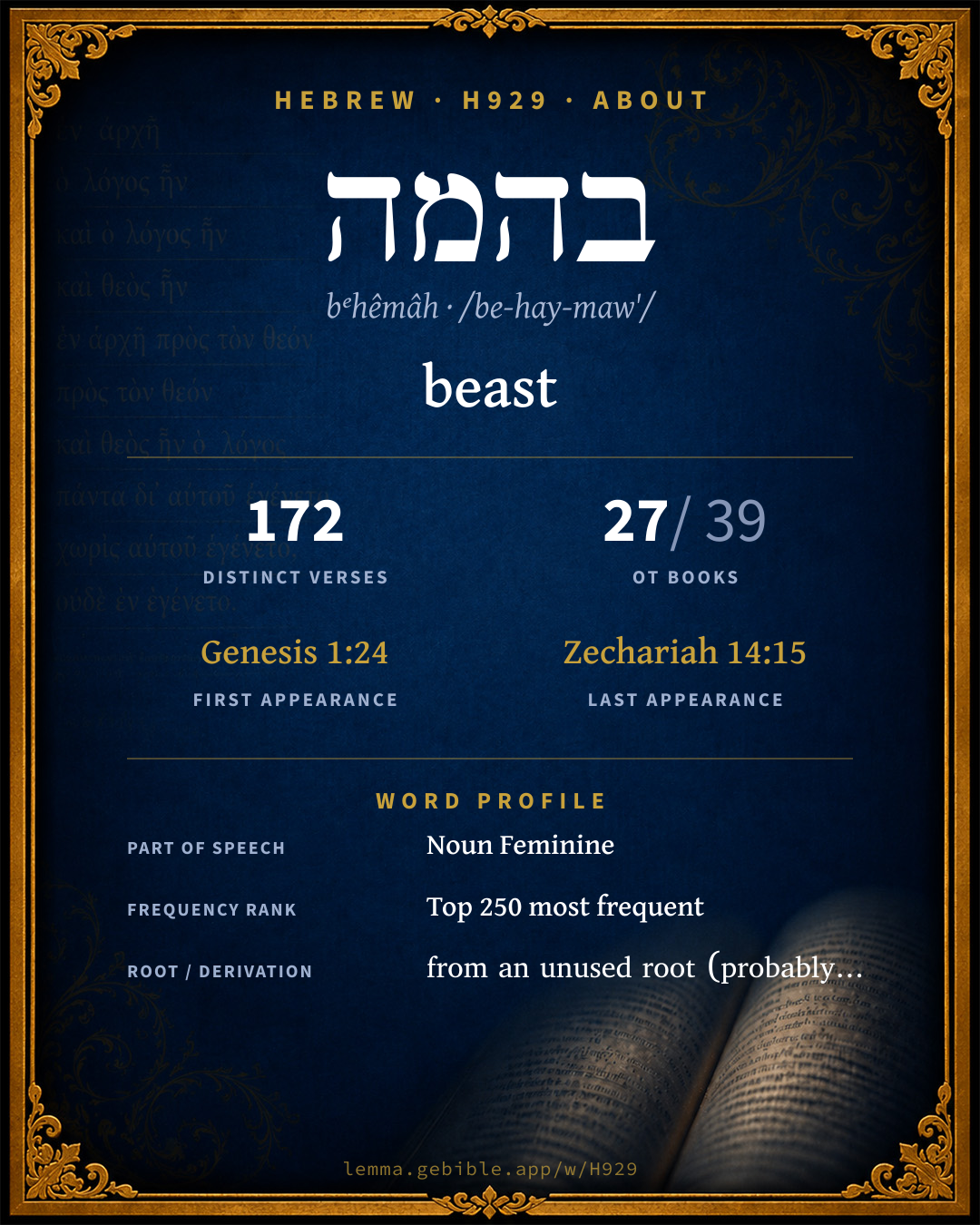
בְּהֵמָה
beast
also: cattle, animal fuller range ↓
Full lexicon entry — Brown-Driver-Briggs (BDB)
From Brown-Driver-Briggs (BDB)
Where this word appears
See every Absolute-state word in the Hebrew Bible →
Grammar key — what these labels mean
Part of speech
- Noun
- A naming word — a person, place, thing, or idea.
Noun type
- Common
- A common noun — a general class of person, place, or thing (“king,” “city,” “water”), not a specific name.
State
- Absolute
- The independent form of a noun, not bound to a following word.
- Construct
- A noun bound to a following noun in a possessive / “of” relationship (the construct chain).
Gender
- Feminine
- Grammatically feminine.
Number
- Singular
- One.
- Plural
- More than one (in Hebrew, generally three or more).
41 distinct verses where H929 appears in the Construct state, across 17 books. Filtered view — show all forms. Click any verse to open its interlinear word-by-word view. Verse text shown in the World English Bible for context — . Each verse’s Hebrew form is shown with its reference; the English is not keyword-highlighted, since the data carries no word-level English alignment. Use “Compare translations” on any verse to read it across multiple English versions. This concordance covers the Hebrew Bible; Septuagint (Greek Old Testament) occurrences are not indexed here.
Genesis 2 verses
- Genesis 34:23 בְּהֶמְתָּ֔/ם n c fs cs + sfx pers 3mp Won't their cattle and their substance and all their animals be ours? Only let us give our consent to them, and they will dwell with us."
- Genesis 36:6 בְּהֶמְתּ֗/וֹ n c fs cs + sfx pers 3ms Esau took his wives, his sons, his daughters, and all the members of his household, with his cattle, all his animals, and all his possessions, which he had gathered in the land of Canaan, and went into a land away from his brother Jacob.
Exodus 1 verse
Leviticus 3 verses
- Leviticus 19:19 בְּהֶמְתְּ/ךָ֙ n c fs cs + sfx pers 2ms "'You shall keep my statutes. "'You shall not crossbreed different kinds of animals. "'you shall not sow your field with two kinds of seed; "'neither shall there come upon on you a garment made of two kinds of material.
- Leviticus 25:7 וְ/לִ֨/בְהֶמְתְּ/ךָ֔ conj + prep + n c fs cs + sfx pers 2ms For your cattle also, and for the animals that are in your land, shall all the increase of it be for food.
- Leviticus 26:22 בְּהֶמְתְּ/כֶ֔ם n c fs cs + sfx pers 2mp I will send the wild animals among you, which will rob you of your children, destroy your cattle, and make you few in number; and your roads will become desolate.
Numbers 5 verses
- Numbers 3:41 בֶּהֱמַ֣ת בְּ/בֶהֱמַ֖ת n c fs cs prep + n c fs cs You shall take the Levites for me (I am Yahweh) instead of all the firstborn among the children of Israel; and the cattle of the Levites instead of all the firstborn among the cattle of the children of Israel."
- Numbers 3:45 בֶּהֱמַ֥ת בְּהֶמְתָּ֑/ם n c fs cs n c fs cs + sfx pers 3mp "Take the Levites instead of all the firstborn among the children of Israel, and the cattle of the Levites instead of their cattle; and the Levites shall be mine. I am Yahweh.
- Numbers 31:9 בְּהֶמְתָּ֧/ם n c fs cs + sfx pers 3mp The children of Israel took captive the women of Midian and their little ones; and all their cattle, and all their flocks, and all their goods, they took for a prey.
- Numbers 32:26 בְּהֶמְתֵּ֑/נוּ n c fs cs + sfx pers 1cp Our little ones, our wives, our flocks, and all our cattle, shall be there in the cities of Gilead;
- Numbers 35:3 לִ/בְהֶמְתָּ/ם֙ prep + n c fs cs + sfx pers 3mp The cities shall they have to dwell in; and their suburbs shall be for their cattle, and for their substance, and for all their animals.
Deuteronomy 9 verses
- Deuteronomy 5:14 בְּהֶמְתֶּ֗/ךָ n c fs cs + sfx pers 2ms but the seventh day is a Sabbath to Yahweh your God: [in it] you shall not do any work, you, nor your son, nor your daughter, nor your man-servant, nor your maid-servant, nor your ox, nor your donkey, nor any of your cattle, nor your stranger who is within your gates; that your man-servant and your maid-servant may rest as well as you.
- Deuteronomy 7:14 וּ/בִ/בְהֶמְתֶּֽ/ךָ conj + prep + n c fs cs + sfx pers 2ms You shall be blessed above all peoples: there shall not be male or female barren among you, or among your cattle.
- Deuteronomy 11:15 לִ/בְהֶמְתֶּ֑/ךָ prep + n c fs cs + sfx pers 2ms I will give grass in your fields for your cattle, and you shall eat and be full.
- Deuteronomy 13:15 בְּהֶמְתָּ֖/הּ n c fs cs + sfx pers 3fs you shall surely strike the inhabitants of that city with the edge of the sword, destroying it utterly, and all that is therein and the cattle of it, with the edge of the sword.
- Deuteronomy 28:4 בְהֶמְתֶּ֑/ךָ n c fs cs + sfx pers 2ms Blessed shall be the fruit of your body, and the fruit of your ground, and the fruit of your animals, the increase of your cattle, and the young of your flock.
- Deuteronomy 28:11 בְהַמְתְּ/ךָ֖ n c fs cs + sfx pers 2ms Yahweh will make you plenteous for good, in the fruit of your body, and in the fruit of your cattle, and in the fruit of your ground, in the land which Yahweh swore to your fathers to give you.
- Deuteronomy 28:26 וּ/לְ/בֶהֱמַ֣ת conj + prep + n c fs cs Your dead body shall be food to all birds of the sky, and to the animals of the earth; and there shall be none to frighten them away.
- Deuteronomy 28:51 בְהֶמְתְּ/ךָ֥ n c fs cs + sfx pers 2ms and shall eat the fruit of your cattle, and the fruit of your ground, until you are destroyed; that also shall not leave you grain, new wine, or oil, the increase of your cattle, or the young of your flock, until they have caused you to perish.
- Deuteronomy 30:9 בְהֶמְתְּ/ךָ֛ n c fs cs + sfx pers 2ms Yahweh your God will make you plenteous in all the work of your hand, in the fruit of your body, and in the fruit of your cattle, and in the fruit of your ground, for good: for Yahweh will again rejoice over you for good, as he rejoiced over your fathers;
Joshua 2 verses
- Joshua 8:2 וּ/בְהֶמְתָּ֖/הּ conj + n c fs cs + sfx pers 3fs You shall do to Ai and her king as you did to Jericho and her king: only the spoil of it, and the cattle of it, shall you take for a prey to yourselves: set you an ambush for the city behind it.
- Joshua 21:2 לִ/בְהֶמְתֵּֽ/נוּ prep + n c fs cs + sfx pers 1cp and they spoke to them at Shiloh in the land of Canaan, saying, Yahweh commanded Moses to give us cities to dwell in, with the suburbs of it for our cattle.
1 Samuel 1 verse
2 Kings 1 verse
Nehemiah 2 verses
- Nehemiah 9:37 וּ/בִ/בְהֶמְתֵּ֨/נוּ֙ conj + prep + n c fs cs + sfx pers 1cp It yields much increase to the kings whom you have set over us because of our sins: also they have power over our bodies, and over our cattle, at their pleasure, and we are in great distress.
- Nehemiah 10:36 וּ/בְהֶמְתֵּ֔י/נוּ conj + n c fs cs + sfx pers 1cp also the firstborn of our sons, and of our cattle, as it is written in the law, and the firstborn of our herds and of our flocks, to bring to the house of our God, to the priests who minister in the house of our God;
Job 1 verse
Psalms 2 verses
Proverbs 1 verse
Isaiah 2 verses
- Isaiah 18:6 וּֽ/לְ/בֶהֱמַ֖ת בֶּהֱמַ֥ת conj + prep + n c fs cs n c fs cs They shall be left together to the ravenous birds of the mountains, and to the animals of the earth; and the ravenous birds shall summer on them, and all the animals of the earth shall winter on them.
- Isaiah 30:6 בַּהֲמ֣וֹת n c fp cs The burden of the animals of the South. Through the land of trouble and anguish, from whence come the lioness and the lion, the viper and fiery flying serpent, they carry their riches on the shoulders of young donkeys, and their treasures on the humps of camels, to a people that shall not profit [them].
Jeremiah 5 verses
- Jeremiah 7:33 וּ/לְ/בֶהֱמַ֣ת conj + prep + n c fs cs The dead bodies of this people shall be food for the birds of the sky, and for the animals of the earth; and none shall frighten them away.
- Jeremiah 15:3 בֶּהֱמַ֥ת n c fs cs I will appoint over them four kinds, says Yahweh: the sword to kill, and the dogs to tear, and the birds of the sky, and the animals of the earth, to devour and to destroy.
- Jeremiah 16:4 וּ/לְ/בֶהֱמַ֥ת conj + prep + n c fs cs They shall die grievous deaths: they shall not be lamented, neither shall they be buried; they shall be as dung on the surface of the ground; and they shall be consumed by the sword, and by famine; and their dead bodies shall be food for the birds of the sky, and for the animals of the earth.
- Jeremiah 19:7 וּ/לְ/בֶהֱמַ֥ת conj + prep + n c fs cs I will make void the counsel of Judah and Jerusalem in this place; and I will cause them to fall by the sword before their enemies, and by the hand of those who seek their life: and their dead bodies will I give to be food for the birds of the sky, and for the animals of the earth.
- Jeremiah 34:20 וּ/לְ/בֶהֱמַ֥ת conj + prep + n c fs cs I will even give them into the hand of their enemies, and into the hand of those who seek their life; and their dead bodies shall be for food to the birds of the sky, and to the animals of the earth.
Ezekiel 1 verse
Joel 2 verses
- Joel 1:20 בַּהֲמ֥וֹת n c fp cs Yes, the animals of the field pant to you, For the water brooks have dried up, And the fire has devoured the pastures of the wilderness.
- Joel 2:22 בַּהֲמ֣וֹת n c fp cs Don't be afraid, you animals of the field; For the pastures of the wilderness spring up, For the tree bears its fruit. The fig tree and the vine yield their strength.
Micah 1 verse
About this entry
At a glance — auto-summarized from this page’s data, not written by a person. Every figure links to its source below. This summary describes the numbers; it doesn’t interpret them.
At its core, בהמה (bᵉhêmâh) means “beast.” Older and newer Bibles part ways — “beast” in the King James Version, “livestock” (Berean Standard Bible) and “animal” (unfoldingWord Literal Text) in modern versions. See the renderings breakdown. Spanning 172 verses in 27 books, it ranks among the common words of the Hebrew Bible. Scripture first uses it in Genesis 1:24. Not a single-sense word: its full sense range also takes in “cattle” and “animal”. See the sense tree, 172-verse concordance, and the renderings breakdown below.
Gloss history
Strong's 1890 vs modern scholarship
About this word
Strong's H929 catalogs a Hebrew word from the Hebrew Old Testament.
These counts are not copied from any lexicon or concordance. They are computed here, from the morphology-tagged Hebrew Old Testament. What Lemma adds →
- 172
- distinct verses
- The word appears in 172 distinct verses.
- 27 / 39
- OT books
- The word appears in 27 of 39 Old Testament books.
- #245
- by frequency
- Top 250 most frequent Hebrew words (rank 245 of 8,640 Hebrew words by occurrence).
View all 172 occurrences in the concordance →
By section of the Old Testament
By traditional corpus
Conventional, traditional groupings — biblical authorship is debated, so this is a traditional corpus grouping, not an authorship claim. Each share is this word’s portion of its verses in that division of the Hebrew canon. Each figure is a share of the word’s 172 distinct verses.
- Torah (Pentateuch) 91 verses · 53%
- Prophets (Nevi'im) 55 verses · 32%
- Writings (Ketuvim) 26 verses · 15%
How translations render this word
Counts come from each version’s own published word-to-Strong’s tagging or interlinear alignment — an approximate guide to how each version renders this word, not a word-level alignment the data otherwise carries. Because each total is that version’s own tagged count, the per-version totals vary from one another and need not match the appearance or distinct-verse counts above. These counts may also differ from a printed concordance because Lemma counts each distinctly tagged rendering and does not collapse phrase taggings into a single head-word total. This is a fixed set of word-tagged versions (KJV, ASV, BSB, ULT) and does not change with the reading translation you choose elsewhere. Each version’s license is shown beside its name below (and on Sources).
- King James Version: Beast 61×, Beasts 31×, Cattle 31×
- American Standard Version: Beast 57×, Cattle 31×, Beasts 25×
- Berean Standard Bible: Livestock 40×, Beast 37×, Animal 28×
- unfoldingWord Literal Text: Animal 35×, Beast 35×, Livestock 35×
King James Version Public Domain
Renders H929 across 188 tagged occurrences — most commonly:
Plus other, less common renderings. Plus 37 renderings that appear only once — usually multi-word phrases or single function words the recovered tagging swept in, not distinct renderings. Not rendered by a distinct English word in 1 further occurrence.
American Standard Version Public Domain
Renders H929 across 188 tagged occurrences — most commonly:
Plus other, less common renderings. Plus 45 renderings that appear only once — usually multi-word phrases or single function words the recovered tagging swept in, not distinct renderings.
Berean Standard Bible Public Domain
Renders H929 across 186 tagged occurrences — most commonly:
Plus 23 renderings that appear only once — usually multi-word phrases or single function words the recovered tagging swept in, not distinct renderings. Not rendered by a distinct English word in 4 further occurrences.
unfoldingWord Literal Text CC BY-SA 4.0
Renders H929 across 189 tagged occurrences — most commonly:
Plus other, less common renderings. Plus 22 renderings that appear only once — usually multi-word phrases or single function words the recovered tagging swept in, not distinct renderings.
Senses in the full BDB
What do BDB’s symbols mean?
BDB uses these scholarly abbreviations:
| Symbol | Meaning |
|---|---|
| 𝔊 | the Septuagint (the ancient Greek translation, LXX) |
| 𝔙 | the Vulgate (the Latin translation) |
| 𝔖 | the Syriac version (the Peshitta) |
| 𝔗 | the Targum (the Aramaic translation) |
| ψ | the Psalms |
| √ | root (the underlying root or stem) |
| ‖ | parallel passage (a synonymous or contrasted parallel) |
| † | the dagger: every passage where the word occurs is cited |
The 3 senses and sub-senses the full Brown-Driver-Briggs lexicon distinguishes for this word, in lexicon order (not ranked by frequency), with BDB’s own verbatim wording and sub-sense lettering. Shown in Hebrew script with BDB’s own scholarly abbreviations. The condensed entry is in the Lexicon Entry tab. See also the Forms in the corpus table below.
- 1. of living creatures other than man (אָדָם) Gn 8:1 Ex 8:13, 14; 9:9, 10, 22; 22:18 Lv 18:23(×2) (where בּ׳ is male, S 20:16) Dt 27:21 ψ 36:7 etc.; מֵאָדָם וְעַד בּ׳ (בּ׳ including all the larger animals) Ex 9:25; 12:12 ψ 135:8 Je 50:3 etc.; as inferior to man Jb 18:2 ψ 49:13, 21, so also Ec 3:18, 19(×2), 21; opp. also birds & reptiles Gn 6:7; 7:23; 8:17 cf. Ez 44:31 etc.; also to fishes 1 K 5:13 Jb 12:7 cf. v 8, ψ 8:9 Zp 1:3. e.g. Genesis 8:1
- 2. opp. also to wild beasts חַיַּת הָאָרֶץ, ח׳ הַשָּׂדֶה Gn 1:24, 25, 26; 2:20; 3:14; 7:14, 21; 9:10 ψ 50:10; 148:10 Is 46:1 etc.; especially therefore cattle, as owned and used by man, Gn 47:18 (מִקְנֵה הַבּ׳) Ex 20:10 = Dt 5:14, Lv 19:19; 26:22 Nu 3:41(×2) 45(×2) Dt 2:35; 11:15 Jon 4:11 Zc 2:8; 8:10; 14:15 Ezr 1:4, 6 Ne 9:37; 10:37 etc.; in one (late) passage of animal for riding (horse? mule?) Ne 2:12(×2), 14. e.g. Genesis 1:24
- 3. rarely of wild beasts, especially carnivora, בּ׳ יַעַר Mi 5:7; בּ׳ הָאָרֶץ Dt 28:26 Is 18:6(×2) Je 7:33; 15:3; 16:4; 19:7 34:20; בּ׳ הַשָּׂרֶה 1 S 17:44; alone, Pr 30:30; שֶׁן־בְּהֵמוֹת Dt 32:24; שֹׁד בּ׳ Hb 2:17.—On בְּהֵמוֹת ψ 73:22 cf. infr. e.g. Micah 5:7
Senses from the full Brown-Driver-Briggs lexicon (Brown, Driver, Briggs; Oxford 1906 — public domain), digitized via Sefaria, supplemented by the OpenScriptures HebrewLexicon (CC BY 4.0). Full attribution on Sources.
Word origin
n.f. beast, animal, cattle (Arabic بَهِيمَةٌ )—בּ׳ Gn 1:24 + 137 times; cstr. בֶּהֱמַת Nu 3:41(×2) + 10 times; sf. בְּהֶמְתְּךָ Lv 19:19 + 4 times; בְּהֶמְתֶּ֑ךָ Ex 20:10 + 4 times; בְּהֶמְתּוֹ Gn 36:6 Pr 12:10; pl. abs. בְּהֵמוֹת Dt 32:24 + 6 times + ψ 73:22 (v. infr.); cstr. בַּהֲמוֹת ψ 8:8 + 5 times;—beast, & coll. beasts (Gn 8:1 + very often)
— Brown-Driver-Briggs (Oxford 1906, public domain), digitized via Sefaria, supplemented by the OpenScriptures HebrewLexicon (CC BY 4.0). See Sources.
Origin: from an unused root (probably meaning to be mute)
Jastrow Dictionary
A second Hebrew/Aramaic lexicon for comparison, covering Aramaic and post-biblical (Talmudic, Targumic, Midrashic) usage that the biblical-Hebrew BDB does not. Matched by lemma rather than by Strong’s number, so a lemma may carry more than one Jastrow headword (shown separately below), and the entries cover usage well beyond the Bible.
בְּהֵמָה
- , Æthiop. to be dumb; √בה, v. בהי) cattle, quadruped domestic animal (mostly of the horned race); in gen. dumb beast, opp. to man. Gen. R. s. 20 ב׳ חיה ועופות domestic animals, wild beasts, and birds; a. fr.—ב׳ גסה large cattle (of the bovine race); ב׳ דקה small cattle (sheep, goats &c.). Bekh. 8ᵃ; a. fr.—בֶּהֱמַת מלוג, ב׳ ארנונא &c., v. מְלוּג, אַרְנוֹנָא &c.—Pl. בְּהֵמוֹת Gen. R. s. 86; a. fr.
הָמָה
- , v. המי
המי
- to be noisy, excited, with אחר to rush after, be greedy, envious &c.—Cant. R. to VIII, 11 הָמוּ, v. הָמוֹן a. הֲמוֹנוּת. Part. הוֹמֶה, v. infra; fem. הוֹמִיָּה. Y. M. Kat. III, beg. 81ᶜ (in a riddle) ה׳ בירכתי ביתה she (the soul?) is restless in the corners of her house. Midr. Till. to Ps. LXXVII הוֹמִים are in commotion.
- same, to covet (with אחר). Lev. R. s. 22 (ref. to אוהב בהמון, Koh. V, 9) כל מי שהומה ומְהַמֶּה אחר הממון whosoever is greedy and covetous for money; ib. הומה ומה׳ אחר תורה ambitious to accumulate learning; a. e.—Part. pass. f. מְהוּמָּת anxious. Nidd. 5ᵃ, v. בַּיִת.—Denom. מָמוֹן. e.g. Ecclesiastes 5:9
A Dictionary of the Targumim, the Talmud Babli and Yerushalmi, and the Midrashic Literature (Marcus Jastrow; London, Luzac, 1903) — Public Domain. Digitized via Sefaria. Digitized via Sefaria. Full attribution on Sources.
Forms in the corpus
The 96 distinct written forms H929 takes in the Hebrew Bible, most frequent first — each parse links to that state’s occurrences in the concordance. Hebrew forms include their vowel points and cantillation, so a single lemma takes many written forms.
The 60 most common forms are shown; 36 rarer forms follow in the full concordance.
Same root — word family
Other BDB entries built from the same root as H929, grouped by Strong’s listed origin. These share a root / origin per the lexicon — not necessarily a shared meaning. Each links to that word’s own entry.
Derived from this word
Compare all same-root words → They share a root, not necessarily a meaning.
Septuagint verse parallels
This word appears in 162 verses that also exist in the Greek Old Testament (Septuagint), out of the 172 Hebrew verses it occurs in. You can read those verses in Greek by switching the Old Testament edition to the Septuagint.
Read these verses in the Septuagint
- Genesis 1:24
- Exodus 8:17
- Leviticus 1:2
- Numbers 3:13
- Deuteronomy 2:35
- Joshua 8:2
- Judges 20:48
- 1 Kings 18:5
- 2 Kings 3:9
- 2 Chronicles 32:28
- Ezra 1:4
- Job 12:7
This is a verse-level parallel only — the same verses exist in both the Hebrew and Greek Old Testaments. No word-level Hebrew↔Greek correspondence is claimed: the data carries no such alignment, so no Greek word is shown as this Hebrew word’s translation. Coverage is not total — the Septuagint omits the deuterocanon and renumbers the Psalms, so some Hebrew verses have no direct Greek parallel.