
Habakkuk 2:17

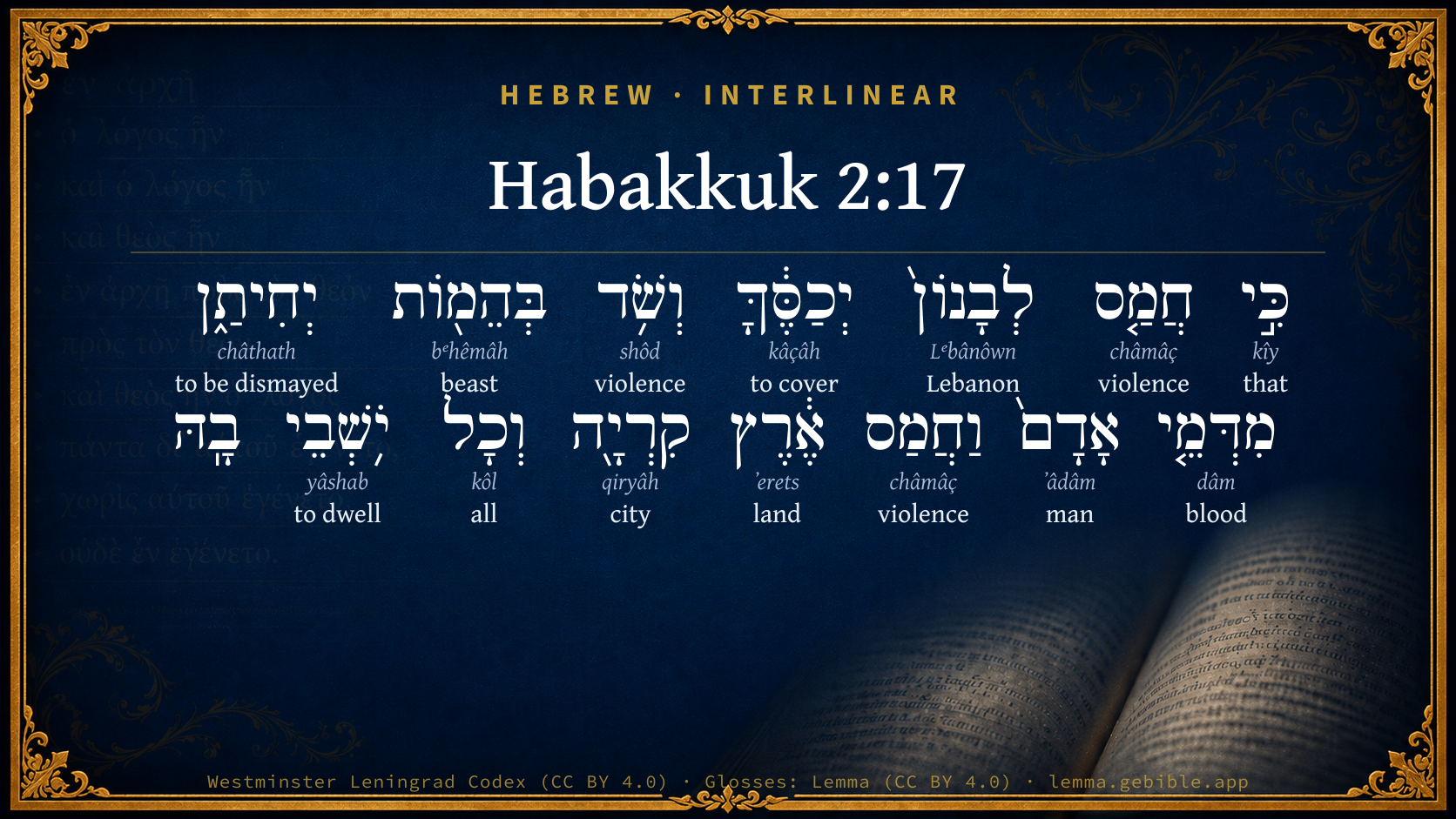
Hebrew (Westminster Leningrad Codex) Habakkuk 2:17 appears in the Hebrew Old Testament. The text above is from the Westminster Leningrad Codex. Each word links to its Strong’s number, a concise gloss, and parsing drawn from the Open Scriptures Hebrew Bible morphology. Click any word for its full Brown-Driver-Briggs (BDB) entry.
Download image
Cite this verse

Habakkuk 2:17 (World English Bible). Public Domain. Lemma interlinear Bible study tool, https://lemma.gebible.app/v/habakkuk/2/17.

Show BibTeX & RIS
BibTeX
RIS
English Translation
For the violence done to Lebanon will overwhelm you, and the destruction of the animals, which made them afraid; because of men's blood, and for the violence done to the land, to every city and to those who dwell in them.
World English Bible · Public Domain
Download a study sheet

One document with this verse’s original text, its word-by-word gloss line, the meaning frame, cross-references with their text, attributed commentary, and full source and license credits — printable, and it pastes into notes with its structure intact.

This verse Autodidact and up

Study sheet (.html) Plain text (.txt)

A passage Seminary Student

Up to 50 verses in one chapter. A passage sheet keeps up to 6 commentary sources and 12 cross-references per verse, in the order this page ranks them, and says so on the sheet whenever that leaves anything out. Ask for a single verse and you get the Autodidact verse sheet above.

Everything on this page stays free to read, with no account — the sheet is a download of what is already on screen, not access to it.

Want to remove ads? Support Godless Engineer
Compare translations 3

The same verse in 3 English versions, stacked beneath the original-language interlinear above. Click any original word for its lexicon entry.

Each is an independent rendering of the whole verse — the interlinear is not word-aligned to these translations.

Highlighted words mark where these versions differ — a whole-verse word diff, not a word-by-word alignment.

  • World English Bible Public Domain
    For the violence done to Lebanon will overwhelm you, and the destruction of the animals, which made them afraid; because of men's blood, and for the violence done to the land, to every city and to those who dwell in them.
  • King James Version Public Domain
    For the violence of Lebanon shall cover thee, and the spoil of beasts, which made them afraid, because of men's blood, and for the violence of the land, of the city, and of all that dwell therein.
  • unfoldingWord Literal Text CC BY-SA 4.0
    For the violence of Lebanon will cover you and the destruction of beasts will terrify them, from the bloodshed of man and the violence of the land, the city, and all the dwellers in it.’

unfoldingWord Literal Text — © unfoldingWord, licensed CC BY-SA 4.0. Word-aligned USFM3 via Door43 (git.door43.org/unfoldingWord/en_ult).

Versions to compare (up to 4)

3 of 4 selected

Show all 18 translations

Every available English version of this verse, each an independent rendering of the whole verse.

  • World English Bible Public Domain
    For the violence done to Lebanon will overwhelm you, and the destruction of the animals, which made them afraid; because of men's blood, and for the violence done to the land, to every city and to those who dwell in them.
  • Berean Standard Bible Public Domain
    For your violence against Lebanon will overwhelm you, and the destruction of animals will terrify you, because of your bloodshed against men and your violence against the land, the city, and all their dwellers.
  • Majority Standard Bible Public Domain
    For your violence against Lebanon will overwhelm you, and the destruction of animals will terrify you, because of your bloodshed against men and your violence against the land, the city, and all their dwellers.
  • King James Version Public Domain
    For the violence of Lebanon shall cover thee, and the spoil of beasts, which made them afraid, because of men's blood, and for the violence of the land, of the city, and of all that dwell therein.
  • American Standard Version (1901) Public Domain
    For the violence done to Lebanon shall cover thee, and the destruction of the beasts, which made them afraid; because of men's blood, and for the violence done to the land, to the city and to all that dwell therein.
  • Revised Version (1885) Public Domain
    For the violence done to Lebanon shall cover thee, and the destruction of the beasts, which made them afraid; because of men’s blood, and for the violence done to the land, to the city and to all that dwell therein.
  • Geneva Bible (1599) Public Domain
    For the crueltie of Lebanon shall couer thee: so shall the spoyle of the beastes, which made them afraide, because of mens blood, and for the wrong done in the land, in the citie, and vnto all that dwell therein.
  • Douay-Rheims (1899) Public Domain
    For the iniquity of Libanus shall cover thee, and the ravaging of beasts shall terrify them because of the blood of men, and the iniquity of the land, and of the city, and of all that dwell therein.
  • Young's Literal Translation Public Domain
    For violence `to' Lebanon doth cover thee, And spoil of beasts doth affright them, Because of man's blood, and of violence `to' the land, `To' the city, and `to' all dwelling in it.
  • Literal Standard Version CC BY-SA 4.0
    For violence [done to] Lebanon covers you, || And spoil of beasts frightens them, || Because of man’s blood, and of violence [to] the land, || [To] the city, and [to] all dwelling in it.
  • Unlocked Literal Bible CC BY-SA 4.0
    The violence done to Lebanon will overwhelm you and the destruction of animals will terrify you. For you have shed human blood and you have acted with violence against the land, the cities, and all who live in them.
  • unfoldingWord Literal Text CC BY-SA 4.0
    For the violence of Lebanon will cover you and the destruction of beasts will terrify them, from the bloodshed of man and the violence of the land, the city, and all the dwellers in it.’
  • Darby Bible Public Domain
    For the violence [done] to Lebanon shall cover thee, and the destruction of beasts which made them afraid; because of men's blood, and for the violence [done] to the land, to the city, and all that dwell therein.
  • World Messianic Bible Public Domain
    For the violence done to Lebanon will overwhelm you, and the destruction of the animals will terrify you, because of men’s blood and for the violence done to the land, to every city and to those who dwell in them.
  • Webster's Bible Public Domain
    For the violence of Lebanon shall cover thee, and the spoil of beasts, which made them afraid, because of men's blood, and for the violence of the land, of the city, and of all that dwell therein.
  • Free Bible Version CC BY-SA 4.0
    As you destroyed the forests of Lebanon you will also be destroyed; you hunted the animals there, and now they will hunt you. For you shed human blood and you destroyed lands and cities, along with those who lived there.
  • Bible in Basic English Public Domain
    For the violent acts against Lebanon will come on you, and the destruction of the cattle will be a cause of fear to you, because of men's blood and the violent acts against the land and the town and all who are living in it.
  • JPS Tanakh (1917) Public Domain
    For the violence done to Lebanon shall cover thee, and the destruction of the beasts, which made them afraid; because of men's blood, and for the violence done to the land, to the city and to all that dwell therein.

Literal Standard Version (2020), Covenant Press — licensed CC BY-SA 4.0. Text via the HelloAO Bible API (eBible.org). Unlocked Literal Bible (unfoldingWord) — licensed CC BY-SA 4.0. Text via the HelloAO Bible API (eBible.org). unfoldingWord Literal Text — © unfoldingWord, licensed CC BY-SA 4.0. Word-aligned USFM3 via Door43 (git.door43.org/unfoldingWord/en_ult). Free Bible Version, Dr. Jonathan Gallagher — licensed CC BY-SA 4.0. Text via the HelloAO Bible API (eBible.org).

Word by word

More ways to search: Search by grammar → Find every occurrence → Compare this word →

Practice this passage: Drill this verse → Learn its vocabulary →

וְשֹׁ֥ד
shôd
H7701
“and · violence of”
Conjunction + Noun, Common, Masculine, Singular, Construct
Part of Speech
Conjunction + Noun
Type
Common
Gender
Masculine
Number
Singular
State
Construct
Full BDB Definition

Origin: from H7736

TWOT: 2331a

havoc, violence, destruction, devastation, ruin - violence, havoc (as social sin) - devastation, ruin
  1. כִּ֣י kîy H3588 “that” Conjunction
  2. חֲמַ֤ס châmâç H2555 “violence of” Noun, Common, Masculine, Singular, Construct
  3. לְבָנוֹן֙ Lᵉbânôwn H3844 “Lebanon” Noun, Proper
  4. יְכַסֶּ֔ךָּ kâçâh H3680 “to cover · you” Verb, Piel, Imperfect, 3rd Person, Masculine, Singular + Suffix, Personal, 2nd Person, Masculine, Singular
  5. בְּהֵמ֖וֹת bᵉhêmâh H929 “beasts” Noun, Common, Feminine, Plural, Absolute
  6. יְחִיתַ֑ן châthath H2865 “to be dismayed · them” Verb, Hiphil, Imperfect, 3rd Person, Masculine, Singular + Suffix, Personal, 3rd Person, Feminine, Plural
  7. מִדְּמֵ֤י dâm H1818 “from · blood of” Preposition + Noun, Common, Masculine, Plural, Construct
  8. אָדָם֙ ʼâdâm H120 “man” Noun, Common, Masculine, Singular, Absolute
  9. וַחֲמַס châmâç H2555 “and · violence of” Conjunction + Noun, Common, Masculine, Singular, Construct
  10. אֶ֔רֶץ ʼerets H776 “land” Noun, Common, Both, Singular, Absolute
  11. קִרְיָ֖ה qiryâh H7151 “city” Noun, Common, Feminine, Singular, Absolute
  12. וְכָל kôl H3605 “and · all of” Conjunction + Noun, Common, Masculine, Singular, Construct
  13. יֹ֥שְׁבֵי yâshab H3427 “dwelling” Verb, Qal, Participle Active, Masculine, Plural, Construct

About this verse

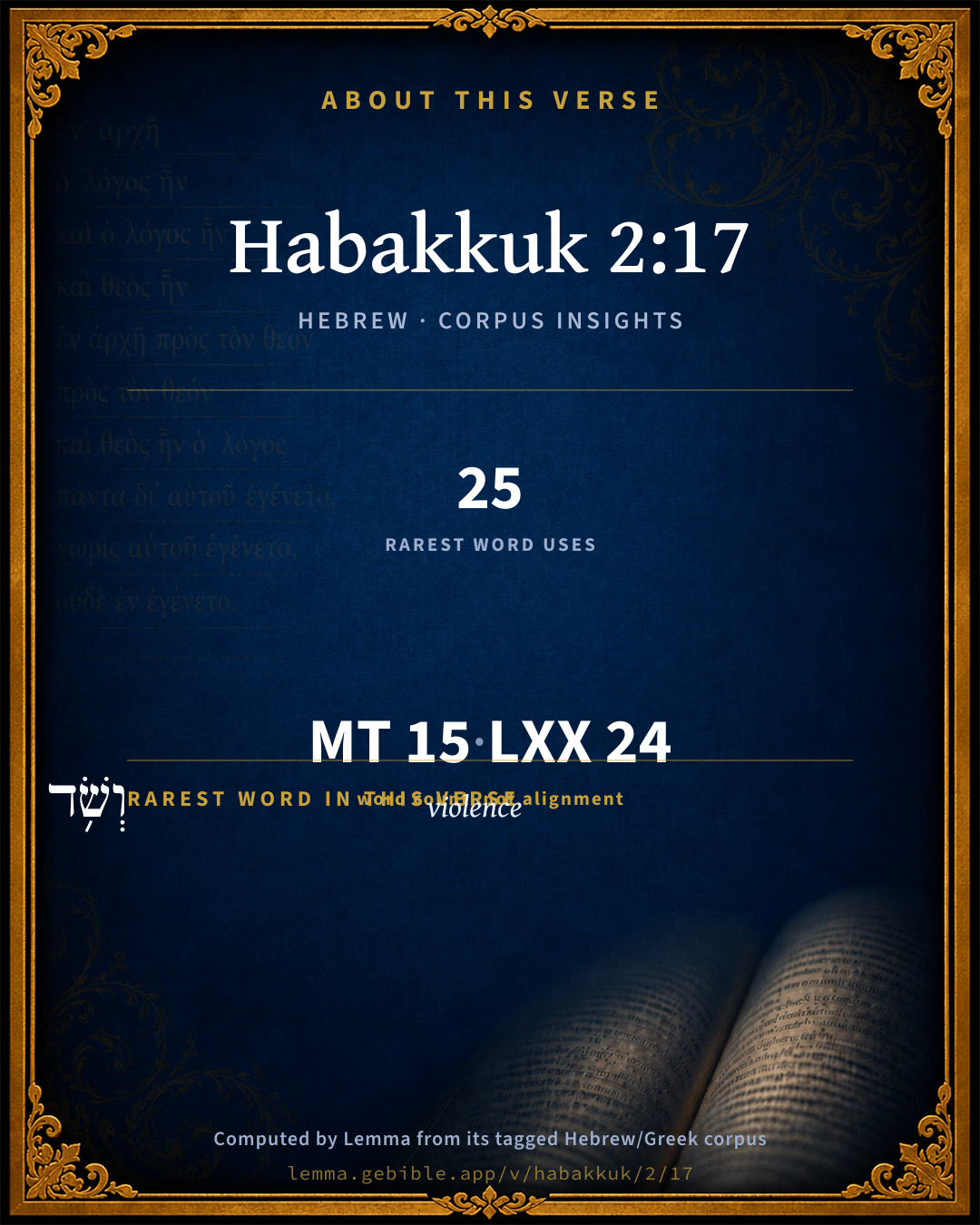
These counts appear in no published source. They are computed here, from the morphology-tagged text and Lemma’s own curated glosses. What Lemma adds →

15
words
13
distinct lemmas
Prophets
section

Notable vocabulary

The rarest word here is וְשֹׁ֥ד violence H7701 — appearing just 25 times in the whole Hebrew Bible.

Shared distinctive vocabulary

וְשֹׁ֥ד violence H7701 occurs in 24 verses of the Hebrew Bible. Also found in:

Grammatical profile

  • 3 verbs
  • 10 nouns
  • 1 preposition
  • 1 conjunction

Verb forms

  • יְכַסֶּ֔ךָּ Piel · Imperfect
  • יְחִיתַ֑ן Hiphil · Imperfect
  • יֹ֥שְׁבֵי Qal · Participle Active

Repetition

A word recurs within this verse — often emphatic in Hebrew:

  • חֲמַ֤ס violence H2555 ×2

Hebrew & Septuagint length

In English translation the verse runs 41 words from the Hebrew and 38 from the Septuagint (LXX English) — closely comparable.

A rough comparison of the two English renderings, which tokenize alike — not a word-level alignment.

Word counts can differ between the Hebrew and the Greek without any difference in meaning — e.g. the Hebrew direct-object marker אֵת has no separate Greek word, and Greek often adds the article ὁ.

In the original languages it is 15 Hebrew tokens and 24 Greek tokens — but the two are counted differently (Hebrew bundles its prefixes and suffixes into one token; the Greek is in lemma form), so that isn’t a like-for-like length.

Cross-references

10

Topical passages linked to Habakkuk 2:17 in the Treasury of Scripture Knowledge — connected by theme and wording, ordered by reader-vote popularity; previews shown in the World English Bible.

  • Habakkuk 2:8 Because you have plundered many nations, all the remnant of the peoples will plunder you, because of men's blood, and for the violence done to the land, to the city and to all who dwell in it.
  • Psalms 55:23 But you, God, will bring them down into the pit of destruction. Bloodthirsty and deceitful men shall not live out half their days, But I will trust in you.
  • Zechariah 11:1 Open your doors, Lebanon, That the fire may devour your cedars.
  • Psalms 137:8 Daughter of Babylon, doomed to destruction, He will be happy who rewards you, As you have served us.
  • Proverbs 28:17 A man who is tormented by life blood will be a fugitive until death; No one will support him.
  • Jeremiah 50:28 The voice of those who flee and escape out of the land of Babylon, to declare in Zion the vengeance of Yahweh our God, the vengeance of his temple.
  • Jeremiah 50:33–34 Thus says Yahweh of hosts: The children of Israel and the children of Judah are oppressed together; and all who took them captive hold them fast; they refuse to let them go.
  • Jeremiah 51:24 I will render to Babylon and to all the inhabitants of Chaldea all their evil that they have done in Zion in your sight, says Yahweh.
  • Jeremiah 51:34–37 Nebuchadrezzar the king of Babylon has devoured me, he has crushed me, he has made me an empty vessel, he has, like a monster, swallowed me up, he has filled his maw with my delicacies; he has cast me out.
  • Revelation 18:20–24 Rejoice over her, O heaven, you saints, apostles, and prophets; for God has judged your judgment on her."

Cross-references courtesy of OpenBible.info (CC BY 4.0).

Hebrew and Greek witnesses Masoretic Hebrew ↔ Greek Septuagint

The same verse in the two great witnesses to the Old Testament, shown verse-for-verse.

These are two independent witnesses, not word-aligned to each other, and the Septuagint is shown in lemma (dictionary) form.

Hebrew Habakkuk 2:17 Masoretic · Westminster Leningrad Codex

כִּ֣י חֲמַ֤ס לְבָנוֹן֙ יְכַסֶּ֔ךָּ וְשֹׁ֥ד בְּהֵמ֖וֹת יְחִיתַ֑ן מִדְּמֵ֤י אָדָם֙ וַחֲמַס אֶ֔רֶץ קִרְיָ֖ה וְכָל יֹ֥שְׁבֵי בָֽהּ

For the violence done to Lebanon will overwhelm you, and the destruction of the animals, which made them afraid; because of men's blood, and for the violence done to the land, to every city and to those who dwell in them.

World English Bible · Public Domain

Greek LXX Habakkuk 2:17 Septuagint · lemma form

διότι ἀσέβεια ὁ λίβανος καλύπτω σύ καί ταλαιπωρία θηρίον πτοέω σύ διά αἷμα ἄνθρωπος καί ἀσέβεια γῆ καί πόλις καί πᾶς ὁ καταοἰκέω αὐτός

For the ungodliness of Libanus shall cover you, and distress because of wild beasts shall dismay you, because of the blood of men, and the sins of the land and city, and of all that dwell in it.

LXX2012 (modern English Septuagint) · Public Domain

On this verse, Joseph Benson's Commentary discusses the Septuagint’s reading. Read the note in Commentary ↓

Hebrew: Westminster Leningrad Codex (CC BY 4.0). Greek: Septuagint (public domain); English from LXX2012 (modern English Septuagint) (Public Domain). How the Septuagint differs from the Hebrew →

Targum (Aramaic paraphrase)

1

The Targum is the ancient Jewish Aramaic paraphrase of the Hebrew Scriptures — an interpretive translation, not the Hebrew text itself. Onkelos (literal) and Pseudo-Jonathan (expansive) render the Torah, and Jonathan the Prophets. Coverage is partial: where no permissively-licensed English translation exists for a verse, only the Aramaic is shown. This is verse-level text, not a word-by-word alignment to the Hebrew.

  1. Targum Jonathan Prophets (Joshua–Malachi)
    אֲרֵי חֲטוֹף בֵּית מַקְדְשָׁא יַחֲפִינָךְ וּבִּזַת עַמֵיהּ תִּתְבְּרִינָךְ מִדְמֵי אֱנָשָׁא וַחֲטוֹף אַרְעָא דְיִשְׂרָאֵל קַרְתָּא יְרוּשְׁלֵם וְכָל דְיַתְבִין בָּהּ:

    (no public-domain English translation for this verse)

    Targum Jonathan — Aramaic: “Mikraot Gedolot” (public domain). English: “Sefaria Community Translation” (CC0 1.0 (public-domain dedication)); “London "Chaldee Paraphrase," 1871” (public domain). Text via Sefaria.

Commentary

Notes on Habakkuk 2:17 from classic Christian and Jewish commentators (each source and its license shown beneath its notes). The classic Christian expositions comment on the surrounding passage and are grouped to its opening verse, so a note may address several verses; the Jewish commentaries on the Tanakh (Rashi and others) are per-verse, so they appear only where the commentator wrote on this verse.

Lemma curates 59 commentaries, every one of them public domain or Creative Commons licensed, each selected and text-cleaned for this edition rather than reprinted as found. About our sources →

Trapp's Complete Commentary

John Trapp

Hab 2:17 For the violence of Lebanon shall cover thee, and the spoil of beasts, [which] made them afraid, because of men’s blood, and for the violence of the land, of the city, and of all that dwell therein.

Ver. 17. For the violence of Lebanon shall cover thee] Here, for the comfort of God’s people (which is the main scope of this prophecy), he repeateth the chief causes of Babylon’s calamity; viz. her cruelty to Lebanon, that is, to all Judaea (a part being put for the whole). Or else he speaketh of the violence done to the temple, which was built of the cedars of Lebanon; as was likewise the temple of Diana at Ephesus made of cedar wood. The devil loves to be God’s ape. This violence in firing the temple and desolating the country shall cover thee all over as a garment doth the body; yea, it shall be as the shirt, made for the murdering of Agamemnon, where the head had no issue out.

And the spoil of beasts which made them afraid] Men are here called beasts, as the land, Lebanon; these were spoiled and terrified, these were murdered and massacred by the Chaldeans, who shall therefore be severely punished, and this written, as it were, over their heads, to signify for what they suffer,

Because of men’s blood, and for the violence of the land, of the city, and of all that dwell therein] {See Trapp on "Hab 2:8"}

John Trapp, A Commentary or Exposition upon All the Books of the Old and New Testament (1647–1656) — public domain. Text from a community e-Sword module.

Joseph Benson's Commentary

Hab 2:17. For the violence of Lebanon [that is, the violence done to Lebanon] shall cover thee — That is, says Grotius, thou shalt suffer the punishment of having destroyed the temple, which is here called Lebanon, because it was built, in a great measure, with the cedars of Lebanon. And the spoil of beasts, which made them afraid — The relative which, added by our translators, obscures the text, which might be more plainly rendered, The spoil of (or, made by) beasts shall make them afraid, or make thee afraid, as the LXX. and Chaldee, with very little alteration, read the text. As thou hast spoiled other, without any sense of common humanity, so the army of the conqueror shall deal by thee, and shall tear thee in pieces as wild beasts do their prey. See Isa 13:15-18. Because of men’s blood — See note on Hab 2:8.

Joseph Benson's Commentary on the Old and New Testaments (1811–1818) — public domain. Text from a community e-Sword module.

Geneva Bible (1599)

Geneva Bible translators

Because the Babylonians were cruel not only against other nations, but also against the people of God, which is meant by Lebanon and the beasts therein, he showeth that the like cruelty shall be executed against them.

Geneva Bible (1599) marginal notes — public domain. Text via Bolls.life.

Jamieson, Fausset & Brown

Robert Jamieson, A. R. Fausset & David Brown

the violence of Lebanon--thy "violence" against "Lebanon," that is, Jerusalem (Isa 37:24; Jer 22:23; Eze 17:3, Eze 17:12; for Lebanon's cedars were used in building the temple and houses of Jerusalem; and its beauty made it a fit type of the metropolis), shall fall on thine own head.

cover--that is, completely overwhelm.

the spoil of beasts, which made them afraid--MAURER explains, "the spoiling inflicted on the beasts of Lebanon (that is, on the people of Jerusalem, of which city 'Lebanon' is the type), which made them afraid (shall cover thee)." But it seems inappropriate to compare the elect people to "beasts." I therefore prefer explaining, "the spoiling of beasts," that is, such as is inflicted on beasts caught in a net, and "which makes them afraid (shall cover thee)." Thus the Babylonians are compared to wild beasts terrified at being caught suddenly in a net. In cruel rapacity they resembled wild beasts. The ancients read, "the spoiling of wild beasts shall make THEE afraid." Or else explain, "the spoiling of beasts (the Medes and Persians) which (inflicted by thee) made them afraid (shall in turn cover thyself--revert on thyself from them)." This accords better with the parallel clause, "the violence of Lebanon," that is, inflicted by thee on Lebanon. As thou didst hunt men as wild beasts, so shalt thou be hunted thyself as a wild beast, which thou resemblest in cruelty.

because of men's blood--shed by thee; repeated from Hab 2:8. But here the "land" and "city" are used of Judea and Jerusalem: not of the earth and cities generally, as in Hab 2:8.

the violence of the land, &c.--that is, inflicted on the land by thee.

Jamieson, Fausset & Brown — Commentary Critical and Explanatory on the Whole Bible (1871) — public domain (CC PDM 1.0). Text via the HelloAO Bible API.

Adam Clarke's Commentary

Verse 17. For the violence of Lebanon] Or, the violence done to Lebanon; to men, to cattle, to Judea, and to Jerusalem. See the note on the parallel place, Hab 2:8. This may be a threatening against Egypt, as the former was against Chaldea.

Adam Clarke's Commentary on the Bible (1810–1826) — public domain. Text from a community e-Sword/MySword module.

John Calvin's Commentaries

We may hence easily learn, that the Prophet has not been speaking of drunkenness, but that his discourse, as we have explained, was metaphorical; for here follows a reason, why he had denounced such a punishment on the king of Babylon, and that was, because he had exercised violence, not only against all nations indiscriminately, but also against the chosen people of God. He had before only set forth in general the cruelty with which the king of Babylon had destroyed many nations; but he now speaks distinctly of the Jews, in order to show that God would in a peculiar manner be the avenger of that cruelty which the Chaldeans had employed towards the Jews, because the Lord had taken that people under his own protection. Since then the king of Babylon had assailed the children of God, who had been adopted by him, and whose defender he was, he denounces upon him here a special punishment. We thus see that this discourse is properly addressed to the Jews; for he intended to bring them some consolation in their extreme evils, so that they might strengthen their patience; for they were thereby made to see that the wrongs done to them were come to a reckoning before God.

By Libanus then we are to understand either Judea or the temple; for Libanus, as it is well known, was not far from the temple; and it is elsewhere found in the same sense. But if any extends this to the land of Judea, the meaning will be the same; there will be but little or no difference as to the subject that is handled. Because the violence then of Libanus shall overwhelm thee

Then come the words, the pillaging of beasts. Interpreters think that the Chaldeans and Assyrians are here called בהמות, bemutt, beasts, as they had been savage and cruel, like wild beasts, in laying waste Judea; but I rather understand by the beasts of Libanus those which inhabited that forest. The Prophet exaggerates the cruelty of the king of Babylon by this consideration, that he had been an enemy to brute beasts; and I consider the pronoun relative אשר, asher, which, to be understood before the verb יחיתן, ichiten, which may be taken to mean, to tear, or to frighten, Some give this rendering, “The plundering of beasts shall tear them;” as though he had said, “The Babylonians are indeed like savage beasts, but they shall be torn by their own plundering:” but another sense will be more suitable that the plundering of beasts, which terrified them, shall overwhelm thee; for the same verb, יבס, icas, shall cover or overwhelm the king of Babylon, is to be repeated here. He adds at last the clause, which was explained yesterday. We now perceive the meaning of the Prophet to be—that the king of Babylon would be justly plundered, because he had destroyed the holy land and iniquitously attacked God’s chosen people, and had also carried on his depredations through almost the whole of the Eastern world. It now follows—

John Calvin's Commentaries (1540-1563) — public domain. Text from the Calvin Translation Society English edition (1840s-50s) via the Christian Classics Ethereal Library (ccel.org). Calvin's coverage is partial (roughly two-thirds of the Bible); uncommented books and verses are honest gaps, never fabricated. The 19th-century editor's footnotes and remarks are omitted so the notes are faithfully Calvin's own voice.

Ellicott's Commentary for English Readers

(17) For the violence of Lebanon. . . .—Better, For the violence done to Lebanon shall overwhelm thee, and the destruction of the beasts which it frightened away. The rest of the verse is a refrain taken from the first woe, that of Hab_2:8. The “destruction of beasts” points, we think, to a raid on the cattle feeding on the sides of Lebanon. But more than this is probably included in the phrase the violence done to Lebanon. Habakkuk probably foresees how the invader will cut down the cedar forests in Lebanon to adorn the palaces of Babylon. (Comp. Isa_14:7-8.) All these outrages shall in due time be Avenged on himself. Some commentators, however, explain the expression as a bold synecdoche, Lebanon representing the Holy Land (of which it was the beauty), or even the Temple, both of which Nebuchadnezzar laid waste.

A Bible Commentary for English Readers, edited by Charles John Ellicott (1878–1897) — public domain. Text from a community e-Sword module.

The Cambridge Bible for Schools and Colleges

gen. ed. J. J. S. Perowne

17. violence of Lebanon] i.e. done to Lebanon. Lebanon is not a figure for the holy land, but used literally. Both Assyrians and Babylonians transported wood from Lebanon for their temples and other edifices. It is possible that their cutting down of wood may have been wanton, and perhaps the use of the cedars by the Chaldean in any form may have been considered desecration. Comp. Isa_14:8.

shall cover thee] Oba_1:10; Jer_3:25. In Oba_1:10 shame covers the Edomites because of the violence; here the violence itself covers. The violence carries shame, its recompense, in itself.

spoil … made them afraid] and the destruction of the beasts shall terrify thee (or, break thee). The ancient versions read thee for them, no doubt rightly. The Chaldeans may have made Lebanon their hunting-ground, and possibly they carried the chase to excess, though “spoil” or destruction does not mean extermination but violent treatment. The earth, the woods and the beasts no less than man have rights; there is nothing that exists which is not moral; wanton excess on anything recoils on the head of the perpetrator. The ravage and terror carried into the world of creatures shall come back in terror and destruction on the Chaldean. The refrain is as in Hab_2:11.

The Cambridge Bible for Schools and Colleges (gen. ed. J. J. S. Perowne; Cambridge University Press, 1878–1918) — public domain. Text from a community e-Sword module.

John Gill's Exposition

What profiteth the graven image that the maker thereof hath graven it,.... The graven images the church of Rome enjoins the worship of; the images of the Trinity, of Christ, of the Virgin Mary, of angels and saints departed, and which are still continued since the Reformation; but of what profit and advantage are they? they may be profitable to the graver, who is paid for graving them; and the metal or matters of which they are made, if sold, and converted to another use, may turn to account; but as deities, and worshipped as such, they are of no profit to them that worship them; they can not hear their prayers, nor answer them; can not bestow any favours on them, and deliver them out of any distress; and particularly can not save them from the judgments before denounced:

the molten image, and a teacher of lies: nor is a molten image any ways profitable, which is made of liquid matter, gold or silver melted and poured into a mould, from whence it receives its form: it may be profitable to the founder, and the metal to the owner, if put to another use; but, as a god, is of no service; and both the graven and molten image, the one and the other, each of then is "a teacher of lies", and so unprofitable; if they are laymen's books, as they are said to be, they do not teach them truth; they do not teach them what God is in his nature and perfections; what Christ is in his person and offices; what angels are, who are incorporeal; nor the saints, they neither describe the shape and features of their body, nor express their characters, minds, or manners; they teach men to believe lies, and to worship false deities, as they are. So the Targum renders it, a false deity; which imposes on men, and therefore cannot profit them: or this may be understood of an idolatrous priest, as Aben Ezra; as the idol itself cannot profit, so neither can the priest that teaches men such lies as to worship the idol, and put trust in it:

that the maker of his work trusteth therein, to make dumb idols? or, "whilst making dumb idols" (m); which is great stupidity indeed! that while a man is graving an image, or casting an idol, which are lifeless senseless things, that can neither move nor speak, yea, are his workmanship, yet puts his trust and confidence in them, that they can do him service he needs, help him in distress, and save him out of his troubles; what profit can be expected from these, though ever so nicely framed, when he considers they are of his own framing, and that they are idols, which are nothing in the world, as the word (n) here used signifies; and dumb ones, which can give no answer to the requests of their votaries? The Targum is,

"idols in whom there is no profit.''

(m) "faciendo idola muta", Junius & Tremellius, Piscator, Vatablus. (n) "dii nihili", Drusius.

John Gill's Exposition of the Whole Bible (1746–1763) — public domain (CC PDM 1.0). Text via the HelloAO Bible API.

Albert Barnes' Notes on the Bible

For the violence of Lebanon - i. e., done to Lebanon, whether the land of Israel of which it was the entrance and the beauty (See Isa 37:24, and, as a symbol, Jer 22:6, Jer 22:23; Eze 17:3; but it is used as a symbol of Sennacherib’s army, Isa 10:34, and the king of Asshur is not indeed spoken of under the name as a symbol (in Eze 21:3,) but is compared to it), or the temple (See the note at Zec 12:1), both of which Nebuchadnezzar laid waste; or, more widely, it may be a symbol of all the majesty of the world and its empires, which he subdues, as Isaiah uses it, when speaking of the judgment on the world, Isa 2:13, “It shall cover thee, and the spoil (i. e., spoiling, destruction) of beasts (the inhabitants of Lebanon) which made them afraid,” or more simply, “the wasting of wild beasts shall crush , Pro 10:14; Pro 13:3; Pro 14:14; Pro 18:7) them (selves),” i. e., as it is in irrational nature, that “the frequency of the incursions of very mischievous animals becomes the cause that people assemble against them and kill them, so their (the Chaldaeans’) frequent injustice is the cause that they haste to be avenged on thee” .

Having become beasts, they shared their history. They spoiled, scared, laid waste, were destroyed. “Whoso seeketh to hurt another, hurteth himself.” The Chaldaeans laid waste Judea, scared and wasted its inhabitants; the end of its plunder should be, not to adorn, but to cover them, overwhelm them as in ruins, so that they should not lift up their heads again. Violence returns upon the head of him who did it; they seem to raise a lofty fabric, but are buried under it. He sums up their past experience, what God had warned them beforehand, what they had found.

Albert Barnes' Notes on the Bible (1834–1885) — public domain. Text from a community e-Sword/MySword module.

Haydock's Catholic Bible Commentary

Libanus. That is, the iniquity committed by the Chaldeans against the temple of God, signified here by the name of Libanus. (Challoner) --- Egypt had persuaded the governor of Cœlosyria and the Jews to revolt, and then abandoned them. --- Beasts, which were adored in Egypt. Those who explain all of the Chaldeans are much perplexed, understanding the army of Cyrus, or the oppressed nations, or subjects to be meant. (Calmet) --- And of. Hebrew, "land of the city," as [in] ver. 8.

George Leo Haydock (1774–1849), Haydock's Catholic Family Bible and Commentary, 1859 edition — public domain. Excludes Psalms (Douay-Rheims chapter numbering differs from Protestant) and Deuterocanonical books (Catholic canon only).

Matthew Poole's English Annotations

The violence of Lebanon shall cover thee: this is added to all the rest, that God’s people might know this was the time of recompences for Zion, that the violence by Babylon done to Judea and its inhabitants should be avenged and no longer deferred, but now should overwhelm Babylon, in which should be made as great devastations as ever she made in the fruitful and beautiful mountain Lebanon, supposed, in Deu 3:25, to express the land of Canaan; or else by Lebanon may be meant the temple, and house of the sanctuary, (as the Chaldee paraphrast,) because it was built of the cedars of Lebanon.

Thee; Babylon.

The spoil of beasts; such spoil as by hunters is made among wild beasts, when they endeavour to destroy the whole kind of them, such havoc, and by all the ways and methods that art and subtlety can invent to extirpate them, such wastes shalt thou suffer; for thou art to be destroyed: Or else thus, such desolations shall thine enemies make in thee as wild, ravenous, and insatiable beasts make where they prevail, they shall tear and devour all they seize, and seize all that peep abroad, and this shall make all men afraid continually.

Because of men’s blood, & c.: see Hab 2:8.

Matthew Poole's English Annotations on the Holy Bible (1683–1685) — public domain. Text from a community e-Sword/MySword module.

The Pulpit Commentary

For the violence of Lebanon shall cover thee; LXX, ajsebeia tou Libanou: iniquitas Libani (Vulgate). It would be plainer if translated, "the violence against," or "practised on, Lebanon," as the sentence refers to the devastation inflicted by the Chaldeans on the forests of Lebanon. (comp. Isa_14:8 Isa_37:24) Jerome confines the expressionin the text to the demolition of the temple at Jerusalem in the construction of which much cedar was employed; others take Lebanon as a figure for Palestine generally, or for Jerusalem itself; but it is best understood literally. The same devastation which the Chaldeans made in Lebanon shall "cover," overwhelm, and destroy them. And the spoil of beasts, which made them afraid. The introduction of the relative is not required, and the passage may be better translated, And the destruction of beasts made them (others read "thee") afraid. Septuagint, "And the wretchedness of the beasts shall affright thee." Jerome, in his commentary, renders, "Et vastitas animalium opprimet te." The meaning is that the wholesale destruction of the wild animals of Lebanon, occasioned by the operations of the Chaldeans, shall be visited upon this people. They warred not only against men, but against the lower creatures too; and for this retributive punishment awaited them. Because of men"s blood, etc. The reason rendered in ver. 8 is here repeated. Of the land, etc., means "toward" or "against" the land.

The Pulpit Commentary (1880–1919), ed. H.D.M. Spence-Jones & Joseph S. Exell — public domain. Text from a community e-Sword module.

John Wesley's Explanatory Notes

The violence - The violence thou hast done to Judea shall overwhelm thee. The spoil of brass - Such spoil as by hunters is made among wild beasts, when they endeavour to destroy the whole kind.

John Wesley, Explanatory Notes Upon the Whole Bible (1754–1765) — public domain. Text via the GEBible commentary corpus.

unfoldingWord translationNotes

Door43 World Missions Community

General Information:

Yahweh continues to answer Habakkuk and to speak of the Chaldeans as if they were one man. (See: Metaphor)

The violence done to Lebanon will overwhelm you

The Chaldeans being punished for the violence done to Lebanon is spoken of as if their violent actions were a person who will overpower them. (See: Metaphor and Personification)

The violence done to Lebanon

Possible meanings for the word "Lebanon" are 1) it represents the forest of Lebanon. AT: "The violence done to the trees of Lebanon" or 2) it represents the people of Lebanon. AT: "The violence done to the people of Lebanon" (See: Metonymy)

the destruction of animals will terrify you

The Chaldeans being punished for destroying the animals in Lebanon is spoken of as if their destruction were a person who will terrify them. (See: Metaphor and Personification)

For you have shed human blood ... all who live in them

See how you translated this sentence in Habakkuk 2:8.

you have shed human blood

The idiom "to shed blood" means "to murder." AT: "you have murdered people" (See: Idiom)

translationWords

Lebanon

blood

unfoldingWord translationNotes — © Distant Shores Media and the Door43 World Missions Community, licensed CC BY-SA 4.0. Source: git.door43.org/Door43/en_tn.

Rashi

Rabbi Shlomo Yitzchaki (Rashi)

the violence of the Lebanon the Temple.

and the plunder of cattle The plunder of your cattle, and your hordes that plundered My people Israel, shall break you.

because of the blood of man Because of the violence done to the blood of Israel.

and the violence of the land The land of Israel.

a city Jerusalem.

Rashi on the Tanakh — English translations: “The Judaica Press complete Tanach with Rashi, translated by A. J. Rosenberg” (CC BY 4.0); “Pentateuch with Rashi's commentary by M. Rosenbaum and A.M. Silbermann, 1929-1934” (public domain); “The Metsudah Tanach series, Lakewood, N.J” (CC BY 4.0); and “The Book of Joshua, Metsudah Publications, 1997” (CC BY 4.0). Text via Sefaria.

Lesson kit

Teaching starters — assembled from the data on this page, not authored interpretation. Every prompt links to the verse data it draws on. Edit before teaching.

Habakkuk, in the Prophets, opens this verse with 15 words (13 distinct Hebrew lemmas). Its most distinctive word is shôd (“violence”). A historical commentator’s framing appears above. Read the whole chapter for the surrounding context.

Discussion questions

  1. How does “violence” (shôd) shape what this verse is saying?
  2. Job 5:21 shares the word «violence» with this verse. How do the two illuminate each other?
  3. “violence” occurs 2× in this one verse. What is the effect of the repetition?
  4. These translations render this verse differently; the difference is in the English rendering, not the original. What questions does that raise?
  5. The verb «יְכַסֶּ֔ךָּ» is Piel Imperfect. How does its form color the action?
  6. Reading how Trapp's Complete Commentary and Joseph Benson's Commentary read this verse, where do the two commentators agree and where do they part?

Things to notice

Reading settings

Reading text

Shown beneath each verse's original-language words.

Old Testament
Old Testament edition

Read the OT as the Masoretic Hebrew (MT) or the Greek Septuagint (LXX).

English shown for the Greek Septuagint (in the Hebrew ↔ Greek comparison).

Comparing translations? Open the Compare panel on any verse page to stack up to four side by side.