Joel 1:20

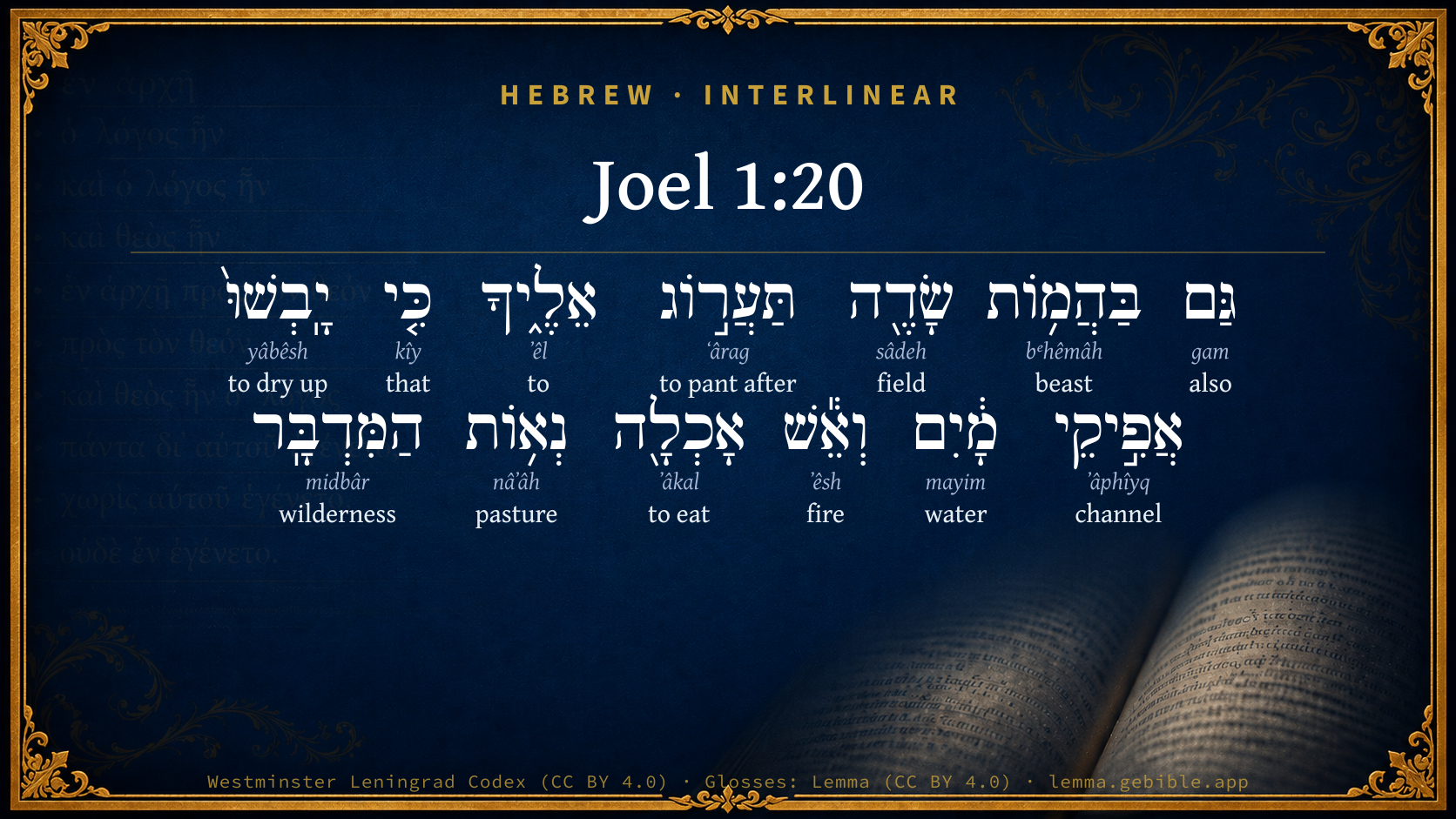
Hebrew (Westminster Leningrad Codex) Joel 1:20 appears in the Hebrew Old Testament. The text above is from the Westminster Leningrad Codex. Each word links to its Strong’s number, a concise gloss, and parsing drawn from the Open Scriptures Hebrew Bible morphology. Click any word for its full Brown-Driver-Briggs (BDB) entry.
Download image
Cite this verse

Joel 1:20 (World English Bible). Public Domain. Lemma interlinear Bible study tool, https://lemma.gebible.app/v/joel/1/20.

Show BibTeX & RIS
BibTeX
RIS
English Translation
Yes, the animals of the field pant to you, For the water brooks have dried up, And the fire has devoured the pastures of the wilderness.
World English Bible · Public Domain
Download a study sheet

One document with this verse’s original text, its word-by-word gloss line, the meaning frame, cross-references with their text, attributed commentary, and full source and license credits — printable, and it pastes into notes with its structure intact.

This verse Autodidact and up

Study sheet (.html) Plain text (.txt)

A passage Seminary Student

Up to 50 verses in one chapter. A passage sheet keeps up to 6 commentary sources and 12 cross-references per verse, in the order this page ranks them, and says so on the sheet whenever that leaves anything out. Ask for a single verse and you get the Autodidact verse sheet above.

Everything on this page stays free to read, with no account — the sheet is a download of what is already on screen, not access to it.

Want to remove ads? Support Godless Engineer
Compare translations 3

The same verse in 3 English versions, stacked beneath the original-language interlinear above. Click any original word for its lexicon entry.

Each is an independent rendering of the whole verse — the interlinear is not word-aligned to these translations.

Highlighted words mark where these versions differ — a whole-verse word diff, not a word-by-word alignment.

  • World English Bible Public Domain
    Yes, the animals of the field pant to you, For the water brooks have dried up, And the fire has devoured the pastures of the wilderness.
  • King James Version Public Domain
    The beasts of the field cry also unto thee: for the rivers of waters are dried up, and the fire hath devoured the pastures of the wilderness.
  • unfoldingWord Literal Text CC BY-SA 4.0
    Even the beasts of the field pant for you, for the streams of water have dried up, and fire has devoured the pastures of the wilderness.

unfoldingWord Literal Text — © unfoldingWord, licensed CC BY-SA 4.0. Word-aligned USFM3 via Door43 (git.door43.org/unfoldingWord/en_ult).

Versions to compare (up to 4)

3 of 4 selected

Show all 18 translations

Every available English version of this verse, each an independent rendering of the whole verse.

  • World English Bible Public Domain
    Yes, the animals of the field pant to you, For the water brooks have dried up, And the fire has devoured the pastures of the wilderness.
  • Berean Standard Bible Public Domain
    Even the beasts of the field pant for You, for the streams of water have dried up, and fire has consumed the open pastures.
  • Majority Standard Bible Public Domain
    Even the beasts of the field pant for You, for the streams of water have dried up, and fire has consumed the open pastures.
  • King James Version Public Domain
    The beasts of the field cry also unto thee: for the rivers of waters are dried up, and the fire hath devoured the pastures of the wilderness.
  • American Standard Version (1901) Public Domain
    Yea, the beasts of the field pant unto thee; for the water brooks are dried up, and the fire hath devoured the pastures of the wilderness.
  • Revised Version (1885) Public Domain
    Yea, the beasts of the field pant unto thee: for the water brooks are dried up, and the fire hath devoured the pastures of the wilderness.
  • Geneva Bible (1599) Public Domain
    The beasts of the fielde cry also vnto thee: for the riuers of waters are dried vp, and the fire hath deuoured the pastures of the wildernes.
  • Douay-Rheims (1899) Public Domain
    Yea and the beasts of the field have looked up to thee, as a garden bed that thirsteth after rain, for the springs of waters are dried up, and fire hath devoured the beautiful places of the wilderness.
  • Young's Literal Translation Public Domain
    Also the cattle of the field long for Thee, For dried up have been streams of water, And fire hath consumed comely places of a wilderness!'
  • Literal Standard Version CC BY-SA 4.0
    Also the livestock of the field long for You, || For dried up have been streams of water, || And fire has consumed lovely places of a wilderness!”
  • Unlocked Literal Bible CC BY-SA 4.0
    Even the animals of the fields pant for you, for the water brooks have dried up, and fire has devoured the pastures of the wilderness.
  • unfoldingWord Literal Text CC BY-SA 4.0
    Even the beasts of the field pant for you, for the streams of water have dried up, and fire has devoured the pastures of the wilderness.
  • Darby Bible Public Domain
    The beasts of the field also cry unto thee; for the water-courses are dried, and the fire hath devoured the pastures of the wilderness.
  • World Messianic Bible Public Domain
    Yes, the animals of the field pant to you, for the water brooks have dried up, and the fire has devoured the pastures of the wilderness.
  • Webster's Bible Public Domain
    The beasts of the field cry also to thee: for the rivers of waters are dried up, and the fire hath devoured the pastures of the wilderness.
  • Free Bible Version CC BY-SA 4.0
    Even the wild animals long for you because the streams have dried up, and fire has destroyed the pastures in the wilderness.
  • Bible in Basic English Public Domain
    The beasts of the field are turning to you with desire: for the water-streams are dry and fire has put an end to the grass-lands of the waste.
  • JPS Tanakh (1917) Public Domain
    Yea, the beasts of the field pant unto Thee; for the water brooks are dried up, and the fire hath devoured the pastures of the wilderness.

Literal Standard Version (2020), Covenant Press — licensed CC BY-SA 4.0. Text via the HelloAO Bible API (eBible.org). Unlocked Literal Bible (unfoldingWord) — licensed CC BY-SA 4.0. Text via the HelloAO Bible API (eBible.org). unfoldingWord Literal Text — © unfoldingWord, licensed CC BY-SA 4.0. Word-aligned USFM3 via Door43 (git.door43.org/unfoldingWord/en_ult). Free Bible Version, Dr. Jonathan Gallagher — licensed CC BY-SA 4.0. Text via the HelloAO Bible API (eBible.org).

Word by word

More ways to search: Search by grammar → Find every occurrence → Compare this word →

Practice this passage: Drill this verse → Learn its vocabulary →

תַּעֲר֣וֹג
ʻârag
H6165
“to pant after”
Verb, Qal, Imperfect, 3rd Person, Feminine, Singular
Part of Speech
Verb
Stem
Qal
Form
Imperfect
Person
3rd Person
Gender
Feminine
Number
Singular
Full BDB Definition

Origin: a primitive root

TWOT: 1691

(Qal) to long for, pant after
  1. גַּם gam H1571 “also” Particle, Accusative
  2. בַּהֲמ֥וֹת bᵉhêmâh H929 “beasts of” Noun, Common, Feminine, Plural, Construct
  3. שָׂדֶ֖ה sâdeh H7704 “field” Noun, Common, Masculine, Singular, Absolute
  4. אֵלֶ֑יךָ ʼêl H413 “to · you” Preposition + Suffix, Personal, 2nd Person, Masculine, Singular
  5. כִּ֤י kîy H3588 “that” Conjunction
  6. יָֽבְשׁוּ֙ yâbêsh H3001 “to dry up” Verb, Qal, Perfect, 3rd Person, Common, Plural
  7. אֲפִ֣יקֵי ʼâphîyq H650 “channels of” Noun, Common, Masculine, Plural, Construct
  8. מָ֔יִם mayim H4325 “water(s)” Noun, Common, Masculine, Plural, Absolute
  9. וְאֵ֕שׁ ʼêsh H784 “and · fire” Conjunction + Noun, Common, Both, Singular, Absolute
  10. אָכְלָ֖ה ʼâkal H398 “to eat” Verb, Qal, Perfect, 3rd Person, Feminine, Singular
  11. נְא֥וֹת nâʼâh H4999 “pastures of” Noun, Common, Feminine, Plural, Construct
  12. הַמִּדְבָּֽר midbâr H4057 “the · wilderness” Particle, Definite Article + Noun, Common, Masculine, Singular, Absolute

About this verse

These counts appear in no published source. They are computed here, from the morphology-tagged text and Lemma’s own curated glosses. What Lemma adds →

13
words
13
distinct lemmas
Prophets
section

Notable vocabulary

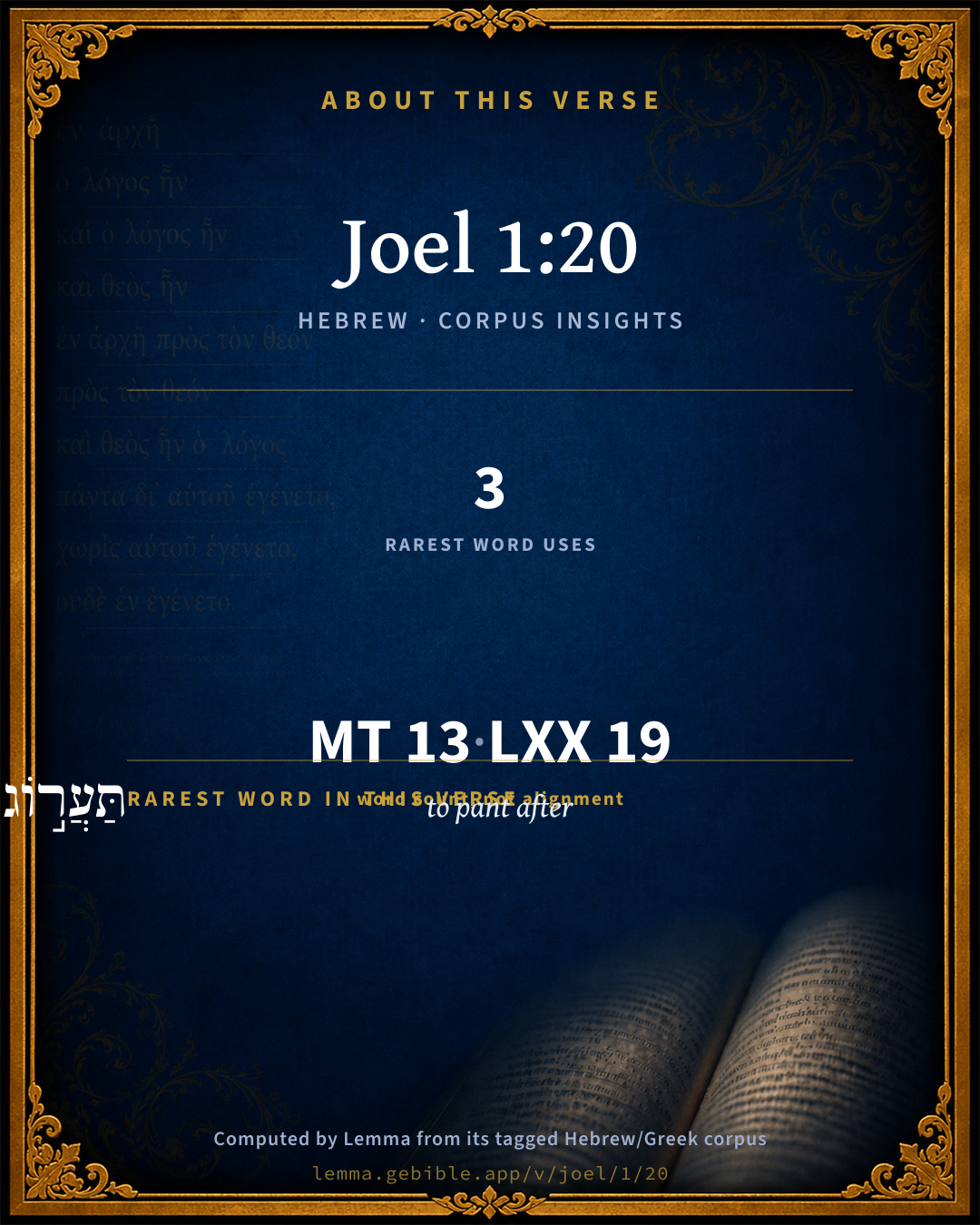
The rarest word here is תַּעֲר֣וֹג to pant after H6165 — appearing just 3 times in the whole Hebrew Bible.

Shared distinctive vocabulary

תַּעֲר֣וֹג to pant after H6165 occurs in 2 verses of the Hebrew Bible. Also found in:

Grammatical profile

  • 3 verbs
  • 7 nouns
  • 1 preposition
  • 1 conjunction
  • 1 particle

Verb forms

  • תַּעֲר֣וֹג Qal · Imperfect
  • יָֽבְשׁוּ֙ Qal · Perfect
  • אָכְלָ֖ה Qal · Perfect

Hebrew & Septuagint length

In English translation the verse runs 26 words from the Hebrew and 30 from the Septuagint (LXX English) — closely comparable.

A rough comparison of the two English renderings, which tokenize alike — not a word-level alignment.

Word counts can differ between the Hebrew and the Greek without any difference in meaning — e.g. the Hebrew direct-object marker אֵת has no separate Greek word, and Greek often adds the article ὁ.

In the original languages it is 13 Hebrew tokens and 19 Greek tokens — but the two are counted differently (Hebrew bundles its prefixes and suffixes into one token; the Greek is in lemma form), so that isn’t a like-for-like length.

Cross-references

6

Topical passages linked to Joel 1:20 in the Treasury of Scripture Knowledge — connected by theme and wording, ordered by reader-vote popularity; previews shown in the World English Bible.

  • Psalms 104:21 The young lions roar after their prey, And seek their food from God.
  • 1 Kings 17:7 It happened after a while, that the brook dried up, because there was no rain in the land.
  • 1 Kings 18:5 Ahab said to Obadiah, Go through the land, to all the springs of water, and to all the brooks: peradventure we may find grass and save the horses and mules alive, that we not lose all the animals.
  • Job 38:41 Who provides for the raven his prey, When his young ones cry to God, And wander for lack of food?
  • Psalms 145:15 The eyes of all wait for you. You give them their food in due season.
  • Psalms 147:9 He provides food for the cattle, And for the young ravens when they call.

Cross-references courtesy of OpenBible.info (CC BY 4.0).

Hebrew and Greek witnesses Masoretic Hebrew ↔ Greek Septuagint

The same verse in the two great witnesses to the Old Testament, shown verse-for-verse.

These are two independent witnesses, not word-aligned to each other, and the Septuagint is shown in lemma (dictionary) form.

Hebrew Joel 1:20 Masoretic · Westminster Leningrad Codex

גַּם בַּהֲמ֥וֹת שָׂדֶ֖ה תַּעֲר֣וֹג אֵלֶ֑יךָ כִּ֤י יָֽבְשׁוּ֙ אֲפִ֣יקֵי מָ֔יִם וְאֵ֕שׁ אָכְלָ֖ה נְא֥וֹת הַמִּדְבָּֽר

Yes, the animals of the field pant to you, For the water brooks have dried up, And the fire has devoured the pastures of the wilderness.

World English Bible · Public Domain

Greek LXX Joel 1:20 Septuagint · lemma form

καί ὁ κτῆνος ὁ πεδίον ἀναβλέπω πρός σύ ὅτι ξηραίνω ἄφεσις ὕδωρ καί πῦρ καταἐσθίω ὁ ὡραῖος ὁ ἔρημος

And the cattle of the field have looked up to you: for the fountains of waters have been dried up, and fire has devoured the fair places of the wilderness.

LXX2012 (modern English Septuagint) · Public Domain

On this verse, Haydock's Catholic Bible Commentary discusses the Septuagint’s reading. Read the note in Commentary ↓

Hebrew: Westminster Leningrad Codex (CC BY 4.0). Greek: Septuagint (public domain); English from LXX2012 (modern English Septuagint) (Public Domain). How the Septuagint differs from the Hebrew →

Targum (Aramaic paraphrase)

1

The Targum is the ancient Jewish Aramaic paraphrase of the Hebrew Scriptures — an interpretive translation, not the Hebrew text itself. Onkelos (literal) and Pseudo-Jonathan (expansive) render the Torah, and Jonathan the Prophets. Coverage is partial: where no permissively-licensed English translation exists for a verse, only the Aramaic is shown. This is verse-level text, not a word-by-word alignment to the Hebrew.

  1. Targum Jonathan Prophets (Joshua–Malachi)
    אַף חֵיוַת בָּרָא מְסַבְרָא קֳדָמָךְ אֲרֵי יְבִישׁוּ פַצִידֵי מַיָא וְקִדוּם תַקִיף כְּאֶשָׁא אָסַף דַרְוָת מַדְבְּרָא:

    (no public-domain English translation for this verse)

    Targum Jonathan — Aramaic: “Mikraot Gedolot” (public domain). English: “Sefaria Community Translation” (CC0 1.0 (public-domain dedication)); “London "Chaldee Paraphrase," 1871” (public domain). Text via Sefaria.

Commentary

Notes on Joel 1:20 from classic Christian and Jewish commentators (each source and its license shown beneath its notes). The classic Christian expositions comment on the surrounding passage and are grouped to its opening verse, so a note may address several verses; the Jewish commentaries on the Tanakh (Rashi and others) are per-verse, so they appear only where the commentator wrote on this verse.

Lemma curates 59 commentaries, every one of them public domain or Creative Commons licensed, each selected and text-cleaned for this edition rather than reprinted as found. About our sources →

Trapp's Complete Commentary

John Trapp

Joe 1:20 The beasts of the field cry also unto thee: for the rivers of waters are dried up, and the fire hath devoured the pastures of the wilderness.

Ver. 20. The beasts of the field cry also unto thee] Glocitant, a term taken from deer; they cry as they can, they cry by implication, imploring thine help, each for himself. See Psa 149:9 Job 39:3 Psa 104:27; and should men be silent?

For the rivers of the waters are dried up] This maketh the hart bray after the waterbrooks, yea, shed tears, as hunters say the hart will, when hot and hard pressed for water. Hereto David seems to allude, Psa 42:3, "My tears have been my meat," &c.

And the fire hath devoured the pastures of the wilderness] This had been said before, Joe 1:19. The reason of such repetitions, {See Trapp on "Joe 1:11"} {See Trapp on "Joe 1:12\i0 } Neither let this last exaggeration of the common calamity, by that which befell the brute beasts, seem superfluous. For whereas the security and obstinace of most men is such, that they take little notice of present pressures, but promise themselves peace and safety, whatsoever God, by his servants, shall say to the contrary; it is but needful, surely, that their danger should be inculcated, and their calamity set out, and set on with utmost importunity and vehemence.

John Trapp, A Commentary or Exposition upon All the Books of the Old and New Testament (1647–1656) — public domain. Text from a community e-Sword module.

Tyndale Open Study Notes

Tyndale Open Resources

1:20 All creation suffers because of human sin (Gen 3:17-18; 9:2; Rom 8:20-21)—even the wild animals cry out to God. The Hebrew word translated “cry out” is the same word used in Ps 42:1 of the deer that “longs” for streams of water. The beasts, urgently requiring their food and drink, set an example of how the people of Judah and Jerusalem should seek their Lord (cp. Isa 1:3).

Tyndale Open Study Notes — © Tyndale Open Resources, licensed CC BY-SA 4.0. Text via the HelloAO Bible API.

Geneva Bible (1599)

Geneva Bible translators

That is, drought.

Geneva Bible (1599) marginal notes — public domain. Text via Bolls.life.

Jamieson, Fausset & Brown

Robert Jamieson, A. R. Fausset & David Brown

beasts . . . cry . . . unto thee--that is, look up to heaven with heads lifted up, as if their only expectation was from God (Job 38:41; Psa 104:21; Psa 145:15; Psa 147:9; compare Psa 42:1). They tacitly reprove the deadness of the Jews for not even now invoking God.

Next: Joel Chapter 2

Jamieson, Fausset & Brown — Commentary Critical and Explanatory on the Whole Bible (1871) — public domain (CC PDM 1.0). Text via the HelloAO Bible API.

Adam Clarke's Commentary

Verse 20. The beasts of the field cry also unto thee] Even the cattle, wild and tame, are represented as supplicating God to have mercy upon them, and send them provender! There is a similar affecting description of the effects of a drought in Jeremiah, Jer 14:6.

The rivers of waters are dried up] There must have been a drought as well as a host of locusts; as some of these expressions seem to apply to the effects of intense heat.

For המדבר hammidbar, "the wilderness," one of my oldest MSS. reads מדבר midbar, "wilderness" simply, as in Joe 1:19. Eight or ten of Dr. Kennicott's have the same reading.

Adam Clarke's Commentary on the Bible (1810–1826) — public domain. Text from a community e-Sword/MySword module.

John Calvin's Commentaries

He afterwards adds The beasts of the field will also cry (for the verb is in the plural number;) the beasts then will cry. The Prophet expresses here more clearly what he had said before that though the brute animals were void of reasons they yet felt God’s judgment, so that they constrained men by their example to feel ashamed, for they cried to God: the beasts then of the field cry. He ascribes crying to them, as it is elsewhere ascribed to the young ravens. The young ravens, properly speaking, do not indeed call on God; and yet the Psalmist says so, and that, because they confess, by raising up their bills, that there is no supply for their want except God supports them. So also the Prophet mentions here the beasts as crying to God. It is indeed a figure of speech, called personification; for this could not be properly said of beasts. But when the beasts made a noise under the pressure of famine, was it not such a calling on God as their nature admitted? As much then as the nature of brute animals allows, they may be said to seek their food from the Lord, when they send forth lamentable cries and noises, and show that they are oppressed with famine and want. When, therefore, the Prophet attributes crying to beasts, he at the same time reproaches the Jews with their stupidity, that they did not call on God. “What do you mean,” he says. “See the brute animals; they show to you what ought to be done; it is at least a teaching that ought to have effect on you. If I and the other prophets have lost all our labor, if God has in vain performed the office of a teacher among you, let the very oxen at least be your teachers; to whom indeed it is a shame to be disciples, but it is a greater shame not to attend to what they teach you; for the oxen by their example lead you to God.”

We now perceive how much vehemence there is in the Prophet’s words, when he says, Even the beasts of the field will cry to God; for the streams of waters have dried up, and the fire has consumed the dwellings, or the pastures of the wilderness. He again teaches what I have lately stated, that sterility proceeded from the evident judgment of God, and that it ought to have struck dread into men, for it was a sort of miracle. When, therefore the courses of waters dried up on the mountains, how could it be deemed natural? אפיקים aphikim mean courses of waters or valleys through which the waters run. The Prophet here refers, no doubt, to those regions which, through the abundance of water, always retain their fertility. When, therefore, the very valleys were burnt up, they ought surely to own that something wonderful had happened. On this account, he ascribes crying to herds and brute animals, and not any sort of crying, but that by which they called on God. What remains we shall defer till to-morrow.

John Calvin's Commentaries (1540-1563) — public domain. Text from the Calvin Translation Society English edition (1840s-50s) via the Christian Classics Ethereal Library (ccel.org). Calvin's coverage is partial (roughly two-thirds of the Bible); uncommented books and verses are honest gaps, never fabricated. The 19th-century editor's footnotes and remarks are omitted so the notes are faithfully Calvin's own voice.

Ellicott's Commentary for English Readers

(20) The beasts of the field cry also unto thee.—The prophet has cried to God; the very beasts echo that cry, “looking up” to Him. As yet, man seems dumb.

A Bible Commentary for English Readers, edited by Charles John Ellicott (1878–1897) — public domain. Text from a community e-Sword module.

The Cambridge Bible for Schools and Colleges

gen. ed. J. J. S. Perowne

20. Yea, the beasts of the field pant (R.V.) unto thee] lit. ascend, mount up (viz. with longing and desire). The verb occurs in Heb. only here and Psa_42:1 (twice). In Ethiopic it is the regular word for to go up, and it has the same meaning also in Arabic: in Heb. it is used only metaphorically in the sense explained above[34]. Cry of A.V. is based upon the interpretation of the Rabbis, who, in their ignorance of the real etymological affinities of the word, conjectured a meaning that would agree fairly with the context.

[34] The derivative ‘arûgâh occurs in the sense of a raised flower-bed, Eze_17:7; Eze_17:10; Son_5:13; Son_6:2.

rivers] channels (Isa_8:7; Psa_18:15), not a very common word, used most frequently by Ezekiel (Eze_6:3, Eze_31:12 al.).

The Cambridge Bible for Schools and Colleges (gen. ed. J. J. S. Perowne; Cambridge University Press, 1878–1918) — public domain. Text from a community e-Sword module.

John Gill's Exposition

The beasts of the field cry also unto thee,.... As well as the prophet, in their way; which may be mentioned, both as a rebuke to such who had no sense of the judgments upon them, and called not on the Lord; and to express the greatness of the calamity, of which the brute creatures were sensible, and made piteous moans, as for food, so for drink; panting thorough excessive heat and vehement thirst, as the hart, after the water brooks, of which this word is only used, Psa 42:1; but in vain:

for the rivers of waters are dried up; not only springs, and rivulets and brooks of water, but rivers, places where were large deep waters, as Aben Ezra explains it; either by the Assyrian army, the like Sennacherib boasts Isa 37:25; and is said to be done by the army of Xerxes, wherever it came; or rather by the excessive heat and scorching beams of the sun, by which such effects are produced:

and the fire hath devoured the pastures of the wilderness; See Gill on Joe 1:19; and whereas the word rendered pastures signifies both "them" and "habitations" also; and, being repeated, it may be taken in one of the senses in Joe 1:19; and in the other here: and so Kimchi who interprets it before of "tents", here explains it of grassy places in the wilderness, dried up, as if the sun had consumed them.

Next: Joel Chapter 2

John Gill's Exposition of the Whole Bible (1746–1763) — public domain (CC PDM 1.0). Text via the HelloAO Bible API.

Albert Barnes' Notes on the Bible

The beasts of the field cry also unto Thee - o: “There is an order in these distresses. First he points out the insensate things wasted; then those afflicted, which have sense only; then those endowed with reason; so that to the order of calamity there may be consorted an order of pity, sparing first the creature, then the things sentient, then things rational. The Creator spares the creature; the Ordainer, things sentient; the Saviour, the rational.” Irrational creatures joined with the prophet in his cry. The beasts of the field cry to God, though they know it not; it is a cry to God, who compassionates all which suffers. God makes them, in act, a picture of dependence upon His Providence, “seeking to It for a removal of their sufferings, and supply of their needs.” So He saith, “the young lions roar after their prey, and seek their meat from God” Psa 104:21, and, “He giveth to the beast his food and to the young ravens that cry” Psa 147:9, and, “Who provideth for the raven his food? when his young ones cry unto God” Job 38:41. If the people would not take instruction from him, he “bids them learn from the beasts of the field how to behave amid these calamities, that they should cry aloud to God to remove them.”

Albert Barnes' Notes on the Bible (1834–1885) — public domain. Text from a community e-Sword/MySword module.

Haydock's Catholic Bible Commentary

Up, as if to pray for rain, Jeremias xiv. 6. (Calmet) --- Hebrew, "cry," (Haydock) or "pant." --- As....rain is not in Hebrew or Septuagint. (Calmet)

George Leo Haydock (1774–1849), Haydock's Catholic Family Bible and Commentary, 1859 edition — public domain. Excludes Psalms (Douay-Rheims chapter numbering differs from Protestant) and Deuterocanonical books (Catholic canon only).

Matthew Poole's English Annotations

The beasts: see Joe 1:18.

Cry; the wilder sort, that rove about many miles seeking their livelihood, find no sustenance, they look up to God, and cry to him: these creatures, that can better shift for themselves, yet can make no good shift; they utter their complaints in their sad tones, they have a voice to cry, as well as an eye to look to God.

Unto thee, who only canst open thy hand, and fill them. Learn, ye brutish among men, look and cry to God. And again, Have pity, O God, many of thy sinless creatures perish without relief; hear them, though thou shouldst not hear men.

The rivers are dried up; most extreme and tedious drought, which hath dried up the rivers themselves; there is no drink for the cattle, they must perish without help, unless thou, O God, send a plentiful and fruitful rain.

The fire hath devoured the pastures of the wilderness: see this explained above, Joe 1:19.

Matthew Poole's English Annotations on the Holy Bible (1683–1685) — public domain. Text from a community e-Sword/MySword module.

John Wesley's Explanatory Notes

Cry - They utter their complaints, their sad tones, they have a voice to cry, as well as an eye to look to God.

John Wesley, Explanatory Notes Upon the Whole Bible (1754–1765) — public domain. Text via the GEBible commentary corpus.

Rashi

Rabbi Shlomo Yitzchaki (Rashi)

cry out Heb. תַּעֲרֹג, will cry out, as Dunash (Teshuvoth Dunash, p. 18) interpreted it: ערג is the cry of the hinds. נהם is the roar of the lions; געה is the lowing of the calves; צהל is the whinnying of the horses; צִפצוּף is the chirping of the birds, and נבח is the barking of the dogs. [Also the beasts of the field—I.e., the hind of the field.]

Rashi on the Tanakh — English translations: “The Judaica Press complete Tanach with Rashi, translated by A. J. Rosenberg” (CC BY 4.0); “Pentateuch with Rashi's commentary by M. Rosenbaum and A.M. Silbermann, 1929-1934” (public domain); “The Metsudah Tanach series, Lakewood, N.J” (CC BY 4.0); and “The Book of Joshua, Metsudah Publications, 1997” (CC BY 4.0). Text via Sefaria.

Lesson kit

Teaching starters — assembled from the data on this page, not authored interpretation. Every prompt links to the verse data it draws on. Edit before teaching.

Joel, in the Prophets, opens this verse with 13 words (13 distinct Hebrew lemmas). Its most distinctive word is ʻârag (“to pant after”). A historical commentator’s framing appears above. Read the whole chapter for the surrounding context.

Discussion questions

  1. How does “to pant after” (ʻârag) shape what this verse is saying?
  2. How does Psalms 42:1, which shares the word «to pant after», read alongside this verse?
  3. These translations render this verse differently; the difference is in the English rendering, not the original. What questions does that raise?
  4. «תַּעֲר֣וֹג» is a Qal Imperfect verb. How does that grammatical form shape the action described?
  5. Compare how Trapp's Complete Commentary and Tyndale Open Study Notes read this verse. Where do they agree or differ?

Things to notice

Reading settings

Reading text

Shown beneath each verse's original-language words.

Old Testament
Old Testament edition

Read the OT as the Masoretic Hebrew (MT) or the Greek Septuagint (LXX).

English shown for the Greek Septuagint (in the Hebrew ↔ Greek comparison).

Comparing translations? Open the Compare panel on any verse page to stack up to four side by side.