
Ezekiel 32:13

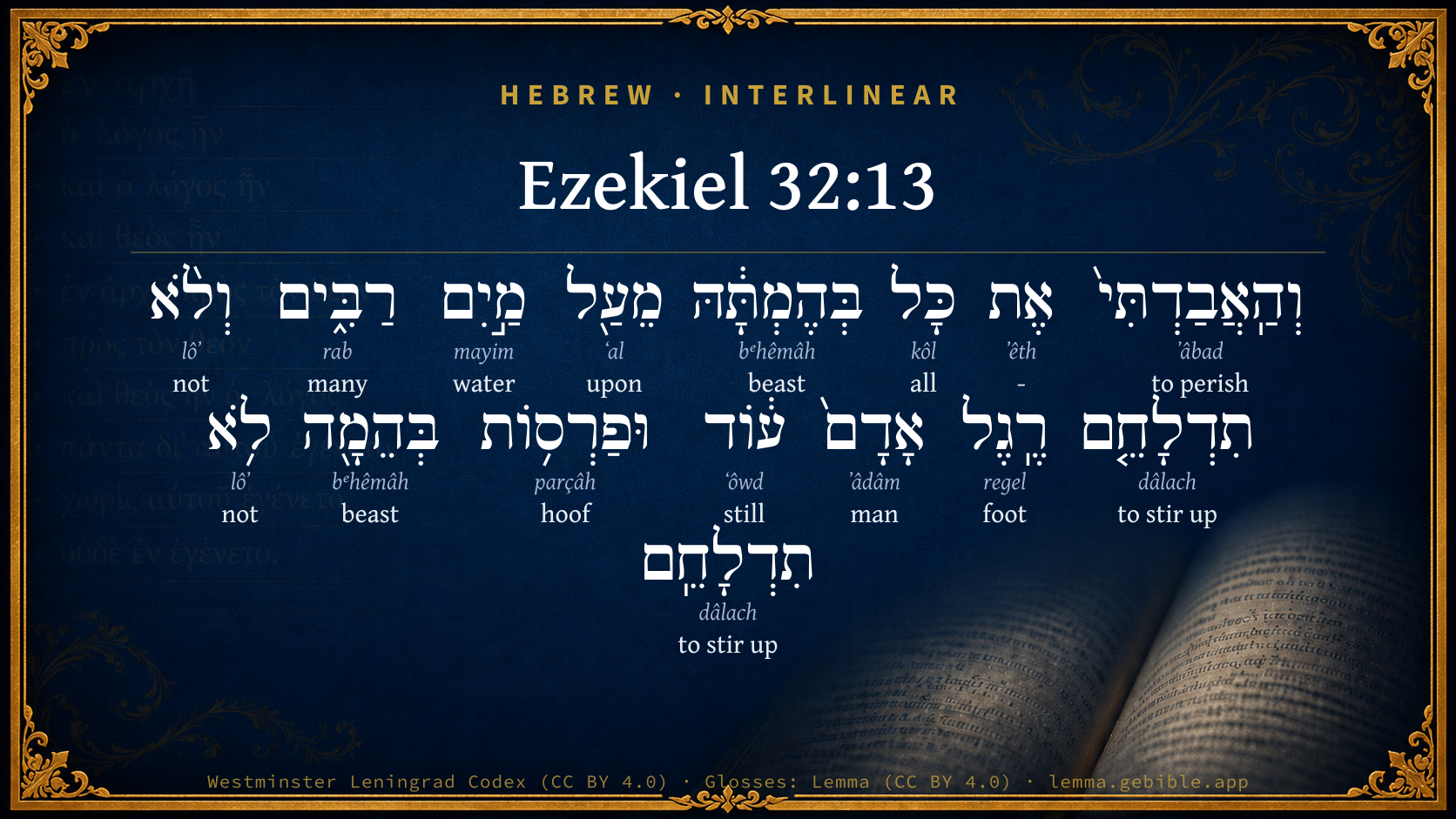
Hebrew (Westminster Leningrad Codex) Ezekiel 32:13 appears in the Hebrew Old Testament. The text above is from the Westminster Leningrad Codex. Each word links to its Strong’s number, a concise gloss, and parsing drawn from the Open Scriptures Hebrew Bible morphology. Click any word for its full Brown-Driver-Briggs (BDB) entry.
Download image
Cite this verse

Ezekiel 32:13 (World English Bible). Public Domain. Lemma interlinear Bible study tool, https://lemma.gebible.app/v/ezekiel/32/13.

Show BibTeX & RIS
BibTeX
RIS
English Translation
I will destroy also all the animals of it from beside many waters; neither shall the foot of man trouble them any more, nor the hoofs of animals trouble them.
World English Bible · Public Domain
Download a study sheet

One document with this verse’s original text, its word-by-word gloss line, the meaning frame, cross-references with their text, attributed commentary, and full source and license credits — printable, and it pastes into notes with its structure intact.

This verse Autodidact and up

Study sheet (.html) Plain text (.txt)

A passage Seminary Student

Up to 50 verses in one chapter. A passage sheet keeps up to 6 commentary sources and 12 cross-references per verse, in the order this page ranks them, and says so on the sheet whenever that leaves anything out. Ask for a single verse and you get the Autodidact verse sheet above.

Everything on this page stays free to read, with no account — the sheet is a download of what is already on screen, not access to it.

Want to remove ads? Support Godless Engineer
Compare translations 3

The same verse in 3 English versions, stacked beneath the original-language interlinear above. Click any original word for its lexicon entry.

Each is an independent rendering of the whole verse — the interlinear is not word-aligned to these translations.

Highlighted words mark where these versions differ — a whole-verse word diff, not a word-by-word alignment.

  • World English Bible Public Domain
    I will destroy also all the animals of it from beside many waters; neither shall the foot of man trouble them any more, nor the hoofs of animals trouble them.
  • King James Version Public Domain
    I will destroy also all the beasts thereof from beside the great waters; neither shall the foot of man trouble them any more, nor the hoofs of beasts trouble them.
  • unfoldingWord Literal Text CC BY-SA 4.0
    For I will destroy all the livestock from beside the plentiful waters; the foot of man will no longer stir the waters up, neither will the hooves of cattle stir them.

unfoldingWord Literal Text — © unfoldingWord, licensed CC BY-SA 4.0. Word-aligned USFM3 via Door43 (git.door43.org/unfoldingWord/en_ult).

Versions to compare (up to 4)

3 of 4 selected

Show all 18 translations

Every available English version of this verse, each an independent rendering of the whole verse.

  • World English Bible Public Domain
    I will destroy also all the animals of it from beside many waters; neither shall the foot of man trouble them any more, nor the hoofs of animals trouble them.
  • Berean Standard Bible Public Domain
    I will slaughter all her cattle beside the abundant waters. No human foot will muddy them again, and no cattle hooves will disturb them.
  • Majority Standard Bible Public Domain
    I will slaughter all her cattle beside the abundant waters. No human foot will muddy them again, and no cattle hooves will disturb them.
  • King James Version Public Domain
    I will destroy also all the beasts thereof from beside the great waters; neither shall the foot of man trouble them any more, nor the hoofs of beasts trouble them.
  • American Standard Version (1901) Public Domain
    I will destroy also all the beasts thereof from beside many waters; neither shall the foot of man trouble them any more, nor the hoofs of beasts trouble them.
  • Revised Version (1885) Public Domain
    I will destroy also all the beasts thereof from beside many waters; neither shall the foot of man trouble them any more, nor the hoofs of beasts trouble them.
  • Geneva Bible (1599) Public Domain
    I will destroy also all the beastes thereof from the great watersides, neither shall the foote of man trouble them any more, nor the hooues of beast trouble them.
  • Douay-Rheims (1899) Public Domain
    I will destroy also all the beasts thereof that were beside the great waters: and the foot of man shall trouble them no more, neither shall the hoof of beasts trouble them.
  • Young's Literal Translation Public Domain
    And I have destroyed all her beasts, From beside many waters, And trouble them not doth a foot of man any more, Yea, the hoofs of beasts trouble them not.
  • Literal Standard Version CC BY-SA 4.0
    And I have destroyed all her beasts, || From beside many waters, || And a foot of man does not trouble them anymore, || Indeed, the hooves of beasts do not trouble them.
  • Unlocked Literal Bible CC BY-SA 4.0
    For I will destroy all the livestock from beside the plentiful waters; the foot of man will no longer stir the waters up, neither will the hooves of cattle stir them.
  • unfoldingWord Literal Text CC BY-SA 4.0
    For I will destroy all the livestock from beside the plentiful waters; the foot of man will no longer stir the waters up, neither will the hooves of cattle stir them.
  • Darby Bible Public Domain
    And I will destroy all the beasts thereof, from beside the great waters; and the foot of man shall not trouble them any more, nor shall the cloven hoofs of beasts trouble them.
  • World Messianic Bible Public Domain
    I will destroy also all its animals from beside many waters. The foot of man won’t trouble them any more, nor will the hoofs of animals trouble them.
  • Webster's Bible Public Domain
    I will destroy also all its beasts from beside the great waters; neither shall the foot of man disturb them any more, nor the hoofs of beasts disturb them.
  • Free Bible Version CC BY-SA 4.0
    I will slaughter all your livestock living beside the wide rivers. Nobody will be there to stir rivers up with their feet; no livestock hooves will make them muddy.
  • Bible in Basic English Public Domain
    And I will put an end to all her beasts which are by the great waters, and they will never again be troubled by the foot of man or by the feet of beasts.
  • JPS Tanakh (1917) Public Domain
    I will destroy also all the beasts thereof from beside many waters; neither shall the foot of man trouble them any more, nor the hoofs of beasts trouble them.

Literal Standard Version (2020), Covenant Press — licensed CC BY-SA 4.0. Text via the HelloAO Bible API (eBible.org). Unlocked Literal Bible (unfoldingWord) — licensed CC BY-SA 4.0. Text via the HelloAO Bible API (eBible.org). unfoldingWord Literal Text — © unfoldingWord, licensed CC BY-SA 4.0. Word-aligned USFM3 via Door43 (git.door43.org/unfoldingWord/en_ult). Free Bible Version, Dr. Jonathan Gallagher — licensed CC BY-SA 4.0. Text via the HelloAO Bible API (eBible.org).

Word by word

More ways to search: Search by grammar → Find every occurrence → Compare this word →

Practice this passage: Drill this verse → Learn its vocabulary →

תִדְלָחֵ֤ם
dâlach
H1804
“to stir up · them”
Verb, Qal, Imperfect, 3rd Person, Feminine, Singular + Suffix, Personal, 3rd Person, Masculine, Plural
Part of Speech
Verb
Stem
Qal
Form
Imperfect
Person
3rd Person
Gender
Feminine
Number
Singular
Full BDB Definition

Origin: a primitive root

TWOT: 432

to stir up, make turbid - (Qal) to stir up, trouble, make turbid
  1. וְהַֽאֲבַדְתִּי֙ ʼâbad H6 “and · to perish” Conjunction + Verb, Hiphil, Sequential Perfect, 1st Person, Common, Singular
  2. אֶת ʼêth H853 “-” Particle, Direct Object
  3. כָּל kôl H3605 “all of” Noun, Common, Masculine, Singular, Construct
  4. בְּהֶמְתָּ֔הּ bᵉhêmâh H929 “beast · her” Noun, Common, Feminine, Singular, Construct + Suffix, Personal, 3rd Person, Feminine, Singular
  5. מֵעַ֖ל ʻal H5921 “from · upon” Preposition + Preposition
  6. מַ֣יִם mayim H4325 “water(s)” Noun, Common, Masculine, Plural, Absolute
  7. רַבִּ֑ים rab H7227 “many” Adjective, Adjective, Masculine, Plural, Absolute
  8. וְלֹ֨א lôʼ H3808 “and · not” Conjunction + Particle, Negative
  9. רֶֽגֶל regel H7272 “foot of” Noun, Common, Feminine, Singular, Construct
  10. אָדָם֙ ʼâdâm H120 “man” Noun, Common, Masculine, Singular, Absolute
  11. ע֔וֹד ʻôwd H5750 “still” Adverb
  12. וּפַרְס֥וֹת parçâh H6541 “and · hooves of” Conjunction + Noun, Common, Feminine, Plural, Construct
  13. בְּהֵמָ֖ה bᵉhêmâh H929 “beast” Noun, Common, Feminine, Singular, Absolute
  14. לֹ֥א lôʼ H3808 “not” Particle, Negative
  15. תִדְלָחֵֽם dâlach H1804 “to stir up · them” Verb, Qal, Imperfect, 3rd Person, Feminine, Singular + Suffix, Personal, 3rd Person, Masculine, Plural

About this verse

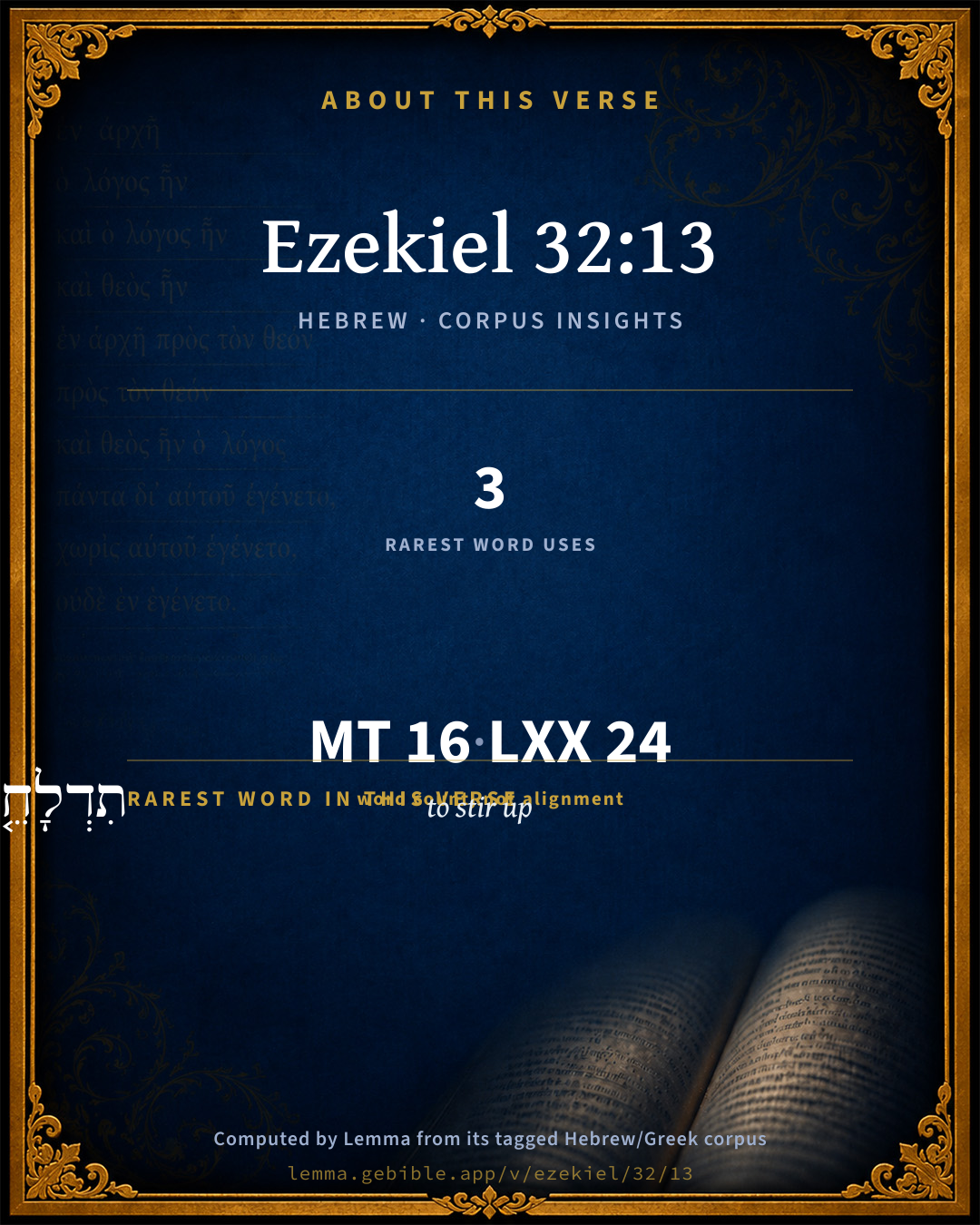
These counts appear in no published source. They are computed here, from the morphology-tagged text and Lemma’s own curated glosses. What Lemma adds →

16
words
13
distinct lemmas
Prophets
section

Notable vocabulary

The rarest word here is תִדְלָחֵ֤ם to stir up H1804 — appearing just 3 times in the whole Hebrew Bible.

Shared distinctive vocabulary

תִדְלָחֵ֤ם to stir up H1804 occurs in 2 verses of the Hebrew Bible. Also found in:

Grammatical profile

  • 3 verbs
  • 7 nouns
  • 1 adjective
  • 1 preposition
  • 1 adverb
  • 3 particles

Verb forms

  • וְהַֽאֲבַדְתִּי֙ Hiphil · Sequential Perfect
  • תִדְלָחֵ֤ם Qal · Imperfect
  • תִדְלָחֵֽם Qal · Imperfect

Repetition

Words recur within this verse — often emphatic in Hebrew:

  • בְּהֶמְתָּ֔הּ beast H929 ×2
  • תִדְלָחֵ֤ם to stir up H1804 ×2
  • וְלֹ֨א not H3808 ×2

Hebrew & Septuagint length

In English translation the verse runs 30 words from the Hebrew and 33 from the Septuagint (LXX English) — closely comparable.

A rough comparison of the two English renderings, which tokenize alike — not a word-level alignment.

Word counts can differ between the Hebrew and the Greek without any difference in meaning — e.g. the Hebrew direct-object marker אֵת has no separate Greek word, and Greek often adds the article ὁ.

In the original languages it is 16 Hebrew tokens and 24 Greek tokens — but the two are counted differently (Hebrew bundles its prefixes and suffixes into one token; the Greek is in lemma form), so that isn’t a like-for-like length.

Cross-references

5

Topical passages linked to Ezekiel 32:13 in the Treasury of Scripture Knowledge — connected by theme and wording, ordered by reader-vote popularity; previews shown in the World English Bible.

  • Ezekiel 29:11 No foot of man shall pass through it, nor foot of animal shall pass through it, neither shall it be inhabited forty years.
  • Ezekiel 29:8 Therefore thus says the Lord Yahweh: Behold, I will bring a sword on you, and will cut off from you man and animal.
  • Ezekiel 30:12 I will make the rivers dry, and will sell the land into the hand of evil men; and I will make the land desolate, and all that is therein, by the hand of strangers: I, Yahweh, have spoken it.
  • Ezekiel 32:2 Son of man, take up a lamentation over Pharaoh king of Egypt, and tell him, You were likened to a young lion of the nations: yet are you as a monster in the seas; and you did break forth with your rivers, and troubled the waters with your feet, and fouled their rivers.
  • Ezekiel 34:18 Seems it a small thing to you to have fed on the good pasture, but you must tread down with your feet the residue of your pasture? and to have drunk of the clear waters, but you must foul the residue with your feet?

Cross-references courtesy of OpenBible.info (CC BY 4.0).

Hebrew and Greek witnesses Masoretic Hebrew ↔ Greek Septuagint

The same verse in the two great witnesses to the Old Testament, shown verse-for-verse.

These are two independent witnesses, not word-aligned to each other, and the Septuagint is shown in lemma (dictionary) form.

Hebrew Ezekiel 32:13 Masoretic · Westminster Leningrad Codex

וְהַֽאֲבַדְתִּי֙ אֶת כָּל בְּהֶמְתָּ֔הּ מֵעַ֖ל מַ֣יִם רַבִּ֑ים וְלֹ֨א תִדְלָחֵ֤ם רֶֽגֶל אָדָם֙ ע֔וֹד וּפַרְס֥וֹת בְּהֵמָ֖ה לֹ֥א תִדְלָחֵֽם

I will destroy also all the animals of it from beside many waters; neither shall the foot of man trouble them any more, nor the hoofs of animals trouble them.

World English Bible · Public Domain

Greek LXX Ezekiel 32:13 Septuagint · lemma form

καί ἀποὀλλύω πᾶς ὁ κτῆνος αὐτός ἀπό ὕδωρ πολύς καί οὐ μή ταράσσω αὐτός ἔτι πούς ἄνθρωπος καί ἴχνος κτῆνος οὐ μή καταπατέω αὐτός

And I will destroy all her cattle from beside the great water; and the foot of man shall not trouble it any more, and the step of cattle shall no more trample it.

LXX2012 (modern English Septuagint) · Public Domain

Hebrew: Westminster Leningrad Codex (CC BY 4.0). Greek: Septuagint (public domain); English from LXX2012 (modern English Septuagint) (Public Domain). How the Septuagint differs from the Hebrew →

Targum (Aramaic paraphrase)

1

The Targum is the ancient Jewish Aramaic paraphrase of the Hebrew Scriptures — an interpretive translation, not the Hebrew text itself. Onkelos (literal) and Pseudo-Jonathan (expansive) render the Torah, and Jonathan the Prophets. Coverage is partial: where no permissively-licensed English translation exists for a verse, only the Aramaic is shown. This is verse-level text, not a word-by-word alignment to the Hebrew.

  1. Targum Jonathan Prophets (Joshua–Malachi)
    וְאוֹבֵיד יַת כָּל בְּעִירָהּ מֵעַל מַיִין סַגִיאִין וְלָא תְזוּעוּנוּן רַגְלֵי דֶאֱנָשָׁא עוֹד וּפַרְסַת בְּעִירָא לָא תְזוּעוּנוּן:

    (no public-domain English translation for this verse)

    Targum Jonathan — Aramaic: “Mikraot Gedolot” (public domain). English: “Sefaria Community Translation” (CC0 1.0 (public-domain dedication)); “London "Chaldee Paraphrase," 1871” (public domain). Text via Sefaria.

Commentary

Notes on Ezekiel 32:13 from classic Christian and Jewish commentators (each source and its license shown beneath its notes). The classic Christian expositions comment on the surrounding passage and are grouped to its opening verse, so a note may address several verses; the Jewish commentaries on the Tanakh (Rashi and others) are per-verse, so they appear only where the commentator wrote on this verse.

Lemma curates 59 commentaries, every one of them public domain or Creative Commons licensed, each selected and text-cleaned for this edition rather than reprinted as found. About our sources →

Trapp's Complete Commentary

John Trapp

Eze 32:13 I will destroy also all the beasts thereof from beside the great waters; neither shall the foot of man trouble them any more, nor the hoofs of beasts trouble them.

Ver. 13. All the beasts thereof.] Egypt, a most moist and fat country, was full of cattle.

John Trapp, A Commentary or Exposition upon All the Books of the Old and New Testament (1647–1656) — public domain. Text from a community e-Sword module.

Joseph Benson's Commentary

Eze 32:13-14. I will also destroy the beasts thereof — Their horses, in which they trusted so much, Isa 31:3, and other cattle, feeding in their rich pastures by the river sides. Neither shall the foot of man, nor the hoofs of beasts, &c. — The country shall be so deserted that the waters of the river shall not be fouled by man or beast. But we may understand the prophet here as speaking metaphorically, and by the beasts of Egypt, intending its armies, which had frequently troubled the neighbouring nations, but which, it is here said, should trouble them no more; for when Egypt should be made desolate, and the number both of men and beasts should be diminished by their wars and confusions, then they should neither have the will nor the power to give their neighbours any further molestation; but the nations around them should enjoy quietness, like that of a river which smoothly glides along, and never has its streams fouled or disturbed: see Eze 32:2. Then will I make their waters deep, &c. — The nations which used to be harassed and troubled by the Egyptians, shall then enjoy great peace and quietness.

Joseph Benson's Commentary on the Old and New Testaments (1811–1818) — public domain. Text from a community e-Sword module.

Jamieson, Fausset & Brown

Robert Jamieson, A. R. Fausset & David Brown

(See on Eze 29:11). The picture is ideally true, not to be interpreted by the letter. The political ascendency of Egypt was to cease with the Chaldean conquest [FAIRBAIRN]. Henceforth Pharaoh must figuratively no longer trouble the waters by man or beast, that is, no longer was he to flood other peoples with his overwhelming forces.

Jamieson, Fausset & Brown — Commentary Critical and Explanatory on the Whole Bible (1871) — public domain (CC PDM 1.0). Text via the HelloAO Bible API.

Ellicott's Commentary for English Readers

(13) Will destroy also all the beasts thereof from beside the great waters.—The figurative description of this and the following verses is taken from the vast herds of cattle in Egypt going to the river to drink, and trampling the banks and disturbing the water with their feet (comp. Eze_32:2). These represent the restless activity and stir of Egyptian life, and its constant disturbance of surrounding nations. With its conquest all this ceases, and, restrained within its own boundaries, Egypt shall no longer be a disturber.

A Bible Commentary for English Readers, edited by Charles John Ellicott (1878–1897) — public domain. Text from a community e-Sword module.

The Cambridge Bible for Schools and Colleges

gen. ed. J. J. S. Perowne

13. The desolation of Egypt shall be complete, man and beast swept away; cf. Zep_1:3. These pictures both of desolation and felicity are always ideal; cf. Eze_29:11.

The Cambridge Bible for Schools and Colleges (gen. ed. J. J. S. Perowne; Cambridge University Press, 1878–1918) — public domain. Text from a community e-Sword module.

John Gill's Exposition

I will destroy also all the beasts thereof from beside the great waters,.... Which used to graze beside the river Nile, and the canal, of it, in the plains and meadows, valley, and hills, which these ran by; meaning both horses, which Egypt abounded with, and would be good booty for the Chaldeans, and oxen and sheep, which they would kill for present use, or drive away for future service:

neither shall the foot of man trouble them any more, nor the hoofs of beasts trouble them; there should so few remain of men and beasts, that the waters of the rivers would not be disturbed, either by men passing over them, and doing any business upon them, or by beasts drinking at them.

John Gill's Exposition of the Whole Bible (1746–1763) — public domain (CC PDM 1.0). Text via the HelloAO Bible API.

Matthew Poole's English Annotations

All the beasts thereof; the sheep and oxen devoured by hungry Chaldean soldiers, or else driven away; the horses taken up to mount the horsemen of the Chaldee army, whose own horses were tired or spoiled.

Beside the great waters; the pastures lying along the river’s side, and along their canals, should be emptied of all cattle, with which once they were full.

Neither shall the foot of man throttle them; there should be so few men left in Egypt, that they should not, as formerly, disturb the waters by digging, swimming, or rowing on them; or, no more trouble the waters with the passing of mighty armies over them to invade their neighbours.

Nor the hoofs of beasts trouble them; so few horses or cows, that they should not at watering times, or in the heat of the day, foul the waters by running into them, and stamping or trampling in them; but the waters shall continue pure and undisturbed.

Matthew Poole's English Annotations on the Holy Bible (1683–1685) — public domain. Text from a community e-Sword/MySword module.

The Pulpit Commentary

Vers. 13, 14. The unvisited river; or, life at a low level.

The great river appropriately represented the great nation which it enriched; and the picture of the fall of the kingdom includes the desertion of the banks of these "great waters" by man and beast (Ver. 14); and also the sinking of the river itself: "Then will I cause their waters to subside" (Fairbairn"s translation). Such a river as the Nile may well illustrate

I A NOBLE LIFE. It is a source of beauty and fertility, and therefore of enrichment, to the land through which it runs. Itself an object of delight to the eye, it is the source of verdure all along its banks. By its overflow, or through simple agricultural appliances, it waters the whole district in which it flows, and makes all the difference between barrenness and abundance. Thousands of animals drink of it and bathe in it, while the inhabitants of town and village flock to its banks in their various necessities. A noble human life may be all this in a higher sphere.

1. It may add very considerably to that spiritual worth and beauty on which Christ looks down with Divine satisfaction.

2. It may be the source of all kinds of good of health, of sustenance, of knowledge, of wisdom, of purity, of piety; of life at its best below, of the beginning of the life eternal.

3. It is a constant source of blessing. As the river runs, not spasmodically, but night and day, continually sending forth its refreshing and nourishing moisture into the land, so a true, Christian life is incessantly and unconsciously communicating good, in many forms, to those around it.

II A LIFE PITIFULLY REDUCED. A very pitiful sight would be a river in such a state as that here imagined (rather than foreseen). Instead of being what it once was, it is now to the prophet"s eye a diminished stream, its waters are low (not deep, but sunk; the verb is properly to "sink and lie far beneath its banks; and they am such that no beast cares to drink of them; no man approaches to use them for the purposes of human life, whether of nourishment or of cleansing. The river is useless, worthless, abandoned to itself. How much more pitiable is the life that has been reduced; the life that has sunk, that moves not any longer on the higher plane of heavenly wisdom, but only on the low and muddy levels of selfishness, of covetousness, of a base indulgence; the life that has shriveled up into a poor dirty stream, no longer reflecting the beauty that is about it or the glory that is above it; the life that is unvisited, that no man cares to consult, by which no virtuous man directs his own, from which no man gains any strength, or impetus, or pure refreshment, which does no man any spiritual good; the life that is severely left alone!

III THE CAUSE OF ITS DECLINE. If any river be thus actually reduced (as in Ezekiel"s thought), it is because it is no longer fed as it once was by the rains of heaven. If a noble human life is thus reduced, it is because it is no longer supplied from above. It lacks the truth, the influences, the sustaining power, which should come to it from God. These may be cut off by some serious sin; or they may be withdrawn because we no longer keep open the channels through which they come.

1. Keep the mind open to all Divine wisdom and the heart to all holy influences.

2. Draw down the renewing rains of Heaven by constant communion and earnest prayer.

3. See that no "great transgression" diverts the waters; and the river of our life will flow on to the sea, without loss to its beauty or its power. C.

The Pulpit Commentary (1880–1919), ed. H.D.M. Spence-Jones & Joseph S. Exell — public domain. Text from a community e-Sword module.

John Wesley's Explanatory Notes

All the beasts - The sheep, and oxen devoured, or driven away: the horses taken up to mount the horsemen, whose own horses were tired, or spoiled. Great waters - The pasture lying along the river side. Trouble them - There shall be so few men left in Egypt, that they shall not as formerly, disturb the waters by digging, swimming, or rowing on them. Nor the hoofs - So few horses or cows, that they shall not at watering-times, or in the heat of the day, foul the waters.

John Wesley, Explanatory Notes Upon the Whole Bible (1754–1765) — public domain. Text via the GEBible commentary corpus.

unfoldingWord translationNotes

Door43 World Missions Community

General Information:

Yahweh continues speaking.

from beside the plentiful waters

"in the places where there is a lot of water"

the foot of man will no longer stir the waters up

The foot here is a synecdoche for the whole person. AT: "people will no longer stir the waters up with their feet" (See: Synecdoche)

stir the waters

make clear water muddy

the hooves of cattle stir them

The hoof is a synecdoche for cattle. AT: "cattle stir them with their hooves" (See: Metonymy)

Then I will calm their waters

Possible meanings are 1) "I will make the water calm" or 2) "I will make the water clear." When no one stirs up the water, the dirt settles down and the water becomes clear.

make their rivers run like oil

Oil flows slowly and smoothly. AT: "make the rivers run smoothly like oil" (See: Simile)

translationWords

livestock

hoof

cow

oil

Lord Yahweh

declare

unfoldingWord translationNotes — © Distant Shores Media and the Door43 World Missions Community, licensed CC BY-SA 4.0. Source: git.door43.org/Door43/en_tn.

Rashi

Rabbi Shlomo Yitzchaki (Rashi)

from beside...waters of other countries that you used to sully.

Rashi on the Tanakh — English translations: “The Judaica Press complete Tanach with Rashi, translated by A. J. Rosenberg” (CC BY 4.0); “Pentateuch with Rashi's commentary by M. Rosenbaum and A.M. Silbermann, 1929-1934” (public domain); “The Metsudah Tanach series, Lakewood, N.J” (CC BY 4.0); and “The Book of Joshua, Metsudah Publications, 1997” (CC BY 4.0). Text via Sefaria.

Lesson kit

Teaching starters — assembled from the data on this page, not authored interpretation. Every prompt links to the verse data it draws on. Edit before teaching.

Ezekiel, in the Prophets, opens this verse with 16 words (13 distinct Hebrew lemmas). Its most distinctive word is dâlach (“to stir up”). A historical commentator’s framing appears above. Read the whole chapter for the surrounding context.

Discussion questions

  1. The word dâlach carries the sense “to stir up.” How does it shape the verse?
  2. Ezekiel 32:2 shares the word «to stir up» with this verse. How do the two illuminate each other?
  3. “beast” occurs 2× in this one verse. What is the effect of the repetition?
  4. The translations on this page render this verse differently — a whole-verse word diff, not a word-by-word alignment. What might account for the different wordings?
  5. The verb «וְהַֽאֲבַדְתִּי֙» is Hiphil Sequential Perfect. How does its form color the action?
  6. Reading how Trapp's Complete Commentary and Joseph Benson's Commentary read this verse, where do the two commentators agree and where do they part?

Things to notice

Reading settings

Reading text

Shown beneath each verse's original-language words.

Old Testament
Old Testament edition

Read the OT as the Masoretic Hebrew (MT) or the Greek Septuagint (LXX).

English shown for the Greek Septuagint (in the Hebrew ↔ Greek comparison).

Comparing translations? Open the Compare panel on any verse page to stack up to four side by side.