
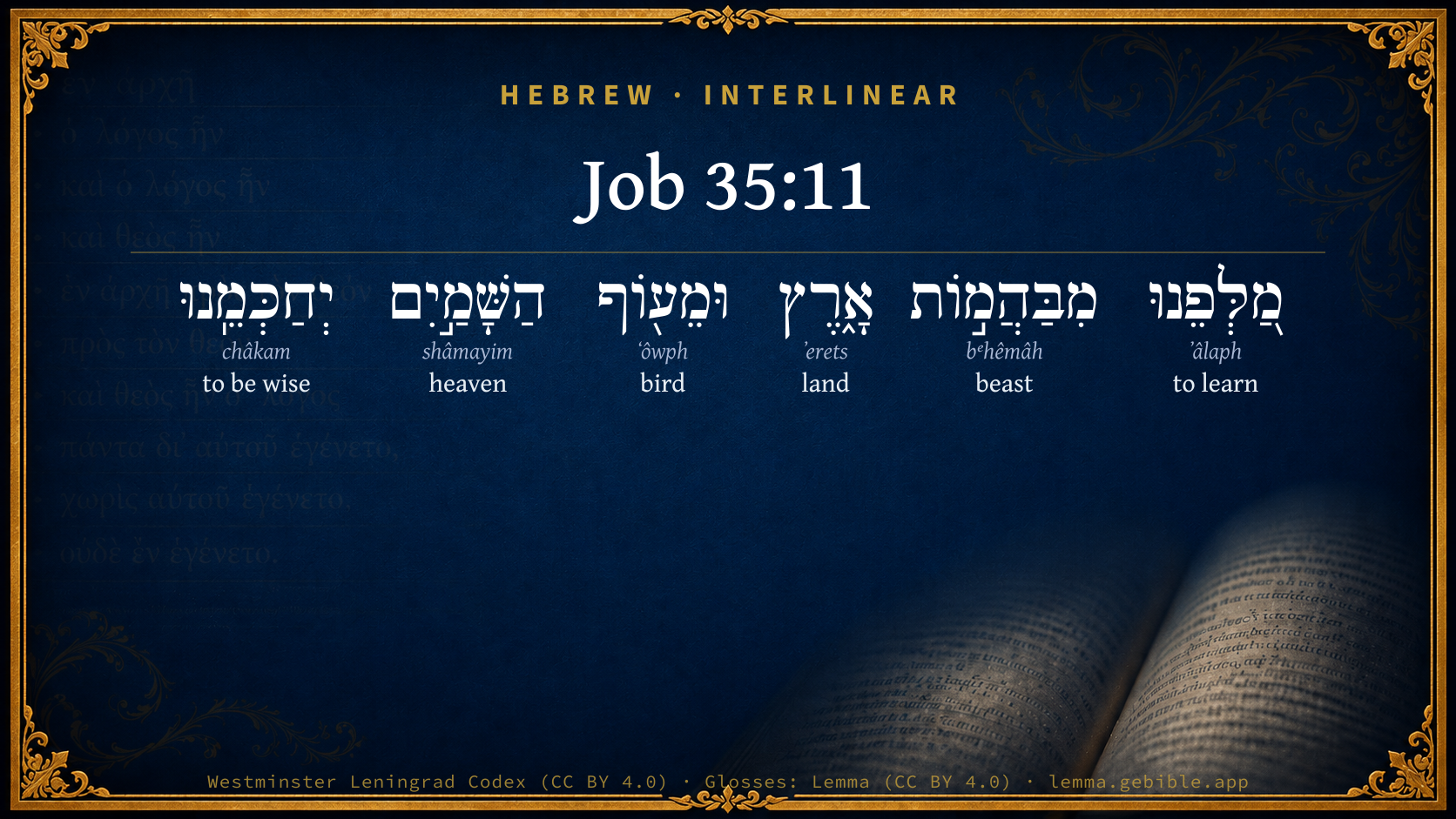
Job 35:11

Hebrew (Westminster Leningrad Codex) Job 35:11 appears in the Hebrew Old Testament. The text above is from the Westminster Leningrad Codex. Each word links to its Strong’s number, a concise gloss, and parsing drawn from the Open Scriptures Hebrew Bible morphology. Click any word for its full Brown-Driver-Briggs (BDB) entry.
Download image
Cite this verse

Job 35:11 (World English Bible). Public Domain. Lemma interlinear Bible study tool, https://lemma.gebible.app/v/job/35/11.

Show BibTeX & RIS
BibTeX
RIS
English Translation
Who teaches us more than the animals of the earth, And makes us wiser than the birds of the sky?'
World English Bible · Public Domain
Download a study sheet

One document with this verse’s original text, its word-by-word gloss line, the meaning frame, cross-references with their text, attributed commentary, and full source and license credits — printable, and it pastes into notes with its structure intact.

This verse Autodidact and up

Study sheet (.html) Plain text (.txt)

A passage Seminary Student

Up to 50 verses in one chapter. A passage sheet keeps up to 6 commentary sources and 12 cross-references per verse, in the order this page ranks them, and says so on the sheet whenever that leaves anything out. Ask for a single verse and you get the Autodidact verse sheet above.

Everything on this page stays free to read, with no account — the sheet is a download of what is already on screen, not access to it.

Want to remove ads? Support Godless Engineer
Compare translations 3

The same verse in 3 English versions, stacked beneath the original-language interlinear above. Click any original word for its lexicon entry.

Each is an independent rendering of the whole verse — the interlinear is not word-aligned to these translations.

Highlighted words mark where these versions differ — a whole-verse word diff, not a word-by-word alignment.

  • World English Bible Public Domain
    Who teaches us more than the animals of the earth, And makes us wiser than the birds of the sky?'
  • King James Version Public Domain
    Who teacheth us more than the beasts of the earth, and maketh us wiser than the fowls of heaven?
  • unfoldingWord Literal Text CC BY-SA 4.0
    the one teaching us more than the beasts of the earth, making us wiser than the birds of the heavens?’

unfoldingWord Literal Text — © unfoldingWord, licensed CC BY-SA 4.0. Word-aligned USFM3 via Door43 (git.door43.org/unfoldingWord/en_ult).

Versions to compare (up to 4)

3 of 4 selected

Show all 18 translations

Every available English version of this verse, each an independent rendering of the whole verse.

  • World English Bible Public Domain
    Who teaches us more than the animals of the earth, And makes us wiser than the birds of the sky?'
  • Berean Standard Bible Public Domain
    who teaches us more than the beasts of the earth and makes us wiser than the birds of the air?’
  • Majority Standard Bible Public Domain
    who teaches us more than the beasts of the earth and makes us wiser than the birds of the air?’
  • King James Version Public Domain
    Who teacheth us more than the beasts of the earth, and maketh us wiser than the fowls of heaven?
  • American Standard Version (1901) Public Domain
    Who teacheth us more than the beasts of the earth, And maketh us wiser than the birds of the heavens?
  • Revised Version (1885) Public Domain
    Who teacheth us more than the beasts of the earth, and maketh us wiser than the fowls of heaven?
  • Geneva Bible (1599) Public Domain
    Which teacheth vs more then the beastes of the earth, and giueth vs more wisdome then the foules of the heauen.
  • Douay-Rheims (1899) Public Domain
    Who teacheth us more than the beasts of the earth, and instructeth us more than the fowls of the air.
  • Young's Literal Translation Public Domain
    Teaching us more than the beasts of the earth, Yea, than the fowl of the heavens He maketh us wiser.'
  • Literal Standard Version CC BY-SA 4.0
    Teaching us more than the beasts of the earth, || Indeed, He makes us wiser than the bird of the heavens.
  • Unlocked Literal Bible CC BY-SA 4.0
    who teaches us more than he teaches the beasts of the earth, and who makes us wiser than the birds of the sky?'
  • unfoldingWord Literal Text CC BY-SA 4.0
    the one teaching us more than the beasts of the earth, making us wiser than the birds of the heavens?’
  • Darby Bible Public Domain
    Who teacheth us more than the beasts of the earth, and maketh us wiser than the fowl of the heavens?
  • World Messianic Bible Public Domain
    who teaches us more than the animals of the earth, and makes us wiser than the birds of the sky?’
  • Webster's Bible Public Domain
    Who teacheth us more than the beasts of the earth, and maketh us wiser than the fowls of heaven?
  • Free Bible Version CC BY-SA 4.0
    who teaches us more than the animals, and makes us wiser than the birds?’
  • Bible in Basic English Public Domain
    Who gives us more knowledge than the beasts of the earth, and makes us wiser than the birds of the heaven?
  • JPS Tanakh (1917) Public Domain
    Who teacheth us more than the beasts of the earth, and maketh us wiser than the fowls of heaven?'

Literal Standard Version (2020), Covenant Press — licensed CC BY-SA 4.0. Text via the HelloAO Bible API (eBible.org). Unlocked Literal Bible (unfoldingWord) — licensed CC BY-SA 4.0. Text via the HelloAO Bible API (eBible.org). unfoldingWord Literal Text — © unfoldingWord, licensed CC BY-SA 4.0. Word-aligned USFM3 via Door43 (git.door43.org/unfoldingWord/en_ult). Free Bible Version, Dr. Jonathan Gallagher — licensed CC BY-SA 4.0. Text via the HelloAO Bible API (eBible.org).

Word by word

More ways to search: Search by grammar → Find every occurrence → Compare this word →

Practice this passage: Drill this verse → Learn its vocabulary →

About this verse

These counts appear in no published source. They are computed here, from the morphology-tagged text and Lemma’s own curated glosses. What Lemma adds →

6
words
6
distinct lemmas
Wisdom
section

Notable vocabulary

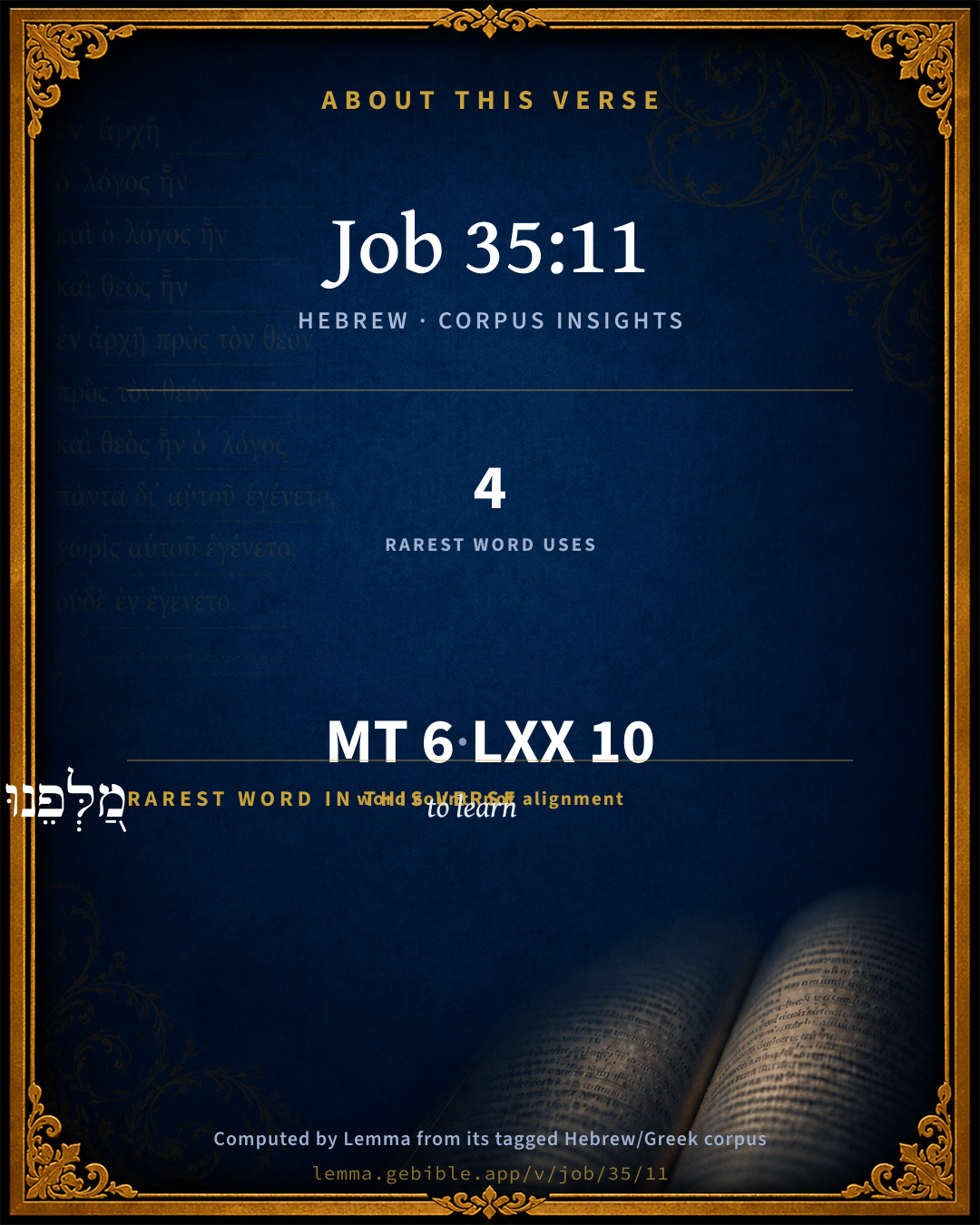
The rarest word here is מַ֭לְּפֵנוּ to learn H502 — appearing just 4 times in the whole Hebrew Bible.

Shared distinctive vocabulary

מַ֭לְּפֵנוּ to learn H502 occurs in 4 verses of the Hebrew Bible. Also found in:

Grammatical profile

  • 2 verbs
  • 4 nouns

Verb forms

  • מַ֭לְּפֵנוּ Piel · Participle Active
  • יְחַכְּמֵֽנוּ Piel · Imperfect

Hebrew & Septuagint length

In English translation the verse runs 20 words from the Hebrew and 19 from the Septuagint (LXX English) — closely comparable.

A rough comparison of the two English renderings, which tokenize alike — not a word-level alignment.

Word counts can differ between the Hebrew and the Greek without any difference in meaning — e.g. the Hebrew direct-object marker אֵת has no separate Greek word, and Greek often adds the article ὁ.

In the original languages it is 6 Hebrew tokens and 10 Greek tokens — but the two are counted differently (Hebrew bundles its prefixes and suffixes into one token; the Greek is in lemma form), so that isn’t a like-for-like length.

Cross-references

5

Topical passages linked to Job 35:11 in the Treasury of Scripture Knowledge — connected by theme and wording, ordered by reader-vote popularity; previews shown in the World English Bible.

  • Psalms 94:12 Blessed is the man whom you discipline, Yah, And teach out of your law;
  • Job 32:8 But there is a spirit in man, And the breath of the Almighty gives them understanding.
  • Job 36:22 Behold, God is exalted in his power. Who is a teacher like him?
  • Genesis 1:26 God said, "Let us make man in our image, after our likeness: and let them have dominion over the fish of the sea, and over the birds of the sky, and over the cattle, and over all the earth, and over every creeping thing that creeps on the earth."
  • Genesis 2:7 Yahweh God formed man from the dust of the ground, and breathed into his nostrils the breath of life; and man became a living soul.

Cross-references courtesy of OpenBible.info (CC BY 4.0).

Hebrew and Greek witnesses Masoretic Hebrew ↔ Greek Septuagint

The same verse in the two great witnesses to the Old Testament, shown verse-for-verse.

These are two independent witnesses, not word-aligned to each other, and the Septuagint is shown in lemma (dictionary) form.

Hebrew Job 35:11 Masoretic · Westminster Leningrad Codex

מַ֭לְּפֵנוּ מִבַּהֲמ֣וֹת אָ֑רֶץ וּמֵע֖וֹף הַשָּׁמַ֣יִם יְחַכְּמֵֽנוּ

Who teaches us more than the animals of the earth, And makes us wiser than the birds of the sky?'

World English Bible · Public Domain

Greek LXX Job 35:11 Septuagint · lemma form

ὁ διαὁρίζω ἐγώ ἀπό τετράποδος γῆ ἀπό δέ πετεινόν οὐρανός

who makes me to differ from the four-footed beasts of the earth, and from the birds of the sky?

LXX2012 (modern English Septuagint) · Public Domain

Hebrew: Westminster Leningrad Codex (CC BY 4.0). Greek: Septuagint (public domain); English from LXX2012 (modern English Septuagint) (Public Domain). How the Septuagint differs from the Hebrew →

Commentary

Notes on Job 35:11 from classic Christian and Jewish commentators (each source and its license shown beneath its notes). The classic Christian expositions comment on the surrounding passage and are grouped to its opening verse, so a note may address several verses; the Jewish commentaries on the Tanakh (Rashi and others) are per-verse, so they appear only where the commentator wrote on this verse.

Lemma curates 59 commentaries, every one of them public domain or Creative Commons licensed, each selected and text-cleaned for this edition rather than reprinted as found. About our sources →

Trapp's Complete Commentary

John Trapp

Job 35:11 Who teacheth us more than the beasts of the earth, and maketh us wiser than the fowls of heaven?

Ver. 11. Who teacheth us more than the beasts of the earth] This many wretched people never consider; and are therefore heavily, but worthily, vexed by oppressors, ut vexatio det intellectum, that smart may make wit; and that they may not bellow as beasts do when they feel pain; but flee to God by well prepared prayer, not so much for ease as for the use of what they suffer. Now, blessed is the man whom God chasteneth, and withal teacheth him out of his law; that he may give him rest from the days of adversity, Psa 94:12-13. Hereunto, not only reason is required (the mercy here mentioned, and celebrated), but religion also; which is the true philosopher’s stone that makes golden afflictions, 1Pe 1:7, and, as Moses’s hand, turneth a serpent into a rod. The truth is, religion is the highest reason (neither is anything more irrational than irreligion, 2Th 3:2), and this also God alone teacheth. For, Cathedram habet in coelo qui corda docet, saith Austin. And again, Quando Christus Magister, quam cito discitur quod docetur? It is God above who teacheth the heart; and this, if he once undertake, it is soon despatched. All this, if sinful men would well weigh, and be thankful for, as they ought, God would surely help them, and not suffer them so to be held under.

And maketh us wiser than the fowls of heaven?] Sapientificat. Some birds are very silly, as the struthiocamelus, that having thrust his head into a thicket, and seeing nobody, thinketh that therefore none seeth him, and so maketh himself a prey (Plin. l. x. c. 1). Doves sit in their dovecotes and see their nests destroyed, their young ones taken away and killed before their eyes; neither ever do they offer to rescue or revenge. Mention is made by writers of a certain nameless little bird, which, for fear lest the heavens should fall upon her, puts always, when she sleepeth, one foot upon her head (Cael. Rhod.). How much better the bird onocrotalus; of whom it is reported, that out of expectation of the hawk to grapple with her, she sleepeth with her beak exalted, as if she would contend with her adversary. Something there is that the wisest may learn from the fowls of the air, to whom, therefore, they are sent and set to school, Mat 6:26 Jer 8:7; yet generally God hath put more understanding into men; so that as he should not do like them by preying upon others, so he should not cry unto God only in distress, as the young ravens do when hunger bitten; but pray always, and in everything give thanks; for which purpose it is that God hath given us reason, speech, and much matter and means, far above the unreasonable creatures. Vae igitur stupiditati hominum in calamitatibus torpentium.

John Trapp, A Commentary or Exposition upon All the Books of the Old and New Testament (1647–1656) — public domain. Text from a community e-Sword module.

Joseph Benson's Commentary

Job 35:11. Who teacheth us more than the beasts — This is mentioned as a further aggravation of men’s neglect of God in their misery. God hath given to men those gifts which he hath denied to beasts, reason and understanding, whereby they might become acquainted with God and themselves, and with their obligations to him, and their dependance upon him. And therefore they are inexcusable for not using that reason and understanding, by calling on God, and seeking help of him in the time of trouble. If they thus take no notice of God, it is no wonder if God takes no notice of them.

Joseph Benson's Commentary on the Old and New Testaments (1811–1818) — public domain. Text from a community e-Sword module.

Jamieson, Fausset & Brown

Robert Jamieson, A. R. Fausset & David Brown

Man's spirit, which distinguishes him from the brute, is the strongest proof of God's beneficence; by the use of it we may understand that God is the Almighty helper of all sufferers who humbly seek Him; and that they err who do not so seek Him.

fowls--(see on Job 28:21).

Jamieson, Fausset & Brown — Commentary Critical and Explanatory on the Whole Bible (1871) — public domain (CC PDM 1.0). Text via the HelloAO Bible API.

Adam Clarke's Commentary

Verse 11. Who teacheth us more than the beasts] "The ox knoweth his owner, and the ass his master's crib; but Israel doth not know me, my people do not consider; " Isa 1:3. Beasts, bards, fowls, and in many cases pond-fishes, know and seem thankful to the hand that feeds them; while man, made much more noble than they, gifted with the greatest powers, privileged with the most important benefits, considers not the Lord, nor discerns the operation of his hand. Quadrupeds, reptiles, and fowls, have more gratitude to their masters than man has to his God.

Adam Clarke's Commentary on the Bible (1810–1826) — public domain. Text from a community e-Sword/MySword module.

Ellicott's Commentary for English Readers

(11) Who teacheth us.—Or it may be, Who teacheth us by, and maketh us wise by, &c. Then the sense will be that the oppression is so severe that the victims of it forget that God can give songs in the night, and that He has favoured men more than the beasts of the field, and that, as not one sparrow can fall to the ground without Him, so He has even numbered the hairs of those who are of more value to Him than many sparrows.

A Bible Commentary for English Readers, edited by Charles John Ellicott (1878–1897) — public domain. Text from a community e-Sword module.

The Cambridge Bible for Schools and Colleges

gen. ed. J. J. S. Perowne

11. God has given to men a higher wisdom than to the beasts, and communicates to them a continuous instruction through His fellowship and ways. Their appeal to heaven should not be the mere instinctive cry of suffering, but the voice of trust and submission.

The Cambridge Bible for Schools and Colleges (gen. ed. J. J. S. Perowne; Cambridge University Press, 1878–1918) — public domain. Text from a community e-Sword module.

John Gill's Exposition

Who teacheth us more than the beasts of the earth?.... Who are taught and know much, especially some of them; but not so much as man, see Isa 1:3;

and maketh us wiser than the fowls of heaven? who are wise to provide food and nests for themselves and their young; and such as are birds of passage, as the turtledove, the crane, the stork, and the swallow, to know the time of their coming and returning, see Jer 8:7. But then neither the beasts not; the fowls, though they are endowed with much knowledge and sagacity, according to their natures, yet not with reason and understanding, as men are, so as to make reflections on things they see and hear, and reason and discourse about them; nor are they capable of being taught and attaining to knowledge and wisdom as men are, by the works of God, of creation, and providence; and by the word of God, the Scriptures of truth, which are able to make men wise unto salvation; and by the Spirit of God, who teaches all things of a spiritual nature. God not only endows men with reason, but with sentiments of religion, which brutes are incapable of: he gives to men wisdom in the hidden part; he puts in them his fear, which is the beginning of wisdom; he makes them wise to know God in Christ, and to know his Son Jesus Christ, whom to know is life eternal; and he gives them knowledge of a future state, and hope of immortality and eternal life. Wherefore it becomes them to bear afflictions and oppressions with a fortitude of mind, and patiently submit to the will of God, and wait his time for deliverance, having called upon him in faith, and left their case with him; but if they only cry, as the brutes do under their burdens, it need not seem strange they are not heard and answered; since God has given them more wisdom and knowledge than they, and therefore should behave after another manner; though sometimes they act a part inferior to them, Jde 1:10.

John Gill's Exposition of the Whole Bible (1746–1763) — public domain (CC PDM 1.0). Text via the HelloAO Bible API.

Albert Barnes' Notes on the Bible

Who teacheth us more than the beasts of the earth - Who is able to teach us mere than the irrational creation; that is, in regard to the nature and design of affliction. They suffer without knowing why. They are subjected to toil and hardships; endure pain, and die, without any knowledge why all this occurs, and without any rational view of the government and plans of God. It is not, or need not be so, says Elihu, when man suffers. He is intelligent. He can understand why he is afflicted. He has only to make use of his superior endowments, and apply to his Maker, and he will see so much of the reason of his doings that he will acquiesce in the wise arrangement. Perhaps there is an implied reflection here on those who suffered generally, as if they manifested no more intelligence than the brute creation. They make no use of intellectual endowments. They do not examine the nature of the divine administration, and they do not apply to God for instruction and help. If they should do so, he would teach them so that they would acquiesce and rejoice in his government and dealings. According to this view, the meaning is, that if people suffer without relief and consolation, it is to be attributed to their stupidity and unwillingness to look to God for light and aid, and not at all to his injustice.

Albert Barnes' Notes on the Bible (1834–1885) — public domain. Text from a community e-Sword/MySword module.

Haydock's Catholic Bible Commentary

Air: and yet the wicked make not use of their understanding, to have recourse to God under distress. (Calmet)

George Leo Haydock (1774–1849), Haydock's Catholic Family Bible and Commentary, 1859 edition — public domain. Excludes Psalms (Douay-Rheims chapter numbering differs from Protestant) and Deuterocanonical books (Catholic canon only).

Matthew Poole's English Annotations

This is mentioned as a further aggravation of men’s neglect of God in their misery. God hath given to men those gifts which he hath denied to beasts, reason and religion, wisdom to know God and themselves, and their obligations to God, and their dependence upon him. And therefore it ill becometh them to lie like brute creatures, roaring and crying out in their miseries, without taking any notice of God in way of prayer or praise; and if they do so, it is no wonder if God takes no notice of them.

Matthew Poole's English Annotations on the Holy Bible (1683–1685) — public domain. Text from a community e-Sword/MySword module.

Whedon's Commentary on the Bible

Daniel D. Whedon

11. More than the beasts of the earth — The bestowment of reason and of a moral sense, and of the knowledge of God and of our duty, leads God to expect something more from us than brutish cries, such as those of the raven, (Psa_147:9,) or the thirsty cattle, (Joe_1:20,) or the hungry young lion. (Psa_104:21.) Their cries he hears, but not the cries of prayerless men.

Fowls of heaven — See note Job_12:7; Job_28:7; Job_28:21.

Daniel D. Whedon (gen. ed.), Commentary on the Old and New Testaments (1874–1909) — public domain. Text from a community e-Sword module.

The Pulpit Commentary

Who teacheth us more than the beasts of the earth, and maketh us wiser than the fowls of heaven. Elihu probably alludes to Job"s defence of his complaints as natural, like the instinctive cries of beasts and birds. (Job_6:5) God, he says, has given to man a higher nature than he has bestowal on the brutes; and this nature should teach him to carry his griefs to God in a proper spirit- a spirit of faith, piety, humility, and resignation. If men cried to him in this spirit, they would obtain an answer. If they do not obtain an answer, it must be that the proper spirit is lacking. (comp. Jam_4:3)

The superiority of men to animals.

Man is naturally superior to animals

I IN INTELLIGENCE. We cannot but admire the intelligence of the horse, the dog, the elephant, the ant. There seems to be more than instinct in these creatures; we notice in them the germs of a reasoning power, because they can adapt means to ends, accommodate themselves to fresh circumstances, and overcome unexpected difficulties. Yet man"s intelligence far exceeds that of the animal world. Two striking characteristics which are peculiar to it may be noted.

1. The supremacy of man. Man is one of the weakest and most defenceless creatures. He has not the hide of the rhinoceros, nor the horns of the bull, nor the fangs of the lion, nor the strength of any of these creatures. Yet he masters them and rules the world, simply by means of superior intelligence.

2. The progress of man. Only man among the animals advances in civilization. Ants build now as their ancestors built ages ago. Man only moves onward. The savage may seem to be as low as the baboon; but he is susceptible of an education that his humble cousin can never enjoy.

II IN CONSCIENCE. There seems to be a trace of conscience in the shame of the dog when he has done what he knows has been forbidden him. But though the animal may know shame, he does not know sin. Purity is an idea quite foreign to his nature. He may be generous, and he may sacrifice his life in devotion to his master. Yet he cannot feel the hunger and thirst after righteousness. The deep sense of sin and the great desire for holiness are peculiar to man.

III IN RELIGION. A dim religious feeling may be dawning in the dog when he raises adoring looks to his master, often to a very unworthy master like poor Caliban worshipping drunken Stephano. But the animal cannot know God. Man alone of all God"s creatures knows his Maker. All nature praises God unconsciously, only man blesses him consciously. To man it is given to feel the love of God, and to love God in return. Man is permitted to hold communion with God; he is God"s child. Nature is the work of God; man his son. Nature is dependent on her Creator; man is sustained by his Father.

IV IN DIVINE FAVOUR. This is implied by all that precedes. All the superiority of man is from God. Intelligence, conscience, and religion are Divine endowments. We could not raise ourselves above the animal world, for no creature could transcend its own nature. If our nature is superior to that of animals, this fact is wholly owing to the grace of God. But we may go further, and see that grace not only in our original creation and natural endowments, but also in our history. By his providence God has been adding to his favour. Not for the animals, but for man, and man alone, Christ came. The Incarnation was a fact of the human world, and in it man is supremely honoured by being united to God. Man is redeemed by the death of the Son of God.

V IN OBLIGATION. Much is expected from him to whom much has been given. What is innocent in the animal may be sinful in man. It is a degradation for man to sink down to animalism. Brutal violence and bestial vice are utterly unworthy of a being exalted far above the animals by nature and the grace of God. When man sinks down to the level of the animals he really falls much lower. It is an insult to innocent brutes to associate them with the habits of corrupt men. W.F.A.

The Pulpit Commentary (1880–1919), ed. H.D.M. Spence-Jones & Joseph S. Exell — public domain. Text from a community e-Sword module.

John Wesley's Explanatory Notes

Who - This is an aggravation of mens neglect of God in their misery. God hath given men, what he hath denied to beasts, wisdom to know God and themselves. Therefore they are inexcusable, for not using that wisdom, by calling on God in the time of trouble.

John Wesley, Explanatory Notes Upon the Whole Bible (1754–1765) — public domain. Text via the GEBible commentary corpus.

Rashi

Rabbi Shlomo Yitzchaki (Rashi)

Who teaches us He teaches us more wisdom than [He does] the beasts; i.e., He esteemed us and made us greater than the beasts and the birds.

Rashi on the Tanakh — English translations: “The Judaica Press complete Tanach with Rashi, translated by A. J. Rosenberg” (CC BY 4.0); “Pentateuch with Rashi's commentary by M. Rosenbaum and A.M. Silbermann, 1929-1934” (public domain); “The Metsudah Tanach series, Lakewood, N.J” (CC BY 4.0); and “The Book of Joshua, Metsudah Publications, 1997” (CC BY 4.0). Text via Sefaria.

Lesson kit

Teaching starters — assembled from the data on this page, not authored interpretation. Every prompt links to the verse data it draws on. Edit before teaching.

Job, in the Wisdom, opens this verse with 6 words (6 distinct Hebrew lemmas). Its most distinctive word is ʼâlaph (“to learn”). A historical commentator’s framing appears above. Read the whole chapter for the surrounding context.

Discussion questions

  1. The word ʼâlaph carries the sense “to learn.” How does it shape the verse?
  2. How does Job 15:5, which shares the word «to learn», read alongside this verse?
  3. These translations render this verse differently. What is at stake in choosing one wording over another?
  4. «מַ֭לְּפֵנוּ» is a Piel Participle Active verb. How does that grammatical form shape the action described?
  5. Compare how Trapp's Complete Commentary and Joseph Benson's Commentary read this verse. Where do they agree or differ?

Things to notice

Reading settings

Reading text

Shown beneath each verse's original-language words.

Old Testament
Old Testament edition

Read the OT as the Masoretic Hebrew (MT) or the Greek Septuagint (LXX).

English shown for the Greek Septuagint (in the Hebrew ↔ Greek comparison).

Comparing translations? Open the Compare panel on any verse page to stack up to four side by side.