
Joshua 8:2

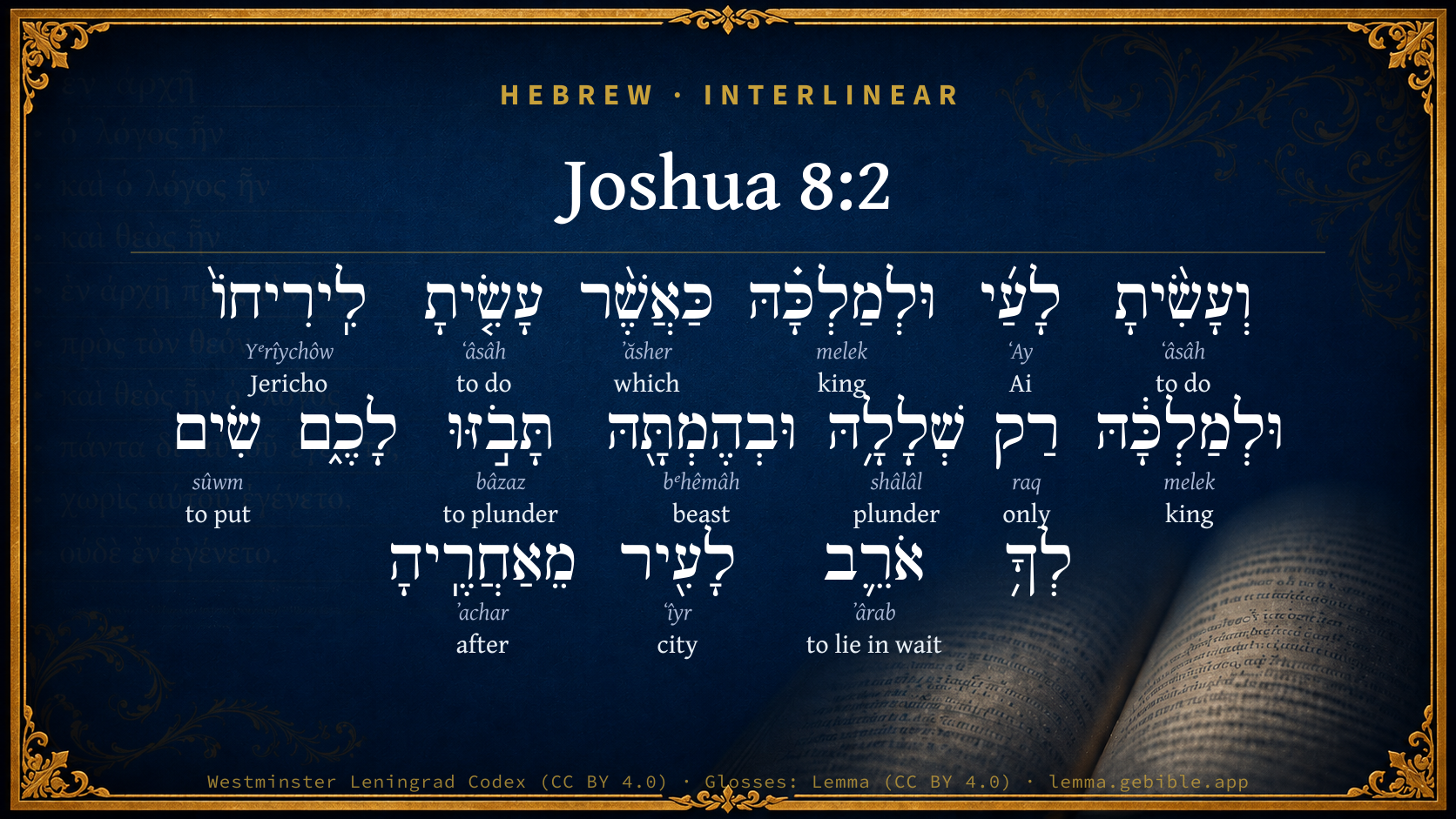
Hebrew (Westminster Leningrad Codex) Joshua 8:2 appears in the Hebrew Old Testament. The text above is from the Westminster Leningrad Codex. Each word links to its Strong’s number, a concise gloss, and parsing drawn from the Open Scriptures Hebrew Bible morphology. Click any word for its full Brown-Driver-Briggs (BDB) entry.
Download image
Cite this verse

Joshua 8:2 (World English Bible). Public Domain. Lemma interlinear Bible study tool, https://lemma.gebible.app/v/joshua/8/2.

Show BibTeX & RIS
BibTeX
RIS
English Translation
You shall do to Ai and her king as you did to Jericho and her king: only the spoil of it, and the cattle of it, shall you take for a prey to yourselves: set you an ambush for the city behind it.
World English Bible · Public Domain
Download a study sheet

One document with this verse’s original text, its word-by-word gloss line, the meaning frame, cross-references with their text, attributed commentary, and full source and license credits — printable, and it pastes into notes with its structure intact.

This verse Autodidact and up

Study sheet (.html) Plain text (.txt)

A passage Seminary Student

Up to 50 verses in one chapter. A passage sheet keeps up to 6 commentary sources and 12 cross-references per verse, in the order this page ranks them, and says so on the sheet whenever that leaves anything out. Ask for a single verse and you get the Autodidact verse sheet above.

Everything on this page stays free to read, with no account — the sheet is a download of what is already on screen, not access to it.

Want to remove ads? Support Godless Engineer
Compare translations 3

The same verse in 3 English versions, stacked beneath the original-language interlinear above. Click any original word for its lexicon entry.

Each is an independent rendering of the whole verse — the interlinear is not word-aligned to these translations.

Highlighted words mark where these versions differ — a whole-verse word diff, not a word-by-word alignment.

  • World English Bible Public Domain
    You shall do to Ai and her king as you did to Jericho and her king: only the spoil of it, and the cattle of it, shall you take for a prey to yourselves: set you an ambush for the city behind it.
  • King James Version Public Domain
    And thou shalt do to Ai and her king as thou didst unto Jericho and her king: only the spoil thereof, and the cattle thereof, shall ye take for a prey unto yourselves: lay thee an ambush for the city behind it.
  • unfoldingWord Literal Text CC BY-SA 4.0
    And you shall do to Ai and its king just as you did to Jericho and its king, except you may plunder its spoil and its livestock for yourselves. Set for yourselves an ambush against the city from behind it.”

unfoldingWord Literal Text — © unfoldingWord, licensed CC BY-SA 4.0. Word-aligned USFM3 via Door43 (git.door43.org/unfoldingWord/en_ult).

Versions to compare (up to 4)

3 of 4 selected

Show all 18 translations

Every available English version of this verse, each an independent rendering of the whole verse.

  • World English Bible Public Domain
    You shall do to Ai and her king as you did to Jericho and her king: only the spoil of it, and the cattle of it, shall you take for a prey to yourselves: set you an ambush for the city behind it.
  • Berean Standard Bible Public Domain
    And you shall do to Ai and its king as you did to Jericho and its king, except that you may carry off their plunder and livestock for yourselves. Set up an ambush behind the city.”
  • Majority Standard Bible Public Domain
    And you shall do to Ai and its king as you did to Jericho and its king, except that you may carry off their plunder and livestock for yourselves. Set up an ambush behind the city.”
  • King James Version Public Domain
    And thou shalt do to Ai and her king as thou didst unto Jericho and her king: only the spoil thereof, and the cattle thereof, shall ye take for a prey unto yourselves: lay thee an ambush for the city behind it.
  • American Standard Version (1901) Public Domain
    And thou shalt do to Ai and her king as thou didst unto Jericho and her king: only the spoil thereof, and the cattle thereof, shall ye take for a prey unto yourselves: set thee an ambush for the city behind it.
  • Revised Version (1885) Public Domain
    And thou shalt do to Ai and her king as thou didst unto Jericho and her king: only the spoil thereof, and the cattle thereof, shall ye take for a prey unto yourselves: set thee an ambush for the city behind it.
  • Geneva Bible (1599) Public Domain
    And thou shalt doe to Ai and to the King thereof, as thou didst vnto Iericho and to the King thereof: neuerthelesse the spoyle thereof and the cattell thereof shall ye take vnto you for a praye: thou shalt lye in wait against the citie on the backside thereof.
  • Douay-Rheims (1899) Public Domain
    And thou shalt do to the city of Hai, and to the king thereof, as thou hast done to Jericho, and to the king thereof: but the spoils and all the cattle you shall take for a prey to yourselves: lay an ambush for the city behind it.
  • Young's Literal Translation Public Domain
    and thou hast done to Ai and to her king as thou hast done to Jericho and to her king; only, its spoil and its cattle ye spoil for yourselves; set for thee an ambush for the city at its rear.'
  • Literal Standard Version CC BY-SA 4.0
    and you have done to Ai and to her king as you have done to Jericho and to her king; only spoil its spoil and its livestock for yourselves; for you set an ambush for the city at its rear.”
  • Unlocked Literal Bible CC BY-SA 4.0
    You will do to Ai and her king as you have done to Jericho and her king, except that you will take the plunder and the cattle for yourselves. Set an ambush behind the city.”
  • unfoldingWord Literal Text CC BY-SA 4.0
    And you shall do to Ai and its king just as you did to Jericho and its king, except you may plunder its spoil and its livestock for yourselves. Set for yourselves an ambush against the city from behind it.”
  • Darby Bible Public Domain
    And thou shalt do to Ai and to its king as thou didst to Jericho and to its king; only, the spoil thereof and the cattle thereof shall ye take as prey for yourselves. Set an ambush against the city behind it.
  • World Messianic Bible Public Domain
    You shall do to Ai and her king as you did to Jericho and her king, except you shall take its goods and its livestock for yourselves. Set an ambush for the city behind it.”
  • Webster's Bible Public Domain
    And thou shalt do to Ai and her king, as thou didst to Jericho and her king: only its spoil, and its cattle, shall ye take for a prey to yourselves: lay thee an ambush for the city behind it.
  • Free Bible Version CC BY-SA 4.0
    You will do to Ai and its king what you did to Jericho and its king. However, this time you may keep for yourselves the plunder and the livestock. Set up an ambush behind the town.”
  • Bible in Basic English Public Domain
    And you are to do to Ai and its king as you did to Jericho and its king: but their goods and their cattle you may take for yourselves: let a secret force be stationed to make a surprise attack on the town from the back.
  • JPS Tanakh (1917) Public Domain
    And thou shalt do to Ai and her king as thou didst unto Jericho and her king; only the spoil thereof, and the cattle thereof, shall ye take for a prey unto yourselves; set thee an ambush for the city behind it.'

Literal Standard Version (2020), Covenant Press — licensed CC BY-SA 4.0. Text via the HelloAO Bible API (eBible.org). Unlocked Literal Bible (unfoldingWord) — licensed CC BY-SA 4.0. Text via the HelloAO Bible API (eBible.org). unfoldingWord Literal Text — © unfoldingWord, licensed CC BY-SA 4.0. Word-aligned USFM3 via Door43 (git.door43.org/unfoldingWord/en_ult). Free Bible Version, Dr. Jonathan Gallagher — licensed CC BY-SA 4.0. Text via the HelloAO Bible API (eBible.org).

Word by word

More ways to search: Search by grammar → Find every occurrence → Compare this word →

Practice this passage: Drill this verse → Learn its vocabulary →

לָעַ֜י
ʻAy
H5857
“to/for · Ai”
Preposition + Noun, Proper
Part of Speech
Preposition + Noun
Type
Proper
Full BDB Definition

Origin: for H5856

TWOT: None

Ai or Aija or Aiath or Hai = "heap of ruins" - a city lying east of Bethel and beside Bethaven near Jericho and the 2nd city taken on the invasion of Canaan - a city of the Ammonites on the east of the Jordan and apparently attached to Heshbon
  1. וְעָשִׂ֨יתָ ʻâsâh H6213 “and · to do” Conjunction + Verb, Qal, Sequential Perfect, 2nd Person, Masculine, Singular
  2. וּלְמַלְכָּ֗הּ melek H4428 “and · to/for · king · her” Conjunction + Preposition + Noun, Common, Masculine, Singular, Construct + Suffix, Personal, 3rd Person, Feminine, Singular
  3. כַּאֲשֶׁ֨ר ʼăsher H834 “like/as · which” Preposition + Particle, Relative
  4. עָשִׂ֤יתָ ʻâsâh H6213 “to do” Verb, Qal, Perfect, 2nd Person, Masculine, Singular
  5. לִֽירִיחוֹ֙ Yᵉrîychôw H3405 “to/for · Jericho” Preposition + Noun, Proper
  6. וּלְמַלְכָּ֔הּ melek H4428 “and · to/for · king · her” Conjunction + Preposition + Noun, Common, Masculine, Singular, Construct + Suffix, Personal, 3rd Person, Feminine, Singular
  7. רַק raq H7535 “only” Particle, Accusative
  8. שְׁלָלָ֥הּ shâlâl H7998 “plunder · her” Noun, Common, Masculine, Singular, Construct + Suffix, Personal, 3rd Person, Feminine, Singular
  9. וּבְהֶמְתָּ֖הּ bᵉhêmâh H929 “and · beast · her” Conjunction + Noun, Common, Feminine, Singular, Construct + Suffix, Personal, 3rd Person, Feminine, Singular
  10. תָּבֹ֣זּוּ bâzaz H962 “to plunder” Verb, Qal, Imperfect, 2nd Person, Masculine, Plural
  11. שִׂים sûwm H7760 “put” Verb, Qal, Imperative, 2nd Person, Masculine, Singular
  12. אֹרֵ֛ב ʼârab H693 “lying in wait” Verb, Qal, Participle Active, Masculine, Singular, Absolute
  13. לָעִ֖יר ʻîyr H5892 “to/for the · city” Preposition, Determined + Noun, Common, Feminine, Singular, Absolute
  14. מֵאַחֲרֶֽיהָ ʼachar H310 “from · after · her” Preposition + Preposition + Suffix, Personal, 3rd Person, Feminine, Singular

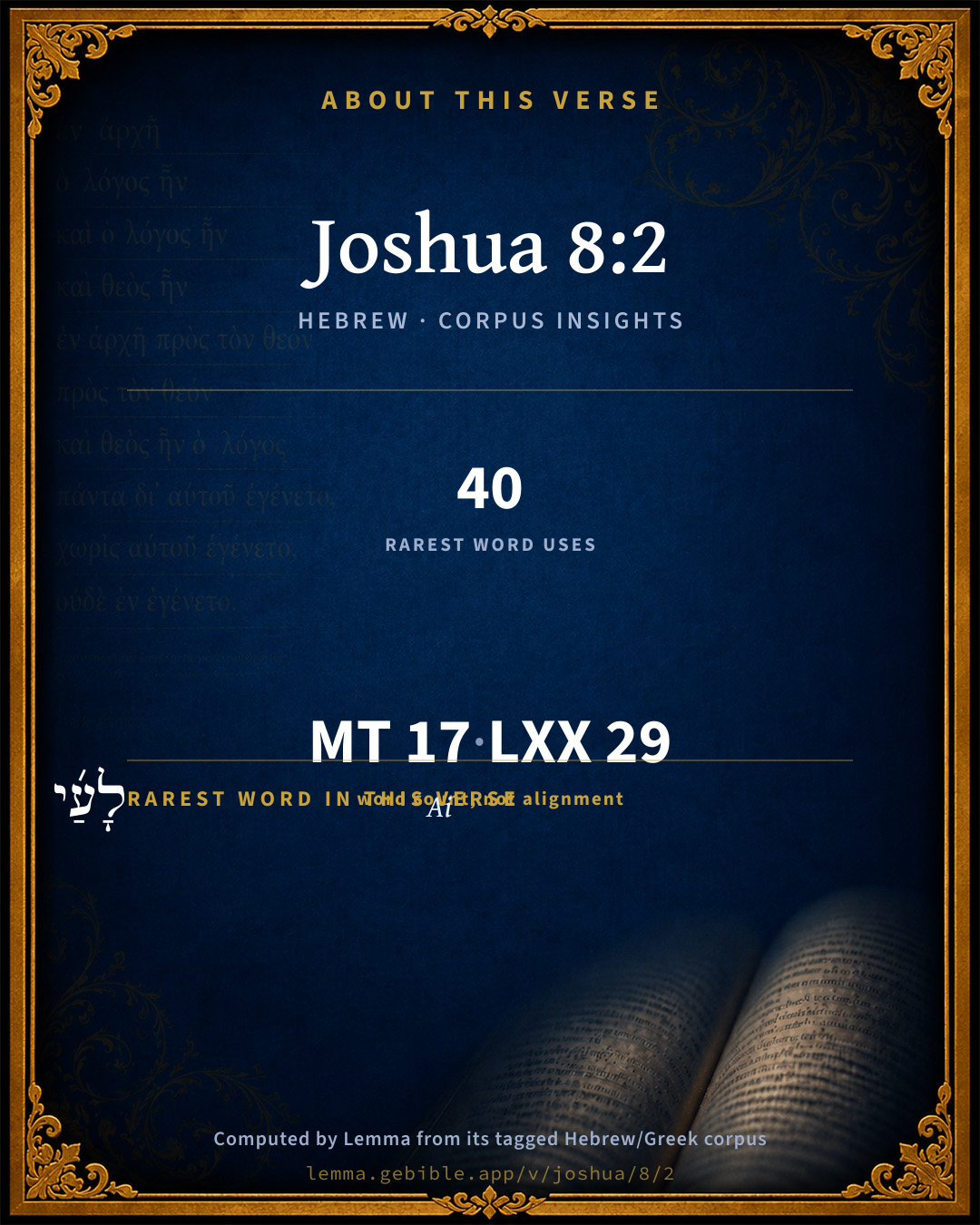
About this verse

These counts appear in no published source. They are computed here, from the morphology-tagged text and Lemma’s own curated glosses. What Lemma adds →

17
words
13
distinct lemmas
Historical
section

Shared distinctive vocabulary

לָעַ֜י Ai H5857 occurs in 34 verses of the Hebrew Bible. Also found in:

Grammatical profile

  • 5 verbs
  • 7 nouns
  • 3 prepositions
  • 2 particles

Verb forms

  • וְעָשִׂ֨יתָ Qal · Sequential Perfect
  • עָשִׂ֤יתָ Qal · Perfect
  • תָּבֹ֣זּוּ Qal · Imperfect
  • שִׂים Qal · Imperative
  • אֹרֵ֛ב Qal · Participle Active

Repetition

Words recur within this verse — often emphatic in Hebrew:

  • וְעָשִׂ֨יתָ to do H6213 ×2
  • וּלְמַלְכָּ֗הּ king H4428 ×2

Hebrew & Septuagint length

In English translation the verse runs 43 words from the Hebrew and 35 from the Septuagint (LXX English) — closely comparable.

A rough comparison of the two English renderings, which tokenize alike — not a word-level alignment.

Word counts can differ between the Hebrew and the Greek without any difference in meaning — e.g. the Hebrew direct-object marker אֵת has no separate Greek word, and Greek often adds the article ὁ.

In the original languages it is 17 Hebrew tokens and 29 Greek tokens — but the two are counted differently (Hebrew bundles its prefixes and suffixes into one token; the Greek is in lemma form), so that isn’t a like-for-like length.

Cross-references

22

Topical passages linked to Joshua 8:2 in the Treasury of Scripture Knowledge — connected by theme and wording, ordered by reader-vote popularity; previews shown in the World English Bible.

  • Deuteronomy 20:14 but the women, and the little ones, and the cattle, and all that is in the city, even all the spoil of it, shall you take for a prey to yourself; and you shall eat the spoil of your enemies, which Yahweh your God has given you.
  • Joshua 6:21 They utterly destroyed all that was in the city, both man and woman, both young and old, and ox, and sheep, and donkey, with the edge of the sword.
  • 2 Chronicles 20:22 When they began to sing and to praise, Yahweh set liers-in-wait against the children of Ammon, Moab, and Mount Seir, who had come against Judah; and they were struck.
  • Proverbs 13:22 A good man leaves an inheritance to his children's children, But the wealth of the sinner is stored for the righteous.
  • Deuteronomy 3:2 Yahweh said to me, Don't fear him; for I have delivered him, and all his people, and his land, into your hand; and you shall do to him as you did to Sihon king of the Amorites, who lived at Heshbon.
  • Joshua 8:7 and you shall rise up from the ambush, and take possession of the city: for Yahweh your God will deliver it into your hand.
  • Joshua 8:9 Joshua sent them forth; and they went to set up the ambush, and stayed between Bethel and Ai, on the west side of Ai: but Joshua lodged that night among the people.
  • Joshua 8:12 He took about five thousand men, and set them in ambush between Bethel and Ai, on the west side of the city.
  • Joshua 8:14 It happened, when the king of Ai saw it, that they hurried and rose up early, and the men of the city went out against Israel to battle, he and all his people, at the time appointed, before the Arabah; but he didn't know that there was an ambush against him behind the city.
  • Joshua 8:19 The ambush arose quickly out of their place, and they ran as soon as he had stretched out his hand, and entered into the city, and took it; and they hurried and set the city on fire.
  • Joshua 8:24 It happened, when Israel had made an end of killing all the inhabitants of Ai in the field, in the wilderness in which they pursued them, and they were all fallen by the edge of the sword, until they were consumed, that all Israel returned to Ai, and struck it with the edge of the sword.
  • Joshua 8:27–29 Only the cattle and the spoil of that city Israel took for prey to themselves, according to the word of Yahweh which he commanded Joshua.
  • Joshua 10:1 Now it happened, when Adoni-zedek king of Jerusalem heard how Joshua had taken Ai, and had utterly destroyed it; as he had done to Jericho and her king, so he had done to Ai and her king; and how the inhabitants of Gibeon had made peace with Israel, and were among them;
  • Joshua 10:28 Joshua took Makkedah on that day, and struck it with the edge of the sword, and the king of it: he utterly destroyed them and all the souls who were therein; he left none remaining; and he did to the king of Makkedah as he had done to the king of Jericho.
  • Judges 20:29–33 Israel set liers-in-wait against Gibeah round about.
  • 2 Chronicles 13:13 But Jeroboam caused an ambush to come about behind them: so they were before Judah, and the ambush was behind them.
  • Job 27:16–17 Though he heap up silver as the dust, And prepare clothing as the clay;
  • Psalms 39:6 "Surely every man walks like a shadow. Surely they busy themselves in vain. He heaps up, and doesn't know who shall gather.
  • Proverbs 28:20 A faithful man is rich with blessings; But one who is eager to be rich will not go unpunished.
  • Jeremiah 17:11 As the partridge that sits on [eggs] which she has not laid, so is he who gets riches, and not by right; in the midst of his days they shall leave him, and at his end he shall be a fool.
  • Jeremiah 51:12 Set up a standard against the walls of Babylon, make the watch strong, set the watchmen, prepare the ambushes; for Yahweh has both purposed and done that which he spoke concerning the inhabitants of Babylon.
  • Luke 12:20–21 "But God said to him, 'You foolish one, tonight your soul is required of you. The things which you have prepared--whose will they be?'

Cross-references courtesy of OpenBible.info (CC BY 4.0).

Hebrew and Greek witnesses Masoretic Hebrew ↔ Greek Septuagint

The same verse in the two great witnesses to the Old Testament, shown verse-for-verse.

These are two independent witnesses, not word-aligned to each other, and the Septuagint is shown in lemma (dictionary) form.

Hebrew Joshua 8:2 Masoretic · Westminster Leningrad Codex

וְעָשִׂ֨יתָ לָעַ֜י וּלְמַלְכָּ֗הּ כַּאֲשֶׁ֨ר עָשִׂ֤יתָ לִֽירִיחוֹ֙ וּלְמַלְכָּ֔הּ רַק שְׁלָלָ֥הּ וּבְהֶמְתָּ֖הּ תָּבֹ֣זּוּ לָכֶ֑ם שִׂים לְךָ֥ אֹרֵ֛ב לָעִ֖יר מֵאַחֲרֶֽיהָ

You shall do to Ai and her king as you did to Jericho and her king: only the spoil of it, and the cattle of it, shall you take for a prey to yourselves: set you an ambush for the city behind it.

World English Bible · Public Domain

Greek LXX Joshua 8:2 Septuagint · lemma form

καί ποιέω ὁ γαι ὅς τρόπος ποιέω ὁ ιεριχω καί ὁ βασιλεύς αὐτός καί ὁ προνομή ὁ κτῆνος προνομεύω σεαυτοῦ καταἵστημι δέ σεαυτοῦ ἔνεδρον ὁ πόλις εἰς ὁ ὀπίσω

And you shall do to Gai, as you did to Jericho and its king; and you shall take to yourself the spoil of its cattle; set now for yourself an ambush for the city behind.

LXX2012 (modern English Septuagint) · Public Domain

Hebrew: Westminster Leningrad Codex (CC BY 4.0). Greek: Septuagint (public domain); English from LXX2012 (modern English Septuagint) (Public Domain). How the Septuagint differs from the Hebrew →

Targum (Aramaic paraphrase)

1

The Targum is the ancient Jewish Aramaic paraphrase of the Hebrew Scriptures — an interpretive translation, not the Hebrew text itself. Onkelos (literal) and Pseudo-Jonathan (expansive) render the Torah, and Jonathan the Prophets. Coverage is partial: where no permissively-licensed English translation exists for a verse, only the Aramaic is shown. This is verse-level text, not a word-by-word alignment to the Hebrew.

  1. Targum Jonathan Prophets (Joshua–Malachi)
    וְתַעְבֵּיד לְעַי וּלְמַלְכָּה כְּמָא דַעֲבַדְתָּ לִירִיחוֹ וּלְמַלְכָּהּ לְחוֹד עֲדָאָהּ וּבְעִירָהּ תִּבְזוֹן לְכוֹן אַתְקַן לָךְ כְּמָנָא לְקַרְתָּא מֵאֲחוֹרָאָה:

    (no public-domain English translation for this verse)

    Targum Jonathan — Aramaic: “Mikraot Gedolot” (public domain). English: “Sefaria Community Translation” (CC0 1.0 (public-domain dedication)); “London "Chaldee Paraphrase," 1871” (public domain). Text via Sefaria.

Commentary

Notes on Joshua 8:2 from classic Christian and Jewish commentators (each source and its license shown beneath its notes). The classic Christian expositions comment on the surrounding passage and are grouped to its opening verse, so a note may address several verses; the Jewish commentaries on the Tanakh (Rashi and others) are per-verse, so they appear only where the commentator wrote on this verse.

Lemma curates 59 commentaries, every one of them public domain or Creative Commons licensed, each selected and text-cleaned for this edition rather than reprinted as found. About our sources →

Trapp's Complete Commentary

John Trapp

Jos 8:2 And thou shalt do to Ai and her king as thou didst unto Jericho and her king: only the spoil thereof, and the cattle thereof, shall ye take for a prey unto yourselves: lay thee an ambush for the city behind it.

Ver. 2. Lay thee an ambush behind it.] Dolus an virtus, quis in hoste requirat? If the war be just, the use of stratagems is unquestionably warrantable. Of Decebalus, king of Dacians, in Domitian’s time, a valiant and wise warrior, it is thus storied, Noverat optime insidias faeere, proelium committere, optime uti victoria, et acceptam cladem ferre moderate; He well knew how to lay an ambush, pitch a field, use a victory, take a defeat. {a}

{a} Dio, in Dom.

John Trapp, A Commentary or Exposition upon All the Books of the Old and New Testament (1647–1656) — public domain. Text from a community e-Sword module.

Joseph Benson's Commentary

Jos 8:2. Thou shalt do to Ai — as thou didst unto Jericho — That is, overcome and destroy the city and people. This was enjoined to chastise their last insolence, and the triumphs and blasphemies which doubtless their success had produced: and to revive the dread and terror which had been impressed upon the Canaanites by Jericho’s ruin, and had been much abated by the late success of Ai. The spoil thereof — shall ye take for a prey — Neither the silver nor gold, nor any thing else, was separated to the use of the tabernacle, nor ordered to be destroyed, but the people were to enjoy it entirely themselves.

Lay thee an ambush for the city behind it — Ai was not to be taken by miracle, as Jericho had been; now they must exercise their own wisdom. Having seen God work for them, whereby they might learn to depend on him, and give him the glory of all their success, they must now exert themselves, and be inured to self-denial and diligence, and to labour, toil, and hardship. And they must learn to outwit as well as to overpower their enemies. God himself commands them to take the town by stratagem; and therefore we may be sure that to do the like is lawful in other wars. But it must be well observed that no treaty was here violated, no oath or promise broken, no untruth told: to do any thing of this kind cannot be allowable or excusable in any war or case whatsoever. Nay, nothing was here concealed by the Israelites but their own counsels, which surely their enemies had no right to be intrusted with; nothing was dissembled and nothing counterfeited but a retreat, which was no necessary indication at all of their inability to maintain their attack, or of a design not to renew it. Common prudence, had they been governed by it, would have directed the men of Ai to have been upon their guard, and either to have kept within their own walls, or at least not to have ventured forward rashly in pursuit of an army which they saw to be very superior to them in number.

Joseph Benson's Commentary on the Old and New Testaments (1811–1818) — public domain. Text from a community e-Sword module.

Tyndale Open Study Notes

Tyndale Open Resources

8:2 Unlike other ancient nations, who went to war to gain wealth, Israel served as God’s agent of judgment upon the Canaanites; the plunder and the livestock were incidental. • The strategy for capturing Ai was to plan an ambush. Joshua executed God’s simple instructions well. • behind the town: On its west side (8:12).

Tyndale Open Study Notes — © Tyndale Open Resources, licensed CC BY-SA 4.0. Text via the HelloAO Bible API.

Geneva Bible (1599)

Geneva Bible translators

Meaning, on the West side, as verse 9.

Geneva Bible (1599) marginal notes — public domain. Text via Bolls.life.

Ellicott's Commentary for English Readers

(2) Only the spoil thereof, and the cattle thereof, shall ye take—i.e., the material spoil, not the persons of the inhabitants. (See Jos_11:14.) Jericho was treated exceptionally, in that the material spoil was made chêrem, devoted to destruction, as the thing accursed of God.

A Bible Commentary for English Readers, edited by Charles John Ellicott (1878–1897) — public domain. Text from a community e-Sword module.

The Cambridge Bible for Schools and Colleges

gen. ed. J. J. S. Perowne

2. the spoil thereof] unlike the case of Jericho, is formally conceded to the Israelites.

an ambush] “Put busshementis to the citye bihynde it,” Wyclif. Literally a weaver, a lier in wait, from arab, to weave = “nectere insidias, struere dolos.”

for the city behind it] High up, probably in the main ravine between Ai and Bethel. “Ai must be somewhere between Michmash and Rimmon, a region greatly cut up with gorges and ravines; and as I passed from Beit-în toward Michmash, I could easily understand how Joshua’s ambush of 5000 men could lie hid between Ai and Bethel.” Thomson’s Land and the Book, p. 671.

The Cambridge Bible for Schools and Colleges (gen. ed. J. J. S. Perowne; Cambridge University Press, 1878–1918) — public domain. Text from a community e-Sword module.

John Gill's Exposition

And thou shalt do to Ai and her king as thou didst to Jericho and her king,.... Burn the one and slay the other:

only the spoil thereof, and the cattle thereof, shall ye take for a prey unto yourselves; which they were not allowed to do at Jericho:

lay thee an ambush for the city behind it; at the west side of it: some have called in question the lawfulness of the ambush, but, as this was appointed by the Lord, there is no room for it.

John Gill's Exposition of the Whole Bible (1746–1763) — public domain (CC PDM 1.0). Text via the HelloAO Bible API.

Haydock's Catholic Bible Commentary

King. There was this difference, that the king of Hai was to be gibbeted, and his corpse stoned, while the city was to be plundered by the Israelites. --- It. This mode of warfare is equally just, as if the enemy was attacked in the open field. Dolus an virtus quis in hoste requirat? (Virgil) --- God was pleased to authorize it on this occasion, that his people might be less exposed, being under some apprehensions on account of the former defeat. Some nations have preferred to encounter the enemy openly. (Grotius, Jur. iii. 1, 20.) But their example is no law for others. "When the war is just, it matters not whether a person gain the victory by open fighting or by stratagem." (St. Augustine, q. 10.) "It is often prudent to conceal the truth." (contra Mend. x.) People engaged in warfare, allow each other to take such advantages. God could easily have routed these few men by means of the army of Israel, or by a miracle, as he did at Jericho. (Haydock) --- But he is at liberty to act as he thinks proper. The ambush was laid on the south-west side of Hai, so that those of Bethel might not perceive it, as they came out to the assistance of their countrymen, ver. 17. Five thousand were placed in one place, and 25,000 in another, while the main body of the army, under Josue, took a circuit by the east, and came to attack the city on the north side. (Calmet)

George Leo Haydock (1774–1849), Haydock's Catholic Family Bible and Commentary, 1859 edition — public domain. Excludes Psalms (Douay-Rheims chapter numbering differs from Protestant) and Deuterocanonical books (Catholic canon only).

Matthew Poole's English Annotations

To Ai, i.e. the city and people of Ai.

As thou didst unto Jericho and her king, i.e. overcome and destroy them. This was enjoined, partly to chastise their last insolence, and the triumphs and blasphemies which doubtless their success produced; and partly to revive the dread and terror which had been impressed upon the Canaanites by Jericho’s ruin, and had been much abated by the late success of Ai, and their confidence and expectation of further and greater success much raised.

Matthew Poole's English Annotations on the Holy Bible (1683–1685) — public domain. Text from a community e-Sword/MySword module.

Whedon's Commentary on the Bible

Daniel D. Whedon

2. Only the spoil thereof… shall ye take — The spoils of Jericho had been devoted wholly to the Lord, as the first fruits of the conquest of Canaan. But the spoils of Ai and of the other conquered cities (Deu_6:10-11) are now to be appropriated unto the conquerors. The people and their king are to be slain and their city subverted. There was, henceforth, to be no temptation to the sin of Achan. Had he waited obediently and refrained from the accursed thing he might now have innocently enriched himself. So sin generally misses the mark.

Lay thee an ambush — If war itself is ever justifiable, it is right to use the mind as well as the hand, strategy as well as brute force. It is certain that a contest of wit is as proper as a contest of muscle. Says Calvin: “Those are pronounced the best generals whose success is due less to force than to skilful manoeuvres. It is, of course, understood that neither must treaties be violated, nor faith broken in any other way.”

Behind it — As Joshua was east of Ai, the ambuscade, by a flank movement up one of the numerous ravines, was to be made on the west side of the city. See note on Jos_8:9.

Daniel D. Whedon (gen. ed.), Commentary on the Old and New Testaments (1874–1909) — public domain. Text from a community e-Sword module.

The Pulpit Commentary

Only the spoil thereof. Ai was not solemnly devoted, like Jericho, though (see Deu_20:16, Deu_20:17) the Canaanitish people were. Behind it. Joshua was advancing from the southeast. The ambush (breao literally, "a lier in wait," here a band of liers in wait, the word itself originally signifying to plait, weave, hence to design) was therefore (ver. 12) on the opposite, or west side of the city. The question which has been raised whether God could rightly command a stratagem seems scarcely to require discussion.

The Pulpit Commentary (1880–1919), ed. H.D.M. Spence-Jones & Joseph S. Exell — public domain. Text from a community e-Sword module.

John Wesley's Explanatory Notes

To Ai - That is, the city and people of Ai. Unto Jericho and her king - That is, overcome and destroy them. This was enjoined to chastise their last insolence, and the triumphs and blasphemies which doubtless their success had produced: and to revive the dread and terror which had been impressed upon the Canaanites by Jericho's ruin, and had been much abated by the late success of Ai.

John Wesley, Explanatory Notes Upon the Whole Bible (1754–1765) — public domain. Text via the GEBible commentary corpus.

Rashi

Rabbi Shlomo Yitzchaki (Rashi)

Take for yourselves as booty. You shall no longer consecrate the spoils.

Rashi on the Tanakh — English translations: “The Judaica Press complete Tanach with Rashi, translated by A. J. Rosenberg” (CC BY 4.0); “Pentateuch with Rashi's commentary by M. Rosenbaum and A.M. Silbermann, 1929-1934” (public domain); “The Metsudah Tanach series, Lakewood, N.J” (CC BY 4.0); and “The Book of Joshua, Metsudah Publications, 1997” (CC BY 4.0). Text via Sefaria.

Lesson kit

Teaching starters — assembled from the data on this page, not authored interpretation. Every prompt links to the verse data it draws on. Edit before teaching.

Joshua, in the Historical, opens this verse with 17 words (13 distinct Hebrew lemmas). Its most distinctive word is ʻAy (“Ai”). A historical commentator’s framing appears above. Read the whole chapter for the surrounding context.

Discussion questions

  1. What does “Ai” (ʻAy) contribute to the verse as a whole?
  2. Genesis 12:8 shares the word «Ai» with this verse. How do the two illuminate each other?
  3. “to do” occurs 2× in this one verse. What is the effect of the repetition?
  4. The translations on this page render this verse differently — a whole-verse word diff, not a word-by-word alignment. What might account for the different wordings?
  5. The verb «וְעָשִׂ֨יתָ» is Qal Sequential Perfect. How does its form color the action?
  6. Reading how Trapp's Complete Commentary and Joseph Benson's Commentary read this verse, where do the two commentators agree and where do they part?

Things to notice

Reading settings

Reading text

Shown beneath each verse's original-language words.

Old Testament
Old Testament edition

Read the OT as the Masoretic Hebrew (MT) or the Greek Septuagint (LXX).

English shown for the Greek Septuagint (in the Hebrew ↔ Greek comparison).

Comparing translations? Open the Compare panel on any verse page to stack up to four side by side.