Deuteronomy 4:17

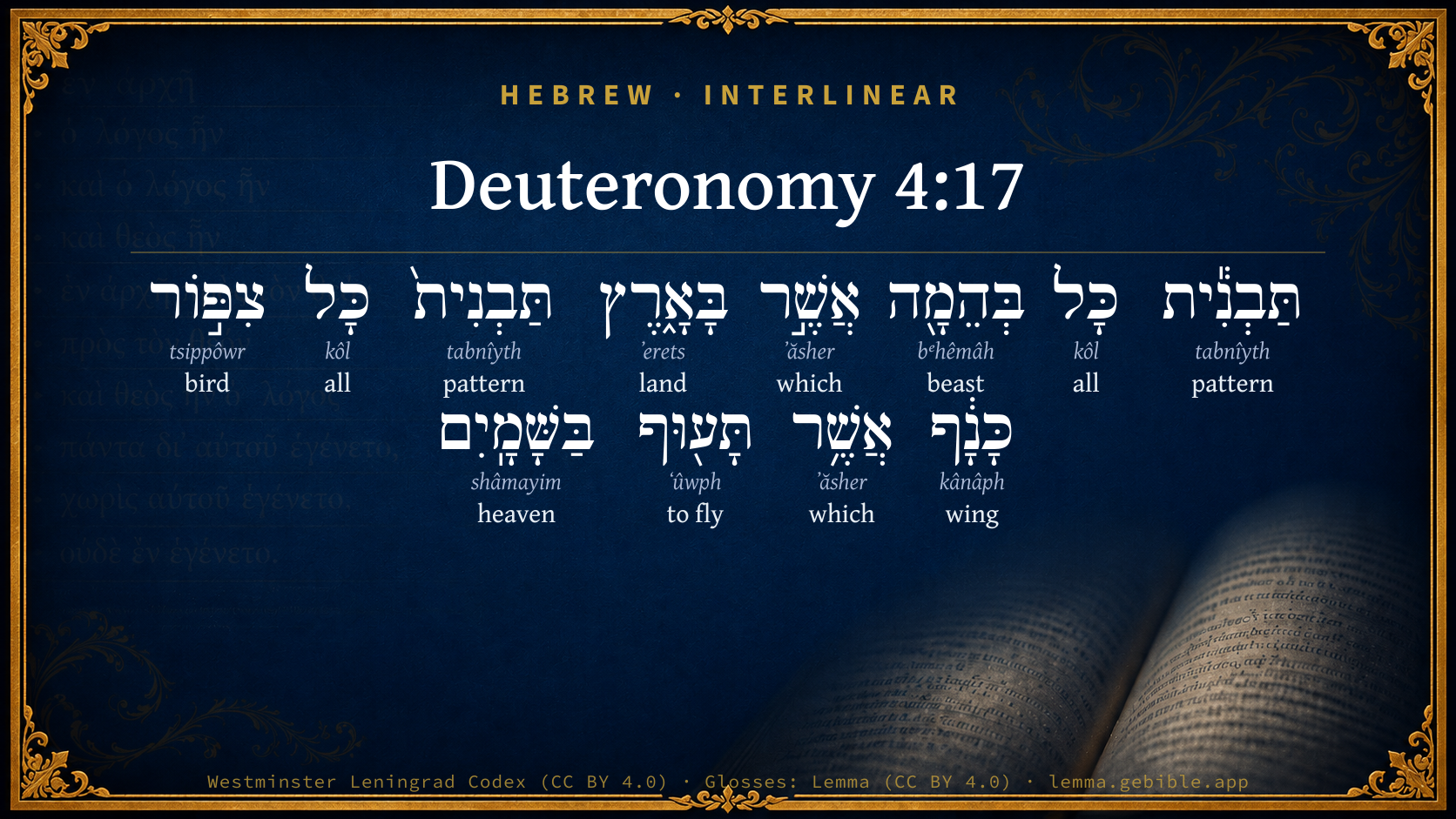
Hebrew (Westminster Leningrad Codex) Deuteronomy 4:17 appears in the Hebrew Old Testament. The text above is from the Westminster Leningrad Codex. Each word links to its Strong’s number, a concise gloss, and parsing drawn from the Open Scriptures Hebrew Bible morphology. Click any word for its full Brown-Driver-Briggs (BDB) entry.
Download image
Cite this verse

Deuteronomy 4:17 (World English Bible). Public Domain. Lemma interlinear Bible study tool, https://lemma.gebible.app/v/deuteronomy/4/17.

Show BibTeX & RIS
BibTeX
RIS
English Translation
the likeness of any animal that is on the earth, the likeness of any winged bird that flies in the sky,
World English Bible · Public Domain
Download a study sheet

One document with this verse’s original text, its word-by-word gloss line, the meaning frame, cross-references with their text, attributed commentary, and full source and license credits — printable, and it pastes into notes with its structure intact.

This verse Autodidact and up

Study sheet (.html) Plain text (.txt)

A passage Seminary Student

Up to 50 verses in one chapter. A passage sheet keeps up to 6 commentary sources and 12 cross-references per verse, in the order this page ranks them, and says so on the sheet whenever that leaves anything out. Ask for a single verse and you get the Autodidact verse sheet above.

Everything on this page stays free to read, with no account — the sheet is a download of what is already on screen, not access to it.

Want to remove ads? Support Godless Engineer
Compare translations 3

The same verse in 3 English versions, stacked beneath the original-language interlinear above. Click any original word for its lexicon entry.

Each is an independent rendering of the whole verse — the interlinear is not word-aligned to these translations.

Highlighted words mark where these versions differ — a whole-verse word diff, not a word-by-word alignment.

  • World English Bible Public Domain
    the likeness of any animal that is on the earth, the likeness of any winged bird that flies in the sky,
  • King James Version Public Domain
    The likeness of any beast that is on the earth, the likeness of any winged fowl that flieth in the air,
  • unfoldingWord Literal Text CC BY-SA 4.0
    a likeness of any animal that on the earth, a likeness of any winged bird that flies in the heavens,

unfoldingWord Literal Text — © unfoldingWord, licensed CC BY-SA 4.0. Word-aligned USFM3 via Door43 (git.door43.org/unfoldingWord/en_ult).

Versions to compare (up to 4)

3 of 4 selected

Show all 18 translations

Every available English version of this verse, each an independent rendering of the whole verse.

  • World English Bible Public Domain
    the likeness of any animal that is on the earth, the likeness of any winged bird that flies in the sky,
  • Berean Standard Bible Public Domain
    of any beast that is on the earth or bird that flies in the air,
  • Majority Standard Bible Public Domain
    of any beast that is on the earth or bird that flies in the air,
  • King James Version Public Domain
    The likeness of any beast that is on the earth, the likeness of any winged fowl that flieth in the air,
  • American Standard Version (1901) Public Domain
    the likeness of any beast that is on the earth, the likeness of any winged bird that flieth in the heavens,
  • Revised Version (1885) Public Domain
    the likeness of any beast that is on the earth, the likeness of any winged fowl that flieth in the heaven,
  • Geneva Bible (1599) Public Domain
    The likenes of any beast that is on earth, or the likenesse of any fethered foule that flieth in the aire:
  • Douay-Rheims (1899) Public Domain
    The similitude of any beasts, that are upon the earth, or of birds, that fly under heaven,
  • Young's Literal Translation Public Domain
    a form of any beast which `is' in the earth -- a form of any winged bird which flieth in the heavens --
  • Literal Standard Version CC BY-SA 4.0
    a form of any beast which [is] in the earth, a form of any winged bird which flies in the heavens,
  • Unlocked Literal Bible CC BY-SA 4.0
    the likeness of any animal on the earth, the likeness of any winged bird that flies in the heavens,
  • unfoldingWord Literal Text CC BY-SA 4.0
    a likeness of any animal that on the earth, a likeness of any winged bird that flies in the heavens,
  • Darby Bible Public Domain
    the pattern of any beast that is on the earth, the pattern of any winged fowl that flieth in the heaven,
  • World Messianic Bible Public Domain
    the likeness of any animal that is on the earth, the likeness of any winged bird that flies in the sky,
  • Webster's Bible Public Domain
    The likeness of any beast that is on the earth, the likeness of any winged fowl that flieth in the air,
  • Free Bible Version CC BY-SA 4.0
    or any land animal or bird that flies,
  • Bible in Basic English Public Domain
    Or any beast of the earth, or winged bird of the air,
  • JPS Tanakh (1917) Public Domain
    the likeness of any beast that is on the earth, the likeness of any winged fowl that flieth in the heaven,

Literal Standard Version (2020), Covenant Press — licensed CC BY-SA 4.0. Text via the HelloAO Bible API (eBible.org). Unlocked Literal Bible (unfoldingWord) — licensed CC BY-SA 4.0. Text via the HelloAO Bible API (eBible.org). unfoldingWord Literal Text — © unfoldingWord, licensed CC BY-SA 4.0. Word-aligned USFM3 via Door43 (git.door43.org/unfoldingWord/en_ult). Free Bible Version, Dr. Jonathan Gallagher — licensed CC BY-SA 4.0. Text via the HelloAO Bible API (eBible.org).

Word by word

More ways to search: Search by grammar → Find every occurrence → Compare this word →

Practice this passage: Drill this verse → Learn its vocabulary →

תַּבְנִ֕ית
tabnîyth
H8403
“pattern of”
Noun, Common, Feminine, Singular, Construct
Part of Speech
Noun
Type
Common
Gender
Feminine
Number
Singular
State
Construct
Full BDB Definition

Origin: from H1129

TWOT: 255d

pattern, plan, form, construction, figure - construction, structure - meaning dubious - pattern - figure, image (of idols)
  1. כָּל kôl H3605 “all of” Noun, Common, Masculine, Singular, Construct
  2. בְּהֵמָ֖ה bᵉhêmâh H929 “beast” Noun, Common, Feminine, Singular, Absolute
  3. אֲשֶׁ֣ר ʼăsher H834 “which” Particle, Relative
  4. בָּאָ֑רֶץ ʼerets H776 “in/at the · land” Preposition, Determined + Noun, Common, Both, Singular, Absolute
  5. תַּבְנִית֙ tabnîyth H8403 “pattern of” Noun, Common, Feminine, Singular, Construct
  6. כָּל kôl H3605 “all of” Noun, Common, Masculine, Singular, Construct
  7. צִפּ֣וֹר tsippôwr H6833 “bird of” Noun, Common, Both, Singular, Construct
  8. כָּנָ֔ף kânâph H3671 “wing” Noun, Common, Feminine, Singular, Absolute
  9. אֲשֶׁ֥ר ʼăsher H834 “which” Particle, Relative
  10. תָּע֖וּף ʻûwph H5774 “to fly” Verb, Qal, Imperfect, 3rd Person, Feminine, Singular
  11. בַּשָּׁמָֽיִם shâmayim H8064 “in/at the · heaven(s)” Preposition, Determined + Noun, Common, Masculine, Plural, Absolute

About this verse

These counts appear in no published source. They are computed here, from the morphology-tagged text and Lemma’s own curated glosses. What Lemma adds →

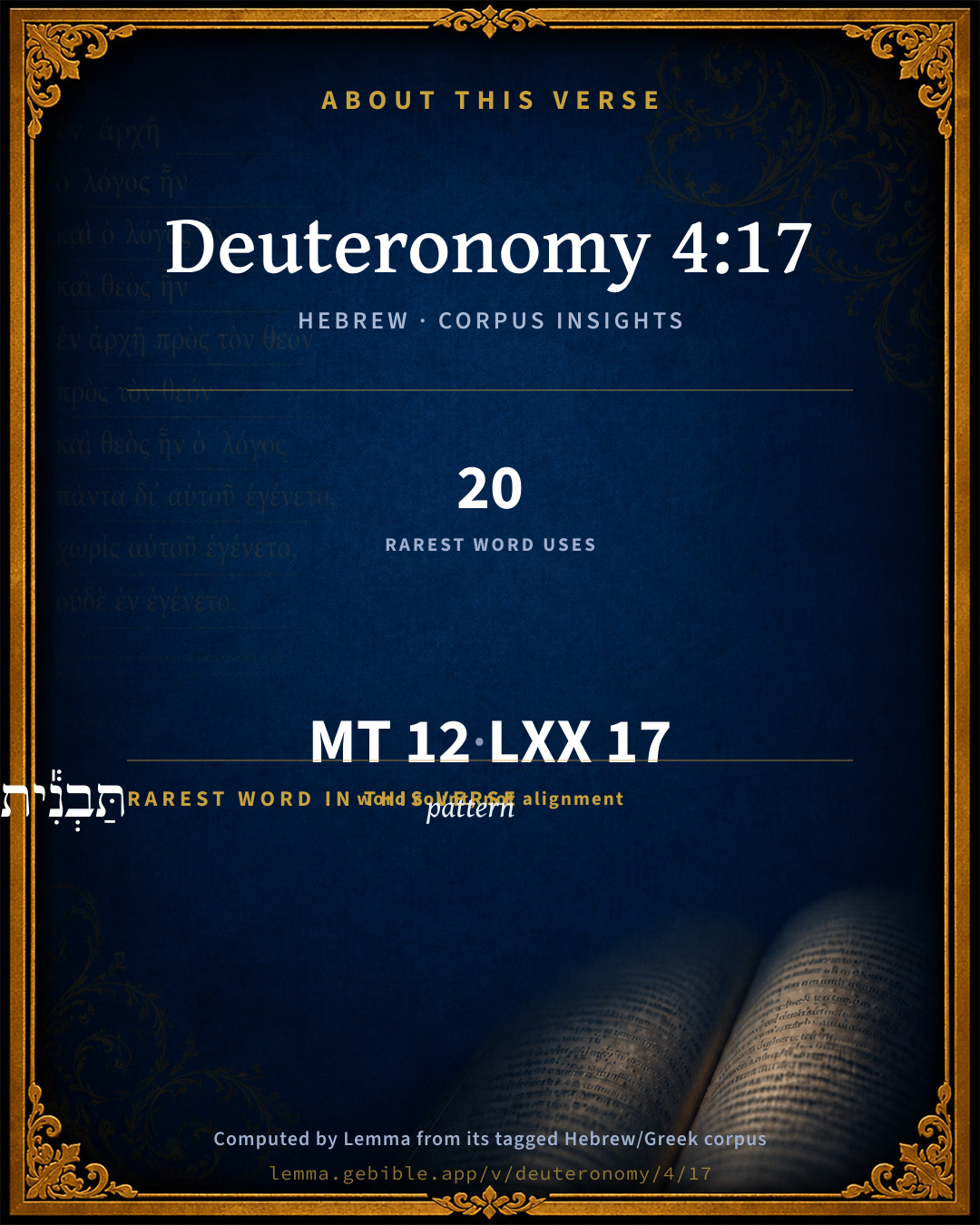
12
words
9
distinct lemmas
Pentateuch
section

Notable vocabulary

The rarest word here is תַּבְנִ֕ית pattern H8403 — appearing just 20 times in the whole Hebrew Bible.

Shared distinctive vocabulary

תַּבְנִ֕ית pattern H8403 occurs in 17 verses of the Hebrew Bible. Also found in:

Grammatical profile

  • 1 verb
  • 9 nouns
  • 2 particles

Verb forms

  • תָּע֖וּף Qal · Imperfect

Repetition

Words recur within this verse — often emphatic in Hebrew:

  • תַּבְנִ֕ית pattern H8403 ×2
  • כָּל all H3605 ×2
  • אֲשֶׁ֣ר which H834 ×2

Hebrew & Septuagint length

In English translation the verse runs 21 words from the Hebrew and 22 from the Septuagint (LXX English) — closely comparable.

A rough comparison of the two English renderings, which tokenize alike — not a word-level alignment.

Word counts can differ between the Hebrew and the Greek without any difference in meaning — e.g. the Hebrew direct-object marker אֵת has no separate Greek word, and Greek often adds the article ὁ.

In the original languages it is 12 Hebrew tokens and 17 Greek tokens — but the two are counted differently (Hebrew bundles its prefixes and suffixes into one token; the Greek is in lemma form), so that isn’t a like-for-like length.

Cross-references

1

Topical passages linked to Deuteronomy 4:17 in the Treasury of Scripture Knowledge — connected by theme and wording, ordered by reader-vote popularity; previews shown in the World English Bible.

  • Romans 1:23 and traded the glory of the incorruptible God for the likeness of an image of corruptible man, and of birds, and four-footed animals, and creeping things.

Cross-references courtesy of OpenBible.info (CC BY 4.0).

Hebrew and Greek witnesses Masoretic Hebrew ↔ Greek Septuagint

The same verse in the two great witnesses to the Old Testament, shown verse-for-verse.

These are two independent witnesses, not word-aligned to each other, and the Septuagint is shown in lemma (dictionary) form.

Hebrew Deuteronomy 4:17 Masoretic · Westminster Leningrad Codex

תַּבְנִ֕ית כָּל בְּהֵמָ֖ה אֲשֶׁ֣ר בָּאָ֑רֶץ תַּבְנִית֙ כָּל צִפּ֣וֹר כָּנָ֔ף אֲשֶׁ֥ר תָּע֖וּף בַּשָּׁמָֽיִם

the likeness of any animal that is on the earth, the likeness of any winged bird that flies in the sky,

World English Bible · Public Domain

Greek LXX Deuteronomy 4:17 Septuagint · lemma form

ὁμοίωμα πᾶς κτῆνος ὁ εἰμί ἐπί ὁ γῆ ὁμοίωμα πᾶς ὄρνεον πτερωτός ὅς πέταμαι ὑπό ὁ οὐρανός

the likeness of any beast of those that are on the earth, the likeness of any winged bird which flies under heaven,

LXX2012 (modern English Septuagint) · Public Domain

Hebrew: Westminster Leningrad Codex (CC BY 4.0). Greek: Septuagint (public domain); English from LXX2012 (modern English Septuagint) (Public Domain). How the Septuagint differs from the Hebrew →

Targum (Aramaic paraphrase)

2

The Targum is the ancient Jewish Aramaic paraphrase of the Hebrew Scriptures — an interpretive translation, not the Hebrew text itself. Onkelos (literal) and Pseudo-Jonathan (expansive) render the Torah, and Jonathan the Prophets. Coverage is partial: where no permissively-licensed English translation exists for a verse, only the Aramaic is shown. This is verse-level text, not a word-by-word alignment to the Hebrew.

  1. Targum Onkelos Torah (Genesis–Deuteronomy)
    דְמוּת כָּל בְּעִירָא דִי בְאַרְעָא דְמוּת כָּל צִפַּר גַדְפָא דִי פָּרַח בַּאֲוֵר רְקִיע שְׁמַיָא

    (no public-domain English translation for this verse)

    Targum Onkelos — Aramaic: “Onkelos Genesis” (public domain); “Onkelos Exodus” (public domain); “Onkelos Leviticus” (public domain); “Onkelos Numbers” (public domain); “Onkelos Deuteronomy” (public domain). English: “Sefaria Community Translation” (CC0 1.0 (public-domain dedication)); “J.W. Etheridge. The Targums of Onkelos and Jonathan Ben Uzziel on the Pentateuch. London: Longmans, Green, 1862” (public domain). Text via Sefaria.

  2. Targum Pseudo-Jonathan Torah (Genesis–Deuteronomy)
    דְּמוּ דְכָל בְּעִירָא דִי בְאַרְעָא דְמוּ דְכָל צִפַּר גַּפָּא דְפָרְחָא בְאֲוִיר רְקִיעַ שְׁמַיָא

    of any beast of the earth, of any winged bird that flieth in the air in the expanse of heaven,

    Targum Pseudo-Jonathan — Aramaic: “Targum Jonathan on Genesis” (public domain); “Targum Jonathan on Exodus” (public domain); “Targum Jonathan on Leviticus” (public domain); “Targum Jonathan on Numbers” (public domain); “Targum Jonathan on Deuteronomy” (public domain). English: “The Targum of Jonathan ben Uzziel, trans. J. W. Etheridge, London, 1862” (public domain). Text via Sefaria.

Commentary

Notes on Deuteronomy 4:17 from classic Christian and Jewish commentators (each source and its license shown beneath its notes). The classic Christian expositions comment on the surrounding passage and are grouped to its opening verse, so a note may address several verses; the Jewish commentaries on the Tanakh (Rashi and others) are per-verse, so they appear only where the commentator wrote on this verse.

Lemma curates 59 commentaries, every one of them public domain or Creative Commons licensed, each selected and text-cleaned for this edition rather than reprinted as found. About our sources →

Trapp's Complete Commentary

John Trapp

Deu 4:17 The likeness of any beast that [is] on the earth, the likeness of any winged fowl that flieth in the air,

Ver. 17. The likeness of any beast.] Which was a piece of the Egyptian madness. Israel, by being there, had learned to set up one calf, Jeroboam two.

John Trapp, A Commentary or Exposition upon All the Books of the Old and New Testament (1647–1656) — public domain. Text from a community e-Sword module.

Adam Clarke's Commentary

Verse 17. The likeness of any beast, c.] Such as the Egyptian god Apis, who was worshipped under the form of a white bull the ibis and hawk, among the FOWLS, had also Divine honours paid to them; serpents and the crocodile among REPTILES; besides monkeys, dogs, cats, the scarabaeus, leeks, and onions! See this explained at large, See Clarke on Ex 20:4.

Adam Clarke's Commentary on the Bible (1810–1826) — public domain. Text from a community e-Sword/MySword module.

The Cambridge Bible for Schools and Colleges

gen. ed. J. J. S. Perowne

17. the likeness] Again tabnîth.

winged fowl] Heb. bird of wing: cp. P, Gen_7:14; Gen_1:21.

The Cambridge Bible for Schools and Colleges (gen. ed. J. J. S. Perowne; Cambridge University Press, 1878–1918) — public domain. Text from a community e-Sword module.

John Gill's Exposition

The likeness of any beast that is on the earth,.... As there are scarce any but the likeness of them has been made and worshipped, or the creatures themselves, as the ox by the Egyptians, the sheep by the Thebans, the goat by the Mendesians, and others by different people:

the likeness of any winged fowl that flieth in the air; as the hawk, and the bird called Ibis, and another by the name of Cneph by the Egyptians, and the eagle by others.

John Gill's Exposition of the Whole Bible (1746–1763) — public domain (CC PDM 1.0). Text via the HelloAO Bible API.

Matthew Poole's English Annotations

Whereby the heathen nations did represent and worship God, some by an ox, some by a goat, or a hen, or a serpent, or a fish, &c.

Matthew Poole's English Annotations on the Holy Bible (1683–1685) — public domain. Text from a community e-Sword/MySword module.

The Pulpit Commentary

Vers. 17, 18. The likeness the figureof any beast, etc. A warning against the animal-worship of Egypt.

The Pulpit Commentary (1880–1919), ed. H.D.M. Spence-Jones & Joseph S. Exell — public domain. Text from a community e-Sword module.

Keil & Delitzsch

C. F. Keil & F. Delitzsch

They were also not to make an image of any kind of beast; a caution against imitating the animal worship of Egypt.

Keil & Delitzsch — Biblical Commentary on the Old Testament (1861–1891) — public domain (CC PDM 1.0). Text via the HelloAO Bible API. (Old Testament only.)

Lesson kit

Teaching starters — assembled from the data on this page, not authored interpretation. Every prompt links to the verse data it draws on. Edit before teaching.

Deuteronomy, in the Pentateuch, opens this verse with 12 words (9 distinct Hebrew lemmas). Its most distinctive word is tabnîyth (“pattern”). A historical commentator’s framing appears above. Read the whole chapter for the surrounding context.

Discussion questions

  1. What does “pattern” (tabnîyth) contribute to the verse as a whole?
  2. How does Exodus 25:9, which shares the word «pattern», read alongside this verse?
  3. What does the repetition of “pattern” (2× in this one verse) do in this verse?
  4. These translations render this verse differently. What is at stake in choosing one wording over another?
  5. «תָּע֖וּף» is a Qal Imperfect verb. How does that grammatical form shape the action described?
  6. Compare how Trapp's Complete Commentary and Adam Clarke's Commentary read this verse. Where do they agree or differ?

Things to notice

Reading settings

Reading text

Shown beneath each verse's original-language words.

Old Testament
Old Testament edition

Read the OT as the Masoretic Hebrew (MT) or the Greek Septuagint (LXX).

English shown for the Greek Septuagint (in the Hebrew ↔ Greek comparison).

Comparing translations? Open the Compare panel on any verse page to stack up to four side by side.