Numbers 35:3

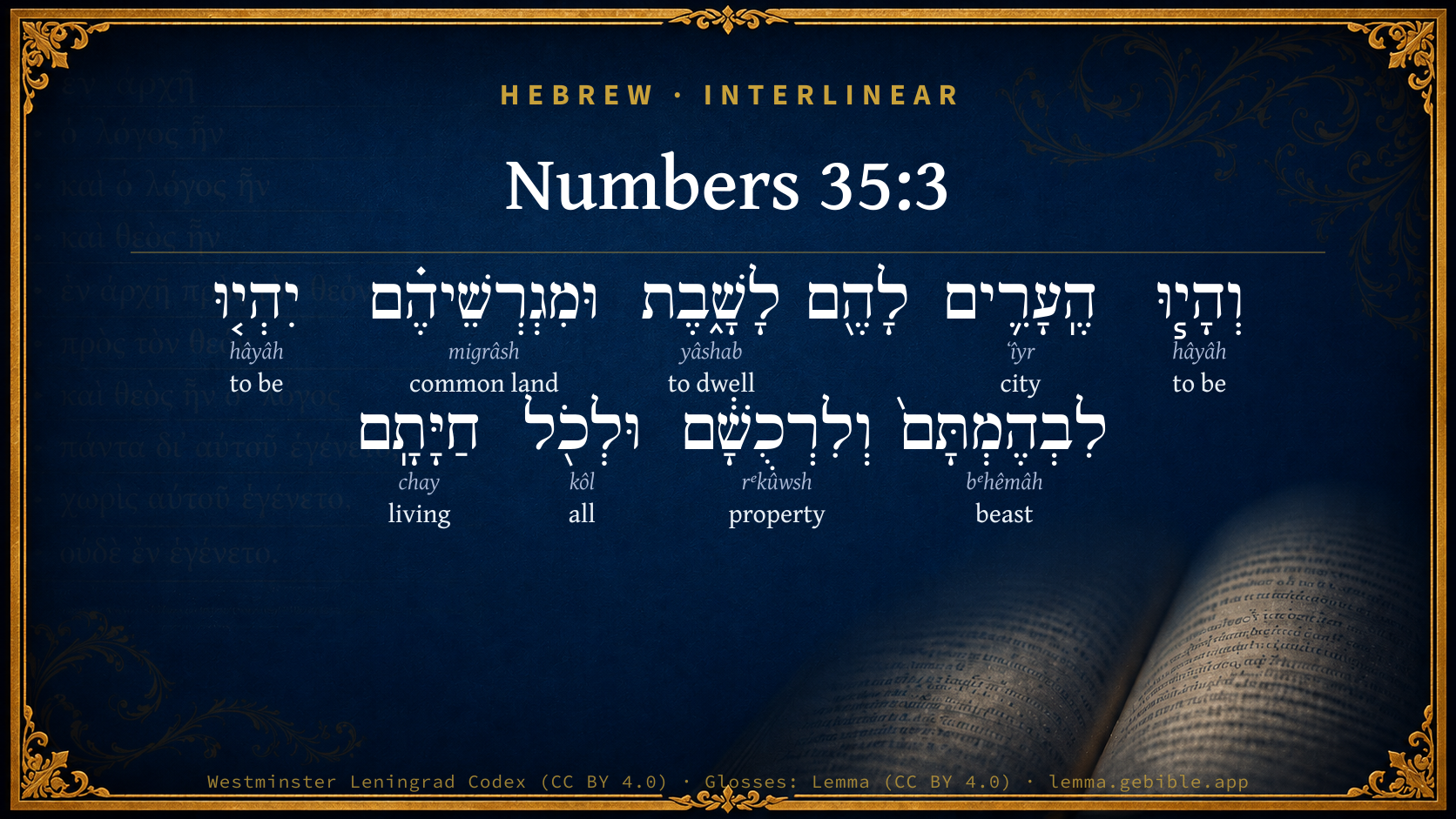
Hebrew (Westminster Leningrad Codex) Numbers 35:3 appears in the Hebrew Old Testament. The text above is from the Westminster Leningrad Codex. Each word links to its Strong’s number, a concise gloss, and parsing drawn from the Open Scriptures Hebrew Bible morphology. Click any word for its full Brown-Driver-Briggs (BDB) entry.
Download image
Cite this verse

Numbers 35:3 (World English Bible). Public Domain. Lemma interlinear Bible study tool, https://lemma.gebible.app/v/numbers/35/3.

Show BibTeX & RIS
BibTeX
RIS
English Translation
The cities shall they have to dwell in; and their suburbs shall be for their cattle, and for their substance, and for all their animals.
World English Bible · Public Domain
Download a study sheet

One document with this verse’s original text, its word-by-word gloss line, the meaning frame, cross-references with their text, attributed commentary, and full source and license credits — printable, and it pastes into notes with its structure intact.

This verse Autodidact and up

Study sheet (.html) Plain text (.txt)

A passage Seminary Student

Up to 50 verses in one chapter. A passage sheet keeps up to 6 commentary sources and 12 cross-references per verse, in the order this page ranks them, and says so on the sheet whenever that leaves anything out. Ask for a single verse and you get the Autodidact verse sheet above.

Everything on this page stays free to read, with no account — the sheet is a download of what is already on screen, not access to it.

Want to remove ads? Support Godless Engineer
Compare translations 3

The same verse in 3 English versions, stacked beneath the original-language interlinear above. Click any original word for its lexicon entry.

Each is an independent rendering of the whole verse — the interlinear is not word-aligned to these translations.

Highlighted words mark where these versions differ — a whole-verse word diff, not a word-by-word alignment.

  • World English Bible Public Domain
    The cities shall they have to dwell in; and their suburbs shall be for their cattle, and for their substance, and for all their animals.
  • King James Version Public Domain
    And the cities shall they have to dwell in; and the suburbs of them shall be for their cattle, and for their goods, and for all their beasts.
  • unfoldingWord Literal Text CC BY-SA 4.0
    And the cities will be for them for dwelling, and their pastureland will be for their livestock and for their property and for all their living things.

unfoldingWord Literal Text — © unfoldingWord, licensed CC BY-SA 4.0. Word-aligned USFM3 via Door43 (git.door43.org/unfoldingWord/en_ult).

Versions to compare (up to 4)

3 of 4 selected

Show all 18 translations

Every available English version of this verse, each an independent rendering of the whole verse.

  • World English Bible Public Domain
    The cities shall they have to dwell in; and their suburbs shall be for their cattle, and for their substance, and for all their animals.
  • Berean Standard Bible Public Domain
    The cities will be for them to live in, and the pasturelands will be for their herds, their flocks, and all their other livestock.
  • Majority Standard Bible Public Domain
    The cities will be for them to live in, and the pasturelands will be for their herds, their flocks, and all their other livestock.
  • King James Version Public Domain
    And the cities shall they have to dwell in; and the suburbs of them shall be for their cattle, and for their goods, and for all their beasts.
  • American Standard Version (1901) Public Domain
    And the cities shall they have to dwell in; and their suburbs shall be for their cattle, and for their substance, and for all their beasts.
  • Revised Version (1885) Public Domain
    And the cities shall they have to dwell in; and their suburbs shall be for their cattle, and for their substance, and for all their beasts.
  • Geneva Bible (1599) Public Domain
    So they shall haue the cities to dwell in, and their suburbes shall be for their cattell, and for their substance, and for all their beasts.
  • Douay-Rheims (1899) Public Domain
    Cities to dwell in, and their suburbs round about: that they may abide in the towns, and the suburbs may be for their cattle and beasts:
  • Young's Literal Translation Public Domain
    And the cities have been to them to inhabit, and their suburbs are for their cattle, and for their goods, and for all their beasts.
  • Literal Standard Version CC BY-SA 4.0
    And the cities have been for them to inhabit, and their outskirts are for their livestock, and for their goods, and for all their beasts.
  • Unlocked Literal Bible CC BY-SA 4.0
    The Levites will have these cities to live in. The pastureland will be for their cattle, their flocks, and all their animals.
  • unfoldingWord Literal Text CC BY-SA 4.0
    And the cities will be for them for dwelling, and their pastureland will be for their livestock and for their property and for all their living things.
  • Darby Bible Public Domain
    And the cities shall they have to dwell in, and their suburbs shall be for their cattle, and for their goods, and for all their beasts.
  • World Messianic Bible Public Domain
    They shall have the cities to dwell in. Their pasture lands shall be for their livestock, and for their possessions, and for all their animals.
  • Webster's Bible Public Domain
    And they shall have the cities to dwell in; and the suburbs of them shall be for their cattle, and for their goods, and for all their beasts.
  • Free Bible Version CC BY-SA 4.0
    The towns are for them to live in, and the pastures will be for their herds and their flocks—for all their livestock.
  • Bible in Basic English Public Domain
    These towns are to be their living-places, with land round them for their cattle and their food and all their beasts,
  • JPS Tanakh (1917) Public Domain
    And the cities shall they have to dwell in; and their open land shall be for their cattle, and for their substance, and for all their beasts.

Literal Standard Version (2020), Covenant Press — licensed CC BY-SA 4.0. Text via the HelloAO Bible API (eBible.org). Unlocked Literal Bible (unfoldingWord) — licensed CC BY-SA 4.0. Text via the HelloAO Bible API (eBible.org). unfoldingWord Literal Text — © unfoldingWord, licensed CC BY-SA 4.0. Word-aligned USFM3 via Door43 (git.door43.org/unfoldingWord/en_ult). Free Bible Version, Dr. Jonathan Gallagher — licensed CC BY-SA 4.0. Text via the HelloAO Bible API (eBible.org).

Word by word

More ways to search: Search by grammar → Find every occurrence → Compare this word →

Practice this passage: Drill this verse → Learn its vocabulary →

וְלִרְכֻשָׁ֔ם
rᵉkûwsh
H7399
“and · to/for · property · their”
Conjunction + Preposition + Noun, Common, Masculine, Singular, Construct + Suffix, Personal, 3rd Person, Masculine, Plural
Part of Speech
Conjunction + Preposition + Noun
Type
Common
Gender
Masculine
Number
Singular
State
Construct
Full BDB Definition

Origin: from pass part of H7408

TWOT: 2167b

property, goods, possessions - property, goods - general term for all movable goods - of livestock - of stores, utensils, etc
  1. וְהָי֧וּ hâyâh H1961 “and · to be” Conjunction + Verb, Qal, Sequential Perfect, 3rd Person, Common, Plural
  2. הֶֽעָרִ֛ים ʻîyr H5892 “the · cities” Particle, Definite Article + Noun, Common, Feminine, Plural, Absolute
  3. לָשָׁ֑בֶת yâshab H3427 “to dwell” Preposition + Verb, Qal, Infinitive Construct
  4. וּמִגְרְשֵׁיהֶ֗ם migrâsh H4054 “and · common lands · their” Conjunction + Noun, Common, Masculine, Plural, Construct + Suffix, Personal, 3rd Person, Masculine, Plural
  5. יִהְי֤וּ hâyâh H1961 “to be” Verb, Qal, Imperfect, 3rd Person, Masculine, Plural
  6. לִבְהֶמְתָּם֙ bᵉhêmâh H929 “to/for · beast · their” Preposition + Noun, Common, Feminine, Singular, Construct + Suffix, Personal, 3rd Person, Masculine, Plural
  7. וּלְכֹ֖ל kôl H3605 “and · to/for · all of” Conjunction + Preposition + Noun, Common, Masculine, Singular, Construct
  8. חַיָּתָֽם chay H2416 “living · their” Noun, Common, Feminine, Singular, Construct + Suffix, Personal, 3rd Person, Masculine, Plural

About this verse

These counts appear in no published source. They are computed here, from the morphology-tagged text and Lemma’s own curated glosses. What Lemma adds →

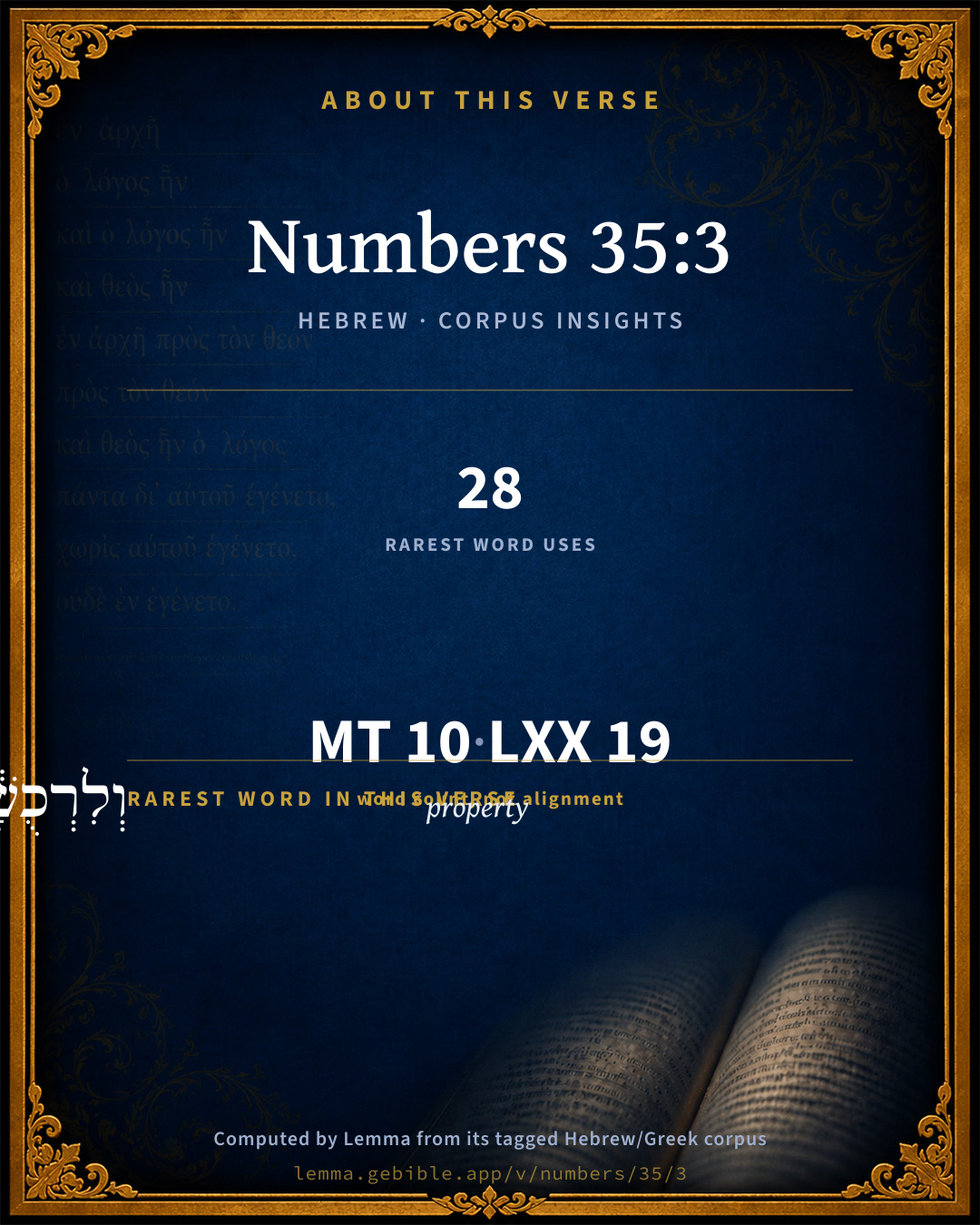
10
words
8
distinct lemmas
Pentateuch
section

Shared distinctive vocabulary

וְלִרְכֻשָׁ֔ם property H7399 occurs in 27 verses of the Hebrew Bible. Also found in:

Grammatical profile

  • 3 verbs
  • 6 nouns
  • 1 preposition

Verb forms

  • וְהָי֧וּ Qal · Sequential Perfect
  • לָשָׁ֑בֶת Qal · Infinitive Construct
  • יִהְי֤וּ Qal · Imperfect

Repetition

A word recurs within this verse — often emphatic in Hebrew:

  • וְהָי֧וּ to be H1961 ×2

Hebrew & Septuagint length

In English translation the verse runs 25 words from the Hebrew and 22 from the Septuagint (LXX English) — closely comparable.

A rough comparison of the two English renderings, which tokenize alike — not a word-level alignment.

Word counts can differ between the Hebrew and the Greek without any difference in meaning — e.g. the Hebrew direct-object marker אֵת has no separate Greek word, and Greek often adds the article ὁ.

In the original languages it is 10 Hebrew tokens and 19 Greek tokens — but the two are counted differently (Hebrew bundles its prefixes and suffixes into one token; the Greek is in lemma form), so that isn’t a like-for-like length.

Cross-references

3

Topical passages linked to Numbers 35:3 in the Treasury of Scripture Knowledge — connected by theme and wording, ordered by reader-vote popularity; previews shown in the World English Bible.

  • Joshua 21:11 They gave them Kiriath Arba, [which Arba was] the father of Anak (the same is Hebron), in the hill-country of Judah, with the suburbs of it round about it.
  • 2 Chronicles 11:14 For the Levites left their suburbs and their possession, and came to Judah and Jerusalem: for Jeroboam and his sons cast them off, that they should not execute the priest's office to Yahweh;
  • Ezekiel 45:2 Of this there shall be for the holy place five hundred [in length] by five hundred [in breadth], square round about; and fifty cubits for the suburbs of it round about.

Cross-references courtesy of OpenBible.info (CC BY 4.0).

Hebrew and Greek witnesses Masoretic Hebrew ↔ Greek Septuagint

The same verse in the two great witnesses to the Old Testament, shown verse-for-verse.

These are two independent witnesses, not word-aligned to each other, and the Septuagint is shown in lemma (dictionary) form.

Hebrew Numbers 35:3 Masoretic · Westminster Leningrad Codex

וְהָי֧וּ הֶֽעָרִ֛ים לָהֶ֖ם לָשָׁ֑בֶת וּמִגְרְשֵׁיהֶ֗ם יִהְי֤וּ לִבְהֶמְתָּם֙ וְלִרְכֻשָׁ֔ם וּלְכֹ֖ל חַיָּתָֽם

The cities shall they have to dwell in; and their suburbs shall be for their cattle, and for their substance, and for all their animals.

World English Bible · Public Domain

Greek LXX Numbers 35:3 Septuagint · lemma form

καί εἰμί αὐτός ὁ πόλις καταοἰκέω καί ὁ ἀφόρισμα αὐτός εἰμί ὁ κτῆνος αὐτός καί πᾶς ὁ τετράπους αὐτός

And the cities shall be for them to dwell in, and their enclosures shall be for their cattle and all their beasts.

LXX2012 (modern English Septuagint) · Public Domain

Hebrew: Westminster Leningrad Codex (CC BY 4.0). Greek: Septuagint (public domain); English from LXX2012 (modern English Septuagint) (Public Domain). How the Septuagint differs from the Hebrew →

Targum (Aramaic paraphrase)

2

The Targum is the ancient Jewish Aramaic paraphrase of the Hebrew Scriptures — an interpretive translation, not the Hebrew text itself. Onkelos (literal) and Pseudo-Jonathan (expansive) render the Torah, and Jonathan the Prophets. Coverage is partial: where no permissively-licensed English translation exists for a verse, only the Aramaic is shown. This is verse-level text, not a word-by-word alignment to the Hebrew.

  1. Targum Onkelos Torah (Genesis–Deuteronomy)
    וִיהוֹן קִרְוַיָא לְהוֹן לְמִתָּב וְרַוְחֵיהוֹן יְהוֹן לִבְעִירְהוֹן וּלְקִנְיָנֵיהוֹן וּלְכָל חֵוַתְהוֹן

    (no public-domain English translation for this verse)

    Targum Onkelos — Aramaic: “Onkelos Genesis” (public domain); “Onkelos Exodus” (public domain); “Onkelos Leviticus” (public domain); “Onkelos Numbers” (public domain); “Onkelos Deuteronomy” (public domain). English: “Sefaria Community Translation” (CC0 1.0 (public-domain dedication)); “J.W. Etheridge. The Targums of Onkelos and Jonathan Ben Uzziel on the Pentateuch. London: Longmans, Green, 1862” (public domain). Text via Sefaria.

  2. Targum Pseudo-Jonathan Torah (Genesis–Deuteronomy)
    וִיהוֹן קִרְוַיָא לְהוֹן לְמֵיתַב וּבְדוֹרְלְהוֹן יְהוֹן לִבְעִירֵיהוֹן וּלְקִנְיָינֵיהוֹן וּלְכָל צוֹרְכֵיהוֹן

    And the cities shall be for them to dwell in, and the suburbs for their cattle, their property, and all their needful things.

    Targum Pseudo-Jonathan — Aramaic: “Targum Jonathan on Genesis” (public domain); “Targum Jonathan on Exodus” (public domain); “Targum Jonathan on Leviticus” (public domain); “Targum Jonathan on Numbers” (public domain); “Targum Jonathan on Deuteronomy” (public domain). English: “The Targum of Jonathan ben Uzziel, trans. J. W. Etheridge, London, 1862” (public domain). Text via Sefaria.

Commentary

Notes on Numbers 35:3 from classic Christian and Jewish commentators (each source and its license shown beneath its notes). The classic Christian expositions comment on the surrounding passage and are grouped to its opening verse, so a note may address several verses; the Jewish commentaries on the Tanakh (Rashi and others) are per-verse, so they appear only where the commentator wrote on this verse.

Lemma curates 59 commentaries, every one of them public domain or Creative Commons licensed, each selected and text-cleaned for this edition rather than reprinted as found. About our sources →

Joseph Benson's Commentary

Num 35:3. The cities shall they have to dwell in — Notwithstanding this provision, it was lawful for them to hire or purchase houses in any other city, particularly at Jerusalem; for we find in Scripture many proofs of their dwelling in other cities besides those which are here assigned them; and, in like manner, other people, with their permission, might dwell with them in their cities. The suburbs for their cattle and for their goods — For stables and pasturage for their cattle, and stowages for their household stuff of all kinds. But they might not build houses, nor plant gardens, orchards, or vineyards; no, nor sow corn in these suburbs, for which things they were abundantly supplied from the first-fruits. And these suburbs did not belong to the Levites in common, but were distributed to them in convenient proportions. They were thus provided for, that they might the more closely attend to the study of the law, and might have more leisure for teaching the people. And living thus near together, they could easily converse one with another about divine things, to their mutual edification; in doubtful cases could consult each other; and in all cases strengthen one another’s hands.

Joseph Benson's Commentary on the Old and New Testaments (1811–1818) — public domain. Text from a community e-Sword module.

Ellicott's Commentary for English Readers

(3) For their cattle . . . —The word which is rendered “cattle” generally denotes oxen and beasts of burden. The word which is rendered “goods” probably refers here to the sheep and goats. (Cf. 2Ch_21:14; 2Ch_35:7.) The passage may be rendered, for their cattle and for their substance, even for all their beasts.

A Bible Commentary for English Readers, edited by Charles John Ellicott (1878–1897) — public domain. Text from a community e-Sword module.

John Gill's Exposition

And cities shall they have to dwell in,.... For them and their families, and indeed for nothing else, they having no trades nor worldly business to carry on in them:

and the suburbs of them shall be for their cattle; for stables and stalls to put them up in, and for barns and storehouses to lay in provender for them:

and for their goods; where to bestow them, as the increase of their fields, oliveyards, and vineyards, see Luk 12:18.

and for all their beasts; or living creatures; or "for their whole life" (z); or livelihood, whatsoever was for the support of it; the Targum of Jonathan adds, by way of explanation, for all their necessities; and so Jarchi.

(z) "ad vitam ipsorum". Vid. Drusium.

John Gill's Exposition of the Whole Bible (1746–1763) — public domain (CC PDM 1.0). Text via the HelloAO Bible API.

Haydock's Catholic Bible Commentary

Cities, in all forty-eight, with a thousand paces round them. This land belonged to the community: but some built upon it, Josue xxi. 18., and 1 Paralipomenon vi. 60. The burial place for the Levites lay behind it. (Drusius) --- In these cities alone, the Levites had houses and gardens of their own; other might live with them, and indeed the cities acknowledged other lords, as Hebron belonged to Caleb, Josue xiv. 14. The Levites were dispersed throughout the land, that they might instruct the people both by word and by example, Deuteronomy xxxiii. 10. They had a clear revenue without labour of husbandry, equivalent to any two of the other tribes. (Abulensis.) --- Six of their cities were assigned for places of refuge, as they were the proper judges of the cases, in which murder may be excused, and to remind them that hey ought to be very merciful. Hence arose the privileges, granted to some churches, of protecting those who fled to them for an asylum. That none might be hindered from enjoying this benefit, three of these cities were situated on each side of the Jordan, and at equal distances. (Salien)

George Leo Haydock (1774–1849), Haydock's Catholic Family Bible and Commentary, 1859 edition — public domain. Excludes Psalms (Douay-Rheims chapter numbering differs from Protestant) and Deuterocanonical books (Catholic canon only).

Matthew Poole's English Annotations

For their cattle; for pasturage for their cattle; where they might not build houses, nor plant gardens, orchards, or vineyards, no, nor sow corn, for which they were abundantly provided out of the first-fruits and tithes. And these suburbs did not belong to the Levites in common, but were distributed to them in convenient proportions, as may appear from Jos 21:18; 1Ch 6:60.

Matthew Poole's English Annotations on the Holy Bible (1683–1685) — public domain. Text from a community e-Sword/MySword module.

The Pulpit Commentary

For their cattle. "for their great cattle," i.e., oxen, camels, and any other beasts of draught or burden. For their goods. "For their possessions," which in this connection would mean their ordinary "live stock," chiefly sheep and goats; the word itself ( is indeterminate. For all their beasts. an expression which apparently only sums up what has previously been mentioned.

The Pulpit Commentary (1880–1919), ed. H.D.M. Spence-Jones & Joseph S. Exell — public domain. Text from a community e-Sword module.

John Wesley's Explanatory Notes

For the cattle - For pasturage for their cattle: where they might not build houses, nor plant gardens, orchards or vineyards, no nor sow corn, for which they were abundantly provided out of the first-fruits. And these suburbs did not belong to the Levites in common, but were distributed to them in convenient proportions.

John Wesley, Explanatory Notes Upon the Whole Bible (1754–1765) — public domain. Text via the GEBible commentary corpus.

unfoldingWord translationNotes

Door43 World Missions Community

one thousand cubits

"1,000 cubits." If it is necessary to use modern distance units, here is a way of doing it. AT: "457 meters" (See: Numbers and Biblical Distance)

translationWords

cow

flocks

unfoldingWord translationNotes — © Distant Shores Media and the Door43 World Missions Community, licensed CC BY-SA 4.0. Source: git.door43.org/Door43/en_tn.

Rashi

Rabbi Shlomo Yitzchaki (Rashi)

ולכל חיתם means FOR ALL THEIR NEEDS (the needs of their life; it does not mean for their animals) (Nedarim 81a).

Rashi on the Tanakh — English translations: “The Judaica Press complete Tanach with Rashi, translated by A. J. Rosenberg” (CC BY 4.0); “Pentateuch with Rashi's commentary by M. Rosenbaum and A.M. Silbermann, 1929-1934” (public domain); “The Metsudah Tanach series, Lakewood, N.J” (CC BY 4.0); and “The Book of Joshua, Metsudah Publications, 1997” (CC BY 4.0). Text via Sefaria.

Sforno

Rabbi Ovadia Sforno

For their animals. For riding and transporting.

Their property. Cattle and flocks.

And all of their necessities to live. Such as the bees in the hive, dovecote pigeon and the rest.

Sforno on the Tanakh — English translation: “Yalkut, Sifsei Chachomim Chumash, Metsudah Publications, 2009” (CC BY 4.0). Text via Sefaria.

Lesson kit

Teaching starters — assembled from the data on this page, not authored interpretation. Every prompt links to the verse data it draws on. Edit before teaching.

Numbers, in the Pentateuch, opens this verse with 10 words (8 distinct Hebrew lemmas). Its most distinctive word is rᵉkûwsh (“property”). A historical commentator’s framing appears above. Read the whole chapter for the surrounding context.

Discussion questions

  1. The word rᵉkûwsh carries the sense “property.” How does it shape the verse?
  2. How does Genesis 12:5, which shares the word «property», read alongside this verse?
  3. What does the repetition of “to be” (2× in this one verse) do in this verse?
  4. These translations render this verse differently; the difference is in the English rendering, not the original. What questions does that raise?
  5. «וְהָי֧וּ» is a Qal Sequential Perfect verb. How does that grammatical form shape the action described?
  6. Compare how Joseph Benson's Commentary and Ellicott's Commentary for English Readers read this verse. Where do they agree or differ?

Things to notice

Reading settings

Reading text

Shown beneath each verse's original-language words.

Old Testament
Old Testament edition

Read the OT as the Masoretic Hebrew (MT) or the Greek Septuagint (LXX).

English shown for the Greek Septuagint (in the Hebrew ↔ Greek comparison).

Comparing translations? Open the Compare panel on any verse page to stack up to four side by side.