2 Chronicles 32:28

Hebrew (Westminster Leningrad Codex) 2 Chronicles 32:28 appears in the Hebrew Old Testament. The text above is from the Westminster Leningrad Codex. Each word links to its Strong’s number, a concise gloss, and parsing drawn from the Open Scriptures Hebrew Bible morphology. Click any word for its full Brown-Driver-Briggs (BDB) entry.
Download image
Cite this verse

2 Chronicles 32:28 (World English Bible). Public Domain. Lemma interlinear Bible study tool, https://lemma.gebible.app/v/2-chronicles/32/28.

Show BibTeX & RIS
BibTeX
RIS
English Translation
store-houses also for the increase of grain and new wine and oil; and stalls for all manner of animals, and flocks in folds.
World English Bible · Public Domain
Highlights
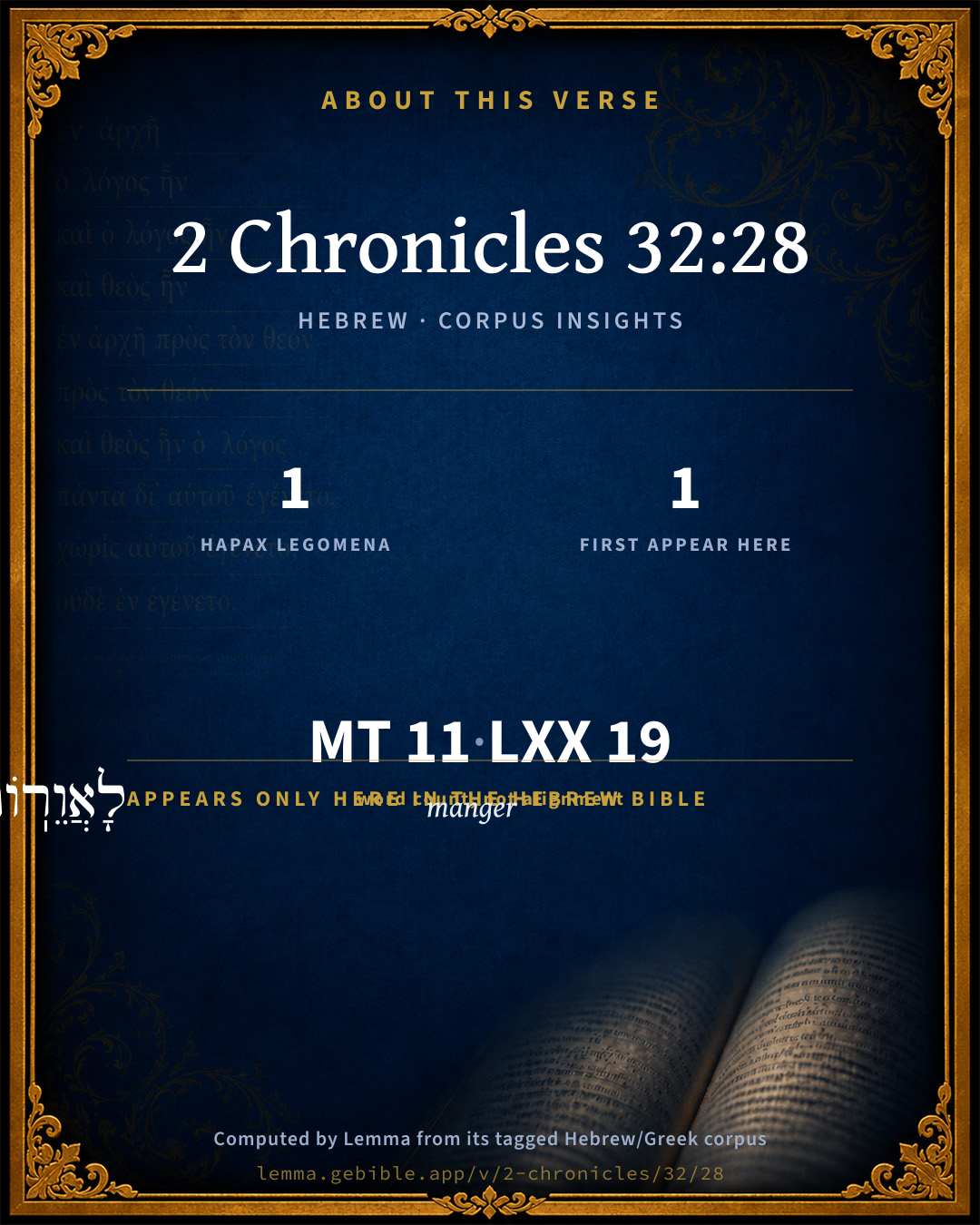
  • 1 hapax legomenon — only here in the Hebrew Bible
  • 1 first appearance in the Hebrew Bible
Full analysis ↓
Download a study sheet

One document with this verse’s original text, its word-by-word gloss line, the meaning frame, cross-references with their text, attributed commentary, and full source and license credits — printable, and it pastes into notes with its structure intact.

This verse Autodidact and up

Study sheet (.html) Plain text (.txt)

A passage Seminary Student

Up to 50 verses in one chapter. A passage sheet keeps up to 6 commentary sources and 12 cross-references per verse, in the order this page ranks them, and says so on the sheet whenever that leaves anything out. Ask for a single verse and you get the Autodidact verse sheet above.

Everything on this page stays free to read, with no account — the sheet is a download of what is already on screen, not access to it.

Want to remove ads? Support Godless Engineer
Compare translations 3

The same verse in 3 English versions, stacked beneath the original-language interlinear above. Click any original word for its lexicon entry.

Each is an independent rendering of the whole verse — the interlinear is not word-aligned to these translations.

Highlighted words mark where these versions differ — a whole-verse word diff, not a word-by-word alignment.

  • World English Bible Public Domain
    store-houses also for the increase of grain and new wine and oil; and stalls for all manner of animals, and flocks in folds.
  • King James Version Public Domain
    Storehouses also for the increase of corn, and wine, and oil; and stalls for all manner of beasts, and cotes for flocks.
  • unfoldingWord Literal Text CC BY-SA 4.0
    and storehouses for produce of grain, and new wine, and oil, and stalls for all beasts and beasts, and flocks for the stalls.

unfoldingWord Literal Text — © unfoldingWord, licensed CC BY-SA 4.0. Word-aligned USFM3 via Door43 (git.door43.org/unfoldingWord/en_ult).

Versions to compare (up to 4)

3 of 4 selected

Show all 18 translations

Every available English version of this verse, each an independent rendering of the whole verse.

  • World English Bible Public Domain
    store-houses also for the increase of grain and new wine and oil; and stalls for all manner of animals, and flocks in folds.
  • Berean Standard Bible Public Domain
    He also made storehouses for the harvest of grain and new wine and oil, stalls for all kinds of livestock, and pens for the flocks.
  • Majority Standard Bible Public Domain
    He also made storehouses for the harvest of grain and new wine and oil, stalls for all kinds of livestock, and pens for the flocks.
  • King James Version Public Domain
    Storehouses also for the increase of corn, and wine, and oil; and stalls for all manner of beasts, and cotes for flocks.
  • American Standard Version (1901) Public Domain
    store-houses also for the increase of grain and new wine and oil; and stalls for all manner of beasts, and flocks in folds.
  • Revised Version (1885) Public Domain
    storehouses also for the increase of corn and wine and oil; and stalls for all manner of beasts, and flocks in folds.
  • Geneva Bible (1599) Public Domain
    And of store houses for the increase of wheat and wine and oyle, and stalles for all beasts, and rowes for the stables.
  • Douay-Rheims (1899) Public Domain
    Storehouses also of corn, of wine, and of oil, and stalls for all beasts, and folds for cattle.
  • Young's Literal Translation Public Domain
    and storehouses for the increase of corn, and new wine, and oil, and stalls for all kinds of cattle, and herds for stalls;
  • Literal Standard Version CC BY-SA 4.0
    and storehouses for the increase of grain, and new wine, and oil, and stalls for all kinds of livestock, and herds for stalls;
  • Unlocked Literal Bible CC BY-SA 4.0
    He also had storehouses for the harvest of grain, new wine, and oil, and stalls for all kinds of animals. He also had flocks in their pens.
  • unfoldingWord Literal Text CC BY-SA 4.0
    and storehouses for produce of grain, and new wine, and oil, and stalls for all beasts and beasts, and flocks for the stalls.
  • Darby Bible Public Domain
    storehouses also for the increase of corn and new wine and oil, and stalls for all manner of beasts, and [he procured] flocks for the stalls.
  • World Messianic Bible Public Domain
    also storehouses for the increase of grain, new wine, and oil; and stalls for all kinds of animals, and flocks in folds.
  • Webster's Bible Public Domain
    Store-houses also for the increase of corn, and wine, and oil; and stalls for all manner of beasts, and cotes for flocks.
  • Free Bible Version CC BY-SA 4.0
    He constructed buildings to store supplies of grain, new wine, and olive oil, and stalls for all kinds of animals, including cattle and sheep.
  • Bible in Basic English Public Domain
    And store-houses for the produce of grain and wine and oil; and buildings for all sorts of beasts and flocks.
  • JPS Tanakh (1917) Public Domain
    store-houses also for the increase of corn, and wine, and oil; and stalls for all manner of beasts, and flocks in folds.

Literal Standard Version (2020), Covenant Press — licensed CC BY-SA 4.0. Text via the HelloAO Bible API (eBible.org). Unlocked Literal Bible (unfoldingWord) — licensed CC BY-SA 4.0. Text via the HelloAO Bible API (eBible.org). unfoldingWord Literal Text — © unfoldingWord, licensed CC BY-SA 4.0. Word-aligned USFM3 via Door43 (git.door43.org/unfoldingWord/en_ult). Free Bible Version, Dr. Jonathan Gallagher — licensed CC BY-SA 4.0. Text via the HelloAO Bible API (eBible.org).

Word by word

More ways to search: Search by grammar → Find every occurrence → Compare this word →

Practice this passage: Drill this verse → Learn its vocabulary →

לָאֲוֵרֽוֹת
ʼăvêrâh
H220
“to/for the · mangers”
Preposition, Determined + Noun, Common, Feminine, Plural, Absolute
Part of Speech
Preposition + Noun
Type
Common
Gender
Feminine
Number
Plural
State
Absolute
Full BDB Definition

Origin: by transposition for H723

TWOT: 158b

manger, stall, crib
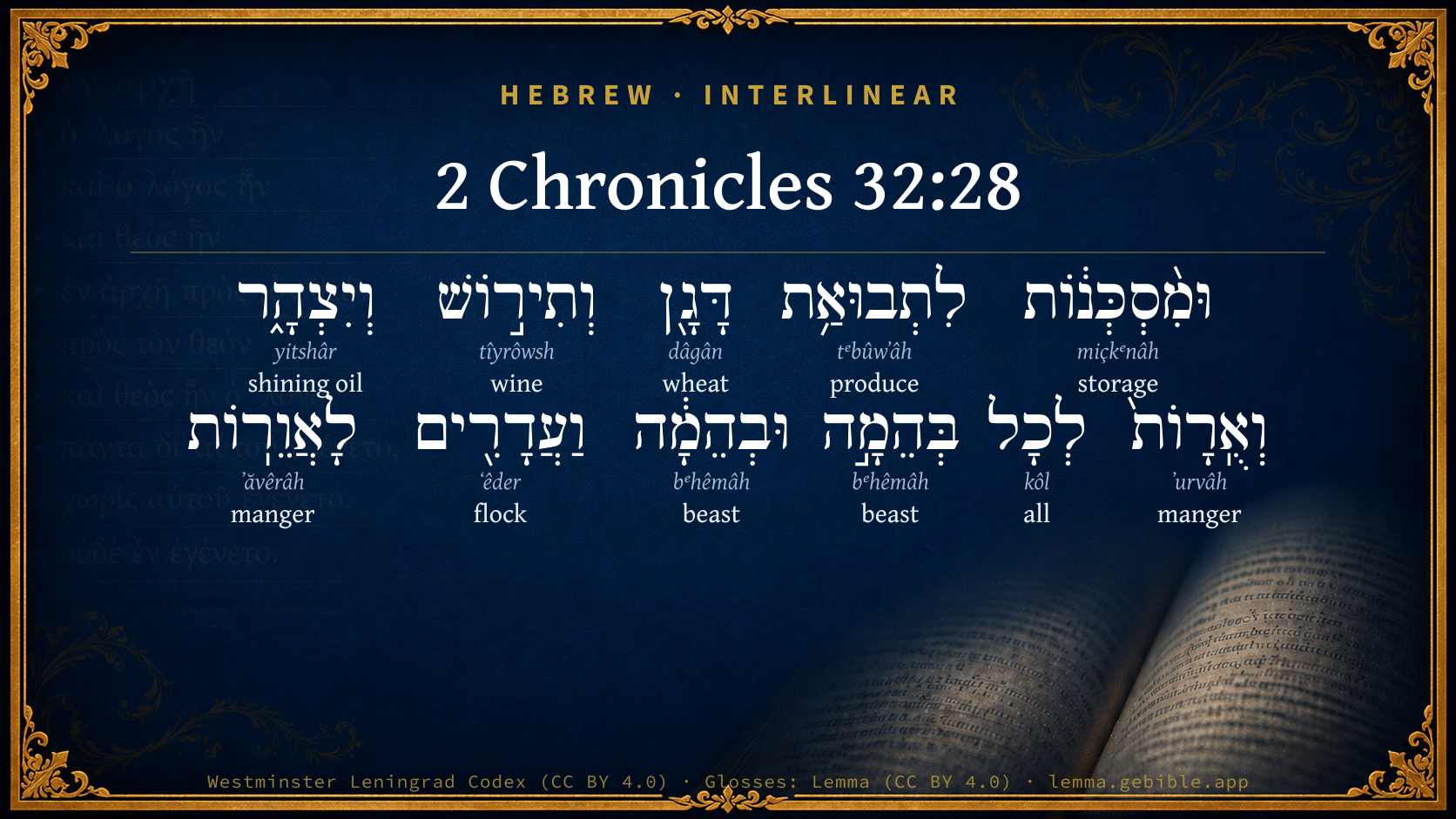
  1. וּמִ֨סְכְּנ֔וֹת miçkᵉnâh H4543 “and · storehouses” Conjunction + Noun, Common, Feminine, Plural, Absolute
  2. לִתְבוּאַ֥ת tᵉbûwʼâh H8393 “to/for · produce of” Preposition + Noun, Common, Feminine, Singular, Construct
  3. דָּגָ֖ן dâgân H1715 “wheat” Noun, Common, Masculine, Singular, Absolute
  4. וְתִיר֣וֹשׁ tîyrôwsh H8492 “and · wine” Conjunction + Noun, Common, Masculine, Singular, Absolute
  5. וְיִצְהָ֑ר yitshâr H3323 “and · shining oil” Conjunction + Noun, Common, Masculine, Singular, Absolute
  6. וְאֻֽרָוֺת֙ ʼurvâh H723 “and · mangers” Conjunction + Noun, Common, Feminine, Plural, Absolute
  7. לְכָל kôl H3605 “to/for · all of” Preposition + Noun, Common, Masculine, Singular, Construct
  8. בְּהֵמָ֣ה bᵉhêmâh H929 “beast” Noun, Common, Feminine, Singular, Absolute
  9. וּבְהֵמָ֔ה bᵉhêmâh H929 “and · beast” Conjunction + Noun, Common, Feminine, Singular, Absolute
  10. וַעֲדָרִ֖ים ʻêder H5739 “and · flocks” Conjunction + Noun, Common, Masculine, Plural, Absolute

About this verse

These counts appear in no published source. They are computed here, from the morphology-tagged text and Lemma’s own curated glosses. What Lemma adds →

11
words
10
distinct lemmas
Historical
section

Notable vocabulary

1 hapax legomenon — a word that appears only here in the entire Hebrew Bible:

  • לָאֲוֵרֽוֹת manger H220

First appearance in Scripture

This word makes its first canonical appearance in the Hebrew Bible here:

  • לָאֲוֵרֽוֹת manger H220

Shared distinctive vocabulary

וְאֻֽרָוֺת֙ manger H723 occurs in 3 verses of the Hebrew Bible. Also found in:

Grammatical profile

  • 11 nouns

Repetition

A word recurs within this verse — often emphatic in Hebrew:

  • בְּהֵמָ֣ה beast H929 ×2

Hebrew & Septuagint length

In English translation the verse runs 23 words from the Hebrew and 24 from the Septuagint (LXX English) — closely comparable.

A rough comparison of the two English renderings, which tokenize alike — not a word-level alignment.

Word counts can differ between the Hebrew and the Greek without any difference in meaning — e.g. the Hebrew direct-object marker אֵת has no separate Greek word, and Greek often adds the article ὁ.

In the original languages it is 11 Hebrew tokens and 19 Greek tokens — but the two are counted differently (Hebrew bundles its prefixes and suffixes into one token; the Greek is in lemma form), so that isn’t a like-for-like length.

Cross-references

3

Topical passages linked to 2 Chronicles 32:28 in the Treasury of Scripture Knowledge — connected by theme and wording, ordered by reader-vote popularity; previews shown in the World English Bible.

  • 2 Samuel 7:8 Now therefore thus shall you tell my servant David, Thus says Yahweh of Hosts, I took you from the sheep pen, from following the sheep, that you should be prince over my people, over Israel;
  • 1 Kings 4:26 Solomon had forty thousand stalls of horses for his chariots, and twelve thousand horsemen.
  • 2 Chronicles 26:10 He built towers in the wilderness, and hewed out many cisterns, for he had much cattle; in the lowland also, and in the plain: [and he had] farmers and vineyard keepers in the mountains and in the fruitful fields; for he loved farming.

Cross-references courtesy of OpenBible.info (CC BY 4.0).

Hebrew and Greek witnesses Masoretic Hebrew ↔ Greek Septuagint

The same verse in the two great witnesses to the Old Testament, shown verse-for-verse.

These are two independent witnesses, not word-aligned to each other, and the Septuagint is shown in lemma (dictionary) form.

Hebrew 2 Chronicles 32:28 Masoretic · Westminster Leningrad Codex

וּמִ֨סְכְּנ֔וֹת לִתְבוּאַ֥ת דָּגָ֖ן וְתִיר֣וֹשׁ וְיִצְהָ֑ר וְאֻֽרָוֺת֙ לְכָל בְּהֵמָ֣ה וּבְהֵמָ֔ה וַעֲדָרִ֖ים לָאֲוֵרֽוֹת

store-houses also for the increase of grain and new wine and oil; and stalls for all manner of animals, and flocks in folds.

World English Bible · Public Domain

Greek LXX 2 Chronicles 32:28 Septuagint · lemma form

καί πόλις εἰς ὁ γένημα σῖτος καί ἔλαιον καί οἶνος καί φάτνη πᾶς κτῆνος καί μάνδρα εἰς ὁ ποίμνιον

and cities for the produce of corn, and wine, and oil; and stalls and mangers for every kind of cattle, and folds for flocks;

LXX2012 (modern English Septuagint) · Public Domain

On this verse, Ellicott's Commentary for English Readers discusses the Septuagint’s reading. Read the note in Commentary ↓

Hebrew: Westminster Leningrad Codex (CC BY 4.0). Greek: Septuagint (public domain); English from LXX2012 (modern English Septuagint) (Public Domain). How the Septuagint differs from the Hebrew →

Commentary

Notes on 2 Chronicles 32:28 from classic Christian and Jewish commentators (each source and its license shown beneath its notes). The classic Christian expositions comment on the surrounding passage and are grouped to its opening verse, so a note may address several verses; the Jewish commentaries on the Tanakh (Rashi and others) are per-verse, so they appear only where the commentator wrote on this verse.

Lemma curates 59 commentaries, every one of them public domain or Creative Commons licensed, each selected and text-cleaned for this edition rather than reprinted as found. About our sources →

Trapp's Complete Commentary

John Trapp

2Ch 32:28 Storehouses also for the increase of corn, and wine, and oil; and stalls for all manner of beasts, and cotes for flocks.

Ver. 28. For the increase of corn, wine, and oil.] These are commodities less precious, but more necessary than the former, as the great Caliph of Babylon found when famished to death in the midst of his great treasure, whereof he was willed to eat and make no spare. {a}

{a} Turk. Hist., fol. 113.

John Trapp, A Commentary or Exposition upon All the Books of the Old and New Testament (1647–1656) — public domain. Text from a community e-Sword module.

Geneva Bible (1599)

Geneva Bible translators

Or, ranges and partitions.

Or, racks.

Geneva Bible (1599) marginal notes — public domain. Text via Bolls.life.

Ellicott's Commentary for English Readers

(28) storehouses also.—And magazines (2Ch_8:4; Exo_1:11).

Stalls.—‘Urâwôth (Syriac, ‘ûrâwôthô). (Comp. ûryôth, 2Ch_9:25; and ‘ãwçrôth, “cotes,” a word only found here.)

All manner of beasts.—Every kind of cattle.

Cotes for flocks.—Heb., and flocks for folds. The words appear to have been transposed by some copyist. (Comp. LXX., καὶ μάνδρας εἰς τὰ ποίμνια, “and folds for the flocks.” So Vulg., “et caulas pecorum.” Syriac omits.)

A Bible Commentary for English Readers, edited by Charles John Ellicott (1878–1897) — public domain. Text from a community e-Sword module.

The Cambridge Bible for Schools and Colleges

gen. ed. J. J. S. Perowne

28. cotes for flocks] A.V. here follows LXX. Vulg. and R.V. (following the Massoretic text) flocks in folds. The “cotes” or “folds” were enclosures with high stone walls as a defence against robbers and wild beasts. The text is probably faulty; Pesh. omits the clause.

The Cambridge Bible for Schools and Colleges (gen. ed. J. J. S. Perowne; Cambridge University Press, 1878–1918) — public domain. Text from a community e-Sword module.

John Gill's Exposition

And Hezekiah slept with his fathers,.... Died, as they did:

and they buried him in the chiefest of the sepulchres of the sons of David; in the more honourable and principal of them; there are still to be seen, on the north of Jerusalem, some grottos, called the sepulchres of the kings, though it is certain none of the kings of Israel or Judah were buried there; unless it may be thought, as Mr. Maundrell (e) conjectures, that Hezekiah was here inferred, and that these are the sepulchres of the sons of David here mentioned; however, he observes, whoever was buried here, this is certain, that the place itself discovers so great an expense both of labour and treasure, that we may well suppose it to be the work of kings:

and all Judah and the inhabitants of Jerusalem did him honour at his death; by attending his funeral in great numbers, by burning spices for him, and by mourning for him many days:

and Manasseh his son reigned in his stead; of whom a further account is given in the next chapter.

(e) Journey from Aleppo, &c. p. 76.

Next: 2 Chronicles Chapter 33

John Gill's Exposition of the Whole Bible (1746–1763) — public domain (CC PDM 1.0). Text via the HelloAO Bible API.

Whedon's Commentary on the Bible

Daniel D. Whedon

28. Cotes for flocks — Rather, flocks for the stalls. He not only provided stalls for cattle, but cattle for the stalls.

Daniel D. Whedon (gen. ed.), Commentary on the Old and New Testaments (1874–1909) — public domain. Text from a community e-Sword module.

The Pulpit Commentary

Cotes for flocks should be tendered, conversely, flocks to the stalls, i.e. stalls full of flocks.

The Pulpit Commentary (1880–1919), ed. H.D.M. Spence-Jones & Joseph S. Exell — public domain. Text from a community e-Sword module.

Rashi

Rabbi Shlomo Yitzchaki (Rashi)

And storehouses for the increase Regarding storehouses of increase [of grain] it is appropriate to use the term מִסְכְּנוֹת, storehouses, in all places, like (Exod. 1:11): “store cities (עָרֵי מִסְכְּנוֹת) for Pharaoh,” and so, (above 8:4): “And he built Tadmor in the desert and all the store cities (עָרֵי מִסְכְּנוֹת) that he built in Hamath,” and perforce, they were for grain, because in the desert he did not have to store gold and silver.

and stalls for all kinds of beasts - Heb. וְאֻרָוֹת, large stables.

Rashi on the Tanakh — English translations: “The Judaica Press complete Tanach with Rashi, translated by A. J. Rosenberg” (CC BY 4.0); “Pentateuch with Rashi's commentary by M. Rosenbaum and A.M. Silbermann, 1929-1934” (public domain); “The Metsudah Tanach series, Lakewood, N.J” (CC BY 4.0); and “The Book of Joshua, Metsudah Publications, 1997” (CC BY 4.0). Text via Sefaria.

Lesson kit

Teaching starters — assembled from the data on this page, not authored interpretation. Every prompt links to the verse data it draws on. Edit before teaching.

2 Chronicles, in the Historical, opens this verse with 11 words (10 distinct Hebrew lemmas). Its most distinctive word is ʼăvêrâh (“manger”). A historical commentator’s framing appears above. Read the whole chapter for the surrounding context.

Discussion questions

  1. What does “manger” (ʼăvêrâh) contribute to the verse as a whole?
  2. 1 word here appears nowhere else in the Hebrew Bible. Why might the author reach for such rare wording?
  3. This is the first place “manger” appears in Scripture (first appears here). What does its debut here establish?
  4. How does 1 Kings 4:26, which shares the word «manger», read alongside this verse?
  5. What does the repetition of “beast” (2× in this one verse) do in this verse?
  6. These translations render this verse differently. What is at stake in choosing one wording over another?
  7. Compare how Trapp's Complete Commentary and Geneva Bible (1599) read this verse. Where do they agree or differ?

Things to notice

  • 1 word in this verse appears nowhere else in the Hebrew Bible.
  • 1 word makes its first canonical appearance in Scripture here.
  • This verse counts 11 Hebrew ↔ 19 Greek words.
  • These translations choose different wording for 13 words in this verse.
  • “beast” occurs 2× in this single verse.

Reading settings

Reading text

Shown beneath each verse's original-language words.

Old Testament
Old Testament edition

Read the OT as the Masoretic Hebrew (MT) or the Greek Septuagint (LXX).

English shown for the Greek Septuagint (in the Hebrew ↔ Greek comparison).

Comparing translations? Open the Compare panel on any verse page to stack up to four side by side.